Bandgap engineering and charge recombination
reducing of NiWO4/CdS solid Z-scheme system
for efficient photocatalytic hydrogen
generation
著者
Li Mingjie
学位授与機関
Tohoku University
学位授与番号
11301甲第18796号
Tohoku University
Graduated school of Environmental Studies
Doctoral thesis (2019.03)
Bandgap engineering and charge
recombination reducing of NiWO
4
/CdS solid
Z-scheme system for efficient photocatalytic
hydrogen generation
(効率的な水素製造を目的とした NiWO
4/CdS 固
体 Z スキームシステムのバンド構造制御と電荷再結
合抑制)
Supervisor: Pro. Kazuyuki Tohji
Associate Pro. Hideyuki Takahashi
Environmental science, Tohji laboratory
Mingjie Li (B6GD1010)
1
1. Chapter 1: Introduction
The conversion of solar light into clean hydrogen through a photocatalytic process is an attractive solution to the problems associated with carbon energy. However, directly splitting water via a photocatalyst in a single component creates a conflict between the large energy band potential demanded for water splitting (∆G=237.2 kJ/mol, ∆E=1.23 V) and the narrow bandgap required to efficiently utilize visible light [1]. Multiple component systems such as type II and pn heterojunction effectively enhance the charge transfer efficiency via a combination of different materials [2], but the efficiency increases at the expense of the energy band potential, which is undesirable for water splitting.
Another multiple component system that has attracted much attention since being discovered in 2006 is the solid Z-scheme system (SZSS) [3]. This system imitates natural photosynthesis. SZSS can generate electrons and holes using visible light without decreasing the redox potential, which is essential for photocatalytic hydrogen generation [4]. SZSS is fabricated by two functionalized parts, which are called photosystem I (Psi) and photosystem II (PSII).
Psi and PSII are used in the reduction and oxidation reaction, respectively. The interface between Psi and PSII is specially designed as an ohmic contact to facilitate the migration of electrons from the conduction band (CB) of PSII to the valence band (VB) of Psi. Because CB in Psi has a higher potential than that in PSII, while VB in PSII has a lower potential than that in Psi. Electrons and holes in CB of Psi and VB of PSII respectively with higher redox abilities can join in the redox reaction.
Some important factors determine the efficiency of SZSS: (1) the physicochemical properties of materials used as Psi and PSII; (2) interface between Psi and PSII; (3) the energy band alignment of Psi and PSII; (4) charge recombination in the SZSS. During the last few years, many studies have investigated the interface properties such as the exploration of different materials like metals [5, 6], carbon dots [7], and oxygen-defect [8] as electron mediators to facilitate the charge transfer between Psi and PSII. However, a rational design of the band alignment and the charge recombination of PSII and Psi have
2
yet to be discovered. Considering the conflict between the large energy demand for water splitting and the requirement for visible light utilization, controlling the energy bandgap in SZSS is essential. Furthermore, charge recombination reducing of SZSS is an important way to increase the performance of SZSS.
Element modulation is an important way to control light absorption and engineer the bandgap for multiple component materials. Introducing foreign elements to form an impurity energy level can change the bandgap of semiconductors. Changing the element composition in the alloyed structures has successfully engineered the bandgap in solid solutions such as ZnxCd1–xSe [9] and ZnxCd1–xS [10]. However, the element modulation
for the bandgap engineering of SZSS has yet to be discovered. On the other hand, charge recombination reducing needs the balance of charge transfer of PSII and Psi. This charge transfer balance demands the control of the ratio of PSII and Psi. Therefore, no matter for bandgap engineering or charge recombination reducing, adjusting the composition of SZSS is the key to success.
Recently, metal tungstates such as NiWO4, CoWO4, CuWO4, and ZnWO4 have been
developed as promising photocatalysts to decompose contaminants [11, 12]. Highly efficient photocatalytic hydrogen generation has been reported using the CdWO4/CdS
structure as a type II heterojunction [13, 14] or SSZS [8]. However, element modulation of metal tungstates/metal sulfide has yet to be achieved. In this research, NiWO4/CdS
SZSS was fabricated under mild reaction conditions using ion-exchange between the NiWO4 precursor and Cd2+, S2– ions. This novel method easily realized element
modulation by changing the stoichiometry of the reactants in a synthetic solution. The element modulation provides an important way for the bandgap and charge recombination adjusting of the SZSS. The effect of the element composition on the energy band, charge recombination, and photocatalytic activity (PCA) in hydrogen generation were reported. These results should provide interesting information for the rational design and fabrication of SZSS in the future.
3
2. Chapter 2: Bandgap engineering of NiWO
4/CdS SZSS via an
ion-exchange reaction.
Some experimental results of this chapter was published in "Bandgap engineering of NiWO4/CdS solid Z-scheme system via an ion-exchange reaction. Applied Catalysis B:
Environmental 241 (2019) 284–291”.
2.1. Research target.
The research target of this chapter is to control the bandgap of NiWO4/CdS SZSS via
an ion-exchange reaction.
2.2. Experimental: fabrication of SZSS
Sample Name
Synthetic solution Sample elements (at%) NiWO4 (g) Cd (mL) S (mL) Ni W Cd S NW 53.0 47.0 NWCS0 0.21 2.1 0 31.3 48.2 20.6 0.0 NWCS15 0.21 2.1 2.8 30.2 34.5 20.1 15.3 NWCS30 0.21 2.1 8.4 27.4 24.3 18.1 30.3 NWCS45 0.21 2.1 14 23.6 15.2 16.3 45.0
Scheme. 2-1. Synthetic procedure of NiWO4/CdS SZSS. The name of samples were
labeled based on the S contents in the samples by EDS.
2.3. Results and discussion 2.3.1. Ion-exchange reaction
To reveal the composition of the samples, Scheme 2-1 shows the proportion of Ni, Cd, W, and S measured by SEM-EDS. NW was synthesized from the precipitation
NW+Cd(CH3COO)2+CH3CSNH2→ NiWO4/CdS (NWCSx) 80 ℃ Ni2++WO
42-→NiWO4
4
reaction between Ni2+ and WO42– ions (Eq. 2-1). The EDS result shows that the ratio of
Ni to Cd is close to 1:1, supporting the NiWO4 structure. Compared with NW, part of W
was “replaced” by S in NWS30, implying an anion-exchange reaction between S2– and WO42– may occur during the synthesis of NWS30 (Eq. 2-2). The solubility product
constants (ksp) of NiWO4 and NiS theoretically support this ion-exchange reaction.
Because kspNiS (1.4×10⁻²⁴) [15] is much lower than kspNiWO4 (7.8×10⁻⁶) [16], NiS is
more stable than NiWO4 under the same conditions. Consequently, NiS is easily generated
in a solution of NiWO4 and S2– because the ions tend to form a stable compound. Similarly,
the part of Ni replaced by Cd in NWCS0 may be induced from the cation-exchange reaction between Cd2+ and NiWO4 (Eq. 2-3). In general, the reactions during fabrication
of NiWO4/CdS SZSS can be described as Eq. 2-4. The ion-exchange reaction provides a
simple way for element modulation under mild conditions.
Ni2+ + WO
42– → NiWO4 kspNiWO4 (7.8×10⁻⁶) (2-1)
NiWO4 + S2– → NiS + WO42– kspNiS (1.4×10⁻²⁴) (2-2)
NiWO4 + Cd2+ → CdWO4 + Ni2+ (2-3)
NiWO4 + Cd2+ + S2– → NiWO4/CdS (2-4)
2.3.2. Bandgap engineering.
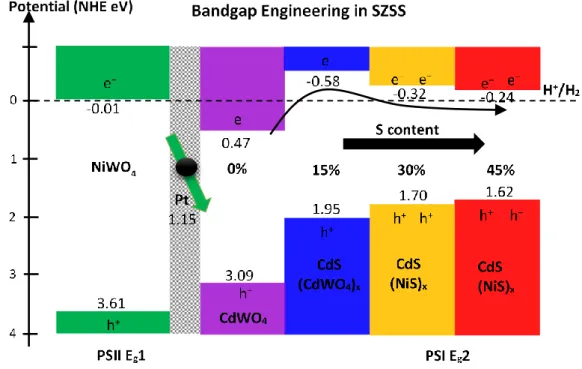
Scheme 2-2 shows the bandgap alignments of NWCS0~NWCS45 SZSS. The bandgap of pure NiWO4 is too large for visible light absorption. Although the
cation-exchange reaction with Cd2+ produces CdWO4 as Psi with a narrow bandgap, ECB is not
favorable for hydrogen generation. The introduction of S with a low electronegativity via an anion-exchange reaction produce CdS with higher ECB for the hydrogen generation
reaction. Further increasing the S content decreases CdS bandgap. This decreased bandgap enables the utilization of a light source with a longer wavelength for Psi, which is essential for the PCA of SZSS.
Based on the energy bandgap theory, introducing a foreign element can induce bandgap bending in a semiconductor by changing the crystal structure and the electron distribution due to the volume and electronegativity difference of the induced element,
5
respectively [17]. The ionic radius and electronegativity of Cd and S drastically differ from those of Ni, W, and O. Therefore, it is easy to understand why the ion-exchange reaction can induce bandgap bending. The decrease of bandgap is attributed to the change of the inner structure or the electron distribution induced by the foreign Cd2+ and S2– ions with different ionic radii and electronegativities.
Scheme 2-2. Bandgap alignments of the samples in SZSS.
2.3.3. Photoluminescence (PL) and PCA.
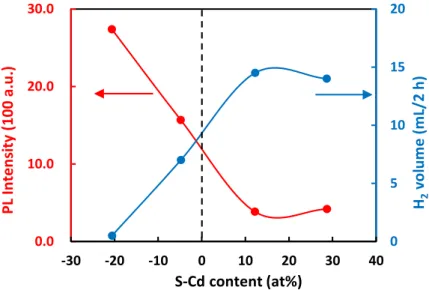
Fig. 2-3 shows the PL intensity at approximately 380 nm and the PCA in hydrogen generation as the function of S-Cd content. The PL intensity decreased dramatically as the S-Cd content increases from approximately -20 to 10 at%, but then slightly increased at 30 at%. On the other hand, PCA increased sharply as the S content increased from approximately -20 to 10 at%, but then slightly decreased at 30 at%. The PL intensity at approximately 380 nm provides an index of the charge recombination rate in Eg1. The
increased charge separation rate and PCA should be related to the change in the band structure induced by the S content in the multicomponent system.
6
Fig. 2-3. PL intensity and PCA of samples as a function of S-Cd content.
Element modulation of the S content via ion-exchange reaction provides a simple method to engineer the bandgap of Psi in NiWO4/CdS SZSS. This work demonstrates that
low bandgaps of Psi can increase the light absorption and decrease the recombination of NiWO4/CdS SZSS. However, CdS bandgap reduction is also at the cost of decrease the
potential for hydrogen generation. NWCS30 and NWCS45 have good properties of appropriated bandgap structure and low recombination, therefore show high PCA.
2.4. Conclusion.
Adjust the band alignment in SZSS is essential to develop practical applications. In the traditional method, SZSS is usually fabricated via the synthesis of Psi (or PSII) on PSII (or Psi) as a supporter. However, the band alignment cannot be adjusted. Using the NiWO4/CdS composition as a representative, we developed a simple fabrication method
that takes advantage of bandgap engineering through a simple ion-exchange reaction between the NiWO4 precursor and Cd2+, S2–. The bandgaps of Psi decrease from 2.62 to
1.86 eV. The PCA reached 7.6 mmol/h/g.
0 5 10 15 20 0.0 10.0 20.0 30.0 -30 -20 -10 0 10 20 30 40 H2 vo lu m e ( m L/ 2 h ) PL In te n si ty (100 a.u .) S-Cd content (at%)
7
3. Chapter 3: Charge recombination reducing of NiWO
4/CdS SZSS via
an ion-exchange reaction.
Some results of this chapter was submitted to “Applied Catalysis B: Environmental”.
3.1. Research target.
The target of this chapter is to reduce the recombination of NiWO4/CdS SZSS.
3.2. Result and discussion.
NiWO4/CdS was prepared by the reaction between NiWO4 and Cd2+/S2– ions, which
was similar with that of chapter 2. The synthesized condition was changed to the hydrothermal method at 180 ℃. Two series of samples were synthesized: (1) Cd content was low and almost the same, while S content was increased. The obtained samples were labelled as CdSx; (2) Both Cd and S contents were increased at a proper ratio, and the samples were labelled as CdxSy. The samples were characterized by SEM, EDS, XRD, UV-vis DRS and PL.
XRD results demonstrates that samples were in crystal state. The samples are constructed by crystallized NiWO4 and CdS, while some NiS existed when the S content
was higher than Cd. The morphologies of all the samples were aggregates. The bandgaps of CdSx drastically decreased with the increase of S content; while those of CdxSy slightly decreased with the increase of Cd and S contents. This result demonstrates that the both Cd and S content influenced the CdS bandgap.
The ratio of CdS to NiWO4 can be modulated by adjusting Cd and S contents. For
CdSx, the ratio of CdS to NiWO4 was low because the Cd content was low. This resulted
in the low charge transfer rate of CdS, which may limit the charge transfer of the whole SZSS. Therefore, the charge recombination of CdSx was high, because the unbalance charge transfer between NiWO4 and CdS. While for CdxSy, the ratio of CdS was
increased, which lead to the increase of charge transfer rate of CdS. Therefore, the charge recombination was decreased by the charge transfer balance.
3.3. Conclusion.
The bandgap of CdS was tuned continuously, and the charge recombination was reduced through the adjusting of both Cd and S content in the NiWO4/CdS SZSS.
8
4. Chapter 4: Morphology control and MWO
4/CdS (M=Ni, Co, Zn)
Some results of this chapter was submitted to “Applied Catalysis B: Environmental”.4.1. Research target.
This chapter was to control the morphology of NiWO4/CdS and to extent this method
to MWO4/CdS (M=Ni, Co, Zn).
4.2. Result and discussion.
NiWO4 was synthesized by hydrothermal method, and CdS was synthesized on
NiWO4. The morphology of NiWO4(Hydrothermal method)/CdS was separated
nano-particles with approximately 5~10-nm diameters. Compared with NWCS30 in chapter 2, although NiWO4(Hydrothermal method)/CdS has a better morphology, its PCA was low.
The reason may the amount of CdS in NWCS30 were higher than that in NiWO4(Hydrothermal method)/CdS.
PCA of CoWO4/CdS was closed to that of NiWO4/CdS, which indicated that this
fabricated method can be also extended to CoWO4/CdS. While PCA of ZnWO4/CdS was
much lower than that of NiWO4/CdS. As bandgap of CoWO4 was close to that of NiWO4,
CoWO4/CdS showed similar PCA with NiWO4/CdS. However for ZnWO4/CdS, bandgap
of ZnWO4 (5.85 eV) was too large for efficient light absorption, which may be the reason
for the low PCA.
4.3. Conclusion.
NiWO4(Hydrothermal method)/CdS with better morphology has been synthesized.
MWO4/CdS (M=Ni, Co, Zn) have been fabricated. NiWO4/CdS and CoWO4/CdS showed
9
5. Chapter 5: Conclusion.
In this research, we proposed a NiWO4/CdS SZSS for photocatalytic hydrogen
generation. By suing the simple ion-exchange reaction between NiWO4 and Cd2+, S2–, the
element modulation of NiWO4/CdS SZSS can be achieved. As a consequence, both
bandgaps and charge recombination properties of SZSS can be controlled. The contributions of this research are:
(1) SZSS synthesized by NiWO4 and CdS was developed and applied in
photocatalytic hydrogen generation. The highest PCA in this work reached 8.44 mmol/h/g. (2) Both the bandgap and charge recombination of the SZSS has been adjusted, via a simple ion-exchange reaction, which provides interesting information for the fabrication of efficient SZSS.
(3) The element modulation method described here also brings a reference for tuning the properties of multicomponent system. This bandgap engineering method may be also extended to other special application, such as the optoelectronic devices design.
References
[1] D. L. Lu, T. Y. Takata, N. B. Saito, et al. Nat. 440 (2006) 295.
[2] S. J. A. Moniz, S. A. Shevlin, D. J. Martin, et al. Energy. Environ. Sci. 8 (2015) 731–795. [3] H. Tada, T. Mitsui, T. Kiyonaga, et al. Nat. Mater. 5 (2006) 782–786.
[4] P. Zhou, J. G. Yu, M. Jaroniec. Adv. Mater. 26 (2014) 4920–4935.
[5] W. B. Li, C. Feng, S. Y. Dai, et al. Appl. Catal. B. 168-169 (2015) 465–471. [6] X. W. Wang, G. Liu, L. Z. Wang, et al. Adv. Energy. Mater. 2 (2012) 42–46. [7] X. Q. Wu, J. Zhao, L. P. Wang, et al. Appl. Catal. B. 206 (2017) 501–509. [8] X. Jia, M. Tahir, L. Pan, et al. Appl. Catal. B. 198 (2016) 154–161. [9] J. Xu, X. Yang, H. K. Wang, et al. Nano. Lett. 11 (2011) 4138–4143. [10] Q. Li, H. Meng, P. Zhou, et al. ACS. Catal. 3 (2013) 882−889.
[11] U. M. García–Pérez, A. M–D. L. Cruz, J. Peral. Electrochimica. Acta. 81 (2012) 227–232 [12] T. Montini, V. Gombac, A. Hameed, et al. Chem. Phys. Lett. 498 (2010) 113–119. [13] L. Wang, W. Z. Wang. Cryst. Eng. Comm. 14 (2012) 3315-3320.
[14] Y. A. Sethi, R. P. Panmand, S. R. Kadam, et al. J. Colloid. Interf. Sci. 487 (2017) 504–512. [15] Weast, R.C. Handbook of Chemistry and Physics. CRC Press, Boca Raton, Florida, 1982–1983. p. B–242.
[16] D. L. Zeng, W. W. Yi. J.Cent. South. inst. Min. Metall. 25 (1994) 6. [17] S. H. Wei, S. B. Zhang, A. Zunger. J. Appl. Phys. 87 (2000) 1304–1311.