Effects of Supplementation of Heat or Un-heat Treated Histamine
on Growth of Yellowtail
Toshiro MAsuMoTo, Bungo TAMuRA, Teruta MATsuBARA and Sadao SHIMENO
Laboratory ofFish IVutrition, Faculty ofAgn-culture, Kochi University B200 Monobe,Kochi, 783-8502, JaPan
Abstract: Effect of supplementation of histamine on yellowtail was examined by feeding for 107 days with heat (HT) or un-heat treated (H) histamine at levels of 500 and 2000 (mglkg diet). During that feedmg period, fish fed HT-2000 and H-2000 diet exhibited lower feed intake and growth rate than fish fed control diet. At end of the expei irnent, five fish from each dietary group were examined for gastric abnormalities, but there was no sign of gastric abnormality even the lowest growih of HT- and H-2000. These results suggest that yeilowtail may have histamine effects different trom rainbow trout, which showed gastric abnormalities without growh retardation.
Key words: yellowtal, fish meal, histarnine, growth
Introduction
Fish meal is an ideal protein source due to its high content of ideal indispensable amino
acids, high digestibility and absence of anti-nutritional factors that may be present in other
pro-tein sources. Grading of fish meal quaHty is depending on several factors. One of the criteria
defining the fish meal quality is histamine content of fish meal. (Romero et al. 1994). Histamine
produced as a consequence of microbial activity during post-catch storage of some marine fish, thus elevation of histamine content indicates improper handling of raw materials. Avian black
vomit disease, characterized gizzard disease, ulceration and cellular necrosis, results from
feed-ing diets containfeed-ing fish meal manufactured degraded raw materials high in histamine which have been overheated during drying (Umemura et al., 1981; Wessels and Post, 1989 cited by
Fairgrieve 1994). Gizzerosine [(2-amino-9-(4-imidazolyl)-7-azanonanoic acid)], the potent,
ulcer-ogenic histamine derivative has also been studied (Mori et al., 1983; Sugahara et al., 1988). While the effects of dietary histamine and gizzerosine on the development of gastric
abnormali-ties in chickens are weli docurnented, inforrnation on their effects in fish is lirnited by two
re-ports in rainbow trout (Watanabe et al., 1987; Fairgrieve et al., 1994) and no studies has been
reported in marine fish species.
The present study was designed to examine if: 1) high histamine supplementation alone
pro-duce gastric abnormalities, or affected growth , feed intake and feed efficiency and 2) heat
tre-ated histamine hasten gastric abnormalities or deteriorate growth parameters.
Materials and Methods
Diet
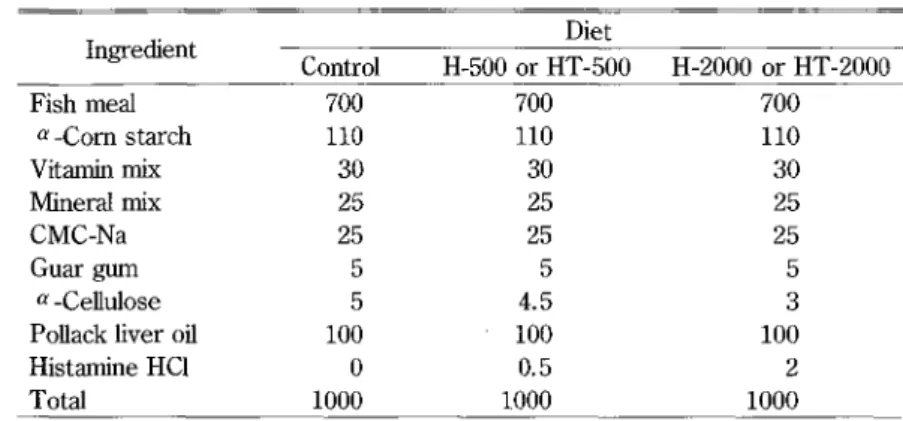
There are five dietary treatments in this study and their dietary composition are shown in Table 1. All diets contained 700 gtkg dry diet of fish meal which purchased from commercial fish mills (Nissui Co., Tokyo, Japan). The reported histamine level of the fish meal was in the range of 200-500ppm. In all dietary groups, 70g of fish meal was blended with 70g of a tap
Table 1. Dietary composition of feedmg experiment (gfkg dry). Ingredient Diet Control H-500 or HT-500 H-2000 or HT-20eO Fish meal a -Com starch Vitamiri mix Mineral mix
CMC-Na
Guar gum a -CellulosePollack liver oil
Histamine HCI Total 700 110 30 25 25
5
5
100o
1000 700 110 30 25 255
4.5 100 O.5 1000 700 110 30 25 25 53
1002
1000water and heated for 3 hrs at 1300C. Heat treated histamine diets (HT) were prepared by dis-solving histamine hydrochloride (Tokyo kasei, Tokyo, Japan) either 500 or 2000 mg in 70 ml of a tap water and blended with 70 g of fish meal, then the resultant mixture was heated. Un-heat treated histamine diet (H) was prepared by mixing histamine hydrochloride with pre-heated fish meal which prepared same manner as HT e'xcept no histamine in a tap water. Control diet was prepared similar to H diet except histamine supplementation.
Fish and facilittes
Juvenile yellowtail (Seriola 4uin4ueradlata) obtained from commercial fish farmer in Usa and were maintained at Usa marine research laboratory Kochi university. The feeding experiment
was conducted in 1.2t FRP aquaria, each supplied with ambient temperature water
(22.0-25.50C) at a rate of 8LfMin. An aeration was supplied in each aquaria. After a week of acclima-tization period, fish were selected for uniform size (mean weight 15.5g) then randomly distri-buted'.among the aquaria unti1 each contained 15 fish. The fish nurnber was reduced to 10 after
36 days of feeding due to high density of fish. The five dietary treatments were assigned to the
tanks two tanks per treatment. Fish were fed apparent satiation twice daily for 107 days. Fish were weighed 10, 20, 30, 67, 77, and 97 days after start of feeding. Feed was withheld the second feeding of the one day before the body weight sampling and the last samplmg. Water temperature was in the range of 22.0-25.50C during the feeding experiment.
Sampling
At end of the experiment, five fish were randomly sampled form each tank and used for the blood analysis and stomach inspection. The blood was withdrawn through caudal vessel punc-tured using 1-mi heparinized syringes, then centnfuged for 5min at 10000rpm. The resultant
serum was used to measure hematocrit (Ht) value, blood urea nitrogen (BUN), asparagate
transaminase (GOT), alanine aminotransaminase (GPT) and alkaline phosphatase (ALP) of each fish. After taking blood sampling, fish were dissected and stomach were preserved in 109o phosphate buffered formaldehyde solution.
Protein digestibildy
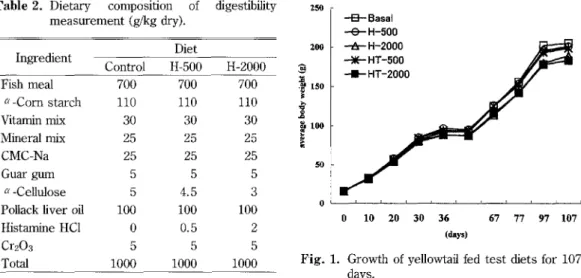
After the final sampling, the remaining fish were fed the experimenta1 diet with containing O.59o chromic oxide diet (Table 2). Chromic oxide was determined following the method of
Statistics
The body weight gain, blood analysis data were examined Duncan's new multiple range test, MRT) and significance was detected at 59o.
Results Growth
The growth of yellowtail fed the experirnental diet for 107 days is shown in Fig. 1 and
growth performance is summarized in Table 3. The growth was retarded between day 36 and
47 because fish were starved due to bad water quality duing that period. Other than those days, fish increased body weight proportionally and there were no mortalities. Result from 107 days feeding, in situ inspection of the stomach in fish from all dietary treatments revealed no
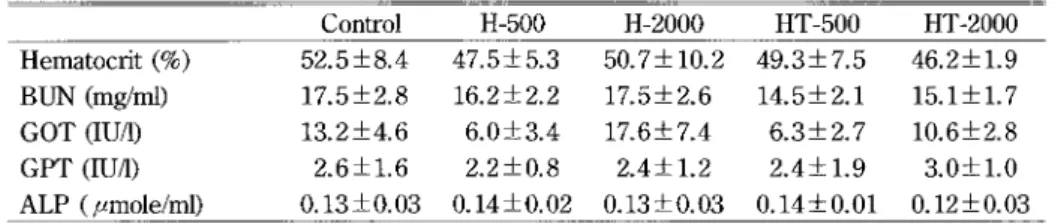
inflammation or ulceration of gastric tissues. The hematological data result from the feeding
ex-perirnent are shown in Table 4. Hematocrit value of HT-2000 was lower than that of control but there was no statistical difference. GOT values of H-500, HT-500 and HT-2000 were lower
than that of control and among them H-500 was the lowest. Apparent protein digestibdity
values of control, H-500 and H-2000 were 77.49o, 77.19o, and 74.99o, respectively.
Table2. Dietary composition of digestibdity 2sQ -Basal measurement (glkg dry).
eH-soo
Ingredient Diet Control H-500 H-2000 Fish meal a' -Com starch Vitamin mix Mineral mixCMC-Na
Guar gum cr -Cellulose Pollack liver oilHistamine HCI Cr203 Total 700 110 30 25 25 5 5 100 o 5 1000 700 110
30
25
255
4.5 100 O.55
1000 700 110 30 25 25 53
100 2 5 1000Table 3. Growth, feed intake, feed ethciency
days. 2ee :. s •ge- 150 s
t
s & 1oo E e q 5D o Fig. of-H--2000
-)te-HT--soo-HT-2000
O 10 20 30 36 67 77 97
(days)1. Growth of yellowtail fed test diets for days.
yellowiail fed experimental diets for 107
107 107 Control H-soe H-2000 HT-500 HT-2000 Weight gain (g) Feed intake (g) Feed eihciency Daily feeding rate (9o) O-36 37-68 68-107 189 366 O.516 2.4 2.6 5.0 187 364 O.514 2.4 2.5 5.0 175 346 O. 506 2.3 2.5 4.7 183 354 O.517 2.3 2.5 4.8 167 351 O.476 2.2 2.4 4.9 Feed eraciency caiculated as wet weight gain (g) 1 dry feed intake (g)
Table 4. Hematological paramerters of yellowtail fed experimental diets for 107 days. Control H-500 H-2000 RT-500 HT-2000 Hematocrit (9o) BUN (mglml) GOT (IUA) GPT (IUA) ALP ( ptmolelml) 52.5Å}8.4 17.5Å}2.8 13.2Å}4.6 2.6Å}1.6 O.13Å}O.03 47.5Å}5.3 16.2Å}2.2 6.0Å}3.4 2.2Å}O.8 O.14Å}O.02 50.7Å}10.2 17.5Å}2.6 17.6Å}7.4 2.4Å}L2 O.13Å}O.03 49.3Å}7.5 14.5Å}2.1 6.3Å}2.7 2.4Å}19 O.14Å}O.Ol 46.2Å}1.9 15.1Å}1.7 10.6Å}2.8 3.0Å}1.0 O.12Å}O.03
Discussion
Growth of HT- and H-2000 diet fed fish were lowest among the dietary treatments though,
appearance of stomach was norrnal in all diets fed fish. Physiological functions of the digestive
system appeared to be unaffected. This conclusion is based on the result from protein digesti-bfity coethcient values, which were similar between control and H-2000 fed fish. In rainbow trout, Watanabe et al. (1987) and Fairgrieve et al. (1884) reported that gastric abnormalities but no growth impairment was observed resulted from feedmg high histamine diets. Watanabe
et al. (1987) found gastric erosion in 409o of rainbow trout after 8 weeks of feeding diets
con-taining sardine meal and supplemented with 2000mg histaminelkg diet. Fairgrieve et al. (1994) found flaccid, extended stomach, although did not fond any histological abnormalities such as gastric lesions, ulcerations. The dfferences in results between our study and those of two
pre-vious reports are 1ikely due to the fish species (marine vs fresh water fish species) used andlor
source of fish meal. Moreover, yellowtail maybe more tolerate to gastric acid secretion by his-tamine stimulation compared to rainbow trout. Regardless the heat treatment of hishis-tamine, growth of yellowtail fed histamine 2000ppm reduced (H-2000 and HT-2000). It has been
sug-gested that i--effect of histamine shows as histamine derivative, gizzerosine, and this has a role
in the development of gastric abnormalities. Gastric abnormalities have confmned at high inci-dence in fish fed with heat treated histamine diets (Watanabe et al. 1984; Fairgrieve et al.
1994). These results suggest that histamine itseif has no ill-effects for rainbow trout but it may have for yellowtail.
Acknowledgements
Maintenance and feeding of fish by lh. Masatoshi Kimura, Laboratory of Fish Nutrition, Kochi University is gratefu11y acknowledged.
References
FAIRGRIEvE, W.T., M.S. MyERs, R.W. HARDy and F.M. DoNG, 1884. Gastric abnorrnalities in rainbow trout (Oncorhynchus mykiss) fed amine-supplemented diet or chicken gizzard erosion-positive fish meal. Aquaculture, 127, 219-232.
FuRuKAwA, A. and H. TsuKAHARA, 1966. 0n the acid digestion method for the determination of chromic oxide as an index substance in the study of digestibmaty of fish feed. Bull. Jpm. Soc. Sci. Fish., 32, 502L506.
MoRI, K., T. OKAzAKI, T. NoGucHI and H. NAITo, 1983. Synthesis of (Å})-gizzerosine, an inducer of gizzard sion in broiler chicks. Agric. Biol. Chem., 47, 2131-2132.
RoMERo, JJ., E. CAsTRo, A.M. DIAz, M. REvEco, J. ZALDIvAR, 1994. Evaluation of methods to certify the mium" quality of Chilean fish meals. Aquacz{lture, 124, 351-358.
SuGAHARA, M., T. HA[I"roRI and T. NAKAJIMA, l988. Effect of synthetic gizzerosine on growth, mortality, and zard erosion in broiler chicks. Poultry Sci., 67, 1580-1584.
ToyAMA, K., M. HosHi, M. IsHiGuRo and H. ABE, 1982. Behavior of histamine during the manufacturing process of fish meal. Bull. IPn. Soc. Sci. Fish., 48, 1333-1339.
ToyAMA, K., M. HosHI and M. KAIzuKA, 1985. Trigger abdity on gizzard erosion by fish meal conceming with a kmd of and freshness of raw fish, and manufacturing conditions. Bull. IPn. Soc. Sci. Fish., 51, 985-993.
UMEMuRA, Y., S. MIYAZAKI, H. YAMANAKA, OHyA, S. HoMMA, M. OKA, S. SATo and T. NAKAHARA, 1981. erties of gizzard erosion-inducing substance in fish meal. Alatl. Inst. Heatth Q. Uapan), 21, 52-60.
WATANABE, T., T. TAKEucHI, S. SAToH, K. ToyAMA and M. OKuzuMI, 1987. Effect of dietary histidine or mine on growth and development of stomach erosion in rainbow trout. Ni on Suisan Gahhaishi, 53, 1207-1214.
WEssELs, JP.H. and B.J. PosT, 1989. Effect of heat treatment of fish meal, fines and the addition of lysine as lated to gizzard erosion in chickens. J Sci. Food Agric., 46, 393-406.