The
generalized
van
der
Corput
sequence
and
its
application
to numerical
integration
*Takahiko
Fujita , Shunji Ito2, and Syoiti Ninomiya31 Faculty of Commerce, Hitotsubashi
University, 2-1 Naka, Kunitachi, Tokyo
186-8601 Japan
E-mail address: fuj ita@math. hit-u.ac.jp
2 Department of Mathematics,
Tsuda College, Tsuda-machi, Kodaira, Tokyo
187-8577 Japan
E-mail address: [email protected]
3 Center for
Research in Advanced Financial Technology, Tokyo Institute of
Technology, 2-12-1 Ookayama, MegurO-ku, Tokyo 152-8550Japan
E-mail address: [email protected]
Abstract. Anew class of $s$-dimensional uniformly distributed sequences called
the generalized van der Corput sequence is defined. The sequence is constructed
by using the generalized number system based on an integer matrix whose all
eigenvalues reside out of the unit circle. In this talk, we show that by using the
generalized van der Corput sequence we can calculate numerical integrations with
the convergence speed $O(1/N)$ when integrands satisfy some regularity conditions.
We also apply thesequenceto anumericalintegration problemand testeffectiveness
ofthe sequence.
1Introduction
We can consider the
van
der Corput seqeunce to be an orbit of the originunder the adding machine transformation that is accompaniedby an
expand-ing one dimensional linear transformation [2,6-8]. Following this principle of regarding the van der Corput sequence as an orbit of the adding machine
transformation, we can generalize the van der Corput sequence in various
directions [1,4,6,7]. In this paper, replacing expanding
one
dimensionallin-ear
transformation with expanding $s$-dimensional linear transformation, weobtain another generalization of the
van
der Corput sequence. We call thissequence the generalized
van
der Corput sequence. We also give atheorem. According to the theorem, the required time for numerical integration of a functionover
$s$-dimensional unit cube is reduced to $O(1/\epsilon)$ where $\epsilon$ denotesthe accuracy, if the integrand is smooth enough. In the last of the paper,
we
give anumerical example.$\star$
This research was partially supported by the Ministry of Education, Science,
Sports and Culture, Grant-in-Aid for Scientific Research (C), 12650061, 2000
数理解析研究所講究録 1240 巻 2001 年 114-124
Fujita, Ito, Ninomiya
2The
generalized
van
der Corput
sequence
First, we introduce the generalized number system based on an expanding
integer matrix.
$\mathbb{N}$, $\mathbb{Z}$, $\mathbb{R}$, and $\mathbb{C}$
are
sets of all natural numbers, all integers, all realnum-bers, and all complex numbers, respectively. 1Ve define $\mathrm{T}^{s}=\mathbb{R}^{s}/\mathbb{Z}^{s}$. For $\mathrm{a}$.
real valued function $f$ defined on T5, $\hat{f}(k)$ denotes the Fourier coefficients of $f$, that is to say
$\hat{f}(k)=\int_{\mathrm{T}^{s}}f(x)e^{-2\pi\sqrt{-1}\langle x.k\rangle}dx$
for $k$ $\in \mathbb{Z}^{s}$. $f\Lambda,f(s_{1}\cdot \mathbb{Z})$ denotes the set of all $(s, s)$ integer matrices and so on.
Let $A\in \mathrm{A}/f(s;\mathbb{Z})$ whose all eigenvalues reside outside of the unit circle
and $N=|\det A|$. Then there exist $P$, $Q\in GL(s_{1}\cdot \mathbb{Z})$ and $u_{1}$,$\ldots$ ,
$u_{s}\in \mathrm{N}$ which
satisfy
(1)
$QAP=(\begin{array}{llll}u_{1} u\vee \ddots \mathrm{t}\mathrm{t}_{S}\end{array})$
and $u_{i}|u_{i+1}$ for $i=1$, $\ldots$ , $s-1$.
($u_{1}$, $\ldots$ ,us) are elementary divisors of
$A$. We define sets $D$ and $D’$ as follows:
$D:=Q^{-1}$ $\{ {}^{t}(x_{1}, \ldots, x_{s})\in \mathbb{Z}^{s}|x_{i}\in\{0, \ldots, u_{i}-1\}\}$
(2)
$D’:={}^{t}P^{-1}$ $\{ {}^{t}(x_{1}, \ldots, x_{s})\in \mathbb{Z}^{s}|x_{i}\in\{0, \ldots, u_{i}-1\}\}$ .
Following relations:
$\mathbb{Z}^{s}/A\mathbb{Z}^{s}=\oplus^{s}i=1\mathbb{Z}/u_{i}\mathbb{Z}$
(3) $\mathbb{Z}^{s}/A\mathbb{Z}^{s}=D$, $\mathbb{Z}^{s}/^{t}A\mathbb{Z}^{s}=D’$
$\# D$ $= \# D’=\prod_{i=1}^{s}u_{i}=N$
hold immediately from above definitions. We also define
(4) $K:=\{y|$ $y= \sum_{n=1}^{\infty}A^{-n}d_{i_{n}}$ , $d_{i_{n}}\in D\}$ .
Definition 1. The quadruplet $(A, D, D’, K)$ is called the $A$-digit expansion.
$D$ is called the digit set of the $A$-digit expansion and $D’$ its dual
The generalized van der Corput sequence
For these A, D, and N
we
define the generalizedvan
der Corputsequence
as
follows.
Definition 2. We define $x_{n}\in \mathbb{R}^{s}$ by
$x_{n}= \sum_{k=1}^{l(1l)}A^{-k}d_{i_{k}}$, $d_{i_{\mathrm{k}}}\in D$
where n $= \sum_{k=1}^{l(n)}N^{k-1}i_{k}$, $i_{k}\in$
{0,1,
\ldots ,
N-1}.
The sequence $\{x_{n}\}_{n=0}^{\infty}\subset \mathbb{R}^{s}$ is called thegeneralizedvan
der Corputsequence
with respect to $A$.
When $s=1$, this sequence becomes the
van
der Corput sequence [5].We introduce two lemmas.
Lemma 1. For any $d’\in D’\backslash \{0\}$,
$\sum_{d\in D}\exp(2\pi\sqrt{-1}(d’, A^{-1}d\rangle)=0$.
Proof.
There exists ${}^{t}(x_{1}, \ldots, x_{s})\neq 0$ which satisfy$d’={}^{t}P^{-1} \sum_{i=1}^{s}x_{i}\mathrm{e}_{i}$
and $x:\in\{0, \ldots, u_{i}-1\}$ for l\leq \’i\leq s, where $\mathrm{e}_{i}$ denotes the $i$-th unit vector
in $\mathbb{Z}^{s}$. Then from (1) and
(2),
$\sum_{d\in D}\exp(2\pi\sqrt{-1}\langle d’, A^{-1}d\rangle)$
$= \sum_{1\leq i\leq s}.\exp(2\pi\sqrt{-1}\langle^{t}P^{-1}(x_{1}\mathrm{e}_{1}+\cdots+x_{s}\mathrm{e}_{s}), A^{-1}Q^{-1}(y_{1}\mathrm{e}_{1}+\cdots+y_{s}\mathrm{e}_{s})\rangle)y_{i}\in\{0_{}\ldots,u.-1\}$
$= \sum_{i\leq s}y_{i}\in\{0 \leq\cdots u -1\} \iota$
$\exp(2\pi\sqrt{-1}(x_{1}\mathrm{e}_{1}+\cdots+x_{s}\mathrm{e}_{s})P^{-1}A^{-1}Q^{-1}(y_{1}\mathrm{e}_{1}+\cdots+y_{s}\mathrm{e}_{s}))$
$= \sum_{y:\in\{0_{}\mathrm{u}_{j}-1\}}\cdots\exp(2\pi\sqrt{-1}(\frac{x_{1}y_{1}}{u_{1}}+\cdots+\frac{x_{s}y_{s}}{u_{s}}))$
$1\leq:\leq s$
$= \prod_{i=1}^{s}$
(
$\sum_{1i\leq}\{0 \leq\cdots u..-1\}$
$\exp(2\pi\sqrt{-1}^{X}\mathrm{i}^{iy})u_{\dot{\iota}})=0$.
Fujita, Ito, Ninomiya
Let $\{x_{n}\}_{\mathrm{v}\iota=0}^{\infty}$ be the $s$
-dimensional generalized
van der Corputsequence
with respect to $A$. We define $L_{i}^{A}={}^{t}A^{i}\mathbb{Z}^{s}$ for non-negative integer
$i$. We have
the following decomposition of $\mathbb{Z}^{s}$:
$\mathbb{Z}^{s}=i=0\mathrm{u}(L_{i}^{A}-L_{i+1}^{A})\infty$ .
It is easy to see the following lemma holds.
Lemma 2. Let $k\in L_{i}^{A}-L_{i+1}^{A}$, $M\in \mathrm{N}_{f}$ and $j$ be an integer which
satisfies
$N^{j}\leq M<N^{j+1}$. Then,
$| \frac{1}{\Lambda f},\sum_{n=1}^{\Lambda\prime I}\exp(2\pi\sqrt{-1}\langle k, x_{n}\rangle)|=\{$
1if
$i>j$,
$N^{i}/M$
if
$i\leq j$.The following theorem holds.
Theorem 1. Following
statements
1.-5. hold. Here $\mu_{S}$ denotes the Lebesguemeasure
of
$\mathbb{R}^{s}$1. $K$ is compact in $\mathbb{R}^{s}$
.
2. $\mathbb{R}^{s}=\bigcup_{z\in \mathrm{Z}^{s}}(K+z)$.
3. For any $z$,$z’\in \mathbb{Z}^{s}$,
if
$z\neq z’$, then $\mu_{s}$ $((K+z)\cap(IC +z’))=0$.4.
$AK= \bigcup_{i=1}^{N}(K+d_{i})$.5. $\mu_{s}(K)>0$.
Proof.
1.:Prom the
condition
of eigenvaluesof
$A$, there existsa
real number $\lambda>1$which satisfies
$|A^{-1}x| \leq\frac{1}{\lambda}|x|$
for any $x\in \mathbb{R}^{s}$. Let $(d_{i_{n}})_{n\in \mathrm{N}}$ be sequence of elements of $D$ and $B=$
$\max_{d\in D}|d|$, then
$| \sum_{n=1}^{\infty}A^{-1}d_{i_{n}}|\leq\frac{B}{\lambda-1}$
and $K$ is bounded. Define
$K_{m}= \{y\in \mathbb{R}^{s}|y=\sum_{n=1}^{m}A^{-n}d_{i_{n}}$, $d_{i_{n}}\in D\}$ ,
and we have the following inequality:
$d_{H}(I \mathrm{f}_{m}, K))=d_{H}(K_{m}, K_{m}+A^{-m}K)\leq|A^{-m}K|\leq\lambda^{-m}\frac{B}{\lambda-1}$,
The generalized van der Corput sequence
where $d_{H}$.denotes the Hausdorff distance. We define
$\mathcal{K}(B/(\lambda-1))$
as
follows:$\mathcal{K}(\frac{B}{\lambda-1})=\{K\subset \mathbb{R}^{s}|K$is compact, K $\subset U$
(0,
$\frac{B}{\lambda-1})\}$ ,where $U(p, r)$ denotethe ball in $\mathbb{R}^{s}$ with center
$p$ and radius $r$. For $\mathcal{K}(B/(\lambda-$
$1))$ is compact with respect to $d_{H}$ and $d_{H}(K_{m}, k)$ $arrow 0$ as $marrow \mathrm{o}\mathrm{o}$, $K$ is
compact.
4.:
This is trivial from the following decomposition:
$AK$
$=(d_{0}+A \sum_{n=2}^{\infty}A^{-n}d_{i_{n}})\mathrm{u}$ $(d_{1}+A \sum_{n=2}^{\infty}A^{-n}d_{i_{n}})\square$ $\cdots \mathrm{u}$ $(d_{N}+A \sum_{n=-}^{\infty}.,$$A^{-n}d_{i_{n}})$
$=\mathrm{u}(K+d:)i=1N$.
5.:
We define $\mu^{(m)}$
as
follows:$\mu^{(n\iota)}=\sum_{y\in K_{m}}\frac{1}{N_{m}}\delta_{y}$, where $\delta_{y}(A)=\{$
1if$y\in A$,
0otherwise
Fujita, Ito, Ninomiya
For $z\in \mathbb{Z}^{s}\backslash \{0\}$, let$m$ and$m’$ be integers and $d’\in \mathbb{Z}^{s}$that satisfy$0\leq m’<m$ , $z\in L_{7n}^{4}.$, $\backslash L_{n\iota+1}^{4}.$, and $z={}^{t}A^{m’}d’$. The following equation:
$\overline{\mu^{(m)}}(_{\sim}7)=\int_{\mathrm{R}^{s}}e^{2\pi\sqrt{-1}\langle z.x)}d\mu^{(n\iota)}(x)$
$= \frac{1}{N^{m}}\sum_{y\in K_{m}}e\underline’\pi\sqrt{-1}\langle z_{:}y)$
$= \frac{1}{N^{m}}\dot{.}\sum_{d_{n}\in D}\exp(2\pi\sqrt{-1}\langle z,$ $( \sum_{n=1}^{n\iota}A^{-n}d_{i_{n}})\})$
$= \frac{1}{N^{m}}\prod_{n=1}^{m}(\sum_{y\in D}\exp(2\pi\sqrt{-1}\langle z, A^{-n}d\rangle))$
$= \frac{1}{N^{m}}\prod_{n=1}^{m}\sum_{y\in D}\exp(2\pi\sqrt{-1}\langle^{t}A^{m’}d’,$ $A^{-n}d\rangle)$
$= \frac{1}{N^{m}}\sum_{y\in D}\exp(2\pi\sqrt{-1}\langle d’, A^{-1}d\rangle)$ $n \neq m’’\dagger 1\prod_{n=1}.\exp(2\pi\sqrt{-1}\langle d’,$
$A^{-(n-m’)}d\rangle)$
$=0$
holds from Lemma 1. Then,
(5) $marrow\infty 1\mathrm{i}\mathrm{n}\mathrm{u}\overline{\mu^{(\iota)}"}(z)=\{$
1if $z=0$
0otherwise. Let $\pi$ be acanonical projection $\mathbb{R}^{s}arrow \mathrm{T}^{s}$ and
$\overline{\mu^{(m)}}$be
ameasure
of$\mathrm{T}^{s}$ definedas
follows:$\overline{\mu^{(m)}}(A)=\sum_{\sim\in\sim \mathrm{Z}^{s}}\mu^{(n)}’(A+z)$ .
Let $\mu$ be the $s$-dimensional Lebesgue
measure
of$\mathrm{T}^{s}$, then
$\hat{\mu}(z)=\{$
1, if $z=0$
0otherwise.
From this and (5),
we see
that$\lim_{marrow\infty}\overline{\mu^{(m)}}(z)=\hat{\mu}(z)$
The generalized van der Corput sequence
for any z $\in \mathrm{T}^{s}$, that is to say, $\overline{\mu^{(\mathfrak{n})}’}$weakly
converges
to $\mu$. For any m,$\overline{\mu^{(m)}}(\pi(K))=\sum_{\vee\in\sim \mathrm{Z}^{s}}\mu^{(m)}(\pi(K)+z)$
$\geq,\sum_{-\in \mathrm{Z}^{s}}\mu^{(m)}(\pi(K_{m})+z)$
$=\mu^{(m)}(K_{m})=1$.
Prom this inequality and the fact that $\mathrm{n}(\mathrm{K})$ is compact, the following
in-equality:
$1 \leq\lim_{n\iotaarrow}\sup_{\infty}\mu^{(m)}(\pi(K))\leq\mu(\pi(K))\leq 1$
holds. Then $\mu_{s}(K)>0$.
2.:
From the preceding result and the “Interior Theorem” [3], $K\circ\neq\emptyset$
, where $IC\circ$
denotes the interior of $K$. Then, $\mathbb{R}^{s}=\square A^{n}Kn=0\infty$
$=\mathrm{u}_{j}(K+A^{j}d0\leq:_{j}+A^{j-1}d_{i_{j-1}}+\cdots+d_{1})$
$=\mathrm{u}(K+z)\underline{\sim}\in \mathrm{Z}^{s}$. 3.:
Prom tlie following inequality:
$|\det A|\mathrm{n}(\mathrm{K})=\mu_{s}(AK)$
$=\mu_{s}(_{i=1}^{N}\square (K+d:))$
$\leq\mu_{s}$ $(I\mathrm{f}+h)+\cdots+\mu_{s}(K+d_{N})$
$=N\mu_{s}(K)$
and the preceding result,
$\mu_{s}((K+d_{i})\cap(K+d_{j}))=0$
for any $i\neq j$. $\square$
3Application
to numerical
integration
problems
In this section, we show that when we use the generalized van der Corput
sequence to calculate numerical integrations of functions which satisfy
some
Fujita, Ito, Ninomiya
regularity conditions, the elapsed time for calculation is proportional to $1/\epsilon$
where $\epsilon$ denotes the approximation error. Let $f$ be areal valued function
defined
on
$\mathrm{T}^{s}$. The inversion formula:(6) $f(x)= \sum_{k\in \mathbb{Z}^{s}}\hat{f}(k)e^{-\pi\sqrt{-1}\langle x.k\rangle}.$
,
holds.
Theorem 2. Let $\lambda_{i}$,$i=1$,
$\ldots$ ,$s$ be eigenvalues
of
A.Define
$\lambda=\min\{|\lambda_{i}||i=1, \ldots, s\}$ ,
$a– \frac{1\mathrm{o}\mathrm{g}N}{1\mathrm{o}\mathrm{g}\lambda}$.
If
$f$satisfies
the following regularity condition: (7) $\sum_{k\in \mathrm{Z}^{s}}|k|^{a}|\hat{f}(k)|<\infty$then there exists a positive constant $C$ which
satisfies
$| \int_{\mathrm{r}},sf(x)dx-\frac{1}{\Lambda f},\sum_{n=1}^{\Lambda\prime I}f(x_{n})|<\frac{C}{\Lambda\prime[}$
for
any $M\in \mathrm{N}$.
Proof
From the inversion formula (6),$| \int_{\mathrm{T}^{s}}f(x)d.x$ $- \frac{1}{\Lambda f},.\sum_{\iota=1}^{\Lambda/f}f(x_{\mathrm{t}},)|$
$=| \hat{f}(0)-\frac{1}{M}\sum_{n=1}’\Lambda I(_{k\in \mathrm{Z}^{*}}\sum\hat{f}(k)e..’\pi\sqrt{-1}(k_{:}x_{n}\rangle)$
(8)
$=|_{k\in \mathrm{Z}}. \sum_{k\neq 0}.\hat{f}(k)\frac{1}{\Lambda f}\sum_{n=1}^{M}e.\pi\underline{)}\sqrt{-1}\langle k_{:}x_{n})|$
$\leq k\in \mathrm{Z}^{s}\sum_{k\neq 0}|\hat{f}(k)||\frac{1}{\Lambda f}\sum_{n=1}^{f\Lambda f}e^{-\pi\sqrt{-1}(k.x_{n})}.,|$.
The generalizeded van der Corput sequence
Let $j(\Lambda\prime I)$ be
an
integer which satisfies $N^{j(\Lambda f)}\leq\Lambda I$ $<N^{j(\Lambda P)+1}$, then fromLemma 2
$k \in \mathrm{Z}^{*}\sum_{k\neq 0}|\hat{f}(k)||\frac{1}{\mathrm{J}I},\sum_{n=1}^{\mathrm{A}F}e\underline’\pi\sqrt{-1}\langle k.x_{n}\rangle|$
$= \sum_{v=0_{k\in L}}^{\infty}$$A_{-,\iota_{v+1}^{r}} \sum_{v}|\hat{f}(k)||\frac{1}{hf}\sum_{n=1}^{M}e\underline’\pi\sqrt{-1}(k.x_{n}\rangle|$
(9) $= \sum_{j(\Lambda 4)\leq v}\sum_{k\in L_{v}^{A}-L_{v+1}^{A}}|\hat{f}(k)||\frac{1}{\Lambda I},\sum_{n=1}^{M}e^{2\pi\sqrt{-1}\langle k_{:}x_{n})}|$
$+ \sum_{0\leq v\leq j(\Lambda/I)-1}.\sum_{k\in L_{v}^{4}-L_{\mathrm{u}+1}^{A}}|\hat{f}(k)||\frac{1}{\Lambda f}\sum_{n=1}^{\mathrm{A}\prime \mathit{1}}e^{2\pi\sqrt{-1}\langle k.x_{n}\rangle}|$
$\leq\sum_{j(M\mathfrak{l}\leq vk\in LvA}\sum_{-L_{v+1}^{A}}|\hat{f}(k)|+\sum_{0\leq v\leq j(\mathrm{A}4)-1}.\sum_{k\in L_{v}^{4}-L_{+1}^{A}}.,|\hat{f}(k)|\frac{N^{v+1}}{\mathrm{A}f},\cdot$
Prom the
definition
of $a$ and the assumption that $|\lambda_{i}|>1$ $(i\in\{1, \ldots, s\})$,for any $k\in L_{v}^{A}-L_{v+1}^{A}$ there exists $h\in\{1, \ldots 1s\}$ and
(10) $|k|=|^{t}A^{v}k’|\geq|\lambda_{h}|^{v}\geq N^{v/a}$.
Then, from the regularity condition (7) and (10),
(11)
$\lim\sup\sum_{v=0}^{j(M)}|Marrow\infty\hat{f}(k)|N^{v+1}\leq\lim\sup_{v}\sum_{=0}^{j(\mathrm{A}4)}\sum_{k\in L_{v}^{A}-L_{v+1}^{A}}\mathrm{A}Parrow\infty|\hat{f}(k)||k|^{a}$
$\leq\sum_{k\in \mathrm{Z}^{s}}|\hat{f}(k)||k|^{a}<\infty$
.
The following inequality:
(12) $| \int_{\bullet}$
.
$f(x)dx- \frac{1}{\Lambda I},\sum_{n=1}^{\mathrm{A}4}f(x_{1},)|\leq\sum_{k\in L_{\mathrm{j}(M)}^{A}}|\hat{f}(k)|+\frac{1}{\Lambda f},\sum_{k\in \mathrm{Z}}$.
$|\hat{f}(k)||k|^{a}$holds from inequalities (8), (9), and (11). The regularity condition (7) means
that the second term of the right hand side of (12) is $O(1/M)$. For the first
term,
we
have the following estimation (13) again by virtue of (7).$\sum_{k\in L_{j(\mathrm{A}\mathrm{f})}^{A}}|\hat{f}(k)|\leq\sum_{|k|\geq\lambda^{j(kl)}}|\hat{f}(k)|$
(13)
$\leq\sum_{|k|\geq\lambda^{j(M\}}}|k|^{a}|\hat{f}(k)|\lambda^{-j(M)a}=O(\frac{1}{M})$
$\mathrm{F}\mathrm{u}\mathrm{j}\mathrm{i}\mathrm{t}\mathrm{a}_{1}$ Ito, Ninomiya
Inequalities (12) and (13) complete the proof. $\square$
4Numerical
example
We apply the generalized
van
der Corputsequence
for calculating thenumer-ical integration of the following function $f$ which is defined on
$\mathrm{T}^{10}$: $f(z)= \frac{1}{1+\sum_{i=1}\iota 0a_{i}(z_{i}-z_{i})^{\sim}0?}$ $(a_{i})_{i=1}^{10}=(3.51540$, 1.92331, 1.83665, 2.58459, 2.55934, (14) 1.99071, 2.93146, 3.83957, 0.964710,2.50068), $(z_{i}^{0})_{i=1}^{10}=(0.397903$,0.262837, 0.472738, 0.292722, 0.478440, 0.274949, 0.149833, 0.272246,C.491894, 0.328846) $\in \mathrm{T}^{10}$
We take $A$ to be alO-dim companion matrix, that is,
$A=(\begin{array}{llll} .000 \cdots -\mathrm{l}\mathrm{l} \mathrm{l}00 \cdots \mathrm{l}00 10 \cdots -90\cdots 00 \cdots\cdots \cdots 1 2\cdots\end{array})$
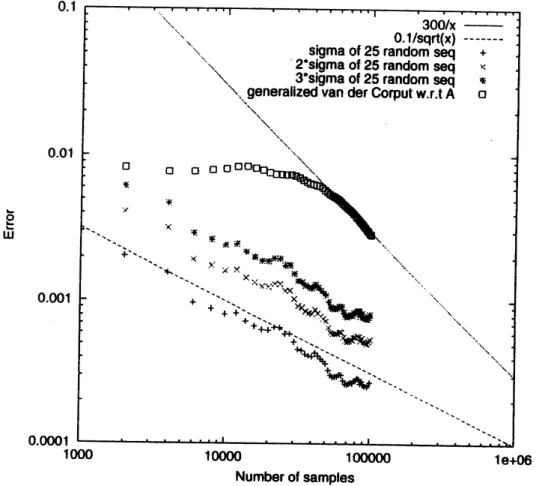
This is an expanding matrix. We calculate the numerical integration by using 25 random number sequences and the generalized van der Corput seqeunce
with respect to $A$. The result is displayed in Figure 1. In the figure,
approx-imation
errors
resulted by using these sequencesare
plotted. For random number sequences, we calculate the aof 25sequences
and plot $\sigma$, $2\sigma$, and$3\sigma$. Figure 1shows that:
1. the approximation
error
of the generalized van der Corputsequence
withrespect to $A$ converges at the speed of $O(1/\Lambda/I)$ where $M$ is the number
of sample points;
2. those of random number sequences at the speed of $O(1/\sqrt{\mathrm{J}\prime I})\mathrm{i}$
3. the generalized van der Corput sequence with respect to $A$ achieves about
10 times
worse
when sample number is 10 .From the practical point of view, how to find a“good $A$”is important and
this problem still remains.
References
1. Takahiko Fujita, Shunji Ito, and Syoiti Ninomiya, Symbolical and
Geornetri-cal Characterizations
of
Kronecker Sequences by Using the Accelerated BrunAlgorithm, J. Math. Sci. Univ. Tokyo 7 (2000), 163-193
The generalized van der Corput sequence
$\overline{\frac{\frac{\mathrm{o}}{}}{\mathrm{u}\downarrow}}$
Fig. 1. Convergence performance: numerical integration of
f
over $\mathrm{I}^{10}$2. P. Hellekalek, Ergodicity
of
a classof
cylinderflows
related to irregularitiesof
distribution, Compositio Mathematica 61 (1987), 129-136.
3. Jeffrey C. Lagarias and Yang Wang,
Self-affine
tiles in $\mathrm{R}^{n}$, Advances inMath-ematics 121 (1996), 21-49.
4. Makoto Mori, Low discrepancy sequences generated by piecewise linear maps,
Monte Carlo methods and its applications 4(1998), 141-162.
5Harald Niederreiter, Random number generation and quasi-Monte Carlo
meth-ods, SIAM, 1992.
6. Syoiti Ninomiya, Constructing a new class
of
low-discrepancy sequences byus-ing the $\beta$-adic transformation, Mathematics
and Computers in Simulation 47
(1998), 403-418.
7. –, On the discrepancy
of
the $\beta$-adic van der Corput sequence, J. Math.Sci. Univ. Tokyo 5(1998), 345-366.
8. G. Pages, Van der Corput sequences, Kakutani
transforms
and one-dimensionalnumerical integration, Journal of Computational and applied Mathematics 44
(1992), 21-39.