Japan Advanced Institute of Science and Technology
JAIST Repository
https://dspace.jaist.ac.jp/
Title
Locally communicative interaction framework for
adaptively self-organizing mobile sensor networks
Author(s)
Tatara, Kazutaka; Lee, Geunho; Ono, Hiroaki;
Chong, Nak Young
Citation
2012 IEEE International Conference on Automation
Science and Engineering (CASE): 1138-1143
Issue Date
2012-08
Type
Conference Paper
Text version
author
URL
http://hdl.handle.net/10119/10875
Rights
This is the author's version of the work.
Copyright (C) 2012 IEEE. 2012 IEEE International
Conference on Automation Science and Engineering
(CASE), 2012, 1138-1143. Personal use of this
material is permitted. Permission from IEEE must
be obtained for all other uses, in any current or
future media, including reprinting/republishing
this material for advertising or promotional
purposes, creating new collective works, for
resale or redistribution to servers or lists, or
reuse of any copyrighted component of this work
in other works.
Locally Communicative Interaction Framework for Adaptively
Self-organizing Mobile Sensor Networks
Kazutaka Tatara, Geunho Lee, Hiroaki Ono, and Nak Young Chong
Abstract— We address the adaptive self-organization problem
for mobile robotic sensors creating wireless ad hoc networks while adapting to topological changes. Our challenge is placed on how to exploit locally communicative interactions with minimal conditions such as locality and implicit coordina-tion. Each sensor node organizes and updates its partially-connected network through selecting specific neighboring nodes with higher connectivity. The effectiveness of the proposed framework is verified by extensive simulations and experiments with RFID sensor networks that contain mobile sensor nodes. The most notable features of our approach include self-organization, topological adaptation, and self-healing, enabling self-organization of mobile sensor networks in an efficient way.
I. INTRODUCTION
Many studies employing large-scale mobile sensors have been reported in fields of networking and swarm robotics. From the viewpoint of the application domain like surveil-lance or environmental monitoring [1], large numbers of mobile sensors can be considered as swarms of wireless sensors mounted on spatially distributed autonomous robots. Robotic sensors deployed across an area of interest may move around to improve area coverage. However, they should remain connected during their movement. Once a desired topology has formed, the network gets easily affected by node movements and/or failures. Meanwhile, the network might suffer from mutual interference if a certain number of sensors send data at the same time. Sensor networks with such latent aspects still remain several issues that need to be tackled. First, it is more essential for robotic sensors to self-organize their network while channeling their communication paths. Secondly, it is necessary to partially reflect topological changes rather than recreate from scratch and to quickly restore networks in the case of node failures. Thirdly, it is desirable to develop a communicative framework with relatively minimal conditions from the mobility point of view.
Most of the approaches for wireless sensor networks proposed so far can be broadly divided into mobility and connectivity approaches. First, it is obvious that controllable mobility for robotic sensors is one of the most important components, as the sensors need to be relocated whenever necessary. Decentralized mobility approaches [2]-[7] have been reported, mainly employing some types of force balance between inter-individual interactions. These interactions re-sult in lattice-type configurations that offer high level
cover-K. Tatara, G. Lee, H. Ono, and N. Y. Chong are with the School of Information Science, Japan Advanced Institute of Sci-ence and Technology, 1-1 Asahidai, Nomi, Ishikawa 923-1292, Japan
{k tatara,geun-lee,H.Ono,nakyoung}@jaist.ac.jp
age and multiple redundant connections, but the interactions are based on implicit communications. Secondly, connec-tivity is another essential factor, enabling communicative collaboration to share useful data. Connectivity approaches can be further classified into connectivity maintenance [8]-[10], optimized connectivity based deployment [11]-[13], and connectivity restoration [14]-[16] schemes. The schemes have been mainly focusing on how to maintain any desired connectivity states through mobility control, resulting in offering topologically robust networks. It has been noted that inter-node communication was established in the schemes for data exchange to improve energy efficiency and deployment accuracy. It may be necessary to further develop an integrated framework considering locality, traffic, path searching, and topological adaptation for a practical use.
This paper addresses the adaptive self-organization prob-lem for autonomous mobile robotic sensors. There are always challenges of how to exploit communicative interactions under simple conditions such as the minimum level of locality, no requirement of long-lived state information, and implicit communication coordination. Based on such a weak model, we propose a locally communicative interaction framework (LCIF), enabling robotic sensors to organize their networks adapting to topological changes due to node movements and/or failures. Individual robots perform the proposed LCIF composed of the following three steps: local distribution acquisition, neighbor selection, and local network generation. We describe LCIF in detail, and perform extensive simulations to demonstrate its unique features such as self-organization, topological adaptation, and self-healing capabilities. As a real system implementation of mobile
ad hoc networks, RFID tags are developed and integrated
into off-the-shelf mobile robots. Both the simulation and experimental results show that robotic sensor swarms based on LCIF can self-organize themselves in an efficient way adapting to unexpected topological changes.
II. PROBLEMSTATEMENT
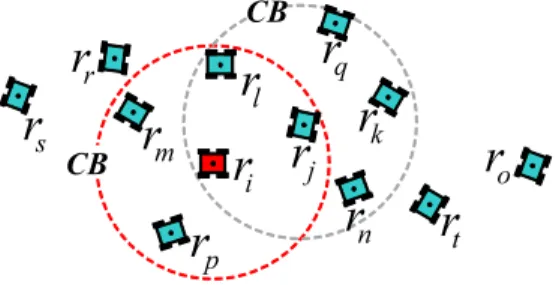
This paper considers a swarm of mobile nodes composed of n autonomous mobile robotic sensors r1, r2,· · · , ri,· · · , rn. In the swarm, a robot ri has its own
identification but there are no initially assigned specific roles such as leader, source, sink, and gateway. All robots independently execute the same algorithm without long-lived states, but asynchronously act from other robots. Specifically, ri can send its information to its adjacent robots within
CB i
r
r
j kr
lr
mr
or
pr
CB nr
rr
r
q sr
tr
Fig. 1. Illustration of definitions and notations
Conversely, ri can receive and/or overhear the broadcasted
data.
According to whether ri communicates to its adjacent
robots rjdirectly or indirectly, communicative states between
ri and rj can be classified into 1-hop and 2-hop
commu-nications, respectively. First, the 1-hop communication is a state where ri and rj can directly communicate each other.
Accordingly, the 1-hop communication robots with respect to ri are simply called ri’s 1-hop robots. A set of the ri’s
1-hop robots is represented as Cii. If rihas a communicative
state for another robot rs located outside its CB through a
robot of Ci1 as shown in Fig. 1, rs is the ri’s 2-hop robot.
Similarly, Ci2 with respect to ri denotes a set of the 2-hop
robots. Moreover, rican select specific robots in elements of
Ci1. The selected robots are defined as ri’s neighbors ri,nj,
and a set of ri,nj is represented as Ni (={ri,nj|1 ≤ j ≤ m}
where m >1).
Next, a fixed waiting time tw is set to determine whether
or not there is a connection to other nodes. Once information is broadcasted to rj from ri in Ci1, ri starts to check its tw.
If ri receives any response from rj during tw, the condition
with respect to ri is defined as the connection (i.e., ri is
connected to rj by local communications). Here, a time
in-terval from ri’s transmission to rj’s returning is represented
as tij. Otherwise, the connection state is determined to be
disconnected.
Based on the connection state, a local network configura-tion of ri is introduced. For the local distribution in Fig. 1,
we use the undirected graphGi={Vi,Ei} where Viis a set of
n vertices{v1, v2,· · · , vn} and Ei is a set of edges between
vertices Ei = {(vi, vj)|vi, vj ∈ Vi}. It is assumed that
there is no self-loops. Specifically, we define only the 1-hop communication state between riand its ri,njby the use ofGi.
Finally,G denotes a global network configuration (Sni=1Gi)
collectingGi where n robots remain in the connection.
Three broadcasting-based communications are employed. First, to notify the existence of ri, a hello message heli is
broadcasted to adjacent robots rjregularly. When rjreceives
heli, it then replies with an acknowledgement notice ackj.
Secondly, the ri’s output message outi of LCIF execution is
given to rj, and then rj gives its acknowledgement notice
ackj back. Thirdly, ri broadcasts (i.e., replies) its answer
message ansi when ri requests any information reqi from
rj. For the sake of simplicity, any messages transmitted from
ri to rj of Ci1are typically represented as msgi.
Here, we seek a decentralized solution based on only locally broadcasting. Individual robots build their local net-works from the distribution of adjacent robots while remov-ing some redundant communication links. Next, collectremov-ing the local networks also allows the robots to reach self-organization of the overall network. Despite its initial gener-ation, this network is very changeable by robot movements. Moreover, disappearances of robots due to robot failures are another cause of changes in the network. Therefore, robots need to partially update its configuration accord-ing to changaccord-ing situations. Then, we formally address the
ADAPTIVE SELF-ORGANIZATION problem for a swarm of n robots based on the aforementioned model definitions as follows: Given n robots with the above-mentioned minimal
capabilities, how can individual robots self-organize their network adapting to topological changes in a decentralized way? Consequently, we advocate that the addressed problem
can be achieved by offering a self-organization, network adaptation, and self-healing solution.
III. LOCALLYCOMMUNICATIVEINTERACTION
This section describes the solution to the addressed prob-lem. The solution, LCIF, is composed of three sequential procedures: information acquisition about the local distribu-tion of adjacent robots, neighbor selecdistribu-tion computadistribu-tion based on the acquired information, and local network generation.
A. Local Distribution Acquisition
The first step in LCIF is to investigate the local config-uration of adjacent robots around ri by broadcasting and
receiving including overhearing. The input is msgj,k−1, and
its outputs are Ci,k1 and Ci,k2 . From msgj,k−1, ri computes
Ci,k1 and Ci,k2 . It is obvious that the inputs obtained through
communications and the outputs are at time k− 1 and k, respectively. For the sake of simplicity, we omit the notations of time k and k− 1 afterwards.
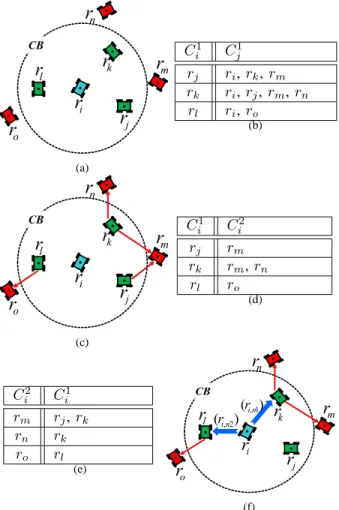
Fig. 2-(a) illustrates a local distribution of robots. To begin, ri broadcasts heli to adjacent robots rj, then waits
to receive their ackj. Depending on the received ackj, ri
computes Ci1 and asks rj of Ci1 for their own Cj1. After
obtaining Cj1 from rj, ri makes a local configuration table
Li associated according to each element of Ci1 as shown in
Fig. 2-(b). Li represented by all elements of collections of
Cj1(represented as
S
j∈C1 i C
1
j) indicates the direct mappings
for individual elements of Ci1. Therefore, these mappings can be regarded as a local network-configured function from Ci1 to Cj1, denoted by Li: Ci1→ Cj1.
Next, from both Ci1 and(Sj∈C1 iC 1 j), Ci2 is computed: Ci2= ( [ j∈C1 i Cj1) − Ci1− {ri}. (1)
By computing Ci2, rican obtain information about a
config-uration located outside its CB. Even though this information is still local, rican estimate a more extended network
config-ured by Ci1and Ci2. Ultimately, from the robot configuration in Ci2, ri can count the number of communication links
CB i
r
jr
lr
nr
mr
or
kr
(a) C1 i Cj1 rj ri, rk, rm rk ri, rj, rm, rn rl ri, ro (b) CB ir
jr
kr
lr
nr
mr
or
(c) Ci1 Ci2 rj rm rk rm, rn rl ro (d) Ci2 Ci1 rm rj, rk rn rk ro rl (e) CB ir
jr
kr
lr
nr
mr
or
) (ri,n1 ) (ri,n2 (f)Fig. 2. Illustration of LCIF ((a) local distribution, (b) local configuration ta-ble: Li, (c) communicative function fi,12from C1
i to C 2
i (d) representation of fi,12: Ti,12, (e) representation of fi,21: Ti,21, (f) neighbor determination of ri) CB i
r
jr
kr
lr
nr
mr
or
(a) ID Ni ri {rk, rl} rj {ri, rk} rk {ri} rl {ri} rm {rk} rn {rk} ro {rl} (b)Fig. 3. Illustration of collecting Gi((a) partially-connected mesh network, (b) neighbor list of individual robots in this network)
B. Neighbor Determination
Before the explanation of the neighbor selection, we define two communicative functions fi,12 and fi,21 allowing ri to
examine its communicative mappings between rj. On the
one hand, fi,12 on Ci1 into Ci2 is defined:
fi,12: Ci1→ Ci2. (2)
The representation of fi,12 is defined as Ti,12. Figs. 2-(c)
and (d) illustrate fi,12 and Ti,12, respectively. On the other
hand, fi,21 on Ci2 into Ci1 is given:
fi,21: Ci2→ Ci1. (3)
Similarly, Ti,21 denotes the representation of fi,21. More
important, the composition of fi,12 and fi,21 is defined as
a function from Ci1 to Ci1 through Ci2 given by
fi,21◦ fi,12. (4)
By the use of the composition of fi,12 and fi,21, ri can
estimate the connected state of its local network.
Here, the input arguments of ri are Ci1 and Ci2, and its
output is Ni. First, ri examines the most mapped element
of Ci1 from robots of Ci2. In other words, ri investigates a
robot of Ci1with the most mapping frequency when applying fi,21 to each robot of Ci2 (to obtain Ci1 = fi,21(r) where
r∈ C2
i). The most mapped element is selected as the first
neighbor ri,n1. Then, ri,n1of Ci1 and its directly associated
robots of Ci2are dropped from Ci1and Ci2, respectively. After the expulsion from Ci1 and Ci2, individual complementary sets are defined as Ci,(1)1 and Ci,(1)2 , respectively. Similar to the process above, ri finds the second neighbor ri,n2
with the most mapping from elements of Ci,(1)2 . After the determination of ri,n2, individual complementary sets are
defined as Ci,(2)1 and Ci,(2)2 , respectively. By repeatedly doing this process until Ci2= ∅, ri can select its ri,nj in Ci1. And,
a set of ri,nj selected by ri is defined as Ni.
C. Local Network Generation
The ri’s input is Ni, and its output is Gi = (Vi,Ei).
In this paper, ri and the selected ri,nj are considered as
individual vertices vi,i, vi,n1,· · · , vi,nj,· · · , vi,nm, and a set
of the vertices is defined asVi. Each edge between vi,i and
vi,nj is represented as eij = (vi,i, vi,nj), and Ei denotes
{eij|1 ≤ j ≤ m}. Next, Gi = (Vi,Ei) is formed with respect
to ri. Fig. 2-(f) shows the generated local network of ri
where rk and rl is selected as ri,n1 and ri,n2, respectively.
Similarly, Gj = (Vj,Ej) is independently built under the
same process. After the completion of Gi = (Vi,Ei), ri
exchanges Ci1 and Ni with its rj as outi by broadcasting.
Since ri is connected to ri,nj of Ni like a Vi-to-Vj
connection as shown in Fig. 2-(f), this can be regarded as the star network topology. Collecting Gi = (Vi,Ei) can
globally reach self-organization forG without a centralized control scheme. When the local star networks overlap each other, the overall network can have the partially-connected mesh network topology as illustrated in Fig. 3. From the standpoint of network topology, LCIF makes it possible to take advantage of some of the network redundancy through being connected to as many adjacent robots as possible. In particular, if individual robots agree on the mutual neighbor, E becomes a central communication path that is connected to their many adjacent robots.
IV. IMPLEMENTATION OFJAIST-PFU RFID TAG
For experimental studies, RFID transponders were utilized as a real wireless communication tool mounted on top of off-the-shelf mobile robots. As shown in Fig. 4, we have
J-P RFID Tag
front rear
(a) J-P RFID tag prototype
antenna battery switch microcontroller photo sensor voltage reference LED RF transceiver oscillator temperature sensor front rear
(b) J-P RFID tag layout Fig. 4. Hardware configuration of J-P RFID tag
Fig. 5. Robot integration using J-P RFID tag and the distribution in an indoor environment
developed JAIST-PFU RFID transponders, which for brevity we will call J-P RFID Tag (see specific details below).
All electric devices and parts of J-P RFID Tag are located on double-sided printed wiring board where the dimension of the wiring board is 85mm× 50mm in area and 1.6mm in thickness. The electric devices are largely divided into three functions: tag control, communication, and sensing. First, Microchip PIC18F2620 microcontroller is employed as the main controller of the tag. The microcontroller is used to control radio-frequency (RF) communications, to compute the proposed algorithm, and to manage sensing components. Moreover, the microcontroller can be connected with an outside component (e.g., robot) through an external communication channel (i.e., RS-232c). Secondly, wireless communication components include an in-house loop an-tenna, Texas Instruments CC1000 RF transceiver, and Murata CSTCE V oscillator with 14.75M Hz for the transceiver. In the receiving mode, the transceiver receives Manchester encoded data at a data rate 76.8 kBaud and forwards the digital demodulated data to the microcontroller. In transmit-ting mode of the transceiver, the RF output is broadcasted to adjacent robots through RF carrier frequencies 315M Hz modulated by frequency shift key (FSK). Specifically, the built-in antenna in the printed wiring board is 131mm in length. Thirdly, National Semiconductor LM4041 voltage reference, National Semiconductor LM20 temperature sen-sor, and Advanced Photonix PDV-P9001 photo sensor are mounted on J-P RFID Tag, as sensing components.
Fig. 5 presents the robot integration with J-P RFID tag where a laptop PC is used as the main controller, and is placed on top of the robot. Practically, five integrated mobile robots and 18 fixed RFID tags are prepared to organize mobile sensor networks. The experimental robots and tags were distributed in an indoor environment.
(a) initial distribution of 25 robots (b) sensor network generation Fig. 6. Simulation results for network organization
(a) (b)
(c) (d)
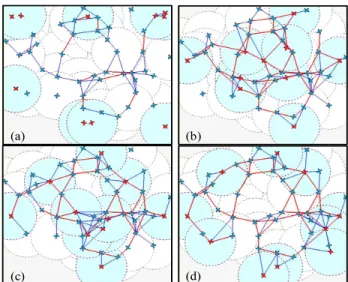
Fig. 7. Simulation result for topological adaptation where 10 red robots move arbitrarily and simultaneously and 40 blue robots remain stationary
Fig. 8. Simulation results for self-healing against loss of 15 robots in 50 robot swarms
V. SIMULATION ANDEXPERIMENTALRESULTS
To evaluate the validity and the effectiveness of LCIF, we performed a series of simulations demonstrating self-organization, topological adaptation, and self-healing fea-tures. First, Fig. 6 shows simulation results for the network generation by 25 robots. In Fig. 6-(b), the blue lines mean the defined edges eij to ri,nj from ri. The red bold lines
indicate individual robots in agreement on the mutual neigh-bor selection after the network generation. It is observed that robots could organize their overall mesh networkG by collecting local networksGi. Secondly, Fig. 7 presents the
simulation result for topological adaptation by 50 robots. 10 red robots move arbitrarily and simultaneously to make topological changes in the generatedG, but the other robots remain stationary. Under LCIF, robots partially updated Ci1,
(a) data for 50 robot swarms
(b) data for one robot selected in the swarm Fig. 9. Analysis results for the number of robots in C1
i and Niaccording to radius variations of CB
Ci2, and Ni by the overhearing and modified a part of G
corresponding to the changes rather than regenerated from scratch by all robots. From the result,Gicould adapt to
topo-logical changes according to the robot movements around ri.
It was confirmed that robot swarms could self-organize them-selves while adapting to network changes. Thirdly, restoring connectivity was verified against robot disappearances due to robot failures after the initial generation of G. 15 robots in 50 robot swarms unexpectedly failed in Fig. 8, and the same number of robots disappeared. Here, the red circles indicate the initial positions of 15 robots before their disappearances. Using broadcasted and overheard information, richecked the
existence of adjacent robots within CB. If adjacent robots disappeared around ri, LCIF allowed each of the robots to
partially restore their local networks by partial modification. To examine potential advantages by the neighbor selection under LCIF, we performed simulations for network orga-nization according to radius variations of CB. For these simulations, we prepared for 30 sorts of initially different distributions by 50 robots. In our simulator, the radii of CB were set to 50, 75, and 100 units, respectively. After network organization at each simulation, the number of robots in Ci1 and Ni for individual robots were recorded,
respectively, and the numbers for Ci1 and Ni were summed
up. Specifically, a specific robot in the swarm was selected to compare the selected robot’s results with those of 50 robot swarm. Fig. 9 shows the statistical analysis results where the error bars represent the 90% confidence intervals and
13
r
6 sec 34 sec
(a) experimental scene
robot interface 1 13 C 2 13 C 13 N
6 sec 19 sec 34 sec
50 sec 56 sec 68 sec
(b) topological changes of r13
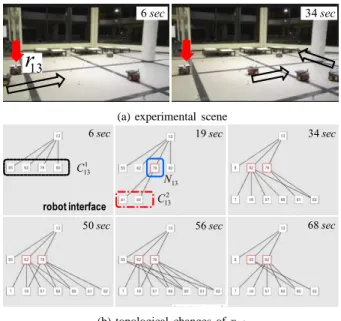
Fig. 10. Experimental result for topological adaptation
the boxes indicate distributions of data in the range of 25-75%. As the radius of CB became larger, the number of robots in Ci1for individual robots increased. This is a logical conclusion from the standpoint of the 1-hop communication as mentioned in Section II. More interestingly, the trends for the number of robots in Ni are almost steady regardless
of radius variations of CB. From the results, it can be inferred that the neighbor selection under LCIF was relatively unaffected by radius variations of CB. This is because ri
selects its ri,nj with higher connectivity after examining its
local distribution. The neighbor selection has several effects on both reducing mutual interference caused by multiple information from adjacent robots and shortening the required time for channeling communication paths as well as restoring connectivity from network redundancy.
Next, two sorts of experiments were conducted to ver-ify that robot swarms can self-organize themselves while adapting to topological changes. Fig. 10 shows the snapshots of the experiment for topological adaptation in the sensor network composed of five mobile robots equipped with the J-P RFID tag and 18 fixed J-P RFID tags. In this experiment, we examined the topological adaptation of a fixed robot r13
when two arbitrary robots move in the swarm. Fig. 10-(a) indicates experimental scenes and Fig. 10-(b) is states of the r13’s local network configuration displaying Ci1, Ci2, and Ni
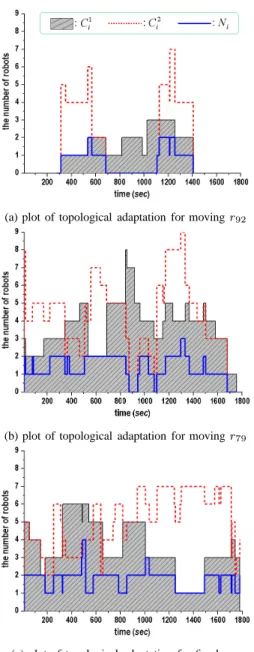
as time went on. From the experiment, we confirmed that LCIF and its realization on the RFID tags mounted on mobile robots could be considered quite satisfactory for the practical use of mobile sensor networks. Moreover, the experimental results verified that robotic sensor swarms based on LCIF can self-organize themselves while adapting to topological changes. Fig. 11 presents an experimental result performed for half of one hour to evaluate topological adaptation and integration feasibility for LCIF and the realization of the RFID tags. In this experiment, three robots move while the others remain stationary. As compared to the variations of
(a) plot of topological adaptation for moving r92
(b) plot of topological adaptation for moving r79
(c) plot of topological adaptation for fixed r13
Fig. 11. Experimental result performed for half of one hour to evaluate topological adaptation and the system integration feasibility
C1
i and Ci2, the contours of N92, N79, and N13 became
nearly flattened regardless of topological adaptation. More interestingly, when Ci2= ∅, N92and N79 were empty sets.
Although ri and its rj of Ci1 are connected, their Ci2 and
C2
j are sets with no elements. Accordingly, riand rj remain
an isolated network.
VI. CONCLUSIONS
In this paper, the adaptive self-organization problem was addressed to organize a mobile ad hoc network adapting to topological changes. As our decentralized solution, we proposed LCIF allowing robots with minimal capabilities to determine neighbors with higher connectivity. Under LCIF, first, individual local networks could be generated with neighbor-based star topologies. When collecting the local networks, robot swarms could self-organize a global network with partially-connected mesh topologies. Secondly,
the proposed algorithm allowed robots to self-adapt their local networks to topological changes due to robot move-ments and/or failures. Thirdly, the proposed neighbor se-lection provided the positive effects in dealing with mutual interference, channeling communication paths, and network redundancy. To demonstrate the validity and effectiveness of LCIF, extensive simulations and experiments were performed using the developed RFID tags, and the results were analyzed and compared. These results were quite encouraging, and we confirm that the proposed framework will increase the applicability of autonomous robot swarms toward mobile
ad hoc sensor networks. We will further investigate
energy-saving and connectivity enhancement issues in mobile sensor networks by integrating LCIF into the control of detailed node movement [7][9].
REFERENCES
[1] D. Bhadauria, V. Isler, A. Studenski, and P. Tokekar, “A robotic sensor network for monitoring carp in Minnesota lakes,” Proc. IEEE Int. Conf. Robotics and Automation, pp.3837-3842, 2010
[2] B. Shucker, T. D. Murphey, and J. K. Bennett, “Convergence-preserving switching for topology-dependent decentralized systems,” IEEE Trans. Robotics, vol.24, no.6, pp.1405-1415, 2008
[3] D. Spears, W. Kerr, and W. Spears, “Physics-based robot swarms for coverage problems,” Int. Jour. Intelligent Control and Systems, vol.11, no.3, pp.124-140, 2006
[4] Y. Zou and K. Chakrabarty, “Sensor deployment and target localization based on virtual forces,” Proc. IEEE Infocom Conf., pp.1293-1303, 2003
[5] B. Werger and M. J. Mataric, “From insect to internet: situated control for networked robot teams,” Ann. Math. and Artificial Intelligence, vol.31, no.1-4, pp.173-198, 2001
[6] J. Reif and H. Wang, “Social potential fields: a distributed behavioral control for autonomous robots,” Robotics and Autonomous Systems, vol.27, no.3, pp.171-194, 1999
[7] G. Lee and N. Y. Chong, “A geometric approach to deploying robot swarms,” Ann. Math. and Artificial Intelligence,” vol.52, no.2-4, pp.257-280, 2008
[8] E. Stump, Michael, V. Kumar, and V. Isler, “Visibility-based de-ployment of robot formations for communication maintenance,” Proc. IEEE Int. Conf. Robotics and Automation, pp.4498-4505, 2011 [9] G. Lee and N. Y. Chong, “Adaptive flocking of robot swarms:
algorithms and properties,” IEICE Trans. Communications, vol.E91-B, no.9, pp.2848-2855, 2008
[10] M. A. Hsieh, A. Cowley, V. Kumar, and C. J. Taylor, “Maintaining network connectivity and performance in robot teams,” Journal of Field Robotics, vol.25, no.1-2, pp.111-131, 2008
[11] H. C. H. Chiu and W.-M. Shen, “ANCHOR - self-configuring robotic network,” Proc. IEEE Int. Conf. Robotics and Automation, pp.5375-5380, 2011
[12] Z. Mi, Y. Yang, and G. Liu, “Coverage enhancement of mobile multi-agent networks while preserving global connectivity,” Proc. IEEE Int. Conf. Robotics and Automation, pp.5381-5386, 2011
[13] E. Stump, A. Jadbabaie, and V. Kumar, “Connectivity management in mobile robot teams,” Proc. IEEE Int. Conf. Robotics and Automation, pp.1525-1530, 2008
[14] K. Akkaya, F. Senel, A. Thimmapuram, and S. Uludag, “Distributed recovery from network partitioning in movable sensor/actor networks via controlled mobility,” IEEE Trans. Computers, vol.59, no.2, pp.258-271, 2010
[15] A. A. Abbsi, M. Younis, and U. Baroudi, “Restoring connectivity in wireless sensor-actor networks with minimal topology changes,” Proc. IEEE Int. Conf. Communications, pp.1-5, 2010
[16] M. Younis, S. Lee, S. Gupta, and K. Fisher, “A localized self-healing algorithm for networks of moveable sensor nodes,” Proc. IEEE Global Telecommunication Conf., pp.1-5, 2008