Evolutionarily
Stable
Seasonal Timing for Insects
with Competition for Renewable Resource
Hideo Ezoe
DepartmentofBiology, FacultyofScience, Kyushu University,
Fukuoka 812, Japan
資源獲得競争による昆虫の鰐化および蝋化のES $S$ タイミング
九州大学理学部生物学科 江副日出夫
I study the evolutionarily stable seasonal patterns ofhatching and pupation for herbivorousinsects that engageinexploitativecompetition for arenewable
resource.
Longer larval feeding period enhances female fecundity, but also
causes a
higher mortality by predation and parasitism. Previously, itwas
shown that theevolutionarily stablepopulation includes asynchronous startingandendingof larval
feeding periodina model inwhich larvaJ growthrate decreases with the total larval biomass in the population due presumably to interference competition. Here I studythe
case
in whichresource
availability changes not onlywith environmentalseasonalitybut also with the depletion by the feeding oflarvae. Ifthe environment
for host plants changes fast, the ESS insect population may include synchronous timingofhatching and pupation. Ifthe impact ofthe herbivoryis strongcompared
with the speed of seasonal change ofthe environment, both hatching and pupation
should
occur
asynchronously in the ESS. In addition, ifthe environmental variablechanges as
a
symmetric function oftime, the length ofperiod in which hatchingIntroduction
Insects living in temperate regions have widely diverse life histories adapted to seasonalityofthe environment. Closely related species or
even
populations ofthe same species may sometimes show greatly different life history
patterns, especially overlatitudinalgradient (Danks 1987;Kidokoro&Masaki 1978;
Masaki 1980;Furunishi&Masaki 1982;Sota 1987, 1998, 1994;Tauber et al. 1986).
Diversityin phenology, orseasonalityin life cycle, maypartially attribute to the
escape from the coldness during winter which may often require winter diapause.
Phenology is also related with seasonally changing resource availability, as well
as
coldness in winter, possibly modified by seasonalily changing risk ofpredationand parasitism. Shapiro (1975) for example studied the phenology ofeight
univoltine oak-feedinglepidopterans in the New Jerseypine barrens and observed that all the eight species have theirfeedinglarval stages in spring in spite ofgreat
differences among them in the adult season orin the overwintering stage. In this paper, I study the evolutionarily stable insect life cycle under
exploitative competition, in which the dynamics ofresource availability are
included explicitly. The resource (or host plant) availability increases by growth
and decreases by herbivory. Bymathematical and numerical analysis I show that whether hatching and pupation
occur
synchronously depends both on theintensityofherbivory and on the rate of seasonal change ofthe environment.
Specificallyboth pupation andhatching
occur
synchronously in the ESSpopulation ifthe feeding larval density is small and ifthe environnent changes
quickly, but they occur asynchronously if the impact ofherbivoryis strong
compared with seasonal change of the environment. In addition, if$bo$th hatching
and pupation occur asynchronously, the interval during which
some
pupationoccur
every day is likelyto be much longerthan a similarinterval for hatching.Model
Consider a population ofherbivorous insects, the larvae of whichfeed on host plants with seasonal availability. Suppose that each larva in thepopulationis indexedby$i$
.
Thegrowth ratein thebodyweight $W_{i}$ ofafeedinglarva$i$ onday$t$ is,$\frac{dW_{i}}{dt}=aR(t)W_{i}$ (1)
where $a$ is a constant for growth efficiency. Function$R(t)$ is the abundance of host
plants or resource availability. The initial size of larvae is assumed a constant $w_{0}$
which is given by the egg size.
Host plants expand their leaves and shoots for photosynthesis, which may
be damaged by feedinglarvae. Abundance of hostplants $R(t)$ changes with time
as follows:
$\frac{dR}{dt}=\{r(1-\frac{R}{K(t)})-bB\}R$ (2)
where$B(t)$ denotes total biomass of feedinglarvaein the population. Equation 2
implies that, when there is no herbivory, resourcelevel $R(t)$ follows a logistic
equation with intrinsic reproductive rate $r$ and carrying capacity$K(t)$.
In themodel, a life history schedule ofa larva is specified byits hatching
date and pupationdate, i.e. the start and the end of activefeeding. To indicate the life cycle timing of
an
individual, I here introduce a feeding activity schedule instead of those two dates. The strategy of individual $i$ is represented by function$\sigma_{i}=\sigma_{i}(t)$ such as $\sigma_{i}$ is equalto unitywhen it is fully active in feedingon day$t$,
zero when it isinactive, and takes a value between zero andunityfor an
intermediate level offeeding activity. A similar formulation
was
used for activity schedule of male frogs in the studyon the seasonal pattern ofsex
ratio (Iwasa&Odendaal, 1984), formate searching activityformale butterflies within a day
(Iwasa&Obara, 1989), for sex expression in discussing sex change evolution
(Iwasa, $1991b$), aswell asforfeeding activityofbutterflylarvae(Iwasa, $1991a$).
By using $\sigma_{i}$, Equation 1 can be rewritten as the following equation, which
holds
over
the whole season$[0, T]$:$\frac{dW_{i}}{dt}=aR(t)W_{i}\sigma_{i}$ (3a)
together with the initial condition:
$W_{i}(0)=w_{0}$ (3b)
Since $W_{i}$ does not change before hatching, $W_{i}$ on the hatching day is the same as
$w_{0}$ from Equation $3b$.
Total biomass of feeding larvae $B(t)$in the populationis the sum of weight of
all larvae multiplied bythe survivorship to day $t$ and the activityonthatday $\sigma_{i}(t)$;
$B(t)= \sum_{i}W_{i}(t)\sigma_{i}(t)\exp(-m\int_{0^{t}}\sigma_{i}(t)dt)$ (4)
Constant $m$ is the daily mortality of
an
actively feedinglarva. Note that thesun
inEquation 4 needs to be calculated for all the individuals includedin the initial
population with population size$N_{0}$. I here
assume
that mortality in inactivestages is negligibly small relative to $m$.
I
assume
thatfecundity, or the expected number of eggs whichan
adultfemale can lay, isproportional to its pupation size, the final body weight oflarvae
(forjustificationofthis assumption,
see
Iwasa, $1991a$; Iwasaet al., 1992, 1994). Inparticular it is equal to $W_{i}(T)$ ofthe solution ofEquation $3a$, because $W$does not
change with time afterpupation date (i.e. during $\sigma_{i}(t)=0$). The fecundityis equal
This multiplied by the larval survivorship is the fitness ofan individual adopting strategy $\sigma_{i}$:
$\phi(\sigma_{i})=Q\frac{W_{i}(T)}{w_{0}}\exp(-m\int_{0^{T}}\sigma_{i}(t)dt)$ (5)
where $\phi$ is the functional of function $\sigma_{i}$(
$\bullet$). Inthe evolutionarilystable
population, each individual chooses its own schedule offeeding activity $\sigma_{i}$ so asto
maximize its fitness $\phi(\sigma_{i})$.
Calculating derivative ofEquation 5 and using Equation $3a$, I
can
derive$\phi(\sigma_{i})=Q\exp[\int_{0^{T}}(aR(t)-m)\sigma_{i}(t)dt]$ (6b)
When$R(t)$ is given, Equation $6b$ is maximized by choosing $\sigma_{i}(t)$
as
follows:$aR(t)-m>0\Leftrightarrow\sigma_{i}=1$ (7a)
$aR(t)-m<0\Leftrightarrow\sigma_{i}=0$ (7化)
$aR(t)-m=0\Leftrightarrow$ $\sigma_{i}$ may have any value
between zero andone. (7c)
In the ESS population, eachindividual musthave the fitness that is no smaller than the fitness for any mutants that invade in small abundance in the
population. Hence I can conclude that all of the members in the populationmust
satisfy Equations $7a,$ $7b$, and $7c$, which indicate that all the individuals must
engage in active feeding when the resource availability $R(t)$ exceeds $m/a$, all should stay inactive when$R(t)$is less than $m/a$, and actively feeding and inactive
individuals can coexist simultaneously only when$R(t)$ equals to $m/a$
.
Then$f_{i}$ isthe
same
between individuals for all $t$, and Iremove
the suffix $i$ of$f_{i}(t)$in thefollowing. It is followed thatEquation 4 and Equation $6a$
are
rewritten asB(t)=N0f=\mbox{\boldmath $\sigma$}テ (8) and
(10)
$\phi(\sigma_{i})=Q\exp[j_{0^{T}}(aR(t)-m)\overline{\sigma}(t)dt]$ (9)
respectively. InEquation 8,$N_{0}$ denotesthe initial population of eggs atthestart of
the
season
and $\overline{\sigma}=\overline{\sigma}(t)$ is the population average of$\sigma_{i}$, and I call it “average
activity“
on
day$t$. ThenEquation 2can
be rewrittenas:$\frac{dR}{dt}=\{r(1-\frac{R}{K(t)})-bN_{0}\ulcorner\sigma\}R$
Specifically I assume that a season favourable for growth of host plant lasts from the beginning $(t=0)$ to date $T_{f}(T_{f}<T)$, duringwhich carrying capacity$K(t)$
$hasasinglepeakK_{1}>m/a$
.
$AfterT_{f},$$K(t)isasmallvaluesatisfyingK_{0}<m/a$.
Specifically I choose
$K(t)= \{K_{0}+\frac{K_{1}^{K_{0}}-K_{0}}{2}(1-\cos\frac{2\pi tt<}{T})0,$ $or_{0<t<T_{f}}t>T_{f}$ (11)
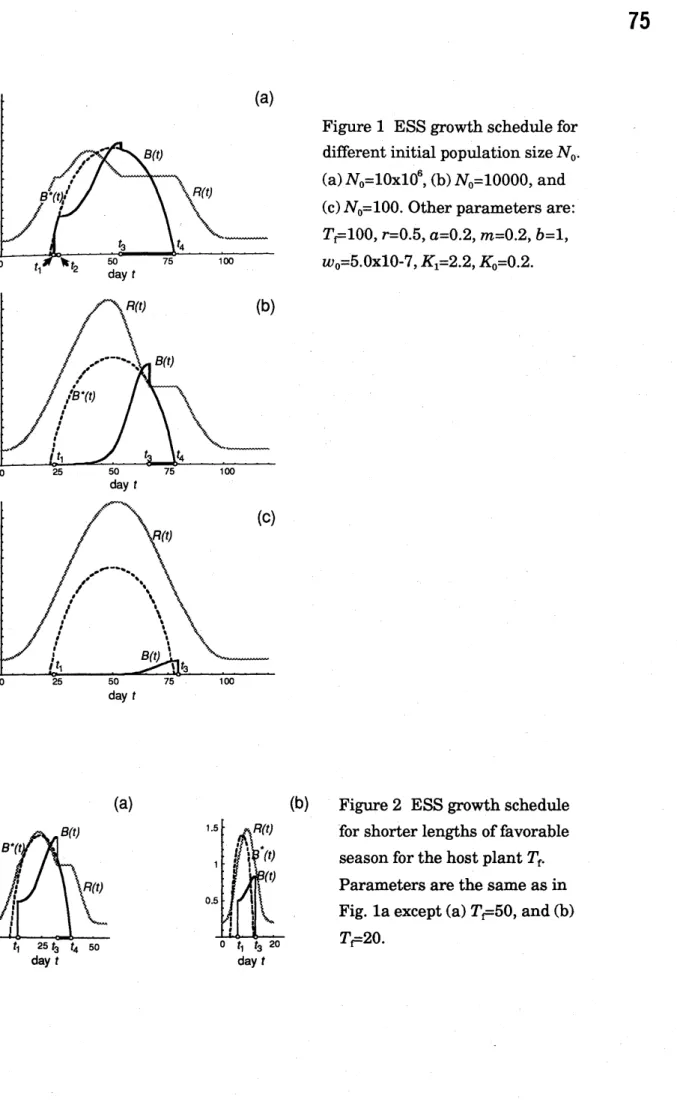
The evolutionarily stable patterns for typical cases are shownin Fig. 1 and
Fig. 2. Figure laillustrates the case in which the impactofherbivory bythe larvae
on
hostplants is large. Theseason
is composed of five phases. In the beginning ofthe season, both carrying capacity$K(t)$ and the resource availability$R(t)$
are
low.Then$K(t)$ starts increasing and resource level $R(t)$ increases following$K(t)$ with
some
time delay. When$R(t)$ reaches a critical level $m/a$, on day $t_{1}$, some fractionofeggs hatches on that day. However in this particular example, some fraction of eggs remains unhatched and they hatch asynchronously over a period from $t_{1}$ to $t_{2}$
, WhichI call’hatching interval’. This is the second phase. $Ont_{2},$ $alltheeggs$
finish hatching and then engage in active feeding as larvae. This third phase of
full growth ends on day$t_{3}$ , on which some fraction ofsurviving larvae enters
pupation. Howeverthe others remain feedinglarvae and they turn to pupae
During this fourth phase,
resource
availability$R(t)$ remain constant $m/a$. On $t_{4}$,all the larvae finish pupation and thereafter they experience non-feeding stages (pupa, adult, and egg), the timing ofwhich is out ofconcern ofourpresent model.
In addition, this asynchronisation also occurs ifthe rate of change in carrying
capacity$K(t)$ is fast compared with intrinsic growth rate $r$ and growth efficiency of
larva $a$
.
In Fig. la hatching and pupation occur asynchronously. During hatching and pupation intervals, the resource availability remains constant $(R(t)=m/a)$
and the biomass ofactively feedinglarvae$B(t)$is equal to
$B^{*}(t)= \frac{r}{b}(1-\frac{m}{aK(t)})$ (12)
which canbe determined only by carrying capacity function$K(t)$. This
curve
isillustratedin Fig. la byabroken line. On the first date ofhatchinginterval$t_{1},$$K(t)$
is greater than$R(t)=m/a$, then$B(t)$ discontinuously changes from zero to $B^{*}(t_{1})>0$.
The last date ofhatchinginterval $t_{2}$ is derived from$B^{*}(t_{2})=N_{0}w_{0}$. Note that those
individuals hatching early do not change its expected biomass during hatching
intervals, because gain bygrowth andloss by mortality cancel with each other
exactly. Similarly ifthe dayforbeginning of pupation $t_{3},$$B(t)$is greater than$B^{*}(t)$,
$B(t)$ discontinuously goes down to$B^{r}(t_{3})$. The last date ofpupationinterval $t_{4}$is
obtainedfrom$B(t_{4})=0$
.
Iftheimpact ofherbivory by thelarvae to hostplantsis not very strong,
eitherhatching or pupation or both
occur
synchronously. Figure lb is the phenology of the ESS population in which hatching occurs synchronously butpupation
occurs
asynchronously. When $R(t)$ reaches a critical level $m/a$ on day$t_{1}$, the total biomass of the insectpopulation maybe smaller than the value given byEquation 12 onthat day:
$N_{0}w_{0} \leq\frac{r}{b}(1-\frac{m}{aK(t_{1})})$ (13)
Then all the eggs hatch synchronously and hatching interval does not exist. Inequality 13
can
be satisfied ifthe egg biomass ofthe insect$N_{0}w_{0}$is sufficientlysmall.
This is likelyto be the case ifthe rate ofchange in seasonal carryingcapacity$K(t)$ is fast (Fig. $2b$), because$K(t)$becomesquite large onthe dayat which
resource
availability reaches the prescribed level $m/a$.
Figure lc illustrates the case in which not only hatching but also pupation
occurs
synchronously. Whether or not the pupation occurs asynchronously in theESS population should also dependonthe impact of the herbivory on host plants.
During the period in which all the individuals should engage in active feeding, the
resource
availability should be larger than $m/a$.
After the peak season, theresource
availability starts to decline with time. The date $t_{3}$ onwhich fully activefeeding ends is determined as a date on which$R(t)$ becomes equal to $m/a$
.
Iftheimpact of the insect feeding onthe
resource
is very $smaU,$$R(t)$is larger than$K(t)$,as
the resource availability decreases following the decline ofcarrying capacity$K(t)$with
some
time delay. Hence,we
have$K(t_{3}) \leq\frac{m}{a}$
(14)
then$B^{*}(t_{3})$isnegative. Consequently $t_{3}$is later than the date $t_{4}$ on whichEquation
14 becomes zero. This implies that all the larvae should pupate onthe same day synchronously(Fig. lc). Ifinstead the impact offeedinglarvae onthe food plant is strong,
resource
availability is smaller than the carrying capacity on day $t_{3}$, andthen there is
a
pupationinterval, asis the case forFig. la and lb. Whetherornotpupation
occurs
asynchronously is determined by the relative magnitude of$R(t_{3})$and$K(t_{3})$, which in turn reflects the impact ofherbivory relative to the rate of
Discussion
Inthis paper I studied the evolutionarily stable pattern of hatching and pupation within a population ofinsects which engage in intraspecific exploitative competition for seasonally changing
resource.
I found that the hatching andpupation timing are synchronous in the evolutionarily stable population if
seasonal environmentchanges rapidly and ifthe impact ofherbivory by the insects on host plants is small.
Previously, Iwasa (1991a) and Iwasa et al. (1994) studied the evolutionarily
stable seasonal timing ofhatching and pupation by theoretical models in which the larval growth rate is simply assumed as a decreasing function of the biomass offeeding larvae at that time. They concluded that the phenological timing of insects is always asynchronous. In contrast the analysis in the present paper in
which the
resource
dynamics are traced explicitly shows that both pupation andhatching
can
be synchronous if theimpact ofherbivory tothe host plantpopulation is small orifthe environmental change very rapidly. It also supports
the conclusion ofthe previous works that the pupationis
more
likely tooccur
asynchronously than hatching.
A similar idea ofevolutionarily stable timing under competition for
resource
has been developed for modelling seasonality in leafexpanding activityfor terrestrialplants. Harada&Takada(1988) studied optimal timing of leaf
expansion and shedding ofdeciduous trees with competition by shading in a model with twolayers ofleaves, and found that the optimal schedule is different between the two layers, which engage in asymmetric competition. Sakai (1992)
studied the evolutionarily stable timing ofleafexpansion for equivalent competitors, and found that the schedule of leafexpansion and shedding is
and shedding
can
be asynchronous under strong competition for light. Thisconclusion
is qualitatively similar to the one inthis paper, although Sakai dealt with thecase
in which no reproduction or growth ofconsumers
(i.e. tree leaves)isconsidered.
In this paper, I adopted several simplifying assunptions, some ofwhich may be removedin the future theoretical works. First, I assumedthatdaily
growthrate is proportional to the larval bodyweight in Equation 1 and that the number of eggs female can layis also proportional to its pupation weight in
Equation 4. However it is more plausible that female fecundity increases with her
body weightbut saturates for averylarge body weight. Second, the growthrate is
assumed
to be proportionalto the resource availabilityin Equation 1. In realityitis
more
likely that the growth rate would saturate for verylargeresource
availability, and also that the saturationlevel would increase with the larval body
weight because larger larva is
more
mobile andis able to sequester moreresource.
This effect
was
consideredin Iwasaet al. $(1992, 1994)$ in a model without resourcedynamics. Third, the competitors may be sibs or half-sibs from the same clutch
laidby a single mother. Then we need the analysisincluding kin selection. These modifications would be important future theoretical study ofinsect life cycle from the viewpoint ofevolutionaryecology.
References
Danks, H.V. (1987) Insect dormancy: an ecological perspective. Biological Survey
ofCanada, Ottawa. 439pp.
Furunishi, S. &Masaki, S. (1982) Seasonallife cycle intwo species of ant-lion (Neuro tera: Mvrmeleontidae). $Jpn$. J. Ecol. 32, 7-13.
Harada, Y. &Takada, T. (1989) Optimal timingof leafexpansion and sheddingin
Iwasa, Y. and Y. Obara, (1989) Agame model for the daily activity schedule of the malebutterfly. J. Insect Behav. 2, 589-608.
Iwasa, Y. (1991a) Asynchronous pupation ofunivoltine insects as the
evolutionarilystablephenology. Res. Poupl. Ecol. 33, 213-27.
Iwasa, Y. (1991b) Sex change evolution and cost ofreproduction.Behav. $Eco$
.
$2,56-$ae.
Iwasa, Y., Ezoe, H. &Yamauchi, A. (1994) Evolutionarily stable seasonal timing of
univoltine and bivoltine insects. InInsect life-cycle polymorphism: theory,
evolution and ecological consequences
for
seasonality and diapausecontrol. (H.V. Danks and S. Masaki, eds.) Kluwer AcademicPubl, MA, USA
(in press).
Iwasa, Y. &Odendaal, F.J. (1984) A theoryon the temporal pattern ofoperational
sex ratio: The active-inactive model.Ecology 65, 886-93.
Iwasa, Y., Yamauchi, A. &Nozoe, S. (1992) Optimal seasonal timing ofunivoltine
and bivoltine insects.Ecol. Res. 7, 55-62.
Kidokoro, T. &Masaki, S. (1978) Photoperiodic responsein relationto variable
voltinism in the ground cricket, Pteronemobius $fasci_{-}Des$ Walker
(Orthoptera: Gryllidae).$Jpn$
.
J. Ecol. 28, 291-8.Masaki, S. (1980) Summer diapause.A. Rev. $Ent$
.
$25,1- 25$.
Sakai, S. (1992) Asynchronous leafexpansion and shedding in a seasonal
environment: result ofa competitive game. J. theor.Biol. 154, 77-90.
Shapiro, A.M. (1975) The temporal components ofbutterfly species diversity. In: Ecology and Evolution ofCommunities. (M.L. Cody&J.M. Diamond, eds.),
Belknap, HarvardUniv., Cambridge, MA. pp. 181-95.
Sota, T. (1987) Mortalitypattern and age structure in two carabid populations with different seasonal life cycles. Res. Popul. Ecol. 29, 237-54.
Sota, T. (1988) Univoltine and bivoltine life cycles ininsects:
a
model withdensity-dependent selection. Res. Popul. Ecol. 30, 134-44.
Sota, T. (1994) Variation of carabidlife cycles alongclimatic gradients: an
adaptive perspective for life history evolution under adverse conditions. In
Insect life-cycle polymorphism: theory, evolution and ecological
consequences
for
seasonality and diapause control. (H.V. Danks and S.Masaki, eds.), Kluwer Academic Publ, MA, USA (in press).
Tauber, M.J., Tauber, C.A.
&Masaki,
S. (1986) Seasonal adaptationsof
insects.Figure 1 ESSgrowth schedulefor
differentinitial populationsize$N_{0}$.
(a)$N_{0}=10x10^{6},$$(b)N_{0}=10000$, and
(c)$N_{0}=100$. Otherparameters are: $T\ulcorner-100,$$r=0.5,$ $a=0.2,$ $m=0.2,$$b=1$, $w_{0}=5.0x10- 7,$ $K_{1}=2.2,$ $K_{0}=0.2$.
(b) Figure2 ESS growth schedule
forshorterlengths of favorable
seasonfor thehostplant$T_{f}$
.
Parametersarethesame asinFig. la except(a) $T_{\overline{\ulcorner}}50$,and(b) $T\ulcorner-20$