IN THE “SHIRASU” PUMICE FLOW REGIONS, JAPAN
著者
OBA Noboru, TOMITA Katsutoshi, YAMAMOTO
Masahiko
journal or
publication title
鹿児島大学理学部紀要. 地学・生物学
volume
18
page range
1-19
別言語のタイトル
シラス地帯における崖崩れ発生のメカニズム
URL
http://hdl.handle.net/10232/5952
MECHANISMS BY WHICH THE LANDSLIDE WAS CAUSED
IN THE “SHIRASU” PUMICE FLOW REGIONS, JAPAN
著者
OBA Noboru, TOMITA Katsutoshi, YAMAMOTO
Masahiko
journal or
publication title
鹿児島大学理学部紀要. 地学・生物学
volume
18
page range
1-19
別言語のタイトル
シラス地帯における崖崩れ発生のメカニズム
URL
http://hdl.handle.net/10232/00006940
蓉 堤 だ 槌 戦 野 巌 的
MECHANISMS BY WHICH THE LANDSLIDE WAS CAUSED
IN "SHIRASU" PUMICE FLOW REGIONS, JAPAN
By
Noboru Oba*, Katsutoshi Tomita* and Masahiko Yamamoto
(Received June 21, 1985)
Abstract
Mechanisms by which the landslide was caused in the "Shirasu" pumice flow regions are
roughly grouped into the following three : (1) the progressive change of the natural environment accompanied by the qualitative and structural changes of the social basement ; (2) natural agencies in the natural environment, as seen in the landslides due to columnar joint, scouring and others in places where none of the development is accompanied; and (3) unnatural agencies accompanied by the development, as seen in the landslides of the disturbed "Shirasu" and the weathered "Shirasu" pumice flow due to the defective handling for the drainage and prevention of water, undercutting, mechanical vibration and others in places where the development is in progress.
The result of an out-door test which was carried out for three models set up in different
●
conditions against artificially prepared shower shows the followings : the filled "Shirasu'is weak in its stability for the moving water ; but, in contrast, the "Shirasu" pumice flow with a
M
coatingon the crown of slope with a vertical cut does not easily collapse ; and the undercutting and the presence of the pipe-like structure are liable to cause the landslide.
Introduction
So-called "Shirasu", having widely been used in earth sciences, evil engineering, pedology, disaster prevention and industrial utilization, is that which was named in a narrow sense for pumice flow or pumice flow deposit, prevailing over South Kyushu, Japan, those which came mainly from Aira and Ata caldera volcanoes (Oba and others, 1967). For this reason, the "Shirasu" has often been called "Shirasu" pumice flow (Oba and others, 1983, 1984) or "Shirasu" pumice flow deposit (Oba and others, 1980). In this paper, "Shirasu" pumice flow or simply "Shirasu" will be used in convenience.
Even if any kind of disaster happened, it would be impossible to establish any countermeasure if mechanism by which the disaster was caused could not be disolved. It is most important to do at first that the mechanism by which the disaster was caused is made clear up (Oba and others, 1976a).
It has been greatly significant to make clear physicochemical nature of the "Shirasu" pumice flow and mechanisms by which landslide disasters frequently occurred in every
heavy rain season throughout over the whole "Shirasu" pumice flow regions in the past. Physicochemical features of the "Shirasu" pumice flow and a fundamental distinction between the primary "Shirasu" (Oba and others, 1972) and/or the "Shirasu" pum主ce flow and both the filled "Shirasu" and the weathered "Shirasu" have been discussed (Oba and others, 1980).
This paper is an outgrowth of research presented by the present authors as
"Physicochemical features of the "Shirasu" pumice flow deposits, and its related landslidesM
in South Kyushu, Japan" at the Third International Symposium on Landslides held in New
Dehli, India in 1980 (Oba and others, 1980). Major attention will be given in this paper to
mechanisms by which the landslide was caused in the ``Shirasu" pumice flow regions and their characteristic patterns.
Mechanisms by Which the Landslide was caused
The whole of various technical names for landslide, landslip, sand and mud flow or fall, earth-fall, failure or collapse of slope and others will be represented by a simple term "landslide" in convenience in the present paper, except for illustrations of each examples.
Mechanisms by which the landslide was caused in the "Shirasu" pumice flow regions
are roughly grouped into the following three: (1) the progressive change of the natural environment accompanied by the qualitative and structural changes of the social basement; (2) natural agencies in the natural environment; and (3) unnatural agencies accompanied by the development.
Landslides due to the Progressive Change of the Natural Environment accompanied by the Qualitative and Structural
Changes of the Social Basement
In 1971, landslide disasters occurred contemporaneously owing to the heavy rainstorms accompanied by tyhoon at many places in the outskirts and secluded areas, where the landslide has so far scarecely taken place, of the "Shirasu" pumice flow regions. As a result of field investigations, it became clear that in accordance with the progression of the economic development of Japan various developments as seen in road-and lroad-and-constructions had been carried out not only in the outskirts around cities, but also
●
in the secluded areas, where it had been thought that the natural environment had been preserved as it is, and, in accompanying with this, the disruption of the natural environment
●
had progressively increased. Thus, many landslides have become to occur even in the secluded areas.
Such a fact shows that "the disruption of the natural environment in accompanying with the qualitative and structural changes of the social basement" (Oba, 1972) had increased while man was not aware of it at all, and, as a result, many landslide disasters have become to occur contemporaneously and suddenly on some occasions in an unexpected place or region someday. The progessive change of the natural environment caused by the
●
qualitative and structural changes of the social basement is significantly noted as one of ●
major mechanisms by which the landslide was caused in the "Shirasu" pumice flow regions (Oba, 1976a, b).
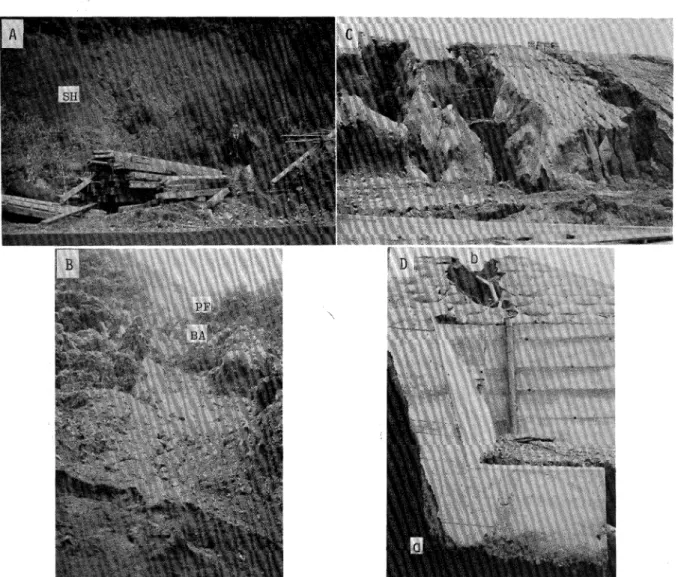
A in Fig. 9 shows, as an example, a place where three persons were killed owing to the landslide of the "Shirasu" pumice flow in the heavy rainstorms accompanied by No. 19 tyhoon in 1971. It was observed there that opened cracks of about 1 cm in width are developed nearly parallel to the extension of the road in front of the slope where the landslide took place, and that they attain downward throughout both the surface soil and
alternation of loam and pumice overlying the "Shirasu" pumice flow.
Landslides due to Natural Agencies in the Natural Environment
Comparing with the disturbed "Shirasu", represented by the filled "Shirasu" whose original welded texture is fractured due to an unnatural agency (Oba and others, 1980), the primary "Shirasu", i. e., the "Shirasu" pumice flow, naturally, has much larger physical stability on a reason that an original welded texture is present. However, the "Shirasu pumice flow is also liable to occur the landslide parallel to the vertical plane and form the vertical cliff. This comes from the following reasons.
When the "Shirasu" pumice flow was formed from "nuee ardente", shrinkage cracks
parallel to three dimensional planes roughly perpendicular to each other, i. e., joints, among which columnar joint is most common, developed in the process of its slow cooling. The typical columnar joint can be observed in the strongly welded "Shirasu pumice flow, 1. e., welded tuff, which is in general gradationally changed into the weakly welded tuff, i. e., the "Shirasu" pumice flow (Oba, 1973).
Both the "Shirasu" pumice flow and the welded tuff are liable to be splitted off parallel to their joint planes, particularly to dominant columnar joint plane. Accordingly, if the open-cut is done by natural agency or unnatural agency for them, it results that they are easily splitted off roughly parallel to the dominant vertical joint plane toward the open-cut face to which the internal stress in the natural ground is released. Thus, the slope of the "Shirasu" pumice flow is liable to fail parallel to the vertical plane and form the vertical cliff.
For landslides which were caused by natural agencies in the "Shirasu" pumice flow
● ●
regions where none of the development is accompanied, the following patterns will be pointed out.
1. Landslides of the 〃Shirasu" Pumice Flow due to Scouring
The slope or cliff in the "Shirasu" pumice flow regions geologically consist, in general, of the "Shirasu" pumice flow, the weathered "Shirasu" pumice flow, alternation of loam and pumice, and surface soil in ascendingorder in most cases, as shown in Fig. 1. The surface soil occupies the upper most of loam of the alternation in many cases. In the following explanations, therefore, the alternation will be treated as that which includes the surface soil in convenience.
●/.\ノ\●/.\・ LJ _ ■ ● _I-\ハハハsH ′\′\/\′ \ハ/\/\ ー 一丁 CRACKS
Fig. 1. Regression cycle by scouring on the slope of the "Shirasu" Pumice flow. When the slope of the "Shirasu" pumice flow (a) is scoured by water action at the foot,号eologic constituents, such as the weathered "Shirasu" pumice flow and alternation of loam and pumice and surface soil, of the upper portion of the slope become unstable (b), and cracks roughly parallel to the face of the slope in both the alternation of loam and pumice and the surface soil (c), thus it results to cause landslide (d). After that time, the slope recoveries again into an initial state (a). Abbreviations.-SH, "Shirasu" pumice flow ; WS, weathered "Shirasu" pumice flow ; LP, alternation of loam and pumice ; SS,
sur-face soil. In the following illustrations, the sursur-face soil is included in the alternation of loam and pumice in convenience.
foot, geologic constituents of the upper portion of the slope naturally become unstable (Fig. 1, b), and cracks roughly parallel to the face of slope, toward which the internal stress in the natural ground is released, occur in the alternation of loam and pumice (Fig. 1, c), thus it result to cause the landslide (Fig. 1, d). After the time when the landslide occurred, the face of slope recoveries again into an initial state (Fig. 1, a). In the natural environment, such a circulation is uninterruptedly and repeatedly continued. The present authors call it "regression cycle by scouring".
2. Landslides of the Alternation of Loam and Pumice followed by Flowing Away
of the Weathered HShirasu" Pumice Flow
When the weathered "Shirasu" pumice flow is encountered with water, it becomes soon
to flow away, and, as a result, the alternation of loam and pumice overlying the weathered "Shirasu" pumice flow, as Fig. 2 shows, becomes to form a roof-like overhanging cliff. The alternation of loam and pumice, accordingly, becomes physically very unstable and falls
●
CRACKS
Fig. 2. Landslide of the alternation of loam and pumice followed by flowing away of the weathered "Shirasu" pumice flow.
down along cracks developed within it.
3. Landslides of the Weathered "Shirasu" Pumice Flow followed by Falling Down
of the Alternation of Loam and Pumice
Surface soil and loam, those which are composed mainly of humic and clayey substances in general, usually overlay the weathered "Shirasu" pumice flow. They play a
role to keep from percolation of water into the weathered "Shirasu" pumice flow. When
they are eroded away and/or denudated away or fall down by water action, however, the weathered "Shirasu" pumice flow is immediately exposed in the air. Thus, when it is encountered with rain water, as Fig. 3 shows, it becomes easily to occur the collapse.
Fig. 3. Landslide of the weathered "Shirasu" pumice flow followed by falling down of the alternation of loam and pumice.
4. Landslides of Talus Deposit overlying the HShirasu" Pumice Flow
In the "Shirasu" pumice flow regions, talus deposit usually overlays the surface soil or loam on the slope. If the slope is scoured at its foot, as Fig. 4 shows, naturally, it becomes
RAIN WATER SS&LP
Fig.4. Landslide of talus deposit overlying the "Shirasu" pumice flow. When the slope is scoured at
the foot and rain water percolates downward through the talus deposit and stays over the imperme-able layer, it becomes to cause the landslide of the talus deposit. Abbreviations.-TD, talus deposit ; SS & LP, surface soil and alternation of loam and pumice.
physically unstable. When there has much rain, rain water percolates downward through
the talus deposit and stays over the clayey surface soil or loam, those which play a role of an impermeable layer, thus the talus deposit results to cause the failure accompanied with a sliding.
5. Landslides of a Mixture of Pumice, Sand and Mud accompanied by the Flush
Down Water
When a large amount of materials such as welded tuff and pumice fall deposit falls
down along the face of slope, a natural dam-like land form may happen to be formed by falling down・materials which are deposited at a peculiar place in a narrow valley or gully on the fore-slope. In such a case, if surface water or percolated water stay in a naturally formed dam and exceed some limit of capacity, the naturally formed dam is destroyed, and a mixture of block, sand, mud and water rushes down and is intermingled with talus deposits and other brittle sediments on the way, thus disaster may happen to cause.
B in Fig. 9 shows the cliff where seven persons were killed owing to the rush down of an avalanche of pumice, sand and mud accompanied by the flush down water in the heavy rainfalls on June 22, 1975.
Geologic constituents of the cliff are, as shown in a schematic model of geologic profile
RAIN WATER
Fig. 5. Schematic model showing geologic profile of the cliff, located at Ushine-fumoto, Tarumizu City, Kagoshima Prefecture, Japan, where the rush down of an avalanche of pumice, sand and mud accom-panied by the flush down water occurred in the heavy rainfalls on June 22, 1975. After Oba (1976). An overhanging lava flow of basaltic andesite (a-c), dipping downward the side of inland, played a role of a natural dam (a) for water which percolated through pumice fall deposit. The ava-lanche of pumice, sand and mud rushed down and captured the talus deposit composed mainly of pumice on the fore-foot of the cliff, and jumped over a national road (d) and attacked houses. Abbreviations.-WT, welded tuff ; BA, basaltic andesite ; SH, "Shirasu" pumice flow ; WS, weath-ered "Shirasu" pumice flow ; SS & LP, surface soil and alternation of loam and pumice ; PF, pumice fall deposit ; TD, talus deposit. Denotations.-a-b & a-c, overhanging basaltic andesite ; d, nation-alroad.
in Fig. 5, strongly welded "Shirasu" pumice flow, i. e., welded tuff, basaltic andesite, weakly welded "Shirasu" pumice flow, weathered "Shirasu" pumice flow, alternation of loam and pumice, surface soil, and pumice fall deposit in ascending order.
Rain water percolated downward through the pumice fall deposit. Percolated water flowed down alongthe plane of the clayey surface soil and loam, those which played a role of
●
an impermeable layer, and stayed within the pumice fall deposit on an overhanging plate-shaped lava flow of basaltic andesite (Fig. 5, a-c) which played a role of a natural dam. At that time when field investigation was done, it was obscure that the plate-shaped lava flow of basaltic andesite is wethere it dips upward (Fig. 5, a-b) or downward (Fig. 5, a-c) the side of inland. Later, it was ascertained by means of seismic prospectingto be the downward dipping which is liable to form a natural dam in this case.
●
Thus, a great amount of an avalanche composed mainly of pumice rushed down in
accompanying with the flush down water. At that time, talus deposit composed mainly of
● pumice on the fore-foot of the cliff was captured by the avalanche, and all of them jumped over a national road and attacked houses along the road.
Mechanism by which the avalanche of pumice accompanied by the flush down water
occurred, is explained as follows :
(a) there was the overhanging lava flow which played a role as a natural dam for water-reservoir on the steeply inclined slope
●
(b) there was the loose pumice fall deposit in an unconsolidated state on the steeply inclined slope at an angle of almost 370 in spite of 350 at the maximum angle of repose, and, accordingly, the pumice fall deposit had been an unstable condition that it is liable to fall down at any shock
(c) there were geologic constituents impermeable against percolated water beneath the pumice fall deposit ;
(d) vegitation on the slope had been not so good to be preserved; and, (e) there had the heavy rainfalls.
Such a disaster owing to the avalanche composed mainly of pumice in accompanying with the flush down water is significantly noted as a typical example showing that it was
●
● ●
caused by a composite condition of geologic and geomorphologic natures.
Landslides due to Unnatural Agencies accompanied by the Development
Since before and after 1961, the cityward concentration of population had increased and works of various developments in the "Shirasu" pumice flow regions surrounding urbanized areas have progressively been proceeded along with the progression of the economic development inJapan, while the disruption of the natural environment has become to be promoted acceleratedly. As a result, a large number of landslide disasters has become to occur frequently and successively at every heavy rain season in almost all places of the "Shirasu" pumice flow regions since before and after 1967.
were caused owing to natural agency such as the heavy rainstorm accompanied by tyhoom in a local place or unnatural agency related to such developments as represented by housing
● land construction, and this subject had been one of major problems in society. It is obvious
●
that landslide disasters were caused owing to an unnatural agency from such a fact that ●
they had increased in proportion to the progression of the regional development and an ●
increase of the developed area in space.
In the meantime, it is true that at that time there was the following easygoing way of ● ●
thinking about the development in the "Shirasu" pumice flow regions : that is, it is easy to cut off hills of the "Shirasu" pumice flow, and to transport the cut off-"Shirasu" materials into low grounds or valleys to fill ; and, in such a way, when flatted lands for housing are
● constructed, housing lands will become possible to serve at a low cost to people who wish to live in urbanized areas. It was also true that such a thinking had widely been believed among many people.
What it is easy to cutjust means what it is liable to collapse. Apparently, there was a
fundamental汀Iisunderstanding that man ignored characteristic features of the "Shirasu" pumice flow itself, and man treated the "Shirasu" pumice flow as the same as the common soil and sand in spite of quite difference in its essential nature.
C and D in Fig. 9 show the face of slope where the landslide occurred atthe time when there had the heavy rainfalls at a place where the housing land construction was moving in ● ●
the "Shirasu" pumice flow region in 1970. C in Fig. 9 shows gullies formed on the face of slope composed of the filled "Shirasu" and, in part, the weathered "Shirasu" pumice flow. D
†I
in Fig. 9 obviously shows that the reinforced concrete wall built on the filled "Shirasu" is easily destroyed even if it is physically so strong.
●
When disaster happened once, an enormous outlay will be required for the
●restoration. If characteristic features of the "Shirasu" pumice flow had fully been investigated in advance, and if the most appropriate design and construction on the basis of
●
their data for the disaster prevention had been applied at first, and, in such a way, if no any disaster occurred until the end, it would have finally resulted into the same thing as that great profits were provided. That is, it can be said that the disaster prevention is the most valuable and best way to be invested.
In the "Shirasu" pumice flow regions where various works of the construction are ●
carrying on, when the impervious loam and clayey surface soil by those which the weathered "Shirasu" pumice flow is protected from erosion and digging are denudated away, the weathered "Shirasu" pumice flow whose initial welded texture is disappeared due to weathering is immediately subjected to erosion, and, subsequently, collapses down by
● rain water.
As seen from the fact mentioned above, most of landslide disasters, which cause during
● the heavy rain season in the "Shirasu" pumice flow regions where various developments are in progress, occurred at the weathered "Shirasu" pumice flow after the time when the surface soil and loam were denudated away, as well as at the disturbed "Shirasu", or at the alternation of loam and pumice.Compared to the disturbed "Shirasu", the primary "Shirasu" pumice flow in a natural
state keeps much larger physical stability. What differences fundamentally are there
between the primary "Shirasu" pumice flow and the disturbed "Shirasu" and/or the weathered "Shirasu" pumice flow were discussed in the former paper (Oba and others, 1980).
For landslides caused by unnatural agencies accompanied by various developments in the "Shirasu" pumice flow regions, the following patterns will be pointed out.
II
1. Landslides of the Weathered "Shirasu" Pumice Flow followed by the
Denuda-tion of the Surface Soil and Loam
Both surface soil and loam are composed mainly of clayey substances, and play a role as an impermeable material for the protection of the weathered "Shirasu" pumice flow underbeneath them from erosion and digging by rain water or surfacial running water. As soon as surface soil or loam afiす/or both of them are denudated away by work of the construction, however, the weathered "Shirasu" pumice flow exposed in the air become loose and flows out right away. Accordingly, this corresponds to a case of the landslide caused by the natural agency in Fig. 3.
2. Landslides of the Weathered "Shirasu" Pumice Flow followed by the Open-Cut
of the Slope of the 〟Shirasu" Pumice Flow, and Subsequent Failure of the
Surface Soil and Loam
When the open-cut is done for the slope of the "Shirasu" pumice flow, as shown in I of
Fig.6. Landslide of the slope of the "Shirasu" pumice flow at place where the development is moving
M
and the mutual relationships among the "Shirasu" pumice flow, the weathered "Shirasu'pumice flow and the alternation of loam and pumice.
I. When the open-cut is done for the natural ground of the slope, the weathered "Shirasu" pumice flow
is exposed in the air. When it is encountered with rain water, gullies are formed, and,
subsequent-ly, it is followed by the failure.
Ji. The internal stress in the natural ground is going to release toward the open-cut face. Thus, it is released in a form that cracks roughly parallel to the open・cut face occur. The open-cut face of the slope where the construction is in progress is always affected by mechanical vibration due to work-ing of busy heavy trucks and civil engineerwork-ing machines. Thus, openwork-ing up, widenwork-ing and exten-sion of cracks are promoted.
ID. When the undercutting is done at the foot of the slope, the weathered "Shirasu" pumice flow is
turned into an unstable hanging state, thus it is liable to occur the falling down in the rain time or
●
Fig. 6, the weathered "Shirasu" pumice flow is immediately exposed in the air, thus gullies are formed right away over the whole surface of the slope and the weathered "Shirasu" pumice flow becomes to cause flowing away, and, subsequently, it follows that the alternation of loam and pumice falls down. This corresponds to a case of the landslide caused by the natural agency in Fig. 2.
●
3. Landslides of the Weathered "Shirasu" Pumice flow due to the Defective
Handling for the Drainage and Prevention of Water
As a result that the alternation of loam and pumice is denudated away in the "Shirasu" pumice flow regions where the development such as civil construction is moving, usually and actually workers encounter with the weathered "Shirasu" pumice flow or the disturbed "Shirasu".
In such a case, accordingly, the perfect and effective handling must be done for the drainage set up within the weathered "Shirasu" pumice flow or the disturbed "Shirasu" and for the prevention of water throughout over the whole of their surfaces. If the handling for them is imperfect and defective, as C in Fig. 9 shows, the weathered "Shirasu" pumice flow or the disturbed "Shirasu" will easily be percolated by water and turned into a mobile fluid, thus the rush down will be taken place. Atthattime, channels or pipes for the drainage will
●
likely be filled by accompanying pumices of various sizes, thus urban areas surrounding ●
places where the development is in progress will be suffered by comming down of overflow ●
water accompanied with a great amount of pumice. Work of the civil construction in a large
scale, therefore, should be avoided as much as possible during the period of rainy season in
I .I + I A I
the ``Shirasu" pumice flow regions.
4. Landslides of the Disturbed "Shirasu" due to the Defective Handling for the
Drainage and Prevention of Water
Physically pressed block of the disturbed "Shirasu" as represented by the filled "Shirasu" whose original welded texture is fractured becomes loose right away by percolation of water (Oba, 1976b). Basins for sedimentation and retarding, therefore, should not be set up within the disturbed "Shirasu", but within the natural ground of the primary "Shirasu" pumice flow. D in Fig. 9 shows an example showing that a portion where a conduit is set up within the filled "Shirasu" allowed to be a way for running water on a place where work of the housing land development was in progress.
Whennever the drainageway is set up in the "Shirasu" pumice flow, handling for the
†Iprevention of water should perfectly and carefully be done soon after the time when the drainageway was set up not only in the disturbed "Shirasu", but also in the "Shirasu" pumice flow in order to be avoided from a much greater disaster which may happen later.
5. Landslides of a Mixture of Pumice, Sand and Silt due to the Disturbed
"Shirasu" Which is le氏at Places Where the Construction is in progress
of various works of the civil construction those of which are in progress. It is very dangerous, however, that the disturbed "Shirasu" is left as it is owing to its own
characteristic features, particularly, in the rainy season. When handling for the disturbed
●"Shirasu" is done in an unappropriate way, the rush down of a mixture of pumice, sand and silt will become soon to occur at the heavy rainfall. Therefore, the disturbed "Shirasu" should carefully be treated so that the safety is guaranteed after the construction, and the
●
remaining disturbed "Shirasu" should be transported to a dumping ground officially autholized.
6. Landslides ofa Mixture of Block, Sand and Mud due to the Flush Down Water
When blocks, cobbles and others such as sand, mud and timbers, all of those which are
derived during work of the development, are deposited and accumulated in a narrow place on the slope or valley, a dam-shaped site may happen be formed there. In such a case, when water stays in the dam-shaped site, and an amount of stayed water exceeds some limit of capacity, the flush down of a mixture of block and others accompanied with a great amount of water may happen suddenly be caused. It is neccessary, therefore, to make effort so that a dam-shaped site is not formed on such a specified slope or valley, particularly, in the rainy
●
season.
7. Landslides of the "Shirasu" Pumice Flow due to the Undercutting
(1) Landslides of the "Shirasu" pumice flow due to the undercutting accompanied by the construction
When the undercutting is done at the toe of the slope of the "Shirasu" pumice flow
during works of various constructions, as shown in III of Fig. 6, the weathered "Shirasu"
RA川WATER
Fig.7. Landslide of the "Shirasu" pumice flow due to geological structure. When percolated water
stays on the boundary plane between the "Shirasu" pumice flow and the underlying geologic consti-tuents which play a role of an impermeable layer, and when the boundary plane is inclined down-ward the open-cut face, the whole of the overlying "Shirasu" pumice flow, weathered "Shirasu" pumice flow and alternation of loam and pumice may happen very often to cause the landslide. Denotations.-a, hard rocks ; b, clayey and weathered portion of hard rocks ; c, spring which
●
pumice flow overlying the "Shirasu" pumice flow is turned into an unstable hanging state, and naturally, becomes unstable mechanically, thus it is liable suddenly to occur the failure in the rain time or just after the rainfall.
●
The undercutting is severely prohibitted on the Labor Standard Law. Neverthless, if the undercutting is needed to be done in an unavoidable reason, a supervisor skilful in this
●
kind of work should be prepared.
(2) Landslides of the "Shirasu" pumice flow due to undercutting by farmers
In South Kyushu,Japan, the undercutting is frequently done by farmers on the slope of the "Shirasu" pumice flow to use the collected "Shirasu" materials for spreading over house gardens in a transitional custum or for mixing to improve air-permeability in farm clayey
● ●
soil. The undercutting is sometimes so dangerous that farmers should not do it or they should seak for much safety place to do it.
8. Landslides of the 〟Shirasu" Pumice Flow due to Geological Structure
When layers or rocks, such as sedimentary rocks, igneous rocks and welded tuff, he
●beneath the "Shirasu" pumice flow and clayey substances exist on their weathered portions, and if percolated water is liable to stay on the boundary plane between the "Shirasu" pumice flow and the underlying geologic constituents and the boundary plane is inclined downward the open-cut face of the slope, as Fig. 7 shows, the whole of the "Shirasu" pumice flow and the alternation of loam and pumice may happen very often to cause the failure accompanied with a sliding on the reason that the boundary plane itself plays a role of a sliding plane.
9. Landslides of the 〃Shirasu" Pumice Flow due to Opening Up of Cracks, parallel
to the Open-Cut Face of the Slope, developed by Mechanical Vibration during
the Construction in a Broad Sense
●
As soon as the open-cut is done for the natural ground and a steeply inclined open-cut face is formed, as I and II in Fig. 6 show, the internal stress in the natural ground is goingto release toward the open-cut face, and, as a result, it is released in a form that cracks roughly parallel to the open-cut face occur. The open-cut face of the slope where the civil construction is moving is always affected by mechanical vibration due to working of busy
● ●
heavy trucks and civil engineering machines. In such a case, opening up, widening and extension of cracks which occur within the geologic constituents of the slope are promoted, and sometimes the cracks attain not only into the weathered "Shirasu" pumice flow but also
into the "Shirasu" pumice flow throughout the alternation of loam and pumice. When rain
water percolates down into the weathered "Shirasu" pumice flow through the cracks, the weathered "Shirasu" pumice flow is pushed out and fails down in part, and, subsequently, it is much more widely exposed in the air, thus it becomes to cause the landslide accerelatedly in a large scale.
It is significantly noted that there is a close relation between an influence of mechanical ●
vibration by which the slope of the "Shirasu" pumice flow is suffered and the disaster owing to the landslide.
10. Landslides of Talus Deposit due to the Open・Cut of the Slope of the HShirasu'
Pumice Flow
●
When the open-cut is done for the slope where talus deposit overlays the other geologic
constituents, and when rain water percolates downward through the talus deposit and stays over the clayey substances, as Fig. 8 shows, the failure accompanied with a sliding is liable
to cause.
Out-Door Test for Three Models of the "Shirasu" Pumice Flow
in Different Conditions against Artificially Prepared Shower
A and B in Fig. 10 show three models set up for an out-door test which was carried out
in 1977 at a place where housing land development was moving in Kagoshima City for
comparison of the stability on the "Shirasu" pumice flow with a cement mortar-coating for
illthe protection over the crown of the face of slope close to a nearly vertical cut, model I on the left handed side in A and the foreground in B ; the "Shirasu" pumice flow without a coating on the crown with a V-shaped side-ditch of the face of slope, with the undercutting at the toe, close to a nearly vertical cut, model II on the center ; and physically compacted filled "Shirasu" without a coating on the crown of the face of slope with a gradient of 55 model HI on the right handed side in A and the backside in B, against artificially prepared
●
shower about 200 mm/m for a half hour, corresponding to several times of the heavy rainfall. The out-door test was done with the cooperation of Kagoshima City Government,
the Corporation for Development Works and Fire Department of the City.
C in Fig. 10 shows the startofthe out-door test. For the face of slope of the model II, falling down occurred at a portion nearby the undercutting at the toe of the slope before the start of the test. Several minutes later, as D in Fig. 10 shows, gullies were formed immediately on the face of slope of the model III.
About a half hour later, as E in Fig. 10 shows, many largely digged gullies were formed over the whole face of slope of the model III and it was followed by flowing away of the
●
RAIN WATER
Fig.8. Landslide of talus deposit at place where the development is moving. When open-cut is done
for the slope where talus deposit overlays the other geologic constituents (a), and when percolated water through the talus deposit stays over the clayey substances, the failure accompanied with a sliding is liable to occur (b).
"Shirasu" materials in a state of mobile fluid. For the model II, a one largely digged gully and a few gullies were formed along the pipe-like structure, which was named in
●
convenience by the present authors for "fossil fumarolic pipe" (Yokoyama, 1970) which was formed at the time when initially the "Shirasu" pumice flow deposited as "nuee ardente", that which exist within the "Shirasu" pumice flow on the face of slope, and it was followed by falling down of the "Shirasu" pumice flow in a much larger scale at the upper portion of the undercutting. In contrast with the model III, no any erosion and digging occurred on either the face of slope and the top in the model I.
●
As a result of the out-door test, the following facts were ascertained :
●(1) the disturbed "Shirasu" represented by the filled "Shirasu" whose original welded texture is fractured is significantly weak in its stability for the moving water, and,
●
accordingly, the slope protection for the prevention of water is required ; ●
(2) in contrast, the "Shirasu" pumice flow with a coating for the protection over the ■
crown of the face of slope with a nearly vertical cut does not easily collapse in order to the presence of its own original welded texture ;
●
(3) the undercutting at the toe of the face of slope of the "Shirasu" pumice flow is liable to cause the vertical collapse due to the dominant columnar joint plane which is
● present essentially in the "Shirasu" pumice flow itself ; and,
(4) the presence of the pipe-like structure within the "Shirasu" pumice flow was noted throughout the out-door test on the reason that the pipe-like structure is liable to make a
●
way for the moving water, and, accordingly, it is liable to cause the collapse of the face of slope.
Summary
Mechanisms by which the landslide was caused in the "Shirasu" pumice flow regions
are roughly grouped into the following three : (1) the progressive change of the natural environment accompanied by the qualitative and structural changes of the social basement, as seen in the spreading of the development represented by the land construction even in the secluded areas during the progression of the economic development ; (2) natural agencies in the natural environment, as seen in the landslides due to columnar joint originated from shrinkage crack, scouring by water action at the toe of slope, weakness of stability of the
●
weathered "Shirasu" pumice flow for moving water, peculiar combined geologic and geomorphologic natures and others in places where none of the development is accompanied and (3) unnatural agencies accompanied by the development, as seen in the landslides of the disturbed "Shirasu" and the weathered "Shirasu" pumice flow due to the denudation of the surface soil and loam, the defective handling for the drainage and prevention of water, undercutting, peculiar geologic structure, cracks developed during mechanical vibration
■
and others in places where the development is in progress.
An out-door test was carried out for three models set up in different conditions against artificially preparedーshower. As a result, the following facts were ascertained : the filled "Shirasu" is significantly weak in its stability for the moving water ; but, in contrast, the
"Shirasu" pumice flow with a coating for the protection on the crown of slope with a vertical cut does not easily collapse ; the undercutting at the toe of slope is liable to cause the vertical collapse ; and the pipe-like structure, if present, is liable to cause the landslide.
●
Acknowledgements
The authors wish to express their appreciation to the following persons and
●
organizations for their cooperation, support and encouragements those which have been given to the authors during the processes of field and laboratory works regarding the
●
disaster prevention and industrial utilization since the time when they got down to the
subject of the "Shirasu" pumice flow : the late Dr. T. Fukuda, the former President of
Kagoshima University, Dr. S. Nakamura, the former President of Kagoshima University and
the present President of Kagoshima Women s University, the late Dr. D. Kimura and Dr. M.
Ueda, Kagoshima University ; Mr. Y. Machida, Mr. H. Yamazaki, Mr. K. Nishimura, Mr. K.
Kawabe, Mr. T. Shiota and Mr. Y. Matsumoto, the Minami-nihon ; Mr. H. Saito and Mr. M.
Yamauchi, the Asahi ; Mr. T. Sawada, Mr. T. Abiru and Mr. K. Suyama, the Yomiuri ; Mr. I.
Kobayashi, Mr. K. Mochimaru, Mr. T. Nishuima, Mr. K. Yoshida, Mr. Y. Hattori, Mr. Y.
Nishimura, Mr. S. Hasegawa, Mr. F. Mizoguchi, Mr. A. Takamine and Mr. I. Nagatsuji, the
Japan Broadcasting Corporation (NHK) ; Mr. H. Hidaka, Deputy Mayor, Mr. Y. Kiyokawa and
Mr. T. Iwamoto, the former staffs, and Mr. A. Maruno, Kagoshima City Government ; the
Housing Corporation of Kagoshima Prefecture and the Corporation for Development Works
; the late Mr. K. Yamada, Kagoshima Prefectural Government ; Mr. T. Hirose, the former staff
of the Japan Railway Corporation, Shimonoseki Branch ; Mr. T. Miyashita and Mr. I.
Nakamichi, Kiso-jiban Consultants Co ; and Mr. K. Inoue, Hiroshima University. One of the
authors gratefully acknowledges for the Minami-nihon Braodcasting Corporation (MBC), for
the Eighth MBC Award which was granted in 1975 for "Research on nature of the "Shirasu"
and its application to the disaster prevention and industrial utilization". Many thanks are
also given to both the Technical Commi比ee for Disaster Prevention on the "Shirasu" and the
Conference for Development of Resources, organized by Kagoshima Prefectural
Govern-merit.
References
Oba, N. (1972) : Geological study on disasters owing to No. 19 and No. 23 tyhoons in 1971 in the Shirasu regions. In "Researches on regional features of disasters in WestJapan" by the Grant in Aid for Specified Scientific Researches in the 1971 fiscal year of the Ministry of Education oHapan, p. 63
(in Japanese).
Oba, N. (1973) : Microstructure and physicochemical features of the "Shirasu". Civil Construction Engineering (Seko-gijutsu), vol. 6, p. 67-72 (in Japanese).
Oba, N. (1976a) : Mechanisms of the landslides due to rainwater ; with reference to the Shirasu regions, South Kyushu, Japan. Civil Construction Engineering (Sek0-gijutsu), vol. 9, p. 82-89 (in Japanese).
Oba, N. (1976b) : Shirasu (2). Jour. Res. Assoc. Powder Technology, Japan, vol. 13, p. 387-395 (in
Japanese).
Oba, N.t Tomita, K., and Yamamoto, M. (1980) : Physicochemical features of the "Shirasu" pumice flow deposits, and its related landslides in South Kyushu, Japan. Proceed. Intern'l Symposium on
Landslides, New Dehli, India, 1980, vol. 1, p. 13-18.
Oba, N., Tomita, K., Yamamoto, Mm Istidjab, M., Badruddin, M., Sudradjat, A., and Suhanda, T. (1983) : Geochemical comparison of volcanic products of Krakatau Group and Aira caldera-Sakurajima Volcano. Paper presented at Symposium on lOOth Year Development of Krakatau and its Surroundings, August 23-27, 1983, Jakarta, Indonesia, Up., with figures.
Oba, N., Tomita, K., Yamamoto, M., Istidjab, M., Sudradjat, A., and Suhanda, T. (1984) : Geologic significance of granitic fragments found from pumice flow of 1883 eruption at the Krakatau Group, Indonesia. Abstracts of Papers presented at Fifth Congress on Geology, Mineral and Energy Resources of Southeast Asia (GEOSEA V), April 8-13, 1984, Kuala Lumpur, Malaysia, p. 24. oba, N., Tsuyuki, T., and Ebihara, H. (1967) : Mineral and chemical compositions, and genesis of the Shirasu
(I). Jour. Japanese Assoc. Mineralogists, Petrologists and Economic Geologists, vol. 58, p. 81-97 in Japanese with English abstract).
Oba, Nm Yamamoto, M., Tomita, K., and Inoue, K. (1980) : Physicochemical features of the "Shirasu" and stability of the filled Shirasu and the weathered Shirasu. Rep. Fac. Sci., Kagoshima Univ., no. 13, p.1-9.
Oba, N., Yamashita, H., and Yamamoto, M. (1972) : Mineral and chemical compositions of the Secondary Shirasu. Jour. Japanese Assoc. Mineralogists, Petrologists and Economic Geologists, vol. 67, p. 84-89 (in Japanese with English abstract).
Yokoyama, S. (1970) : Geomorphology of the Ito pyroclastic flow desposit to the north of the Aira caldera. Geographical Review of Japan, vol. 43, p. 464-482 (in Japanese with English abstract).
Fig. 9. Various patterns of the landslides in the "Shirasu" pumice flow regions.
A. An example of the landslides due to the progressive change of the natural environment accompanied by the qualitative and structural changes of the social basement. Three persons were killed here owing to the landslide of the "Shirasu" pumice flow (SH) in the heavy rainstorms accompanied by No. 19 tyhoon in August 1971. Kihoku-cho, Kimotsuki-gun, Kagoshima Prefecture, Japan. Photo taken by N. Oba.
B. An example of the landslides due to natural agencies in the natural environment. Photo shows the steeply inclined cliff where seven persons were killed owing to the rush down of an avalanche of pumice, sand and mud accompanied by the flush down water in the heavy rainfalls on June 22,
1975. An overhanging portion on the upper side shows a plate-shaped lava flow of basaltic ande-site (BA) (see a-c in Fig. 5) which played a role of a natural dam for water which percolated through pumice fall deposit (PF). Ushine-fumoto, Tarumizu City, Kagoshima Prefecture, Japan Photo taken by N. Oba onJune 25, 1975.
C. An example of the landslides due to unnatural agencies accompanied by the development. Photo shows the face of slope where the landslide occurred at the time when there had the heavy rainfalls at a place where the housing land construction was moving in the "Shirasu" pumice flow region. Many largely digged gullies were formed on the face of slope composed of the filled "Shirasu" and, in part, the weathered "Shirasu" pumice flow. Photo taken by N. Oba on April 14, 1970 at Harara Housing Land in construction, Kagoshima City, Japan.
D. The reinforced concrete wall built on the filled "Shirasu" is easily destroyed even if it is physically so strong. Note the facts that the filled "Shirasu" of the foundation where the reinforced concrete wall is based was perfectly flowed away (a), and that a portion where a conduit is set up within the filled "Shirasu" (b) allowed to be a way for running water owing to the defective handling for the prevention of water. Photo taken at the same place as C.
Fig. 10. Out-door test for three models of the "Shirasu" pumice flow in different conditions against artト ficially prepared shower about 200 mm/m for a half hour.
A & B. Models set up for the out-door test for comparison of the stability on the "Shirasu" pumice flow with a cement mortar-coating of 5-7 cm in thickness over the crown of the face of slope 5 m long by 2 m wide close to a nearly vertical cut, model I on the left handed side in A and the foreground in B ; the "Shirasu" pumice flow without a coating on the crown, with a V-shaped side-ditch of 30 cm in width and 20 cm in depth parallel to the extension of the top, of the face of slope 5 m long by 2 m wide, with the undercutting at the toe, close to a nearly vertical cut, model II on the center ; and physically compacted filled "Shirasu" without a coating on the crown of the face of slope 7 m long by 2 m wide with a gradient of 550 model III on the right handed side in A and backside in B. C. Start of the out-door test. Falling down occurred at a portion nearby the undercutting of the model
II before the start of the test.
E. About a half hour later, many largely digged gullies were formed over the whole face of slope and it was followed by flowing away of the "Shirasu" materials in the model III. A one largely digged guト Iy and a few gullies were formed along the pipe-like structure within the "Shirasu" pumice flow on the face of slope, and it was followed by a much larger scale of falling down of the "Shirasu
● ●
pumice flow at the upper portion of the undercutting in the model II. No erosion and digging occur-red on either the face of slope and the top in the model I.