A NOTE ON AN OVERDETERMINED PROBLEM WITH
NON-CONSTANT NEUMANN BOUNDARY CONDITION
CHIARABIANCHINI, PAOLO SALANI
ABSTRACT. Wereview someresultsabout avariant of the Saint-Venant problem and
about a related overdetermined problem. The latter is a generalization of the Serrin
problem where the overdetermination reads $\nabla u(x)=g(x)$ on the boundary of the
unknowndomain,and$g$:$\mathbb{R}^{N}arrow[0, \infty)$ isagivenfunction. Weanalyzesomegeometric
properties ofthe solution $\Omega$ in relation with
$g$ and weprove some new results about
the continuity of$\Omega$ with respect
to $g$, assuming$g$ is an homogeneousfunction.
1. INTRODUCTION
An overdetermined problem usually consists in a Dirichlet problem given in an un-known domain, whose solution satisfies some extra condition (classically a Neumann
boundary condition) which determines univocally the shape ofthe domain itself. Then
the solution of the problem is given by a couple domain-function, where the former is
the real object of research. The most famous overdetermined problem is probably the
following:
(1) $\{\begin{array}{ll}-\triangle u=1 in \Omega,u=0 on \partial\Omega,|\nabla u|=c on \partial\Omega,\end{array}$
where $c>0$ is a given constant. In a famous paper Serrin [28] proved that, under
suitable regularity assumptions, if a solution to this problem exists, then $\Omega$ must be a
ball $B(O, R)$ and $u(x)=(R^{2}-|x|^{2})/(2n)$. After Serrin, a large amount of literature
has beenproduced about variants of (1), often dealing with similar problems where the
Laplacian is substituted bysomeother operator $and,Jhe$ overdetermination writes again
as $u=0$ and $|\nabla u|=$ constant on $\partial\Omega$; but also other kinds of
overdetermined conditions have been considered in hterature, see for instance [4, 6, 14, 15, 17, 20, 27, 29, 30] and references therein. Moreover, related stability issues have been investigated, see for
instance [3, 8, 16].
Here we consider the following generalization of (1): given a function $g$ : $\mathbb{R}^{N}arrow$
$[0, +\infty)$, positive outside the origin, we investigate the problem
More precisely: for any bounded open set $\Omega$, we denote by
$u\Omega$ the stress
function
of $\Omega,$that is the solution ofthe torsion problem:
(3) $\{\begin{array}{ll}-\triangle u\Omega=1 in \Omega u\Omega=0 on \partial\Omega,\end{array}$
or its weakform
(4) $u\Omega\in H_{0}^{1}(\Omega)$ : $\int_{\Omega}\nabla u\Omega\nabla v=\int_{\Omega}u\Omega v$ $\forall v\in H_{0}^{1}(\Omega)$
.
Then we askwhether a domain $\Omega$ exists such that the solution of (3) satisfies
(5) $|\nabla u\Omega(x)|=g(x) x\in\partial\Omega,$
and we investigate some geometric properties of$\Omega$ in connection with the properties of
the assigned function $g.$
Letusquotethatthe
same
overdeterminedconditions (5) have been alreadyconsideredfor differential problems of the torsion and of the Bernoulli types in [1, 2, 5, 19, 22].
Theoverdetermined problem (2) is naturally linked totheshape optimization problem we describe here below. Let $J$ be the functional defined
as
theopposite of the torsionalrigidity:
(6) $J( \Omega)=\frac{1}{2}\int_{\Omega}|\nabla u_{\Omega}|^{2}dx-\int_{\Omega}u\Omega dx=-\frac{1}{2}\int_{\Omega}u\Omega dx=-\frac{1}{2}\int_{\Omega}|\nabla u\Omega|^{2}dx.$
and let
(7) $\phi(\Omega):=\int_{\Omega}g^{2}(x)dx.$
The shape optimization problem consistsin minimizing $J$ with the constraint $\phi(\Omega)\leq 1,$
i.e.
(8) lnin$\{J(\Omega):\phi(\Omega)\leq 1\}.$
Notice that (8) is a variant of the famous Saint-Venant problem. This consists in
looking for the domainwith given areawhich has maximal torsionalrigidity; the answer
is the ball,
as
proved by G. Poly\‘a [25]. Here we consider the same problemin the classof non-uniformly dense sets, whose density is driven by the function$g.$
We also recall that problem (8) is close to the one considered by B. Gustafsson and
H. Shahgholian in [19]. Indeed they study the partial differential equation $-\triangle u=f,$
where $f$ is a function (or a measure) whose positive part $(f)^{+}= \max\{0, f\}$ has compact
support, which is not our case.
In [7], the authors proved that problem (11) admits a solution (in the class of quasi-open sets) under the assumptions
(9) $g(x)>0$ for $x\neq 0,$ $\lim$ $g(x)=+\infty.$ $|x|arrow+\infty$
On the other hand, the simple existence of a solution to the shape optimization
problem (8) does notguaranteetheexistenceofa solutionof theoverdeterminedproblem
(2). To encounter this problem, in [7] the following assumption on $g$ is considered:
(10) $\{\begin{array}{l}g :\mathbb{R}^{N}arrow \mathbb{R} positively homogeneous of degree \alpha(i.e.g(tx)=t^{\alpha}g(x)\forall t>0, \forall x\in \mathbb{R}^{N}) ,g H\"{o} lder continuous, g>0 outside 0.\end{array}$
Thanks to (10), it is possible to find a solution $\Omega$ to problem (2) and to prove a series
ofproperties ofsuch asolution.
In Section 2 we recallsome basic properties and results about the shape optimization problem (8) and its connection with the overdetermined problem (2). In Section 3 we
review some basic properties of the solution of (2) and its geometric properties, like
starshape, convexity, Steiner symmetry. In Section 4 we give
some
new results about the continuity of $\Omega$ with respect to9. Notice that most of the results recalled in this
paper are taken from [7]. Precisely only Lemma 4.2, Corollary 4.3) and Theorem 4.4
contain original results, while Theorem 3.2 is aslight improvement of the corresponding
result of [7].
2. THE SHAPE OPTIMIZATION PROBLEM
Letus consider theenergy functional$J$defined in (6). It is easilyseenby the maximum
principle that $J$ is decreasing with respect to set inclusion, that is
$J(\Omega_{1})\geq J(\Omega_{2})$ if $\Omega_{1}\subset\Omega_{2}.$
Problem (8) consists in minimizing $J(\Omega)$ among open sets satisfying
(11) $\phi(\Omega)=\int_{\Omega}g^{2}dx\leq 1.$
Notice that the
measure
ofa set $\Omega$ satisfying (11) must be boundedif$g(x)arrow+\infty$ as
$|x|arrow\infty$
.
Thanks to this, it is possible to prove the following.Theorem 2.1. Underassumption (9), there exists a quasi-open set $\Omega$ solving the shape
optimizationproblem (8).
The proof in [7] follows the lines of [18] (see also [21]) and uses a
concentration-compactness argument as in [11] to prove the existence of a minimizer which is
quasi-open and may be unbounded. We refer to [21] for a precise definition and discussion of
the concept of quasi-open sets; here wejust say that, roughly speaking, quay-open sets
are super level sets offunctions in $H^{1}(\mathbb{R}^{N})$.
Apart from theproofof existence, in the restof the paper [7] thefunction$g$is assumed
to be homogeneous, precisely tosatisfy assumption (10). This makes problem (8) easier
and with a nice behavior with respect to homotheties. More precisely, for every $t>0,$
$\Omega\subset \mathbb{R}^{N}$, it holds
$J(t \Omega) = -\frac{1}{2}\int_{t\Omega}t^{2}u_{\Omega}(x/t)dx=t^{2+N}J(\Omega)$,
where the first equality follows from the fact that the stress function of$t\Omega$ is
(12) $u_{t\Omega}(x)=t^{2}u\Omega(x/t)$
.
Then using the notion of local shape subsolution introduced in [12], it is proved that the minimizer is in fact bounded and it is possible to obtain its regularity as in [9]
(see also [10]). The main difficulty is to prove that the solution $\Omega$ is actually an open
set. Once proved this, one can get higher regularity by classical techmiques from free
boundary problems like in [5] and [19].
Theorem 2.2. Under assumption (10) the shape optimization problem (8) admits a
solution$\Omega$.
If
$\alpha\neq 1,$ $\Omega$ is connected. Moreover, in dimension$N=2$ the solutionis $C^{1,\beta}$for
some
$\beta>0$; in dimension $N\geq 3$, the reduced boundary $\partial_{red}\Omega$ is $C^{1,\beta}$ and$\partial\Omega\backslash \partial_{red}\Omega$has
zero
$(N-1)$-Hausdorff
measure$\cdot.$Thanks
to (12) the existence ofa
solution to the overdetermined problem (2) followsby choosing a suitable dilation of
a
solution of (8).Corollary 2.3. Let $g$ satisfy (10)
for
some $\alpha>0,$ $\alpha\neq 1$. Then there exists a solutionto the overdetemined Free Boundary Problem (2).
Remark 2.4. Notice that the case $\alpha=1$ is special, as it can be seen by considering the
mdially symmetric situation, where it is possible to have either no solution oran
infinite
number
of
solutions.3. THE OVERDETERMINED PROBLEM AND THE GEOMETRY OF $\Omega$ Under assumption (10) with
$\alpha>1$
several geometric properties of the solutions of the overdetermined problem (2) are
proved in [7]. The first one is the fact that the origin $O$ must be inside the domain.
This property may look rather technical, but it is fundamental to obtain many other
properties ofthe solution.
Proposition 3.1. Assume that $g$
satisfied
(10) with $\alpha>1$.
Let $\Omega$ be a solutionof
theminimization problem (8). Then the $ori$gin $O$ is inside $\Omega.$
Then the monotonicity of $\Omega$ with respect to
$g$ is proved. Here we present a shght
improvement ofthe corresponding result in [7].
Theorem 3.2. Let $\Omega_{1},$$\Omega_{2}$ be (regular enough) bounded solutions to Problem (2) related
to$g_{1}$ and92, respectively, with $O\in\Omega_{i}$
for
$i=1,2$.
Assume thatfor
some $\alpha>1$ at leastone between the following two assumptions hold.$\cdot$
(13) $g_{1}(tx)\geq t^{\alpha}g_{1}(x)$
for
$t>0,$ $x\in \mathbb{R}^{N},$ $or$(14) $g_{2}(tx)\leq t^{\alpha}g_{2}(x)$
for
$t>0,$ $x\in \mathbb{R}^{N},$Proof.
The proof is very similar to the proof of [7, Theorem 3.2], but we give it for completeness.Assume that (13) holds and
assume
by contradiction $\Omega_{1}\not\subset\Omega_{2}$. Then$t= \sup\{s>0:s\Omega_{1}\subseteq\Omega_{2}\}<1.$
Furthermore $t>0$ for $O\in\Omega_{2}$ and $\Omega_{1}$ is bounded.
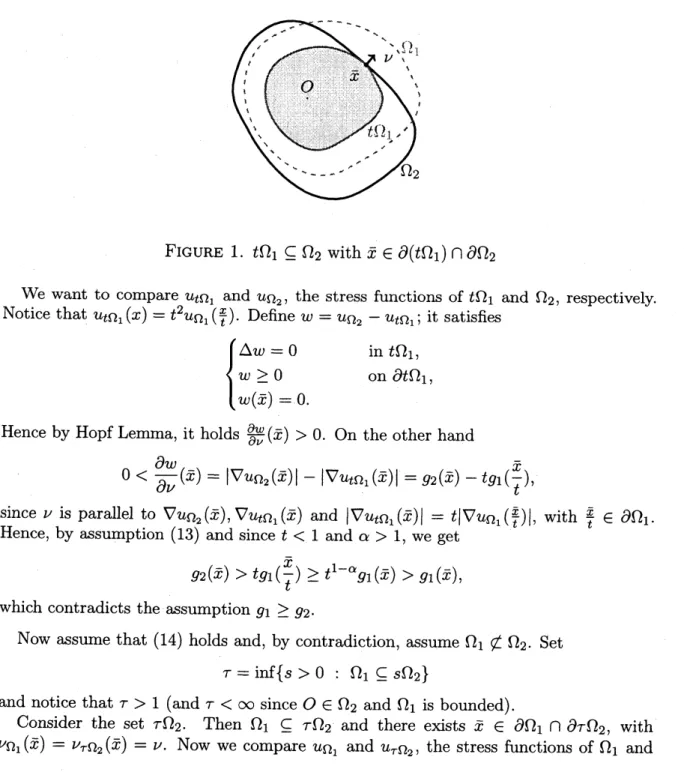
Consider the set $t\Omega_{1}:t\Omega_{1}\subseteq\Omega_{2}$; there exists $\overline{x}\in\partial(t\Omega_{1})\cap\partial\Omega_{2}$, with $\nu_{t\Omega_{1}}(\overline{x})=$
$\nu\Omega_{2}(\overline{x})=\nu$, where $\nu_{\Omega}(x)$ denotes the outer unit normal to $\partial\Omega$ at
$x.$
FIGURE 1. $t\Omega_{1}\subseteq\Omega_{2}$ with $\overline{x}\in\partial(t\Omega_{1})\cap\partial\Omega_{2}$
We want to compare $u_{t\Omega_{1}}$ and $u\Omega_{2}$, the stress functions of $t\Omega_{1}$ and $\Omega_{2}$, respectively.
Notice that $u_{t\Omega_{1}}(x)=t^{2}u \Omega_{1}(\frac{x}{t})$. Define
$w=u\Omega_{2}-u_{t\Omega_{1}}$; it satisfies
$\{\begin{array}{ll}\triangle w=0 in t\Omega_{1},w\geq 0 on \partial t\Omega_{1},w(\overline{x})=0.\end{array}$
Hence by HopfLemma, it holds $\frac{\partial w}{\partial\nu}(\overline{x})>0$
.
On the other hand$0< \frac{\partial w}{\partial\nu}(\overline{x})=|\nabla u\Omega_{2}(\overline{x})|-|\nabla u_{t\Omega_{1}}(\overline{x})|=g_{2}(\overline{x})-tg_{1}(\frac{\overline{x}}{t})$,
since $\nu$ is parallel to $\nabla u\Omega_{2}(\overline{x}),$ $\nabla u_{t\Omega_{1}}(\overline{x})$ and $| \nabla u_{t\Omega_{1}}(\overline{x})|=t|\nabla u_{\Omega_{1}}(\frac{\overline{x}}{t})|$, with $\frac{\overline{x}}{t}\in\partial\Omega_{1}.$
Hence, by assumption (13) and since $t<1$ and $\alpha>1$, we get
$g_{2}( \overline{x})>tg_{1}(\frac{\overline{x}}{t})\geq t^{1-\alpha}g_{1}(\overline{x})>g_{1}(\overline{x})$,
which contradicts the assumption $g_{1}\geq 92.$
Now
assume
that (14) holds and, by contradiction, assume $\Omega_{1}\not\subset\Omega_{2}$.
Set$\tau=\inf\{s>0:\Omega_{1}\subseteq \mathcal{S}\Omega_{2}\}$
and notice that $\tau>1$ (and $\tau<\infty$ since $O\in\Omega_{2}$ and $\Omega_{1}$ is bounded).
Consider the set $\tau\Omega_{2}$. Then $\Omega_{1}\subseteq\tau\Omega_{2}$ and there exists $\overline{x}\in\partial\Omega_{1}\cap\partial\tau\Omega_{2}$, with
$\nu_{\Omega_{1}}(\overline{x})=\nu_{\tau\Omega_{2}}(\overline{x})=\nu$
.
Now we compareCHIARA PAOLO SALANI $\tau\Omega_{2}$ respectively, and
we
set$w=u_{\tau\Omega_{2^{-u}}\Omega_{1}}$ in $\Omega_{1}$
.
Arguingas
beforewe
get $w\geq 0$ in$\overline{\Omega}_{1}$ and $w(\overline{x})=0$ and the HopfLemmayields
$tg_{2}( \frac{\overline{x}}{\tau})>g_{1}(\overline{x})$
.
On the other hand by (14)
$tg_{2}( \frac{\overline{x}}{\tau})\leq\tau^{1-\alpha}g_{2}(\overline{x})\leq g_{2}(\overline{x})$,
since $\tau>1$ and $\alpha>1$. Combining the latter with the former contradicts again the
assumption $g_{1}\geq g_{2}.$ $\square$
As a natural straightforward corollary of the previous theorem, the uniqueness ofthe solution follows.
Corollary 3.3.
If
$g$satisfies
assumptions (10)for
$\alpha>1$, then the solutionof
(2) isunique.
From now on, $\Omega$ will denote the solution of the overdetermined problem (2), unless
otherwise explicitly specfied.
In [7] it is also investigated the geometry of$\Omega$ in connectionwith the properties of
$g.$
In particular, the following results about starshape and convexity hold.
Theorem 3.4.
If
$g$satisfies
assumption (10)for
$\alpha>1$, then $\Omega$ is starshaped (withrespect to $O$).
For possible reader’s convenience, werecall that aset $\Omega$is said starshaped with respect
to a point$x_{0}\in\Omega$ if
$t(x-x_{0})+x_{0}\in\Omega$ for every$x\in\Omega$ and every $t\in[0,1].$
When $x_{0}=O$ we simply say that $\Omega$ is starshaped.
We also recall that a lower semicontinuous function $u$ : $\mathbb{R}^{N}arrow \mathbb{R}\cup\{\pm\infty\}$ is said
quasi-convex if it has convex sublevel sets, or, equivalently, if
$u((1- \lambda)x_{0}+\lambda x_{1})\leq\max\{u(x_{0}), u(x_{1})\},$
for every $\lambda\in[0,1]$, and every $x_{0},$$x_{1}\in \mathbb{R}^{N}$
.
If$u$ is defined only in a proper subset $\Omega$ of $\mathbb{R}^{N}$,we extend $u$
as
$+\infty$ in $\mathbb{R}^{N}\backslash \Omega$ andwe
say that$u$ is quasi-convex in $\Omega$ ifsuch an extension is quasi-convex in $\mathbb{R}^{N}.$
Theorem 3.5. Let$g$ be a quasi-convexand homogeneous
function of
degree$\alpha\geq 2$, with$g(x)>0$
for
$x\neq 0$. Then $\Omega$ is convex.Notice that, due to the $\alpha$-homogeneity, the quasi-convexity of $g$ is equivalent (for
$\alpha>0)$ to the following apparently stronger $prope^{I}r$ty:
$g^{1/\alpha}$ is convex.
Finally, it is noticed in [7] that also Steiner symmetry is preserved by the solution of
the shape optimization problem (8) (and then by the solution of (2) given by Corollary
Theorem 3.6. Consider a
function
$g$ satisfying assumptions (10) andassume
$g$ to beSteiner symmetric with respect to the hyperp lane $\{x_{N}=0\}$, that is
$g(x’, x_{N})\geq g(x’, y_{N})$, whenever $|x_{N}|\geq|y_{N}|,$ $x’\in \mathbb{R}^{N-1}$
Then the solution $\Omega$ to Problem (8) is
symmetric with respect to $\{x_{N}=0\}.$
4. CONTINUITY WITH RESPECT TO $g$
Always thankstohomogeneity, it is easilyunderstood that$g$ is completely determined
by $\alpha$ and by the shape ofone of it level sets. For this reason it is convenient to
set
$G_{1}=\{x\in \mathbb{R}^{N}:g(x)<1\}.$
More generally,for $t\in(0, \infty)$ we denote by $G_{t}$ the (open) $t$-sublevel set of
$g$, that is
$G_{t}=\{x\in \mathbb{R}^{N}:g(x)<t\}.$
Then $G_{1}$ and$\alpha$fullycharacterize
$g$ and it is easilyseenthat all thelevelsets are dilations
of$G_{1}$, precisely
(15) $G_{t}=t^{\frac{1}{\alpha}}G_{1}.$
Notice that,
as
level set of a homogeneous (not identically zero) function, $G_{1}$ must be starshaped.If$G_{1}$ is a ball then
$g$ is radial and $\Omega$ is aball. This may suggest
some strong relation betweenthe shape of$G_{1}$ and the shape of$\Omega$, but in fact this is the only
one case where $\Omega$ is a level set of
$g$ (i.e. it has the same shape as $G_{1}$), as the famous Serrin’s result [28]
implies. On the other hand, some estimate of$\Omega$ in term of$G_{1}$ is possible and we recall the following result from [7].
Theorem 4.1.
If
$G_{1}$ is regular enough, there exist two positive constants $A$ and$B,$
depending only on $G_{1}$, such that
if
$\alpha>1$ it holds$A^{1/(\alpha-1)}G_{1}\subseteq\Omega\subseteq B^{1/(\alpha-1)}G_{1}.$
The constants $A$ and $B$ can be explicitly computed
as
follows: let$u_{1}$ be the solution
of
(16) $\{\begin{array}{ll}-\Delta u_{1}=1 in G_{1}u_{1}=0 on \partial G_{1};\end{array}$
then
(17) $A= \min_{\partial G_{1}}|\nabla u_{1}|, B=\max|\nabla u_{1}|\partial G_{1}^{\cdot}$
Notice that $A\leq B$ and $A<B$ unless $G_{1}$ is a ball (see $[28]$), that is
$g$ is radial. In
sucha case, the solution $\Omega$ is a ball. An interesting
question which naturally rises is the following: if $g$ is close, in some sense, to be a radial function, is $\Omega$ close (in a suitable sense) to be a ball? And how does the distance of $\Omega$ from the round shape depend on the distance of$g$ from the radial shape?
Infactit is possibletouseTheorem 4.1toestimatethestabilityofthe radialsymmetry,
but in [7] better results are obtained in this sense by using Theorem 3.2. Here weprove
CHIARA
get the continuity of $\Omega$ with respect to
$g$ or, in other words, to get the stability of the
solution of (8) or (2),
even
when radial symmetry is not involved, for $\alpha>1.$Precisely we consider two $\alpha$-homogeneous functions $g$ and $h$ and we show that we
can control the Hausdorff distance betw\‘een the associated solutions $\Omega_{g}$ and $\Omega_{h}$ of the corresponding overdetermined problem (2) problem in terms ofsome distance between
$g$ and $h$, precisely in terms of the Hausdorff distance between $G_{1}$ and $H_{1}$, where
$G_{1}=\{x:g(x)\leq 1\}, H_{1}=\{x:h(x)\leq 1\}.$
We recall that the Hausdorffdistance betweentwo sets $E$ and $F$ is defined as
$d_{H}(E, F)= \max\{\sup_{x\in F}d(x, E),\sup_{x\in E}d(x, F)\}=\min\{r\geq 0 : E\subseteq F+rB_{1}, F\subseteq E+rB_{1}\}.$
First we give this easy lemma.
Lemma 4.2. Let$g$ and $h$ satisfy (10) with the same $\alpha>1$ and denote by $\Omega_{g}$ and $\Omega_{h}$ the solutions
of
problem (2) related to $g$ and $h$ respectively. Assume there exists $\epsilon>0$such that
(18) $(1-\epsilon)g(x)\leq h(x)\leq(1+\epsilon)g(x) x\in \mathbb{R}^{N}$
Then
$(1+\epsilon)^{-1/(\alpha-1)}\Omega_{g}\subseteq\Omega_{h}\subseteq(1-\epsilon)^{-1/(\alpha-1)}\Omega_{9}.$
Proof.
Firstobserve that, given$\lambda>0$ and$E$solution of (2) associatedtoagiven function$k$, satisfying (10), the solution of
$\{\begin{array}{ll}-\triangle u=1 in Eu=0 on \partial E,|\nabla u(x)|=\lambda k(x) on \partial E.\end{array}$
is $\lambda^{-1}/(\alpha-1)_{E}.$
Then the conclusion follows from (18) thanks to Theorem 3.2. $\square$
Corollary 4.3. Let$g$ and$h$ satisfy (10) with the same $\alpha>1$ and denote by $\Omega_{g}$ and$\Omega_{h}$ the solutions
of
problem (2) related to $g$ and $h$ respectively. Assume there exists $\epsilon>0$such that
(19) $(1-\epsilon)G_{1}\subseteq H_{1}\subseteq(1+\epsilon)G_{1}.$
Then
$(1-\epsilon)^{\alpha/(\alpha-1)}\Omega_{g}\subseteq\Omega_{h}\subseteq(1+\epsilon)^{\alpha/(\alpha-1)}\Omega_{g}.$
Proof.
Assumption (19) can be rewritten as$(1-\epsilon)x\in H_{1}$ for every $x\in G_{1}$
and
$\frac{y}{1+\epsilon}\in G_{1}$ for every $y\in H_{1},$
or equivalently
$h((1-\epsilon)x)\leq 1=g(x)$ for every $x\in\partial G_{1}$
and
Thanks to the homogeneity of$g$ and , these yield
$(1+\epsilon)^{-\alpha}g(x)\leq h(x)\leq(1-\epsilon)^{-\alpha}g(x) x\in \mathbb{R}^{N}$
and the conclusion follows from Lemma 4.2. $\square$
Let us denote by $\rho_{1}$ and $\rho_{2}$ the radial functions of the starshaped sets $G_{1}$ and $G_{2}$
respectively, that is
$\rho_{i}(\theta)=\sup\{\rho\geq 0:\rho\theta\in F_{i}\}, \theta\in S^{N-1}i=1,2$
where $F_{1}=G_{1}$ and $F_{2}=H_{1}$ and set
$r_{i}=\underline{\min_{S^{N1}}}\rho_{i},$ $R_{\iota}= \max\rho_{i}s^{N_{1}}$ ’ $i=1,2,$
$r= \min\{r_{1}, r_{2}\} R=\max\{R_{1}, R_{2}\}.$
Now we
are
ready to state the following.Theorem 4.4. Let$g$ and$h$ satisfy (10) with the same$\alpha>1$ and let$G_{1},$ $H_{1},$ $r$ and$R$ as
above. Denote by $\Omega_{g}$ and$\Omega_{h}$ the solutions
of
problem (2) related to$g$ and$h$ respectively.
Then there exists a constant $C>0$ depending only on $r$ and $R$ such that
(20) $d_{H}(\Omega_{g}, \Omega_{h})\leq Cd_{H}(G_{1}, H_{1})$,
for
$d_{H}(G_{1}, H_{1})$ small enough.Proof.
Set $d_{H}(G_{1}, H_{1})=d$. Then$G_{1}\subseteq H_{1}+dB_{1}$ and $H_{1}\subseteq G_{1}+dB_{1},$
whence
$G_{1} \subseteq(1+\frac{d}{r})H_{1}$ and $H_{1} \subseteq(1+\frac{d}{r})G_{1}.$
Then Corollary 4.3 entails
$\Omega_{g}\subseteq(1+\frac{d}{r})^{\alpha/(\alpha-1)}\Omega_{h}$
and
$\Omega_{h}\subseteq(1+\frac{d}{r})^{\alpha/(\alpha-1)}\Omega_{g}.$
Since
$(1+ \frac{d}{r})^{\alpha/(\alpha-1)}\leq 1+\frac{2\alpha d}{(\alpha-1)r}$
for $d$small enough, we can write
(21) $\Omega_{g}\subseteq\Omega_{h}+\frac{2\alpha d}{(\alpha-1)r}\Omega_{h}$ and $\Omega_{h}\subseteq\Omega_{g}+\frac{2\alpha d}{(\alpha-1)r}\Omega_{9}.$
Notice now that, by the very definition of$R$, we have $G_{1},$$H_{1}\subseteq RB_{1}$, whence $g(x) \geq(\frac{|x|}{R})^{\alpha}$ and $h(x) \geq(\frac{|x|}{R})^{\alpha}$
Sincethe solution ofproblem (2) for $g(x)=|x|^{\alpha}/R^{\alpha}$ isthe ball centeredat $O$with radius $\rho=\frac{R^{\alpha/(\alpha-1)}}{n^{1/(\alpha-1)}},$
Theorem 3.2 implies $\Omega_{g},$$\Omega_{h}\subseteq\rho B_{1}$
.
Then (21) entails$\Omega_{g}\subseteq\Omega_{h}+\frac{2\alpha\rho}{(\alpha-1)r}dB_{1}$ and $\Omega_{h}\subseteq\Omega_{9}+\frac{2\alpha\rho}{(\alpha-1)r}dB_{1}.$
that are equivalent to (20) with
$C= \frac{2\alpha\rho}{(\alpha-1)r}.$
$\square$
REFERENCES
[1] A. Acker, Interiorfree boundaryproblemsforthe Laplace equation, Arch. Rational Mech. Anal. 75
(1980/81), n. 2,157-168.
[2] A.Acker, Uniqueness and monotonicity ofsolutionsforthe intereor Bemoullifree boundaryproblem
inthe convex$n$-dimensional case, Nonlinear Anal. 13 (1989), n. 12, 1409-1425.
[3] A. Aftalion, J. Busca, W. Reichel, Approximate radial symmetryforoverdeterrreined boundary value
problems, Adv. Diff. Eq. 4 n. 6 (1999), 907-932
[4] V. Agostiniani, R. Magnanini, Symmetries in an overdetermined problemforthe Green’s function,
Discrete Contin. Dyn. Syst. Ser. S4(2011), n. 4,791-800.
[5] H.W. Alt, L.A. Caffarelli, $Ex\iota$stence and regularityfor a minimum problem withfree boundary, J.
Reine Angew. Math., 325 (1981), 105-144.
[6] C. Bianchini, A Bemoulliproblem wth non constantgmdient boundary constraint, Appl. Anal. 91,
n.3 (2012), 517-527.
[7] C. Bianchini, A. Henrot, P. Salani, An overdeterminedproblem tmth non-constant boundary
condi-tions, preprint 2013.
[8] B. Brandolini, C, Nitsch, P. Salani, C. Trombetti, On the stability ofthe Serrinproblem, J. Diff.
Equations245, Issue 6 (2008), 1566-1583.
[9] T. Briangon, Regulamtyofoptimalshapesforthe Dinchlet’s energywith volume constraint,ESAIM:
COCV, 10 (2004), 99-122.
[10] T. Briangon, M. Hayouni, M. Pierre, Lipschitz Continuity of State Functions in Some Optimal
Shaping, Calculus of Variations andPDE’s, 23no 1 (2005), 13-32.
[11] D. Bucur, Concentration-compacit\’eet$\gamma$-convergence, C. R.Acad. Sci. Paris, S\’erie I, 327(1998), p.
255-258.
[12] D. Bucur, Minimization of the k-th eigenvalue of the Dimchlet Laplacian, Arch. Rational Mech.
Anal., 206-3 (2012), 1073-1083.
[13] L. A. Caffarelli, J. Spruck Convexetyproperties ofsolutions to some classical variational problems,
Comm. Partial DifferentialEquations 7 (1982), n. 11,1337-1379.
[14] A. Cianchi, P. Salani, Overdetemined anisotropic elliptic problems, Math. Ann. 345 n. 4 (2009),
859-881.
[15] G. Ciraolo, R. Magnanini, S. Sakaguchi, Symmetry ofminimizers with a levelsurfaceparallel to the
boundary, Preprint 2012.
[16] G. Ciraolo, R. Magnanini, S. Sakaguchi, Solutions of elliptic equations with a level surfaceparallel
to the boundary: stability ofthe radial configuration, Preprint 2013.
[17] C. Enache, S. Sakaguchi, Somefully nonlinearelliptic boundary valueproblems wlthellipsoidalfree
boundaries, Math. Nachr. 284 (2011), n. 14-15, 18721879.
[18] M. Crouzeix, Variational approachofamagneticshaping ptvblem,Eur.J. Mech. B Fluids 10, (1991),
527-536.
[19] B. Gustafsson, H. Shahgholian, Extstence andgeometnc properties ofsolutions ofafree boundary
problem in potential theory, J. Reine Angew. Math., 473 (1996), 137-179.
[20] A.Henrot, G. A.Philippin,Some overdeterminedboundary value problems with ellipticalfree
bound-anes, SIAM J. Math. Anal. 29 n. 2 (1998),309-320.
[21] A.Henrot, M. Pierre, Vanationetoptimisation de forme, uneanalyse g\’eom\’etnque, Math\’ematiques
[22] A. Henrot, H. Shahgholian, The one phase free boundary problem for the $p$-Laplacian with
non-constant Bemoulli boundary condition, Trans. Amer. Math. Soc. 354 no 6 (2002), 2399-2416.
[23] B. Kawohl, Rearrangements and convexity oflevel sets in P.D.E., LectureNotes in Mathematics,
1150, Springer, Berlin 1985.
[24] C.B. Morrey, Multiple integmls in the calculus ofvanations, Springer 1966.
[25] G. P\’olya, Torsional ngidity, pnncipal frequency, electrostatic capacity and symmetmzation, Quart.
Appl. Math., 6 (1948), 267-277.
[26] G. P\’olya, G. Szeg\"o, $Isopervmetr\iota c$ inequalities in mathematicalphysics, Ann. Math. Studies, 27,
Princeton Univ. Press, 1951.
[27] P. Salani, A Chamctenzation of balls through optimal concavityforpotentialfunctions, to appear
in Proc. Amer. Math. Soc.
[28] J. Serrin, A symmetryproblem inpotentialtheory, Arch. Rational Mech. Anal., 43 (1971), 304-318.
[29] P. W. Schaefer, On nonstandard overdeterminedboundary valueproblems, Proceedings of theThird
World Congress ofNonlinear Analysis, Part 4 (Catania, 2000). Nonlinear Anal. 47 n. 4 (2001),
2203-2212.
[30] H. Shahgholian, Diversifications of Semn’s and related problems, in press in Complex Var. and