Nonlinear
IS-LM
Model with Tax
Collection*
Akio Matsumoto
Department of Economics
Chuo University
1
Introduction
Since the pioneering work of Kalecki (1933) and the seminal work of Goodwin
(1951),
it has been recognized that economic dynamic systems usuallyincorpo-rate delays intheir actions and delay is one ofthe essentials for macroeconomic
fluctuation. Nevertheless, little attention has been given to studies on delay in
economic variables
over
the past few decades. Aftera long $\uparrow/gestation^{\dagger 1}$ period oftime, the number of studies on delay gradually increases and various attempts
have been done on the impact of delays on macro dynamics. Amongothers, we
draw attention to the papers of De Cesare and Sportelli (2005) and Fanti and
Manfredi (2007). Both papers introduce time delay into a simple $IS$-$M$ model
with a pure money financing deficit, which
are
used later to show the existenceof cyclic fluctuations of the macro variables in the $1980s$ (Schinasi $(1981, 1982)$
and Sasakura (1984)$)$
.
Noticing the established fact that there are delays incol-lecting tax, De Cesare and Sportelli (2005) concern “economic situations where
a finite time delay cannot ignored” and investigate how the fixed time delay in
tax collection affects the fiscal policy outcomes. Two main results are shown:
the emergence of limit cycle through a Hopf bifurcation when the length of
the delay becomes longer and the co-existence of multiple stable and unstable
limit cycles when the steady (equilibrium) point is locally stable.
On
the otherhand, Fanti and Manfredi (2007) replace the fixed time delay with the
distrib-uted time delay, emphasizing the evidence that there is $|/$a
wide variation in
collection lag” and demonstrate the possibility that in the same $IS$-$LM$
frame-work, complex dynamics involving chaos is born though an \’ala period-doubling
bifurcation with respect to the length of the delay. Recently Matsumoto and
Szidarovszky (2013) reconsider the delay $IS$-$LM$ model. . Stability conditions
are derived and the destabilizing effect of the delay are numerically examined.
Emergence of wide spectrum of dynamics rangingfrom simple cyclic oscillations
to complex dynamics involving chaos is described through Hopf bifurcations.
*The authors highly appreciate the financial suppports from the MEXT-Supported
Pro-gram for the Stratgic Research Foundation at Private Universities 2013-2017, the Japan
So-ciety for the Promotion of Science (Grant-in-Aid for Scientific Research (C) 24530202 and
This short note is a complement of Matsumoto and Szidarovsky (2013) and
aims to provide the basic structure of the non-delay $IS$-$LMmo$del, which could
be useful to anlyse the delay $IS$-$LM$ model. The followings are shown:
1$)$ Stability condition;
2$)$ Parametric conditions for stability switch;
3$)$ Emergence of periodic and aperiodi oscillations via Hopf bifurcation;
4$)$ Stability regain has initial point dependency.
This short note develops as follows. In
Section
2, the non-delay$IS$-$LM$ modelis formulated and its steady state is obtained. In Section 3, the local stability
condition isdetermined. In Section 4, the taxeffect
on
stability is examined andthe critial value ofthe tax rate is derived at which the stability$($switch occurs.
2
Non-delay
$IS$-$LM$Model
We construct the fixed-price $IS$-$LM$ model with apure money financing deficit:
$(M_{I}):\{\begin{array}{l}\dot{Y}(t)=\alpha[I(Y(t), R(t))-s(Y(t)-T(t))+g-T(t)],\dot{R}(t)=\beta[L(Y(t), R(t))-M(t)],\dot{M}(t)=g-T(t) ,\end{array}$
where the three state variables, $Y,$ $R$ and $M$
,
respectively represent income,interest rate and real money supply, the parameters, $a,$ $\beta,$ $g$ and $s$ are positive
adjustment coefficients in the markets of income and money, constant
govern-ment expenditure and the constant marginal propensity to
save
and $I(\cdot)$ and$L(\cdot)$ denote the investment and liquidity preference functions. Tax
revenue
isdenoted by $T$ and is collected as a lump sum with a constant rate, $0<\tau<1,$
$T(t)=\tau Y(t)$
.
(1)Following De Cesare and Sportelli (2005), we specify the investment and money
demand functions as
$I(Y, R)=A \frac{Y}{R}$ and $L(Y, R)= \gamma Y+\frac{\mu}{R}$
with positive parameters $A,$ $\gamma$ and $\mu$
.
The conditions, $\dot{Y}(t)=\dot{R}(t)=\dot{M}(t)=0$determine the unique steady state $(Y^{*}, R^{*}, M^{*})$ such that
3
Local
Stability
In this section, we investigate the local stability.of the stationary state. To this
end, we first expand the nonlinear model $(M_{I})$ in a Taylor’s series around
a
neighborhood of the steady state and then discard all nonlinear terms to obtain
the linearly approximated system,
$(\begin{array}{l}\dot{Y}_{\delta}(t)\dot{R}_{\delta}(t)\dot{M}_{\delta}(t)\end{array})= (-\alpha\tau-\tau\beta\gamma -\beta\frac{\frac{s^{2}(1-\tau)^{2}}{\mu s^{2}(1-\tau)\tau A}g2}{o^{A^{2}}}-\alpha -\beta 00)(\begin{array}{l}Y_{\delta}(t)R_{\delta}(t)M_{\delta}(t)\end{array})$ (3)
where wedefinenewvariables$Y_{\delta}(t)=Y(t)-Y^{*},$ $R_{\delta}(t)=R(t)-R^{*}$ and$M_{\delta}(t)=$ $M(t)-M^{*}$ To check whether the linear system (3) has solutions approaching
the steady state, we look at the corresponding characteristic equation,
$\lambda^{3}+a_{2}\lambda^{2}+a_{1}\lambda+a_{0}=0$ (4)
with
$a_{0} = \alpha\beta\frac{s^{2}(1-\tau)^{2}}{A}g>0,$
$a_{1} = \alpha\beta\frac{s^{2}(1-\tau)^{2}}{\tau A^{2}}(\gamma Ag+\mu\tau^{2})>0,$
$a_{2} = \alpha\tau+\beta\mu\frac{s^{2}(1-\tau)^{2}}{A^{2}}>0.$
Wenow determine the parametric conditions for which all roots of the
char-acteristic equation satisfy${\rm Re}(\lambda)<0$
.
Sinceallcoefficientsarepositive, accordingto the Routh-Hurwitz stability
criterion,1
the following inequality ensures localstability ofthe steady state,
$a_{1}a_{2}-a_{0}>0$
where
$a_{1}a_{2}-a_{0} = \alpha\beta\frac{s^{2}(1-\tau)^{2}}{\tau A^{4}}\{\mu\tau^{2}[\beta\mu s^{2}(1-\tau)^{2}+\alpha\tau A^{2}]$
(5) $+A[\beta\gamma\mu s^{2}(1-\tau)^{2}-(1-\alpha\gamma)\tau A^{2}]g\}.$
Apparently the inequality $1-\alpha\gamma\leq$ Oleads to $a_{2}a_{1}-a_{0}>0$
.
To consider thecomplementary case of $1-\alpha\gamma>0$, we rewrite the right hand side of equation
(5),
$a_{1}a_{2}-a_{0}= \alpha\beta\frac{\mathcal{S}^{2}(1-\tau)^{2}}{\tau A^{4}}A[\beta\gamma\mu s^{2}(1-\tau)^{2}-(1-\alpha\gamma)\tau A^{2}](g-\varphi(\tau))$
1See, for example, Gandolfo (2010) for the Routh-Hurwitz stability theorem, according to
which, in the case of cubic equation (4), $a_{i}>0$ for $i=0,1,2$ and
$aa-a0>0$
are the stability conditions.where
$\varphi(\tau)=\frac{\mu\tau^{2}[\beta\mu s^{2}(1-\tau)^{2}+\alpha\tau A^{2}]}{A[(1-\alpha\gamma)\tau A^{2}-\beta\gamma\mu s^{2}(1-\tau)^{2}]}$
.
(6)The numerator of$\varphi(\tau)$ is definitely positive, however, the $sign$ of the
denomina-tor is ambiguous. Provided that $1-\alpha\gamma>0$, solving $(1-\alpha\gamma)\tau A^{2}-\beta\gamma\mu s^{2}(1-$
$\tau)^{2}=0$ for $\tau$ yields two real solutions, oneis greater than unity and the other is
less than unity. Let $\tau_{-}$ be a smaller solution, then the denominator is positive
if $\tau_{-}<\tau<1$ and negative if$\tau<\tau$-where
$\tau_{-}=1+\frac{A^{2}(1-\alpha\gamma)-A\sqrt{1-\alpha\gamma}\sqrt{A^{2}(1-\alpha\gamma)+4\beta\gamma\mu s^{2}}}{2\beta\gamma\mu s^{2}}<1.$
Thus we have $a_{1}a_{2}-a_{0}>0$ if either $\tau\leq\tau_{-}$ or $\tau_{-}<\tau<1$ and $\varphi(\tau)>g$
.
Thelocal stability conditions of the undelay $IS$-$LM$ model, $(M_{I})$
,
is summarized:Theorem 1
If
one
of
the three exclusive conditions is satisfied, then the steadystate is locally asymptotically stable;
($i$) $1-\alpha\gamma\leq 0,$
(ii) $1-\alpha\gamma>0$ and $\tau\leq\tau_{-},$
(iii) $1-\alpha\gamma>0,$ $\tau_{-}<\tau<1$ and$g<\varphi(\tau)$
.
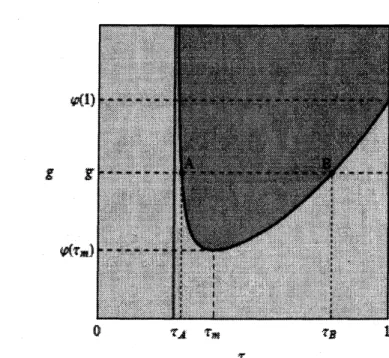
The conditions (ii) and (iii) are visualized in Figure 1. The steady state is
locally stable for all values of the parameters $\tau$ and $g$ lying in the light-gray
region and locally unstable in the dark-gray region where $1-\alpha\gamma>0,$ $\tau_{-}<$ $\tau<1$ and $g\geq\varphi(\tau)$
.
The division between these two areas is indicated by thedistorted $U$-shaped boundary curve, the locus of$a_{1}a_{2}-a_{0}=0$ or$g=\varphi(\tau)$
.
Thiscurve separates the stable region from the unstable region in the $(\tau, g)$ plane and
thusoften called thepartition curve. The light-gray region is further divided into
two subregions by the vertical real line $\tau=\tau_{-}$
.
The condition (ii) holds in thesubregion to the left ofthe line andthe steady state is locally stable irrespective
of the value of $g$
.
The condition (iii) holds in the subregion to the right. Theboundary curve, $g=\varphi(\tau)$, is asymptotic to the vertical line as $\tau$ tends to $\tau_{-}$
from
above.2
The minimum value of$\varphi(\tau)$ is attained for $\tau=\tau_{m}$.
The maximumvalue oftax rate $\tau$ is unity by definition and the corresponding value of$\varphi(\tau)$ is
$\varphi(1)$
.
It is then apparent that the horizontal line at $g=\overline{g}$ has no intersection with the partition curve if $\overline{g}<\varphi(\tau_{m})$,one
intersection if $\overline{g}>\varphi(1)$ and twointersections including the equal roots otherwise. Notice that $\overline{g}$ is selected so
as to satisfy $\varphi(\tau_{m})<\overline{g}<\varphi(1)$ in Figure 1 and thus the horizontal line
crosses
twice the $g=\varphi(\tau)$ curve at points $A$ and $B$, yielding the corresponding tax
rates $\tau_{A}$ and $\tau_{B}$,
respectively.3
$g$
$\mathfrak{B}$
$\tau_{X}$ $\prime r_{\mathfrak{B}}$ ig $\}$
$\tau$
Figure 1. Stable and instable regions
4
Tax Effect
on
Stability
The $10$cal stability conditions of the steady state are analyticallyobtained. Now
our concern is on global behavior of locally unstable trajectories. The
nonlin-earities of the dynamical system $(M_{I})$ indicates the emergence of limit cycle or
other more complex behavior through a Hopf bifurcation when loss of stability
occurs
on the partitioncurve.
Its conditions are as follows:(Hl) The characteristic equation atthe critical point has apair ofpurely
imag-inary roots and no other roots with zero real parts;
(H2) The real part of these imaginary $ro$ots change $sign$ at the critical point.
Substituting $a_{0}=a_{1}a_{2}$ into equation (4) gives the factored form,
$(\lambda^{2}+a_{1})(\lambda+a_{2})=0.$
On this curve, the characteristic equation has a conjugate pair ofpurely
imagi-nary $ro$ots and one real negative root,
$\lambda_{1,2}=\pm i\sqrt{a_{1}}$ and $\lambda_{3}=-a_{2}<0.$
3The particular values of the paramters to depict Figure 1 are given in the Assumption below.
So
the first condition (Hl) is satisfied. To check the second condition,we
select the tax rate $\tau$ as the bifurcation parameter and treat the root of thecharacter-istic equation as a continuous function of $\tau$:
$\lambda(\tau)^{3}+a_{2}\lambda(\tau)^{2}+a_{1}\lambda(\tau)+a_{0}=0.$
Differentiating it with respect to $\tau$ yields
$\frac{d\lambda}{d\tau}=-\frac{\lambda^{2da}\vec{d\tau d_{\mathcal{T}}^{\Delta}}+\lambda\frac{da_{1}}{d\tau}+\underline{d}a}{3\lambda^{2}+2a_{2}\lambda+a_{1}}$
.
Substituting $\lambda=i\sqrt{a_{1}}$and rationalizing the right hand side yield the following
form of the real part of this derivative,
${\rm Re}( \frac{d\lambda}{d\tau}\lambda=i\sqrt{a_{1}})=-\frac{(_{d\tau}^{\underline{d}a}\Delta-a_{1_{\vec{d\tau}}}^{\underline{d}a})(-2a_{1})+2a_{2}a_{1^{\frac{da_{1}}{d\tau}}}}{4a_{1}(a_{1}+a_{2}^{2})}$
.
The denominator is definitely positive. Let
us
denote the numerator as $\Omega$ andconfirm its $sign$. Notice first that
$\Omega=-\frac{2\alpha^{2}\beta^{2}s^{4}(1-\tau)^{2}(Ag\gamma+\mu\tau^{2})}{\tau^{3}A^{6}}\triangle(\tau)$
where
$\Delta(\tau)=-\frac{\mu(1-\tau)\tau^{2}}{\beta\gamma\mu s^{2}(1-\tau)^{2}-(1-\alpha\gamma)\tau A^{2}}\phi(\tau)$
and
$\phi(\tau)$ $=$ $2\beta^{2}\gamma\mu^{2}s^{4}(1-\tau)^{4}-\beta\mu A^{2}s^{2}[1-4\alpha\gamma(1-\tau)-3\tau](1-\tau)\tau$ $-2\alpha(1-\alpha\gamma)A^{4}\tau^{2}.$
Further we have
$\frac{d\varphi}{d\tau}=-\frac{\mu\tau}{Af(\tau)^{2}}\phi(\tau)$
with
$f(\tau)=\beta\gamma\mu s^{2}(1-\tau)^{2}-(1-\alpha\gamma)\tau A^{2}$
Notice that $-f(\tau)$ is the second factor of the denominator of $\varphi(\tau)$
.
Finally $\Omega$can be expressed as
$\Omega=kf(\tau)\frac{d\varphi}{d\tau}$
with
$k= \frac{2\alpha^{2}\beta^{2}s^{4}(1-\tau)^{2}(Ag\gamma+\mu\tau^{2})(1-\tau)\tau}{\tau^{3}A^{6}}>0.$
Since $\varphi(\tau)$ is defined on the interval $(\tau_{-}, 1)$, we check the $sign$ of $\Omega$ on that
interval. Since,
we have
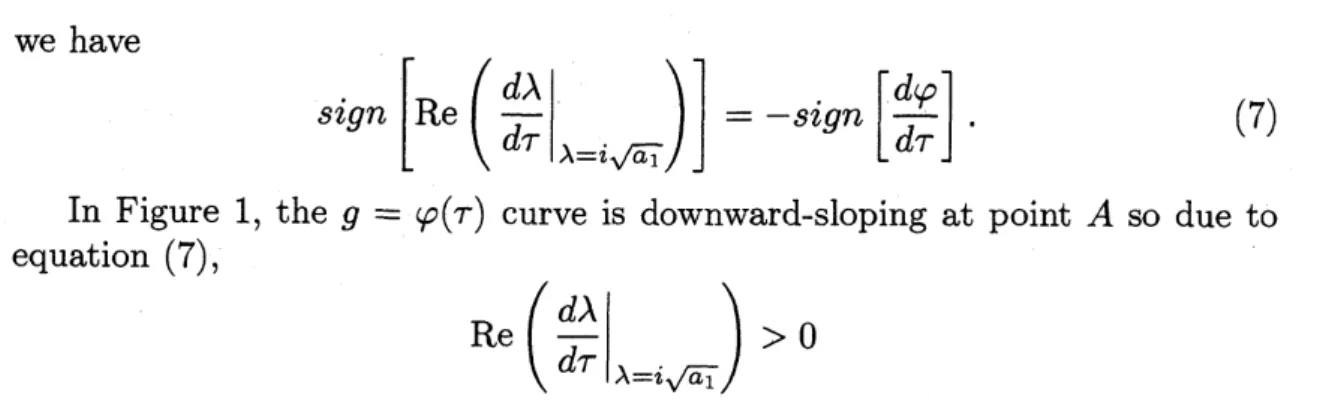
sign $[{\rm Re}( \frac{d\lambda}{d\tau}|_{\lambda=i\sqrt{a_{1}}})]=$ -sign $[ \frac{d\varphi}{d\tau}]$ (7)
In Figure 1, the $g=\varphi(\tau)$ curve is downward-sloping at point $A$ so due to
equation (7),
${\rm Re}( \frac{d\lambda}{d\tau}\lambda=i\sqrt{a_{1}})>0$
implying that all roots cross the imaginary axis at $i\sqrt{a_{1}}$ from left to right as $\tau$
increases, that is, the steady state loses stability. On the other hand, at point
$B$, it is upward-sloping so due to equation (7),
${\rm Re}( \frac{d\lambda}{d\tau}\lambda=i\sqrt{a_{1}})<0$
implying that the steady state regains stability. The effect caused by a change
in the tax rate depends on constellations of $\tau$ and $g$ and summarized as follows:
Theorem 2 Given $g=\overline{g}$, stability switch occurs twice, to instability
from
sta-bility
for
$\tau=\tau_{A}$ at point $A$ and to stabilityfrom
instabilityfor
$\tau=\tau_{B}$ atpoint $B$
if
$\varphi(\tau_{m})\leq\overline{g}\leq\varphi(1)$, oncefrom
stability to instabilityif
$\overline{g}>\varphi(1)$ andno stability switch occurs
if
$\overline{g}<\varphi(\tau_{m})$ where $\overline{g}=\varphi(\tau_{A})hold_{\mathcal{S}}$ at point $A$ and$\overline{g}=\varphi(\tau_{B})$ holds at point$B.$
We numerically examine the analytical results just obtained. Before
pro-ceeding, we specify the parameter values as follows and formulate this selection
as an assumption since we repeatedly use this set of the parameters in further
numerical studies.
Assumption : $\alpha=\beta=A=1,$ $\gamma=4/5,$ $\mu=3,$ $s=1/5$ and $\overline{g}=10.$
Figure 1 is actually illustrated under Assumption and takes the following
parameter values, $\tau_{A}\simeq 0.29,$ $\tau_{B}\simeq 0.8,$ $\tau_{m}\simeq 0.4,$ $\varphi(\tau_{m})\simeq 4.7$ and $\varphi(1)=$
$15$
.
Thus $1-\alpha\gamma>0$ and $g(\tau_{m})<\overline{g}<g(1)$. According to Theorem 2, thestationary state of the $3D$ system $(M_{I})$ loses local stability at point $A$ and
regains it at point $B$
.
Local stability does not necessarily mean global stabilityin a nonlinear system. To find how nonlinearities in system $(M_{I})$ affect global
dynamics, we numerically detect the effects caused by a change in the tax rate
on global dynamics between $\tau_{A}$ and $\tau_{B}$
.
In performing simulations, we takethe same initial values for $Y(O)=Y^{*}$ and $R(O)=R^{*}$ and the different initial
values of $M(O),$ $M(O)=M^{*}+1$ in the first simulation and $M(O)=M^{*}+5$
in the second simulation. The resultant bifurcation diagrams are presented in
Figures 2(A) and (B), in each of which thedownward sloping blackcurvedepicts
the equilibrium value of output, $Y^{*}=g/\tau$
.
In the simulations, the bifurcationparameter$\tau$is increased from 0.2to 1withanincrement of1/1000,theiterations
last
100
iterationsare
plotted against each value of $\tau$. In Figure 2(A), thebifurcation diagram of the first simulation is depicted. It is observed that the
stationary state loses stability when $\tau$ arrives at $\tau_{A}$
and
bifurcates to aperiodiccycle having
one
maximum and one minimum for $\tau>\tau_{A}$.
It is also observedthat
an
oscillation disappears at $\tau=\tau_{B}$ and stability is regained for $\tau>\tau_{B}$.
InFigure 2(B), the bifurcation diagram in the second simulation is illustrated. It
is seen that stability is lost at $\tau=\tau_{A}$
as
in Figure 2(A) but regained atsome
value larger than $\tau_{B}$
.
Further simulations with different initial points have beenconducted and then lead to the fact that stability is regained not necessarily at
$\tau=\tau_{B}$ but at
some
larger value although stability is always lost at $\tau=\tau A.$This difference implies that it depends on a selection of the initial values of the
variables when it regains
stability.4
These numerical results are summarizedas
follows:
Proposition 3 The. nonlinear $IS$-$LM$ model $(M_{I})$ generates periodic
oscilla-tions when the steady state is destabilized and has initial point dependency to
regain stability.
$\tau_{A} \tau,$
$\tau_{l} \{r_{\delta}$$\tau$
$\tau$
(A) $M(0)=M^{*}+1$ (B) $M(0)=M^{*}+5$
Figure 2. Bifurcation diagrams with different initial values
De Cesare and Sportelli (2005) and Fanti and Manfredi (2007) also examine
the local stability and arrive at the same result
as
in Theorem 1. However, theformer does not consider a Hopf bifurcation in the undelay model whereas the
latter discusses the Hopf bifurcation with respect to the government
expendi-ture, the other fiscal policy parameter, but not with respect to the tax rate. As
can be
seen
in Figure 1, given,
increasing $g$ destabilizes the steadystate when it crosses the partition curve from below. As a natural consequence,
neither authors mention a possibility of stability regain with respect to the tax
rate.
References
[1] De Cesare, L. and Sportelli, M. (2005): A Dynamic $IS$-LM model with
Delayed Taxation Revenues, Chaos, Solitions and Fractals, 25, 233-244.
[2] Fanti, L. and Manfredi, P. (2007): ChaoticBusiness Cyclesand Fiscal Policy:
An $IS$-LMModel with Distributed Tax Collection Lags, Chaso, Solitions
and Enactals, 32, 736-744.
[3] Gandolfo,
G.
(2010): Economic Dynamics, 4th Edition, Springer-Verlag,Berlin/Heiderberg/New York.
[4] Goodwin, R. (1951): TheNonlinear Accelerator and the Persistence of
Busi-ness Cycles, Econometrica, 19, 1-17, 1951.
[5] Kalecki, M., A. (1935): Macrodynamic Theory of Business Cycles,
Econo-metrica, 3, 327-344.
[6] Sasakura, K. (1994): On the Dynamic Behavior ofSchinasi’sBusiness Cycle
Model, Journal of Macroeconomics, 16, 23-444.
[7] Schinasi,
G.
(1982): Fluctuations in a Dynamic, Intermediate-run $IS$-LMmodel: Applications of the Poincare-BendixsonTheorem, Journalof
Eco-nomic Theory, 28,
369-375.
[8] Matsumoto, A. and Szidarovsky, F. (20013): Dynamics in Delay $IS$-LM