Strong and weak
$(1, 3)$homotopies
on
spherical
curves
and
related topics
Noboru
Ito
Waseda
Institute for Advanced
Study
Yusuke Takimura
Gakushuin
Boys’
Junior
High
School
Kouki
Taniyama
Department
of
Mathematics,
School
of Education, Waseda University
1
Introduction
A spherical curve is the image of ageneric immersion ofa circle into atwo dimensional
sphere. It is knownthat any two spherical
curves
are related by afinite sequence offirst,second, and third Reidemeister moves. The first, second, and third Reidemeister moves
are denoted by RI, $R\mathbb{I}$, and RM, respectively.
$\sim^{1}R\mathfrak{p})(R\sim^{||}K$
昏則廿
Figure 1: Reidemeister moves
By using the rotation number, we
can
detect spherical curves, corresponding to apair,that are related by a finite sequence consisting of $RlI$ and RM. Hence, about three years
ago, one of the authors of this paper Takimura, asked the following questions:
Question (1) How to obtainthenecessary and sufficient conditionthat anytwo spherical
curves are
related by a finite sequence consisting ofRI and $R\mathbb{I}$?Question (2) How to obtain the necessary andsufficientcondition that any two spherical
curves
are related byafinite sequence consistingof RI and RM? The solutionto Question(1) can be found in [7]. However, Question (2) is still open. However, we would like to
mention that there existsaspherical
curve
that isnon-trivial under anequivalencerelationMany studies concerning with
Arnold
invariantsare
often not useful forclassification
problems related to RI.
For Question (2), Ito,
one
of the authors, considered smaller problems concerning withpairs, (RI, strong RM) and (RI, weak Rm) (see Definition 1), as a first step.
2
Preliminaries
Definition 1. Reidemeister
moves
consist of thefive types of local replacements in asuf-ficiently small disk
on a
2-sphere. The five types of local replacementsare
RI, strong RIB,weak RI, strong RM, andweak RM. Here, strong RIB, weak R ,strong RM, andweak RM
are
defined in Fig. 2. RI (resp. Rll) increasing double point is denoted by la (resp. $2b$).$\zeta$
$)( Stro\bigcap_{\sim^{g||}}R.\cdot.\cdot..K^{\prime’}\cdots$
Figure 2: StrongRll andweakRII (left);strong RIII and weak RM (right)
Similarly, strong R (resp. weak $R\mathbb{I}$)increasingdouble point is denoted by$s2b$ (resp. $w2b$).
As shown in Fig. 2, a single strong RM, from the right to the left, is denoted by $s3b.$
3
Summary–several
characterizations of trivialities.
In this section, we select known results related to the spherical
curve
is trivialized by afinite sequence consisting ofcertain types of Reidemeister moves.
Figure 3: Trefoil projection
Let $P$be aspherical
curve
and$O$the sphericalcurve
withno
double points. Asphericalcurve
is the projection image of the standard knot diagram of the trefoil, as shown in(1) $P$ and $O$
can
be related by a finite sequence consisting of RI if and only if thereexists
a
finite sequence consisting of $1b$from $P$ to $O[3].$(2) $P$ and $O$ can be related by a finite sequence consisting of Rll if and only if there
exists a finite sequence consisting of $2b$ from $P$ to $O[3].$
(3) $P$ and $O$ can be related by a finite sequence consisting of RI and R if and only if
there exists a finite sequence consisting of $1b$ and $2b$ from $P$ to $O[7]$ (cf. [3]).
(4) $P$ and $O$
can
be related bya
finite sequence consisting of RI and weak Rll if andonly if there exists
a
finite sequence consisting of $1b$ and $w2b$ from $P$ to $O[4].$(5) $P$ and $O$ can be related by a finite sequence consisting of RI and strong Rll if and
only ifthere exists a finite sequence consisting of $1b$ and $s2b$ from $P$ to $O[4].$
(6) $P$ and $O$ can be related by a finite sequence consisting of RI and weak RIII if and
only if there exists a finite sequence consisting of $1b$ from $P$ to $O[3].$
(7) $P$ and $O$
can
be related bya
finite sequence consisting of RI and strong Rm if andonly if there exists a finite sequence consisting of $1b$ and $3b$ from $P$ to $O[6].$
(8) $P$ and $O$
can
be related by a finite sequence consisting of RI and strong RM if andonly if $P$ is a connected
sum
consisting ofa
finite number of spherical curves, eachof which is $O$, the curve appearing as $\infty$, or the trefoil projection [6].
Another characterization of the triviality corresponding to (6) or (8) is obtained by [5]
using so-called chord diagrams up to three chords: $\otimes,$ $\Theta$, and $\Phi.$
4
Prime reduced
spherical
curves
up to
seven
double points
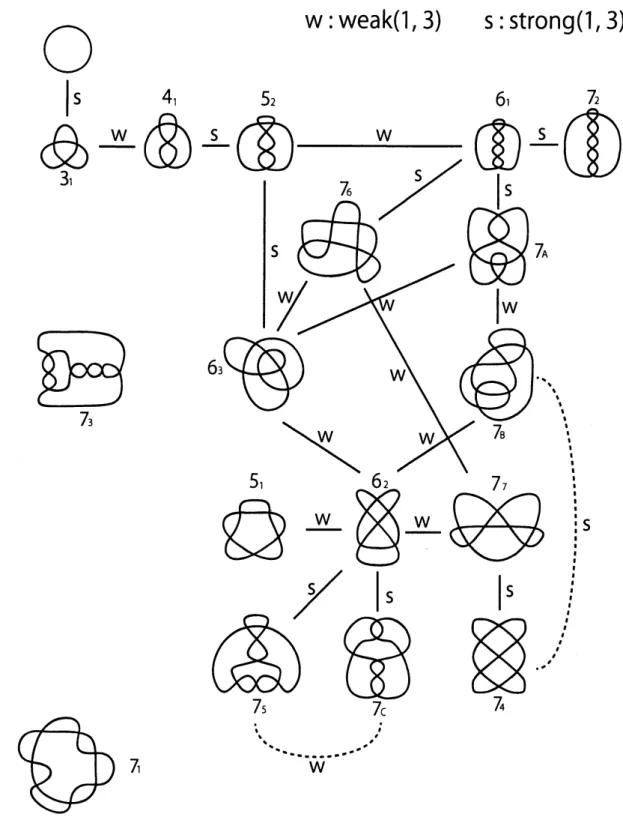
Fig. 4 consists of prime reduced spherical curves up to seven double points. The list of
spherical
curves
is obtained by theRolfsen table of knot diagrams and flypes. There existthree pairs $(7_{6},7_{A})$, $(7_{7},7_{B})$, and $(7_{5},7_{C})$, where the two spherical curves corresponding
toeachpair are related by aflype. Two sphericalcurves are connected by a solid segment
labeled
as
“s” (resp. “w”) if theyare
related by a finite sequence consisting ofa
singlestrong RM (resp. weak RM) and a finite number of RIs. We would like to mention that
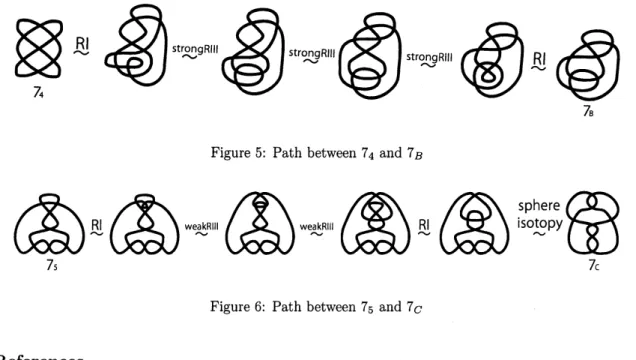
$7_{4}$ and $7_{B}$ (resp. $7_{5}$ and $7_{C}$) can be related by a finite sequence consisting of RI and
strong RM (resp. weak RM) via a prime spherical curve with eight double points, which
can be
seen
in Fig. 5 (resp. Fig. 6). For the pairs $(7_{4},7_{B})$ and $(7_{5},7_{C})$, a pair of knot$0$
$w:weak(1,3)$
$s:$strong
(
$1,3)$Figure 5: Pathbetween $7_{4}$ and $7_{B}$
Figure 6: Path between $7_{5}$ and $7_{C}$
References
[1] V. I. Arnol’d, Topological invariants ofplane
curves
and caustics. University LectureSeries,
5.
American Mathematical Society, Providence, RI,1994.
[2] T. Hagge and J. Yazinski, On the necessity of Reidemeister
move
2 for simplifyingimmersed planar curves, Banach Center Publ. 103 (2014), 101-110.
[3] N. Ito and Y. Takimura, (1, 2) and weak (1, 3) homotopies on knot projections, J.
Knot Theory
Ramifications
22 (2013), 1350085, 14pp.[4] N. Ito and Y. Takimura, Strong and weak (1, 2) homotopies
on
knot projections andnew
invariants, to appear in Kobe J. Math.[5] N. Ito and Y. Takimura, Sub-chord diagrams of knot projections, to appear in
Hous-ton J. Math.
[6] N. Ito, Y. Takimura, and K. Taniyama, Strong and weak (1, 3) homotopies on knot
projections, to appear in Osaka J. Math.
[7] M. Khovanov, Doodle groups, Trans. Amer. Math. Soc. 349 (1997), 2297-2315.
Waseda Institute for Advanced Study
Tokyo 169-8050
JAPAN
$FfflfflX\neq^{\sim}\ovalbox{\tt\small REJECT}\not\cong\Re_{J\iota P}^{*\gamma}ff\ovalbox{\tt\small REJECT} F$
Gakushuin Boys’ Junior High School
Tokyo
171-0031
JAPAN
$E$-mail address: [email protected]
$\neq^{\sim}\ovalbox{\tt\small REJECT}\Re\Leftrightarrow\iota F\ovalbox{\tt\small REJECT}\ovalbox{\tt\small REJECT}_{\underline{\backslash }}^{\backslash }\}\Re sr\backslash iffi_{J}^{\bigwedge,}$
Department of Mathematics
School of Education
Waseda University
Tokyo
169-8050
JAPAN
$E$-mail address: [email protected]