i MASTER'S THESIS
RITSUMEIKAN ASIA PACIFIC UNIVERSITY AND BEPPU CITY, OITA PREFECTURE: EXPLORING MEANINGFUL PARTNERSHIP
By
FRANCO JOSE R. FELLIZAR (ID:51109003)
GRADUATE SCHOOL OF ASIA PACIFIC STUDIES RITSUMEIKAN ASIA PACIFIC UNIVERSITY
ii Acknowledgement
To my Almighty Father, Lord, and Savior, Jesus Christ, for His faithfulness, unfailing love and careful guidance throughout this whole journey and for providing me the wisdom, the knowledge and the resources that enabled me to reach the goal, to Him I humbly dedicate this thesis.
To Prof. Jeremy S. Eades, my adviser and mentor, my deep and sincere gratitude for taking me under his wings despite his hectic schedule, and most especially for his guidance, encouragement, and support throughout this study.
To my ever-loving family, my parents, Dr. Francisco P. Fellizar Jr. and Dr. Nectarinia R. Fellizar, my highest appreciation for their countless advice, unending patience, support and dedication throughout the whole process of this study. To my brother, Pastor Francis Mark Dioscoro R. Fellizar, my sister-in-law, Dr. Joyce Flores Fellizar, their lovely baby girl, Juliana Franceska F. Fellizar, and my sister Dr. Lina Lourdes R. Fellizar, I am very grateful for their loving concern and for always believing in me. Without their love and prayers, this thesis would not have been possible.
To Beppu City Mayor Hiroshi Hamada, my highest gratitude for his humility and great generosity for sharing and dedicating his time for the interview despite his busy schedule running the city. It was truly a great honor to have met such a humble and compassionate person. My sincerest gratitude and appreciation to Ritsumeikan Asia Pacific University President Shun Korenaga, for his support and generosity in sparing his precious time for the interview on such short notice. I am truly grateful for the meaningful advice and valuable ideas he provided. To the staff of the APU Office of the President, Mr. Hisahito Nanushigawa and Mr. Hiroshi Kondo, and to the staff of the Beppu City Hall Cultural and International and Onsen Tourism Divisions, Ms. Junko Abe and Mr. Koji Maki I am deeply grateful for their boundless assistance with the interview and for their generosity in providing me with the important data needed to complete my study. My special thanks to Mr. Kazuhiko Naito for his help in scheduling an interview with the Beppu City Mayor. May they all continue to strengthen and solidify the foundation of the APU-Beppu Partnership.
I am deeply indebted to the following people who in countless ways generously supported me in the completion of this thesis. To Ms. Kiyoka Yamase, my best friend, my sincerest thanks for being a source of inspiration and for her support and encouragement at times I needed them the most. I am also thankful for her understanding and patience in the long process of this study. To Ms. Tomoi Nasu, I would like to express my deepest gratitude for generously dedicating an ample amount of her time and staying up until midnight to help me with translations. To my FAT brother Mr. Rio Paulus, I am very thankful for his help with translations and also to my GODLY sister Ms. Metha Sumbung for her kind assistance. My special thanks go to Mrs. Joy Endo, Ms. Masako Endo, Mrs. Noriko Kihara, Ms. Yurie Takeshita, Ms. Kaori Adachi, Ms. Satoko Tomono, Mr. Rehabya Randy Wijaya, Mr. Kokoh Lie, Mr. Samuel Ray, Ms. Marsha Nugroho, Ms. Kyoko Fukuda and , Ms. Megumi Hill for their help in distributing the questionnaires. I also wish to thank Prof. Robert Salazar and Mr. Yuuji Shinozaki for their helpful advice.
I would like to extend my greatest appreciation to all my brothers and sisters at FFF and BIBC, for consistently covering me with your prayers, and for taking time to help me distribute and collect, as well as answer the questionnaires. May the good Lord bless you all exceedingly!
iii Finally, to the Beppu Community, and to the students and faculty of APU, I owe my sincerest
gratitude for your support and cooperation in answering my questionnaires. May you continue to further deepen the friendship and continue to make Beppu City a better place.
iv
TABLE OF CONTENTS
CHAPTER TITLE PAGE
Title Page i
Acknowledgement ii
Table of Contents iv
List of Tables ix
List of Figures xi
List of Appendix xiii
List of Acronyms xiv
Abstract xvi
CHAPTER I : INTRODUCTION
1.1 Introduction 1
1.2 Background of the Study 4
1.3 Research Problem and Objectives 5
1.4 Specific Objectives 5
1.5 Significance of the Study 6
1.6 Scope and Limitations of the Research 6
CHAPTER II : LITERATURE REVIEW
2.1 Introduction 8
2.2 Globalization and Education 9
2.3 Internationalization of Higher Education 11 2.3.1 Internationalization of Higher Education: Japanese
Perspectives
14
2.3.2 Internationalization of Universities: The Japanese Initiatives 16
2.4 University and Community Partnership 20
v
2.5.1 What is Partnership? 22
2.5.2 Related Concepts 25
2.5.2.a Participation and partnership 25 2.5.2.b Private-Public-Community Partnership 26
2.5.3 Related Theories 27
2.5.3.a Enforced Cooperation 27
2.5.3.b Game Theory 28
2.5.3.c Open Systems Theory 29
2.5.3.d Institutional Theory 30
2.5.3.e Social Impact Theory 32
2.5.3.f Social Exchange Theory 33 2.5.4 Elements of Successful Partnerships 34 2.6 University-Community Relations/Partnerships: Historical Perspective 36 2.6.1 University and Community Partnership 36
2.6.2 "Town and Gown" 37
2.7 University-Community Partnerships: Benchmarks and Indicators 38 2.8 University-Community Partnerships: Innovative Strategies 41
2.9 Summary 45
2.10 Definition of Terms 47
Town & Gown Partnership University-Community Partnership Perception Impact Close Relationship Local Community APU Internationals Globalization Internationalization Higher Education
vi CHAPTER III : METHODOLOGY
3.1 Introduction 50
3.2 Research Design 50
3.3 Methods of Data Collection 50
3.4 Sampling and Respondents 51
3.5 Profile of Respondents 51
3.5.1 Conceptual Framework and Assumptions 51
3.5.2 Profile of APU students 52
3.5.2.a APU Student Respondents according to Gender 52
3.5.2.b Club/Circle Membership 53
3.5.3 Profile of APU Faculty 54
3.5.3a APU Faculty Respondents According to Nationality 54
3.5.4 Profile of Beppu Citizens 54
3.5.4.a Local Beppu Citizens According to Gender 54 3.5.4.b Local Beppu Citizens According to Age Group 55 3.5.3.c Local Beppu Citizens according to Marital Status 55 3.5.3.d Local Beppu Citizens according to Educational
Attainment
56
3.5.3.e Local Beppu Citizens According to Place of Birth 57 3.5.3.f Local Beppu Citizens According to Number of Years in
Beppu
57
CHAPTER IV : HISTORICAL PERSPECTIVES
4.1 Introduction 58
4.2 Beppu City 58
4.3 Ritsumeikan Asia Pacific University 62
CHAPTER V : IMPACTS OF APU ON BEPPU COMMUNITY
5.1 Introduction 68
5.2 Population 68
vii
5.4 Local Economy and Business 73
5.4.1 Local Economy 73
5.4.2 Local Shops, Restaurants and Other Business Establishments 73
5.5 Language Classes and Schools 75
5.6 Housing and Apartments 77
5.7 Transportation and Traffic 79
5.8 Religion 81
5.9 Community Events and Activities 83
5.10 International Events and Activities 85
5.11 Parks and Recreational Facilities 86
5.12 Summary 87
CHAPTER VI: FINDINGS AND DISCUSSIONS The Nature of APU-Beppu Community Partnership
6.1 Introduction 89
6.2Elements of Partnership 89
6.2.1 Shared Vision/Goal 89
6.2.2 Formalization 90
6.2.3 Mechanism/Structure for Partnership 91
6.2.4 Communication 93
6.2.5 Resource Sharing 94
6.2.5 Evaluation and Feedback 95
6.3 Perception of APU-Beppu Partnership 96
6.3.1 Awareness of APU-Beppu Partnership 96 6.3.1.a Local Beppu Citizens' Awareness of APU-Beppu
Partnership
96
6.3.1.b APU Students' Awareness of APU-Beppu Partnership 97 6.3.2 Perception of APU's Contribution to the Community 98
6.3.2.a Beppu Locals' Perception of APU's Contribution to the Community
98
6.3.2.b Beppu Locals' Perceived Contributions of APU to Beppu
viii 6.3.2.c APU Students' Perception of APU's Contribution to the
Community
101
6.3.2.d APU Students' Perceived Contributions of APU to Beppu
103
6.3.3 Perception of Beppu Community's Contribution to APU 104 6.3.3.a APU Students' Perception of Beppu Community's
Contribution to APU
104
6.3.3.b APU Students' Perceived Contributions of Beppu Community to APU
106
6.3.3.c Beppu Locals' Perception of Beppu Community's Contribution to APU
108
6.3.3.d Beppu Locals' Perceived Contributions of Beppu Community to APU
109
6.4 Summary 110
CHAPTER VII: Towards a Sustained APU-Beppu Community Partnership
7.1 Introduction 113
7.2 Perception on APU-Beppu Partnership 113
7.2.1 Importance of Partnership to APU and Community 113 7.2.1.a Beppu Locals' Perception of the Importance of
APU-Beppu Partnership
114
7.2.1.b APU Students' Perception of the Importance of APU-Beppu Partnership
115
7.3 Enhancing Current Level of Participation 118 7.3.1 Participation in Joint APU-Beppu activities or projects 118
7.3.1.a APU Students' Participation in Joint APU-Beppu Activities
118
7.3.1.b Beppu Locals' Participation in Joint APU-Beppu Activities
119
7.3.2 Joint Activities 120
7.3.3 Means of Disseminating Information Regarding APU-Beppu Activities
ix
7.4 Suggestions for Meaningful Partnership 122
7.4.1 Suggestions from Beppu Locals 122
7.4.2 Suggestions from APU Students 123
7.4.3 Suggestions from APU President and Staff 125 7.4.4 Suggestions from the Beppu City Mayor and Staff 125 7.4.5 Suggestions from APU Faculty Members 125 7.5 Suggested Activities for Meaningful APU-Beppu Community Partnership 128
7.5.1 Service Learning 128
7.5.2 Service Provision 129
7.5.3 Faculty Involvement 129
7.5.4 Student Volunteerism 130
7.5.5 Community in the Classroom 130
7.5.6 Applied Research 130
7.5.7 Major Institutional Change 131
7.6 Summary 131
CHAPTER VIII: CONCLUSIONS & RECOMMENDATIONS
8.1 Introduction 133
8.2 Conclusions 134
8.2.1 Nature of Partnership 134
8.2.2 Perception of Co-existence 135
8.2.3 Awareness of Partnership 135
8.2.4 Impacts of APU on the Community 136
8.2.5 Lessons/Issues in Partnership 136
8.3 Recommendations 137
8.3.1 Recommendations for APU 138
8.3.2 Recommendations for the Beppu Community 139
8.3.3 Recommendations for future study 139
LIST OF TABLES
Table 2.1 Ratio of Foreign Undergraduate Students, 2004 18 Table 2.2 Ratio of Foreign Graduate Students, 2004 19
x Table 2.3 Core Characteristics of Authentic
University-Community Partnerships
39
Table 3.1 APU Student Respondents According to Gender 53
Table 3.2 Club/Circle Membership 53
Table 3.3 APU Faculty Respondents According to Nationality
54
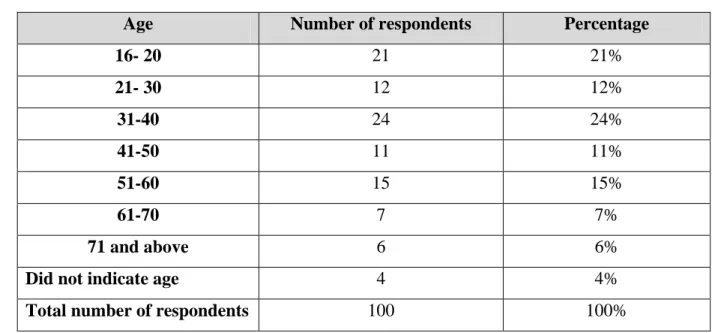
Table 3.4 Local Beppu Citizens According to Gender 54 Table 3.5 Local Beppu Citizens According to Age Group 55 Table 3.6 Local Beppu Citizens according to Marital
Status
56
Table 3.7 Local Beppu Citizens According to Educational Attainment
56
Table 3.8 Local Beppu Citizens According to Place of Birth
57
Table 3.9 Local Beppu Citizens According to Number of Years in Beppu
57
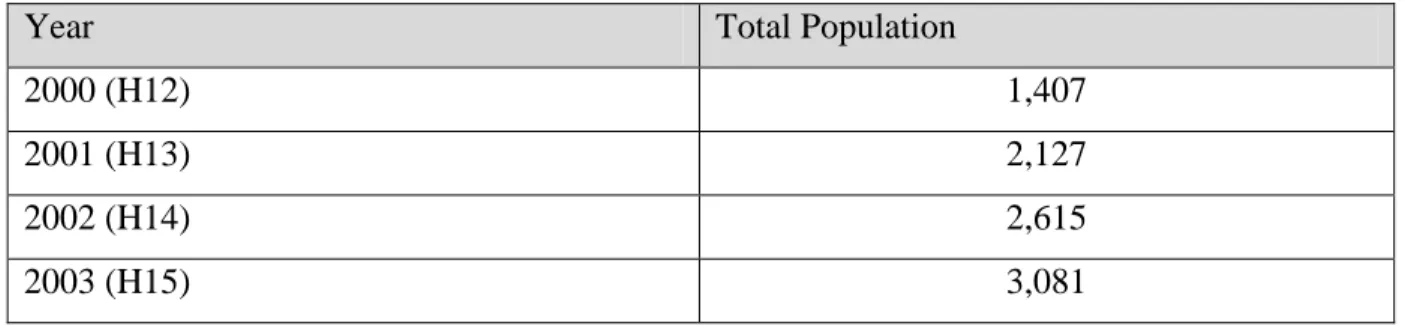
Table 4.1 Beppu City Foreign (Registered) Population for the Year 2000-2010
59
Table 4.2 Beppu City Local Population for the Year 2000-2010
61
Table 4.3 Beppu City Local and Foreign Population for the Year 2000-2010
62
Table 4.4 History of APU 63
Table 4.5 Student Enrollment at Ritsumeikan Asia Pacific University
65
Table 5.1 Beppu City Local and Foreign Population for the Year 2000-2010
69
Table 5.2 Breakdown of Total Disbursements from APU 73 Table 6.1 List of APU Local Government Partners 91 Table 6.2 Local Beppu Citizens' Awareness of APU-Beppu
Partnership
96
Table 6.3 APU Students' Awareness of APU-Beppu Partnership
xi Table 6.4 Comparison of APU Students and Local Beppu
Citizens' Awareness of APU-Beppu Partnership 98
Table 6.5 Beppu Locals' Perception of APU's contribution to the Community
99
Table 6.6 APU Students' Perception of APU's Support to the Community
102
Table 6.7 APU Students' Perception of Beppu Community's Contribution to APU
105
Table 6.8 Beppu Locals' Perception on Beppu Community's Contribution to APU
108
Table 7.1 Beppu Locals' Perception of the Importance of APU-Beppu Partnership
114
Table 7.2 APU Students' Perception on Partnership for the Development of APU and Beppu Community
116
Table 7.3 APU Students' Participation in Joint APU-Beppu Activities
118 Table 7.4 Beppu Locals' Participation in Joint
APU-Beppu Activities
119 Table 7.5 Means of Disseminating Information Regarding
APU-Beppu activities
121
LIST OF FIGURES
Figure 2.1 Partnership Continuum 23
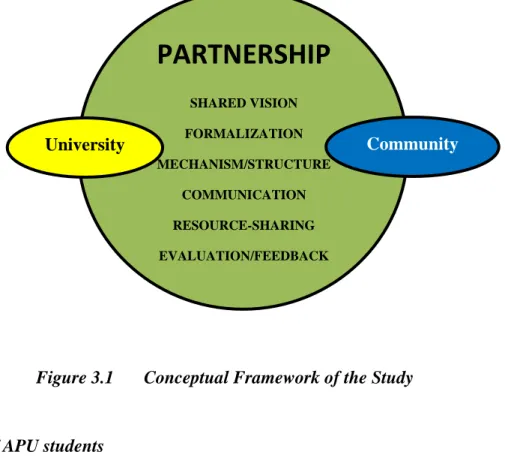
Figure 2.2 Arnstein's Ladder of Participation 26 Figure 2.3 Fundamental Factors in Partnership 34 Figure 2.4 Elements of Successful Partnership 35 Figure 3.1 Conceptual Framework of the Study 52 Figure 4.1 Beppu City Foreign (Registered) Population for
the Year 2000-2010
60
Figure 4.2 Beppu City Local Population for the Year 2000-2010
61
Figure 4.3 Growth in Student Enrollment at Ritsumeikan Asia Pacific University
66
Figure 5.1 Beppu City Local Population for the Year 1980-2010
xii Figure 5.2 Beppu City Population Movement (1990-2009) 70 Figure 5.3 International students and Beppu locals
watching an acoustic concert held at the local Starbucks coffee.
74
Figure 5.4 A sign board at a local beauty salon in Kamegawa.
78
Figure 5.5 A typical bilingual traffic sign in Beppu employing Kanji (Traditional Characters) and the English Alphabet.
80
Figure 5.6 A view of the sign of the Central Kyushu Masjid & Islamic Center.
82
Figure 5.7 APU students performing during a concert held at a local church
83
Figure 6.1 Local Beppu Citizens' Awareness of APU-Beppu Partnership
97
Figure 6.2 APU Students' Awareness of APU-Beppu Partnership
98
Figure 6.3 Beppu Locals' Perception of APU's contribution to the Community
99
Figure 6.4 APU Students' Perception of APU's Support to the Community
102
Figure 6.5 APU Students' Perception of Beppu Community's Contribution to APU
105
Figure 6.6 Beppu Locals' Perception on Beppu Community's Contribution to APU
109
Figure 7.1 Beppu Locals' Perception of the Importance of APU-Beppu Partnership
115
Figure 7.2 APU Students' Perception on Partnership for the Development of APU and Beppu Community
116
Figure 7.3 Beppu Locals' Participation in Joint APU-Beppu Activities
119
Figure 7.4 APU Students' Participation in Joint APU-Beppu Activities
xiii
BIBLIOGRAPHY 141
List of Appendix
Appendix 1 Student Enrollment at Ritsumeikan Asia Pacific University By Country/Region
Appendix 2 Beppu City Memorandum of Agreement for Community Development and Exchange Appendix 2.A Beppu City Memorandum of Agreement for
Community Development and Exchange (Original Text in Japanese)
Appendix 2.B Beppu City Memorandum of Agreement for Community Development and Exchange (English Translation)
Appendix 3 Interview Questionnaires
Appendix 3.A Interview Questionnaire for APU Office Appendix 3.B Interview Questionnaire for Beppu City Hall Appendix 4 Questionnaires
Appendix 4.A1 Survey Questionnaire for Local People (Japanese)
Appendix 4.A2 Survey Questionnaire for Local People (English)
Appendix 4.B Survey Questionnaire for APU Students/Faculty Appendix 5 Letter of Request for Interview
Appendix 5.A1 Letter to APU President(Japanese) Appendix 5.A2 Letter to APU President(English) Appendix 5.B1 Letter to Beppu City Mayor(Japanese) Appendix 5.B2 Letter to Beppu City Mayor(English) Appendix 5.C1 Letter to Beppu City Mayor 2(Japanese) Appendix 5.C2 Letter to Beppu City Mayor 2(English) Appendix 6 List of Joint APU-Beppu Events
Appendix 7 Maps
xiv B. Map of Oita Prefecture
C. Map of Beppu City
Appendix 8 Location of Ritsumeikan Asia Pacific University Appendix 9 Picture of Ritsumeikan Asia Pacific University
LIST OF ACRONYMS
APEC – Asia Pacific Economic Cooperation
APU - Ritsumeikan Asia Pacific University
COPC - Community Outreach Partnership Center
CCPH - Community-Campus Partnerships for Health
HUD - U. S. Department of Housing and Urban Development
MECS (Currently MEXT) - Ministry of Education, Science, and Culture
METI – Minister of Economy, Trade and Industry
MEXT - Ministry of Education, Culture, Sports, Science, and Technology
OUP - Office of University Partnerships
xv SIH - Strategic Fund for Establishing International Headquarters in Universities
UMAP - University Mobility in Asia and the Pacific
UNESCO – United Nations Educational, Scientific and Cultural Organization
xvi Ritsumeikan Asia Pacific University and Beppu City, Oita Prefecture: Exploring
Meaningful Partnership
Abstract
The "town (community) and gown (university)" relationship can either be one of trust or indifference, as each one impacts the other – positively or negatively. Fortunately, the last decade has witnessed a new era of a stronger, more purposeful and meaningful partnership as both realized that their development and futures are intricately woven. In the light of
globalization, higher education institutions and their respective governments elsewhere including Japan took several initiatives and reforms to make their respective education systems responsive to the demands of an increasingly competitive and globalizing economy. In year 2000, the Ritsumeikan Trust in collaboration with the Oita prefectural and Beppu city governments established the Ritsumeikan Asia Pacific University (APU) in response to the growing global importance of the Asia Pacific Region in this era. This exploratory study involving respondents from both APU and the Beppu community, including officials and staff from both administration offices, sought to answer the question: "What is the nature of partnership between APU and Beppu Community?" Primary data were obtained through survey questionnaires and interviews with selected key informants, while secondary data consisted of official documents and records. Direct observations were also made to record the impacts resulting from the presence of the university. The nature of APU-Beppu Partnership was examined using the following critical elements of university-community partnership: (1) Shared Vision; (2) Formalization; (3) Structure; (4) Communication; (5) Resource-Sharing; and (6) Evaluation and Feedback. The study showed that both share a common vision to make Beppu City a pleasant place to live in. This vision is reflected in the formal agreement signed by officials of the university and the local city government in 2004. The
organizational mechanism or structure still needs to be enhanced as there is no office or personnel exclusively dedicated for the purpose of partnership affairs. Communication, as well, needs improvement as it still remains irregular and inadequate at the moment. Sharing of resources is still limited to the use physical facilities and resources for joint activities. An effective evaluation and feedback system needs to be established. APU's presence contributed to changes in the socio-economic and physical landscape of Beppu. Both APU and Beppu community's contribution to each other are seen to be mutually beneficial. While more than
xvii half of the respondents do not know of the partnership between APU and Beppu community, majority of them agree that partnership is beneficial to both the university and the community. Suggestions to make the partnership more meaningful were given and possible partnership activities were identified to include among others; service learning, faculty involvement, student volunteerism, community in the classroom, applied research and institutional change. Finally, recommendations for both APU and the community are given including areas for further study as well as concrete actions towards meaningful partnership.
1 CHAPTER I
INTRODUCTION
1.1 Introduction
Historically, relationships between the university and the community where it is situated have been a source of difficulty for both sides (Bruning, McGrew and Cooper, 2006). Both have failed to co-exist and work cooperatively to address common problems. As a result, the university has often, if not always, attempted to separate itself from the community
(Martin, Smith, and Phillips, 2005; Kenyon 1997).
The past few decades have witnessed a significant development in partnership between universities and their surrounding communities. Both sides came into realizations that their futures were intimately linked and their growth and prosperity rely on effective and fruitful partnership and coexistence. In the 1990s, colleges and universities began to address the problems of universities being separated from the community by taking measures to develop strategies to strengthen town (municipality/city) and gown (university) relationships and engage the community (Bruning, et al. 2006). Generally, there are two strategies that have emerged during the process. The strategy adopted by most universities, focuses on increasing student access to community resources in the form of student teaching, internships and volunteer opportunities. The other strategy focuses on linking the two entities through efforts that create a unified vision and identity by maintaining the character of the community given the universities' drive to enhance their assets and resources (Steinkamp, 1998). Policies are jointly formulated by these two entities aimed at promoting effective and sustainable partnership.
2 There has been a shift from an old government paradigm to a new governance
paradigm – which encourages the creation of innovative partnerships not only between the government sector and the private sector. In order to harness the collective energies and strengths of all partners, the non-profit sector is involved as well. (Martin, et. al. 2005). In recent years, "Community-university partnerships are gaining momentum across the country (U.S) as a powerful force for revitalizing communities, fostering civic engagement and strengthening the core missions of higher education" (Seiffer and Carriere, 2003, p.2).
The continuing influx of students into communities brought by universities has inevitable influences on the life of the communities and nearby vicinities where these
universities are located. The "town (community) and gown (university)" relation can either be one of trust or indifference as each one impacts on each other. Holland (2003) cites that "as long as there have been campuses located in communities, there has been attention to the impact each has on the other – for good and for bad, constructive and destructive, accidental and intentional, real and imagined. Fortunately, the last decade has opened an era of new, more purposeful efforts to create constructive, mutually-beneficial and enduring interactions through formal partnerships between communities and their academic residents. The nature of economic, cultural, social and political conditions for both sectors evolved to a point where the need to learn to work together became so urgent and compelling it could no longer be ignored or denied."
In the light of globalization, as an effort to adapt to the changing demands emanating from this phenomenon, many universities are now undertaking reforms towards
"internationalization" (Bartell, 2003). Universities world-wide are now engaged in deliberate efforts to attract and cater to students coming from different parts of the globe. Japan is one
3 of the countries that have been actively pursuing the promotion of policies for
"internationalizing" its universities. The uniqueness of the "internationalization" process of Japanese universities is mainly due to the significant role of the Japanese government as the initiator of the process. The government takes the role of introducing various policies to promote the reform of the higher education system to attract more students from overseas, as well as provide financial support to these students through scholarships and tuition reductions. With the assistance of the government, new international programs, institutions and agencies both private and local, were established for the purpose of providing high-class educational services to foreign students.
The Ritsumeikan Asia Pacific University (APU) in Oita prefecture, Japan, the first full-fledged international university in the country, was established as a joint initiative by both private and public sectors. Even after its establishment, the university has retained a close relationship with the local government, as well as its community. Through the years, both sides have been actively working together in collaboration with several local educational institutions and non-profit sectors in organizing activities and events. This study is an attempt to describe and examine the nature of the partnership that exists between APU and Beppu Community, as well as identify the university's impacts on the local community, in order to formulate and recommend strategies for sustaining and further improving the relationship between the two.
1.2 Background of the Study
April 2000 marked the establishment of the Ritsumeikan Asia Pacific University (APU) in the suburban city of Beppu located in Oita prefecture. As a result, the city opened
4 its doors to several thousands of students, as well as professors and staffs coming from
various nations and regions of the world. Although Beppu City has long been a popular tourist destination for foreign tourists because of its famous hot springs or "Onsens", this is a huge transformation for the city since this is its first time to have this many foreign residents. Currently there are 2,921 students from 98 countries and a good number of foreign staff and faculty members residing in the city. The foreign population of Beppu City increased from 1,143 in 1999 to 4,824 as of September 2010. Likewise foreign tourists, as well as local tourists, come to the City not only for the famous "Onsens" but to visit the APU campus. The presence of the University also attracted various international organizations to hold meetings and conferences in the City. It also led the city government to hold events making use of the multicultural influences and environment brought about by the university. Many international students from the university participate in such events. This provides good opportunity for the local people to be exposed to different cultures from other countries. The presence of
foreigners in Beppu City also created a desire for local people to be able to communicate in English. As a result, learning English has become a popular trend for the locals. Schools and English Conversation classes or "Eikaiwa's" employ international students as part-time English teachers thus providing greater interaction of locals to foreigners.
Beppu City has also been slowly undergoing a face lift. Immediately before APU was built, new roads were constructed so buses and cars could go up to the University campus. More parks and recreational facilities have been put up. A big mall, several shops,
restaurants serving foreign food, and other businesses were established. The Beppu City Station was renovated in 2005. There has been an increase in the number of public
5 the establishment of APU, more apartment houses have been built and are under construction to accommodate the growing number of students in APU.
Ten (10) years have passed since the establishment of APU in Beppu City. Its presence exposed the locals to foreigners and enabled them to experience living within a "multicultural" and "international" environment. This brought about changes on the city and its locals. This paper seeks to identify the impacts of APU on Beppu Community and to describe the partnership between APU and Beppu Community. It is hoped to provide insights on how to further improve the existing university-community partnership.
1.3 Research Problem and Objectives
This paper attempts to answer the question "What is the nature of partnership between APU and Beppu Community?"
1.4 Specific Objectives
1. To describe the nature of APU-Beppu Community partnership.
2. To describe the view/awareness of APU and Beppu Community on university-community partnership.
3. To identify the impacts of APU on the Beppu Community
4. To identify lessons/issues arising from APU-Beppu Community partnership 5. To describe Beppu community's perception about APU's presence
6 1.5 Significance of the Study
Universities (Gown) and the local communities (Town) where they are located must ideally co-exist in a mutual and beneficial relationship. The growth and development of the communities is determined to a certain extent by the universities and vice-versa. Given these realizations, supportive policies and programs from both the communities and the universities must be formulated and promoted. The nature of policies and programs that would enhance the university-community relations must benefit from a thorough understanding of the impacts of the university on community as well as the responses and perceptions of the community on the university (and vice versa). This study is an initial yet significant input to the formulation of policies and programs from both the university and the community that will redound to a healthier, more progressive and sustained cooperation and partnership between these entities. Moreover, this study will serve as basis for a more in-depth and broader study towards understanding university impacts on the community and that of forging community-university partnerships for mutual benefits.
1.6 Scope and Limitations of the Research
This study focuses only on exploring the nature of partnership that exists between the Ritsumeikan APU and Beppu Community, and therefore, generalizations about the overall experiences of other universities and communities in Japan is not possible. Nevertheless, the study presents some pointers with policy and management implications for both universities and communities seeking to engage in meaningful partnership. Areas for further study are also identified.
7 The respondents of the study were limited to APU third year and fourth year students on the assumption that they have longer years of stay in the community compared to first and second year students of the university. A number of faculty members were also included as respondents.The study was conducted within a period of four months but was able to secure cooperation from the community despite cultural and language difficulties, the researcher being a foreigner. Interviews conducted were limited to selected top officials and staff of both the university and the City government. Securing appointments were extremely difficult due to conflicting and busy schedules of officials and staff.
Lack of relevant literature and studies in APU library on the subject of university-community partnership is one logistical problem encountered during the study. Thus, many of the literature used in the research were taken from materials available on online database sources.
8 CHAPTER II
LITERATURE REVIEW
2.1 Introduction
Universities exist in a community. The life and activities of universities affect the community and in the same manner the community can limit or enhance the growth and direction of universities. Whenever universities get established in any community, changes and impacts are inevitable. It is desirable that university and community grow together and mutually achieve a common goal.
It is for this reason that the town-and-gown concept became popular as an area of growth as well as study. At the core of this concept is the term partnership. Partnership can be seen from different perspectives. Business views it as sharing of resources and information for effectiveness and efficiency of operations. Partnership is also becoming a very important concern in the area of development programs. Private-public partnership has been growing in infrastructure development projects, natural resources management and in social concerns such as health, welfare and education. The interest for public-private-community partnership has also been on the rise given the concern for localizing development efforts in the light of poverty and environmental destruction. Indeed, partnership is becoming more and more significant and relevant in development circle and has captured the interest of academics, professionals and policy-makers.
9 This chapter discusses the general perspective and significance of
University-Community Partnership in the context of emerging internationalization of higher education brought about by globalization. The nature of partnership is examined from a conceptual and theoretical perspective as well as its various applications and uses. Lessons and experiences from previous studies are presented and analyzed as bases for formulating the framework of the study. Benchmarks and indicators for university-community partnerships are presented including innovative strategies in forming and maintaining university-community
partnerships.
2.2 Globalization and Education
Globalization has generated phenomenal impacts on the world which has led to the rising unification and integration of the societies, languages, cultures, economies, industries and politics among nations world-wide. It has enabled the increasing flow of people,
information, culture, commodity, capital and power all over the world thus creating tremendous impacts on different parts of the world (Croucher, 2004; Palmer, 2002)
Today, globalization is very often recognized as "economic globalization" (Chomsky, 2006), the process of international economic integration through the reduction of state-enforced barriers and regulations, promoting free trade, foreign direct investment and easier flow of capital, which is built on the idea of creating a "global market". This trend is
described as the increase of economic prosperity and reduction of poverty among developing countries through their integration with more developed countries (Sachs, 2005). However, there is always no reassurance that all the countries involved will be benefiting from this.
10 Although globalization may have proved to be beneficial for some countries, it has also generated some serious problems and concerns in some nations and has been an object of serious debate, opposition and criticism for the past few years. For some developing countries, particularly, China and India, globalization has significantly aided in the rapid economic growth and poverty reduction in these countries. (The World Bank Group, 2001) While it has apparently helped in the development of these once poor countries, this was not the case for some. Other developing countries, especially the poorer ones, are suffering from the negative effects of globalization since these nations have to compete and adjust to the global standards that were imposed on by the process. It has increased inequality among nations, in which strong nations just became stronger and the weak just became weaker (Hurst, 2006).
Nations are now faced with a very significant challenge of maintaining their economic competitiveness in order to stay alive in the global arena. Some nations, especially the ones with limited natural resources, have realized the importance of the development of their human resource as an answer to the challenge. In the case of two East Asian Tigers, Hong Kong and Singapore, realizing the need to produce global competent citizens, the respective governments of these countries began to make comprehensive reviews and then implemented various reform initiatives for their education systems (Mok & Tan 2004). In these countries, higher education was made one of the top priorities, encouraging the respective governments to deliberately invest largely on higher education.
As the economies, societies, and politics world-wide gradually become integrated, nations started to become increasingly interdependent. Global economic interdependence also poses new challenges on education. Globalization encouraged the establishment of a distinct trend in the labor market, wherein the needed workforce should be based on
11 knowledge and science and technology, which gives higher education a more important role. In a global economy, the demand for specialists is growing considerably. To be able to stay ahead of the competition, organizations world-wide are engaged in deliberate efforts to improve higher education with the aim of producing skilled specialists who are able to understand and are able to adapt to the continuous change of economic and social structures in the global world. In developing countries, the development of higher education is
determined by the following factors: (a) expansion of the quantity of higher education and access of population to higher education; (b) Improvement of the quality of higher education; and (c) promoting higher education as a top government development priority. (SEAMEO Report, 2005)
All these efforts show that globalization influences the goals and processes of
educational reforms in almost all countries of the world. For instance, Torres (2002) suggests that globalization places limits on state autonomy and national sovereignty, affecting
education in various ways. Those limits are expressed in tensions between global and local dynamics in virtually every policy domain. Globalization not only blurs national boundaries but also shifts solidarities within and outside the national state. He further opined that educational policy and its contributions to citizenship, democracy, and multiculturalism will face unprecedented challenges amidst globalization and other events.
2.3 Internationalization of Higher Education
Globalization and the evolution of the knowledge-based economy have brought about dramatic changes to the function and structure of higher education in most countries
12 are being challenged to initiate reforms to adapt to the pervasive changes in the global
economy. Bartell (2003) states that during the last two decades, there has been an increasing pressure on universities worldwide to require them to initiate extensive institutional
adaptations. This is in response to the rapidly changing social, technological, economic and political forces emanating from the unprecedented development, complexity and
competitiveness of the global economy. The adaptations carried out by higher education institutions involve significant reforms in the "… organization of research, training, and administration in higher education" (Cohen 1997, p. 549). UNESCO (2003) described globalization as "a phenomenon in which the concepts of space and location are no longer constraining factors to either the process of production or the process of exchange. Thus, it can apply quite easily to many areas of human endeavor, including knowledge production and dissemination, in other words research and higher education."
"Internationalization" of higher education, although recognized in many studies as a broad, fairly comprehensive concept which can involve cooperation among nations
worldwide, may also refer to changes occurring within a given institution through policies and initiatives. In this context, internationalization is "an objective pursued in its own right" (UNESCO, 2003). In fact, others have argued that "the predominant thrust is not so much the extension of activity but the internal transformation of the institution itself" (Bond and Lemasson, 1999). Knight and de Wit (1997) described "internationalization" of higher
education as a process of integrating an international/ intercultural dimension into all areas of research and education. The internationalization of higher education is mostly internally directed and driven, and is perceived as a deliberate rather than a reactive process. It is undeniable that the process is powered by an increasing globalization that requires new international competencies and intercultural understanding which create new demands for
13 higher education institutions. However, this process of "internationalization" of higher
education is mainly aimed towards but not exclusively linked to academic purposes. It is an ever-changing and evolving process and is not limited within one institution but also in other sectors and in different nations worldwide (UNESCO, 2003).
UNESCO (2003) cited that perhaps the three most significant developments of the past five years in the areas of internationalization and international cooperation in higher education are: (a) The increased complexity of the strategies and growth in variety of initiatives to achieve or strengthen internationalization, mainly due to accelerated
globalization; (b) The blending of academically and economically driven rationales driving the process; and (c) The overall importance of internationalization and of the global context in the policy discussion at the institutional, systemic and international level in higher education.
The "internationalization" of higher education is one major transformation carried out by universities in most countries all over the world with the aim of developing their
respective systems of higher education to become more globally/internationally
oriented.(Mok 2006) One important factor that should be considered when dealing with the concept of "internationalization" in/of higher education is that, as stated by Wihlborg (2005), even though the phenomenon has been frequently investigated during the last three decades, it has been described as unclear, vague, ambiguous, and obscure, and has not become clearly conceptualized in an educational practice. How Internationalization of Education is viewed and discussed may vary depending on the background or setting in which it occurs.
14 Bartell (2003) argues that the understandings, interpretations, and applications of "internationalization" of higher education are diverse. The concept can be viewed as a minimalist, instrumental and static process, such as securing external funding for study abroad programs, by the international exchange of students, and conducting research internationally. This could also be a far more complex, all-encompassing and policy-driven process which includes and permeates the life, culture, curriculum and instruction as well as research activities of the institution and its members.
2.3.1 Internationalization of Higher Education: Japanese Perspectives
The "internationalization" of higher education in Japan has been discussed by various scholars. Ebuchi (1989) focused on the Japanese concept of internationalization or "Kokusai-ka" in the Japanese language, which is defined in Japanese dictionaries as a process of change to be accepted by the rest of the world. Japanese people view "internationalization" as a process of becoming international. In other words, his concept of "internationalization" of higher education was a process of assimilation and attainment of international standards into the higher educational system.
Umakoshi (1997) described the "internationalization" of Japanese universities as a response to the growing number of international students and faculty coming into Japan. The increasing numbers of international students and faculty revealed the inadequacies in the Japanese education system to accept them which led the government to encourage reforms and restructures in the higher education system.
15 Doyon (2001) links "internationalization" of universities with the changes in
demography in Japan. He argued that with the recent decrease in the 18 year old population, universities, especially third-tier universities, are now starting to have trouble recruiting students and have come under increasing pressure to make reforms. He further added that "…the industry is demanding a new breed of employee – one much different than the Japanese educational system has been known to produce".
Kitamura (1984) emphasized "internationalization" of higher education as a reform which could be pursued by making education more generally significant in a global
perspective, interchangeable, and accessible.
Horie (2002) paid attention to another key concept of "internationalization" of higher education which is openness to students from any background. He pointed out another trend in internationalization which is the process of securing equal opportunity for ethnic minority students who live in Japan, which he believes is an issue that has been often left behind in discussions of internationalization. He mentioned that ethnic minorities are not getting equal treatment and educational opportunities similar to international students. He insisted that internationalization should now be considered from a broader perspective. Furthermore he emphasized two main factors: the improvement of quality and efficiency of university education including instruction and administration in global perspective, and the openness to students of any background or country.
16 2.3.2 Internationalization of Universities: The Japanese Initiatives
Japan's initiative for internationalization of its universities started in the 1980's when the country came into realization that with its economic achievements it needed to make significant contributions to the international community. During that time, Japan did not have sufficient human resources capable of engaging in international activities. Concurrently, the country had an increasing number of students and faculty coming in from overseas which revealed that Japanese universities lacked the capacity to accommodate them. These, along with several other factors showed inadequacies in Japan's educational systems (Umakoshi, 1997).
In response, the Japanese government initiated various policies to promote reforms with the purpose of improving the quality of its higher education through greater
"internationalization". Since 1983, the government has been actively promoting
"internationalization" in higher education at both institutional and national levels in order to attract more students from overseas. One of the first was the "100,000 by 2000 plan", a policy released by the Ministry of Education, Science and Culture (MECS) now known as Ministry of Education, Culture, Sports, Science and Technology (MEXT), which proposed to admit 100,000 foreign students in Japanese universities by the year 2000. Furthermore, the
government has also been engaged in activities such as allocation of funding to secure human resources, establishment of new international programs, and assisting private and local
agencies in providing educational services to foreign students (Umakoshi, 1997; Horie, 2002).
Another policy is Japan's participation in University Mobility in Asia and the Pacific. This "aims to enhance international understanding through increased mobility of university
17 students and staff." The policy involves securing systematic exchanges of students and
transfers of credits among institutions in member countries. The UMAP has been influential in institutional policy making in the field of international education by virtue of Japan's role in its initiation. Moreover, the secretariat is located in Japan. This policy intends to promote more essential reforms in higher education compared to the early stages of the "100,000 by 2000" plan. The policy is trying to change the system and its regulation which led to drastic changes in university programs, systems and resource allocations. Such changes include: (a) development of English-based short-term programs for international students; (b)
establishment of English based graduate degree programs; and (c) maintenance of
international student enrollment quotas for newly established schools. In addition to changes in Japan's universities, there have also been drastic changes to Japan's immigration law. For instance, the issuance for college visas to international students was simplified in 2000. Also, the regulation for international students' part time job employment was altered to allow more flexibility in scheduling work hours (Horie, 2002).
One program that the Japanese government has recently launched was the "Strategic Fund for Establishing International Headquarters in Universities" or SIH. The goal of SIH is to change the culture of Japanese universities by developing institutional strategies for
internationalization. (Shinohara, 2008) What makes "internationalization" of higher education in Japan unique is the government's significant role as the initiator, supporter and promoter of the process (Umakoshi, 1997).
In 2008, then Prime Minister Fukuda proposed the "300,000 international students plan", a policy that aims to host 300,000 foreign students to Japan by 2020. This plan was launched through the collaboration of six ministries (Ministry of Education, Culture, Sports,
18 Science and Technology, Ministry of Justice, Ministry of Health, Labor and Welfare,
Ministry of Economy, Trade and Industry, Ministry of Land, Infrastructure, Transport and Tourism, and Ministry of Foreign Affairs). The Japanese government intends to
"internationalize" or "globalize" higher education by investing on 30 premiere universities, selected from over 700 universities nationwide. This project was dubbed the "Global 30" or the "30 Global Universities." This initiative targets to make 30% of the selected universities' faculty foreign, all of whom ideally would teach courses in English. Furthermore, at least 20% of the enrollments at these universities are to be foreign students (UNESCO, 2008).
Hence, it can be said that "internationalization" of higher education in Japan generally implies a process of change and enhancement of education in order to meet the challenges and dynamic demands in the international environment.
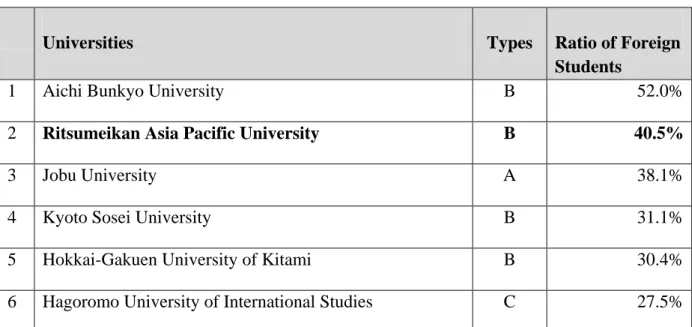
The 20 universities with the highest ratio of foreign students and 20 universities with the highest ratio of graduate students are listed in Tables 2.1 and 2.2 respectively.
Table 2.1 Ratio of Foreign Undergraduate Students, 2004
Universities Types Ratio of Foreign
Students
1 Aichi Bunkyo University B 52.0%
2 Ritsumeikan Asia Pacific University B 40.5%
3 Jobu University A 38.1%
4 Kyoto Sosei University B 31.1%
5 Hokkai-Gakuen University of Kitami B 30.4%
19
7 Niigata Sangyo University B 23.5%
8 International Christian University B 21.7%
9 Josai International University A 20.5%
10 Takamatsu University B 19.5%
11 Sonoda Women's University B 17.9%
12 Ryutsu Keizai University B 17.8%
13 Shizuoka Sangyo University B 17.6%
14 Bunri University of Hospitality B 17.5%
15 Nagasaki International University B 17.3%
16 Yamanashi Eiwa College C 15.6%
17 Kanazawa Seiryo University B 15.4%
18 Asahi University A 15.2%
19 Ube Frontier University C 14.5%
20 Hamamatsu University B 13.9%
Table 2.2 Ratio of Foreign Graduate Students
Universities Types Ratio of Foreign
Students
1 Ritsumeikan Asia Pacific University B 90.2%
2 Niigata Sangyo University B 83.3%
3 Ryutsu Keizai University B 81.4%
4 The University of Marketing and Distribution Sciences B 81.0%
5 Asia University B 79.1%
20
7 Nagasaki Prefectural University B 68.8%
8 Hiroshima University of Economics B 65.2%
9 Josai International University A 65.1%
10 The University of Shimane B 63.6%
11 Osaka University of Commerce B 63.0%
12 Kanazawa Seiryo University B 60.7%
13 Tokyo University of Marine Science and Technology B 60.6%
14 Hannan University B 60.6%
15 Bunka Women's University B 60.0%
16 Aomori Chuo Gakuin University B 57.1%
17 Reitaku University B 55.9%
18 Okayama Shoka University B 54.9%
19 Jobu University A 51.7%
20 Hamamatsu University B 51.2%
Based on the data from Daigaku Ranking 2006; Source: (Yamauchi, 2006)
2.4 University and Community Partnership
Historically, the university has often alienated itself from the community as the relationship between the two has always been a source of conflicts and frustrations. Early institutions, originally developed as a training ground for members of the ministry – being religious in nature, have often perceived the (town/city) community as being morally corrupt and believed that education should take place in rural areas – far away from the "evil ways" of the city (Brockliss, 2000). This serious concern initiated the creation of policies that would insure the safety and protection of students from the community thus resulting to the
21 complete separation of the university from its nearby/surrounding neighborhood. However, the past few decades have witnessed a dramatic change in the historically strenuous
relationship between the university and the community as universities began to recognize the even greater problems resulting from their separation. Many universities and colleges took the initiative of finding common ground with the communities and began to develop policies that would engage and strengthen their relationship with their surrounding communities (Bruning, et. al., 2006).
University-community relationships, as perceived by many, signify a potentially untouched resource in the revitalization of communities and in the development of
university's institutional and community leadership. Higher education institutions in cities are often in a position to engage the neighborhood in which they are situated (Bierbaum, 2005). "Universities and colleges are equipped to contribute effectively to their local neighborhoods in many ways, academically, economically, and beyond. For the most part, however, they are underutilized local assets" (Maurrasse, 2001). According to Andrew Cuomo, former
Secretary of the U.S. Department of Housing and Urban Development, "Universities are the creators, preservers, and transmitters of knowledge and culture; they are also economic engines, applied technology centers, major employers, investors, real estate developers, and reservoirs of creative and energetic people" (Cuomo,1998).
22 2.5 Nature of Partnership: Theoretical and Conceptual Understanding
2.5.1 What is Partnership?
To better aid the understanding of the nature of partnership between the university and the community, one must look at the concept of partnership not only from a conceptual, but also from a theoretical stand point as well.
An earlier definition of "partnership" was one given by White (1909) as "a contract of two or more competent persons to place their money, efforts, labor and skill, or some or all of them, in lawful commerce or business, and to divide the profit and bear the loss in certain
proportions". The Encyclopedia Britannica defines partnership as a voluntary association of two or more persons for the purpose of managing a business enterprise and sharing its profits and losses.
The World Bank (1998) offers its working definition of partnership as "a collaborative relationship between entities to work toward shared objectives through a mutually agreed division of labor." It also offers several key components of partnership to include: shared leadership, common purpose, common understanding, culture and values, learning and development, communication and performance management.
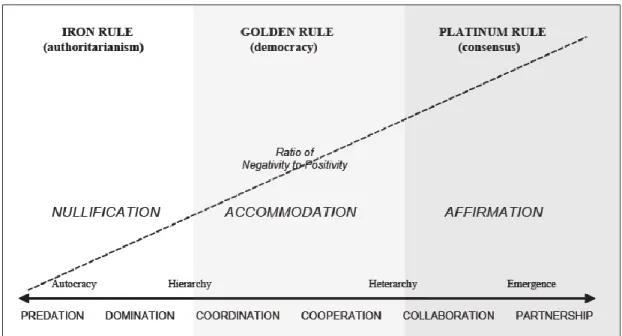
Uhlik (2007) sees partnership as a "transforming relationship oriented toward the mutual achieving of meaningful goals" and earlier put forward what is called partnership continuum as shown in the following diagram. The diagram (Figure 2.1) shows that
23 regime (Iron rule), predation and domination prevail, whereas under democracy (Golden rule), coordination and cooperation exist. Real partnership and collaboration is possible whenever there is consensus (Platinum rule) in society about mutual concerns. (Uhlik, 2006)
Figure 2.1 Partnership Continuum, (Uhlick 2006)
It must be noted, however, that the term 'partnership' is often used generically, lacks a definition and model, and has a wide variety of interpretations. (Linder, Quill, Aday, 2001). According to McQuaid (2000, p.3), the term "…covers greatly differing concepts and practices and is used to describe a wide variety of types of relationship in a myriad of
circumstances and locations." Although numerous case studies of partnerships exist, the more theoretical basis for understanding and analyzing them remain underdeveloped. Thus,
examining or evaluating 'partnership' as a theory often becomes a challenging task. (Eilbert, 2003; McQuaid, 2000; Linder, et al, 2001; Wannop, 1990)
24 'Partnership', as defined by the American Heritage Dictionary (1992), is "a
relationship between individuals or groups that is characterized by mutual cooperation and responsibility, as for the achievement of a specified goal." The term "partnership" was first used in business law where it was used to describe a contract for a fair division of the profit and loss of a joint business and later on applied to organization and management areas (Linder, et. al., 2001). The Merriam-Webster Dictionary (2010) also shares a similar notion of partnership. It defines the concept as "a legal relation existing between two or more persons contractually associated as joint principals in a business" ;and/or as "a relationship resembling a legal partnership and usually involving close cooperation between parties having specified and joint rights and responsibilities".
Underlying the definition of partnership are three fundamental assumptions according to McQuaid (2000), such as: a) potential for synergy; b) generation and implementation of strategies and projects; and, c) private-public partnership is also social where the public sector does not necessarily pursue commercial goals.
Partnership, simply, involves cooperation – working or acting together for common benefit. In public policy, partnership can be defined as cooperation between individuals or organizations in the public or private sector for mutual benefit (Holland, 1984).
Partnership in this study is used generically to cover organizational relations and affiliation between university and community. Partnership in this manner is one "based around a common goal, where participating organizations (groups) share benefits and risks, as well as resources and power. The partnership agreement may be formal and in writing or
25 Generally organizations join together in pursuit of self-interest which may be shared with others. Partnership must have a shared purpose, a common understanding of problems to deal with and an understanding of organizational roles in dealing with an identified problem or concern (Wood and Gray 1991) Motivations for engaging in partnership must be clear for both parties and doors are open for understanding differences and the means available for settling them.
2.5.2 Related Concepts
2.5.2.a Participation and partnership
There are a number of concepts and terms associated with partnership such as
collaboration and participation, among others. The Oxford Dictionary defines participation as the act of taking part or sharing in something. Viera (1991) refers to it as a process based on the citizens physical involvement in shaping society's development and projects and
benefiting from its results. The World Bank (1994) offers a similar definition to that by Viera (1991) describing participation as a process, through which stakeholders' influence and share control over development initiatives, decisions and resources that affect them. It regards participation as a vehicle that allows stakeholders to have a direct effect on policy
formulation, alternative designs, investment choices and management decisions concerning their respective communities. In the ladder of participation Arnstein (1969) included partnership as one involving shared planning and decision-making by parties through such mechanism as joint committees among others.
26 Figure 2.2 Arnstein's Ladder of Participation (1969)
2.5.2.b Private-Public-Community Partnership
Recently partnership has been gaining ground due to the realization of the
contributions of different sectors of society in formulating and implementing projects that would benefit the community as well as parties involved. More specifically, public-private and community partnerships refers to the combination of public, business and civil
constituencies who engage in voluntary, mutually beneficial, innovative relationships to address common societal aims through combining their resources and competencies
(Copenhagen Center, 2000). In essence they are collaborative efforts among the three sectors to achieve shared and compatible objectives that would contribute to the common good of society. These partnerships according to Tremolet and Browning (2002) may take on different forms but can essentially be grouped into three main categories, consultative, collaborative and strategic. Consultative efforts can include but are not limited to ad hoc seminars, workshops and conferences. Collaborative efforts can be specific one-off events, campaigns and other issue-specific projects. Strategic partnerships can include consultative processes as well as the formation of statutory and non-statutory advisory bodies.
27 2.5.3 Related Theories
2.5.3.a Enforced Cooperation
The concept of cooperation is central to partnership. One of the theories that provide insight into the nature of partnership is that of enforced cooperation. This theory proposes that cooperation is possible only when there is effective central control or common compelling reason or motive to achieve mutual benefits among parties involved in such partnership. Cooperation is possible whenever there is threat of coercion or negative consequences. It was Hobbes (1651) who maintained that developing cooperation is not possible without defined and enforcing central authority. This argument is supported by the Darwinian perspective of competition and survival of the fittest. Ridley (1997) a biologist, says that humans are selfish by nature but likewise have the potential to be trusted, to cooperate and to associate with others especially if such would benefit them. So that partnership is possible if the instinct to cooperate can be awakened or harnessed by various means including threats of control or authority and by making them aware of the benefits of such cooperation. For instance, cooperation for community welfare can be enhanced through regulations or ordinances and such other means as financial controls.
When the people and the government share common vision and objectives for the welfare of the community, there is a motivation to cooperate. In reality however, differences in priorities, knowledge, resources, personal factors and the competition for power and recognition may blur the prospects for meaningful partnership. This situation calls for more authoritative direction and positive enticements from the part of organizations or individuals seeking partnership.