熊本学園大学 機関リポジトリ
Procuring Better Employment and Income in
Tourist Industry, Siem Reap, Cambodia: The
Role of English Communication Ability
著者
Morrow Jeffrey Stewart
学位名
博士(経済学)
学位授与機関
熊本学園大学
学位授与年度
2014年度
学位授与番号
37402甲第39号
博士論文
Procuring Better Employment and Income in
Tourist Industry, Siem Reap, Cambodia:
The Role of English Communication Ability
2014 年度
モロー ジェフリー スチュワート
熊本学園大学大学院
経済学研究科経済学専攻
Procuring Better Employment and Income in Tourist Industry, Siem Reap, Cambodia: the Role of English Communication Ability
Abstract
During the history of both developed and developing countries, one of the most important undertakings for policy makers, governments, and economists has been the creation of employment and income on both the large and small scale. Accordingly, hundreds of both empirical and theoretical research studies have been completed to combat the dilemma of global employment and income. A major shortcoming however is that research on the role of English in procuring better employment and income has been lacking. The author conducted a continuous study of 4 surveys over 5 years to examine the question of English communication ability in tourist industry employment and income. To this end, the goals of this study are: 1) to verify the role of English in procuring better employment and income in the tourist industry of Siem Reap, Cambodia; and 2) to integrate the field of English education into the field of development economics. Chapter 1 offers the research background and also reviews related literature. Chapter 2 examines the socioeconomic background of Cambodia and Siem Reap. Chapter 3 contains the study on procuring better employment and income in tourist industry, Siem Reap, Cambodia: the role of English communication ability. Chapter 4 offers the main findings of the study, explains the main contributions of the study, and gives policy suggestions derived from the survey situation.
Table of Contents
Introduction
... 1Chapter 1. Research Background and Review of Related Literature
... 31.1 Research Background ... 3
1.2 Review of Related Literature ... 9
2.1 Review of Literature Related to Tourism and Economic Growth ... 9
2.2 Review of Related Literature to Education, Employment, and Income ... 10
2.3 Review of Literature Related to English Language Proficiency,Employment, and income ... 14
Chapter 2. General Socioeconomic Background of Cambodia
... 182.1 Location of Cambodia and General Features ... 18
2.2 Siem Reap, Gateway to Angkor ... 19
2.2.1 Cambodian Employment ... 20
2.3 Three Main Businesses in Development Post Khmer Rouge ... 21
2.3.1 International Aid Agencies ... 22
2.3.2 Trade ... 24
2.3.3 Tourism ... 25
2.4 English Education in Cambodia: A Retrospective Tourism View ... 30
2.4.1 General Education Background ... 30
2.4.2 The Introduction of English Education ... 32
2.4.3 Tertiary English Education ... 34
Chapter 3. Procuring Better Employment and Income: The Role of English
Communication Ability
... 373.1 Preliminary Survey, 2008 ... 40
3.1.1 Preliminary Survey, Dates, Sample, Location ... 41
3.1.2 Preliminary Sample Breakdown ... 42
3.1.3 Socioeconomic Features of 2008 TI Businesses ... 42
3.2 Introduction to the Surveys of 2010, 2012, and 2013 ... 44
3.2.1 Survey Method, Dates, Location, Sample, and Limitations ... 46
3.2.2 Methods ... 46
3.2.3 Survey Dates and Location ... 48
3.2.4 Samples ... 49
3.2.5 Limitations ... 50
3.3 General Socioeconomic Conditions of Siem Reap TI: Survey Results ... 51
3.3.1 Classification and General Socio-economic Features of the Businesses ... 52
3.3.2 General TI Demographics ... 61
3.4 Method of Analysis ... 64
3.5 Statistical Results of SR TI Businesses Under Study ... 66
3.5.2 Correlation Results ... 80
3.5.3 Spearman’s Rank Correlation Results ... 82
3.6 Discussion and Further Implications ... 83
3.6.1 Income Distribution ... 83
3.6.2 Generating Employment with English ... 84
Chapter 4. Main Findings, Contributions, and Policy Recommendations
... 894.1 Main Findings ... 89 4.2 Main Contributions ... 91 4.3 Policy Recommendations ... 91
Concluding Remarks
... 96References
... 101Appendices
... 105Introduction
Researchers have examined the question of what variables are at play to increase income in any population. Moreover, many experts have begun exploring the question of income increase in the developing world. In this area, many aspects have been viewed thus far including age, years of schooling, gender, living situation, parents' education, and the like. Since the 1970's, researchers have examined earnings among immigrants into developed nations such as the United States to determining what might drive income. In the 1970's and 1980's, economic research began on the relationship between education and income (Becker, 1964; Mincer, 1974). Bleakly and Chin (2003) investigated language skills and earning of childhood immigrants into the United States. Some research (Casale and Posel, 2010) has focused on English ability and earnings where the language of business and politics is not the indigenous language. In this case, the research is focused on South Africa. Other researchers (Yoneoka, 2009) have examined the role of English language in tourism in the Far East.
Very little research has been undertaken in the direction of economic gain from the human capital acquisitions in intercultural communication, more specifically language communication, with respect to income and employment. Nor has much empirical research been completed on income, employment, and language proficiency in developing countries, and fewer, to the author's knowledge, have examined these facets within the tourist industry in developing countries specifically. The author’s research hypothesis was that since tourists visit a destination yearly, then with adequate communication training, employees could procure employment and also receive higher salaries with communication proficiency. With research data into this area lacking, the author’s goal was to examine employment and income in the tourist industry (TI) of a developing country. The objective of this thesis is twofold. Firstly, this study attempts to verify the effect of English communication ability on employment and income. Secondly, it also tries to integrate the field of English education into development economics.
In order to substantiate the author’s research goals, literature in 3 areas will be reviewed in this thesis. Those areas are: 1) the economic impact of TI, 2) literature related to investments in education and English education, and 3) literature related to English proficiency and earnings. As for research into the economic impact of tourism, a study by Ennew (2003), and information from the WTTC (2014) will be offered. Because background education and English education is paramount to this study, research by Becker (1964) and Mincer (1974) will be included. Finally, to strengthen the author’s goal in language proficiency and earnings, research by Bleakley and Chin (2003), Casale and Posel (2010), and Sandford (2002) and will be reviewed.
The author’s goal was to create 4 questionnaires over 5 years to administer to employees to gather data regarding total years of schooling, total years of English education, and expenditure for English study. The author then chose Siem Reap as the continuous survey locale due to its proximity to Angkor Wat and the fact that it is a typical cultural tourist destination, much like the Pyramids of Egypt, the Great Wall of
cultural tourist sites. Any language could be researched as a variable; however, since the author’s background is in English language education, English was chosen as the language used in research. Since the author’s goal was to examine background educational, life, and socioeconomic variables statistically, questionnaires were designed with this aim in mind. Early on, a question arose as to how to determine English proficiency. Because of this, the author designed an English language assessment system loosely based on the Common European Framework of References for Languages (CEFR), which can be used with any language. This system allowed the author to obtain English language proficiency assessment numerically to be calculated with statistical measures to determine correlations.
The method of research was to create the questionnaires, then to calculate sample sizes based on total number of businesses rather than population for all 4 surveys. The Angkor University Research Center for Economic Development (AURCED) provided much background information for the Siem Reap area. They also helped in hiring six advanced-level English students from Angkor University to act as assistants during the survey experience. The assistants were provided with hand-held IC recorders on which to record respondents’ self-introductions; the self-introductions were then assessed after the interviews to obtain English language proficiency. After the interviews, the data in each of 4 surveys were calculated using certain variables and statistical measures to determine correlations.
The thesis is structured thusly: chapter 1 contains the research background and review of related literature. Chapter 2 offers general background of Cambodia including Siem Reap. It also offers the author’s idea on 3 factors that assisted in the economic recovery of Cambodia after Pol Pot, and examines the history of English education in Cambodia. Chapter 3 offers the study on the employment and income in TI using the role of English proficiency. Chapter 4 contains the main findings of the study, and offers policy suggestions.
Chapter 1. Research Background and Review of Related Literature
IntroductionImportant to any research work is the relevant background. This is necessary to explain any background elements the reader must know to grasp the full impact of the research work. The next section contains information on the communication process, gives information on second languages, and examines the author’s English proficiency assessment system, which was administered during the surveys in Siem Reap to obtain accurate English language proficiency levels. To link the author’s research to the existing studies, the author will then offer reviews of literature related to education, employment and income; as well as literature related to English language proficiency, employment, and income.
1.1 Research Background
When the author visited Cambodia in 2000, it was obvious that TI employees could not speak English well, nor did they have training or experience in hospitality management. This is one reason the author decided to do research in English ability, employment, and income in the TI of Siem Reap City. The objective became an examination of the role of English ability on employment and income Siem Reap TI through economic analysis of an empirical study, which was designed by the author. This endeavor was difficult for several reasons. First, Cambodia was long an isolated country and closed to Western influence. As a result, researchers had obstacles in gaining access in order to complete survey work. Secondly, the language barrier in Cambodia makes communication difficult; many people can speak English, but it is not the norm, nor is it the language of business or politics. This means that researchers must have access to Cambodians with English and translation abilities. One more reason SR was chosen was the events of Pol Pot in Cambodia from 1975-79. Although horrific, the situation has made this country unique in that during this genocide, thousands of intellectuals including academics, doctors, teachers and even students were executed. This meant that younger population did not have adequate role models from which to learn basic aspects such as infrastructure development. In addition, libraries, hospitals, and academic institutions were burned. Economic, social, and educational data were also destroyed, leaving the country in chaos. These conditions meant that much vital information and important socioeconomic, educational, and individual data is now missing, and this has had a largely negative effect on the people and society.1 After this experience, the multitude of new visitors led to growth of TI in Siem Reap. The author’s research and following analysis will take the stance that, since many international tourists visit Siem Reap from all around the world annually, the tourism labor force needs to have strong intercultural communication skills, English language proficiency and other interpersonal skills, such as cultural
1
and human knowledge, to attract would-be tourists and to accommodate them efficiently. Since there is an incredible lack of individual socioeconomic data in Siem Reap, especially on the role of English and education in employment, the author has set out to gather socioeconomic, general education, and English education background data of individual tourist industry TI employees in SR, and to examine returns to investments in English education to elevate English communication ability. During the process, the author collected important individual data, much of which has not been collected before. English background, along with various other aspects such as on-the-job training and other learned skills, should contribute to returns on investments if treated as a form of education. The author has found through survey work that employees with higher overall education, longer years of general schooling, longer years of English study (both in school and on one's own), and spending more money to achieve better English proficiency, all have higher paying jobs in the TI of SR. It is impossible to say that English alone contributed to the higher incomes and returns. There are many other factors that contribute to higher incomes and employment such as ambition, drive, incentive, ability, and other personal attributes. However, individuals with English ability have better overall income and employment experiences according to survey results. These experiences include ease of finding jobs, ability to keep jobs, better lifestyles, better conditions overall, better sense of community contribution, and better sense of their own employment.
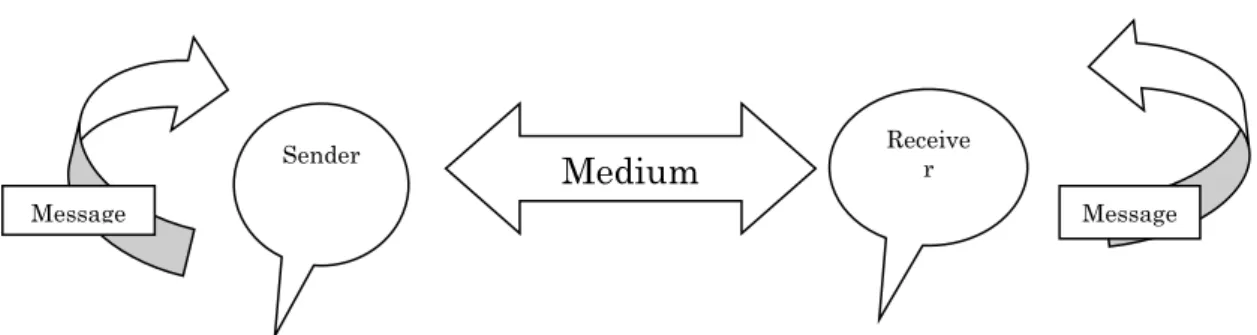
Communication2 itself is an uncomplicated process in which two bodies transmit information, and includes a sender, a medium, and a message (Fig. 1.1).
Figure 1.1 The Cycle of Communication
Source: Adapted by author from Reisinger, 2009.
Intercultural communication thereby refers to this same process although among different cultures. Within intercultural and international settings, communication entails different aspects, and through communication within and among different cultures, many difficulties may arise, such as incorrect word usage and unintelligible body language. With education, training, and experience, these problems can be alleviated, leading to satisfying and interesting experiences (Reisinger, 2009) for all involved in the communication process, especially in TI as it is a profession in which
2
Let the definition of communication for this paper be "face to face speaking using language."
Sender
Medium
Receiverintercultural communication is used on a continual basis, both in developed and developing countries worldwide. As a result, TI is extremely important for increasing any nation's GDP, not to mention creating millions of jobs yearly. As mentioned above, communication itself is the process entailing a sender, a receiver and a message, and usually means verbal communication. When one mentions intercultural communication, one means mainly language, although communication can range from speaking, to radio, TV, Internet, print, etc. Those working in tourism must have knowledge of intercultural communication, and all its facets: gestures, language, and symbols. TI and all hospitality related jobs are primarily comprised of endless face-to-face interactions with tourists, and as such intercultural communication becomes necessary. Intercultural communication entails not only talking, but is also a process whereby people can understand a shared meaning in symbols, body language, certain cultural codes, and language and behavior in context. If two people are “of the same mind,” or “on the same wavelength,” they can have an experience of “maximum satisfaction” through a shared language, understanding of body language, and knowledge of cultural clues.3 Reisinger et al. (2004) proposes that a new concept of intercultural communication should be the acknowledgement of cultural values, and that the focus should be on effective communication rather than just idle talk, showing the necessity of effective second language and intercultural communication proficiency in the tourism process.4 Hand in hand with intercultural communication is second language proficiency. A second language can be defined as a language people share which is not the mother tongue (the language one learns upon growing up), usually another language with which people have knowledge, and also defined as a lingua franca. (Chirikba, 2008).5 Many examples of lingua franca exist today; the most widespread second language is English. Other historical examples of lingua franca are Spanish in South America, and Latin in the European colonies. Arabic has become the lingua franca of choice in the UAE (United Arab Emirates) since the 7th century due to the enormity of the Arab population at that time. Of course, English is perhaps the most widely used second language, and can even now be considered a world language. English has become a world language most likely stemming from the British imperialism, which existed in the 19th century throughout much of Asia. Although some countries rebut this notion because of the feeling of imperialism, it nevertheless has taken root in modern societies as a lingua franca in politics or business. In addition, the official language of air traffic control is English. Kachru (1985) has categorized the use of English internationally in three areas: inner circle countries, which use the language daily as a mother tongue, and include the United States, England, Canada, Australia, New Zealand, South Africa, and
3
See Reisinger, 2009, for a detailed discussion of intercultural communication. The term, “maximum satisfaction” was coined by Maung Maung Lwin 2010.
4
See International Tourism: Cultures and Behavior for further discussion (Reisinger, 2009). 5
See "The problem of the Caucasian Sprachbund" Viacheslav A. Chirikba in Pieter Muysken, ed., From Linguistic Areas to
Caribbean nations; outer circle countries use English as the language of politics or business regularly and has cultural significance. Examples of outer circle countries include: India, Pakistan, Philippines, Singapore, Bangladesh, and Tanzania. The third category is defined as expanding circle countries, which also use English as a language of business or as a lingua franca and includes much of the rest of the world, and includes countries such as China, Japan, and the European nations.
Why English is the international language and whether it should be is considered a complex and difficult topic, filled with debate. However, to this date it has become so, due to the large population familiar with, and adept in, speaking and writing it. Perhaps it can be said that English is easier to learn than other languages because it lacks certain native language requirement criteria that other languages possess: gender specific nominal forms (such as the gender endings in French and Spanish); complex verb conjugations as in French or Spanish; complex ideographic writing systems such as Chinese, Japanese, or Arabic. The word order in English is fairly consistent, the spelling is not incredibly complex, and the pronunciation can be loosely based. Of late, the term world English has been coined to contain English that is accented from the speakers' first language, but is grammatically consistent. Researchers (Richards, 2011) have the viewpoint now that native-like English is not necessarily the best goal for lingua franca speakers to strive towards, but that grammatically sound, accented English proficiency is perfectly acceptable. It certainly cannot be stated with any certainty that a language is easy; any second language is difficult to learn when the target language contains features which are not in the first language repertoire, such as in a Japanese speaker learning English, an English speaker learning Japanese. Another factor that makes learning a second language difficult is the critical period hypothesis (Lenneberg, 1967), which states that there is cut-off period (usually associated with puberty) after which learning a second language is difficult or impossible. In bilingualism this period is determined to be around 6 or 7 years of age; in second language acquisition it is determine to be roughly around 12 or 13. The critical period hypothesis reports that beyond this age, learning a second language is difficult, because of the loss of brain elasticity (Penfield and Roberts, 1959). The critical period is widely accepted, but also widely debated; many researchers currently think that with training it is possible to learn a second language well, and that motivation and identity (Moyer, 1999) play a more important role in second language acquisition than does the critical period. Nonetheless, learning a second language can be difficult, but it is possible to speak adequately well in a second language with practice and training. Just by virtue of the fact that millions speak English as a second language or language of business yearly makes it easy to see that it may be easier to grasp than other languages.
In order to know exactly how language speakers use English, and what their abilities are, language assessment testing must be carried out. As mentioned in the introduction, data collection for analysis from survey work is completed on a broad scale and uses census data in many cases. Census data can be used adequately in many cases for topics such as: length of time in the particular country; average monthly expenditure average income; number of children; age, gender, etc. These data can all
be quantified for use in statistical analysis, such as calculation of the means, variance, covariance, and to perform correlation tests. English proficiency data is collected using census data in most cases, allowing the researcher to gather large amounts of data saving money and time. However, the English proficiency is often self-reported which can lead the respondent to over or undervalue his or her own ability. The US Census (2000) uses English proficiency questions on a four point scale self-rating scale of those who can use English: 1) very well; and 2) well; 3) not well; and 4) not at all; the levels are further broken down into: speak English at home; and speak a language other than English at home. (U.S. Census Bureau, 2000). Because of the subjective nature of the English assessment, it is the author's belief that this type of data collection does not gather accurate evidence of a true English proficiency level. Accuracy in measuring language proficiency is important in order to correlate it with length of time in a given country, in a particular employment situation, or at a specific income level. This four-point scale system is not adequate for appropriately measuring English proficiency. As Glimpse notes,
"English language proficiency is a cornerstone of communication, business, and the economy. Data on English language proficiency equip us to better understand 'where we are' and help enable us to develop plans to identify problems areas and improve on English language proficiency. Much of the challenge, and opportunity, to make improvements lies within the realm of K-12 schools and school systems….But, decennial census (Census, 2000) data do not tell us about English language proficiency (ELP) for those who speak only English. In addition, census data are respondent-based. Data about language proficiency is in the view of the respondent." (Glimpse, 2012).6
Of course, the author understands that this information is based in the United States, and therefore is America-specific with regards to English language proficiency, within the U.S. However, other census data, such as that found in Casale and Posel (2010), and Chiswick (1995) use other census and similar large-scale data for English proficiency; most English proficiency is measured using the common four-point, self-reporting scale. The author believes that if one measures language proficiency in any context and any country, it must be done so in a standardized fashion. Time and monetary constraints make this difficult, but a newly fashioned system, utilizing a website on the Internet for example, may be able to eventually alleviate this burden. Measuring second language proficiency in any person is a difficult and sometimes controversial topic. However, second language proficiency and communicative competence (Hymes, 1966) is especially important in order to avoid
6This information is by Warren Glimpse, founder of Proximity, a group that helps organizations, such as Federal and state governmental, university, and other associations use strategic data to assist in decision making. Glimpse is econometrician and former US Census Bureau official. Further information on English proficiency, language use at home, and language
communication blunders that could lead to embarrassing, difficult, or incomplete experiences (Reisinger, 2009). It is also important in employment situations where those who work closely around particular language speakers must be proficient in that language. In developed countries, where there is ample funding to translate information into the mother tongue, or to hire interpreters, second language proficiency may not be a significant issue. However, in developing countries it may not be feasible to simply translate or interpret due to lack of adequate financing vehicles. As can be agreed, language proficiency is a complex and debatable topic. The method of choice for determining English language, and other language, proficiency has been using self-reported data on censuses or other large-scale surveys. In conversations with linguists, the author has determined that it is worthwhile for a speaker to be able to judge his or her own language ability, although to measure language proficiency accurately requires a more quantifiable approach. In 2010, 2012, and 2013 during the author's survey in Siem Reap, Cambodia, a more concrete, quantifiable method of measuring English proficiency was administered. This design was loosely based on the Council of European Framework of References for Languages measurement system. The CEFR system is proposed by the Council of Europe to determine EU citizen's language proficiency, widely employed in the EU, and is now being used in other countries such as the Philippines and Vietnam. The system judges respondents on a six-level scale of low-beginner to advanced six-levels, and is applicable to any language. The CEFR encapsulates various kinds of knowledge: linguistic, sociolinguistic, pragmatic, and contains six reference levels for application to any language. The author emulated these features but also simplified the scale on a 0 (no ability) to 5 (advanced ability) to be useful in the context of Cambodia where many people cannot speak English at all. This system builds upon the CEFR by creating the levels more appropriate for the Cambodia. For example, very few reach the way-stage or threshold levels as depicted in the CEFR. For this reason the author chose only simple classification for those in Cambodia. An additional change in the author’s system is that the English ability levels can be quantified, and therefore can be tested numerically. These tables show the levels of the CEFR (Table 1.1) and the author's variation (Table 1.2):7
Table 1.1 CEFR Reference Levels
A1 Breakthrough or beginner - can understand familiar everyday expressions, can introduce self
A2 Way-stage or elementary - can understand and use expressions within immediate relevance
B1 Threshold or pre-intermediate - can understand main points and deal with traveling
B2 Vantage or intermediate - can understand and produce ideas on concrete and abstract topics
C1 Effective operational proficiency - can get implicit meaning, can use language flexibly
C2 Mastery or advanced - can understand everything, can express spontaneously and fluently Source: Council of Europe for Language Education, 2001.
7
Table 1.2 The Author's Variation of English Ability Assessment 0 No or little ability - can't communicate at all
1 Low Beginner - can only understand and use familiar everyday expressions
2 High Beginner - can understand and use expressions within everyday relevance
3 Low Intermediate - can understand many things, can produce but with many mistakes
4 High Intermediate - can understand and produce ideas but with lower confidence
5 Advanced - can understand everything and produce fluently and confidently Source: Morrow, 2010.
1.2 Review of Related Literature8
In order to verify the importance and to show the viability of a study linking English ability with employment and income the author will introduce several documents that are related to this study. These include: tourist industry and economic growth; human capital; schooling, experience and earning; income and employment with English proficiency in Africa; language skills and earnings of childhood immigrants to the U.S.; and English proficiency and income in Mexican immigrants to the U.S. The first study is related to TI and economic growth. The next 2 documents are based on human capital and its contributions to per capita GDP income; the following documents are related to English proficiency and earnings.
1.2.1 Review of Literature Related to Tourism and Economic Growth
Ennew (2003) considers the way in which individual countries benefit economically from tourism. Tourism expenditure basically provides three main positive effects: 1) direct effects, which are contributions from tourist expenditure and is immediate income for TI business; 2) indirect effects, which, as the expenditure is received by the business is re-spent for daily upkeep of business through purchases necessary items; and 3) induced effects, which are contributions spent by businesses and governments, and household consumption, such as taxes and the like. In a sense, GDP contributions are multiplied through the economy, and the effects throughout the economy can be considered. Ennew states that there are many social factors as well as economic ones that stimulate economic growth, particularly in countries that do not have many natural resources, such as Jordan, Ireland, the Caribbean, and Egypt. Cambodia has seen a high influx of TI activity, and perhaps TI will continue to be important for future economic growth there. TI also has a positive effect on development overall, especially regional development, which help regions of a country that do not have major urban centers or various attractions to offer tourists. Although Cambodia has Phnom Penh, Sihanoukville, and Siem Reap, these areas are not as bustling as some other major urban locations. Ennew has found also, that TI encourages local entrepreneurs and small businesses within areas that do not have access to larger labor markets, such as Siem Reap. According to Ennew (2003), such activity ranges from tour guide services to new attractions to production of local handicrafts.
8
As the previous paragraph shows, TI contributes to GDP in many ways. However, the assessment of the economic impacts to TI is difficult to measure, especially in developing countries. One method of assessment is the Tourism Satellite Account (TSA) for determining TI contributions to GDP, which is used extensively by the World Travel and Tourism Council (WTTC). The WTTC publishes reports annually. This fact is already widely known but, TI accounts for $US millions in contributions yearly in addition to creating thousands of new jobs in TI and TI offshoot businesses. A TSA is found by using national account information in calculations with the production of particular products by particular industries. Then it observes and the finances necessary for production. Tourism economic analyses often use input output tables. Input/output analysis draws on data in a particular industry for understanding the relationship between suppliers and producers (beverages and food, hotel accommodations, and the like) and their economic impact to meet consumer demand. The difference between the value of the outputs (capital and goods produced) by an industry and the inputs (capital and goods needed) that it uses can be examined; the impact of demand can be estimated using the input output table. For example, the increased activity in hotel accommodation or restaurant demand can be traced and calculated to check increased demand for the inputs these industries use to meet such demand (this includes labor and goods). It is included in this paper to exemplify that tourist demand for goods and services is especially high in souvenir shop, restaurant, guesthouse, and hotel businesses in SR, and therefore, both supply of goods as well as a trained labor force must accommodate tourist demand efficiently in SR TI. Accordingly, tourists’ spending in various aspects can be tracked and studied at length.
Using TSA’s, the WTTC reported that total direct contribution to GDP in Cambodia in 2013 was KHR 6,509.7 bn (10.4% of GDP) (WTTC, 2014). This figure was forecast to rise by 10.2% during 2014, and primarily represents TI related businesses such as hotels, restaurants, travel agencies, and passenger transportation. It is expected to rise by 6.2% or KHR 13,927.4 bn by 2024. As for employment, TI generated 735,000 jobs in 2013 (8.9% of total employment) and was forecast to grow to 784,000 during 2014.
1.2.2 Review of Related Literature to Education, Employment, and Income
The author chose the following work as important background because their work is from 30 years ago, and the economic situation 30 years ago in the U.S. is almost identical to the wage situation in Cambodia presently. Gary Becker (1964), noted University of Chicago economist and Nobel Prize Laureate in economics, completed monumental work and conducted empirical research in an economic and social field known as human capital. Human capital is the education, skills, training, and knowledge one has developed over one's life, and is very much like other more investments into a company’s stock of equipment or machinery. Becker has done much research on the economic impact of education and other human capital on employment, and has investigated the role of age, training, and education on income. He specifically investigated the role of age, training, and education on
monetary returns to investment. In research, Becker first wished to determine the rate of return to human capital attainments in education, but soon shifted towards creating a more unified theory of economics where all investments, such as on-the-job training and other knowledge, were taken into account. He noted that many economists were surprised that they could not account for the high levels of income they found in data. For example, age and years of education were two facets that could explain the income level of a particular person. It was found, however, that sometimes these facets could not explain employment and income levels entirely. Hence, some hidden aspect was at work influencing income levels, and Becker characterized this hidden aspect as human capital.
Mincer (1974) has further researched what drives income through an examination of the influence of years of schooling as a type of human capital. The relationship between schooling, followed by employment and income earnings during one’s life differ among individuals as do time investment in training, knowledge, and skills; Becker focused on human capital and Mincer focused on schooling. What can also be found is that long-term income shifts and time spent in schooling or unemployment made individual earnings incredibly difficult to compare. Correlations between education and income throughout an entire working life can be negative; this is a fact that has been seen by economists for many years. This is also the case in developing countries such as Cambodia, a fact that was documented by the author during research in 2008-2013. Mincer (1974) examined schooling as the simplest form of human capital, building upon the human capital foundation by Becker. He then expanded the model to encapsulate various schooling groups and examined how these groups differed in earnings. He accomplished this by relating life income to human capital investments after the initial schooling process; his objective was to understand the observed income distributions of accumulated investments in human capital for sets of employees. Outcomes of the distribution of personal income within the various age-education groups resulted; however, one problem was the sheer lack of background data regarding an individual’s investment in human capital. The total investment stock in human capital do not equal the total capital stock because some investments, such as those made in the home for example, are excluded from the individual’s net stock, and are therefore hidden as Becker discovered. Mincer was able nonetheless to receive important insights into the analysis of income distribution and individual earnings. In research, Mincer used one’s working life incomes to investigate the role of education after schooling from ages 15 to 64. Similarly, in Cambodia, many people have trouble finding work and are often unemployed, making the data collection and analysis doubly challenging. For this reason, we examined present situation only, and estimated returns to investments in human capital on the short term. Nonetheless, the author has made an attempt at being perhaps one of the first ones to capture data regarding income and English education and proficiency. English education and proficiency are essentially one in the same; one’s proficiency in English comes from some kind of English education. In a sense, all hours of, years of, amount of money spent on, lead one to becoming proficient in English. It is with this fundamental thought that the author approaches the study.
Mincer’s schooling model is essentially as follows: In Ys = In Y0 + rs
Where, InYs refers to the present income with s number of school years; InY0 to income with 0
years of schooling or experience; r to rate of return with one additional school year; and s to the total number of school years. This model basically infers that the present value of an individual’s income with s years of schooling (InYs) where one does not invest in human capital after s school years, is
equal to someone with no years of schooling or experience (InY0) plus the rate of return on
investments to education together with one additional year of schooling (r), multiplied by the total years of schooling (s). After analysis, Mincer found 3 main points: 1) people with more schooling have higher annual incomes, 2) as the rate of return on investments in schooling get higher, the difference between individual earnings due to differences in investment in schooling is larger, and 3) this difference is larger if the working life is shorter since the cost of education must be regained over a shorter period. These are perhaps obvious; however, Mincer made inroads by including empirical proof. In fact, in quantitative analysis Mincer has examined income distributions at length. Human capital attainments have been researched to examine and explain individual differences in income in subjects with different schooling ages in many regions and countries. As of Mincer writing his book, the only way to examine income differences and investments in human capital were limited to those related to schooling. Using Mincer’s schooling model, in simple regressions of income of working men ages 25-64, Chiswick (1967) found coefficient of determination (R2) values between 10 and 20% within U.S. regions using 1959 census data. These levels are quite low, and in regressions using the same regressions in white, non-farm working, and those who were not students were found to have coefficients of determination to be even less at 7%. This may have been because the model does not fit the data 100%, but the results were still positive. The schooling model did not account for human capital attainments post-schooling, nor those learned at home. Mincer also examined earnings of individuals using grouped data sets of years of schooling. Here he found that at median age 52, an individual with only 4 years of education earned US $2,5209 in the 10th year of experience. On the other hand, an individual with 17 or more years of experience at median age 37 earned US $10,200 in the 10th year of experience, US $7,680 more than the individual with only 4 years of education. Obviously, this is significant, and shows schooling does make a difference. Regression analysis using ungrouped data, which gives the ability to examine individual’s background rather than the group of schooling years, showed similar characteristics, and the R2 values were still not as high as preferred in regression analysis at 0.26 to 0.33. The standard deviations in these data were low, which signifies the data was close to the central line, but variance in years of schooling was quite high at around 7.9 in all regressions. Mincer wrote that the high variance and unequal distribution in schooling data is due to several factors and cannot be fully explained by differences in schooling years only. Factors of
9
unequal schooling years and earnings were: 1) the distributions of schooling investments was only partially measured by the distribution of schooling years; 2) because of lack of data, individuals were placed in average school departure age groups in which there is much dispersion; and 3) true variation was found to be overstated due to the differing returns even among individuals with the same amount of schooling and experience.
In an extension of this research, Mincer found that experience is more important than age in influencing income levels, especially at younger ages, due to the fluctuations of markets, elements of chance, psychological behavior, and the like. Mincer examined income individuals at a given level of education, and then separated them into different education groups to examine average incomes with experience. Finally, he considered individual differences in those with the same amount of schooling. Results of this analysis show that those with low levels of experience earn less income regardless of age, and found those with more experience earn higher incomes. Interestingly, Mincer found that economists with years of experience resulted in an R2 of 41%. In addition, those with years of age resulted in R2 value of 23%. Scientists exhibited an R2 value of 34% when examined with years of experience, and an R2 value of 24% with age included. Clearly, in such fields education is important, but this also implies that experience is probably the most important factor in income returns to investments in human capital. One problem Mincer had at that time was the lack of information as to an individual’s investment in human capital. In addition, long-term income shifts and time spent in schooling or unemployment made individual earnings difficult to compare. As Becker (1964) noted, the accumulations in human capital do not equal the total capital stock because some investments, such as those made in the home for example, are excluded from the individual’s net stock, and are therefore hidden. Nevertheless, Mincer was able to receive some insight into the analysis of income distribution and individual earnings.
Since human capital entails those things intangible, and encapsulates the inner knowledge one has attained, then the author argues that English communication ability, as any language proficiency, is also one facet of human capital, as it is entails intangible skills such as grammatical structure, pronunciation fluency, and interpersonal communication. Of course, language is both a tool and a skill, and is used by millions, especially in the tourism industry, in such things as hotel check in, dining at restaurants, and sightseeing. It is used for communicative purposes and allows travelers to have all-around pleasurable experiences from their trips. Therefore, language skill is necessary for those employees working in the tourism industry. Without ample language skill, many employees will find themselves in lower paying jobs, sometimes jobless, and will have lower incomes. This chapter argues that English is needed by people ranging from retail shop staff, restaurant wait staff, guesthouse and hotel front desk clerks, to taxi drivers, airline attendants, souvenir shop employees, and shop owners. Because of the value of language as a skill, it is a very important part of human capital, and is something therefore, that is worthy of investigation.
To this end, as the theoretical basis for this study, the author wished to build on Becker’s human capital work by examining hidden facets that are at play in returns to income; and also Mincer’s work with English proficiency as similar to schooling in human capital by addressing 2 things: 1) the socio-economic life of tourist industry staff in the developing country of Cambodia, and 2) a simple statistical analysis of English education and ability to generate employment and income in Cambodia’s TI. To satisfy this goal, the author incorporated several elements related to English education and proficiency into the Mincer schooling equation, such as total years of English education in school, hours of English education in school, amount of money spent on learning English monthly, which can be denoted as variables directly related to income. Those indirectly related to income are: frequency of English speaker visits to the establishment, usage of English in days per month, English ability on a scale from no ability (0) to advanced ability (5). These would be tested using data collected by the author during survey work in Cambodia during 5 years. The author changed this situation slightly because in developing countries, many employees do not finish high school, and many do not attend in the first place, making a comparison using schooling alone impossible. However, those working in tourist industry have good commands of English, whether learned in school or by oneself. This being the case, it is worth using schooling data as much as possible, but also by introducing the variable of English education into this fundamental idea.
1.2.3 Review of Literature Related to English Language Proficiency, Employment, and Income In English Language Proficiency and Earnings in a Developing Country: the Case of South Africa, Casale and Posel (2010) investigated the role of English in a country where the dominant language of business is English. In their research they found that high returns to English language proficiency exist, and that there was a large advantage to reading and writing English very well. Casale and Posel used data on those who use English at home and general English language proficiency to determine the relationship on English proficiency and earnings in African men. The data used for Casale's research was based on the National Income Dynamics Survey (NIDS), which tracked 28,000 individuals in approximately 7,300 households nationwide. NIDS gathers information on English language in self-reporting on a four point scale of very well, fair, not well, and not at all (Casale and Posel 2010). Casale chose a narrow definition of proficiency for their data examination, focusing on the ability to read and write the English language very well. Casale and Posel tested the relationship between earnings and English proficiency among African men between ages 25 and 65. Statistical results showed that individuals with a completed secondary education earned 120% more than those without any schooling. Proficient English language users earned almost 55% higher than non-proficient English users. The implications are that English language proficiency can elevate job productivity and also lead to more effective communication among co-workers and management. In the end, a high premium to English language proficiency for over 50% of respondents was found. Results also show that Africans who are not English proficient have no gain in the returns to
completed secondary or secondary education outcomes. In the study, African men who had post-secondary education earned approximately 97% more if they were also proficient in the English language. Statistical results were low but positive, and showed positive correlations between English proficiency and earnings, at least in the case of South Africa. Correlations were expected to be high, but this may be due to this survey situation, and may also be due to the accuracy of obtaining English proficiency. In many data collection situations, respondents' own English ability is self-reported. However, this is not accurate as self-reported abilities can be over or under-valued. In addition, this study focused on reading and writing only as the main determinant of English proficiency. Casale suggests a better method of determining English ability is through a proxy such as test scores (such as TOEFL or TOEIC), but this excludes many developing countries due to the cost. Perhaps the best way is a language proficiency test during face-to-face interviews. While these methods are time consuming and costly, similar methods must be achieved to measure English proficiency accurately. This could be accomplished by creating simplified version of a language proficiency assessment test, which should be produced and offered inexpensively over the Internet.
Bleakley and Chin's, Language Skills and Earnings: Evidence from Childhood Immigrants (2003) found positive results when measuring English proficiency and wages with adult migrants who immigrated to America as children. They worked under the assumption that inadequate language skills increase the earnings gap when measured with nativity. The 2000 U.S. Census, on which Bleakley and Chin base their research, stated that 10.4% of the U.S. population was foreign born, and that most immigrants were from non-English speaking countries. In the U.S. Census, respondents rated their own English ability on five levels: speaking only English, speaking very well, speaking well, not well, or not at all. In the 2000 census, 47 million residents in the US spoke a language other than English at home, and that 21 million of those spoke English less than very well. Bleakley and Chin found a positive effect on income and education in previous research using 1990 census data. A dramatic part of the effect of language skills appears to be achieved by schooling. Language proficiency's role in the establishment of human capital is more important that the effect of language on the entire labor product. When examined in a comparison with US immigrants, it can be predicted that those who enter the U.S. at a young age will be more adept at learning English as a second language than those who arrive later. This prediction is used in Bleakley and Chin's research; results for returns to language education show that one unit of increase in English speaking ability can increase wage rates by 39%. Investment in education may point to a significant boost in earnings, and can resemble earning patterns by age at arrival. Results show the effect of language skills on earnings show that those who can speak English very well can earn 33% more than whose who speak just well. As for the contribution of English language proficiency on income, results show that proficiency in English brings a substantialincrease in incomes. Much of this effect has to do with age of individual arrival into the U.S. and also to amount of education undertaken by the subjects. In conclusion,
U.S., who migrated there as children. Bleakly and Chin state that policymakers should be aware of these factors in designing classes for immigrants.
Jeremy Sandford (2002) measured the importance of English language on the wage rates of Mexican migrants into the U.S. English language has an effect on the wage rates of Mexican migrants into the U.S. The 1990’s saw a higher increase in Mexican migration than any other decade (INS 1999 in Sandford, 2002). Mexicans had one of the largest incomes among many groups, but earned much less than natives. Sandford points out that this could be due to the fact that Mexican migrants are self-segregated from the remainder of society; many lived in Hispanic-only neighborhoods in 1990 to be among those who share their culture and language. Unfortunately, many of those people also share low education and low English language skills. As such, they have less chance to escape poorer areas. Moreover, employers are not likely to open businesses in these areas, and as a result, Mexicans earn lower income. Sandford argued that English language deficiency, or the lack of English language skills, could determine this wage gap difference between native English speaking males and Mexican immigrants. Sandford (2002) hypothesized that Mexican migrants will not be able to move to higher levels because they lack communication skills, and used a sample of 81,059 adult Mexican migrants into the U.S. labor force from the 1990 U.S. Census to study the effect of English Language deficiency on incomes. The sample consisted of males 18 years of age and over who were born in Mexico and included in the U.S. Census as citizens. Sandford’s study used census data in which respondents rated their own English ability as to: speaking only English, speaking very well, speaking well, not well, or not at all. Sandford wished to measure language deficiency, and its effects on earnings. Results showed that those with college degrees but spoke no English earned 71.5% less overall than fluent English-speaking College graduates. Even those with a high school degree and spoke some English had a deficiency rating of only 30%. Those with labor experience can benefit with an extra year of experience, and earn 2.6% more. Some results show that a college degree helps earn 72.6% more than those with less than a high school education. Results also show that only migrants with a high school diploma or some labor force experience will make less than migrants who speak English proficiently. Results also showed that migrants who do not speak English at all earn half of what migrants who can speak English very well make. English speakers are generally better educated, and perhaps differences in human capital can explain this wage gap. English is important because English-speaking firms will offer more jobs in the long run, and English speakers can interact with co-workers better, and can learn about technology in English more quickly than non-English speakers. Employers do not hire those without the dominant language of the nation because they are less useful. Similarly, the author reasons that those with English proficiency in tourism will be able to find work easier, communicate efficiently with guests, and gain income advancement more readily within tourism related business in developing countries. A suggestion by Sandford for future research is to conduct a similar study with a better, clearer measure of English language proficiency. This statement adheres to the author's goal in that the author has developed a clearer numerical English
proficiency determination. The U.S. should also promote English education programs that would raise migrant earnings by increasing the return to their human capital investments.
The above studies are useful and interesting and verify the relationship between generation of employment and income through English among the labor force in Africa and America. It is difficult to apply the same research and analysis method in Cambodia, particularly due to the lack of similar data and information there. For this reason the author personally conducted the surveys within Siem Reap to collect data which otherwise was unobtainable. Data collection on site is also difficult because of the differing lifestyles, backgrounds, socioeconomic problems, and ways of answering questions during survey interviews. These are shortcomings, but through this literature review, the author wanted to show evidence that English proficiency is important in many different countries for better incomes and employment in many situations. Although there is no direct evidence in the case of Siem Reap, the author wished to emphasize that English is not only important for native English speakers, but also for migrants to developed countries and for those in developing countries as well.
Conclusion
This chapter examined several documents related to the author’s study: human capital, English language proficiency in a developing country, language skills and earning in migrants to America, and income rates with English proficiency in Mexican migrants to the U.S. These studies have shown that, without fail, English proficiency is important in obtaining higher incomes in both developed and developing countries. These studies used census data or a national income survey to gather and analyze data. In all cases the outcome empirically demonstrated the importance of English language proficiency to employment and income. However, all of the above studies used self-reported assessments from census data to analyze English proficiency assessment data, which is not accurate enough. This is not the fault of the researchers, but rather limited knowledge of measuring language proficiency. Therefore, the author wanted build on existing research concerning English language proficiency for employment and income, and to improve upon the limitations of using self-reported English language proficiency data by creating and utilizing a numeric and quantifiable language assessment system. This system has ensured that the author and the research team have obtained true and accurate results that can be correlated with other numeric data such as income, years of English study, hours of English study, money spent on learning English monthly, and the like. The next chapter more full explains the background of Cambodia, and offers a more detailed synopsis of the survey city: Siem Reap. A detailed discussion of the role of English in procuring better employment and income, as well as an analysis of survey results, can be found in chapter 3.
Chapter 2. General Socioeconomic Background of Cambodia
Introduction
This chapter will explain the background of Cambodia and Siem Reap, including the location, geographical features, and employment aspects, which will prove useful to being able to understand Cambodia more fully. This will assist the reader in understanding the hardships faced by Cambodia, and its subsequent slow development. Section 1 views the location of Cambodia, and gives geographical features. Section 2 introduces Siem Reap, considered to be the gateway to Angkor Wat and includes employment data. Section 3 explains 3 important factors in development post Pol Pot: international agencies, trade, and tourism. Section 4 introduces general education in Cambodia as well as a retrospective view of English education in Cambodia and tertiary English education leading to its role in the TI of Siem Reap.
2.1 Location of Cambodia and General Features
Cambodia is located in Indo-China, bordered by Laos to the northeast, Thailand to the north and west, and Vietnam to the south and southeast (Fig. 2.1). Roughly the same size as the U.S. state of Missouri, it has a small coastline on the south. Cambodia is basically a plain country, with the Cardamom Mountains on the north and southwest and the Mekong River to the east. The central plain is situated around Tonle Sap Lake, south of the Angkor area and the city of Siem Reap. The land area is 176,519 square kilometers (68,154 square miles). The estimated population as of 2010 is 14,753,320, consisting mainly of Khmer (90%), Vietnamese (5%), Chinese (1%), other (4%).
Figure 2.1 Map of Cambodia
Table 2.1 General Features of Cambodia
Particulars Unit of measure
1. Total population* 2. Total land area 3. Total Male* 4. Total Female* 5. Sex-ratio*
6. Total working age population (both sexes-Cambodia)** 7. Labor force participation rate (both sexes-Cambodia)** 8. Employment rate (both sexes-Cambodia)**
9. Population Density** 13.4 Million 181,035/km2 6,516,000 6,880,000 94.7% 8,865,000 84.4% 84.3% 75 persons/km2 Source: *Ministry of Tourism, 2010; General Population Census of Cambodia, 2008, **Cambodia Socio-economic Survey, National Institute of Statistics, 2009.
The total population is around 13.4 million, and was arrived at through the 2008 census. The Statistical Yearbook of Cambodia from 2011 states that, in fact Cambodia's population is declining. This is most likely due to the tragic loss of life during the 1970's. The total population sees more females than males, evident at a 94.7% sex ratio. The total working age population is 8.8 million, and labor force participation rate is 84%. Employment is long considered a problem in Cambodia, but the above data show the employment rate is actually 84.3%. This is because employment in Cambodia categorizes both those working and looking for work. More information on Cambodia employment is found later in this chapter. The population density is 75 persons per square kilometer.
2.2 Siem Reap, Gateway to Angkor
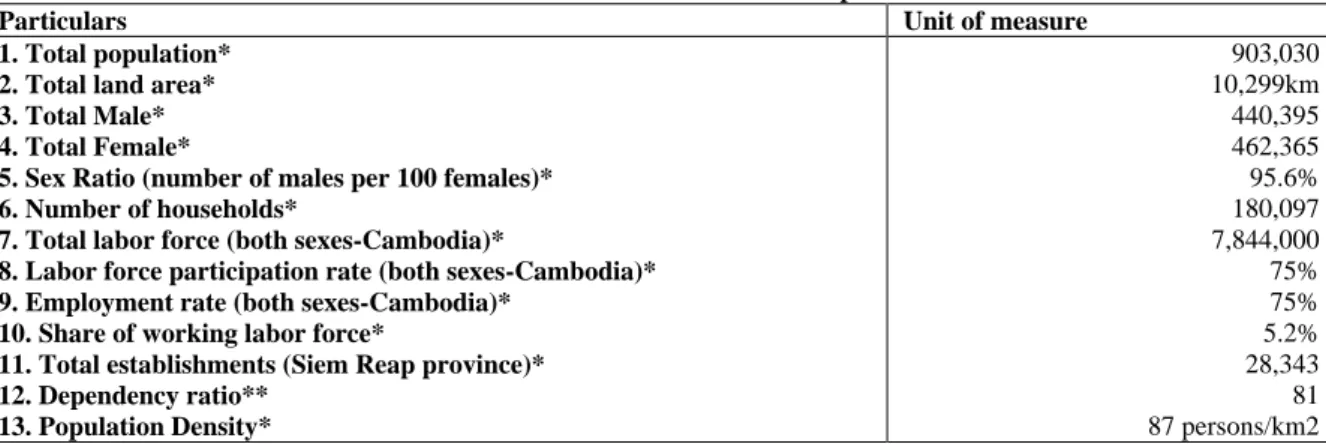
Siem Reap province is located in the northwestern part of Cambodia, north of Phnom Penh and around Tonle Sap Lake. It is also the home of Angkor Wat, which became a world heritage site in 1992. As of the last national census, the total population of Siem Reap Province was 903,030 or 6.3% of the country's total of 14,753,320. The population of Siem Reap Province was comprised of 440,395 males and 462,365 females. The land area of Siem Reap Province is 10,299 km. The population of Siem Reap City is 171,800 (Ministry of Planning, 2009). Table 2.2 provides general features of Siem Reap.
Table 2.2 General Features of Siem Reap Province
Particulars Unit of measure
1. Total population* 2. Total land area* 3. Total Male* 4. Total Female*
5. Sex Ratio (number of males per 100 females)* 6. Number of households*
7. Total labor force (both sexes-Cambodia)*
8. Labor force participation rate (both sexes-Cambodia)* 9. Employment rate (both sexes-Cambodia)*
10. Share of working labor force*
11. Total establishments (Siem Reap province)* 12. Dependency ratio** 13. Population Density* 903,030 10,299km 440,395 462,365 95.6% 180,097 7,844,000 75% 75% 5.2% 28,343 81 87 persons/km2 Source: *Cambodia Socioeconomic Survey, Ministry of Planning, 2009; **General Population Census of Cambodia, Ministry of Planning, 2008.
Siem Reap has become a thriving town center built along the Siem Reap River, within distance of Angkor Wat. Souvenir shops are located in the downtown Old Market area along with trendy restaurants, pubs, and guesthouses. It is also close to Tonle Sap Lake, important for fishing and a major sightseeing hub in Siem Reap. Siem Reap offers much to do for the traveler, including a visit to Angkor Wat and surrounding temples, a ride on Tonle Sap Lake, shopping at one of the many souvenir shops, visiting a handicraft museum and workshop, and eating at one of the many restaurants enveloping the area.
2.2.1 Cambodian Employment 10
In 2009, 84% of the working age population (ages 15-64) in Cambodia participated in the labor force, and 83% was considered employed, and 0.1% was considered unemployed. At that time, 88% of men and 80% of women were employed. Other employment data from the National Institute of Statistics of Cambodia in Table 2.3 shows that the percentage of working age population per sector, in 2010 is the highest percentage in tourist industry (TI) at 75% in Phnom Penh, 63% in other urban areas (such as Siem Reap), and 21% in other rural areas (National Institute of Statistics, 2010). TI of course falls under the services sector, and although it is low in rural areas, the service sector provides necessary employment for young Cambodians who have drive and ability. The services sector has large investment from foreign owners who can speak English well; those working in services need and use English as an International Language (EIL) regularly.
Table 2.3 Employed Population Share by Sector and Region, 2010
Phnom Penh Other Urban Other Rural Employed Population 687,000 772,000 6,214,000
Agriculture (share %) 1.6 19.7 64.3
Industry (share %) 23.3 17.8 15.3
Services (share %) 74.9 62.5 20.5
Other {Mining, etc} (share %) 0.2 0.0 0.0
Total 100% 100% 100%
Source: Labor and Social Trends of Cambodia, Ministry of Planning, 2010.
This table details the educational background of the labor force in certain sectors. It goes without saying that education is necessary for employees from many sectors. According to the 2011 Statistical Yearbook of Cambodia, 71% of both men and women in the labor force ages 15-64 with post-secondary education were employed, compared with 59% who were unemployed. In addition, 43.3% of employed service workers completed secondary schooling, as compared to 6.5% who had no schooling at all; of those remaining, 24.9% had not completed primary school, and 25.3% of employed labor force had completed primary school only. The next section contains information on three important businesses that helped Cambodia in redevelopment.
10
2.3 Three Main Businesses in Development Post Khmer Rouge
In the early 1970's, a son of a wealthy landowner, Pol Pot (whose official name was Saloth Sar) became involved in communist activities while in France during study there in the early 1950's.11 A poor student, he soon dropped studying altogether in favor of taking up with the Communist cause and quickly became completely engrossed. Upon returning to Cambodia, he joined the United Freedom Front (a Cambodian group of communists who were against French rule), and then found his way into the Khmer People's Revolutionary Party; this was the first group of communists in Cambodia. He began to hate intellectuals and politicians around this time and with several followers secretly began the Workers' Party of Kampuchea (WPK) at the railway station of Phnom Penh during September 1960. It appears he changed his name to protect his family. Pol Pot continued to organize his WPK with followers in the remote forests of Cambodia for the next thirteen years. His influence became stronger and stronger, and he aimed to stay on the positive side of Vietnamese communists who were themselves striving for control of Cambodia. Eventually, Pol Pot made numerous trips to Beijing to study organization fundamentals. The WPK thereafter changed its name to the Communist Party of Kampuchea (CPK), and Pol Pot was elected as Secretary General. In 1975, a new state of "democracy" was formed during a struggle for power between pro-Sihanouk groups, other communist groups, and Pol Pot's own CPK. During 1976, a new Democratic Kampuchea (DK) was created, and Pol Pot became premier; other top officials were quick to denounce and chastise many of the decisions by the leader, and rivalry intensified. Pol Pot began to remove any opponent in his party from office, including top party leaders such as cabinet ministers. It was at this time he began to force ordinary citizens into labor, and killed, tortured, and maimed university professors, academics, lawyers, doctors, and students, around 20% of the total population of Cambodia. Eventually animosity towards Pol Pot grew, and the Vietnamese attacked DK strongholds in Phnom Penh, forcing Pol Pot and the Khmer Rouge to disperse in January of 1979. However, they re-grouped in the forests around the Cardamom Mountains, and continued attacks on civilian territory. In July 1979, Pol Pot was tried in absentia for one of the worst mass murder episodes since Hitler. He stepped down as DK prime minister in December 1979, but remained as the secretary general of the CPK military commission, the top leading position of an over 20,000-man force army battling Vietnamese troops in Phnom Penh. After this the whereabouts of Pol Pot became unknown; in 1985 the DK officially announced that he had retired from the DK. In addition, they stated that he was re-appointed to the position of Director of Higher Institute for National Defense, although this position was most likely a façade. Even so, as the recognized communist leader of Cambodia, he unbelievably continued to hold onto power. He remained underground yet still in power while Phnom Penh continued to be demolished in the face of battle. He was eventually captured in 1997, after being hunted down by former Khmer Rouge