〈研究ノート〉A Detailed Derivation of the
Distribution of Class Identification in a “
Chance Society” : A Note on the Fararo-Kosaka
Model
journal or
publication title
社会学部紀要
number
114
page range
257-266
year
2012-03-15
URL
http://hdl.handle.net/10236/9021
1 Purpose
Kenji Kosaka and Thomas J. Fararo (1991) proposed a model, hereafter referred to as “the Fararo-Kosaka model,” to explain the generalization of images of stratification and distribution of class iden-tification. Because the Fararo-Kosaka model is mathematically simple and has a number of meaningful derivations, the model has attracted many followers. In particular, in Japan, the Fararo-Kosaka model has been considered a plausible theoretical framework for explaining the middle classification phe-nomenon, which has been empirically observed in the last three decades.
This note presents a detailed derivation of the distribution of class identification in order to help learners, especially beginners in mathematical sociology, to gain a deeper understanding of the model.
2 Axioms of the Model
The complete axioms of the Fararo-Kosaka model are described in detail in Kosaka and Fararo (1991), Fararo and Kosaka (2003), and Kosaka (2006). Here, we briefly introduce the essence of the model axioms.
Axiom 1. There exists a multidimensional stratification system S that is composed of a Cartesian
product of s characteristics C1, C2, …, Csand each Ciis ordered linearly. Each s-tuple representing a
social class in C1×C2×…×Csis ordered lexicographically. In a word, S is mathematically defined as
a linearly ordered set (C1×C2×…×Cs,!l) with a lexicographic order!l.
We call each of C1, C2,…, Csa “dimension” and each component of Cia “rank.” In the
follow-ing analysis, we assume that each dimension has an identical number of ranks more than 1 (i.e., the rank homogeneity assumption). The number of dimensions is denoted by s and the number of ranks in
Ciis denoted by r. At this stage, we call S the “s×r stratification system.” The ranks in Ci are
de-noted by integers from 0 as the lowest up to r−1 as the highest as follows: 〈研究ノート〉
A Detailed Derivation of the Distribution of Class Identification in a “Chance Society”:
A Note on the Fararo-Kosaka Model*
Atsushi ISHIDA
**─────────────────────────────────────────────────────
*Key Words: class identification, Fararo-Kosaka model, convolution of sequences
This note is partly based on the lecture notes for “Mathematical Sociology” at School of Sociology, Kwansei Gakuin Univer-sity in 2009 and 2010. This work was supported by the JSPS Grant-in-Aid Scientific Research 2333071 on “Theoretical and Empirical Studies of Relative Deprivation in Unequal Societies in a Time of Globalization” (2011−2013).
**Associate Professor, School of Sociology, Kwansei Gakuin University
Ci={0, 1, 2, …, r−2, r−1}.
An s-tuple representing a class in the stratification system is generally denoted by (k1, k2,…, ks), ki∈Ci.
Axiom 2. Each actor in the society has an initial image of the stratification system, and this image
consists only of one social class to which the actor belongs. The images of the stratification system change through interaction with others.
Axiom 3. In each interaction among actors, each actor’s image is transformed according to the
follow-ing postulated process: The actor searches for information as to the class location of the other actor (termed an alter) in an order corresponding to the lexicographic ordering and the search continues until a class distinction is made or all dimensions have been exhausted, whichever comes first.
Axiom 4. The following postulated process transforms the state of the image of any actor as a
conse-quence of any interaction. Let cl (a) be the sampled part of the class location of alter a, when the in-formation search process has been completed in that interaction. Then the following four transition rules determine the transformation of the image state:
1. If cl (a) is represented in the image that is already held by the actor, no change occurs. 2. If cl (a) is above the highest class in the image, then cl (a) becomes the new highest class. 3. If cl (a) is lower than the lowest class in the image, then cl (a) becomes the new lowest class. 4. If cl (a) is between some pair of classes in the image, then it is “inserted” between them in the new image.
Given that there is at least one actor in each class and each actor randomly encounters each other actor in the society, then sooner or later every actor will have a stable image of the system, which will remain unchanged by any further encounters. The last axiom is about the determination of class identi-fication that is also called as “self-location in the stratiidenti-fication system” in Fararo and Kosaka’s termi-nology.
Axiom 5. An actor expresses his/her class identification on the basis of the relative location of his/her
affiliation class on his/her own stable image of the stratification system.
3 Derivations of the Model
Findings of the Fararo-Kosaka model derived from the model axioms are examined in detail in a se-ries of articles and books by Fararo and Kosaka. Here, I only state the propositions relevant to the dis-tribution of class identification.
Proposition 1. The number of classes in any stable image is the same for all actors and is given by
s 2 s 3 s 4 s 7 0.5 1.0 1.5 2.0 ρs 0.2 0.4 0.6 0.8 1.0 1.2 s fρ rs n=s(r−1)+1. (1)
Proof. In the i-th dimension, an actor belonging to (k1, k2, …, ks) recognizes r−1−ki classes of
higher rank and kiclasses of lower rank. Therefore, the number of classes recognized by an actor is r
−1−ki+ki=r−1. Because this applies to all dimensions, we have s(r−1) classes. By adding 1,
which is the number of the affiliation class of the actor, we arrive at Equation (1).
Here, let us label the ranks on a stable class image from the top to the bottom as s(r−1),
s(r−1)−1, …, 2, 1, 0.
Proposition 2. For an actor who belongs to (k1, k2,…, ks), a rank of the affiliation class on a stable
class image, which is assumed to be actor’s class identification, denoted byρ , is given by ρ =!s
i=1ki. (2)
Proof. The rank ρ is given by the total number of classes recognized to be of lower rank by the
ac-tor. As the total number of classes recognized to be of lower rank in the i-th dimension is ki, the
sum-mation of all dimensions yields Equation (2).
According to Fararo and Kosaka (1991), we now introduce the term “chance society” to denote a society in which an equal number of people are assigned to each logically possible class in a stratifica-tion system. In addistratifica-tion, to simplify the following descripstratifica-tion, we assume that one person is assigned to each class. Then, the last proposition is about the distribution of class identification in a “chance so-ciety.”
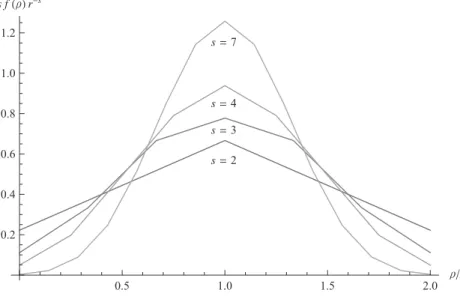
Proposition 3. In a “chance society,” the distribution of class identification ρ is given by a function
f (ρ ) such that
Figure 1: Distribution of class identification in a chance society (r=3)
f (ρ)= [ρ /r]! k=0(−1) k+ρ −rk
(
ks)(
−s ρ −rk)
(3) = [!ρ /r] k=0(−1) k(
sk)(
s+ρ −rk−1 s−1)
(4)where [a] denotes the integer part of a, and
(
sk)
denotes a binomial coefficient.Kosaka and Fararo (1991), Fararo and Kosaka (2003), and Kosaka (2006) present this distribution function in the form of Equation (4) from a textbook on combinatorial mathematics by Niven (1965). On the other hand, Yosano (1996) and Kosaka and Yosano (1998) present this proposition in the form of Equation (3) from the proposition of the convolution of independent discrete uniform distributions (Feller 1957). Given that each dimension of stratification system is independently uniformly distrib-uted over Ci, we get the probability function of class identification by dividing the above equation by
rs. Furthermore, apart from the chance society assumption, according to the central limit theorem, it is
concluded that relative class identification ρ /s is asymptotically normally distributed on N (μ , σ2/s)
if s→∞ given that each dimension is independently and identically distributed with mean μ and vari-ance σ2 (Yosano 1996; Kosaka and Yosano 1998). Finally, Hamada (2012) proves by using the
Lyapounov’s central limit theorem that relative class identification is asymptotically normally distrib-uted no matter how each dimension is distribdistrib-uted, as long as each independent distribution of dimen-sion has finiteμ , σ2
and the maximum value of ranks.
These propositions are mathematically true and there are no words to be added to the propositions in terms of mathematics. However, it is worth noting the detailed derivation of Proposition 3, espe-cially for undergraduate students who have a strong desire to learn mathematical sociology and want to completely understand the derivation. Therefore, in the next section, we present the derivation of Proposition 3 in terms of the convolution of sequences.
4 Detailed Derivation of Proposition 3
Let us consider the distribution of class identification in a chance society where one person is assigned to each class.
4. 1 A Case with r=2
First, we shall consider the case in which each dimension of the stratification system consists of two ranks Ci={0, 1}.We want to determine the number of s-tuples (k1, k2, …, ks), ki∈{0, 1} that satisfy
the constraint condition ρ =!si=1ki. In this case, if ρ of the s dimensions are 1 and the rest are 0,
then the condition is satisfied. This leads to “the combination of s objects takenρ at a time.” Hence, the number of actors whose class identification isρ , denoted by f (ρ ), is given by
f (ρ )=
(
ρs)
=sCρ= s!ρ !(s−ρ )!. (5)
From the binomial theorem,
(1+x)s= s ! ρ =0
(
s ρ)
xρ. (6) ― 260 ― 社 会 学 部 紀 要 第114号This identity indicates that f (ρ ) coincides with a coefficient of xρ in the binomial theorem. Further-more, (1+x)s is the generating function of each row in Pascal’s triangle. Hence, the distribution of
class identification under the condition of s dimensions is shown in Pascal’s triangle (Table 1).
4. 2 Generalization
By analogy with the above analysis using the binomial theorem, it can be predicted that if all dimen-sions have the same rank r, the number of actors of rank ρ is given by the function f (ρ ), which de-termines the coefficient of xρ in a expansion of power of a single-variable polynomial, such that
(
kr!−1=0x k)
s = s(r!−1) ρ =0f (ρ )x ρ. (7)Indeed, this is right. To prove this equation, we introduce the concept of generating functions of se-quences and their convolution1).
In general, we denote any infinite sequence as
〈an〉=〈a0, a1,…, an,…〉.
Let us now introduce a function a(x) in which the coefficient of xρ corresponds one to one with the
k-th element of the sequence〈an〉,that is
a(x)= ∞ ! k=0akx k=a 0x0+a1x1+…+anxn+….
This function a(x) is called “the generating function” of the sequence〈an〉.
Let us introduce another infinite sequence as
〈bn〉=〈b0, b1,…, bn,…〉.
The generating function of this sequence〈bn〉is
b(x)= ∞ ! k=0bkx k. ───────────────────────────────────────────────────── 1)A detailed explanation on the binomial coefficient, generating function of sequence and convolution is given in Ch.5 of
Graham et. al. (1989).
Table 1 The number of dimensions s and Pascal’s triangle (r=2)
s generating function 0 (1+x)0 1 1 (1+x)1 1 1 2 (1+x)2 1 2 1 3 (1+x)3 1 3 3 1 4 (1+x)4 1 4 6 4 1 5 (1+x)5 1 5 10 10 5 1 6 (1+x)6 1 6 15 20 15 6 1 March 2012 ― 261 ―
Now, we introduce the specific mathematical operation on sequences called “convolution of se-quences” which produces another sequence. Strictly, the convolution of〈an〉and〈bn〉, denoted by
〈an〉*〈bn〉,is defined as
〈an〉*〈bn〉=〈 n
!
k=0akbn−k〉 (8)
=〈(a0b0), (a0b1+a1b0), (a0b2+a1b1+a2b0),…,
n
!
k=0akbn−k,…〉.
Furthermore, the product of the generating functions a(x) and b(x) is
a(x) b(x)= ∞ ! n=0
(
n ! k=0akbn−k)
x n. (9)From Equations (8) and (9), we can see that the convolution of sequences corresponds to the product of the generating functions of these sequences.
Generally, the convolution of s infinite sequences〈a1n〉,〈a2n〉,…,〈asn〉is defined as
〈a1n〉*〈a2n〉*…*〈asn〉=
〈
!
k1+…+ks=n
a1k1a2k2… asks
〉
. (10)We now introduce a specific infinite sequence Urwhose first r elements are 1 and the remaining are
0, that is Ur=〈u0, u1,…, ur−1, ur,…〉 =〈1, 1, …, 1, 0, 0, …〉 ! !r objects where uk= 1 (k!r−1) 0 (k>r−1) We denote the generating function of Uras Ur(x), that is
Ur(x)= r!−1
k=0x
k.
For example, U2=〈1, 1, 0, 0, …〉and its generating function is (1+x).
From the definition of convolution, theρ−th element of the convolution of s objects of Uris
!
k1+…+ks=ρ
uk1uk2… uks. (11)
If at least one kiexceeds r−1, then the term uk1 uk2… uks is zero. Therefore, Equation (11) yields the
number of patterns of s-tuples (k1,…, ks) satisfying the following conditions:
∀i∈{1, …, s}, ki∈{0, 1, . . . , r−2, r−1}, ρ = s
!
i=1ki,
and this is equal to the number of actors whose rank isρ in his/her image of the stratification system in a chance society in the framework of the Fararo-Kosaka model.
Until now, it is shown that the distribution of class identification in the s×r stratification system in a chance society is uniquely given by the convolution of s objects of Ur, that is
Ur*Ur*…*Ur.
!! !!s objects
Next, we derive the explicit expression of the sequence. To this end, we use the finding that the con-volution of sequences corresponds to the product of the generating functions. The generating function that corresponds to convolution of s objects of Uris given by
(Ur(x))s=
(
r!−1 k=0x k)
s . We derive the explicit form of f (ρ ) by expanding this equation:(
rk!−1=0x k)
s =(1+x+x2+x3+…+xr−1)s =(
1−x r 1−x)
s =(1−xr)s(1−x)−s =(
∞ ! k=0(
s k)
(−1)kxrk)(
∞ ! j=0(
−s j)
(−1)jxj)
(12)As for the last form of the right-hand side of the equation, both left and right terms are derived by the generalized binomial theorem.
Let us introduce the notations ark, bjdefined as
ark=
(
sk
)
(−1)k, bj=(
−sj
)
(−1)j.Furthermore, bjcan be transformed into the following form:
bj=
(
−sj
)
(−1)j=
(
s+j−1j)
=sHjwheresHjis known as “the repeated combination of s objects taken j with duplication allowed.”
By using the notations ark and bj, Equation (12) can be transformed into the following: Table 2 Outcome of convolution of three objects of U3
k 0 1 2 3 4 5 6 7 U3 U3 U3 1 1 1 1 1 1 1 1 1 0 0 0 0 0 0 0 0 0 0 0 0 0 0 0 U3*U3*U3 1 3 6 7 6 3 1 0 March 2012 ― 263 ―
(
rk!−1=0x k)
s =(
∞ ! k=0arkx rk)(
j!=0∞ bjx j)
. (13)Equation (13) consists of the product of two different generating functions. Comparing with Equation (9), let us examine the coefficient of xρ in the expansion of Equation (13). The coefficient of xρ is the sum of arkbjwhich satisfies ρ =rk+j. Because j=ρ −rk and j !0, k moves in the range between 0
and [ρ /r]. Hence, the function f (ρ ), which is equal to the coefficient of xρ, is
f (ρ )= [ρ /r]! k=0arkbρ −rk= [ρ /r]! k=0(−1) k+ρ −rk
(
sk)(
−s ρ −rk)
= [ρ /r]! k=0(−1) k(
sk)(
s+ρ −rk−1 ρ −rk)
= [ρ /r]! k=0(−1) k(
sk)(
s+ρ −rk−1 s−1)
.Therefore, Equations (3) and (4) in Proposition 3 are derived. The generating function of the distribu-tion of class identificadistribu-tion is the following:
(
kr!−1=0x k)
s =(
∞ ! k=0arkx rk)(
j!∞=0bjx j)
= s(r!−1) ρ =0(
[!ρ /r] k=0arkbρ −rk)
x ρ = s(r!−1) ρ =0(
[!ρ /r] k=0(−1) k+ρ −rk(
s k)(
−s ρ −rk))
xρ. 5 ConclusionWe presented a detailed derivation of the distribution of class identification in a chance society. We hope that this will aid learners in gaining a deeper understanding of the Fararo-Kosaka model. There are a number of works which apply or extend the model in terms of, for example, images of shape of the stratification (Fararo and Kosaka 1992), social mobility (Watanabe and Doba 1995), cognitive effi-cientcy (Ishida 2003), reference group (Maeda 2011), as well as theoretical works revisiting the model’s derivations by Yosano (1996) and Hamada (2012). Learners interested in this model are ad-vised to review these works next.
References
Fararo, T. J., and K. Kosaka. 1992. “Generating Images of the Shape of a Class System.” Journal of Mathematical Sociology 17(2−3): 195−216.
Fararo, T. J., and K. Kosaka. 2003. Generating Images of Stratification: A Formal Theory. Dordrecht: Kluwer Academic Pub-lisher.
Feller, W. 1957. An Introduction to Probability Theory and Its Applications. New York: Wiley.
Graham, R. L., D. E. Knuth, and O. Patashnik. 1989. Concrete Mathematics: A Foundation for Computer Science. Boston: Addison-Wesley.
Hamada, H. 2012. “A Model of Class Identification: Generalization of Fararo-Kosaka Model with Lyapounov’s Central Limit Theorem.” Kwansei Gakuin University School of Sociology Journal 114: 21−33.
Ishida, A. 2003. “Cognitive Efficiency and Images of Stratification: FK Model Revisited under Condition of Truncation of Scanning Process(認識の効率性と階層イメージ−スキャニング打ち切り条件を課した FK モデル).”Sociological
Theory and Methods(理論と方法)18(2): 211−28. [in Japanese]
Kosaka, K., and T. J. Fararo. 1991. “Self-location in a Class System: A Formal-Theoretical Analysis.” Pp.29−66 in Advances in
Group Processes Volume 8 edited by Edward J. Lawler, Barry Markovsky, Cecilia Ridgeway and Henry A. Walker.
Greenwich: JAI Press.
Kosaka, K. 2006. A Formal Theory in Sociology: FK Model Relevant to Images of Stratification System(社会学におけるフォ ーマル・セオリー−階層イメージに関する FK モデル【改訂版】).Tokyo: Harvest-sha. [in Japanese]
Kosaka, K., and A. Yosano. 1998. “The Methods in Sociology(社会学における方法).”Pp.199−238 in Course in Sociology
1: Theories and Methods(講座社会学 1 理論と方法)edited by K. Kosaka and Y. Koto.Tokyo: Tokyo University Press. [in Japanese]
Maeda, Y. 2011 “Mathematical Model of Class Identification Reflecting Discrimination Process: FK Model with Comparative Reference Group(識別仮定を考慮した階層帰属意識の数理モデル−比較準拠集団を組み入れた FK
モデル).”Socio-logical Theory and Methods(理論と方法)26(2): 303−20. [in Japanese]
Niven, I. 1965. Mathematics of Choice: or, How to Count without Counting. New York: Random House.
Watanabe, T., and G. Doba. 1995. “Images of Stratification and Social Mobility(階層イメージと社会移動−ファラロ=高坂 モデルの拡張の試み).”Sociological Theory and Methods(理論と方法)10(1): 45−52. [in Japanese]
Yosano, A. 1996. “Prolification of Class Identifying Factors and Self
Identification(階層評価の多様化と階層意識).”Socio-logical Theory and Methods(理論と方法)11(1): 21−36. [in Japanese]
A Detailed Derivation of the Distribution of Class
Identification in a “Chance Society”:
A Note on the Fararo-Kosaka Model
ABSTRACT
Kosaka and Fararo (1991) proposed a model to explain the generalization of im-ages of stratification and distribution of class identification. This note presents a de-tailed derivation of the distribution of class identification in order to help learners, es-pecially beginners in mathematical sociology, to gain a deeper understanding of the model.
Key Words: class identification, Fararo-Kosaka model, convolution of sequences