Density Functional Theory Study of Cu-Zn alloys
Information Technology Center Norio Nunomura
Abstract
We have studied comparatively the electronic states of disordered (Į-phase) and ordered (ȕ-phase) structures of Cu-Zn alloys using the Korringa-Kohn-Rostoker coherent-potential approximation (KKR-CPA) calculations with density functional and general plane-wave pseudopotential calculations with the generalized gradient approximations (GGA). The change of the valence and conduction bands between Į andȕ phase of Cu-Zn alloys is related to the variation in structure and increase in Zn concentration.
The density of states for CuZn shows a monotonic decrease near the Fermi energy (EF) with a dip at about 1.7 eV above EF.
Keywords Density functional theory, Cu-Zn alloys, KKR-CPA, Electronic structures
1. Introduction
Brass (Cu-Zn alloys) has played a major role in an evolution of human civilization, and it is also a general material used for fundamental researches.The brass including an equivalent amount of Cu and Zn has a stable structure called ȕ-brass.On the other hand, Į-brass has low Zn concentration which can vary up to 30%.They differ structurally, in other words, Į-brass is a face centered cubic (fcc), and ȕ-brass has crystal structure of an ordered CsCl type at the room temperature. However, ȕ-brass is a body centered cubic (bcc) structure at a high temperature, and it arranges Cu atom and Zn atom at random, and takes an order state by cooling down at about 450 Υ or less. The difference in this structure is interesting. In general, CuZn is considered to be a Hume-Rothery alloy [1] with the valence-electron to atom ratio of 3/2.
The theoretical research of the electronic structure of the brass which includes the effect of disorder diffusion until now exists in the literature [2-4].Although, some of the early works were not self-consistent.The current work demonstrates that the predictive and reliable simulations of CuZn alloys can be obtained using density functional theory (DFT) [5,6] approach.
2. Theoretical Methods
The Korringa-Kohn-Rostoker coherent-potential approximation (KKR-CPA) [7,8] has been widely used to describe the electronic structure of disordered systems based on a first-principles description of the crystal
potential. The electronic structure calculations of the disordered Į-brass were performed self-consistently by KKR-CPA program package (MACHIKANEYAMA 2002) [9] using the parameterization of Perdew-Wang 91 (PW91) and Vosko-Wilk-Nusair (VWN) for the exchange-correlation functional. The shape of the potentials is restricted to the muffin-tin type.
In the supercell calculations, we employ the Quantum-ESPRESSO package [11], which is a density functional calculation code using plane-waves as the basis set. The generalized gradient approximation (GGA) functional as parameterized by Perdew-Burke-Ernzerhof (PBE) is adopted throughout our calculations, and the effects of the core electrons and nuclei are described using ultra-soft pseudopotentials. The Brillouin zone integration was carried out with smearing techniques using a 16×16×16 k-point mesh and an energy broadening of 0.02 Ry. The cutoffs for the smooth part of the wave function and the augmented density were 30 and 300 Ry, respectively. Figure 1 shows the unit cell of pure Cu, Cu3Zn and CuZn. This figure was produced using VESTA package [10].
(a) (b) (c)
Cu fcc Cu3Zn CuZn
Zn Cu
Fig.1. The crystal strucure of fcc Cu (left panel) CuZn (middle panel) and ordered CuZn (right panel).
富山大学総合情報基盤センター広報 vol.9 (2012) 35-38頁.
3. Results and Discussion
From the dependence of the unit cell energy on the volume, we have obtained the lattice constant and the bulk modulus using the Murnaghan equation of state [12]
V C V V B
B V B E
B
tot +
⎥⎥
⎦
⎤
⎢⎢
⎣
⎡ ⎟ +
⎠
⎜ ⎞
⎝
⎛
′ −
= ′
′
1 1 ) 1
(
0
0 0
0 0
where is V the volume of the unit cell, V0 the volume of the same unit cell at zero pressure, C is a constant,
0
2 2 0
V
V
V
VV P V
V E B
=
⎟ ⎠
⎜ ⎞
⎝
⎛
∂
− ∂
⎟⎟ =
⎠
⎜⎜ ⎞
⎝
⎛
∂
= ∂
is the bulk modulus of the solid at zero pressure,
P
TB B ⎟
⎠
⎜ ⎞
⎝
⎛
∂
= ∂
′
00
is the pressure derivative of the bulk modulus.
0 10 20 30 40
3.5 3.6 3.7
Lattice constant (Å)
Zn concentration (%) α-Brass
LDA(VWN) GGA(PW91)
Experiment PW(GGA,PBE)
0 10 20 30 40
100 120 140 160 180
Bulk moduls (GPa)
LDA(VWN)
Zn concentration (%) GGA(PW91) Experiment
PW(GGA,PBE)
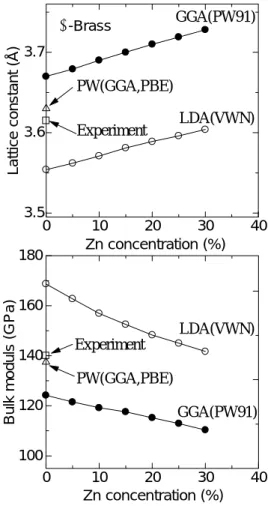
Fig.2. The calculated lattice constants (upper panel) and bulk modulus (bottom panel) of CuZn alloys (α-brass.
Figure 2 shows the lattice parameter and bulk-modulus of pure Cu and Cu-Zn (α-brass 5-30 % Zn atom). The experimental value of pure Cu and a calculated result by the plane wave method were shown as comparison. The result of GGA was slightly large in comparison with the experimental value, and that of LDA showed the small value. As for the lattice parameter, both GGA and LDA showed the upward tendency with the increase in the concentration of Zn, because the atomic radius of Zn is larger than that of Cu.By contrast, in the bulk-modulus, both GGA and LDA showed the tendency to decrease.
This means that the increase in the quantity of Zn affects softening. In GGA, compared with LDA, it is small, and the change is gradual.
The total density of states (DOS) and partial density of states (PDOS) for Cu-Zn (α-brass 5-25 % Zn atom) calculated by the KKR-CPA method are indicated in Fig.3.A contribution of the d-orbital electrons of Cu and Zn is dominant in the DOS. The energy difference between Cu d and Zn d states leads to the absence of hybridization. The bandwidth of the d-electron of Cu and Zn is about 4 and 1 eV, respectively. Depending on the concentration of Zn, the DOS of the d-orbital electrons of Zn increases, and then it is found that the DOS distribution of Cu is smooth. The contribution of the d-electrons of Cu is a predominantly also here, and that of the p-electrons of Cu follows. There is little contribution of s-orbital electrons of Cu and Zn. However, in more than 3 eV, the contribution of s-electrons of Cu is increase slightly.The character of Cu is principal in the disordered phase, while the electron number of Cu atom decreases due to the lattice extension by inclusion of Zn.
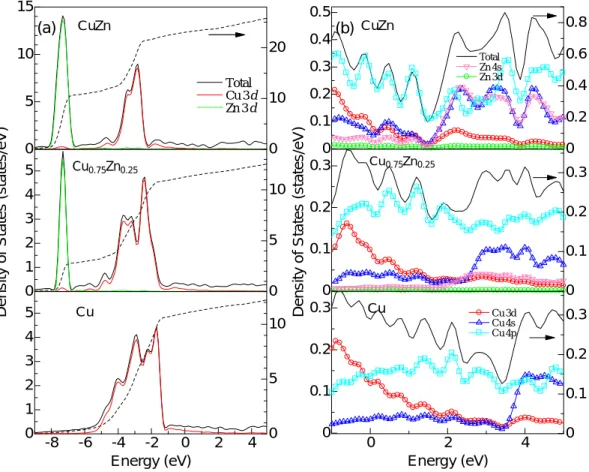
Figure 4 shows the total DOS and PDOS for pure Cu, Cu0.75Zn0.25 and CuZn obtained by plane-wave method.
Cu3Zn is α-phase and has been treated as a supper-lattice shown in Fig.1 (b), and CuZn belongs to β-phase.In the valence band below a Fermi level, the d-electrons of Cu and Zn were also dominant. The d-band width of Zn is about 1 eV and the shape is sharp. From the DOS of the conduction-band above the Fermi level, the value is decreasing in a monotone, and a dip exists near 3.5 eV for pure Cu.These results are in agreement with the FLAPW calculation results of Dhaka et al. [3].
富山大学総合情報基盤センター広報 vol.9 (2012) 35-38頁.
0 0.1 0.2
Zn d Zn s Zn p
0 0.1 0.2
Cu0.75Zn0.25
Cu0.80Zn0.20
Cu0.85Zn0.15
0 2 4
0 0.1 0.2
Energy (eV)
Density of States (states/eV)
TotalDOS Cu d Cu s Cu p
0 1 2 3
0 2 4 6
Total Cu d Zn d
0 1 2 3
0 2 4 6 Cu0.75Zn0.25
Cu0.80Zn0.20
Cu0.85Zn0.15
-8 -6 -4 -2 0 2
0 1 2 3
0 2 4 6
Energy (eV)
Density of States (states/eV)
0 0.1 0.2
TotalDOS Cu d Cu s Cu p
Zn d Zn s Zn p
0 0.1 0.2
Cu0.90Zn0.10
Cu0.95Zn0.05
Cu
0 2 4
0 0.1 0.2
Energy (eV)
Density of States (states/eV)
0 1 2 3
0 2 4 6
Total Cu d Zn d
0 1 2 3
0 2 4 6 Cu0.90Zn0.10
Cu0.95Zn0.05
Cu
-8 -6 -4 -2 0 2
0 1 2 3
0 2 4 6
Energy (eV)
Density of States (states/eV)
Fig.3. Total and partial density of states (DOS and PDOS) for α-brass obtained with KKR-CPA method. (upper panel: Cu0.75Zn0.25, Cu0.80Zn0.20 and Cu0.85Zn0.15; bottom panel: Cu0.9Zn0.1, Cu0.95Zn0.5 and pure Cu).The zero-energy value is set at the Fermi level.
富山大学総合情報基盤センター広報 vol.9 (2012) 35-38頁.
0 5 10 15
0 10 20
Total Cu 3d Zn 3 d
0 1 2 3 4 5
0 5 10 CuZn
Cu0.75Zn0.25
Cu
-8 -6 -4 -2 0 2 4
0 1 2 3 4 5
0 5 10
Energy (eV)
Density of States (states/eV)
0 0.1 0.2 0.3 0.4 0.5
0 0.2 0.4 0.6 0.8
Total Zn 4s Zn 3d
0 0.1 0.2 0.3
0 0.1 0.2 0.3 CuZn
Cu0.75Zn0.25
Cu
0 2 4
0 0.1 0.2 0.3
0 0.1 0.2 0.3
Energy (eV)
Density of States (states/eV)
Cu 3d Cu 4s Cu 4p
Fig. 4. (a) The calculated density of states (DOS) and the partial DOS for CuZn and Cu0.75Zn0.25 compared with Cu metal. The dashed line shows integrated total DOS.(b) The unoccupied part of the DOS for CuZn, Cu0.75Zn0.25 and Cu shown in an expanded scale.
4. Conclusion
We have calculated the optimized lattice constants and the electronic structures of Cu-Zn alloys using both KKR-CPA and a general pseudopotential plane-wave DFT method.Inα-brass, the change of the lattice constant was found to depend linearly on the concentration of Zn atom.Although the density of states of the valence band had the dominant d electron, it was shown that there is no mutual hybridization. In the computational model of super-lattice Cu3Zn using a plane-wave method, it was confirmed that the distribution of the d-electron of Zn is significantly sharp.
Reference
[1] N. F. Mott and H. Jones, The Theory of the Properties of Metals and Alloys (Dover Publications, Inc., New York, 1958).
[2] H. Amar, K. H. Johnson, and C. B. Sommers, Phys. Rev. 153 (1967) 655.
[3] O. Gourdon, D. Gout, D. J. Williams, T. Proffen, S. Hobbs, and G. J.
Miller, Inorg. Chem. 46 (2007) 251.
[4] R. S. Dhaka, A. K. Shukla, V. Vyas, A. Chakrabarti, S. R. Barman, B.
L. Ahuja, and B. K. Sharma, Phys. Rev. B 78 (2008) 073107.
[5] P. Hohenberg and W. Kohn, Phys. Rev. 138 (1964) B864.
[6] W. Kohn and L.J. Sham, Phys. Rev. 140 (1965) A1133.
[7] W. Kohn and N. Rostoker, Phys. Rev. 94 (1954) 1111.
[8] J. Korringa, J. Phys. Chem. Solids 7 (1958) 252.
[9] H. Akai, http://sham.phys.sci.osaka-u.ac.jp/kkr/
[10] K. Momma and F. Izumi, J. Appl. Crystallogr., 41 (2008) 653.
[11] P. Giannozzi, S. Baroni, N. Bonini, M. Calandra, R. Car, C.
Cavazzoni, D. Ceresoli, G. L. Chiarotti, M. Cococcioni, I. Dabo, A. Dal Corso, S. Fabris, G. Fratesi, S. de Gironcoli, R. Gebauer, U. Gerstmann, C. Gougoussis, A. Kokalj, M. Lazzeri, L. Martin-Samos, N. Marzari, F.
Mauri, R. Mazzarello, S. Paolini, A. Pasquarello, L. Paulatto, C. Sbraccia, S. Scandolo, G. Sclauzero, A. P. Seitsonen, A. Smogunov, P. Umari, R. M.
Wentzcovitch, J. Phys. Condens. Matter 21, 395502 (2009).
[12]F.D. Murnaghan: Proc. Natl. Acad. Sci. USA 30 (1944) 244.
(a) (b)
富山大学総合情報基盤センター広報 vol.9 (2012) 35-38頁.