Managing environmental and behavioral
uncertainty in supply chains : moderating effects of vertical integration on logistics performance
著者(英) Yonghoon Choi, Yoritoshi Hara journal or
publication title
Doshisha Shogaku (The Doshisha Business Review)
volume 70
number 2
page range 259‑270
year 2018‑09‑30
権利(英) Doshisha Daigaku Shogakkai
The Association of Commerce Doshisha University
URL http://doi.org/10.14988/pa.2018.0000000268
Managing Environmental and
Behavioral Uncertainty in Supply Chains : Moderating Effects of Vertical Integration
on Logistics Performance
1Yonghoon Choi Yoritoshi Hara
Ⅰ Introduction
Ⅱ Effect of Uncertainty on Performance
Ⅲ Moderating Role of LogisticsSystem Integration
Ⅳ Research Method
Ⅴ Analysis and Results
Ⅵ Discussion and Conclusions
Ⅰ Introduction
Uncertainty is one of the most fundamental concepts in the organization and marketing literatures and managing uncertainty is a pivotal subject in supply chain management.
Uncertainty influences firms’ logistics performance owing to its effects on not only the costs incurred on physical distribution activities, but also the transaction costs related to contract enforcement in interorganizational relationships. Transaction cost analysis (TCA) has focused on governance choices by firms and relied on uncertainty as one of the explanatory variables (Williamson, 1975, 1985). According to TCA, uncertainty poses the issue of transaction hazards in interorganizational relationships (Williamson, 1975; 1996).
Although uncertainty is sometimes combined with other variables, such as asset specificity, empirical studies have found that uncertainty may have an independent relation with vertical integration (Krickx, 2000), wherein environmental and behavioral uncertainty are dealt as different dimensions of uncertainty. Environmental uncertainty refers to “unanticipated changes in circumstances surrounding an exchange” (Noordewier, John, and Nevin 1990,
────────────
1 The previous version of the current research was presented at 2016 CBIM (Center for Business and Industrial Marketing) Workshop held in Bilbao, Spain. We thank the participants of the workshop for their helpful comments. We also acknowledge that this research project was financially supported by JSPS KAKENHI Grant Number 15H03396 and 17K04005.
(259)89
p.82). Environmental uncertainty is related to customers’ needs, fluctuating sales, market expansion and competitors’ strategies. Meanwhile, behavioral uncertainty refers to the performance ambiguity that one often associates with the difficulty of measuring business partners’ performance. Behavioral uncertainty is supposed to arise from the difficulties associated with monitoring the contractual performance of exchange partners (Williamson, 1985).
The fundamental assumption in TCA is that vertical integration is an alternative governance mechanism to minimize transaction costs, which are associated with environmental and behavioral uncertainty, as well as asset specificity.
Uncertainty itself is assumed to negatively influence firms’ performance. This study focuses on how the two different types of uncertainty influence logistics performance in supply chains.
Many empirical studies have been conducted to examine the relationship between uncertainty and vertical integration in the contexts of supply chain and marketing channel relationships.
However, much fewer deal with the influence of vertical integration on the effect of uncertainty on firms’ performance. Our research model elucidates the role of logisticssystem integration as a moderator in the relationships between the two types of uncertainty and logistics performance.
The article begins with the theoretical background of our research; our research hypotheses is discussed in the section that follows it. The section after that explains the research method and data collection procedure. Thereafter, the results of the regression analyses are presented and scrutinized. Some implications and shortcomings of current study are provided in the final section.
Ⅱ Effect of Uncertainty on Performance
Uncertainty is inherent in supply chain and marketing channel relationships, and has a significant influence on firms’ performance. Basically, it is assumed to have a negative impact on firms’ performance in channel relationships (Achrol and Stern, 1988; Anderson and Weitz, 1986; Heide and Stump, 1995). As some literatures of supply chain management also indicate, failure to manage uncertainty would lead to a deterioration in business performance (e.g., SimchiLevi, Kaminsky, and SimchiLevi, 2007).
As Rindfleish and Heide (1997, p.42) pointed out, uncertainty seems to be problematic from a measurement standpoint. In the prior studies on uncertainty, the uncertainty construct is seen to have several dimensions. Uncertainty can be classified according to its sources―
同志社商学 第70巻 第2号(2018年9月)
90(260)
environmental and behavioral― because a number of extant studies have presumed that uncertainty arises either when : (i) the relevant contingencies surrounding an exchange are too unpredictable to be specified ex ante in a contract (i.e., environmental uncertainty) or (ii) performance cannot be easily verified ex post (i.e., behavioral uncertainty) (Geyskens, Steenkamp, and Kumar 2006).
Further, the construct of environmental uncertainty can be subdivided into demand, supply, competitive, and technological uncertainty (Davis, 1993; Sutcliffe and Zaheer, 1998; Walker and Weber, 1984); this is because environmental uncertainty is related to several factors, such as customers’ needs, fluctuating sales, market growth, competitors’ strategies, and technological changes. Current research deals with manufacturers’ downstream logistics performance, which is affected largely by the demand uncertainty in market places. Therefore, we focus on demand uncertainty as a type of environmental uncertainty.
Along with the extant marketing channel literatures that have acknowledged the negative impact of uncertainty on channel performance (e.g., Achrol and Stern, 1988; Anderson and Weitz, 1986; Heide and Stump, 1995), we assume that uncertainty negatively influences logistics performance, irrespective of its dimensions. Manufacturers’ effectiveness and efficiency in downstream logistics may decline significantly as demand unpredictability increases because it raises not only their inventory costs, but also the delivery costs. Under a highly uncertain environment, their downstream counterparts are likely to place orders irregularly, in response to the turbulent demand of their own customers. To respond swiftly to such requests of downstream intermediaries, manufactures are required to hold sufficient inventories in advance and /or to deliver the products frequently and on a smalllot basis. As a result, manufacturers may experience excess inventory and/or inefficient delivery.
Besides those operational costs, transaction costs are also likely to soar owing to the prevailing uncertainty. The primary consequence of demand uncertainty is an adaptation problem (Geyskens et al., 2006). An adaptation problem is created when a firm, whose decision makers are limited by bounded rationality, has difficulty modifying its contractual agreements to the changes in the external environment (Rindfleisch and Heide, 1997).
Transaction costs for contract enforcement may increase when information asymmetry arises because of uncertainty, opportunism, and bounded rationality (Williamson, 1975). Thus, we hypothesize the following :
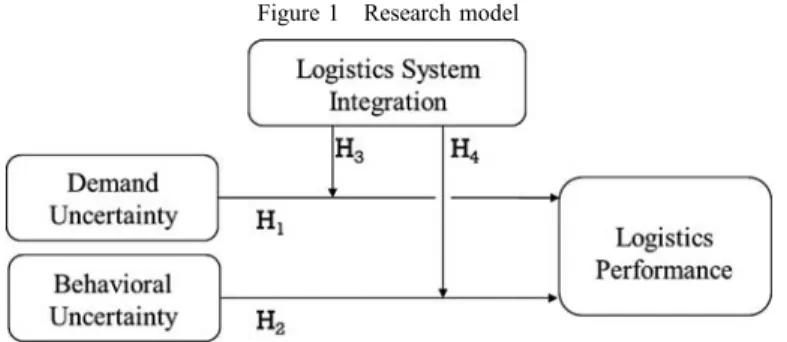
H1: Demand uncertainty perceived by manufacturers will be negatively related to their downstream logistics performance.
Managing Environmental and Behavioral Uncertainty in Supply Chains : Moderating Effects of Vertical Integration on Logistics Performance(Choi・Hara)(261)91
TCA views behavioral uncertainty as arising from the difficulties associated with monitoring the contractual performance of exchange partners (Williamson 1985). The effect of this kind of uncertainty is a performance evaluation problem. A performance evaluation problem arises when a firm, whose decision makers are limited by bounded rationality, has difficulty assessing the contractual compliance of its exchange partners (Rindfleisch and Heide, 1999; Geyskens et al., 2006).
Difficulties in ascertaining performance increase when firms share responsibilities for the same tasks; the performance in collaborations is evaluated on multiple criteria (Anderson and Weitz, 1986). Behavioral uncertainty causes opportunism problems, such as shirking, cheating, and free riding. Because of the possibility of such opportunistic behavior, the efficiency of logistics activities provided by the partners will deteriorate; thus, high levels of behavioral uncertainty increase the costs of evaluating the performance of exchange partners. Hence, we hypothesize the following :
H2: Behavioral uncertainty perceived by manufactures will be negatively related to their downstream logistics performance.
Ⅲ Moderating Role of LogisticsSystem Integration
Both the theoretical and empirical findings of the previous studies examining the relationship between environmental uncertainty and vertical integration have been controversial. Studies based on TCA suggest that uncertainty leads to a higher degree of vertical integration. This view is in contrast to the theoretical position taken by some organization and strategic management literatures, in which it is argued that looser structures (i.e., those less vertically integrated) are more effective under conditions of high uncertainty because a flexible organization is better able to adapt to changing circumstances (e.g., Lawrence and Lorsch, 1967; Pfeffer and Salancik, 1978; Sutcliffe and Zaheer, 1998).
What causes such contradictory assertions? We assume that the appropriateness of the choices about the governance mechanism depends on the difference of uncertainty sources. As Klein (1989, p.256) stated, uncertainty is too broad a concept and different facets of it can lead to either a desire for flexibility or a motivation to reduce transaction costs.
Prior research on environmental uncertainty has focused on the two problems associated with uncertainty : information asymmetry (Williamson, 1975) and lack of flexibility (Barney, 2002). According to Barney (2002), there are the two sources of uncertainty―uncertainty
同志社商学 第70巻 第2号(2018年9月)
92(262)
based on opportunism and uncertainty associated with future value created by investments.
The former leads to hierarchical governance to reduce opportunism, whereas the latter results in the adopting of market governance to retain flexibility.
In supply chain settings, manufacturers have to deal with different types of uncertainty related to upstream procurement of product components and downstream procurement related to sales and supply. With respect to the upstream uncertainty, for example, manufactures may face technological uncertainty, wherein they are not certain which of the technologically different and alternative components of a final product will contribute more to the end product in the future.
Meanwhile, manufacturers may have to collect information regarding their product demand and customer’s preferences to manage downstream demand uncertainty. In such cases, they face the two different problems : retaining flexibility to manage upstream technological uncertainty and reducing opportunism to manage downstream demand uncertainty. In this vein, we can speculate that manufactures will select market governance to handle technological uncertainty and maintain flexibility, while choosing hierarchal governance to manage demand uncertainty and safeguard themselves from the opportunistic behaviors of their exchange partners.
Practically, on the one hand, Balakrishnan and Wernerfelt (1986) and Geyskens and his colleagues (2006) predict that technological uncertainty is associated with disintegration. On the other hand, Geyskens et al. (2006), Heide and John (1990), Heide and Stump (1995), and John and Weitz (1988) suggest that demand uncertainty will result in a greater degree of forward integration into distribution. Along with the discussion above, we hypothesize the following :
H3: The negative relationship between demand uncertainty and logistics performance will be alleviated as the level of logisticssystem integration increases.
As to behavioral uncertainty, marketing scholars have argued that it requires greater degrees of forward integration to gain the right to monitor and direct behavior. Vertical integration might minimize difficulties for evaluating other partners’ performance because employment contracts enable employers to access employees’ efforts (Anderson and Weitz, 1986). This proposition has been tested in the industrial context and was supported in previous empirical studies, which find that behavioral uncertainty leads to the integration of various downstream functions (e.g., Anderson, 1985; Heide and John, 1990; John and Weitz, 1988). The high
Managing Environmental and Behavioral Uncertainty in Supply Chains : Moderating Effects of Vertical Integration on Logistics Performance(Choi・Hara)(263)93
degree of behavioral uncertainty increases transaction costs in business relationships. As a result, firms’ performance will deteriorate. The transaction costs caused by behavioral uncertainty, however, could be mitigated in hierarchies (Williamson, 1975; 1996). Thus, we hypothesize the following :
H4: The negative relationship between demand uncertainty and logistics performance will be alleviated as the level of logisticssystem integration increases.
The conceptual model framework and our hypotheses are illustrated in Fig.1.
Ⅳ Research Method
The quantitative empirical analysis is based on survey data from Japanese manufacturing firms. The sampling framework for our research was the Kaisha-Shikiho (Japan Company Handbook), from which a random sample of 3,000 business units of Japanese manufacturing firms in a broad range of industries, such as chemical products, steel, metal, machines, electronic/electrical equipment, paper, pharmaceutical products, and food, was selected. Owing to our desire to control for industryspecific heterogeneity, we did not narrow our survey unit to a particular industry. We identified the executives responsible for their respective marketing departments as the key data sources in this research. A total of 415 questionnaires were completed and returned by them. After removing responses with missing data, 375 were found to be valid for the empirical testing.
We measure all the focal theoretical variables and control variables using multiitem scales.
The theoretical variables include logistics performance (PERF), demand uncertainty (DU), behavioral uncertainty (BU), and logisticssystem integration (LSI). Statistically, the entire model can be expressed as :
Figure 1 Research model
Control Variables : Market Power, Exploitation Capacity 同志社商学 第70巻 第2号(2018年9月)
94(264)
PERF=c+b1(DU)+b2(BU)+b3(EU×LSI)+b4(BU×LSI)+control variables+ε.
All the theoretical variables and control variables were measured by a selfreported questionnaire using a 7point scale ranging from 1 (“highly disagree”) to 7 (“highly agree”).
Appendix A presents the measurement items we used for the six variables. Further, in Table 1, we present the correlation matrix and descriptive statistics of the measures.
To examine construct validity and reliability, we performed confirmatory factor analysis (CFA). Overall model fit indices (χ2 [120]=175.872; CFI=.982; GFI=.953; RMSEA
Table 1 Descriptive statistics and correlations
1 2 3 4 5 6
1. Logistics performance 1
2. Logisticssystem integration .153** 1
3. Market power .464** .055 1
4. Exploitation capability .399** .179** .414** 1
5. Demand uncertainty −.178** .074 −.188** −.054 1
6. Behavioral uncertainty −.189** −.010 −.223** −.113* .330** 1
Mean 4.02 3.74 4.72 4.39 3.35 3.44
S.D. 1.05 1.64 1.10 1.11 1.09 1.11
Notes : N=375, *p<0.05, **p<0.01
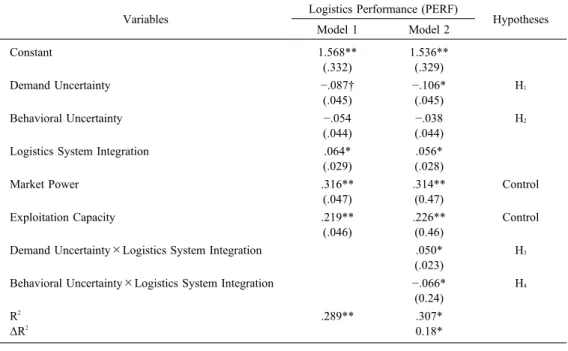
Table 2 Results of model estimation
Variables Logistics Performance (PERF)
Hypotheses
Model 1 Model 2
Constant 1.568**
(.332)
1.536**
(.329)
Demand Uncertainty −.087†
(.045)
−.106*
(.045)
H1
Behavioral Uncertainty −.054
(.044)
−.038 (.044)
H2
Logistics System Integration .064*
(.029)
.056*
(.028)
Market Power .316**
(.047)
.314**
(0.47)
Control
Exploitation Capacity .219**
(.046)
.226**
(0.46)
Control
Demand Uncertainty×Logistics System Integration .050*
(.023)
H3
Behavioral Uncertainty×Logistics System Integration −.066*
(0.24)
H4
R2 ΔR2
.289** .307*
0.18*
†p<.1.
*p<.05.
**p<.01.
Note : Unstandardized coefficients are indicated with standard errors in parentheses.
Managing Environmental and Behavioral Uncertainty in Supply Chains : Moderating Effects of Vertical Integration on Logistics Performance(Choi・Hara)(265)95
=.035) were acceptable (Bagozzi and Yi, 1988). The result indicates that the current research model fits the data well. Further, as shown in Appendix A, all the factor loadings associated with the observed variables were statistically significant and, thus, confirmed the convergent validity.
Next, we examined the discriminant validity of the measures with the value of average variance extracted (AVE) (Fornell and Larcker, 1981). As shown in Appendix A, the AVE of all the constructs is greater than, or close to, the widely accepted threshold of 0.50. In addition, the composite reliabilities (CR) of all of the constructs are >. 0.60, the threshold suggested by Fornell and Larcker (1981); this confirms our constructs’ reliability.
Ⅴ Analysis and Results
We ran regression models to test the hypotheses discussed above. Since the regression we used had interaction terms, it was necessary to mitigate the potential threat of multicollinearity between the main effects and the interaction terms. To avoid potential problems of multicollinearity, we meancentered the variables related with interaction terms. The value of the variance inflation factors (VIF) showed no significant bias. We summarize the regression results in Table 2.
H1suggests that demand uncertainty decreases manufacturers’ logistics performance in their downstream supply chains. The results show that demand uncertainty has a significant negative influence on manufacturers’ logistics performance (β=−0.106, p<.05), which supports H1. With respect to H2, the effect of behavioral uncertainty on manufacturers’
logistics performance is insignificant (b2=−.038, p>.1), a result inconsistent with our expectation.
Regarding the moderating effects, we propose that logisticssystem integration by manufacturers weakens the negative relationships between the two types of uncertainty and logistic performance. The results for H3, which hypothesizes the moderating effect of logistics
system integration on the negative relationship between demand uncertainty and logistics performance, are found to be positive and significant (b3=.050, p<.05). With respect to H4, the moderating effect of logisticssystem integration on the relationship between behavioral uncertainty and logistics performance is negative and significant (b4=−.066, p<.05); this is contrary to our hypothesized expectation.
To investigate the moderating effects proposed in H3 and H4 further, we decomposed the interaction terms and the impact of the demand uncertainty and behavioral uncertainty on the
同志社商学 第70巻 第2号(2018年9月)
96(266)
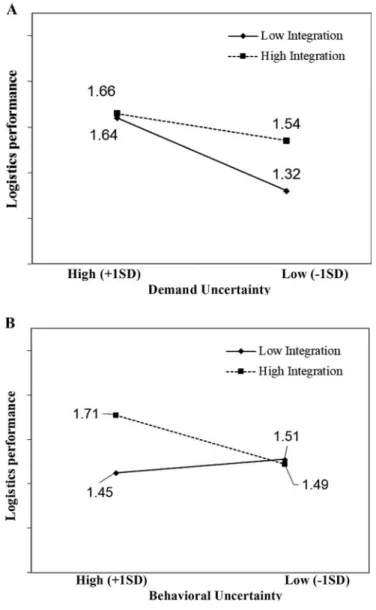
logistics performance at low (at one standard deviation below the mean) and high (at one standard deviation above the mean) levels of logistics system integration, according to the widely known procedures suggested by Aiken and West (1991). Figure 2 a shows that, while the logistics performance of manufacturers sharply declines as demand uncertainty increases at low level of logistic system integration, the slope between demand uncertainty and logistics performance at low level of logistic system integration becomes gentler. Thus, we find that the negative performance effect of demand uncertainty on logistics performance is mitigated as the level of logisticssystem integration increases; this further supports H3.
In contrast, and somewhat surprisingly, the slope between performance and behavioral
Figure 2 Posthoc Probing of Interactions between : A) demand uncertainty and integration and B) behavioral uncertainty and integration.
Managing Environmental and Behavioral Uncertainty in Supply Chains : Moderating Effects of Vertical Integration on Logistics Performance(Choi・Hara)(267)97
uncertainty over the range of logisticssystem integration indicates that the performance effect of behavioral uncertainty decreases as the level of the integration is greater. We discuss the results in greater detail in the next section.
Ⅵ Discussion and Conclusions
Managing uncertainty significantly influences logistics performance in supply chains.
Traditionally, the relationship between uncertainty and vertical integration has been a pivotal research topic among researchers in economics, management, and marketing. Despite its importance, both the theoretical and empirical findings of previous studies have been contradictory. We point out that the cause of the contradictory findings is the failure to discriminate between the sources of uncertainty while examining the relationship between uncertainty and vertical integration. This is one of the theoretical contributions of this study.
We assume that each uncertainty source is related to vertical integration in a different way and, then, focus on demand uncertainty and behavioral uncertainty in downstream supply chains of manufacturers.
We examine the effects of these types of uncertainty on logistics performance and the moderating role of logisticssystem integration in the relationship between these types of uncertainty and performance. The results of our analysis support the hypotheses regarding the relationship among demand uncertainty, logisticssystem integration, and logistics performance.
However, the hypotheses related to behavioral uncertainty were not supported. Interestingly, the results indicate that the effect of behavioral uncertainty on performance decreases as the degree of logisticssystem integration is greater. This implies that the disintegration strategy should be adopted when the level of behavioral uncertainty is high. A plausible interpretation of the result is the substantial costs or investments required in logistics system integration. The decision of channel integration by manufacturers involves a tradeoff between acquiring control over distribution operations and bearing the substantial costs, risk, and responsibility for all the actions in the channel. Highly integrated channels are very costly to establish and operate, in terms of investments in personnel, equipment, facilities, software, inventory, etcetera (Harrigan, 1983; Shervani, Frazier, and Challagalla, 2007). Thus the decision to integrate a certain function should be made only when the strategic achievements through the integrated channel outweigh the costs associated with the internalization. Our result may imply that behavioral uncertainty related with the logistics function is not a significant hazard
同志社商学 第70巻 第2号(2018年9月)
98(268)
because the costs incurred in the integration offset the benefits derived. With respect to this, further research is required.
References
Achrol, R. S. and Stern, L. W. (1988), Environmental Determinants of DecisionMaking Uncertainty in Marketing Channels,Journal of Marketing Research,Vol.25 No.1, pp.3650.
Aiken, Leona S., and Stephen G. West. (1991), Multiple Regression : Testing and Interpreting Interactions, Thousand Oaks, CA : Sage Publications.
Anderson, E. (1985), The Salesperson as Outside Agent or Employee : A Transaction Cost Analysis,Marketing Science,Vol.4, No.3, pp.234254.
Anderson, E., and Schmittlein, D. C. (1984), Integration of the Sales Force : An Empirical Examination,The Rand Journal of Economics,Vol.15, No.3, pp.385395.
Anderson, E. and Weitz, B. A. (1986), MakeorBuy Decisions : Vertical Integration and Marketing Productivity, Sloan Management Review,Spring, pp.319.
Bagozzi, R. P. and Yi, Y. (1988), On the Evaluation of Structural Equation Models,Journal of the Academy of Marketing Science,Vol.16 No.1, pp.7494.
Appendix A Measurement Items
Construct Description Factor
loading Logistics Performance
CR=0.67 AVE=0.49 Alpha=0.747
Compared to our competitors, the physical distribution activities of our main product are efficient.
Compared to our competitors, the level of inventory turnover of our main products is high.
Compared to our competitors, the promotion activities for our main products are efficient.
0.732 0.673 0.703 Demand Uncertainty
CR=0.82 AVE=0.65 Alpha=0.88
It is difficult to predict the changes in our customers’ needs It is difficult to predict the changes in our main products’ sales It is difficult to predict the market growth rates of our main products It is difficult to predict our competitors’ behaviors
0.788 0.812 0.885 0.737 Behavioral Uncertainty
CR=0.83 AVE=0.73 Alpha=0.878
It is difficult to access objectively the partner wholesalers’ sales performance.
It is difficult to observe whether the partner wholesalers provide appropriate distribution services.
It is difficult to observe whether the sales and logistics of the partner wholesalers are efficient.
0.685 0.962 0.891 Logistics System
Integration CR=0.61 AVE=0.72 Alpha=0.801
The extent to which we integrate the logistics function with our products is high.
The extent to which we own the system and equipment for our product distribution is high.
0.675 0.990
Exploitation Capacities CR=0.63
AVE=0.51 Alpha=0.754
We have a crosssectional organization to share customer needs, leading to product development and improvement.
We have capabilities to apply experience and knowledge obtained from a customer relationship to other relationships.
We have capabilities to communicate to our customers our advantage over competitors.
0.648 0.743 0.754 Market Power
CR=0.71 AVE=0.6 Alpha=0.793
Our sales performance is relatively high.
We have a capable sales force compared to our competitors Our market share is high.
0.804 0.895 0.587
CR=composite reliability; AVE=average variance extracted All the factor loadings are significant at the 0.001 level.
Managing Environmental and Behavioral Uncertainty in Supply Chains : Moderating Effects of Vertical Integration on Logistics Performance(Choi・Hara)(269)99
Balakrishnan, S. and Wernerfelt, B. (1986), Technical Change, Competition and Vertical Integration,Strategic Management Journal,Vol.7 No.4, pp.347359.
Barney, J. B. (2002),Gaining and Sustaining Competitive Advantage[2nd Edition], Prentice Hall.
Davis, T. (1993), Effective Supply Chain Management,Sloan Management Review,Summer, pp.3546.
Fornell, C. and Larcker, D. F. (1981), Evaluating Structural Equation Models with Unobservable Variables and Measurement Error,”Journal of Marketing Research,Vol.18 No.1, pp.3950.
Geyskens, I., Steenkamp, J. E. M. and Nirmalya Kumar, N. (2006), Make, Buy, or Ally : A Transaction Cost Theory MetaAnalysis,Academy of Management Journal,Vol.49 No.3, pp.519543.
Harrigan, K. R. (1983).Strategies for Vertical Integration.Lexington Books.
Heide, J. B. and John, G. (1990), Alliances in Industrial Purchasing : The Determinants of Joint Action in Buyer
Supplier Relationships,Journal of Marketing Research,Vol.27 No.1, pp.2436.
Heide, J. B. and Stump, R. L. (1995), Performance Implications of BuyerSupplier Relationships in Industrial Markets : A Transaction Cost Explanation,Journal of Business Research,Vol.32 No.1, pp.5766.
John, G. and Weitz, B. A. (1988), Forward Integration into Distribution : An Empirical Test of Transaction Cost Analysis,Journal of Law, Economics, and Organization,Vol.4 No.2, pp.337355
Klein, S. (1989), A Transaction Cost Explanation of Vertical Control in International Markets, Journal of the Academy of Marketing Science,Vol.17, No.3, pp.253260.
Krickx, G. A. (2000), The Relationship between Uncertainty and Vertical Integration,The International Journal of Organizational Analysis,Vol.8, No.3, pp.309329.
Lawrence, P. R., and Lorsch, J. W. (1967), Differentiation and Integration in Complex Organizations.
Administrative Science Quarterly,Vol.12, No.1, pp.147.
Noordeweir, T., John G., and Nevin J. (1990). Performance Outcome of Purchasing Arrangements in Industry BuyerVendor Relationships.Journal of Marketing, Vol.54, No.4, pp.8093.
Pfeffer, J., and Salancik, G. R. (1978), The External Control of Organizations : A Resource Dependence Approach,NY : Harper and Row Publishers.
Rindfleish, A. and J. B, Heide (1997), Transaction Cost Analysis : Past, Present and Future Applications, Journal of Marketing, Vol.61, No.4, pp.3054.
Shervani, T. A., Frazier, G., & Challagalla, G. (2007), The Moderating Influence of Firm Market Power on the Transaction Cost Economics Model : An Empirical Test in a Forward Channel Integration Context, Strategic Management Journal,Vol.28, No.6, pp.635652.
SimchiLevi, D., Kaminsky, P., and SimchiLevi, E. (2007), Designing and Managing the Supply Chain : Concepts, Strategies and Case Studies[3rd Edition], McGraw/Irwin.
Sutcliffe, M. S. and Zaheer, A. (1998), Uncertainty in the Transaction Environment : An Empirical Test, Strategic Management Journal,Vol.19 No.1, pp.123
Walker, G and Weber, D. (1984), A Transaction Cost Approach to MakeorBuy Decisions, Administrative Science Quarterly,Vol.29 No.3, pp.373391.
Williamson, O. E. (1975),Markets and Hierarchies : Analysis and Antitrust Implications, New York : Free Press.
Williamson, O. E. (1985), The Economic Institutions of Capitalism, Simon and Schuster.
Williamson, O. E. (1996),The Mechanisms of Governance,Oxford University Press.
同志社商学 第70巻 第2号(2018年9月)
100(270)