Kyushu University Institutional Repository
標数3の超特異楕円曲線上のηTペアリングの高速実 装
川原, 祐人
九州大学大学院数理学府
https://doi.org/10.15017/21704
出版情報:Kyushu University, 2011, 博士(機能数理学), 課程博士 バージョン:
権利関係:
Efficient Implementation of η
TPairing on Supersingular Elliptic Curves in Characteristic 3
Yuto KAWAHARA
A dissertation submitted in fulfillment of the requirements for the degree of
Doctor of Philosophy in Functional Mathematics
Supervisor: Tsuyoshi TAKAGI
Graduate School of Mathematics Kyushu University
Abstract
Pairing-based cryptosystems can provide cryptographic schemes which have novel and useful properties, such as Identity-based encryption schemes, and they have been attracted in cryptography. These schemes are constructed by using pair- ings, such as the Tate and Weil pairings, hash functions, and group computations.
Miller proposed the first polynomial-time algorithm for computing the Weil pair- ing on algebraic curves, and various pairings such asηT, Ate, Atei, R-ate, Optimal pairings and their variants are indicated. TheηT pairing overF3m is one of the fastest pairing now.
We propose efficient algorithms of addition and subtraction inF3 and MapTo- Point, which is a hash function to compute a point on elliptic curves, for efficient implementation of theηT pairing overF3m. Firstly, we construct instruction se- quences of addition and subtraction inF3 with the minimum number of logical instructions, since all functions of the ηT pairing over F3m are based on them.
EveryF3-element is assigned to two bits, and theF3-addition and subtraction are considered as a map(F2)2×(F2)2 → (F2)2. We perform an exhaustive search for finding the instruction sequences of the F3-addition that use seven or fewer logical instructions. Indeed, we find many implementations of theF3-addition and subtraction with only six logical instructions, and no instruction sequence that can compute them with less than six logical instructions for any assignment of elements or logical instructions. In other words, we have proven that the minimum number of logical instructions for computing theF3-addition and subtraction inF3 is six by two-bit encoding.
MapToPoint algorithm is used to compute a point of an elliptic curve from identity. There exists two conventional algorithms for supersingular elliptic curves overF3m: one is computed by using a square root computation in F3m, whose computational cost isO(logm)multiplications andO(m)cubings inF3m; another is computed by using an(m−1)×(m−1)matrix overF3, that is stored in the off- line memory. We construct an efficient MapToPoint algorithm on the supersingular
i
elliptic curves by using 1/3-trace overF3m. The 1/3-trace overF3mcan compute a solutionxofx3−x =cusing no multiplication inF3m. The proposed algorithm is computed byO(1)multiplications andO(m)cubings inF3m, and it stores less thanmF3-elements in the off-line memory to efficiently compute trace overF3m. Finally, we implement the main components, the ηT pairing, arithmetic over the supersingular elliptic curvesE(F3m)and the finite fieldF3m for constructing the pairing-based cryptosystems. We implement them in C and Java as program- ming languages, and measure the running time of these functions on an Intel Core i7-950 processor.
Acknowledgements
Firstly, I would like to thank Professor Tsuyoshi Takagi for insightful sugges- tions, advices and comments. If he did not invite me to the cryptographic research 6 years ago, I had not studied this field and this thesis could not be done. I would also like to thank Professor Shigenori Uchiyama for nice comments, and I would be thankful to Professor Masaaki Shirase for their helpful advices. I would be very grateful to all members and former members in Takagi laboratory for their support.
I give a special thanks to Professor Eiji Okamoto who was indebted by joint research. Then I give a great thanks to Kazumaro Aoki, Tetsutaro Kobayashi, Gen Takahashi, Go Yamamoto and the members of NTT Information Sharing Platform Laboratories for their fruitful comments and discussions at joint research and in- tern. I have received support from the Japan Society for the Promotion of Science during Ph.D. student.
Finally, I would like to thank everyone in my family for their support, advices and encouragement.
iii
Abstract i
Acknowledgements iii
List of Tables viii
List of Algorithms x
1 Introduction 1
1.1 Public Key Cryptography . . . 1
1.2 Pairing-based Cryptography . . . 2
1.3 Motivation and Contribution . . . 4
1.4 Organization . . . 6
2 Mathematical Background 7 2.1 Introduction . . . 7
2.2 Finite Fields . . . 7
2.2.1 Bases . . . 8
2.2.2 Legendre Symbol . . . 9
2.2.3 Trace and Norm . . . 10
2.3 Elliptic Curves . . . 11
2.3.1 Weierstrass equation . . . 11
2.3.2 Group Law and Group Order . . . 13
2.3.3 Simplified Weierstrass Equation . . . 14
2.3.4 Explicit Addition Formulas onE/K . . . 16
2.3.5 Point Multiplication . . . 18
2.3.6 Frobenius Map . . . 19
2.4 Pairings . . . 19
2.4.1 Divisors . . . 20 iv
CONTENTS v
2.4.2 Tate Pairing . . . 22
2.4.3 Weil Pairing . . . 22
2.4.4 Miller’s Algorithm . . . 23
2.4.5 Distorsion Map . . . 24
2.4.6 Hard Problems of Pairings for Security . . . 24
3 ηT Pairing overF3m 27 3.1 Introduction . . . 27
3.2 Duursma-Lee Algorithm . . . 27
3.3 Construction ofηT Pairing overF3m . . . 30
3.4 ηT Pairing overF3m without Cube Root . . . 31
3.5 UniversalηT Pairing overF3m . . . 32
3.6 Final Exponentiation ofηT Pairing overF3m . . . 33
4 The Detail of Implementation ofηT Pairing overF3m 35 4.1 Introduction . . . 35
4.2 Arithmetic inF3m . . . 36
4.2.1 Element Representation inF3m . . . 36
4.2.2 Addition and SubtractionF3m . . . 37
4.2.3 Multiplication inF3m . . . 38
4.2.4 Reduction . . . 40
4.2.5 Cubing inF3m . . . 41
4.2.6 Inversion inF3m . . . 41
4.2.7 Square Root inF3m . . . 42
4.2.8 Cube Root inF3m . . . 43
4.3 Arithmetic inF33m . . . 44
4.4 Arithmetic inF36m . . . 45
4.5 Arithmetic on Supersingular Elliptic Curves in Characteristic Three 47 4.5.1 Projective Coordinate . . . 49
4.5.2 Jacobian Coordinate . . . 50
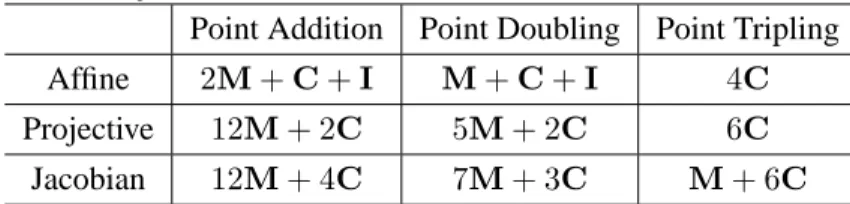
4.5.3 Comparison of Computational Cost in Affine, Projective and Jacobian Coordinates . . . 50
4.5.4 Point Multiplication . . . 51
4.6 ηT Paring overF3m . . . 53
5 Construction of Addition and Subtraction inF3using Minimum Num-
ber of Logical Instructions 58
5.1 Introduction . . . 58
5.2 Addition and Subtraction inF3 . . . 60
5.3 Search Algorithm forF3-Addition . . . 61
5.3.1 Choice of Assignment inF3 . . . 61
5.3.2 Logical Instruction Set . . . 63
5.3.3 Search Procedure . . . 64
5.3.4 Search Cost . . . 66
5.4 Search Algorithm forF3-Subtraction . . . 66
5.5 Search Results and Some Examples . . . 67
5.6 Application toηT Pairing overF3m . . . 72
5.6.1 Bit Representation ofF3m . . . 72
5.6.2 Addition and Subtraction inF3m . . . 72
5.6.3 Multiplication inF3m . . . 73
5.6.4 ηT Pairing overF3mand its Efficient Implementation . . . 74
5.7 Conclusion . . . 76
6 MapToPoint over Supersingular Elliptic Curves inF3m 77 6.1 Introduction . . . 77
6.2 Conventional MapToPoint Algorithms . . . 79
6.2.1 MapToPoint overE(F2m)using half-trace . . . 79
6.2.2 MapToPoint overE(F3m)using Square Root . . . 80
6.2.3 MapToPoint overE(F3m)using Matrix . . . 81
6.3 Proposed MapToPoint Algorithm . . . 81
6.4 Comparison of Proposed and Conventional MapToPoint Algorithms 85 6.4.1 Theoretical Estimate of Cost for MapToPoint . . . 85
6.4.2 Implementation Results for MapToPoint overE(F3m) . . 85
6.4.3 Implementation Results for Checking Conditions of Input Coordinate . . . 87
6.5 Conclusion . . . 88
7 Experiment and Timing Results 89 7.1 Introduction . . . 89
7.2 Parameters and Experimental Environment . . . 90
7.3 Timing Results in C . . . 91
7.4 Timing Results in Java . . . 93
CONTENTS vii
7.5 C vs. Java . . . 95
8 Conclusion 96
8.1 Review . . . 96 8.2 Open Problem and Future Work . . . 97
Bibliography 99
History 112
2.1 List of Simplified Weierstrass Equations . . . 16 4.1 Computational Cost of Arithmetic on Supersingular Elliptic Curve
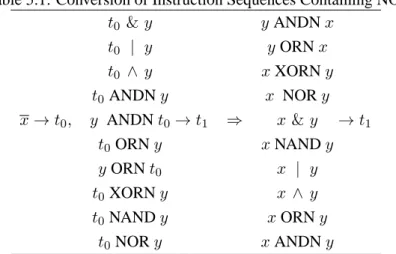
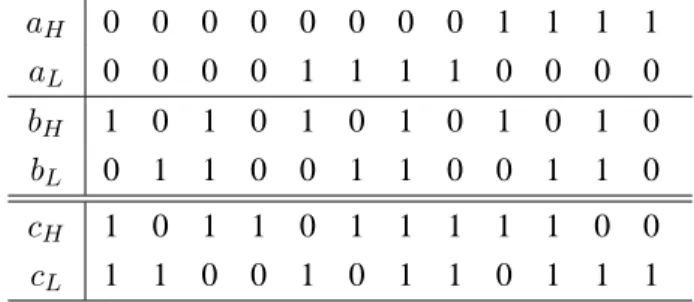
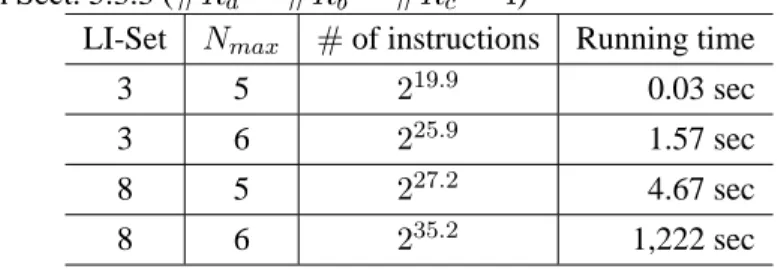
overF3min Affine, Projective and Jacobian Coordinates . . . 51 5.1 Conversion of Instruction Sequences Containing NOT . . . 63 5.2 Calculation ofx∈ {0,1}and Constant Values Zero or One . . . . 64 5.3 Truth Table for Assignment SetRa,Rb,Rcin Equation 5.2 . . . . 65 5.4 Number of Logical Instructions for Simple Search . . . 66 5.5 Number of Logical Instructions and Running Time of Search with
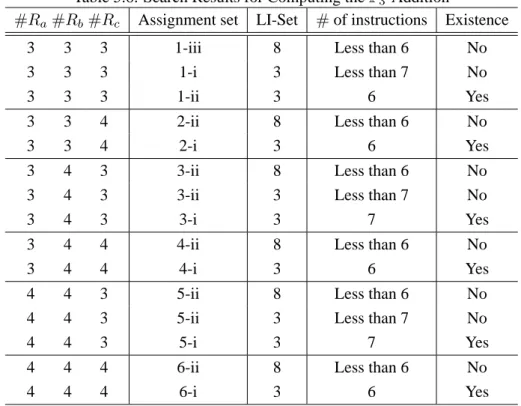
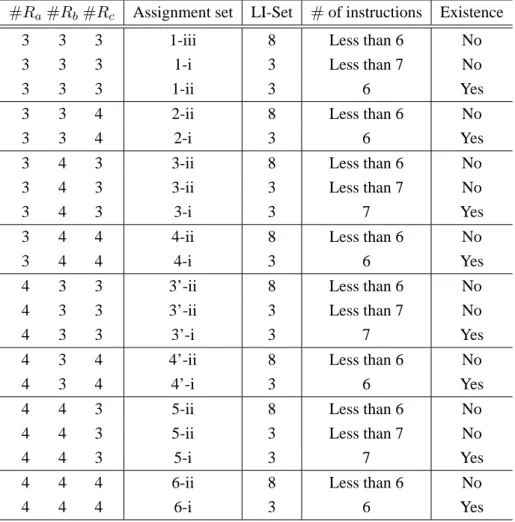
Conditions in Sect. 5.3.3 (#Ra= #Rb= #Rc= 4) . . . 67 5.6 Search Results for Computing theF3-Addition . . . 69 5.7 Search Results for Computing theF3-Subtraction . . . 70 5.8 Running Time Comparison for Addition and Subtraction inF3509
(µsec) . . . 73 5.9 Running Time Comparison for Multiplication inF3509 (µsec) . . . 74 5.10 Running Time Comparison forηT Pairing overF3509 (µsec) . . . . 75 5.11 Running Time for Arithmetic inF3m and theηT Pairing with the
Type 2 Assignment (µsec) . . . . 75 6.1 Computational Cost of Proposed and Conventional MapToPoint
Algorithms overF2mandF3m . . . 85 6.2 Running Time Results of Arithmetic inF3m and MapToPoint Al-
gorithms overE(F3m)(µsec) . . . 86 6.3 Running Time Results to Check whether Tr3(c) = 0 and c is
Quadratic Residue inF3m(µsec) . . . 87 7.1 Running Time for Arithmetic inF3min C (µsec) . . . 91 7.2 Running Time for Arithmetic overE(F3m)in C (µsec) . . . 92
viii
LIST OF TABLES ix
7.3 Running Time forηT Pairing overF3m, Point Multiplication over E(F3m), and Exponentiation inF36min C (µsec) . . . 92 7.4 Running Time for Arithmetic inF3min Java (µsec) . . . 93 7.5 Running Time for Arithmetic overE(F3m)in Java (µsec) . . . 94 7.6 Running Time forηT Pairing overF3m, Point Multiplication over
E(F3m), and Exponentiation inF36min Java (µsec) . . . 94 7.7 Comparison of Running Time between C and Java inF3509 (µsec) 95
2.1 Legendre symbol inFp[x]. . . 11
2.2 Binary method for point multiplication . . . 19
2.3 Miller’s algorithm . . . 25
3.1 Duursma-Lee Algorithm for Tate Pairing overF3m [36] . . . 30
3.2 ηT Pairing overF3m whenm=±1 mod 12 . . . 32
3.3 ηT Pairing overF3m w/o Cube Root whenm=±1 mod 12[24] . 32 3.4 ηfT Pairing overF3m [99] . . . 33
4.1 Addition inF3m . . . 37
4.2 Subtraction inF3m . . . 37
4.3 Shift-Addition Method for Multiplication inF3m . . . 38
4.4 Right-to-Left Comb Method for Multiplication inF3m . . . 38
4.5 Left-to-Right Comb Method for Multiplication inF3m . . . 39
4.6 Precomputation for Window Method . . . 40
4.7 LR-Comb Multiplication with Window Method inF3m . . . 40
4.8 Reduction inF3m . . . 41
4.9 Ternary GCD for Inversion inF3m . . . 42
4.10 Square root inF3m[9] . . . 43
4.11 Conversion of Positive Integer into Sliding Window Form . . . 47
4.12 Triple-and-Multiply Exponentiation with Sliding Window Method inF36m . . . 48
4.13 Triple-and-Addition Method for Point Multiplication . . . 51
4.14 Conversion of Positive Integer intorw-NAF Form forE(F3m) . . 52
4.15 rw-NAF Method for Point Multiplication inE(F3m) . . . 53
4.16 ηfT Pairing overF3m with Unroll Loops when(m−1)/2is Even . 55 4.17 Computation of(u0+u1σ+u2ρ−ρ2)(v0+v1σ+v2ρ−ρ2)[17] 55 4.18 Multiplication inF36m [17] . . . 56
4.19 Final Exponentiation ofηT Pairing [101] . . . 57
4.20 Computation ofΛ(fσ)[101] . . . 57 x
LIST OF ALGORITHMS xi
6.1 MapToPoint overE(F2m)[40] . . . 80 6.2 MapToPoint overE(F3m)using Square Root [9] . . . 82 6.3 Proposed MapToPoint overE(F3m) . . . 83
Introduction
1.1 Public Key Cryptography
Recently, there exists many convenient network services such as Cloud com- puting that is a model for using shared pool of computing resources on-demand. In order to use the network services, information need to be communicated securely because much personal information (e.g., name, address, password, message) may be included in the information. Cryptography is a base factor of information secu- rity in information and communication technologies.
Symmetric key cryptography is one of the algorithms for cryptography. It uses a common single key in both encryption and decryption. In order to use the sym- metric key cryptography, both users who communicate some information initialize the same key for encryption and decryption. In addition, users must have many keys corresponding to each user’s key. AES is generally used as the symmetric key encryption now, and it can calculate much quickly encryption and decryption of a message.
Diffie and Hellman gave a solution to key agreement of the symmetric key cryptography in 1976 [35], and this paper introduced a concept of public key cryp- tography. In this solution, two users computega andgb for random integersa, b and a cyclic multiplicative group generated byg, and send them mutually. Then each user computes(gb)aand(ga)b respectively, and uses it as the symmetric key of the symmetric key cryptography.
In 1978, Rivest, Shamir and Adleman proposed RSA cryptography that is the first practical public key encryption [90]. It is the revolutionary idea to commu- nicate information securely, since the problem of the key agreement solved using public key cryptography. For example, Alice shows her public key correspond-
1
1.2. Pairing-based Cryptography 2
ing to her private key in public. Bob encrypts a message with her public key and sends the ciphertext to her. Alice decrypts the ciphertext with own private key. The security of RSA cryptography is based on an RSA assumption, it believed to be equivalent to an integer factorization problem. The fastest algorithm to solve it is number field sieve now.
ElGamal showed a new public key cryptosystem, called ElGamal cryptosys- tem, that encrypt and decrypt using exponentiation over finite fields [38]. Its secu- rity is based on a discrete logarithm problem over finite fields, which is the problem to computexsatisfied witha = gx fromaandg, where a generatorgof a finite field, and an elementain the field. In 1985, Koblitz and Miller independently sug- gested elliptic curve cryptography that uses a group of rational points on elliptic curves over finite fields [69, 80]. The security of the elliptic curve cryptography is based on a discrete logarithm problem over elliptic curves. This problem is harder than the discrete logarithm over the finite filed and the integer factorization, since there is no efficient algorithm to solve this problem. Then the size of keys of the elliptic curve cryptography is smaller than that of the RSA and ElGamal cryp- tography, and the functions of the elliptic curve cryptography can be efficiently computed. There are some solving algorithms for the general elliptic curve cryp- tography such asρ-method.
Now we usually apply the RSA cryptography and elliptic curve cryptography on public key infrastructure for encryption and signature in the network services.
1.2 Pairing-based Cryptography
In former public key cryptosystems, a user public key is generated from a user private key, and then the user public key becomes a random bit-string. There- fore the user cannot know whether the public key used in encryption is correct.
Pairing-based cryptosystems are widely shown by ID-based encryption scheme having been proposed. Moreover, by using computable bilinear pairing over el- liptic curves, various novel cryptosystems have been achieved such as a short sig- nature [30], keyword searchable encryption [27], broad cast encryption [29], proxy re-encryption [77], and functional encryption [75, 84].
By the short signature, the length of the signature is shorter than that in the pre- vious signature scheme. The keyword searchable encryption searches a keyword in the ciphertext without decryption. In the proxy re-encryption, a proxy can convert the ciphertext encrypted one public key into the different ciphertext which can be
decrypted with another private key. The broadcast encryption make a ciphertext for some appointed users of a group. Each user have own private key, respec- tively, however, the users decrypt the same ciphertext with own private key. The functional encryption has the ability of flexible decryption. For example, a user encrypts a message with attributes, and the others can decrypt it if own private key constructed by AND, OR, etc. satisfies the attributes. It can use many applications such as access control, mail services, and contents distribution.
In addition, the cryptosystems with various convenient properties have been proposed until now. Thus, for construction of secure and useful cryptosystem, pairing-based cryptography by using bilinearity of pairings is very effective cryp- tosystem.
ID-based encryption scheme:
ID-based encryption is one of the most well-known pairing-based cryptosys- tems. In this scheme, when Bob sends a message to Alice securely, he can encrypt the message with her identity such as e-mail address as Alice’s public key. He can easily check whether the public key is correct without a certificate authority, since the identity is the known string. In the ID-based cryptosystems, a public key gen- erator that is trusted third party like the certificate authority is required in order to make a master key, system parameters, and user public and private keys.
In 1984, Shamir showed a general idea of identity based cryptosystems [98], that can make the public key as arbitrary known information (e.g., e-mail address).
The practical encryption scheme of the identity based cryptosystems was proposed by Sakai, Ogishi, Kasahara by using bilinear pairing over elliptic curves [93, 92].
Boneh and Franklin also suggested the identity based cryptosystem and its concrete implementation [28]. After that, there are many ID-based encryption schemes with additional functions or high security.
Here, we present the Boneh-Franklin ID-based encryption scheme as an ex- ample of ID-based encryption. The scheme is described by the four algorithms:
Setup, Extract, Encrypt and Decrypt. LetG1 be an additive group, andG2 be a multiplicative group of orderq. The basic idea of the ID-based encryption scheme is presented as follows:
Setup. Given a security parameterk ∈ Z. The setup phase for the ID-based en- cryption executes the following steps.
(1) Run a randomized algorithm on input k to generate a primeq, two
1.3. Motivation and Contribution 4
groupsG1andG2of orderqgenerated by random generatorsP ∈G1
andg∈G2, and an admissible bilinear mape:G1×G1 →G2. (2) Pick a randoms∈Z∗qand setPpub←sP.
(3) Choose cryptographic hash functions H1 : {0,1}∗ → G∗1 and H2 : G2 → {0,1}nfor some positive integern.
(4) Set message space M = {0,1}∗ and ciphertext space C = G∗1 × {0,1}n. Then publishparam = {q,G1,G2, e, n, P, Ppub, H1, H2}as system parameters, and conceals ∈ Z∗q as a master key which has a public key generator.
Extract. For a given user identityID ∈ {0,1}∗, computeQID ← H1(ID) ∈ G∗1, and set the private keydID←sQIDwheresis the master key.
Encrypt. To encrypt a message M ∈ M using the user identity ID, compute QID←H1(ID)∈G∗1. Then chooser∈Z∗q randomly, and set the ciphertext to be
C= (rP, M⊕H2(grID)),
wheregID=e(QID, Ppub)∈G∗2and then-bit bitwise XOR instruction⊕.
Decrypt: LetC = (U, V) ∈ C be a ciphertext encrypted using the user identity ID. To decrypt the ciphertextCusing the private keydID∈G∗1 corresponds to the user identityID, compute
V ⊕H2(e(dID, U)) (=M).
1.3 Motivation and Contribution
Pairing-based cryptosystems can be constructed many novel and useful cryp- tosystems with bilinearity such as identity based encryption. Then various conve- nient network services with cryptography can be provided securely. The efficient computation of pairing such as Tate and Weil pairings are required for the efficient construction of the pairing-based cryptosystems. However the computational cost of the pairing is slower than that of the previous public key cryptosystems.
Miller proposed the first efficient algorithm in order to compute the Tate pair- ing, and it can compute the pairing value in polynomial time [82, 81], Then some algorithms which calculates the pairing value more faster such as [9, 10, 42] were shown. Duursma and Lee proposed an efficient algorithm for computing the Tate
pairing on hyperelliptic curves of the formy2 = xp−x±1overFpm, where a prime p such thatp ≡ 3 mod 4and gcd(m,2p) = 1 [36]. Barreto et al. indi- cated anηT pairing [7], which is a different version of the Duursma-Lee algorithm, and it is about twice faster than the Duursma-Lee algorithm. In addition, various algorithms to compute pairing such as Ate pairing [57], Atei pairing [115], R-ate pairing [74], Optimal pairing [110] have been proposed until now. Currently, the ηT pairing overF3m is one of the fastest pairings.
The previous public key cryptography uses prime fieldsFpor binary fieldsF2m
for a prime integerpand a positive integerm. Thus many efficient algorithms to compute arithmetic inFp,F2m have been proposed until now. On the other hand, theηT paring computation is based on arithmetic inF3m, and arithmetic inF3mhad not been used before proposed theηT paring. Therefore it is required to construct efficient algorithms inF3m.
In this thesis, we propose some efficient algorithms for constructing pairing- based cryptosystems using theηT pairing in characteristic three. We firstly con- struct the optimal addition and subtraction inF3. The addition and subtraction in F3 are the functions used as the base of all computations for theηT pairing. For implementation of the addition and subtraction inF3, the instruction sequences with the minimum number of logical instructions need to be searched. An element inF3 is assigned to two bits, and the addition and subtraction are considered as a map(F2)2×(F2)2 → (F2)2. The instruction sequence consists of logical in- structions such as AND, OR and XOR. Then we search the minimum instruction sequences by an exhaustive search. As the result of the search, we found many implementation of the addition and subtraction sequences with six logical instruc- tions, and no implementation of them with less than six logical instructions for any two-bit encodings and binary logical instructions. In other words, we proved that the minimum construction of the addition and subtraction inF3 is six logical instructions.
Secondly, we suggest an efficient MapToPoint algorithm on supersingular el- liptic curves inF3. MapToPoint is a hash function onto a point on an elliptic curve from a bit-string. It is used for constructing pairing-based cryptosystems as one of the components. For example, in encryption of the Boneh-Franklin ID-based encryption, the elliptic curve point is computed from a user ID. In the conventional MapToPoint algorithm on supersingular elliptic curves inF3,y-coordinate is com- puted from x-coordinate using a square root computation in F3m. We propose 1/3-trace overF3m, which solves a solutionxofx3−x=twithout multiplication
1.4. Organization 6
inF3m. Then the proposed algorithm computes y-coordinate from x-coordinate using 1/3-trace, and the number ofF3m-multiplications in the proposed algorithm is reduced fromO(logm)toO(1).
In addition, we describe the implementation detail ofηT pairing, point multi- plication on supersingular elliptic curves overF3m, and exponentiation inF36mfor the efficient construction of the paring-based cryptosystems. Then we implement them in C and Java, which are the most well-known programming languages and generally used for constructing systems. Moreover we measure the running time of these functions on an Intel Core i7-950 processor.
1.4 Organization
This thesis organizes as follows: Chapter 2 provides a preliminary of a finite field, an elliptic curve, the Weil and Tate pairings, and Miller’s algorithm. In Chap- ter 3, we review the papers dealing with the efficient computation of pairings on supersingular elliptic curves in characteristic three, and then Chapter 4 details effi- cient implementation of theηT pairing overF3m. Chapter 5 explores the minimum number of logical instruction for optimizing the addition and subtraction in F3. Chapter 6 shows the efficient construction of a hash function from a bit-string to a point on supersingular elliptic curves overF3m. Chapter 7 shows the timing re- sults of the functions used by constructing the pairing-based cryptosystems in C and Java. Finally, the thesis is concluded in Chapter 8.
Mathematical Background
2.1 Introduction
Cryptography, which consists of using some properties based on algebra, re- quires some mathematical background for constructing secure system. This chap- ter describes an overview of the mathematical techniques in order to build pairing- based cryptography.
We firstly explain the properties of finite fields, elliptic curves that are impor- tant components in cryptography. Moreover the notion of a bilinear pairing that has the property of bilinearity such as the Weil and Tate pairings are examined.
Then we indicate Miller’s algorithm that is the efficient algorithms to compute the result of the Tate and Weil pairings in polynomial time.
This chapter explains the basic facts of the mathematics. For the more detailed description such as theorems and proofs, refer to the books [25, 31, 32, 55, 76, 104]
and so on.
2.2 Finite Fields
Definition 2.1. A fieldKis a commutative ring such that every non-zero element is invertible. The field is equipped with two operations, addition and multiplication.
Subtraction and division in the field are defined in term of addition and multiplica- tion, respectively.
If the number of elements contained in a field K is a finite number, then the fieldKis said to be a finite field. The additive identity element in the field is 0 and the multiplicative one is 1.
7
2.2. Finite Fields 8
Let LandK be fields. An elementa ∈ L is algebraic overK if there is a non-zero polynomialf(x)with all coefficients inK, such thatf(a) = 0. Thena is called a root of the polynomialf(x). A fieldLis an algebraic extension ofKif every element inLis algebraic overK.
The characteristic of a fieldK is the least positive integerpifp-time addition of the multiplicative identity 1 + 1 +| {z· · ·+ 1}
ptimes
is equal to the additive identity 0;
otherwise the characteristic is 0. If the characteristic of the fieldK is a primep, thenKis an extension of the prime fieldFp ={0,1, ..., p−1}. For any positive integer kand prime field Fp, there exists the extension field Fq with q = pk in characteristic p, then the positive integer k is said to an extension degree ofFq. Arithmetic of addition and multiplication in a prime field Fp is given by (a+ b) modpand(a·b) modpfor givena, b∈Fp, respectively.
Definition 2.2. LetKbe a field. Then a fieldKis said to be an algebraic closure ofK, if K is algebraic over K, and every polynomial of degree at least 1 with coefficients inKhas a root inK.
For a given finite fieldFq, the algebraic closure ofFqis defined by Fq = ∪
i≥1, i∈N
Fqi.
The set of non-zero elements ofFq, denotedF∗q =Fq\ {0}, is a cyclic group with respect to multiplication. The set of all polynomials with coefficients inFq
forms a commutative ring, denotedFq[x]. A polynomialf(x)inFq[x]is said to be irreducible overFq[x]iff has a positive degree andf =ghwithg, h∈Fq[x]
implies that eithergorhis a constant value.
LetFq be a finite field andf(x)be a polynomial of degreenoverFq. Then Fq[x]/(f(x))denotes the set of all polynomials of degree less thann, and is a field if and only iff(x)is irreducible.
2.2.1 Bases
LetFqandFqk be finite fields such thatFqk is a finite extension ofFq. If every elementc∈Fqk has a unique representation of the form
c=
k−1
∑
i=0
ciαi (c0, ..., ck−1 ∈Fq),
with the elementsα0, ..., αk−1 ∈ Fqk, the set (α0, ..., αk−1) ∈ (Fqk)k is said to be a basis of the finite fieldFqk. Then the element inFqk is denoted by the vector representation(c0, c1, ..., ck−1). For implementing arithmetic in finite fields, there are two basis representations; a polynomial basis and a normal basis.
Polynomial basis. The most familiar basis for implementation is a polynomial basis. It can easily and efficiently implement the field operations with polynomial calculation. Letf(x)be an irreducible polynomial of degreekinFq[x]. Ifα ∈Fqk
is a root off(x), then a polynomial basis ofFqk overFqis a set of the form (1, α, α2, ..., αk−1).
Normal basis. A normal basis is a less commonly used basis rather than the polynomial basis. Let α be an element in Fqk. If α, αq, ..., αqk−1 are linearly independent,αis called normal overFq, and then a set of the form
(α, αq, αq2, ..., αqk−1)
is denoted by a normal basis ofFqk. There exists the normal bases ofFqk overFq
for anyFqand positive integerk. By using a normal basis, the exponentiationcq of the elementc=∑k−1
i=0 ciαqi = (c0, c1, ..., ck−1)∈Fqk can be easily computed by the shift operation of the vector representation
(ck−1, c0, c1, ..., ck−2).
2.2.2 Legendre Symbol
Let p be an odd prime number. An integera such that a≢ 0 (modp) is a quadratic residue modulopif there existsxsatisfying
x2 ≡amodp,
otherwiseais a quadratic non-residue modulop. The number of elements which are quadratic residue is(p−1)/2inFp.
Definition 2.3. The Legendre symbol is a function, for an integer a and prime integerp, defined by
(a p
)
=
−1 if ais a quadratic non-residue, 0 if a≡0 (modp),
+1 if ais a quadratic residue.
2.2. Finite Fields 10
The Legendre symbol satisfies the following properties, for input integersa,b and an odd primep,
(a p
)
≡a(p−1)/2 (modp), (ab
p )
= (a
p ) (b
p ) Ifpandqare prime integer, then one has the quadratic reciprocity law
(q p
) (p q
)
= (−1)(p−1)(q−1)/4.
The Jacobi symbol is a generalization of the Legendre symbol. For an integer aand a positive odd integernsuch thatn =pα11p2α2· · ·pαkk, where primespi and positive integersαi, the Jacobi symbol is given by the product of the Legendre symbol:
(a n )
= (a
p1
)α1( a p2
)α2
· · · (a
pk )αk
. Ifn= 1, then the Jacobi symbol is defined by
(a 1 )
= 1.
The Legendre symbol for an extension fieldFpk in odd characteristic is defined similarly to the case of the prime field. Letf(x)be an irreducible polynomial of degreekinFp[x]such thatFp[x]/(f(x))is isomorphic toFpk. For a polynomial t(x)∈Fp[x], the Legendre symbol inFp[x]is defined by
(t(x) f(x)
)
=
−1 if t(x)is not a square modulof(x) 0 if t(x)|f(x)
+1 if t(x)is a non-zero square modulof(x)
The Legendre symbol ofFpk can be extended to the Jacobi symbol whenf(x)is not an irreducible polynomial. The algorithm to compute the Legendre symbol in Fp[x]is shown in Algorithm 2.1.
2.2.3 Trace and Norm
LetFqk andFqbe finite fields. The trace and norm of the endomorphism over Fqare defined as follows.
Definition 2.4. Forα∈Fqk, the traceTrF
qk/Fq(α)ofαoverFqis defined by TrF
qk/Fq(α) =α+αq+αq2 +· · ·+αqk−1. The normNF
qk/Fq(α)ofαoverFqis defined by NF
qk/Fq(α) =α·αq·αq2· · · · ·αqk−1.
Algorithm 2.1 Legendre symbol inFp[x]
INPUT: an irreducible polynomialf(x)and a polynomialt(x)inFp[x]
OUTPUT: c= (t(x)
f(x)
)
1: c←1
2: fordegf ̸= 0do
3: ift(x) = 0then return 0
4: a←the leading coefficient oft(x)
5: t(x)←t(x)/a
6: if degf ≡1 (mod 2)thenc←c·(
a p
)
7: ifpdegf ≡3 (mod 4)anddegfdegt≡1 (mod 2)thenc← −c
8: r(x)←t(x)
9: t(x)←f(x) modr(x)
10: f(x)←r(x)
11: end for
12: return c
2.3 Elliptic Curves
2.3.1 Weierstrass equation
LetK be a field andK be its algebraic closure. A projective planeP2 overK is the set of the form
P2={(X:Y :Z)|X, Y, Z∈K}\{0 : 0 : 0},
with respect to an equivalence relation∼. For given(X1:Y1 :Z1)and(X2 :Y2 : Z2)inP2, the equivalence relation∼ofP2is so defined that
(X1 :Y1 :Z1)∼(X2:Y2:Z2)
if and only if there existsλ∈K∗such thatX1=λX2,Y1=λY2,Z1 =λZ2. An equivalence class of the form
{(λX :λY :λZ)|λ∈K∗}
is represented by[X :Y :Z]. Then the set ofK-rational points inP2is the set P2(K) ={[X:Y :Z]∈P2|X, Y, Z ∈K}.
Let P2(K) be the set of all projective points in P2 over K. A Weierstrass equation is a homogeneous equation of the form
Y2Z+a1XY Z+a3Y Z2 =X3+a2X2Z+a4XZ2+a6Z3,
2.3. Elliptic Curves 12
wherea1,a2,a3,a4,a6 ∈K. HereO= [0 : 1 : 0]is the base point and said to be the point at infinity of the curve.
The Weierstrass equation is said to be a smooth or non-singular if at least one of three partial derivatives∂F/∂X,∂F/∂Y,∂F/∂Zis non-zero atP for all points [X :Y :Z]∈P2(K)satisfying the equation
F(X, Y, Z) =Y2Z+a1XY Z+a3Y Z2−X3−a2X2Z−a4XZ2−a6Z3 = 0.
If all partial derivatives is zero at some pointP in∈ P2(K), the pointP and the Weierstrass equation is called a singular point and singular curve, respectively.
In order to use the equation conveniently, we generally write the Weierstrass equation for an elliptic curve overKusing non-homogeneous coordinate
E/K :y2+a1xy+a3y=x3+a2x2+a4x+a6.
Here each point of the curve using Affine coordinate is given byx = X/Z and y=Y /Zfor[X:Y :Z]∈P2(K).
Quantities∆E andjE ofE/Kis defined as follows:
d2 = a21+ 4a2, d4 = 2a4+a1a3, d6 = a23+ 4a6,
d8 = a21a6+ 4a2a6−a1a3a4+a2a23−a24, c4 = d22−24d4,
∆E = −d22d8−8d43−27d26+ 9d2d4d6, jE = c34/∆E.
The quantity∆Eis called a discriminant of the Weierstrass equation, andjEis also called aj-invariant ofE/Kif∆E ̸= 0. The curveE/Kis the non-singular elliptic curve if and only if the discriminant is not equal to 0. For two elliptic curvesEand E′over a fieldK, if these curves are isomorphic, thenjE =jE′.
LetK be any extension field of a fieldK0. The set ofK-rational points onE is defined by
E(K) ={(x, y)∈K2|y2+a1xy+a3y−x3−a2x2−a4x−a6 = 0} ∪ {O}. A point in E(K) is writtenP = (x, y). The n-exponent group of E(K) is the following set:
nE(K) ={nP |P ∈E(K)},
and the group ofn-torsion point that is the subgroup ofE(K)is defined by E(K)[n] ={P ∈E(K)|nP =O}.
2.3.2 Group Law and Group Order
LetE be an elliptic curve given by a Weierstrass equation, andK be a field.
TheK-rational points onEbecome an Abelian group with respect to the addition described below. For the setE(K)and the point at infinityO, an addition low of the elliptic curve is defined as follows:
1. ForP inE(K), thenP + (−P) =O. The point−P is the negative point ofP, and it is(x,−y−a1x−a2)for a givenP = (x, y).
2. LetP,Qbe points onE(K)such thatQ≠ ±P andP, Q̸=O. The lineℓ is throughP,Q, then there exists a third pointTof intersection ofℓwithE.
ThenR=P+QoverE(K)is the point−T.
3. LetP be a point onE(K)such thatP ̸= −P andP ̸=O, and letℓbe the tangent line toEatP. The lineℓintersects the curveEat a second pointT. ThenR= 2P overE(K)is the point−T.
4. P+O=P for all pointsP inE(K).
5. P+Q=Q+P for all pointsP,QinE(K).
6. LetP, Q, R∈E(K). Then(P+Q) +R=P+ (Q+R)
Letp be a prime and q = pm, and let Fq be a finite field withpm elements.
Then the number of points onE(Fq), denoted#E(Fq), is the order of the elliptic curve. The order of a pointP is defined by the least positive integerr such that rP =O.
LetE be an elliptic curve over a finite fieldFq. For the order of the elliptic curve, we obtain
#E(Fq) =q+ 1−tand |t| ≤2√ q
from Hasse’s theorem. The integertis called the trace of the Frobenius, and the interval[q+ 1−2√q, q+ 1 + 2√q]is called the Hasse interval.
Let p be a prime integer and Fq be a finite field of characteristic p. An el- liptic curveE defined overFq is supersingular, if it satisfies one of the following equivalent conditions:
1. pdivides the trace of the Frobeniust.
2. Ehas no point of orderpoverFq.
2.3. Elliptic Curves 14
3. The endomorphism ring ofEoverFqis non-commutative.
Otherwise, it is an ordinary (non-supersingular) elliptic curve.
2.3.3 Simplified Weierstrass Equation
In order to construct group operations over elliptic curves efficiently, we ap- ply admissible change of variables to the Weierstrass equation for simplifying the Weierstrass equation.
The two elliptic curveEandE′overKgiven by the equations:
E :y2+a1xy+a3y=x3+a2x2+a4x+a6 E′:y2+a′1xy+a′3y=x3+a′2x2+a′4x+a′6
are said to be isomorphic overK, if there areu, r, s, t∈ K, andu ̸= 0such that the curveE′is obtained fromEby the following admissible change of variables
(x, y)→(u2x+r, u3y+u2sx+t).
We may use the Weierstrass equation for any field K including that of char- acteristic 2 or 3. Generally, we deal with the simplified elliptic curves that are isomorphic curves of the Weierstrass equation for efficiently calculating. There are the following three transformations according to the characteristic of the field.
Char=2. If the characteristic of the fieldK is equal to 2, then the admissible change of variables is
(x, y)→ (
a21x+a3 a1
, a31y+a21a4+a23 a31
) .
The Weierstrass equation is transformed to the following curve by the above ad- missible change of variables:
y2+xy =x3+ax2+b,
wherea, b∈K. The discriminant andj-invariant of this elliptic curve are∆E =b andjE = 1/b. Ifa1 = 0, then the curve transforms by the admissible change of variables
(x, y)→(x+a2, y) to the curve
y2+cy=x3+ax+b,
wherea, b, c∈K. The discriminant andj-invariant are∆E =c4andjE = 0, and thus this curve is a supersingular elliptic curve.
Char=3. In an ordinary (non-singular) curve of the field in characteristic 3, if a21 ̸=−a2, then the admissible change is
(x, y)→ (
x+d4
d2
, y+a1x+a1
d4
d2
+a3
)
whered2 =a21+a2,d4=a4−a1a3, and the Weierstrass equation is transformed into the curve
y2 =x3+ax2+b,
where a, b ∈ K. The discriminant and j-invariant are ∆E = −a3b and jE =
−a3/b. Ifa21 =−a2, then the admissible change is (x, y)→(x, y+a1x+a3).
Fora, b∈K, the Weierstrass equation then transforms to the curve y2=x3+ax+b.
The discriminant andj-invariant are∆E = −a3 andjE = 0. This curve is also said to be a supersingular elliptic curve in characteristic 3. This form is the same equation of non-supersingular curves in characteristicp̸= 2,3.
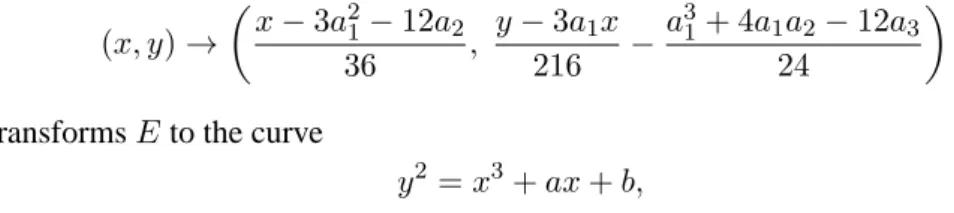
Char̸=2, 3. If the characteristic ofKis not equal to 2 or 3, then the admissible change of variables
(x, y)→
(x−3a21−12a2
36 , y−3a1x
216 − a31+ 4a1a2−12a3
24
)
transformsEto the curve
y2=x3+ax+b,
wherea, b∈K. The discriminant andj-invariant of this curve are
∆E =−16(4a3+ 27b2), jE =−1728(4a)3
∆E ,
respectively. The elliptic curve is a supersingular elliptic curve if and only if the tracetof the Frobenius satisfiest≡0 (mod p); otherwise it is an ordinary elliptic curve.
Table 2.1 lists the curves of simplified Weierstrass equations applying the ad- missible change of variables for each characteristic.
2.3. Elliptic Curves 16
Table 2.1: List of Simplified Weierstrass Equations
Char Curve Determinant∆E j-invariantjE
̸= 2,3 y2=x3+ax+b −16(4a3+ 27b2) −1728(4a)3/∆E
= 2 y2+xy =x3+ax2+b b 1/b
= 2 y2+cy=x3+ax+b c4 0
= 3 y2 =x3+ax2+b −a3b −a3/b
= 3 y2=x3+ax+b −a3 0
2.3.4 Explicit Addition Formulas onE/K
For each simplified Weierstrass equation, there are the explicit addition formu- las of the group law. Now, we indicate the explicit formulas of a negative point, point addition and point doubling for each characteristic and each ordinary and supersingular elliptic curve, respectively.
LetE/Kbe an elliptic curve overKandE(K)be a set of all points onE/K. The identityOsatisfiesP+O=O+P =P for allP ∈E(K), and the pointQ whereP+Q=Ois said to the negative point ofP ∈E(K), denoted by−P.
For the elliptic curvey2=x3+ax+b, the formulas of the negative point, the point addition and point doubling are as follows:
Negative point. IfP = (x, y)∈E(K), then−Pis(x,−y).
Point addition. Let P = (x1, y1), Q = (x2, y2) be points in E(K) such that P ̸= ±Q. Then the point addition R = (x3, y3) = P+Qis computed as
follows:
λ = y2−y1
x2−x1
x3 = λ2−(x1+x2) y3 = λ(x1−x3)−y1
Point doubling. LetP = (x1, y1)be a point in∈ E(K)whereP ̸=−P. Then the point doublingR= (x3, y3) = 2P is computed as follows:
λ = 3x21+a 2y1
x3 = λ2−2x1 y3 = λ(x1−x3)−y1
These formulas can be applied to ordinary and supersingular elliptic curves in characteristic ̸= 2,3 and supersingular elliptic curves in characteristic 3. If the
characteristic of the fieldKis 3, then the computational cost of the point doubling can be reduced, since3x21 modulo 3 is equal to 0.
For the ordinary elliptic curvey2+xy=x3+ax2+bin characteristic 2, the formulas of the negative point, the point addition and point doubling are as follows:
Negative point. IfP = (x, y)∈E(K), then−Pis(x, x+y).
Point addition. LetP = (x1, y1), Q = (x2, y2) be points in E(K) whereP ̸=
±Q. Then the point additionR= (x3, y3) =P+Qis calculated by:
λ = y1+y2 x1+x2
x3 = λ2+λ+x1+x2 y3 = λ(x1+x3) +x3+y1
Point doubling. LetP = (x1, y1)be a point in∈ E(K)whereP ̸=−P. Then the point doublingR= (x3, y3) = 2P is computed by:
λ = x1+y1
x1
x3 = λ2+λ+a=x21+ b x21 y3 = x21+λx3+x3
When the elliptic curve is the supersingular y2 +cy = x3 +ax+b, their formulas are as follows:
Negative point. IfP = (x, y)∈E(K), then−Pis(x, y+c).
Point addition. For given points P = (x1, y1), Q = (x2, y2) in E(K) where P ̸=±Q, the point additionR= (x3, y3) =P +Qis calculated as:
λ = y1+y2 x1+x2 x3 = λ2+x1+x2
y3 = λ(x1+x3) +y1+c
Point doubling. LetP = (x1, y1)be a point in∈E(K)whereP ̸=−P, then the point doublingR= (x3, y3) = 2Pis calculated by:
λ = x21+a c x3 = λ2
y3 = λ(x1+x3) +y1+c