Funeral Ceremony as an Embedded Social Capital
Katsumi SHIMANE (Email: [email protected]) 要約 本論文は、葬送儀礼は社会的ネットワークに埋め込まれた社会関係資本の発露によって実施 されているということを論証するために議論が展開されている。上記の命題を証明するために、 第1 節では E.デュルケームの儀礼論とナン・リンの社会関係資本論を理論的背景として紹介し た。第2節では、専修大学社会関係資本研究センター(CSCS)がアジア各国の研究機関と共同 して行った国際比較アンケート調査の結果をもとに、一人当たりGDP が大きくなるとともに、 近隣住民の葬儀への参加度が低くなることを紹介した。つまり経済的に発展すればするほど、 葬儀における近隣住民による相互扶助は低下すると考えられる。第3 節では、その現状を詳し く探るために、急激な社会変動下にあるベトナムにおいて、伝統的な葬儀がどのように変化し つつあるかを、事例研究によって記述した。ベトナムにおける伝統的葬儀では近隣住民による 相互扶助がなければ実施できなかった。しかし急激な都市の膨張による農村から都市への人口 の移住は、近隣住民による葬儀への参加を二つの部分に分けることになった。すなわち現在居 住している都市空間における葬儀の実施と、死者の出身地における野辺送りと埋葬は、それぞ れ異なったコミュニティーメンバーによって行われているのである。故人とその家族は現住地 と故郷という二つの異なったコミュニティから葬儀に必要な資源を引き出している。このよう に葬儀の変化の様子を子細に観察すると、その社会が被っている社会の変動の実態を知ること ができるというのが本論の結論である。 この論文をもとに、2014 年 7 月に開催された第 18 回世界社会学会議横浜大会「社会関係資 本と合理的選択理論」(RC45)セッションで同名のタイトルで口頭報告を行った。Keywords: Funeral Ceremony, Social Capital, Embedded Resources, Vietnamese Society
Introductionbehaviors, are important issues for sociology. A funeral is a social fact surrounded by nonrational emotions and rational choices.
This paper is organized as follows. In Chapter 1, the social capital theory is used to show how the labor and goods required for holding funerals are already embedded in networks. Chapter 2 elaborates on the finding that the lower a society’s gross domestic product (GDP), the higher the level of participation by neighboring residents in funerals, and, conversely, the higher a society’s GDP, the lower the level of neighboring residents’ participation in funerals, using data from a questionnaire conducted in seven Asian countries. In Chapter 3, Vietnamese society, which is currently undergoing drastic changes, is used as a case study to illustrate how long-standing traditional funeral practices are undergoing changes. Through this discussion, I illustrate that the process of change from homophilous social relationships to heterogeneous social relationships is evident from changes in the composition of the people who participate in funerals.
1. Theoretical background
A funeral is a social fact that can be observed in all societies. However, regardless of the fact that a funeral is a social phenomenon that serves as an intensive expression of various human relationships and social structures, I am not aware of any classical texts that analyze these factors from a sociological perspective. While anthropologists and folklorists are interested in funerals, their interest has focused on documenting and comparing the different forms of each society’s traditional funerals. The attitude of sociologists suggests that funerals do not exist as a social fact in modern society. However, it is clear that there is a deep relationship between the collective rituals that occur when somebody dies, and that community’s social structure. We will not, however, enter into a complicated discussion of whether a funeral is a religious phenomenon or not. The French sociologist Emile Durkheim makes the following claim in his classical work concerning the religious life of primitive people.
a funeral are still too much for a single individual or family to bear, making the cooperation of relatives, acquaintances, and neighboring residents essential. We conclude that the resources expended on behalf of communal obligations in primitive societies are drawn from the resources embedded in social relations.
Whether or not it is possible to procure the labor required for transporting and burying the corpse, the joint action needed to organize the funeral, and the gifts required for religious people and participants—in other words, whether a funeral will be a success or not—depends on how abundant the social capital of the deceased and his or her family is. Particularly for Asian societies that are very face-saving, funerals are an extremely important social event (Shimane, 2012: p. 29).
When a family member dies, how do families go about identifying the labor and goods required for the funeral? To answer this question I will refer to Nan Lin’s discussion concerning social capital. Nan Lin defined social capital as follows: “Social capital consists of resources embedded in one’s network or association…, which is not the individual’s possessed goods, but resources accessible through direct and indirect ties” (Lin, 2001: p. 56). Therefore, I conclude that families are normally able to procure resources required to conduct appropriate rituals in response to emergency events, including funerals, from the social capital that is embedded in their network. Lin states that “Maintaining valued resources…dictates actions undertaken to preserve and defend valued resources already at the individual’s disposal,” and defines these actions as “expressive actions.”
Expressive actions are expected to result in interactions consistent with the principle of homophilous interaction. Recognition of similarity of resources and of the need to reciprocate concerns about them and protect them constitutes the basis for satisfying interactions. This expectation is consistent with the observation that interactions tend not only to take place more often but also to be more satisfying among participants with similar socioeconomic characteristics, lifestyles, and attitudes (Lin, 2001: p. 58).
When ceremonies that have costs, such as funerals, are conducted by a community member, other community members will provide labor and goods, a little at a time over the long term, based on feelings of mutual trust. This serves as an installment payment in the case of an unfortunate event affecting one’s own family someday. It is because community members are homophilous that they need to help each other out by providing the things that are needed, for each other. Furthermore, because there is very little social movement in traditional societies, and members have internalized social exchange as an obligation, even if resources are provided without collateral, society members believe that they will be able to get a return on these investments someday. It is thought that funerals in many traditional societies, not just those in the Asia region, have long been based on this concept of social exchange.
2. Data from an international comparative survey on social capital
the main instruments used was an international comparative survey of seven Asian countries. The survey asked questions about topics including social trust, lifestyles, risk and the social safety net, and social rituals. Two locations were selected in each country, and a sampling survey was conducted. Although the survey had the disadvantage of a low sample count, it does provide some very interesting data from the perspective of gaining an understanding of significant changes in the composition of people who participate in funerals as a result of social development.1 (Table 1)
Table 1. Basic data on the questionnaire survey target area
Urban Vietnam (2010) Rural Vietnam (2011) Urban Vietnam (2014) Rural Vietnam (2014) Survey Period October 2010 March 2011 January 2014 January 2014 Target City and
Village
Nam Dinh province Nam Dinh province Nam Dinh province Nam Dinh province Nam Dinh city Giao Thuy district Nam Dinh city Giao Thuy district Vi Xuyen ward Giao Tan commune Quang Trung ward Hai Hau commune
Abbreviation VU VR VqU VhR
Sample Size 100 samples 100 samples 100 samples 100 samples
Survey operator Vietnam Academy of Social Sciences Institute of Sociology
●
Urban Cambodia Rural Cambodia Urban Laos Rural Laos Survey Period October 2011 October 2011 January 2010 October 2011 Target City and
Village
Siem Reap province Prey Ven province Vientiane Municipality Vientiane province Siem Reap district Peam Ro district Chanthaboury district Meuang Feuang district Sala Kamreauk commune Babang commune Nongping village Nakang village
Baban village Phonesavang village Done village Nongthatai village
Abbreviation CaU CaR LU LR
Sample Size 200 samples 200 samples 116 samples 116 samples
Survey operator Cambodia’s Leading Independent Development Policy Research Institute (CDRI) National University of Laos Research and Academic Service Office
●
Thailand Thailand Korea Korea
Survey Period December 2012 December 2012 August 2011 September 2012 Target City and
Village
Nonthaburi province Chonburi province Busan City South Gyeongsang Province
Bangkruai district Panasnikom district Gimhae City
Bang Kruai Municipal Phanat Nikhom Municipal
Abbreviation ThNU, ThNR ThCU, ThCR KB KG
Sample Size 400 samples 400 samples 248 samples 200 samples
Survey operator Chulalongkorn University Social Research Institute Research Institute for Social Enterprise
●
Taiwan Taiwan
Survey Period December 2012 December 2012 Target City and
Village Taipei City New Taipei City
Abbreviation TwT TwNT
Sample Size 360 samples 457 samples Survey operator Center for Japanese Studies, National Sun Yat University
(Source: CSCS)
The survey asked questions about participants’ involvement in funerals as a social ritual. The question asked was: “Of the following people, who do you feel has to attend someone’s funeral? (Multiple answers possible.)” The answer selections were: “1. Family, 2. Relatives, 3. Friends, acquaintances, 4. People in neighborhood, 5. Friends from work/coworkers, 6. Employers, and 7. People from a religious organization such as a temple or church.”
Table 2 provides response rates for the above question, and lists the GDP per capita of each respective country. For the column labeled family, participation rates were high, at 80% to 100%, with the exception of Busan in South Korea, where the response rate was in the 70% range. For Cambodia, Laos, and Vietnam, a response rate of close to 100% was received for family participation in funerals for all regions. Nearly the same trend was evident for relatives as for family members, in terms of funeral participation. The Asian value of placing importance on one’s relationship with family members and relatives is very apparent in these results.
Table 2. Percentage of participation in funerals Target region
Abbre-viation GDP Family Relatives
Friends, acquaintances
People in the
neighborhood Coworkers Employers
Rural Cambodia CaR $853 100.0% 100.0% 100.0% 99.5% 30.5% 2.0%
Urban Cambodia CaU $853 100.0% 100.0% 99.5% 99.0% 38.5% 12.0%
Rural Laos LR $1,204 100.0% 100.0% 97.4% 93.0% 82.6% 32.6% Urban Laos LU $1,204 99.1% 99.1% 96.5% 93.8% 86.7% 66.4% Rural Vietnam VR $1,532 99.0% 98.5% 95.0% 95.0% 69.0% 45.5% Urban Vietnam VU $1,532 99.5% 99.0% 99.0% 98.5% 76.0% 59.5% Thailand (Chonburi) ThC $5,115 96.8% 97.5% 97.0% 90.0% 70.0% 36.5% Thailand(Nontaburi) ThN $5,115 94.7% 98.0% 93.5% 84.5% 23.2% 13.8%
New Taipei City, Taiwan TwNT $20,030 89.3% 89.8% 94.0% 44.2% 53.6% 39.8%
Taipei, Taiwan TwT $20,030 88.4% 92.7% 95.8% 40.4% 55.4% 42.9%
Busan, South Korea KB $22,388 77.8% 73.8% 73.0% 31.0% 54.4% 35.1%
Gimhae, South Korea KG $22,388 99.0% 94.0% 87.5% 55.5% 68.0% 62.0%
(Source: CSCS, JETRO)
We will look at the response rates for friends and acquaintances next. Consistent with response rates for family participation, the response rates for friends and acquaintances are extremely high, with the exception of a portion of South Korea. This suggests that ties between friends and acquaintances are strong in Asia, in the same manner that ties between family members and relatives are strong.
We next develop a diagram using GDP per capita as a benchmark to express social development. Diagram 1 displays GDP per capita (2011) on the horizontal axis, and the funeral participation rates of people in the neighborhood are shown on the vertical axis.2
Figure 1. Funeral participation rate × GDP per capita
(Prepared using data from CSCS and JETRO)
The following points can be intuitively understood by looking at this diagram. The six countries used in this study can be divided into two groups: a Southeast Asia group with a GDP per capita of up to USD 5,000, and an East Asia group with a GDP per capita that exceeds USD 20,000. For Cambodia, which has a GDP per capita of less than USD 1,000, the funeral participation rate of people in the neighborhood is high at nearly 100%. Conversely, the funeral participation rate of people in the neighborhood decreases as GDP per capita rises, falling as low as the 80% range for Thailand. That is considered by some to be Southeast Asia’s newly industrialized country. Looking at the two high income countries of East Asia that were covered in the survey, the participation rate drops to 30% for the lowest scorer of Busan, South Korea. Although we unfortunately were not able to collect data from Japan, it is expected that if the same type of survey were conducted on urban areas in Japan, the participation rate would be lower. It should be mentioned here, for people not very familiar with funerals in Asia, that according to traditional social relationships, people in East Asian countries feel very strong obligations to participate in and provide labor and goods for funerals held by people in the neighborhood. Figure 1
shows that these norms are breaking down rapidly, with the advance of social development.
In the next chapter, I will introduce the case of funerals in Vietnamese society, to provide a better understanding of the factors behind these changes.
3. Changes in funerals in Vietnam
In the previous chapter, I confirmed that the more the GDP per capita increases, the lower the funeral participation rate by people in the neighborhood. According to the data introduced in the previous chapter, the funeral participation rate of people in the neighborhood was at least 95% in both regions of Vietnam that were studied. However, a case study I conducted in Hanoi and rural areas in Northern Vietnam clearly suggested that major changes are underway in the way funerals are held. In this chapter, I will use the case of Vietnamese society to illustrate how social changes have transformed the way in which funerals are conducted.
While Vietnam is a multi-ethnic country, the main ethnic group named Kinh accounts for approximately 90% of the population. Their traditional funeral practices are being handed down in the rural areas, while being influenced by the Chinese culture. Even today, various funeral-related rituals continue to be based on Thọ Mai Gia Lễ (a Vietnamese book describing ritual methods for ceremonies), which has been strongly affected by Chinese culture (Nguyen: 2012). While the original basis for this book was Zhuzi Jiali (The Family Rituals of Zhu Xi), written in China in the 12th century, it was said that it began to spread across Vietnam in the 18th century (Sakurai, Momoki, eds. 1999).
Michio Suenari conducted long-term cultural anthropological research in the agricultural area of Trieu Khuc near Hanoi, from 1994 to 1998, and collected detailed records on traditional funerals in rural societies in Northern Vietnam (Suenari: 1998 & 2000). Due to length limitations, I am not able to introduce the complex funeral ritual process here. However, I would like to introduce the section describing the participation of local community members in funerals.
From the early morning of the funeral day, relatives, neighbors, and friends gather around, and a band plays drums and pipes. At times the old women incant Buddhist chants.… The funeral procession proceeds in the order of elderly women holding Buddhist flags (flags decorated with Buddhist images and characters), flower garlands, drum players, leaders, the coffin, the mourners, and elder women. … Just like the people who carry the coffin, leaders and sub-leaders do not receive any special offers other than being invited for a meal. The attendance of mourners is also entirely voluntary, and there can be significant differences in these numbers depending on the how well connected the deceased was and their popularity (Suenari: 2008, pp. 94-95, emphasis added by author).
Figure 2. Women holding flags at the head of a funeral procession
(Nam Dinh Province, August 2011, photo by author)
Allow me to explain further using actual case studies. I had the opportunity to participate in Vietnamese Funerals in Hanoi, and I will describe these cases.
One funeral was held on April 4, 2011, and the deceased was an 83-year-old woman who had been born in 1928. She died a sudden death. The funeral was conducted at a home in a residential area close to the center of Hanoi. On the day before the burial, neighbors and acquaintances paid their condolences in a manner reminiscent of a wake. People stopping by to offer their condolences brought gift money with them, and offered it to the deceased. The people in the neighborhood also helped the grieving family in various other ways.
I conducted interviews with the relatives who played central roles (the biological daughter and her husband) at a later date. The husband made the following comment: “In Vietnam there is a saying that you should ‘sell your faraway brothers and buy your neighbors,’ meaning that you should prioritize the people in your neighborhood over a brother who lives somewhere far away. In social relations, it is common sense for the people in the neighborhood to help out when a family in the area conducts some form of ceremony” (August 20, 2011, Hanoi).
This is a statement that supports Suenari’s previously quoted observation. It is possible that so many people participated in this family’s funeral because the family had much social capital.
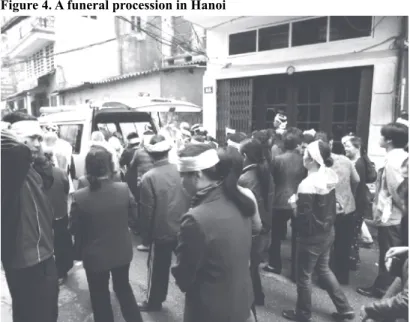
Another characteristic of these funerals is getting help from people in different neighborhoods, when conducting burials at cemeteries far from the home, where the funeral was held. Figure 3 is a photo that was taken after a funeral held at a home in Hanoi. Many residents from the surrounding area participated in the funeral. Figure 4 shows a funeral procession heading toward a cemetery in a rural area near Hanoi. The corpse, which was transported from the city, has been moved to another hearse, and the funeral procession is composed of residents from the deceased’s hometown. The person is first carried in a hearse, which resembles an ambulance, and is then also carried in a traditional wooden hearse, on the same day.
Figure 3. A funeral ceremony conducted at a home in Hanoi
Figure 4. A funeral procession in Hanoi
(Hanoi City, April 2011, photo by author)
Figure 5. A funeral procession in a rural area near Hanoi
Figure 6. A Burial by the residents of her hometown
(Rural area near Hanoi, April 2011, photo by author)
This situation is quite a deviation from the detailed steps for funeral rituals described in Thọ Mai Gia
Lễ. The reason for this is that there are dozens of kilometers between the house where the deceased lived
in Hanoi, and her hometown where the cemetery is located.
What I would like to focus on is not the difference between the rituals, but rather the composition of the participants in the rituals. Following the funeral at the home in Hanoi, and the funeral procession through the neighborhood, the corpse and the family traveled dozens of kilometers to the deceased’s hometown by bus. Upon arriving at the hometown, waiting residents of the local community transferred the corpse to a traditional hearse. A funeral procession of over 100 people then walked together to the cemetery. The task of burying the coffin at the cemetery was conducted by residents of the deceased’s hometown. The deceased had been sent off by residents of the community where she had lived, and was buried by the residents of the community where she had been born and raised. The deceased and her family had two communities, and this funeral ceremony can be viewed as a ritual for saying goodbye to both communities.
family are affiliated with two communities, one in Hanoi, and one in their hometown in the suburbs. This creates a situation in which a funeral, which should consist of a single ritual, is divided into two, and resources embedded in the respective communities are mobilized.3
However, as new generations are born, it may become more difficult for people to belong to multiple communities. As generations are born and raised in urban areas, relationships with rural communities will likely become more distant. Furthermore, in accordance with urban lifestyles, people will not be able to take holidays from work to provide labor for a neighbor’s funeral. In rural areas, where there is not much movement by residents, one can expect to get a return without collateral, through social exchanges related to funerals that may only occur once every several years. In contrast, in urban areas, where people move about frequently, the risk increases of not receiving a return on social exchanges made without collateral over an extremely long time. As it becomes more difficult to hold funerals through the mobilization of a bonding-based social network, it is likely that other forms of funerals will be practiced. In Japanese society, it was these types of changes in social structure that led to the rapid commercialization of the funerary industry (Shimane & Tamagawa: 2011). The funerary industry also became commercialized at a rapid pace in Taiwan and South Korea. It is believed that the commercialization of funerals in Vietnam will occur in the future.
Conclusion
In this paper, I have asserted that a funeral is a social custom that expresses the resources embedded in social networks, and that it is possible to observe the condition of social networks by observing funerals. For this reason, Durkheim’s theory on rituals and Nan Lin’s theory on social capital were introduced. Next, survey data from various countries in Asia were used to illustrate the negative correlation between increases in GDP and the funeral participation rate of people in various neighborhoods. I then introduced the subject of funerals in Vietnam, to exemplify significant changes in funerals in Asia, and postulated that there is the possibility of a drastic transformation of funerals in the future, even in Vietnamese society, where there is still a very strong tradition of neighbors providing mutual assistance at funerals. I would like to close this paper by describing the current state of funerals in Japanese society. As already explained in detail (Shimane: 2012 etc.), Japan historically had strong norms and traditions, in which regional groups held traditional funerals. These traditions rapidly fell into disuse, as urban areas were formed during a time of rapid economic growth in the 1960s. Before the bubble economy burst in the late 1990s, funerals became more and more extravagant, causing the economic burden on families to increase. However, with the economy’s collapse, lower fertility rates, and an aging population, the scale of funerals has decreased, and they been simplified. More and more people hold “family funerals” (funerals held for close family members only, without inviting relatives, friends or acquaintances, coworkers, or people in the neighborhood), and “direct cremation” (the disposal of the corpse without any ceremonies or rituals). It can be said that at least some Japanese people are beginning to place less
importance on social relationships with the deceased and their family members in the event of the death of someone close to them. Going forward, we would like to study what meaning this has, in terms of the state of social relationships in Japanese society.
References
Collins, Randall. 1992. Sociological Insight; An Introduction to Non-Obvious Sociology, Second Edition. Oxford University Press.
Durkheim, Emile (author), Cladis, Mark S. (ed.), and Cosman, Carol (translator). 1912, [2001]. The
Elementary Forms of Religious Life, Oxford University Press.
Huard, Pierre and Durand, Maurice. 1954. Vietnam: Civilization and Culture, Ecole Française d’Extrême-Orient, Hanoi.
Lin, Nan. 2001. Social Capital. A theory of Social Structure and Action. Cambridge University Press. Nguyen, Thi Oanh. 2012. Vietnam no shukan to Sinko wo Koten Bungaku ni Saguru (Vietnamese
Customs and Belief in Classical Literature) International Research Center For Japanese Studies (http://www.nichibun.ac.jp/graphicversion/dbase/forum/pdf/fn252.pdf) Sakurai, Yumio and Momoki, Shiro. (eds.) Vietnam no Jiten (Encyclopedia of Vietnam). Doho sha. Shimane, Katsumi. 2004. Planifier sa propre mort, (ed.), Ansart Pierre et al., Quand la vie s’allonge;
France-Japon, l’Harmattan.
Shimane, Katsumi and Tamagawa, Takako. 2011. Senngo Nihon ni Okeru Sogi to Sosaigyo no tennkai (Development of Funeral Service and Funeral Industry after the World War II). Senshu
Ningen-Kagaku Ronshu.
Shimane, Katsumi. 2012. The Experience of Death in Japan’s Urban Societies. In: Invisible Population:
The Place of the Dead in East Asian Megacities, (ed.), Aveline-Dubach, Natacha, Lexington Books.
Suenari, Michio. 1998. Vietnam no Sosen Suhai; Treiu Khuc no Shakai Seikatsu (Vietnamese Ancestor Worship; Social Life in Treiu Khuc). Fukyosha.
Suenari, Michio. 2008. Jinsei Girei; Kekkon to Sorei (Ceremonies in Life; Marriage and Funeral).
Vietnam; Henkasuru Iryo to Girei (Vietnam; Medical Practices and Ceremonies in Transition).
Shunpu sha.
Acknowledgments
This paper was presented at XVIII ISA World Congress of Sociology 14 July 2014 in Yokohama. I got useful suggestions from participants of Social Capital and Rational Choice Theory.
This case study research on Vietnamese society was supported by the project titled “Social exchange and social networks: sociological approaches to social change in rural Vietnam,” sponsored by the Vietnam Foundation for Sciences and Technology. In particular, much support was provided by Dr. Bui Quang Dung and MA. Dang Thi Viet Phuong.
data concerning social capital in the countries of East Asia are the results of surveys and research conducted by their counterparts from 2009 to 2014.