A Factor Analysis of the Future Use of English Scale
Jean-Pierre Joseph Richard Suwako Uehara
Since 2003 when Irie summarized the research into the motiva- tions of Japanese university learners into two principal orientations, career and contact, two important trends have been identified in Japanese society, (a) the increasingly important role that English is perceived to play in Japanese business and (b) the struggles of graduates to find successful employment. This paper reports on the development of a 50-item psychometric scale, FUES 2.0, to measure future use of English. The participants included both Japanese (n = 317) and Korean (n = 326) university learners, in the total sample (N = 643). Each of the 50-items on FUES 2.0 was scored on a 6-point Likert-scale. Results suggested FUES 2.0 is composed of four factors: (a) hopefulness to use English;
(b) conformity to use English; (c) English as a job requirement;
and (d) English contact; and Cronbach’s α reliability coeffi- cients ranged from .86 to .94. These results imply that career and contact are indeed the principal goal orientations of uni- versity learners; however, career orientation is likely to be multifaceted.
Keywords: future use of English, goals, scale development, factor analysis, university learners, Japan, Korea
Introduction
Irie (2003) summarized the results of more than a decade of research into the English-language motivations of Japanese university learners into two categories: career and contact orientations. In that article, Irie also called for a tightening of our understanding of these two constructs related to the motivations of Japanese university students. Since 2003, two trends have continued in Japan, (a) the growing role of English in Japanese business (see Asahi Shimbun, 2012; Nikkei BP, 2010; Sankei Shimbun, 2010; Yomiuri Shimbun, 2010), (b) and the continued struggles of Japanese university graduates to successfully find employment (see Burgess, 2011) in this employment “ice age” (Ito & Fujioka, 2010). Obun- sha Educational Information Center (2010) showed employment rates were the worst in 14 years and stood at 58% for university graduates.
Indeed, a 2010 Cabinet Office report stressed that for recent, current, and future university graduates, the Japanese employment system is de- generating and is not sustainable in the long run (Hamaaki, Hori, Maeda,
& Murata, 2010, p. 24). In light of these recent trends, and the calls from Irie to better understand the motivational constructs related to Japanese university students, this paper reports on a factor analysis of a psycho- metric scale that is being newly developed to measure the English-lan- guage motivations of university students, the future use of English scale 2.0 (FUES 2.0).
Gardner’s socio-educational model
Previously, the dominant view of motivation was Gardner’s socio-edu- cational model, and its key component of integrativeness (Gardner, 1985, 2006; Gardner & Lalonde, 1985; Gardner, Lalonde, & Pierson, 1983) was based on studies that took place in Canada in the 1970s and 1980s. In es- sence, integrativeness is the motivation to learn an L2 due to a desire to integrate into the L2 community. Integrativeness was differentiated from instrumentality, a learner’s motivation to learn the L2 for utilitarian reasons, e.g. advance one’s career. In bilingual Canada, integrativeness meant the desire for anglophones to “take on characteristics” (Gardner,
2006, p. 247) of the francophone culture, and vice versa; and learners who had a greater desire to integrate into the L2 culture would likely be more successful at learning the L2, than learners who were learning an L2 for instrumental reasons. Gardner (2006) argued that this perspec- tive, of a group of learners motivated to learn an L2 based on their in- terest in characteristics of the L2 cultural group, remained valid and was not unlike other motivational constructs, such as international pos- ture (Yashima, 2002), the attitude of Japanese learners towards the inter- national community that influences language learning.
Must-have English
Gardner’s macro-perspective view of motivation was criticized for a number of reasons, in part because it failed to capture the motivations of language learners who were learning languages without desiring to integrate into a second language community; and also because it failed to capture the rise of global languages, in particular English (Dörnyei, 2005; Lamb, 2004; Ryan, 2009; Yashima, 2002). At the beginning of the 21st Century, it is apparent that English no longer belongs to one people or one culture. English has become for many individuals, a ‘must-have’
educational skill without a clearly defined linguistic community to which English belongs (Ushioda, 2011). Indeed, a number of university learners in one recent study involving both Japanese and Korean participants have described this must-have view of English-language learning in their own words. For example, one participant in Richard, Uehara, Min, and Chung (2012) wrote: “there are more people speaking English ... we need to at least have communication skills (in English)”. Additionally, one participant in Richard and Uehara (forthcoming) wrote: “now, English is spoken all over the world, and it is essential for people to be able to use in the international community.”
Previous studies on the future use of English
Following Irie’s call for a greater understanding of the motivational goals of L2 language learners (2003), we have initiated a number of stud-
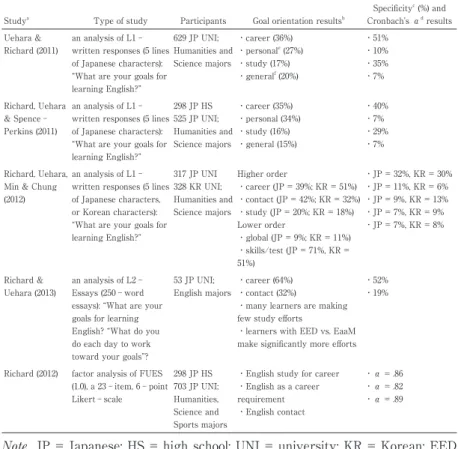
Table 1 Previous Studies on the Future Use of English
Studya Type of study Participants Goal orientation resultsb
Specificityc (%) and Cronbach’s αd results Uehara &
Richard (2011)
an analysis of L1 - written responses (5 lines of Japanese characters):
“What are your goals for learning English?”
629 JP UNI;
Humanities and Science majors
・career (36%)
・personale (27%)
・study (17%)
・generalf (20%)
・51%
・10%
・35%
・7%
Richard, Uehara
& Spence - Perkins (2011)
an analysis of L1 - written responses (5 lines of Japanese characters):
“What are your goals for learning English?”
298 JP HS 525 JP UNI;
Humanities and Science majors
・career (35%)
・personal (34%)
・study (16%)
・general (15%)
・40%
・7%
・29%
・7%
Richard, Uehara, Min & Chung (2012)
an analysis of L1 - written responses (5 lines of Japanese characters, or Korean characters):
“What are your goals for learning English?”
317 JP UNI 328 KR UNI;
Humanities and Science majors
Higher order
・career (JP = 39%; KR = 51%)
・contact (JP = 42%; KR = 32%)
・study (JP = 20%; KR = 18%) Lower order
・global (JP = 9%; KR = 11%)
・skills/test (JP = 71%, KR = 51%)
・JP = 32%, KR = 30%
・JP = 11%, KR = 6%
・JP = 9%, KR = 13%
・JP = 7%, KR = 9%
・JP = 7%, KR = 8%
Richard &
Uehara (2013)
an analysis of L2 - Essays (250 - word essays): “What are your goals for learning English? “What do you do each day to work toward your goals”?
53 JP UNI;
English majors
・career (64%)
・contact (32%)
・many learners are making few study efforts
・learners with EED vs. EaaM make significantly more efforts
・52%
・19%
Richard (2012) factor analysis of FUES (1.0), a 23 - item, 6 - point Likert - scale
298 JP HS 703 JP UNI;
Humanities, Science and Sports majors
・English study for career
・English as a career requirement
・English contact
・α = .86
・α = .82
・α = .89
Note. JP = Japanese; HS = high school; UNI = university; KR = Korean; EED
= English environmental desire; EaaM = English as a means; FUES = Future use of English scale.
aStudies are listed in publication date order. bPercentage of goal orientations out of total goals. Ex. 36% of all goals in Uehara & Richard (2011) were career
- oriented. cSpecificity is the percentage of learners per goal orientation category that richly described their goals. Ex. 51% of all career goals in Uehara & Richard were more specifically described. dCronbach’s α for each of the three factors in Richard (forthcoming). ePersonal was later labeled contact.
fGeneral included poorly defined, vague or unclear goal orientations.
ies to investigate English-language goal orientations, using both quasi-
qualitative methods, in which large numbers of learners’ L1-written re- sponses and L2-written essays regarding their L2 goals were analyzed and categorized by goal orientation and level of goal description; and quantitative methods, with the development of a psychometric scale to measure future use of English. The following section summarizes these studies. See also Table 1.
Uehara and Richard (2011) asked a large number (N = 629) of Japa- nese university learners to describe their English-language goal orienta- tions. These orientations were classified into four large disparate catego- ries: career, personal, study, and general. Of these four, career and personal goals constituted nearly two-thirds of the goal orientations identified; and study and general together accounted for the remaining one-third. General goals were not specific to career, personal nor study goal orientations. Such general goal orientations may have been directed towards one of the three goal orientations (career, personal or study);
however, learners did not specifically refer to these orientations and thus their descriptions were often interpreted as vague, poorly-worded or unclear. Dörnyei (2009) pointed out, in his L2 motivational self-system, that learner goal descriptions need to be rich in detail. Thus, Uehara and Richard also categorized goals by level of specificity, that is, the amount of detail in each learner’s goal description was measured. Personal goals were overwhelmingly less specific; only 10% were categorized as more specific. Conversely, the majority of career goals (51%) were categorized as more specific. Similarly, a large number, 35%, of study goals were more specific.
Building on the dual motivational goals summarized in Irie (2003), and from the large number of responses in Uehara and Richard (2011) that were career and personal related, Richard (2012) developed the first ver- sion of the future use of English scale (FUES). This earlier scale included 23 items intended to measure career and contact goal orientations of Japanese learners. Results from this study, which included both high school and university learners (N = 1001), indicated that FUES is com-
posed of three factors: (a) English study for career, (b) English as a ca- reer requirement, and (c) English contact; Cronbach’s α reliability coeffi- cients ranged from .82 to .89.
Richard, Uehara, and Spence-Perkins (2011) asked university and high school learners (N = 823) to describe their English-language future goal orientations. Results were similar to those in Uehara and Richard (2011).
That is, career, personal, study, and general were found across the dif- ferent learners’ descriptions of their future goals. Again, career and per- sonal goal orientations accounted for two-thirds of all goal orientations.
Furthermore, personal goal orientations were predominantly less specif- ic, while a large number of career and study goals were more specific.
In a study of L2-written essays by English majors (N = 53) regarding future English-language goal orientations and daily efforts made by the learners to orient to their goals, nearly 100% of the goal orientations were career and contact (formerly labeled personal in previous studies by the authors) (Richard & Uehara, 2013). It was found that many learn- ers identified few efforts they were making to orient to their goals. More career goals were more often more specific (52%) while contact goals were rarely more specific (19%). Finally, the authors categorized goals by level of direction. Learners who have an English environmental de- sire, EED, (e.g. work for Rakuten because they love English) compared with learners who see English as a means to their goals, EaaM, (e.g.
study English to get a job at Rakuten) were found to be significantly more likely to engage in factual efforts to achieve their goals.
Finally, Richard, et al. (2012) asked the same question that was asked in two previous studies (Uehara & Richard, 2011; Richard, et al., 2011):
what are your English-language goal orientations? Participants in Rich- ard et al. (2012) included both Japanese and Korean university learners (N = 645). Once more, career and contact were the predominant goal ori- entations, of which the former included significantly more specific de- scriptions; and study goal orientations were also numerous. The authors also found skills-based and test-based orientations, and a global outlook, which could be considered as a means or a reason to an end or end
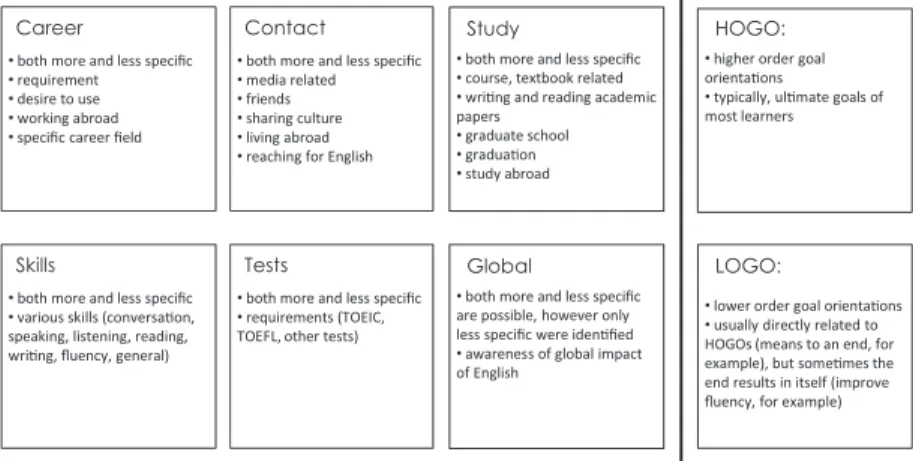
goals themselves. As a result, the authors developed a two-tier concept map of likely future English-language goal orientations. See Figure 1.
These included, as the authors suggested, both lower order (skills, tests, and a global outlook) and higher order goal orientations (career, contact, and study).
Thus, results from several recent large-scale studies, involving pri- marily a quasiqualitative analysis of written descriptions of learner goal orientations (Richard, et al., 2011; Richard et al., 2012; Richard & Uehara, 2013 and Uehara & Richard, 2011), but also an early version of the FUES (Richard, 2012) indicated that there may be several English-language goal orientations, of which the predominant orientations are career and contact, as argued by Irie (2003). Furthermore, career orientations seemed to be richer or more nuanced, and perhaps include more than one factor, such as study for career and career requirement.
Career Contact Study
•both more and less specific
•course, textbook related
•wri�ng and reading academic papers
•graduate school
•gradua�on
•study abroad
•both more and less specific
•requirement
•desire to use
•working abroad
•specific career field
•both more and less specific
•media related
•friends
•sharing culture
•living abroad
•reaching for English
HOGO:
•higher order goal orienta�ons
•typically, ul�mate goals of most learners
Skills Tests Global
•both more and less specific are possible, however only less specific were iden�fied
•awareness of global impact of English
•both more and less specific
•various skills (conversa�on, speaking, listening, reading, wri�ng, fluency, general)
•both more and less specific
•requirements (TOEIC, TOEFL, other tests)
LOGO:
•lower order goal orienta�ons
•usually directly related to HOGOs (means to an end, for example), but some�mes the end results in itself (improve fluency, for example)
Note. HOGO = higher order goal orienta�ons; LOGO = lower order goal orienta�ons.
Figure 1. Future use of English - Written Concept Map
Research question
To further broaden our understanding of the motivational constructs related to future use of English, we adapted FUES (Richard, 2012), by in-
cluding more items written following the results from Richard et al.
(2011). The result was a 50-item scale, FUES 2.0, whose aim is to mea- sure university students’ future English-language goal orientations. This paper will address one research question: what is the dimensionality of the FUES 2.0?
Method Participants
A total of 721 surveys were distributed; however, complete responses from 643 participants were gathered for this study. Approximately 11%
of the original 721 distributed surveys, of near equal numbers of partici- pants from Japan and Korea, were lost due to nonachievement or incom- pleteness. Participants included 317 (F = 213 and M = 104) learners from five Japanese universities and 326 (F = 180 and M = 146) learners from three Korean universities. See Table 2. A large majority (61%) of the Ko- rean sample were in upper grades (year 3 and above) compared with 14% of the Japanese sample. Combined, 63% of all participants were Arts (humanities) majors, while the remaining participants were Science majors. Of the Korean sample, more than half (57%) were enrolled in Arts programs, and the remaining Koreans students were Science ma- jors. Approximately two-thirds (69%) of the Japanese participants were Arts students, while the remaining students were Science majors. By gender, 55% of the Korean participants were female, compared with 67%
of the Japanese sample. Finally, the three Korean universities were com- posed of one national university and two private universities; while the five Japanese universities included one national and four private univer- sities. In sum, while the sample size of the Korean and Japanese partici- pant populations were near equal, the Japanese sample skewed heavily towards lower grade students, Arts majors, and females. On the other hand, the Korean sample was more equal in terms of gender and major, but skewed towards upper grade students. These differences in sample populations may affect results.
Measure
Participants completed the FUES 2.0. The FUES (Richard, 2012) was composed of 23 items on a 6-point Likert-scale ranging from completely disagree (1) to completely agree (6). The 23-items were originally devel- oped following Irie (2003) in which she proposed that Japanese university students endorse two English orientations, English for career and con- tact with English speakers and culture; and similar results from Uehara and Richard (2011).
All items were written in English, then translated to Japanese for the Japanese version, by one trained translator, and translated to Korean for Table 2 Distribution of Participants by Country, University, Department and
School Year
University Department Yr 1 Yr 2 Yr 3 Yr 4 Yr 5 Total
Japanese university participants
Uni 1 Arts 30 25 0 0 0 55
Uni 2 Science 67 0 0 0 0 67
Uni 3 Arts 5 45 25 12 2 89
Uni 4 Arts 56 17 1 0 0 74
Uni 5 Science 8 19 4 1 0 32
JP Total 166 106 30 13 2 317
Korean university participants Uni 6 Arts (120) &
Science (84) Science Arts
36 89 51 26 1 203
Uni 7 0 1 35 22 0 59
Uni 8 1 0 46 18 0 65
KR Total 37 90 132 66 1 326
JP + KR totals 203 196 162 79 3 643
Note. Uni = university; Yr = year; JP = Japanese; KR = Korean.
Richard (2012) found that learners endorsed three different factors: (a) English desire; (b) English as a career requirement; and (c) English contact. The researchers of this paper built on the 23 items of FUES to develop the 50 - item psychometric scale used in this study, FUES 2.0. These new items were written following an analysis of learner descriptions of their goal orientations (Richard et al., 2011).
the Korean version, by another trained translator, then these versions were back-translated by other trained translators to identify possibly poorly worded or poorly translated items. A trilingual English, Japanese, Korean academic also read through the items to identify problems. No problems were identified. The items on FUES 2.0, were pilot tested with a small group of university students in both Japan and Korea. Bilingual versions of the survey, English-Japanese and English-Korean, were dis- tributed to the respective participants. See Appendix A and Appendix B for a list of the bilingual English-Japanese and English-Korean FUES 2.0 items.
Procedure
Participants completed a multipage document, which included a con- sent form, biographical data, and the 50-item FUES 2.0. This document was completed during one section of the regular class session at the be- ginning of the spring semester and took on average 20-minutes to com- plete. Information on the documents, including FUES 2.0, were input into a Microsoft Excel file using optical mark recognition (OMR) sheets and then exported to an SPSS file.
Results and discussion
What is the dimensionality of FUES 2.0?
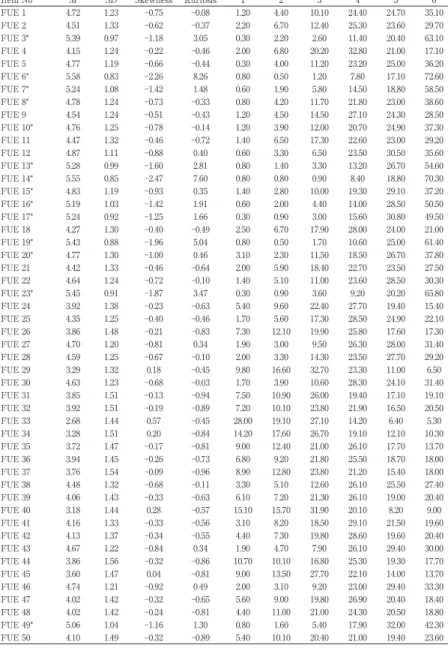
Table 3 presents the descriptive statistics for each item. Mean scores ranged from 2.68 (item 33, “it would be great to have a job where I only use English”) to 5.58 (item 6, “if I can use English fluently, that will be advantageous for me”) on the 6-point Likert-scale. The average mean score for all 50 items was 4.43, and most items (k = 46) had mean scores above 3.5, the mid-point of the scale. Taken together, these two indica- tors, the mean score and large number of items above the mid-point, suggest a positive agreement towards the items in FUES 2.0. Table 3 also includes the standard deviation (SD) for each item; skewness, which is a measure of asymmetry for each item; kurtosis, which is a measure of peakedness for each item; and the percentage of responses for each of
the six points on the scale. Before performing principal axis factor analy- sis, we checked the assumptions for factor analysis following Tabachnick and Fidell (2007) in terms of normality, linearity, univariate and multi- variate outliers, absence of multicollinearity and singularity, and fac- torability of R. Factor analysis is a frequently used technique to develop questionnaires which enable researchers to investigate latent variables (Field, 2009). Regarding normality, several items were extremely nega- tively skewed, meaning the bulk of the responses were significantly above the mid-point of the scale.
Thus, to check for floor and ceiling effects, we examined whether the mean scores minus or plus one standard deviation fell within the range of the Likert-scale. Because ceiling effects were found for 14 items, (3, 6, 7, 8, 10, 13, 14, 15, 16, 17, 19, 20, 23, and 49), these were excluded from the analysis.
The dimensionality of the remaining 36 items was analyzed using principal axis factor analysis. The Kaiser-Meyer-Olkin measure (KMO) verified the sampling adequacy for the analysis, KMO = .97 (superb, ac- cording to Field, 2009). Bartlett’s test of sphericity X2 (630) = 17194.77, p
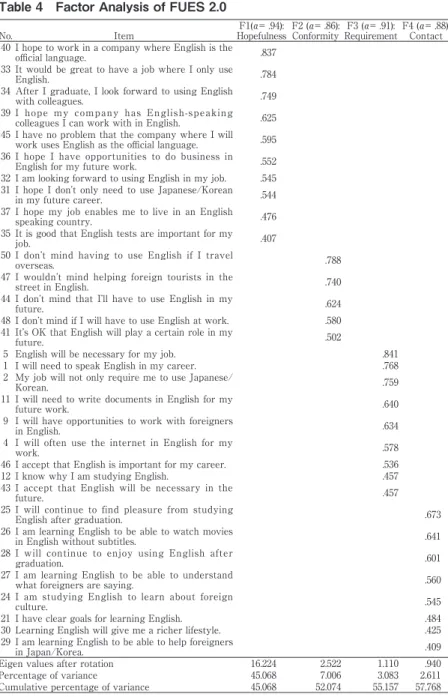
< .000, indicated that correlations between items were sufficiently large for the analysis. An initial analysis was run to obtain eigenvalues for each component in the data. To determine the number of factors to ro- tate, two criteria were used: the scree plot and the interpretability of the factor solution. Four factors were rotated, accounting for 58% of the variance, using the direct oblimin rotation procedure. For interpretations of factor loadings, we used the criterion of .40 or above on the basis of Field (2009). The rotated solution is shown in Table 4. A detailed exami- nation of the statements loading on each factor suggested the following labels: (a) hopefulness to use English; (b) conformity to use English; (c) English as a job requirement; and (d) English contact. Table 4 also indi- cates which items had a loading of .40 or higher on each factor and the reliability coefficients as measured by Cronbach’s alpha. The reliability coefficients ranged from .86 to .94 indicating high internal consistencies (see Field, 2009, p. 677).
Table 3 Descriptive Statistics for FUES 2.0 (N = 643)
Item No M SD Skewness Kurtosis 1 2 3 4 5 6
FUE 1 4.72 1.23 -0.75 -0.08 1.20 4.40 10.10 24.40 24.70 35.10
FUE 2 4.51 1.33 -0.62 -0.37 2.20 6.70 12.40 25.30 23.60 29.70
FUE 3* 5.39 0.97 -1.18 3.05 0.30 2.20 2.60 11.40 20.40 63.10
FUE 4 4.15 1.24 -0.22 -0.46 2.00 6.80 20.20 32.80 21.00 17.10
FUE 5 4.77 1.19 -0.66 -0.44 0.30 4.00 11.20 23.20 25.00 36.20
FUE 6* 5.58 0.83 -2.26 8.26 0.80 0.50 1.20 7.80 17.10 72.60
FUE 7* 5.24 1.08 -1.42 1.48 0.60 1.90 5.80 14.50 18.80 58.50
FUE 8* 4.78 1.24 -0.73 -0.33 0.80 4.20 11.70 21.80 23.00 38.60
FUE 9 4.54 1.24 -0.51 -0.43 1.20 4.50 14.50 27.10 24.30 28.50
FUE 10* 4.76 1.25 -0.78 -0.14 1.20 3.90 12.00 20.70 24.90 37.30
FUE 11 4.47 1.32 -0.46 -0.72 1.40 6.50 17.30 22.60 23.00 29.20
FUE 12 4.87 1.11 -0.88 0.40 0.60 3.30 6.50 23.50 30.50 35.60
FUE 13* 5.28 0.99 -1.60 2.81 0.80 1.40 3.30 13.20 26.70 54.60
FUE 14* 5.55 0.85 -2.47 7.60 0.80 0.80 0.90 8.40 18.80 70.30
FUE 15* 4.83 1.19 -0.93 0.35 1.40 2.80 10.00 19.30 29.10 37.20
FUE 16* 5.19 1.03 -1.42 1.91 0.60 2.00 4.40 14.00 28.50 50.50
FUE 17* 5.24 0.92 -1.25 1.66 0.30 0.90 3.00 15.60 30.80 49.50
FUE 18 4.27 1.30 -0.40 -0.49 2.50 6.70 17.90 28.00 24.00 21.00
FUE 19* 5.43 0.88 -1.96 5.04 0.80 0.50 1.70 10.60 25.00 61.40
FUE 20* 4.77 1.30 -1.00 0.46 3.10 2.30 11.50 18.50 26.70 37.80
FUE 21 4.42 1.33 -0.46 -0.64 2.00 5.90 18.40 22.70 23.50 27.50
FUE 22 4.64 1.24 -0.72 -0.10 1.40 5.10 11.00 23.60 28.50 30.30
FUE 23* 5.45 0.91 -1.87 3.47 0.30 0.90 3.60 9.20 20.20 65.80
FUE 24 3.92 1.38 -0.23 -0.63 5.40 9.60 22.40 27.70 19.40 15.40
FUE 25 4.35 1.25 -0.40 -0.46 1.70 5.60 17.30 28.50 24.90 22.10
FUE 26 3.86 1.48 -0.21 -0.83 7.30 12.10 19.90 25.80 17.60 17.30
FUE 27 4.70 1.20 -0.81 0.34 1.90 3.00 9.50 26.30 28.00 31.40
FUE 28 4.59 1.25 -0.67 -0.10 2.00 3.30 14.30 23.50 27.70 29.20
FUE 29 3.29 1.32 0.18 -0.45 9.80 16.60 32.70 23.30 11.00 6.50
FUE 30 4.63 1.23 -0.68 -0.03 1.70 3.90 10.60 28.30 24.10 31.40
FUE 31 3.85 1.51 -0.13 -0.94 7.50 10.90 26.00 19.40 17.10 19.10
FUE 32 3.92 1.51 -0.19 -0.89 7.20 10.10 23.80 21.90 16.50 20.50
FUE 33 2.68 1.44 0.57 -0.45 28.00 19.10 27.10 14.20 6.40 5.30
FUE 34 3.28 1.51 0.20 -0.84 14.20 17.60 26.70 19.10 12.10 10.30
FUE 35 3.72 1.47 -0.17 -0.81 9.00 12.40 21.00 26.10 17.70 13.70
FUE 36 3.94 1.45 -0.26 -0.73 6.80 9.20 21.80 25.50 18.70 18.00
FUE 37 3.76 1.54 -0.09 -0.96 8.90 12.80 23.80 21.20 15.40 18.00
FUE 38 4.48 1.32 -0.68 -0.11 3.30 5.10 12.60 26.10 25.50 27.40
FUE 39 4.06 1.43 -0.33 -0.63 6.10 7.20 21.30 26.10 19.00 20.40
FUE 40 3.18 1.44 0.28 -0.57 15.10 15.70 31.90 20.10 8.20 9.00
FUE 41 4.16 1.33 -0.33 -0.56 3.10 8.20 18.50 29.10 21.50 19.60
FUE 42 4.13 1.37 -0.34 -0.55 4.40 7.30 19.80 28.60 19.60 20.40
FUE 43 4.67 1.22 -0.84 0.34 1.90 4.70 7.90 26.10 29.40 30.00
FUE 44 3.86 1.56 -0.32 -0.86 10.70 10.10 16.80 25.30 19.30 17.70
FUE 45 3.60 1.47 0.04 -0.81 9.00 13.50 27.70 22.10 14.00 13.70
FUE 46 4.74 1.21 -0.92 0.49 2.00 3.10 9.20 23.00 29.40 33.30
FUE 47 4.02 1.42 -0.32 -0.65 5.60 9.00 19.80 26.90 20.40 18.40
FUE 48 4.02 1.42 -0.24 -0.81 4.40 11.00 21.00 24.30 20.50 18.80
FUE 49* 5.06 1.04 -1.16 1.30 0.80 1.60 5.40 17.90 32.00 42.30
FUE 50 4.10 1.49 -0.32 -0.89 5.40 10.10 20.40 21.00 19.40 23.60
Note. The asterisk (*) indicates that the item was removed from the following factor analysis.
Table 4 Factor Analysis of FUES 2.0
No. Item F1(α= .94):
HopefulnessF2 (α= .86):
Conformity F3 (α= .91):
RequirementF4 (α= .88):
Contact 40 I hope to work in a company where English is the
official language. .837
33 It would be great to have a job where I only use
English. .784
34 After I graduate, I look forward to using English
with colleagues. .749
39 I hope my company has English-speaking colleagues I can work with in English. .625 45 I have no problem that the company where I will
work uses English as the official language. .595 36 I hope I have opportunities to do business in
English for my future work. .552
32 I am looking forward to using English in my job. .545 31 I hope I don’t only need to use Japanese/Korean
in my future career. .544
37 I hope my job enables me to live in an English
speaking country. .476
35 It is good that English tests are important for my
job. .407
50 I don’t mind having to use English if I travel
overseas. .788
47 I wouldn’t mind helping foreign tourists in the
street in English. .740
44 I don’t mind that I’ll have to use English in my
future. .624
48 I don’t mind if I will have to use English at work. .580 41 It’s OK that English will play a certain role in my
future. .502
5 English will be necessary for my job. .841
1 I will need to speak English in my career. .768
2 My job will not only require me to use Japanese/
Korean. .759
11 I will need to write documents in English for my
future work. .640
9 I will have opportunities to work with foreigners
in English. .634
4 I will often use the internet in English for my
work. .578
46 I accept that English is important for my career. .536
12 I know why I am studying English. .457
43 I accept that English will be necessary in the
future. .457
25 I will continue to find pleasure from studying
English after graduation. .673
26 I am learning English to be able to watch movies
in English without subtitles. .641
28 I will continue to enjoy using English after
graduation. .601
27 I am learning English to be able to understand
what foreigners are saying. .560
24 I am studying English to learn about foreign
culture. .545
21 I have clear goals for learning English. .484
30 Learning English will give me a richer lifestyle. .425
29 I am learning English to be able to help foreigners
in Japan/Korea. .409
Eigen values after rotation 16.224 2.522 1.110 .940
Percentage of variance 45.068 7.006 3.083 2.611
Cumulative percentage of variance 45.068 52.074 55.157 57.768
The first factor included ten items, all of which appeared to indicate a general hopefulness to use English in the work environment, and thus was titled “hopefulness to use English”. Sample items included item 32, M = 3.92 (“I am looking forward to using English in my job”), and item 37, M = 3.76 (“I hope my job enables me to live in an English-speaking country”). However, the mean score for the ten items in this first factor was 3.60; a score that is near the mid-point of the Likert-scale. This fac- tor included three items below the 3.5 midpoint of the Likert-scale, items 33, M = 2.68 (“it would be great to have a job where I only use English”); 34, M = 3.28 (“after I graduate, I look forward to using English with colleagues”, and 40, M = 3.18 (“I hope to work in a company where English is the official language”); and seven items above the 3.5 mid-
point, including item 39, M = 4.06 (“I hope my company has English-
speaking colleagues I can work with in English”) and item 36 M = 3.94 (“I hope I have opportunities to do business in English in my future work”). The internal consistency of the ten items in this factor was mea- sured by Cronbach’s alpha, α = .94. This is excellent (Field, 2009). Dele- tion of any item did not improve reliability and thus all ten items were maintained.
The second factor included five items, all of which appeared to indi- cate learners were conforming to demands to use English in a variety of settings, and thus was titled “conformity to use English”. Sample items included item 41, M = 4.16 (“it’s OK English will play a certain role in my future”) and item 44, M = 3.86 (“I don’t mind that I’ll have to use English in my future”). All five items in this factor were above the mid-
point of 3.5 on the Likertscale, with mean scores ranging from 3.86 to 4.16, and the mean score for the five items in this second factor was 4.03 which indicates a positive level of agreeability. The internal consistency of the five items in this factor was measured by Cronbach’s alpha, α = .86. This is good (Field, 2009). Deletion of any item did not improve reli- ability and thus all five items were maintained.
The third factor originally included ten items, most of which appeared to indicate agreeability that English is a future work requirement, and
was thus titled “English as a job requirement”. Of these ten items, one item, item 22, M = 4.64, double-loaded on both factors 3 and 4, and was thus removed from both factors. Sample items included item 12, M = 4.87 (“I know why I am studying English”) and item 5, M = 4.77 (“English will be necessary for my job”). After deleting item 22, the remaining nine items in this factor, all of which were above the mid-point of 3.5 on the Likert-scale, with mean scores ranging from 4.15 to 4.87, had a com- bined mean score of 4.60 which indicates a very positive level of agree- ability. Other items in this third factor include item 1, M = 4.72 (“I will need to speak English in my career”), and item 11, M = 4.47 (“I will need to write documents in English for my future work”). The internal consis- tency of the remaining nine items in this factor was measured by Cron- bach’s alpha, α = .91. This is excellent (Field, 2009). Deletion of any item did not improve reliability and thus all remaining nine items were main- tained.
The fourth factor included eight items, all of which appeared to indi- cate positive attitude towards contact with English, and was thus titled
“English contact”. Sample items included item 24, M = 3.92 (“I am study- ing English to learn about foreign culture”) and item 30, M = 4.63 (“Learning English will give me a richer lifestyle”). The mean scores for the eight items ranged from item 29, the only item below the 3.5 mid-
point of the Likert-scale, M = 3.29 (“I am learning English to be able to help foreigners in Japan/Korea”) to item 27, M = 4.70 (“I am learning English to be able to understand what foreigners are saying”), and the combined mean scores of items in this factor was 4.22, which indicates a positive level of agreeability. Other items in this fourth factor include item 26, M = 3.86 (“I am learning English to be able to watch movies in English without subtitles”), and item 28, M = 4.59 (“I will continue to en- joy using English after graduation”). The internal consistency of the eight items in this factor was measured by Cronbach’s alpha, α = .88.
This is good (Field, 2009). Deletion of any item did not improve reliability and thus all eight items were maintained.
Conclusion and future study
The goal of this study was to further develop our understanding of the English-language goal orientations of university learners following a call by Irie (2003). For this study, a 50-item scale, FUES 2.0, a psycho- metric measure of L2 learners’ English language goal orientations, was developed. Principal axis factor analysis, for the group of Japanese and Korean university learners (N = 643) that participated in this study indi- cated that there were four factors: (a) hopefulness to use English; (b) conformity to use English; (c) English as a job requirement; and (d) Eng- lish contact. This builds on work by Richard (2012) in which he identi- fied three similar factors. It appears that the two general goal orienta- tions noted in Irie (2003), career and contact, remain; however, the former in particular appears to be more nuanced, and this orientation in- cludes awareness that English is required for future work, and it also in- cludes hopefulness and conformity to use English. The results here may be similar to those in Taguchi, Magid, & Papi (2009) in which instrumen- tality (career) was found to be composed of different constructs, promo- tion (similar to ideal L2-self) and prevention (similar to ought-to L2-self).
One major problem with our study was the dissimilarities between the sample populations of the participants from Japan and Korea. As was noted, the Japanese sample skewed heavily towards female, Arts majors, and lower grade students. The Korean sample had near equal numbers of participants by gender and major; however, and perhaps more importantly, the Korean sample skewed significantly towards up- per grade students. Thus, for members of this latter group, their post-
university life, that is, their future career, is closer in proximity. As a re- sult, it may be the case that the Korean sample was more sensitive to FUES 2.0 items. Indeed, while ceiling effects were found for 14 of the 50 items in this survey for the combined Japanese and Korean sample, 23 of the items had ceiling effects for the Korean sample. In other words, for nearly half of the FUES 2.0 items, the upper bar of the 6-point Lik- ert-scale was set too low for the Korean sample. That is, the items were too easy to agree with.
Future work involving FUES 2.0 should retest the items of the scale with a different population while using confirmatory factor analysis, which allows researchers to test whether measures of a construct are consistent with our understanding of that construct. FUES 2.0 should also be tested longitudinally with the same population, such as at the be- ginning and end of an academic semester and year. Additionally, dimen- sionality should also be investigated using Rasch-analysis, which pro- vides a logistic function of the difference between person and item parameters. Also, future work should include considerations for more points on the Likert-scale. Another avenue of future work would be to reanalyze the written data gathered in Uehara and Richard (2011), Rich- ard et al. (2011), and Richard et al. (2012) to clarify the previously identi- fied categories in order to find qualitative support for the factors identi- fied in this research.
References
Asahi Shimbun. (2012, June 30). Ready or not, Rakuten switching to English as in-
house language on July 2. Retrieved from http://ajw.asahi.com/article/econo- my/business/AJ201206300064
Burgess, C. (2011, April 19). Students choose failure over uncertainty. The Japan Times. Retrieved from http://search.japantimes.co.jp/cgi-bin/fl20110419zg.html Dörnyei, Z. (2005). The psychology of the language learner: Individual differences in
second language acquisition. Mahwah, NJ: Lawrence Erlbaum.
Dörnyei, Z. (2009). The L2 Motivational Self System. In Z. Dörnyei and E. Ushioda (Eds.), Motivation, language identity and the L2 self (pp. 9–42). Bristol, UK: Mul- tilingual Matters.
Field, A. (2009). Discovering statistics using SPSS (4th ed.). London, UK: Sage.
Gardner, R. C. (1985). Social psychology and second language learning: The role of atti- tudes and motivation. London: Edward Arnold Publishers.
Gardner, R. C. (2006). ‘The socio-educational model of second language acquisition: A research paradigm,’ EUROSLA Yearbook 6, 237–260.
Gardner, R. C., & Lalonde, R. N. (1985). Second language acquisition: A social psycho- logical perspective. Paper presented at the Annual Convention of the American Psychological Association (93rd, Los Angeles, CA, August 23-27, 1985).
Gardner, R. C., Lalonde, R. N., & Pierson, R. (1983). The socio-educational model of
SLA: An investigation using LISREL causal modeling. Journal of Language and Social Psychology, 2, 1–15.
Hamaaki, J., Hori, M., Maeda, S., & Murata, K. (2010). Is the Japanese employment sys- tem degenerating? Evidence from the Basic survey on Wage Structure. Eco- nomic and Social Research Institute. Cabinet Office, Tokyo.
Irie, K. (2003). What do we know about the language learning motivation of university students in Japan? Some patterns in survey studies. JALT Journal 25(1), 86–
100.
Ito, A., & Fujioka, T. (2010, March 12). Japan “Ice Age” Returns as Student Jobless- ness Soars to Record. Bloomberg. Retrieved from http://www.bloomberg.com/
apps/news?pid=newsarchive&sid=aSj9Cvt0AZHg
Lamb, M. (2004). Integrative motivation in a globalizing world. System, 32, 3–19.
Nikkei BP net. (2010, August 30). ユニクロ、楽天だけじゃない 英語公用語化へ向かう 現実 [Not only Uniqlo, Rakuten: Reality of English and the official company lan- g u a g e ]. R e t r i e v e d f r o m h t t p : / / w w w . n i k k e i b p . c o . j p / a r t i c l e / news/20100824/242724/
Obunsha Educational Information Center. (2010, November). 大学生の就職内定率過去 最低の57.6% 前年同期比で4.9 ポイント低下 [University graduate employment rates for those officially seeking employment worst ever at 57.6%. 4.9 points down compared to the same period in the previous year]. Retrieved from http://eic.obunsha.co.jp/resource/topics/1011/1102.pdf
Richard, J.-P. J. (2012). Developing a scale to measure future use of English. In S. Ue- hara, J.-P. J. Richard, and D. Beglar (Eds.), Proceedings of the 2012 Temple University Colloquium in Applied Linguistics (pp. 81–87). Tokyo: Temple Uni- versity, Japan Campus.
Richard, J.-P. J., & Uehara, S. (2013). Imagining a future of English: A pilot investiga- tion of learners’ goals and efforts. Tokyo Woman’s Christian University, Essays and Studies, 63(2), 165-188.
Richard, J.-P. J., Uehara, S., Min, S., & Chung, B. (2012). English goal orientations of Japanese and Korean university learners: An initial overview. Proceedings of the 2012 Joint International Conference of ETAK / KALS / MELLS held at LCS Jeju, Korea, 16 June 2012 (pp. 69–74). Jeju, Korea: Jeju National University College of Humanities.
Richard, J.-P. J., Uehara, S., & Spence-Perkins, T. (2011, November). Measuring goal orientation: Future Use of English. Paper presented at the 2011 JALT Confer- ence. Tokyo, Japan.
Ryan, S. (2009). Self and identity in L2 motivation in Japan. The ideal L2 self and Japa- nese learners of English. In Z. Dörnyei & E. Ushioda (Eds.), Motivation, language
identity and the L2 self (pp. 120–143). Bristol, UK: Multilingual Matters.
Sankei Shimbun (2010, October 28). シャープが英語公用化 電機初、研究開発部門で
[English as the official language in the research development department in Sharp. First in the electronics field]. Retrieved from http://sankei.jp.msn.com Tabachnick, B. G., & Fidell, L. S. (2007). Using multivariate statistics (5th ed.). Boston,
MA: Pearson Education.
Taguchi, T., Magid, M., & Papi, M. (2009). The L2 motivational self system among Jap- anese, Chinese and Iranian learners of English: A comparative study. In Z.
Dörnyei and E. Ushioda (Eds.), Motivation, Language Identity and the L2 Self (pp. 66–97). Bristol, UK: Multilingual Matters.
Uehara, S., & Richard, J.-P. J. (2011). A survey of Japanese university students’ future use of English goal orientations. English Language & Literature Teaching, Eng- lish Teachers’ Association in Korea, 17(3), 213–236.
Ushioda, E. (2011). Language learning motivation, self-identify: Current theoretical perspectives. Computer Assisted Language Learning, 24(3), 199–210.
Yashima, T. (2002). “Willingness to communicate in a second language: The Japanese EFL Context.” The Modern Language Journal, 86, 54–56.
Yomiuri Shimbun. (2010, September 18). English as an official language: Is it neces- sary? Retrieved from http://www.yomiuri.co.jp/dy/columns/commentary/
T100917003018.htm
Appendix A
List of items for FUES 2.0 for Japanese participants
1. I will need to speak English in my career.
私は仕事上で英語を話す必要があるだろう。
2. My job will not only require me to use Japanese.
私の仕事は日本語以外を使うだろう。
3. Being able to use English will be beneficial in my line of work.
英語が出来ることは私の仕事上利益になるだろう。
4. I will often use the Internet in English for my work.
私は仕事で英語を頻繁にインターネットで利用するだろう。
5. English will be necessary for my job.
私の仕事で英語は必要となるだろう。
6. If I can use English fluently that will be advantageous for me.
私の英語が流暢であれば私にとって有利となるだろう。
7. I can help the company I will work at if I can use English fluently.
私の英語が流暢であれば私が働く会社を手伝うことが出来るだろう。
8. I will need to speak with foreigners in English in my future work.
将来仕事上で私は外国人と英語で会話する必要があるだろう。
9. I will have opportunities to work with foreigners in English.
仕事上、英語で外国人と働く機会があるだろう。
10. I will need to read documents in English for my future work.
将来仕事上で英文資料を読む必要があるだろう。
11. I will need to write documents in English for my future work.
将来仕事上で英文資料を作成する必要があるだろう。
12. I know why I am studying English.
私は何故英語を勉強しているか理解している。
13. Learning English is not a waste of time for me.
私にとって英語を勉強するのは時間の無駄ではない。
14. If I travel abroad, Japanese will not be sufficient.
海外旅行した時、日本語だけでは十分ではない。
15. I look forward to continue to study English in the future.
私は将来的に英語を学ぶことを楽しみにしている。
16. I recognize that English will be important for me.
英語は私のために重要であることを認識している。
17. I’m conscious of the fact that studying English is worthwhile.
私は英語を学ぶことは価値がある事実を認識している。
18. I realize that there will be more English in my Japanese environment.
私の日本にいる環境でより多くの英語が使われることを実感している。
19. It will be fruitful for me to know English.
私は英語を知っておくことは有意義である。
20. I hope I keep on using English after university.
大学卒業後、英語を使用続けることを願う。
21. I have clear goals for learning English.
私は英語を学習するための明確な目標を持っている。
22. I don’t intend to stop studying English after graduation.
大学卒業後英語を学ぶことをやめる予定はない。
23. I want to be able to have conversations with foreigners in English in the future.
私は将来、外国人と会話出来るようになりたい。
24. I am studying English to learn about foreign culture.
私は海外の文化を学ぶために英語を勉強している。
25. I will continue to find pleasure from studying English after graduation.
卒業後、英語を学ぶ事に満足感を持ち続ける。
26. I am learning English to be able to watch movies in English without subtitles.
字幕なしで英語の映画鑑賞ができるように英語を学習している。
27. I am learning English to be able to understand what foreigners are saying.
外国人が話していることを理解するために英語を学習している。
28. I will continue to enjoy using English after graduation.
卒業後、英語を使う事については満足感を持ち続ける。
29. I am learning English to be able to help foreigners in Japan.
私は日本にいる外国人を助けるために英語を学習している。
30. Learning English will give me a richer lifestyle.
英語を学習することによって私に豊かなライフスタイルを提供する。
31. I hope I don’t only need to use Japanese in my future career.
将来仕事上で日本語だけ使用しないことを願っている。
32. I am looking forward to using English in my job.
私は仕事で英語を使えることを楽しみにしている。
33. It would be great to have a job where I only use English.
英語だけ使う仕事に就ければ最高である。
34. After I graduate, I look forward to using English with colleagues.
卒業後、私は同僚と英語を使用することを楽しみにしている。
35. It is good that English tests are important for my job.
英語のテストが私の仕事のために重要であることは良い。
36. I hope I have opportunities to do business in English for my future work.
将来仕事上では英語でビジネスができる機会があることを願っている。
37. I hope my job enables me to live in an English speaking country.
私は仕事で英語圏の国に住むことが可能であることを願っている。
38. I hope my company gives me opportunities to study English.
私は自分が働く会社に英語を勉強する機会を提供してほしい。
39. I hope my company has English-speaking colleagues I can work with in English.
私が働く会社では英語で一緒に働ける同僚がいることを願っている。
40. I hope to work in a company where English is the official language.
私は英語が公用語である会社で働くことを希望している。
41. It’s OK that English will play a certain role in my future.
英語が私の将来にある程度な役割があることは構わない。
42. I’m glad that English will play a certain role in my future.
英語が私の将来にある程度な役割がある事は嬉しいです。
43. I accept that English will be necessary in the future.
私は英語が将来必要になることを受け入れる。
44. I don’t mind that I’ll have to use English in my future.
私は将来英語を使用する必要があることは構わない。
45. I have no problem that the company I will work for uses English as the official language.
英語が公用語である会社で働くことについて抵抗はない。
46. I accept that English is important for my future career.
英語は私の将来の仕事にとって重要であることを受け入れる。
47. I wouldn’t mind helping foreign tourists in the street in English.
私は外国人観光客に道案内するのは構わない。
48. I don’t mind if I will have to use English at work.
将来仕事で英語を使用することについて抵抗はない。
49. I acknowledge that English will be beneficial for me in my future.
私の将来にとって英語は役に立つと認めている。
50. I don’t mind having to use English if I travel overseas.
海外旅行する場合、英語を使用することについて抵抗はない。
1. I will need to speak English in my career.
나는업무상영어를말할필요가있을것이다. 2. My job will not only require me to use Korean.
나의직업은한국어사용능력만요구하지않을것이다. 3. Being able to use English will be beneficial in my line of work.
영어를할수있는것은나의업무상이로울것이다. 4. I will often use the Internet in English for my work.
나는업무상영어로인터넷을자주사용할것이다. 5. English will be necessary for my job.
나의업무에서는영어를필요로할것이다.
6. If I can use English fluently that will be advantageous for me.
영어를유창하게구사할수있다면나에게유리하게작용할것이다. 7. I can help the company I will work at if I can use English fluently.
영어를유창하게구사할수있다면근무할직장에도움을줄것이다. 8. I will need to speak with foreigners in English in my future work.
향후업무상외국인과영어로회화하는능력이필요할것이다. 9. I will have opportunities to work with foreigners in English.
업무상외국인과영어로함께일할기회가있을것이다. 10. I will need to read documents in English for my future work.
향후업무상영어로작성된문서를읽을필요가있을것이다. 11. I will need to write documents in English for my future work.
향후업무상영어로문서를작성해야할필요가있을것이다. 12. I know why I am studying English.
나는왜내가영어를공부하는지알고있다. 13. Learning English is not a waste of time for me.
영어를공부하는것은시간낭비가아니다. 14. If I travel abroad, Korean will not be sufficient.
해외여행할때한국어만으로는충분하지않을것이다. 15. I look forward to continue to study English in the future.
나는미래에영어를계속공부하기를고대하다. 16. I recognize that English will be important for me.
나는영어가나를위해중요한것으로인식하고있다. 17. I’m conscious of the fact that studying English is worthwhile.
나는영어를공부하는것이가치있는것이라는사실을인식하고있다. 18. I realize that there will be more English in my Korean environment.
나는한국에서생활하는데영어가더욱많이사용되리라는것을자각하고있다. 19. It will be fruitful for me to know English.
영어를아는것이나에게유익할것이다. 20. I hope I keep on using English after university.
나는대학졸업후에도계속영어를사용하기를바란다. 21. I have clear goals for learning English.
나는영어를공부하기위한확실한목표가있다. 22. I don’t intend to stop studying English after graduation.
나는대학졸업후에영어를계속공부할의향이있다.
23. I want to be able to have conversations with foreigners in English in the future.
나는미래에영어로외국인들과대화할수있기를고대한다. 24. I am studying English to learn about foreign culture.
나는외국문화를배우기위해영어를공부하고있다.
25. I will continue to find pleasure from studying English after graduation.
나는대학졸업후에도영어공부하는것에대해서만족감을계속해서느낄것이다.