Japan Advanced Institute of Science and Technology
https://dspace.jaist.ac.jp/
Title 同族会社におけるファミリネスの探究−ミャンマーで
の事例研究−
Author(s) Nay, Zar Aung Citation
Issue Date 2018‑06
Type Thesis or Dissertation Text version ETD
URL http://hdl.handle.net/10119/15426 Rights
Description Supervisor:神田 陽治, 知識科学研究科, 博士
Doctoral Dissertation
Exploring the Familiness in Family-Owned Business:
The Case of Myanmar
Nay Zar Aung
Supervisor: Youji Kohda
School of Knowledge Science
Japan Advanced Institute of Science and Technology
June 2018
To My Parents
i
Acknowledgement
I would like to express my warm regards to all who helped me during my time at JAIST. Without that help, I could not have achieved the final steps of my education, especially in the study of family business.
Since, the family business research project is challenging to explain explicitly to others with it's phenomena and concept due to the terms and complex usage.
Firstly, I would like to show my gratitude to Professor YOUJI KOHDA who supported me with proper guidance, critical ideas and tolerance at every moment. Without having KOHDA Sensei’s support, it would not have been possible to accomplish my study on time. Secondly, I would like to thank my second supervisors, Associate Professor KUNIO SHIRAHARA, minor research supervisor Associate Professor YAKAYA YUIZONO and Assistant Professor HISASHI MASUDA for assisting me and take caring of me at every stage of the research project. If I had not gotten their warm guidance in the past years, I could not imagine how I would have been able to shape the image of research.
Importantly, I would to like to give my honors to the Myanmar family-owned businesses for allowing me to share their various kind of stories with warmly hospitality. Those stories made me to understand the new phenomenon of family business research, without supporting those help I could not able to succeed in the academic life. I also wish to thank the Japan Advanced Institute of Science and Technology (JAIST) for allowing and supporting me in everything, such as living, studying and giving a touch of Japanese society and culture at the Ishikawa prefecture. I gratefully acknowledge the Ministry of Education, Culture, Sports, Science and Technology (MEXT) for funding me since 2012 to 2018 in my educational journey.
Also, I would like to give my regards to (Union Civil Service Board, Myanmar) and all the Professors, Associate Professors, Assistant Professor at JAIST, Nomi, Ishikawa, Japan. Without their warm support at all times, it would have been tough for me to continue as a student here.
Finally, I would like to give my love and regards to my parents who were always beside me in every way, encouraging me when I felt stressed, helping me when I had a problem and supporting me at all times. Without them, I could not have been able to stand by myself. I am always proud of having my four elder brothers by my side, as I am the only daughter in my family. I thank them so much for always helping me with small tiny points, sharing their time and patient with my anger so many times. Without having them by my side, I wouldn’t have managed the many steps for my positive journey in this universe.
ii
Lastly but not least, I would like to give my special thanks to the beloved one, Mr. Harold Hewitt Pattern who always took care of me and gave me support in every way, mentally, emotionally and physically.
I will never forget his love and always being with me in life.
Nay Zar Aung JAIST, June 2018
iii
Abstract
Familiness is a well-known phenomenon of the family business, which represents a kind of intrinsic resource. It has been accepted as an interaction results from the family, individuals and business entities that occurs while members are working together in the business. However, it is still difficult to grasp the occurrence of familiness. Indeed, previous studies have not investigated the sources of resources which engender familiness so as to explain which integral parts of the family supports to occur this phenomenon. Therefore, this study aims to develop an understanding of embedded family resources that are generative of familiness. During clarification of the resource configuration, the resource-based view aspect helps to examine tacit and explicit features of family resources relating to familiness. The research also explores the association of familiness to the business performance by the strategy and performance aspects.
This research used the qualitative case-based study due to their flexibility so that it can design the appropriate research framework with the breadth and depth of study. This study conducted the Myanmar family-owned businesses as the cases due to their more recent ventures into the world of business compared to other neighboring countries. Specifically, this research applied multiple case study to observe the majorities of person’s behavior, characteristic and performance at business. In this study, thirteen cases are conducted in six different cities of Myanmar FOBs. During the analysis, grounded theory analysis is used to observe the family-owned business of resources.
Three main resource dimensions were found to construct the familiness. There are family resource dimension (internal governance system and family leading patterns), individual resource dimension (family unity and members of engagement), and business resource dimension (family attitude which regulates the institutional form and heading the way of doing business). These three resource dimensions are naturally inseparable and interdependent in daily activities, even though the study considered the particular phenomena. Through findings, familiness model is verified with facts and figure.
In particular, the family dimension accounts for the institution and govern form of all family matters, such as nurturing system, parent-child of cognitive and emotional relation, and family bond system. This background is important foundation of family members’ behaviors to generate the implicit shape of resource viz. familiness. From individual perspective, member's engagement and unity mindset is essential in working at business. In fact, the family conflicts, selfishness and competitiveness are main cause of terminating the business and this two features can help to digest those family breaking. Accordingly, the way of thinking and behaving (family institution) have
iv
shaped the ways of doing business and it could affect business behaviors, such as strategical usage and business performance. Those three dimensions regulate the background family nature as the resource profiles for familiness. Findings show that Myanmar's business families have two types of institutional forms: traditional and cooperative that regulate the different background family nature and behaviors. Based on this, the study can categorize into two kinds of familiness: stable and flexible. Also, the study suggests that different familial resources may shape to develop the different business performance.
Therefore, this study provides the working definition of familiness is that “a sense of awareness that occurred on the collective mindset and effort to support the business". Based on the definition, the study suggests two assumptions: resource shape and resource conversion of familiness. The first assumption is that the involvement of resources are necessary for the harmony and interrelated to support familiness within the business. The second assumption is that familiness doesn’t emerge instantaneously, it is rather initiated as a tacit nature and then develops as a background resource that later appear as the inseparable form. By combining these significant findings, this research suggests that familiness acts as the strategic resource rather than a pure resource because the familiness can be seen as a mechanism rather than a fixed condition. This study has three facts that illustrate originality of the research in terms of research approach (i.e., family- centered approach), findings (i.e., two types of familiness and its associated five resources) and business performance measurement (i.e., non-financial performance indicators by KPIs). Thus, this research is one empirical research that articulate sources and consequence of familiness by family perspective with the Resource-Based view theory.
This research contributes our knowledge into three communities: the academic, knowledge science and family business communities. This research is one of the empirical studies examining the sources and consequence of familiness by resource-based view aspect and grounded theory analysis. Therefore, the uniqueness and trustworthiness of findings illustrate the significance of study.
Secondly, this study offers to share knowledge as feedback to Myanmar FOBs that was aimed at encouraging their socio-economic development. Thirdly, it offers to complement the family business literature by adding our three-dimensional resource concept to the original concept. Therefore, this research does not only encourage an understanding of the phenomenon of familiness but also helps to enhance the business competency and continuity. Although this study depicted the case evidence from Myanmar, which may represent the emerging economies of the FOB's nature, it might be replicated in small and medium-sized of FOBs in Asia.
Keywords: family-owned business, familiness, resource-based view, family member, strategy, performance
v
Table of Contents
Acknowledgement ……….. i
Abstract ……….. iii
Table of Contents ……… v
List of Tables ……….. ix
List of Figures ………. x
List of Publication and Presentation ……… xi
Chapter 1: Introduction ………. 1
1.1 Research background ……… 1
1.1.1 Family-owned business ……….. 1
1.1.2 Family-owned business of performance ………. 2
1.1.3 Familiness Resource ……….. 3
. 1.2 Research problem……… 4
1.3 Research objectives and research questions ………. 4
1.4 Research scope ………. 5
1.5 Research Methodology ………. 5
1.6 Definitions of research Terms ………..…………. 6
1.7 Significant of the study ……….. 7
1.8 Structure of the dissertation ………. 9
Chapter 2: Literature review ………... 10
2.1 Family-owned business ………. 10
2.1.1 Definitions ………. 11
2.1.2 Two-circle model ……….……….…… 11
2.1.3 Differences between Family-Owned Business and Non-Family-Owned Business ……….………….. 12
2.1.4 The Family Influence effects to Business ………. 14
2.1.4.1 Background Culture of Business ………15
2.1.4.2 Family Influencing Scales ……… 16
2.1.4.3 Non-financial Performance Indicators for Business Performance ….17 2.2 Familiness ………... 18
2.2.1 Familiness and Its Representative Features ……….. 20
2.2.2 Family orientation at FOB ……… 23
2.2.2.1 Family Unit ………... 24
vi
2.2.2.2 Siblingship ……… 24
2.2.2.3 Family Relationship ………. 25
2.2.3 Family Governance at FOB ……….. 25
2.3 Resource-based view of the firm ……….. 26
2.3.1 Resources and Knowledge …..……….. 28
2.4 Business Strategy ……….. 29
2.5 Myanmar Family-Owned Business ………. 31
2.6 Chapter summary ……….. 32
Chapter 3: Research Methodology ………... 33
3.1 Research Paradigm ……….. 33
3.1.1 Research Methodology ……… 34
3.1.2 Inductive and Deductive reasoning ……….. 34
3.1.3 Qualitative Research Method ……….………. 35
3.2 Research Design ……….. 35
3.2.1 Case Study Method ………. 35
3.2.2 Sample of Case ………….……….. 36
3.2.3 Case Selection ………. 37
3.2.4 Case Study Protocol ……… 37
3.2.5 Data Collection ……… 39
3.2.6 Data Analysis ……… 40
3.2.6.1 The Grounded Theory Analysis ……..……… 40
3.2.6.2 Six Data Analysis Steps ……….. 41
3.2.6.3 Unit of Analysis ……….. 42
3.3 Evaluation and Ethical Consideration ………. 42
3.3.1 Criteria of Research Quality ……… 42
3.3.2 Triangulation ………….……… 44
3.3.3 Role of Researcher in Research …..………. 45
3.4 Limitation of Research Methodology ………. 45
3.5 Research Structure ……… 46
3.6 Chapter Summary ………. 47
Chapter 4: Research Findings ……….. 48
4.1 Case Study Profiles ……….. 48
4.1.1 Size of Family-Owned Business ………….………. 48
4.1.2 Age, Type and Places of Family-Owned Business …..………. 49
4.1.3 Data Collection ………..……….. 51
vii
4.1.4 Data Analysis Steps ………..……… 51
4.2 Family of Resources Core-Categories and Categories ……….……… 52
4.2.1 Member’s Engagement ………..……….. 53
4.2.2 Family Unity ………..……….. 56
4.2.3 Internal Governance System ………..……….. 60
4.2.3.1 Traditional Internal Governance System ……… 61
4.2.3.2 Coorperative Internal Governance System ……….. 62
4.2.4 Family Leading Patterns ……… 63
4.2.4.1 The Relationship between Family Resources and Business Features 65 4.2.5 Family Attitude ……….…... 67
4.2.5.1 Stable Family Attitude …………..………68
4.2.5.2 Flexible Family Attitude ……….………. 69
4.2.5.3 Relationship between Family Resources and Business Features…. 70 4.2.8 Next-Generational Family Members of Participating Role ………. 72
4.2.8.1 Succession Process of Myanmar FOBs ……..………. 72
4.2.8.2 The Participating Purpose of the Next-Generation Family Members ………. 73
4.3 Family-Owned Business’s Performance ………..……… 74
4.3.1 Technology Usage ……….……… 77
4.3.2 Relationship among Core-Categories ……… 78
4.4 Chapter Summary ……….. 79
Chapter 5: Emergence of Familiness in Family-Owned Business ……… 80
5.1 Working Definition and Concept of Familiness ……… 80
5.2 Familiness in Family-owned Business ………..……… 81
5.2.1 Familiness Model ………. 81
5.2.1.1 Familiness Resource Profile ….……….. 81
5.2.1.2 Familiness …….………. 84
(1) Stable Familiness and its Business Behaviors ………. 84
(2) Flexible Familiness and its Business Behaviors ……….. 85
5.2.1.3 Attributes of Familiness in Performance Phase ………. 86
5.2.1.4 Familiness and Generational Shifting Process ……… 88
5.2.1.5 Next-Generational Family Members of Contribution ……… 88
5.2.1.6 Resource Evolving Process and Replenishment ……… 89
5.3 Theoretical Framework …….……… 90
5.4 Chapter Summary ….……… 91
viii
Chapter 6: Conclusion and Implications …..……….. 93
6.1 Summary of Study ……… 93
6.2 Practical Implication ………. 94
6.3 Contribution ……….. 95
6.3.1 Contribution to Academic Community ………. 95
6.3.2 Contribution to Knowledge Science ………. 96
6.3.3 Contribution to Business Community ……….. 96
6.4 Research Limitations ……… 96
7.5 Future Research Direction ……… 96
7.6 Conclusion ………. 97
References ……….. 99
Appendices ……… 108
Appendix 1: Interview Guide ………. 108
Appendix 2: Invitation Letters ………..………. 111
Appendix 3: Approval Letters 1. University Recommendation Letter ………. 113
2. Participant Consent Letter ……… 114
3. Approval Letter from Surveyed Business …..………. 116
Appendix 3: The Summary of Categories and Core Categories-1 ………. 117
Appendix 3: The Summary of Categories and Core Categories-2 ……… 118
Appendix 4: Case Profiles ……… 119
ix
List of Tables
Table 2-1 Comparing of FOBs and Non-FOBs……….……..……… 13
Table 2-2 Prior studies of family influence effects to business performance ………….……. 14
Table 2-3 Familiness and its Representative Features ……… 20
Table 2-4 Four Types of Strategies ………..………. 30
Table 3-1 The Criteria of Selected Cases ………..……… 37
Table 3-2 Cast Study Protocol ………..……… 38
Table 4-1 Criteria of Small and Medium Enterprise Firm Size ………..……….. 49
Table 4-2 Family-Owned Business Profiles ……….……… 50
Table 4-3 Two-Types of Internal Governance Systems in Myanmar FOBs ……… 61
Table 4-4 Relationship between Family Resources and its Business Performance …………. 66
Table 4-5 Stable Family Attitude and its Business Features …………..………. 68
Table 4-6 Flexible Family Attitude and its Business Features ………..……….. 69
Table 4-7 Relationship between Resources Dimensions and Business Features ………. 71
Table 4.8 Profiles and Purpose of Next Generational Family Members ………. 74
Table 4.9 Performance Summary of FOB according to Generations and Time Segments …. 75 Table 5.1 Relationship of Familiness and Business Performance ……… 85
Table 5.2 FOB’s Improved Performance by Non-Financial Indicators ……… 87
x
Lists of Figures
Figure 1-1 Research Focus of Familiness ………... 4
Figure 2-1 Two-Circle Model ……….………. 12
Figure 2-2 The F-PEC Scale ………. 16
Figure 2-3 Relationship of Family input, Familiness and Competitive Advantages ………… 19
Figure 2-4 Resource-Based View of the Business ……….. 27
Figure 3-1 Research Paradigm ………. 33
Figure 3-2 Six Data Analysis Steps ………. 42
Figure 3-3 Research Diagram ………. 46
Figure 4-1 Thirteen Cases of Surveying Places in Myanmar ……….. 49
Figure 4-2 Data Analysis Steps ……….. 52
Figure 4-3 Summary of Resource Core-Categories and Categories ………. 53
Figure 4-4 Family Unity of Categories ………. 57
Figure 4-5 Internal Family Governance System of Resource Categories ……… 60
Figure 4-6 Relationship of Familial Resources and Business Performance ……….. 78
Figure 5-1 Familiness Model …….……… 82
Figure 5-2 Theoretical Framework of FOB Performance ….……… 90
xi
List of publication and presentation
International Journal
Nay Zar Aung & Youji Kohda, “Emergence of Familiness and Family-Owned Business Performance: The Case of Myanmar”. (2019). The International Journal of Asian Business and Information Management (IJABIM), IGI Global, Volume-10, Issue-3.
Nay Zar Aung & Youji Kohda. “Three Dimensional Concept of Familiness in Family-Owned Businesses: Evidence from Myanmar”, International Journal of Entrepreneurship and Small Business (IJESB), Inderscience Publishing. (2018) (Under reviewing)
Nay Zar Aung, “Comparative Analysis of Two Research Methods: Grounded Theory and Affinity Diagram”, (2018). The Qualitative Report. (Under reviewing)
International Conference
Nay Zar Aung and Youji Kohda (2015). “Employees Proficiency in Service Sector: A Case Study in Myanmar”,The Fourth Asian Conference on Information Systems, ACIS 2015, October 15-17, Penang, Malaysia. 2015.
Nay Zar Aung, Takaya Yuizono and Youji Kohda (2016). “The Comparative Analysis of Grounded Theory and Affinity Diagram”, The 11th International Conference on Knowledge, Information and Creativity Support System , KICSS 2016, Yogyakarta, November 10-11, November, Indonesia. 2016. (Best Paper Award)
1
Chapter 1 Introduction
This chapter introduces and explains our research framework. In the first section, the background of the research is presented. We discuss what a family-owned business is and further posit the importance of studying such businesses. And then, we briefly present familiness from a resource aspect. We, then state the research problem. In addition, the research objective, research questions, method and the significance of research are highlighted in the third section. Finally, the dissertation structure is presented.
1.1 Research background
1.1.1 Family-Owned Business
Nowadays, the global economy is becoming more uncertain. Most business sectors are confronted by imminent lack of resources and rapidly changing business landscape. As a result, the international business environment has been unstable due to economic crises, for example-Brexit. However, these conditions do not apply to family-owned businesses (Irava and Moore, 2010) due to their specific sizes, structure and management boundaries.
The family-owned business (FOB) is the oldest business form in the business history. It refers to “the business established by a family or families with the intention to use family oriented management ways and keep the business across generations”. Thus, it emanates that the nature of this business is different from others. In fact, FOBs are established and managed by the family and, the influencing effects of family are much associated to their business, even the small detail facts such as employees’ salaries (Basco, 2013). As the business body, the constitution of FOBs and management systems are not formally organized yet even though they may be legal businesses. Thus, the leadership system, performance, duties, responsibilities and longevity are different than other businesses which make them to possess so many significant facts.
As the business performance, the role of existing FOBs is remarkable in many countries’
economies. They create the job opportunities, provide welfare of local communities and contribute to socio-economic enlightenment. Therefore, studies suggest that FOBs are the engine of economic growth (Gersick et al., 1997) in both local and national level. It is posited than 80% of large businesses are controlled by families in Southeast Asia, while 65%-75% of large family controlled
2
businesses in Middle East, Latin America and India (Kets de Vries, 2017). In particular, in the Southeast Asian nations and region FOBs contribute a larger percentage to economic development, for instance, in Malaysia’s GDP 67.2% is covered by family enterprises (Lee, 2008), while 83% of small and medium enterprises are considered as family owned in Myanmar (Anh, 2016) but the exact percentage of family-owned business is not expressed yet. In general, the contribution of FOBs in business sector is tremendous and foremost in Asia economy (Raharso, 2014). These kinds of businesses could be different in size and industry type, but their basic characteristics and customs are same in a social aspect (Lanberg, 1983).
1.1.2 Family-Owned Business of Performance
While focusing insights into FOBs, the business behaviors and performance are much attractive research points. Because FOB and Non-FOB business natures and characteristics are different (e.g., business goal and members influence). Furthermore, there are some positive and negative family influencing effects integrated in the FOBs. It is on this note that Habbershon and William (1999, p.14) assert that configuration upon the positive family effects is needed in the study that aims to digest and lessen the negative effects of family. Anderson and Reeb (2003) further observed that FOBs are stronger than any kinds of businesses in terms of their family members’
serving and its characteristics (Dyer, 2003).
Although, most FOBs carryout activities in the industry they exist in, their actual business lifespans are not much longer along through the generations. The continuity in FOBs does not only rely on the business capacity but also depends on the background the families, for example, members’
willingness to do business. Studies have revealed that only 40% of FOBs can survive into the second generation and about 15% of total businesses survive into the third generation (Marshall et al., 2006;
Morris et al., 1997). It, therefore, emanates that family background factors have a great effect on the survival capabilities of the FOBs. In fact, there are different background issues that need to be considered in sustaining FOBs. These include resource endowment, lack of professions, weak in management and generational segment. Among them, deploying the resources is a very important issue for FOBs especially in cases when the family members have integrated their resources and efforts. In such cases, the effectiveness and dedication of members are essential for FOBs. On the other hand, the resource nature in FOBs is still unclear in studies because resources in FOBs may not only rely on the physical, human and organizational resources but also integrated with family’s tangible and intangible resources (Irava and Moore, 2010).
In case of FOBs, the primary resources are considered as the family members themselves, and the family nature or their characteristics (e.g., parents-children of interactions and members’
ties) are assumed connected to FOB business performance. To support this assertion, Astrachan et al., (2002) used three different scales called the F-PEC to explain the family influencing effects on
3
the business. These scales are explained as F (Family) of P: Power (ownership and management system), E: experience (generational transferring knowledge or experience), and C: culture (family overlapping value or commitment) and that identify both tangible and intangible levels of family integrating resources at the business.
1.1.3 Familiness Resource
From resource perspective, Habbershon and William (1999) defines the family business unique resources as “familiness”. This refers to each family member’s intrinsic mind-set or internal quality abilities and drive to generate an effective business performance (Dawson & Mussolino, 2014). In other words, this mind-set is one distinct concept in clarifying the difference between FOBs and non- FOBs. Through a system perspective, familiness is articulated as the unique bundle of resources which could occur while the members are working together at business (Habbershon et al., 2003).
This phenomenon aligns well with the interaction results of three dimensions that help businesses to gain the competitive advantages which are individuals, family and business entity (Dawson and Mussolino, 2014). However, prior studies couldn’t describe the exact integral part of those dimensions in the familiness research.
Using the resources-based view aspect, it can be posited that familiness is the intangible assets assumed as resources which are valuable, inimitable and un-substitutable from outside competitors (Barney, 1991). In addition, familiness can act as the strategically relevant behavioural and social phenomenon (Habbershon and William, 1999; Pearson et al., 2008). Therefore, familiness can be regarded as the resources and capabilities available for deploying and managing a task.
Furthermore, Habbershon et al., (2006) extended the early work on the familiness concept by describing it with the agency theory aspect that later developed a family business ecosystem. In fact, the authors showed that the family members’ familiness is partially shaped by the economic and non- economic preferences, and belonging to a family and business.
Regarding the family members’ affairs, Ensley and Pearson (2005) observed familiness in the behaviours of a top management team with cohesive patterns and highlighted the family leaders of collaborative unit. From the social-capital perspective, familiness may assist in mediation among family members (Pearson et. al, 2008) to help tie members’ relationship into a dynamic business process. Based on social interaction between family and business, the authors observed three social dimensions: structure, relationship and cognitive dimensions and that are essential for the smooth interactions at business performance. Irava and Moore (2010) also identified familiness based on three dimensional resources, that is, human, organizational, and business process, that delineate an individual’s behaviours on the business level. From a human resources’ perspective, familiness can be explained using 3Hs which are: Head (knowledge), Hand (ability) and Heart (willing to performance) (Dawson, 2012). Recently, Frank et al., (2016) and explained familiness as the
4
interaction effects of family through business by developing the familiness measurement scale.
Drawing from the literature, familiness can be said to be the overlapping value of family members who are working for business.
1.2 Research Problem
Although different aspects of familiness appear in various behaviors and performance levels in businesses, the prior studies have not paid much attention to the background of the family entity and its nature. In fact, FOB is born from the family entity and resources that the family puts forth to initiate and sustain the business performance are important for the business. As such, familiness emerges from interaction result of family, individuals and business dimensions, their primary background is the family nature.
Therefore, this study aims to develop an understanding of the embedded family resources that are generative of familiness which drives the business performance. For this purpose, this study emphasizes on the familiness resources by the family-centered approach. Since it is suggested that the family itself has originated resources or hidden abilities that help to shape the business tasks.
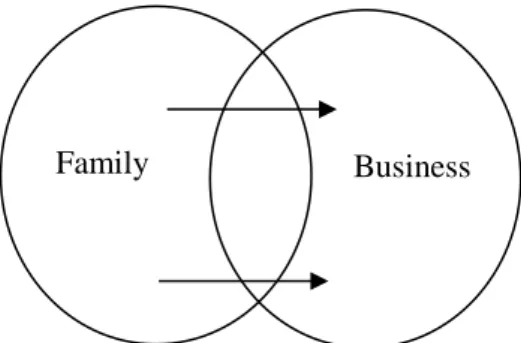
This study of research focus and approach is illustrated in figure1.1.
Figure 1.1. Research Focus of Familiness
1.3 Research Objectives and Questions
To investigate FOB in an effort to obtain insight into the FOB of unique resource: familiness. This dissertation has following objectives:
(1) To understand the unique resources accrued by FOBs due to the family involvement (2) To explore how familiness emerges from interaction values of family and business (3) To explore linkages between familiness mindset and its performance
5
(4) To propose the familiness of theoretical model for family-owned business
To achieve the research objectives, one major research question (MRQ) and three subsidiary research questions (SRQs) have been formed to give the guidance in each research steps.
MRQ: How does the familiness emerge through from the family’s involvement as resources?
SRQ1: What kind of family resources are embedded in the family?
SRQ2: How do the family members combine their resources to emerge the familiness?
SRQ3: Which business strategy and performance are brought forth from familiness?
1.4 Research scope
This dissertation employs a qualitative case-based approach to examine the ways of familiness occurrence. It is argued that the nature of FOBs is born from family resources hence it is necessary to comprehensively understand their nature rather than just relying on statistical facts of business performance (Irava and Moore, 2010). Specifically, it examines what familiness is in a family-owned business and then explores its’ effects on business strategy and members of performance efforts.
Therefore, this dissertation is hinged on the resource-based view (RBV) perspective to explain the tacit nature and explicit behaviour of family resources: familiness through business. Since RBV arose from multiple theoretical frameworks, such as the theory of firm growth by Penrose (1959) which involved the view of Wernerfelt (1984) and focuses on the firm-specific resources rather than the products (Hannson, 2015). Moreover, this study followed the knowledge concept by Nonaka and Takeuchi (1995). Through this way, the familiness concept can be drawn from the RBV by analysing steps that seek the phenomenon in heterogeneous nature of individual and group level interactions.
Furthermore, this study employs the Myanmar FOBs as a case because their businesses are still ‘young’ (1st -2nd generations) in their economic sectors and compares them with those of neighbouring countries, particularly those in Thailand which are now 3rd-4th generations (Suehiro, and Wailerdsak, 2004). Other report also addressed that 83% of small and medium businesses are regarded as family owned (Anh, 2016) in Myanmar, but it was not described the exact amount of family-owned business, but it is necessary to encourage their business at country level economic development. Thus, this study aims to use the Myanmar FOBs as the research target to demonstrate and understand the occurrence of familiness in family.
1.5 Research Methodology
By highlighting the philosophical paradigm, this dissertation adopted a constructive approach with using case study. In fact, this approach allows us to construct the meanings from the interpretation of human beings and their behaviours. Thus, this study uses the inductive reasoning approach to find out the phenomenon from the bottom up way. Under the research roof, the
6
qualitative case-based method is adopted as research strategy (Yin, 1994) due to their flexibility of designing on the focus with depth and breadth. Since the nature of FOB and familiness are complex and difficult to understand that could not be able to explain with statistical facts (Klein et al., 2005;
Irava and Moore, 2010). Therefore this study used case-based method for understanding the familiness.
Explicitly, this study adopted thirteen case studies of Myanmar business under the guidance of research purpose. Worth noting is that this study used the grounded theory analysis method as a tool (Corbin and Strauss, 1990). Because, it aims to ensure reliability and trustworthiness of the analysis and findings, as well as the conceptualization of the outcome result. Therefore, the coding steps, theoretical concept and developed categories are disclosed through the study. Also, evaluation is co-existing within the analysis steps of grounded theory; thus, the result outcomes are valid and reliable. Finally, the familiness model is proposed based on the conceptualized outcomes with answering the major research question.
1.6 Definitions of Research Terms
(1) Family
Family is defined as a group of people who live and share money, food and life-time together by law or customs or biological connection.
Nuclear family: It refers the group of people consists of two couple with/without their dependent children as a basic group.
Extended family: A family that includes the nuclear family with grandparents, aunts and, the children’ spouse who all live nearby or in one household.
(2) Family-owned business
Family-owned business is defined as the business established by a family or families with the intention to use family oriented management ways and keep the business across generations.
(3) Familiness
Familiness is defined as “the unique bundle of resources a particular firm has because of the systems interaction between the family, its individual members, and the business”. Particularly, it refers the tacit mindset and explicit abilities of the family member. The term “familiness” is firstly defined from Habbershon and William (1999, p.11).
(4) Resources
Resources can be defined as “tangible and intangible assets which are tied semi permanently to the firm” (Wernerfelt, 1984. P.172). Traditionally, resources has three kind of assets:
7
land, labours and capital, however knowledge or tacit nature of resources are involved in business as an essential resources in nowadays.
(5) Resource-based view of the firm
The resource-based view of the firm (RBV) is an economic theory and it mainly emphasize on the internal resources and capabilities of firm rather than focusing on the business of outside features (i.e., market and production). For family-owned business study, it helps to catch the resources occurrence of family members who interacts through family and business. Thus, RBV is used as the theoretical background which can access all people resources and capabilities to gain the competitive advantages for business (Barney, 1991; Penrose, 1959; Wernerfelt, 1984)
(6) Knowledge
Knowledge is defined as “a meaningful set of information that constitutes a justified true belief and/or embodied technical skill” Nonaka et al., (1996, P.205). In this study, knowledge refers to both tangible and intangible behavior with fluid performance and understanding upon the task.
(7) Strategy
Strategy refers the business of using a way of technique to meet the benefits. Traditionally, it has been described as “resource position of the firm” or “continue search for rent” where rent refers the economic benefits (Mahoney and Pandian, 1992, p.364). Thus, the strategy could be a creating or innovation for the business process or products or services which aim to use at market, in case of FOBs.
(8) Competitive Advantages
Competitive advantages refers the complete value creating of the business by using their unique strategy not simultaneously from other businesses. This business may lead in the market one period of time.
1.7 Significance of the Study
This study is important as it observe the insights into family-owned business with resources-based view aspect. Although, this study highlighted the resources attributes into the business, it also figured out the ways of business practices, especially the familiness effect on the business strategy and its performance thus possessing more significance than the previous research. The main outcome of significant facts are described as follows.
(1) It is suggested that familiness might have some degree as the level of resource. Even prior studies have recognized those phenomenon, they were not able to analyse with the empirical
8
studies through families. Ironically, this study of main findings can delineate the shapes of familiness with two features: stable familiness and flexible familiness. This two familiness may address the real context of family involvement into FOB. Besides, it also demonstrates the shape of business strategy and performance aligned on the familiness.
(2) The ultimate goal of exploring resources is to obtain the sustainable competitive advantages for business. Thus, the relationship between the resources and business performance is an essential in operating of business. From this perspective, this study discloses the detail relationship of sources of resources that articulate the familiness. Also business of long-term and short-term features are discussed based on the background resources via familiness.
Therefore, we believe that those significant facts are more advanced than other family business studies. Moreover, the study has several unique features in family-owned business research which are described in terms of the following aspects:
It is widely accepted that the role of family is essential in the FOBs, however, prior studies do not explicitly delineate the aspects of a family which might appear as the main resource (e.g., how the family’s internal governance system can profit the cohesive unit of business).
Therefore, this study tries to bridge such research gaps by explaining two aspects: (1) the family itself is able to shape the members’ mindsets as the hidden resources and, (2) the family can produce the specific behaviors as the performance outcomes. Theses phenomena are of significance in this study.
Prior studies have accepted that familiness is one distinct resource of family business and it might appear from the interaction results of family, individual and business. However, the previous studies have not much done in clarifying of this three dimensions with detail facts which support to emerge familiness. Interestingly, this study of family-centred approach makes it clear with evidence. Findings of five resources constructs might be depicted the sources of resources to develop familiness at the center of three-dimensional concept. So that this is the vital part of research and offer to contribute to the original concept by filling with this significant facts.
In family business landscape, employing the empirical research is very rare, because of difficulties in conducting such research in families. This is because such families usually keep their information as closely guarded secrets while their management and documentation systems are not well organized. To overcome these research difficulties, this study tried to conduct the real-life context and content of the FOB as the empirical research, therefore this is one distinct feature of the research.
9
1.8 Structure of the dissertation
Chapter One Introduction
Chapter Two Literature Review
Chapter Three Methodology
Chapter Four Analysis and Findings
Chapter 1 introduces the topic of the dissertation and shows the study framework with the research problem, research questions, the objectives of study, methodology. Significant of study and terms of dissertation are introduced.
Chapter 2 explains the research focus and highlights prior literature. Mainly, family-owned business, familiness and resources-based view aspects are discussed. That assist to create the idea upon the conceptualization of familiness construct.
Chapter 3 presents the adopted methodology of study. Firstly, it leads to discuss about background philosophy, research approach, method, surveying and analysis steps. Finally, the chapter concludes with evaluating and ethical consideration.
Chapter 4 expresses about analysis concept, steps and findings results. During analysis, grounded theory is used to seek new phenomenon by iterative coding process until no new facts.
Through this, the final outcomes show the developed categories and core-categories to construct the familiness.
Chapter 5 discusses about the familiness supported from the categories and core-categories. Based on evidence and participated understanding, familiness model is constructed.
Besides, the relationship between familial resources and business performance is explained with significant facts.
Chapter 6 concludes each research part. Summarize the findings and interprets on related work, research questions and purpose of research. Contribution and implication are also discussed. Finally, future research direction is suggested.
Chapter Five Discussion
Chapter Six Conclusion
10
Chapter 2 Literature Review
This chapter reviews the prior studies, theoretical insights and their phenomena in the context of family-owned businesses. Based on this, this chapter offers information about two sub-systems:
family, business and their interactions as business performance, as well as familiness. In family business landscape, the terms family business and family-owned business are different due to the organizational characteristics, and this study mainly uses “family-owned business” which is fully operated and governed by the family entity. As theoretical lens, this study adopted “resource-based view of the firm” by (Barney, 1991; 2001).
As overview, section 2.1 firstly introduces about the family-owned business comprehensively. Section 2.2 deeply explains what familiness is and then section 2.3 demonstrates the resource-based view aspect. The background nature of Myanmar FOB is discussed in section 2.4 and concludes with the chapter summary.
2.1 Family-owned business
2.1.1 Definitions
In research, the definition gives the overview image and context of focus phenomenon. In case of family business, there have so many identifying terms based on specific focuses and it has not one precise definition to represent the term. Drawing from literature, we reviewed most cited family business definitions for understanding to the business behaviors (e.g., familial behaviors and business of generational shifting phase).
Donnelley (1964) firstly defined a family business as “a company is considered a family business when it has been closely identified with at least two generations of a family and when this link has had a mutual influence on company policy and on the interests of the family” (Harms, 2014).
It focused on the chain of generation and family’s collaboration unit at business.
Chua et al., (1999, p-25) also defined the theoretical definition based on the essence of a family business which is most cited in the literature. “A business governed and/or managed with the intention to shape the vision of the business controlled by members of the same family or a small number of families that is potentially sustainable across generations of the family or families”. This
11
definition figured out the family influence into business with three aspects: governed/managed, family members’ goal, and generational stage that emphasize the strategic direction of business behind the family influence (Chua et al., 1999). Another definition is that “family firms are those in which multiple members of the same family are involved as major owners or managers, either contemporaneously or over time” (Miller et al., 2007, p-836) and it emphasized on lone founder businesses rather than normal family-established business. Thus, it has been noticed that the majority of definitions aim to describe the vital role of family (ies), such as family management or ownership or succession (Habbershon et al., 2003; Sharma, 2004). Thus, it has been noticed that different perspectives make the divert phenomena of business nature and its behaviors.
Regarding the family-owned business (FOB), some studies address that any business in which two or more family members are involved, and the majority of ownership or control lies within a family (Inc. Magazine, 2017). In fact, the family-owned businesses (FOBs) are the oldest form of businesses, and their characteristics and nature are much different than other types of business in terms of the business body (Basco, 2013), management system and organizational culture (Dyer, 1988). In this dissertation, we proposed the definition of FOB as “the business established by a family or families with the intention to use family oriented management ways and keep the business across generations”. In doing so, the role of family and socio-economic goals are primary in the business system. Due to the family management, their business structure does not necessarily have to be formal, such as management and legal stakeholder system (Basco, 2013), however the families can operate business through their own resources (e.g., knowledge, experience and reputation). Therefore, most FOBs prefer a traditional management system by their family.
2.1.2 Two-Circles Model
Family business of ordinary figure is firstly illustrated by Tagiuri and Davis (1996) that explained the family business with two-circle model that illustrated with two interaction systems: family and business. Two systems have different nature in which family is emotional based, while business is economic based entity. By integrating two system as the family business, their overlapping area become interesting and complexity. Later, these authors extended the three-circle model for family enterprises by including the ownership system (Gersick et al., 1997). In case of FOBs, the ownership system is excluded because the family itself do not have such kind of legal system, and all members are homogenous in every matter, such as social, economic and, education etc. (Basco, 2013). In two- circle model, it can be seen two feature: family involvement at workplace (family members’ affairs and individual’s efforts) and business management system (business governance system, experience and family working system) as shown in Figure 2.1. It has been noted that the family leader is considered as a manager, as well as the owner of business.
12
Figure 2.1 Two-circles model (adopted from Tagiuri and Davis, 1996)
Family involvement: According to objective, the family of the intentional goal is to live and work together under the same roof (Basco, 2013) and most members are willing to corporate in the business as their life. Concerning this, some studies observed that the family business goal has both economic and emotional intentions hence so called socio-economic goal. In doing so, family’s involving patterns is associated with the business performance.
In case of FOBs, most family members traditionally follow the previous generation’s steps.
Here, some studies examine the family members’ behaviors with agency theory, because members of involvement are regarded as the agents who facilitate the business tasks between business and family. On the other hand, some suggest that family members (individual) are regarded as the steward due to their commitments and scarifies for business (Frank et al., 2010).
Business management system: This aspect described the business of experience, governance system, and the family contribution to the business. In terms of family involvement, the FOB of operating system is complicated and more informal than other private non-family businesses (Basco, 2013), such as generational shifting, knowledge transferring, and members’ mutual understanding. Therefore, governance system is essential for both family and business system. Regarding this, most studies have emphasized on governance upon the business activities, such as top management team of cohesive, potency, handling conflicts through the decision making (Ensley and Pearson, 2005). The detail explanation of business governance system is discussed on the next section.
2.1.3 Difference between Family-Owned Business and Non-Family-Owned Business Drawing from two-cycle model and prior literature, the distinct characteristics of FOBs have been found in multiple aspects. Mainly, it can be categorized into four dimensions: architecture, governance, entrepreneurship and stewardship that namely AGES Framework (Craig, 2015).
Architecture (structure and system) refers the business of how do they generate the tasks, while
Family Business
13
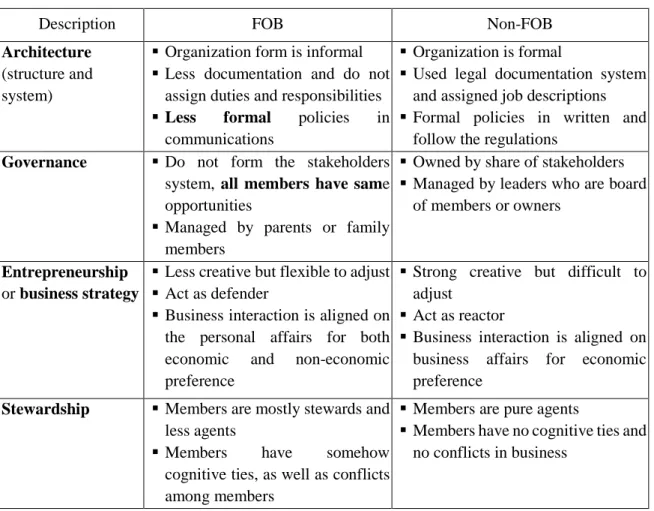
governance (family and business) refers the business of how do they decided to operate business, entrepreneurship (leadership and strategy) refers about how do the business create strategy in the market, and then stewardship (individual and family) refers the members of actions. Each dimension delineates the major difference of FOB from non-family-owned businesses approach, and their distinct features are described in Table 2.1.
Table 2.1 Comparing of FOBs and Non-FOB (adopted by Craig, 2015)
Description FOB Non-FOB
Architecture (structure and system)
Organization form is informal
Less documentation and do not assign duties and responsibilities
Less formal policies in communications
Organization is formal
Used legal documentation system and assigned job descriptions
Formal policies in written and follow the regulations
Governance Do not form the stakeholders system, all members have same opportunities
Managed by parents or family members
Owned by share of stakeholders
Managed by leaders who are board of members or owners
Entrepreneurship or business strategy
Less creative but flexible to adjust
Act as defender
Business interaction is aligned on the personal affairs for both economic and non-economic preference
Strong creative but difficult to adjust
Act as reactor
Business interaction is aligned on business affairs for economic preference
Stewardship Members are mostly stewards and less agents
Members have somehow cognitive ties, as well as conflicts among members
Members are pure agents
Members have no cognitive ties and no conflicts in business
From Table 2.1, it can be noted that the strategies of FOBs are inward orientation, generating their available resources and long-term commitment than other private businesses (Gumundson et al., 1999). The most distinct feature is less formal policies (such as job descriptions, documentation system and assigning the duties) regarding the family nature. Therefore, business is informally managed and, it has un-limited space, time and responsibilities that drive the family members to participate freely in all aspects. Based on the members’ cognitive ties, their physical and mental interactions become the reciprocal and strong peer network at business based on their governance (Craig, 2015). Due to the frankly orientation system, most FOBs of loyal employees are warm- heartedly rewarded (Ward, 1988) than other private businesses. Although the entrepreneurship
14
system is not strong at market but the FOB of persistence and patience help to keep the business, and they can create their own innovation in products or services processes.
2.1.4 The Family Influence Effects to Business
The family involvement plays a critical role, is very important, for FOB. According to Chua et al., (1999) definition, business’s behaviors is significantly shaped by family members’ colourful influence by intentionally or un-intentionally. Prior studies observed the positive and negative outcomes of family effects to business performance. In 1988, Dyer suggested that the family nature (i.e., nepotism) may reflect as the negative effects in professional management and assumed to foster the family culture. For example, members’ collaboration and sharing ideas can improve the decision making and lessen the selfishness within business. Some studies have concerned about the family types (nuclear and extended), because the family structures and relationships of members could be effective to the business success. Meanwhile, Aderson and Reeb (2003) found that FOBs are strengthened than other types of businesses due to the family members’ self-serving and characteristics (e.g., members’ ties and parents-children’ interactions). Regarding this, family involvement in management and performance stages are not clear picture in studies until now, because it have both positive and negative effects (Poutziouris et al., 2015). Also it has been noticed that family background component becomes a trigger to capture the business performance.
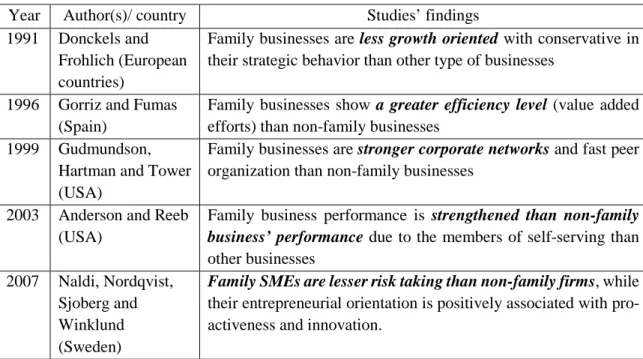
This section briefly shows the numbers of studies which examine family influence effects into business in different countries. Table 2.2 shows the chronological order of some empirical studies. As described in table, all findings are not the same and it might be related to the business size, type and family size of those business.
Table 2.2 Prior case studies of family influence effect to business performance
Year Author(s)/ country Studies’ findings
1991 Donckels and Frohlich (European countries)
Family businesses are less growth oriented with conservative in their strategic behavior than other type of businesses
1996 Gorriz and Fumas (Spain)
Family businesses show a greater efficiency level (value added efforts) than non-family businesses
1999 Gudmundson, Hartman and Tower (USA)
Family businesses are stronger corporate networks and fast peer organization than non-family businesses
2003 Anderson and Reeb (USA)
Family business performance is strengthened than non-family business’ performance due to the members of self-serving than other businesses
2007 Naldi, Nordqvist, Sjoberg and Winklund (Sweden)
Family SMEs are lesser risk taking than non-family firms, while their entrepreneurial orientation is positively associated with pro- activeness and innovation.
15 2010 Minichilli et al.,
(Italy)
In family business, top management team of family members and firm performance are U-shaped relationship than other businesses
2015 Machek and Votavova (Czech Republic)
Parents-ancestors of cognitive disagreement, spouses of competitiveness and sibling of un-equal emotional treatment are common problems of family owned business
2015 Massis, Kotlar, Campopiano and Cassia (Italy)
Evidence on 787 SMEs suggest that an inverted U-shaped relationship between the family ownership and business performance, and the family ownership is seemed as negative affect among family members.
2016 Massis et al.
(USA)
The authors explored the effects of family governance on product innovation. The result suggested that it can engender either positive or negative outcome during the innovation process regarding on how the family develop the new product for business.
Through this studies, it has been seen that examining of family influencing effects to business has both bright side and dark side, also the business features, such as performance, corporate network, entrepreneurship, and innovations are vary aligned on the different viewpoint and theoretical background. By comparing with non-family firms, most studies figured out the nature of family which is weak, having conflicts and lesser in professional skills at business. However, the background family nature of characteristics are less attention in the studies which implicitly facilitate the members of abilities at work. Regarding this, Dyer (1988) figured out the family of background culture and its business behaviors.
2.1.4.1 Background Culture of Business
Culture refers to the “mental software” and it is not inherited and actually it derives from one social environment (Hofstede, 1991, p-5). Based on the different environment, the results of mental programming (culture, behaviors and social norms) could be different. For instance, Indian family business is not only the business but also the social identity in their community, while the U.S.
companies are viewed as the commodity to make the benefits of selling and buying, in term of their individualism and collectivism cultural dimension (Hofstede, 2011). Notion from the previous studies, Colli and Rose (2008) pointed out the background culture effects to the business. This means that different family background cultures affect the different business nature.
In terms of the cultural context, it can be classified as four levels: symbols (physical things), heroes (personal affairs), rituals (group or collective activities) and values (feelings or intrinsic quality of mind) (Hofstede, 2011). In the real sense, these four levels are interlinking, integrating each other and, remain in an inseparable form as the embeddedness behaviors. According to Hofstede of survey lists, USA is the least collectivist country, and Guatemala is the most collectivist country
16
among in the 50 countries. These collectivistic cultures are mostly found in East (eastern world) and Latin America countries (Triandis, 2001). Regarding the collectivist feature, the most distinct form is family and it connect with the blood ties, cognitive relations, customs, conformity and so on.
Therefore, the underlying culture of a nation and family is also necessary to consider in study, for example Asian and western families of customs.
2.1.4.2 Family Influencing Scales
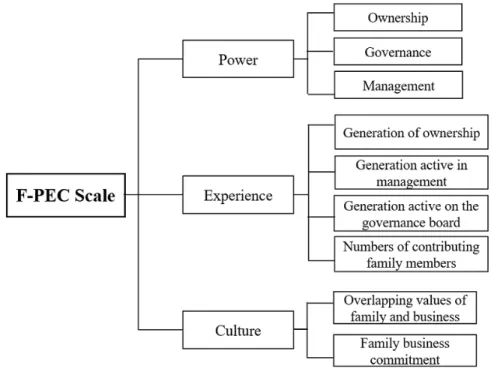
Generally, the family influence effects can be investigated by using three scales, namely F-PEC scales (Astrachan et al., 2002) where the F means family, P: power (ownership, stakeholders and business management), E: experience (knowledge or experience transferring through generation) and C: culture (family overlapping value or commitment) as described in Figure 2.2. The development of F-PEC scale is based on in-depth content analysis of various definitions with quantitative study. Therefore, this scale can cover both visible and invisible levels of family integrating values, such as physical performance, retention and commitment. Specifically, these three scales provide overall measure of family influence, especially in soft factor (Harms, 2014).
Each sub-scale of description is described in Figure as follow.
Figure 2.2 The F-PEC Scale
Power refers the ownership, governance and management system of business that prefer to consider the legal, political and economic considerations of different culture/country. For example some western family businesses of board members structure is one-level while other countries are based on two-level system by law (Klein et al., 2005). Thus, family members of ownership system, voting ratio and family’s representativeness are important in
17
business. Thus, ownership effect on the cost of debt financing (Anderson et al., 2003a), business of corporate mechanism and comparing the CEO’s performance (i.e., descendant CEO and new CEO) are often cited in the studies (Astrachan et al., 2008).
Experience refers the exchanging the family and business of values (i.e., knowledge, skills and family’s experience) from their previous generation to current generation. Mainly, this sub-scale relates to the succession and family members of contributions. From resource aspect, informal or formal form of knowledge transferring and sharing are comprised in the experience. In case of FOBs, the family members’ learning are always based on the non- verbal or practical learning than formal learning. Indeed, the younger members follow the ways of the elder persons or parents. Also, familial habits, the ways of thinking and doing business are informally transferred to the next generation. Thus, experience appears in both tangible and intangible features.
Culture refers the business values rooted in the organization and important one (Astrachan et al., 2002). Here, culture means the overlapping values of family and business, and their commitments, thus this sub-scale refers the internal integrated values, e.g., style of communication and the ways of handling the conflicts. Otherwise, this kind of values are developed from family members and can consider as the overlapping values. As the organizational culture, the degree of centralization or decentralization is related in this sub- scale. Furthermore, family of commitment is a kind of value and shape to business as the culture.
Besides, this scales are able to measure the business performance. Astrachan et al. (2008) further recommend these three scale to investigate with short-term and long-term approach. Since, it allows to scan with a continuous scale rather than a simple dichotomy of family and non-family business (Chrisman et al., 2005). For example, experience sub-scale is valid to investigate the tacit and explicit knowledge of family members effort for business that under the supervision of owner/CEO of governance (Astrachan et al., 2008). In this regards, Teters, et al. (2017) explored the familiness of influence on performance with quantitative approach in Netherland family business.
They found that culture sub-scale demonstrated positive and significant effects on return on equity, return on capital and net profit margin. Other subscales: power and experience are not much significant effect with familiness resource.
2.1.4.3 Non-financial Performance Indicators for Business Performance
Regarding the performance measurement, the some studies identified the numerical facts as measurement. Since, the performance indicators are not so much well-known in family business studies, because each study use their own criteria to examine the business performance.
18
Under the conceptualization of business performance, Venkatraman and Ramanujam (1986) codified three domains to measure the business performance: financial performance, financial + operational performance (business performance), and organizational effectiveness that comprise both soft and hard skills (e.g., return on assets, intrinsic retention of person). In overview, concerning the financial facts only might not be represented the whole business’s figure, but other soft factors perspective is also necessary to consider in screening the performance (Teters, et al. (2017).
In the business studies, they employed the Key Performance Indicators (KPIs) for navigation of business, based on the balanced scorecard. Balanced scorecard has four perspectives (financial, internal business process, innovation and learning, and customer perspective) (Lodder, 2009). Indeed, KPIs is used to measure a whole business matters (i.e., financial or non-financial), such as business process and products that allow to measure the business performance. This KPIs indicators may vary depended on the business nature and mechanism. For example, the manufacturing firm of KPIs (e.g., the quality of products) and HR firms of KPIs (e.g., customers’ satisfaction) might not be the same.
In case of FOBs, the underlying businesses nature is different with other private businesses and they wouldn’t able to disclose the financial figure because most FOBs are lack of documentation and recorded system. Thus, non-financial indicators are suitable to use in FOBs rather than financial indicators, while non-financial indicators measure the manufacturing and production, sales and marketing, people, research and development, and the environment (Lodder, 2009). Also, Astrachan et al. (2008) and Chrisman et al. (2005) called to capture the in-depth context and content of family business by using with the unique methodology. Here, the business of generation phase is a critical part in performance measurement, for example, the founder stage of business could not able to scan their transferring knowledge on generation.
2.2 Familiness
Familiness is the concept that refers the internal qualities and mindset of the family (Dawson, 2014) that operate in business as a resource. Specifically, familiness is defined as “the unique bundle of resources a particular firm has because of the system interaction between the family, its individual members, and the business” (Habbershon and Williams, 1999, p.11). Since, familiness is assumed as the tacit nature and develop as the explicit features that is the interaction result of family, individual and business by the resource-based view aspect (Barney, 1991). According to the original concept, the familiness emerge from the family members of working togetherness at business. Thus, occurrence of familiness is not only based on one fundamental source and certain facts and seems that it is necessary to consider the multiple facts. From the performance perspective, familiness is unique resource and is able to generate business’ capabilities to gain the competitive advantages as performance at market (Frank et al., 2016). Besides, this intrinsic resource could occur at both
19
tangible and intangible levels of behaviors in individuals and group performance. As the resources’
criteria, familiness is valuable and cannot imitate and substitute from outsiders (Barney, 1991).
The ultimate goal of clarifying the resource is to gain the competitive advantages which is sustainable for business in long run. Based on the strategic assessment on resources (Grant, 1991), Habbershon and William (1999) adopted the resource intervention from the family to business performance as shown in Figure 2.3. This relation process illustrates the antecedents and consequence of familiness which are strategically transform with the relevant shape of resource, capabilities, strategy and performance. Besides, it reveals that resource of replenishing, augmenting and upgrading nature as the looping circle or process intervention at business mechanism (Habbershon and William, 1999). If resource can’t accept to replenish or upgrade in the business evolving process, the familiness would not able to remain in longer.
Figure 2.3 Relationship of family, familiness and competitive advantages (adopted by Habbenshon and William, 1999)
As primary assumption, the family possesses the resource to generate the business, such as belief, politics and philosophies which provide as the inputs into the idiosyncratic bundle of resources. This familial inputs are regarded as the resources to emerge familiness by scanning with RBV of VIRO (i.e., valuable, rare, inimitable and, un-substitutable) and four resource categories (i.e., physical, human, organizational and process). Based on this assessment, the familiness or unique resource would be occurred. As the third stage, the capabilities of the business should be analyzed and match with occurrence of familiness. This stage show that how familiness drive to create the business’s capabilities for gaining the competitive advantages. In developing the competitive advantages stage, the business might have two functions: generate the business performance and create the strategy. According to the external environment, the business might create the relevant strategy aligned on their resource competency and capabilities. On the other hand, the competitive advantages might be headed to act their performance over their competitors. Through this way, business generate their performance and their gaining values return to the primary resource of business: familiness as intervention (e.g., family meetings, sharing and consulting). These figure