JAIST Repository
https://dspace.jaist.ac.jp/
Title Resource Management for Smart Services in the Home
Author(s) MARIOS, SIOUTIS Citation
Issue Date 2016‑06
Type Thesis or Dissertation Text version ETD
URL http://hdl.handle.net/10119/13718 Rights
Description Supervisor:丹 康雄, 情報科学研究科, 博士
Resource Management for Smart Services in the Home
Marios Sioutis
Japan Advanced Institute of Science and Technology
Doctoral Dissertation
Resource Management for Smart Services in the Home
Marios Sioutis
Supervisor: Yasuo Tan
School of Information Science
Japan Advanced Institute of Science and Technology
June 2016
Abstract
Advances in network technology and consumer electronics have brought the dream of an intelligent home a step closer to reality. Currently, the most com- mon approach to introduce intelligence in a home is by using commercially available home automation systems. However, these automation systems have many disadvantages. A non-exhaustive list of these disadvantages in- cludes the following: home automation systems are platforms that are closed or tightly controlled by a single vendor, have severely limited interoperability and extensibility in terms of supported devices and services, offer limited or no third party services and finally the degree of sophistication of the services that these automation systems bring to the table is relatively low. These disadvantages thus lower the value proposition of home automation.
To address the above limitations of home automation and realize the dream of a truly intelligent home, the idea of middleware platforms, col- lectively known as “home service platforms”, was pursued by the research community. These middleware platforms address the problems of traditional home automation systems by following a layered design approach. In a home service platform, the intelligent decision making process is decoupled from the actual hardware and devices, and it is delegated to software programs called “smart services”. In turn, these smart services can access any device that is present in the home through a well defined Application Program- ming Interface (API) that is offered by the home service platform, leading to services of far greater sophistication. This clean separation of devices and application logic with the use of a middleware platform also addresses inter- operability issues, and new services may be introduced at will, making such middleware platforms very extensible.
The design of home service platforms enables uninhibited device access to smart services. In contrast to home automation systems that are closed by nature and tightly controlled, this design now raises the possibility for con- flicts among services over the use and operation of devices. If such conflicts are not addressed, they will negatively impact the user’s experience, and the illusion of the smart home will dissolve.
The topic of this research is to address conflicts among smart services by introducing resource management as part of the home service platform.
Through resource management, the author argues that conflicts among ser- vices can be resolved adequately with minimum impact on the user’s overall experience. Other contemporary home service platforms tend to have limited capabilities for addressing conflicts or outright ignore this problem.
In regards to conflicts among services over resources, two types of conflicts have been identified:
• conflicts over devices,
• conflicts over physical properties of space.
The first type of conflict occurs when two or more services try to operate the same device in contradictory fashion over an overlapping period of time.
A typical example would be the operation of an illumination device by two services, with one service trying to turn a light on and the second trying to turn it off; if the middleware platform does not intervene, the outcome of the above operations is time dependent. Furthermore, if device status feedback is available, the above scenario can lead to rapid blinking of the light.
The proposed home service platform addresses conflicts over devices by treating devices as resources, the access to which is managed by the platform itself. The problem of resource management in the home is similar to the resource management in computer operating systems, a source of inspira- tion for this research. To manage access to devices, the proposed platform introduces four design primitives that are readily usable by smart services:
• device access rights,
• service and user priorities,
• event notification mechanism,
• condition sets.
Using these primitives, the design of resilient services which exhibit well- defined behaviour in case of device conflicts is simplified. Exclusionary access to a device becomes explicit and services have a chance to gracefully recover in cases of conflicts. The effectiveness of these primitives is demonstrated through a set of several scenarios.
The second type of conflict (conflicts over physical properties of space) occurs when two or more smart services operate devices that have conflicting effects on the home environment. For example, the operation of a heater and an air condition unit at the same time is not only self-defeating but also a waste of electric power.
To address conflicts over physical properties, the proposed system man- ages physical properties of space as environmental resources and provides a high-level API to interact with them. Using this powerful API, a smart ser- vice may make requests such as “set the temperature of the room to 25◦C”
or “ set the illumination around the user to 300 lx, thus further simplifying the development of smart services.
The proposed system is now able to not only detect such conflicts (using the notion of “Area of Effect”) but also attempt conflict resolution, using ei- ther a space-based or intensity-based resolution scheme. To find a solution to such conflicts, the platform must decide on a set of device settings that can at least partially fulfill the conflicting environmental requests. As the number of devices and possible device settings increases, the search space becomes increasingly vast and an exhaustive search is prohibitive. The proposed sys- tem thus utilizes local and global search algorithms as well as simulation of physical properties in each iteration step to evaluate possible solutions.
The effectiveness of this approach is demonstrated over several experiments regarding illumination in which conflicting requests were made. The experi- ments were performed in a real smart home environment and the difference between estimated and actually measured illumination intensity formed the basis for evaluating these solutions. Furthermore, the system was evaluated in terms of performance. As conclusion, the proposed home service platform is able to produce high quality solutions within a tight execution time frame of 1 second.
The final key piece of information necessary to perform conflict resolution is user location information. Currently, in contrast to outdoor location sys- tems where GPS is the defacto standard, there is no such standard for indoor location. A multitude of indoor location systems exist with different advan- tages and disadvantages. For the purpose of this research, a user location information system based on passive infrared sensors and space subdivision was developed. This location system is non-intrusive, relatively low cost and can be replicated with off-the-self parts, while providing location information that is accurate to within 50cm.
Overall, this research led to the development of a home service platform that advances the state of the art of smart homes. The proposed platform offers compelling features and advanced functionality, while at the same time making smart service development simpler and more robust. By addressing conflicts among services adequately, the last technical obstacle towards mass adoption of home service platforms by consumers has been cleared. Any future home service platform that fails to offer functionality that is at least equivalent to that of the proposed platform will face obsolescence.
Keywords. Smart Home, Home Service Platform, Pervasive Computing, Resource Management, Conflict Resolution
This page is intentionally left blank.
Acknowledgments and Dedications
To my friends and family,
to my colleagues and advisers over the years, you made this work possible.
Thank you.
To Penelope,
I’ve reached Ithaca, but you were gone.
Contents
1 Introduction 1
1.1 Quality of Life in the House . . . 1
1.2 The Smart Home . . . 2
1.3 Ubiquitous Intelligence and Automation . . . 3
1.4 Ubiquitous Intelligence and the Home: a Home Service Platform 5 1.5 Limitations of Current Home Service Platforms - Conflicts Among Smart Services . . . 6
1.6 Targets and Scope of this Research . . . 8
2 Management of Environmental Resources in the Home 10 2.1 Introduction . . . 10
2.2 Related Works . . . 11
2.3 Design and Rationale . . . 13
2.3.1 Design Principles and Advantages . . . 13
2.3.2 Area of Effect and Compromising Techniques . . . 14
2.3.3 Achieving an Optimal Solution: a Combinatorial Prob- lem . . . 15
2.3.4 Local Search and Search Iterations . . . 16
2.3.5 Exploration . . . 19
2.3.6 Simulation . . . 22
2.3.7 Evaluation . . . 26
2.3.8 Meta-Heuristic Search Strategies . . . 28
2.4 Environmental Resource Request API . . . 29
2.5 Experiments . . . 31
2.5.1 Experiment Setup . . . 31
2.5.2 Illumination Conflict Among Multiple Services . . . . 31
2.5.3 Evaluation of Optimized Fitness Function for Single Requests . . . 37
2.5.4 Illumination Conflict for Moving Target . . . 42
2.6 Conclusions and Future Work . . . 43
3 Managing Devices as Resources of the Home Environment 46
3.1 Related Research . . . 46
3.1.1 Consumer Oriented Platforms . . . 46
3.1.2 Conflict Detection and Conflict Resolution . . . 48
3.1.3 Interconnectivity and Home Automation . . . 49
3.1.4 Home Service Platform Architecture . . . 49
3.2 Platform Architecture and Smart Services . . . 50
3.3 Device Modeling . . . 51
3.3.1 Operations . . . 51
3.3.2 Device Implementation . . . 52
3.3.3 Adapter Interfaces . . . 54
3.4 Primitives for Conflict Resolution . . . 55
3.4.1 Device Access Rights . . . 55
3.4.2 Service and User Priority . . . 57
3.4.3 Event Notification Mechanism . . . 57
3.4.4 Condition Sets . . . 58
3.5 API and Examples . . . 60
3.5.1 Searching For Devices . . . 61
3.5.2 Acquiring Access Rights . . . 62
3.5.3 Using Devices . . . 63
3.5.4 Receiving Notifications . . . 66
3.5.5 Using Condition Sets . . . 67
3.6 System Demonstration . . . 68
3.6.1 Sample Smart Services . . . 68
3.6.2 Simple Device Conflict . . . 70
3.6.3 Condition Set Demonstration . . . 71
3.7 Conclusions and Future Work . . . 75
4 A User Indoor Location System 77 4.1 Introduction . . . 77
4.2 Related Research . . . 77
4.3 Design Approach and Rationale . . . 78
4.3.1 Subdivision of Space . . . 81
4.3.2 Sensor Behaviour . . . 85
4.3.3 Area Evaluation Algorithm . . . 86
4.4 Implementation Details And Cost . . . 89
4.4.1 Implementation Details . . . 89
4.4.2 Cost . . . 90
4.5 Experiments . . . 91
4.5.1 Room Setup . . . 91
4.5.2 Evaluation Approach . . . 93
4.5.3 Run Result Analysis . . . 94 4.6 Conclusions and Future Work . . . 98
5 In Conclusion 100
5.1 Summary of this Research . . . 100 5.2 The Importance and Impact of this Research . . . 101
Chapter 1 Introduction
1.1 Quality of Life in the House
Since the dawn of time, mankind has fought a hard battle for survival. The weapons of choice for this battle include (but are not limited to) intuition, perception, persistence, and above all, tenacity; countless tries and failures with the occasional successes that push the species one tiny step forward each time. Each hard fought success has made an impact to the way of life of our species by first being stored in our collective memories and knowl- edge through oral, written and later on digital means, and then replicated countless times by the vast swath of the population, in order to aid survival.
The struggles of mankind over the past couple of millennia, with its incre- mental successes such as the combustion engine and electricity, has lead us to the current age, often hailed as the great “digital age”, where in any rea- sonably civilized society there is a guaranteed standard of living. Although exceptions to the rule still exist, survival of the individual is mostly thought as a solved problem in such societies. However, mankind has not rested on its laurels; with survival mostly a solved problem, the focus now swifts to further improving quality of life in terms of safety, comfort and individual fulfillment and growth.
One such area that is expected to be at the forefront in our collective struggle for a better quality of life in the coming years involvesthe house, an indoor environment tightly coupled with the quality of life of an individual.
Many activities that directly pertain to survival, safety and general well- being of an individual are associated with the house. It is our respite from the elements of nature, a safe haven from ill-meaning individuals, a place for rest and sleep, a place where hunger can be satiated, hygiene maintained, and in the recent years, a space for entertainment and personal growth. It
should be of no surprise that such a multi-purpose space is, to this day and age, still riddled with inefficiencies.
The main focus of this research is the house and more specifically the
“smart home”, a concept that tries to address the numerous inefficiencies present in the house. By extension, it is to this fight, the fight for a better quality of life, that my research hopes to contribute, even if this contribution is infinitesimal.
1.2 The Smart Home
As a result of progress in automation technology and electronics, the notion of “smart houses” reached the general public in the late 1970’s with the re- lease of products supporting the X10 protocol[11]. Furthermore, according to [29], the term “smart home” appears for the first time in an official capacity in 1984. In this term, the word “smart” is interpreted as “intelligent”, indi- cating that the house itself exhibits some behaviour that can be perceived as intelligent.
Indeed, in recent years, the term “smart house” has been closely associ- ated with the regulation of power consumption and its reduction, achieved through automation and other means. It can be easily argued that regulat- ing power consumption is a “smart” thing to do, in the sense that regulating power consumption leads to less power consumed, something that directly benefits an individual in monetary terms.
However, this definition of a smart house is very narrow in scope, and for the purpose of this research the term “smart home” is preferred. The interpretation of this term by the author is the following: a smart home is any indoor household environment which exhibits behaviour that can be classified as intelligent, with the ultimate motive of improving the quality of life of the house occupants. This definition encompasses power consumption but also includes (but not limited to) notions such as personal safety, hygiene regulation and comfort.
To an extent, the notion of a house exhibiting “behaviour” may seem intuitive to a technologically savvy individual. However, this notion was nothing sort of revolutionary as recently as fifty years ago, thus it is prudent to expand on it and explain the finer details of house behaviour.
Behaviour impliesaction, reaction to stimulus and decision making, con- cepts that must be explained in the context of a home environment. By its inherent nature, a house is inert and static. There are characteristics of the house such as weather insulation and natural light penetration that, al- though designed intelligently, are passive traits of the house. In other words,
no dynamic action occurs as a result of these traits. There is no reaction to stimulus and there is certainly no decision making in a newly built, unoccu- pied house.
It is through electric and electronic devices installed in the house, where it can be argued that the house exhibits some sort of behaviour. Indeed, household appliances and electronic devices exhibit behaviour (and in many cases quite complex behaviour) that may be considered intelligent. As such an example, consider an air condition unit: it exhibits
1. action, as it regulates the temperature and humidity of a room, it demonstrates
2. reaction, as through its sensors it varies its operation and power con- sumption, and finally
3. decision making, as demonstrated through its “auto” operation setting, where the device relies on some algorithm to decide its operation.
The above example shows a typical device that exhibits a complex be- haviour that can be considered smart. However, introducing smart devices in the house is not enough to consider a house as being “smart”. A way to assess if a house is smart or not is to evaluate how ubiquitous and pervasive this intelligence is throughout the house. It can be argued that introducing smart devices in the house will improve the quality of life and introduce some intelligent behaviour in the house. However, this intelligence will not be per- vasive; it will be, at best, fragmented. Each smart device will be smart, on its own, and the user will be able to tell so.
To realize a truly smart home, the boundaries among individual devices must be removed so that the illusion of an intelligent indoor environment, as a whole, can be maintained. This means that devices should be able to interoperate in harmony, achieving tasks that are complex and the contribu- tion of each device although distinct, is just a part of bigger effort. In this model, the contributions of each device are blended together to achieve the greater task at hand.
1.3 Ubiquitous Intelligence and Automation
The first attempts at a smart home involve automation. To this day, many vendors such as Insteon[6] offer automation solutions for the home. The main areas where such solutions focus (but are not limited to) are home security and surveillance, energy management and automated control systems.
Home security automation solutions involve a vast array of sensors such as open/close sensors, CO2 sensors, broken glass sensors, cameras and a central controlling device that processes their feedback. In case of an emergency, this central controlling device may be configured to contact a security company or the local authorities directly, notifying them regarding the nature of the emergency. Furthermore, surveillance solutions usually offer the option of streaming video, providing an individual the chance to check up on the status of a loved one or a pet, and in case of emergency contact a family member or a friend for assistance.
Home energy management systems (collectively known as HEMS) is a field of applied research with growing popularity, especially in this day and age where cheaper energy from fossil fuels is in the process of being heavily regulated and alternative power sources such as nuclear and renewable en- ergy sources still struggle to become viable alternatives of producing power.
HEMS provide immediate monetary benefits to the occupants of a house by reducing the amount of money spent on electric energy throughout the day.
These systems again rely on a series of sensors to measure power consump- tion, a central controlling device that provides the user with feedback and in recent years integrate with demand-response systems deployed by various electric power companies. Such systems have the capability to schedule the operation of devices during times when the electricity cost is lower and also sell electric power back to the grid, if a solar panel or wind turbine is present.
With the advent of electric cars, such systems will gain in popularity even more.
Finally, automation control systems allow the occupants of a house to au- tomate tedious tasks such as controlling the illumination of a room, garden- ing solutions and operating specific devices under certain conditions. These automation solutions do exhibit action and reactions to stimuli (they can de- termine whether the conditions for invoking an automation procedure have been met) but it can be argued that there is limited to no automated decision making in the process. Nevertheless, such systems are deemed useful by their users, assisting them in their everyday lives.
A common theme in automation systems is that they instrument multi- ple devices and combine them with a central control point to achieve their task. Such systems are more sophisticated that single smart devices, albeit still have a tight focus on a single task. These systems are pervasive and ubiquitous in spatial terms as their deployment may cover the entirety of the house. However, these systems are limited in terms of the functionality offered, thus of limited intelligence.
Traditional automation systems have several other disadvantages that severely limit their usefulness. First, automation systems are often incom-
patible. Devices from other vendors can rarely be integrated with the rest of the automation system, leading to vendor lock-in. Second, the functionality provided by such solutions is tightly controlled by the automation system vendor. Upgrades to the functionality are usually distributed in the form of closed-source firmware upgrades for the central controlling point, with the users unable to officially extend and enhance said functionality. Thirdly, each automation system comes with its own central control point, leading to a clutter of devices that are both difficult to operate, maintain, manage and secure. Many automation systems also prove to be a fertile attack vector, by adopting weak encryption protocols or no security mechanisms at all.
To conclude, automation systems have many disadvantages and although they may have spatial pervasiveness in the confines of the home, due to their limited functionality fail to be truly intelligent.
1.4 Ubiquitous Intelligence and the Home: a Home Service Platform
To overcome the limitations of automation systems, a different system design approach has been pursued by the smart home research community. In this approach, a software platform is designed in such a way that can commu- nicate with a vast array of heterogeneous devices, ranging from sensors to cameras, air conditions to multimedia equipment and others. The intelligent decision making is delegated to software programs that integrate or commu- nicate over the network with the software platform in order to interact with the devices in the house. Throughout this research, such platforms will be referred to as “home service platforms” and the intelligent decision making programs as “smart services” (or plainly services).
A home service platform following this design paradigm can fulfill the criteria of ubiquitous intelligence. First, spatial ubiquity can be achieved in the same fashion as automation systems; as long as devices are installed throughout the house, the system can exhibit its intelligence everywhere inside the house. Secondly, in stark contrast to the automation systems, by utilizing the home service platform services have now access to a multitude of devices of diverse types. Using these diverse devices, it is now possible to achieve far more sophisticated tasks that were simply not possible in the confines of a traditional automation system.
This design paradigm also addresses the shortcomings of traditional au- tomation solutions by offering
1. network communication protocol independence,
2. smart service implementation flexibility,
3. open or at least “hacker-friendly” service development tools and li- braries.
Expanding on the above advantages, a home service platform avoids ven- dor lock-in and has better device integration from multiple device vendors by implementing various, often at times competing network communication protocols. This fact combined with the diverse types of devices often sup- ported leads to a more flexible ecosystem on which smart services are free to utilize whichever devices are deemed necessary to carry out their tasks. Fur- thermore, in their effort to support functionally diverse devices, such home service platforms often some protocol independent API focused on the func- tionality of the device, abstracting any communication protocol minutia and in turn making the development of smart services easier. Lastly, a very im- portant feature of home service platforms is their improved value proposition by virtue of being extensible systems; new functionality can be added by de- ploying smart services developed by a third party. In their effort to gain traction, the tools for developing smart services are often offered usually free of charge to third party developers, enterprise companies or hobbyist hackers alike. It is expected that when a home service platform achieves widespread adoption, such third parties that develop smart services are going to play a crucial role for enhancing the functionality of the platform by offering new and innovative smart services.
In their current form, home service platforms still have some limitations that further prevent them for reaching widespread adoption. This research hopes to address some of these limitations and thus make home service plat- forms an even better value proposition over traditional automation systems.
An overview of the most important limitations of home service platforms is given in the next section
1.5 Limitations of Current Home Service Plat- forms - Conflicts Among Smart Services
The introduction of home service platforms lifts the limitations of traditional automation systems. However, these platforms also remove the tightly con- trolled and usually well-tested environment associated with automation sys- tems which is responsible for their robustness. Automation systems operate inside well-defined boundaries, with very specific tasks to complete.
In contrast, home service platforms offer an open-access device model;
given sufficient credentials, a smart service may access any device it needs, at
any given time. In this open-access device model the possibility for conflicts among smart services emerges. It is the view of the author that in order to create a functional and well-behaving home service platform, management of conflicts among smart services is of utmost importance.
Before the overall scope of this research is introduced, it is necessary to consider the nature of the conflicts which may occur among smart services as well as their cause. In general, the cause of a conflict lies with the limited availability of a given resource that is necessary to two or more entities at the same time. In the context of smart home services, two major types of conflicts have been identified:
• conflicts over the use of a device and,
• conflicts over the environmental properties of the home environment.
The first type of conflict is easy to grasp; two or more smart services try to utilize the same device or home appliance in a contradictory fashion.
For example, two smart services may try to use the tv set at the same time, one for entertainment purposes and another for streaming the latest news.
Another example would involve the use of a surveillance camera; a smart security service uses the camera to detect break-ins or suspicious movement whereas an indoor location system may use the camera to track the location of the occupants of the house. Finally, an even simpler example is that of two services trying to control directly an air condition unit, using different temperature settings and/or operation modes.
The above examples are typical cases where it is necessary for a smart service to operate a device in anexclusionarymanner. This problem may also be considered a parallel to the resource management that typical computer operating systems perform, a field of research from which inspiration was drawn.
The second type of conflict has a more complex nature. In this type of conflict, two or more services operate devices that have conflicting effects on the environment. A simple example is the following: a smart service is operating an air condition unit in cooling mode and at the same time another smart service operates a heater in the same room; although the smart services do not conflict directly over the use of devices (as they operate different devices) they do produce conflicting effects on the environment.
Unless there is specific support from the home service platform, these two types of conflicts cannot be predicted ahead of time and user input is necessary to resolve them. In turn, if user intervention is necessary to resolve conflicts, the illusion of a ubiquitous intelligent home environment dissolves.
1.6 Targets and Scope of this Research
This research aims to advance the state of the art of home service plat- forms by addressing conflicts of smart services through comprehensive re- source management. A home service platform is designed from the ground up with conflict detection and resolution as top priority.
The proposed home service platform addresses the two types of conflicts introduced earlier with distinct approaches. For conflicts over environmental properties, the proposed platform uses a novel approach where the properties of the environment are treated as resources themselves. The environmental properties targeted by the platform are
1. illumination, 2. temperature,
3. humidity and finally, 4. sound and noise levels.
By undertaking the responsibility to manage the environmental resources itself, the proposed platform now has the ability to detect and even attempt to resolve these conflicts. The management of environmental properties is dis- cussed in detail in chapter 2, where its effectiveness is demonstrated through various experiments.
Regarding device related conflicts, the platform draws inspiration from computer operating systems and introduces a set of primitives to facilitate exclusionary use of devices: device access rights, service and user priority, an event notification mechanism and finally condition sets. The rationale and effectiveness of these primitives are demonstrated in chapter 3.
Finally, the last piece that completes a home service platform that aspires to be characterized as ubiquitous and intelligent is the availability of context information. In the author’s view, information regarding the location of the users inside the house is necessary to offer reactive smart services. Although a variety of indoor location systems exist today, most of them are the result of research efforts and there are hardly any commercially available solutions that do not have an exorbitant price tag. For this reason, an experimental indoor location system based on passive infrared sensors was developed. The details regarding this indoor location system as well as its overall evaluation can be found in chapter 4. Although this location system was proven to be of limited usage, its design and availability affected the design of several APIs regarding location information offered by the proposed platform.
To finish this introduction, the advantages of using the proposed platform are introduced. Firstly, due to the comprehensive API for discovering and controlling devices, development of smart services is simplified and services can be executed on any instance of the proposed service platform, regardless of the variations of deployed devices in a house.
Secondly, the proposed platform provides a predictable execution envi- ronment for the smart services; any kind of change in the execution context (such as losing access rights to a device) can be intercepted and services can then react and take corrective measures, or even voluntarily suspend their execution. This predictable behaviour is a key factor to designing resilient services that behave consistently and in a predictable fashion.
Finally, by delegating the management of environmental resources to the home service platform itself, it is now possible to detect and resolve conflicts regarding environmental properties. Furthermore, the difficult task of con- trolling environmental properties from a smart service by directly controlling devices such as lights, curtains and others is simplified; the service only need to specify the intensity of the property as well as the area over which the desired intensity is to be enforced. The proposed platform then proceeds to find the most appropriate combination of devices and device settings to fulfill such request by services.
Chapter 2
Management of Environmental Resources in the Home
2.1 Introduction
The use of home service platforms opens the way for new and highly sophis- ticated services to be deployed in the home. As the sophistication level of these smart services increase, the need to control aspects of the user’s sur- rounding physical environment arises. Aspects of the environment such as temperature, humidity, illumination as well as sound and noise levels can be considered to be innate properties of the physical environment. These properties or characteristics are readily perceptible to the occupants of the house1, affecting them in many direct and sometimes more subtle ways.
The physical environment as perceived in terms of the four properties identified earlier is for example tightly interlinked with a sense of comfort;
a room temperature that is too high or too low usually leads to discom- fort. Furthermore, different illumination conditions may be more fitting for specific tasks or time of the day, while also having an impact on the mood of the occupant. Sound such as music may affect the mood of the listener and stimulate his or her creativity, while on the other hand noise may be irritating, especially when the occupant tries to relax or sleep.
With such a huge potential to affect an occupant’s every day life, it only stands to reason that a smart service of high sophistication should be able to affect these physical properties. Currently, smart services do have the ability to manipulate these physical properties indirectly, by operating devices that have an effect on these properties. For example, a smart service may turn on and off a light to control illumination or operate an air conditioning unit
1Or any person in the house for that matter
in hopes of adjusting the temperature.
This model of indirect interaction with the physical properties of space turns out to be less than ideal. First, it is very difficult for a smart service to estimate the effect of the operation of a device on the surrounding environ- ment. Thus, trying to control a physical property this way is rudimentary at best, complicated in terms of programming and grossly unsatisfying for user experience at worst. Secondly, the possibility of conflicts in regards to physical properties arises; two or more services may try to affect physi- cal properties in a contradictory way. For example, two services may try to achieve both a bright and a dark illumination environment in the same room.
Such scenario is a common case of conflict over environmental resources. Fi- nally, depending on the availability of devices in the home environment and their variability, it becomes hard to develop smart services that are “write once, run everywhere” without including specific logic for individual devices.
To address these issues, a different approach wherethe physical properties of space are treated as environmental resourcesthat are managed directly by the service platform was pursued. In this approach, smart services can make abstract requests for environmental resources, and then having the home service platform decide the most appropriate combination of devices and device settings that should be used to fulfill these requests. Furthermore, by delegating the responsibility of management of environmental resources to the home service platform, it is now possible to detect and resolve conflicts regarding physical properties at least partially. Finally, by introducing a more abstract API to facilitate requests regarding physical properties, smart service development is simplified, reducing development time and making services more easy to deploy in any home.
The work presented in this chapter was published in [58].
2.2 Related Works
To the best of the author’s knowledge, so far there has not been a home service platform that integrates physical properties of the environment as resources. Thus, the related works usually only focus on a single physical property such as illumination. It is for this reason that related works in this section will be presented in groups, depending on the physical property that is to be controlled.
Illumination The work presented in [52] follows a similar approach with the proposed system. In it, a set of constraints regarding illumination are first formulated and then with the use of genetic algorithms an acceptable
solution is found. However, no discussion regarding the performance of the system in terms of execution time is presented.
In [50], the problem of finding appropriate illumination settings for de- vices is formulated as a binary satisfaction model and also as a continuous satisfaction model. At its core, a binary search algorithm is used to derive the appropriate settings for devices. The results show a good match between the measured and estimated illumination intensity.
In [49], a closed-loop illumination control system is presented that in its core uses stochastic hill climbing. Its convergence speed was reported to be in the order of 5 minutes, thus making its use in real-time scenarios hard to recommend. Nevertheless, power savings of up to 33% were reported in comparison to an office environment that does not utilize this system.
Temperature and Humidity The management of temperature and hu- midity in the proposed platform is currently not implemented. However, related research in the field of Home Ventilation and Air Conditioning sys- tems (HVAC) is plentiful and can serve as a source of inspiration.
A review of contemporary HVAC systems is presented in [44]. In it, an HVAC system is described as a “complex, non-linear, multi-input multi- output system”. A mathematical model that describes the operation process of such systems is difficult to construct, therefore different intelligent control methods utilizing for example neural networks, evolutionary algorithms and fuzzy logic are proposed as the preferred modeling tools. Examples of HVAC systems deploying fuzzy logic include [17], [18]. Furthermore, a method for training such a fuzzy logic controller using genetic algorithms is presented in [32]. A system that further utilizes past data to make accurate predictions about the temperature can be found in [43].
To attempt to effectively control temperature and humidity, a simulation model that is fast enough and produces reasonable accuracy results is needed.
In [56], a method for fast simulation of temperature based on proper orthogo- nal decomposition (POD) is discussed. Such an approach can be appropriate for the proposed system and would compare favourably to time-consuming simulation methods based on computational fluid dynamics. A second work that utilizes POD and finite volume method can be found in [41].
Sound In a similar fashion, a fast simulation method for sound sources would be necessary for the correct estimation of sound and noise levels. A very interesting work based on ray tracing is presented in [64]. The authors proposed a guided ray tracing system which is able to compute the effects of a sound source from a receiver’s position from 8 to 30 times per second.
As it is explained in section 2.3.6 a ray tracer for the proposed system has already been developed. With slight modifications to account for diffraction, it could potentially be used for the modeling of sound and noise in the home.
2.3 Design and Rationale
2.3.1 Design Principles and Advantages
The design of the proposed system comes as a direct answer as to how to simplify the management of environmental resources in the home. Two simple ideas that answer this question lead our design:
1. offer a high-level API to control physical properties to the smart ser- vices and
2. delegate the management of the physical properties to the home service platform.
The presence of a high-level API for controlling physical properties of space is a unique feature of this platform. Using this API a smart service may make a request regarding the intensity of a physical property over an area of space. As an example, a service may request that the illumination around the user be set to a specific amount of lux, or that the temperature of a room be set at 25◦C.
The advantages of using such a high-level API is that service development issimplified. Any complex and error-prone logic for identifying individual de- vices and estimating their effects on the environment becomes unnecessary.
Eliminating this portion of software logic leads to decreased development time and allows the service to be deployed in any instance of the home service platform, regardless of the different devices that may be in use. Fur- thermore, even if such a complex logic was developed successfully for a smart service, this effort is an effort that would have to be duplicated for any other service that would want to achieve similar results. This is a process that is bound to introduce errors and produce corner cases that were not taken into consideration during development, thus having a negative impact on the user’s experience.
The advantages of delegating the management of physical properties to the home service platform are also clear. This feature is complementary to the high-level API for controlling physical resources and is the mechanism that makes the most appropriate decisions regarding how to better fulfill requests regarding physical properties. On top of the advantages described
above, the home service platform is also able to perform conflict detection and resolution regarding physical properties, something that was previously impossible. Conflicts over environmental resources can now be detected based on the overall “Area of Effect” that a request has. Conflict resolution can also be achieved by making a compromise among the conflicting requests.
The conflicting request can be compromised either in terms of the area that they cover or the intensity of the physical property that they address.
2.3.2 Area of Effect and Compromising Techniques
The proposed platform supports conflict detection and conflict resolution for environmental resources such as temperature, humidity, illumination, as well as sound and noise levels. To achieve this, the concept of “Area of Effect”
was introduced.
The area of effect can be classified in two categories: the area of effect of a device and the area of effect of a smart service. The area of effect of a device is the physical space over which the device is able to affect one or more properties of said space. The effect that the device has on the intensity of a property of the physical space must exceed a certain threshold, or else its effects can be deemed insignificant and thus ignored. As this threshold value increases, it is usually the case that the area of effect decreases. For example, the area that a light may illuminate at an intensity of 1000 lux must be many times smaller than the area which could be illuminated at only 100 lux.
The area of effect of a service is the physical space over which the service enforces the intensity of a physical property over a certain threshold. The area of effect of a service is the result of the combination of the area of effect of the devices that are used to fulfill the needs of the service.
Depending on the physical property, some properties may be contained successfully in smaller areas than other properties. Taking illumination as an example, barring any windows or transparent surfaces, it is usually limited in the confines of a single room. Conversely, sound and noise may penetrate walls and be perceptible in other adjacent rooms or different floors of the same building. Temperature and humidity can be reasonably contained and controlled inside a room, but thermal loss to adjacent room is a fact that should be accounted for.
The area of effect can now be used to check for conflicts. Should two or more smart services try to achieve a different effect on the environment, their respective areas of effect can now be examined for conflicts. A simple example are two smart services that want to achieve different temperature settings in the same room. The area of effect for these services becomes the room itself.
Assuming that these services want to achieve an exact intensity setting, these services conflict. It is worth noting that, if these two services specified an intensity ofmore than 25◦C and 28◦C respectively, without an upper bound, these services do not conflict for they are pushing the intensity of the physical property (in this case temperature) towards the same direction.
After a conflict has been detected, the next step is to attempt conflict resolution. In stark contrast with device conflicts (which are the main topic of chapter 3), physical properties may in essence be treated as shared envi- ronmental resources, i.e. these resources can be used at the same time by multiple services. However, the requests made by the smart services may be only partially satisfied.
Two main compromising approaches for resolving conflicts over environ- mental resources are proposed:
• space-based conflict resolution,
• intensity-based conflict resolution.
In the space-based conflict resolution approach, the system tries to min- imize the overlapping area of effect of the services. This approach can be used when the physical property that is to be controlled can be reasonably contained over a given area. Illumination is the most representative case of such a property. For example, in a reasonably sized room it is possible to illuminate only part of it, keeping the rest of room substantially darkened.
In contrast, the intensity-based conflict resolution approach is used when the physical property that is to be controlled has a tendency to become homogeneous over an area. The most representative physical property of this kind is temperature, which tends over time to spread evenly inside the confines of a room. In the intensity-based conflict resolution approach, an intermediate intensity that will partially satisfy the conflicting requests of the smart services is applied. For example, given two services that want to achieve 22◦C and 25◦C of temperature in a room, the system may choose to apply any temperature in the [22◦C,25◦C] range. The details for choosing the most appropriate temperature in this range may vary depending on the sophistication of the algorithm employed and may take into consideration many parameters that affect the perceived temperature by the user.
2.3.3 Achieving an Optimal Solution: a Combinatorial Problem
Having established that the home service platform is responsible for the man- agement of environmental resources, it must now fulfill request regarding
these resources as optimally as possible. To satisfy these requests, the plat- form must operate one or more devices with appropriate settings.
As the number of settings for each device and the number of devices increases, the number of possible combinations explodes exponentially. For n number of devices that have m possible settings, the number of possible configurations C becomes:
C =mn (2.1)
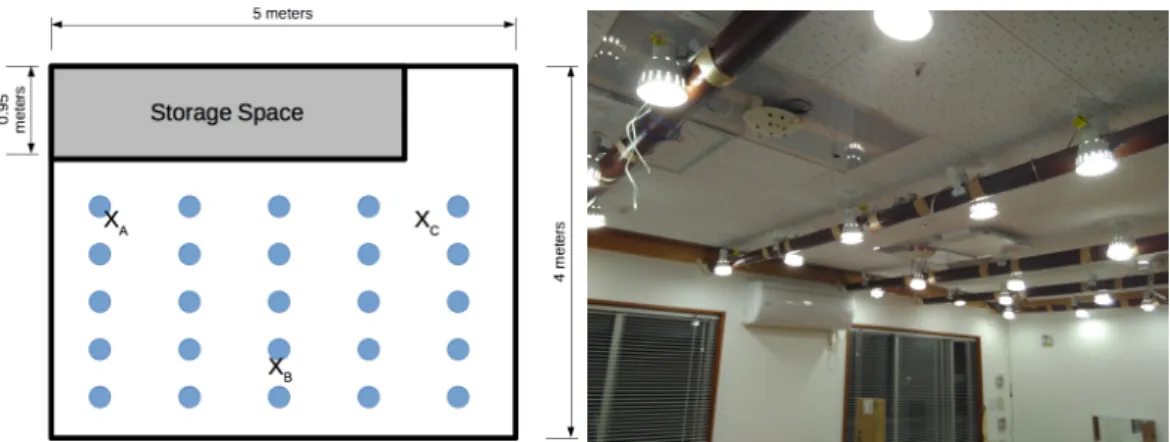
In the experiments section, a room with 25 lights that have dim-switch functionality (0%− 100% illumination intensity) is used. This particular setup creates an immense search space (10025 possible configurations) that has to be searched to find an appropriate solution. Although typical room configurations and device deployments currently may seem unusual, this does not detract from the fact that the problem of operating appropriate devices with the most appropriate settings is in essence a combinatorial problem.
The reason that such configurations are unusual is due to the simple fact that up until now they were difficult to operate by regular users. With the presence of a home service platform, such rich configurations with many devices are not only possible, but even desirable, as they enable more granular control of the physical properties of the home.
There are several options to explore the search space of this problem.
One of the first approaches pursued was a heuristic method as described in [57]. The problem with heuristic methods lies in the fact that such methods may have implicit assumptions regarding the environment and may fail to perform adequately well in other scenarios that differ significantly.
In light of such previous experience, local search algorithms that make no hidden assumptions were pursued. A local search approach is flexible enough to produce acceptable results even in the most unusual circumstances due to their agnostic nature.
2.3.4 Local Search and Search Iterations
For each iteration during a local search, one solution candidate is selected and is evaluated for its overall fitness. After the evaluation of the candidate solution is complete, the local search meta-heuristic is used to guide the search towards even better solutions.
Some well-known meta-heuristic strategies are the following: Hill Climb- ing, Simulated Annealing, Tabu Search and Ant Colony Optimization. Fur- thermore, Genetic Algorithms can also be used to tackle such combinatorial problems. Each of these meta-heuristic (or classes of) strategies vary in op- eration and in their handling of candidate solutions. A simple hill climbing
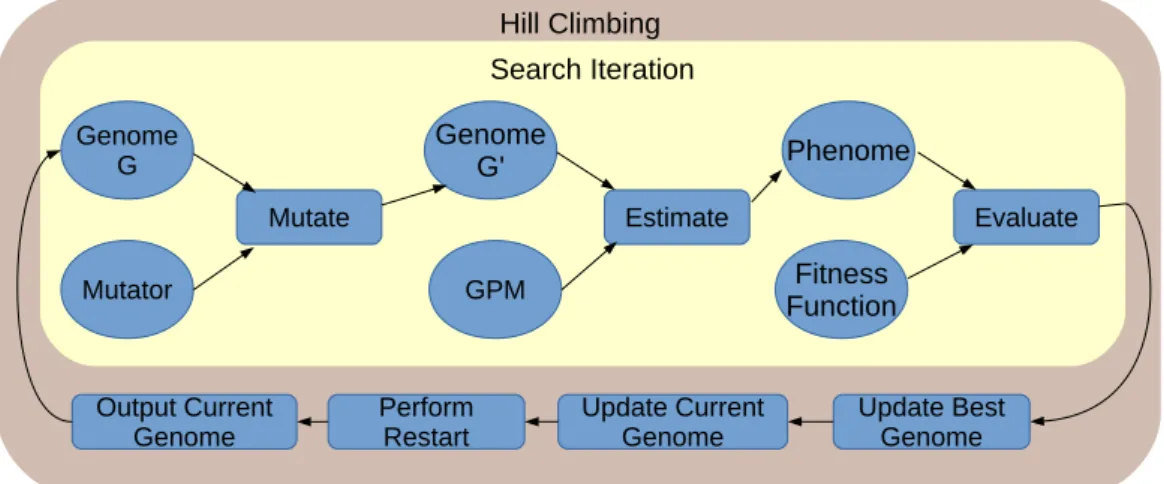
Figure 2.1: Local Search Engine Configuration
algorithm will for example, reject any solution that is strictly worse than the currently best known solution. However, this kind of greedy approach may lead to a local optimum point, failing to find better solutions that otherwise exist in the search space. Random Restarts is a common strategy supple- mentary to Hill Climbing which resets the search and starts off again from a new random point in the search space. Tabu Search will not consider so- lutions that have been visited before and so on. An exhaustive list of global optimization algorithms and their details can be found in [68].
The configuration of the local search utilized in this platform can be seen in Fig. 2.1. The proposed system utilizes a hill climbing meta-heuristic strategy and, depending on the configuration, restarts may occur.
Before describing the steps performed in each search iteration, several key concepts that pertain to global search algorithm must be briefly introduced.
These concepts are also prevalent in genetic algorithms, so the nomenclature borrows heavily from the science field of biology.
The first two concepts are those of theGenomeand Phenome. According to [68], “the search space G (genome) of an optimization problem is the set of all elements g which can be processed by the search operations”. In the context of this research, given a set of devices D and a set of settings Si for the i-th devicedi, a genotype g takes the form of:
g = (s1, s2, ..., sn) where si ∈Si, n= number of devices (2.2) The search space thus becomes
G=S1×S2 ×...×Sn (2.3)
As it is, a genotype cannot be directly evaluated for its quality; it is just a set of device settings. The next step is to evaluate what would be the effect of these device settings on the environment. Here the notion of the Phenome appears.
The phenome P (also known as the problem space) of an optimization problem is the set containing all elements p which could be its solution. A candidate solution p∈P is also known as a phenotype.
For a given problem there may be many representations of P. In the context of this research, the effects that devices have on the environment have to be quantified. Thus, given a set ofnpoints, andIibeing the intensity of the physical property at pointi, a candidate solutionp∈Ptakes the form:
p= (I1, I2, ..., In) (2.4) Furthermore, since the intensity of a physical property can be measured as non-negative real number, P is an n-dimensional R space.
P=R≥0n (2.5)
It is clear now that there is a need for a specific function that can convert from a given genotype to a phenotype in the problem space. Such functions are known as Genome-to-Phenome mappings. This gpm function has the following property:
∀g ∈G∃p∈P:gpm(g) = p (2.6) In other words, each possible genotype g can be mapped to a candidate solution. An inverse function may exist in other problems, but in this research the gpm maps from a discrete space of device settings into a continuous space of physical property intensity. Thus, strictly speaking, such an inverse function is not possible2.
Depending on the problem, the actual implementation of a gpmfunction may vary significantly, from a simple function that completes in an instant to multi-day complex simulations.
After a candidate solution has been found, it is time to be evaluated in terms of its overall fitness. For this purpose, special objective functions that map from a phenotype to R are used.
Obj(p)→R (2.7)
These objective functions are specific to the problem domain, and usually contain expert knowledge directly pertaining to the problem at hand. In
2Reduced accuracy inversegpmfunctions may be possible by making the problem space discrete, but actually creating such functions may still be impossible or extremely difficult.
there are multiple objectives that need to be optimized, the problem becomes a multi-objective optimization problem. This is the case for the proposed system when a conflict over physical resources occurs; two or more smart services request conflicting properties on the environment and the system performs a multi-objective optimization for these conflicting requests.
In multi-objective optimization, a fitness function F it(p) can be used to determine the overall fitness of a candidate solution. A fitness function combines the results of all the objective functions currently present into a single index, usually inR, that can be used for comparisons among candidate solutions.
F it(p) =f(Obj1(p), Obj2(p), ..., Objn(p))→R (2.8) As is also the case with objective functions, it cannot be stressed enough that the quality of this fitness function is going to have a huge impact on the results of the local search. There are many approaches to multi-objective optimization such as Weighted Sums, Pareto Optimization, Constraint Han- dling and others, each with its own advantages and disadvantages. Depend- ing on the nature of the problem, some approaches may be more fitting for certain classes of problems than others.
In the following sections the details for each discrete phase of a search iteration step (exploration, simulation and evaluation) will be explained.
2.3.5 Exploration
The exploration step of each search iteration is responsible for generating a new genome that will later be examined for its fitness. This generation of a new genotype is achieved with the use of mutation operations (also known as mutators). These mutation operations operate on a given number of parent genotypes and produce a new offspring genotype by altering and/or combining the characteristics of the parents.
In local search, the null operation and a unary operation are prevalent.
A null operation can generate a genotype without any external input. This new genotype is usually created at random or, depending on the problem, be a copy from a collection of initial genotypes that are deemed appropriate.
The unary mutation operation receives as an input a parent genotype.
This genotype will then be modified and a single offspring genotype will be produced. The way that the parent genotype is modified is again problem- specific.
In evolutionary algorithms, binary and even n-nary mutation operations are more common. As their names imply, these mutation operations combine 2 or more genotypes to produce a new offspring genotype.
Regardless of the context of use, it must be stated that the quality of the mutation operation will effect the overall results of the global search. This is because the mutator operation dictates which neighbors of the current ac- cepted solutions will be visited. This exploration needs to be versatile enough to consider neighbors which have a good chance to escape local minima.
Mutation Operations Used For the needs of this system, two unary mutation operations were developed: a random mutator and a binary-search mutator. The null operation used in the system is again a random genotype generator that picks initial values for the genotype.
The behaviour of the random unary mutator is as follows: provided with an initial genotype g, the mutator will first select one “gene” (in this case, the setting of one device) si and assign to it a random value from Si. This random unary mutator is fair in terms of the probability of each device being considered for mutation in each iteration. However, if a device i has a vast number of possible settings compared to another devicej (i.e. the cardinality relation of the set for these two devices is |Si|>> |Sj|), the settings for the device i will statistically have less chances to be examined. If the number of all devices involved in the search have the same number of settings, then this random unary mutator is completely fair. Furthermore, even in the case where the number of settings for each device differs significantly, it is still trivial to create a completely fair random mutator.
The second unary mutator that was developed for this system is a “binary search” mutator. This mutator is stateful, i.e. it has a state that is retained through consecutive calls to this mutator. This binary search mutator oper- ates as seen in Algorithm 1. In essence, one device is picked at random, and the range of possible settings are evaluated using binary search. When there is no further improvement possible, the mutator will reset its state (associ- ated with the gene index that is under investigation) and proceed to select another gene in its next iteration.
It must be stated that this binary mutator operation has a hidden assump- tion: if the last mutation operation is not present in the genome g that is supplied as an initial argument, it means that the mutation produced strictly worse results and thus was rejected by the meta-heuristic strategy. Although this assumption is correct when the meta-heuristic strategy is a simple hill climbing, this assumption does not hold true for all possible meta-heuristics.
For example, if a simulated annealing meta-heuristic search strategy is used, it is possible that, although the mutation produced an overall less fit phe- notype, it was adopted as the base for the new search iteration due to high
Algorithm 1 “Binary Search” Unary Mutator
1: geneIndex=−1, geneIndex, geneV alue
2: function Binary Mutator(g)
3: if geneIndex=−1 then
4: returninitBinarySearch(g)
5: else
6: returnperf ormBinarySearch(g)
7: end if
8: end function
9:
10: function initBinarySearch(g)
11: geneIndex←Random(geneRange)
12: geneV alue←Random(min, max)
13: decide search direction
14: g′ =g
15: g′[geneIndex] =geneV alue
16: return g′
17: end function
18:
19: function performBinarySearch(g)
20: if g[geneIndex]! = geneV aluethen
21: ▷Previous gene modification did NOT survive
22: change search direction if necessary
23: end if
24: Updatemin, max search range
25: geneV alue←Random(min, max)
26: g′ =g
27: g′[geneIndex] =geneV alue
28: if min == max then
29: geneIndex=−1 ▷ Binary Search Finished
30: end if
31: return g′
32: end function
“temperature”3.
The two mutators will be compared in terms of result quality and speed performance in the experiments section of this chapter.
2.3.6 Simulation
To estimate the effects that a given genotype has on the indoor environment, a simulation step becomes necessary. This simulation acts as the gpm func- tion of the local search, i.e it maps a set of device settings (the genotype) to the estimated effects that these results would have on the environment if they were to be applied (the phenotype).
The phenotype for the classes of conflicts that the proposed system han- dles is the intensity of a physical property at a set of points in space. This set of points is generated through information that was passed to the plat- form as part of the physical resource requests that the smart services make.
For example, a service may request a specific amount of illumination at the user’s current location; the user’s location will be used as such one point of the phenotype. It is also possible that depending on the request, one request may require multiple points in space to be evaluated.
Illumination Simulation In its current iteration, the system supports only the management of illumination as a physical property. To estimate the effects that devices have in regards to illumination, two simulation ap- proaches were pursued:
• an approach based on ray-tracing,
• an approach based on interpolation.
Simulation Using a Ray-Tracer For the approach based on ray-tracing, a custom ray-tracer was developed that utilizes attenuation fall-off informa- tion from the light sources. This ray-tracer was based on the octree imple- mentation that was used for the indoor location system described in chapter 4.
Performing ray-tracing in real time is a computationally intensive task.
Although it may be possible to perform real time ray-tracing with commod- ity and specialized hardware that is available as of early 2016, it is still a challenge. Furthermore, relying on real time ray-tracing would in turn mean
3A temperature setting is present in simulated annealing. Depending on this temper- ature setting, worse solutions may be adopted as the base for a new search.
that the cost of deployment for the proposed home service platform would rise, as specialized or expensive hardware would become necessary.
To tackle the above difficult points, a non real time ray-tracing approach that needs an extra pre-computation step was pursued. A simple physical fact makes this possible: illuminance (the intensity of light) from a point source falls off according to the inverse square law.
I = P
4πr2 (2.9)
For a given scene that involves illumination devices, assuming that the emit- ted amount of power of the light sources is known, the amount of light that reaches a specific point in the scene from each light source can be computed.
However, this model of a perfect point light source does not represent re- ality very well. First, reflection from surfaces is not taken into consideration.
Secondly, the remaining geometry of the scene is also not taken into con- sideration. This means that this simple model does not account for blocked illumination, as is the case when a scene object blocks the direct line-of-sight path from a light source to a point in space.
The ray-tracer used in the system models light sources as a set of rays.
The number of rays used for each light source is customizable and using typical settings a light source is represented with as much as a few hundred rays. The energy of the illumination source is split evenly among these rays.
These rays bounce freely in the scene and collide with objects. The rays re- flect on surfaces that have an associated absorption coefficient. Furthermore, each ray is intersected with the leaf nodes of the octree, and attenuation information in the form of 4πr12 is recorded. By multiplying this attenuation information with the energy that is carried by a ray and summing the contri- butions of all the rays of a light source, it is possible to estimate the effects that a light source has on the given octree node.
Another point that must be addressed is the quantization of space. Al- though space as perceived by humans seems continuous and not quantized4, the system must perform quantization of space, since otherwise the number of points for which light attenuation information will have to be computed would be infinite. The quantization of space is performed through the use of an octree. For each leaf node of the octree, light attenuation information from all the sources present in the scene is stored. Depending on the size and the initial creation parameters of the octree, the granularity of space quantization can be controlled. For example, during the experiment session 15cm3 leaf nodes were used.
4The physics regarding quantization of space has yet to reach a definitive conclusion.
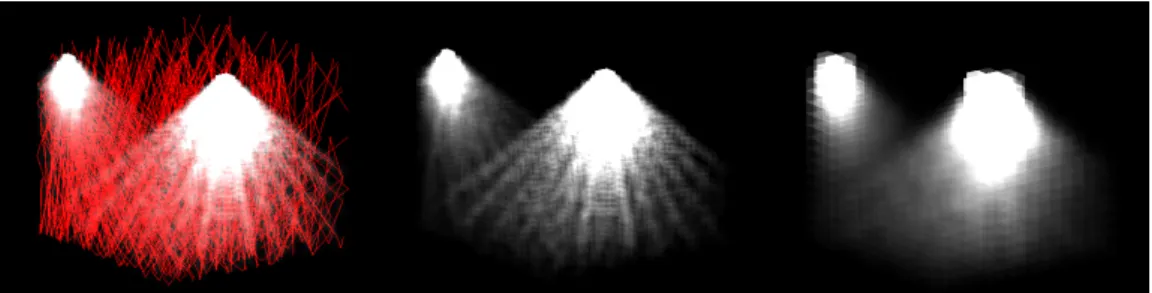
Figure 2.2: Ray-Tracer Visualization for 2 Light sources. Left: Rays Visual- ized. Center: Without Rays. Right: With Smoothing Pass
With this infrastructure in place, given a genotypeg it is now possible to estimate the illumination at a given point z as follows:
• find the bounding leaf node for the pointz in the octree,
• retrieve the attenuation information for the light sources that illuminate that node,
• depending on the settings of each light source ing, calculate the power output of each light source that reaches that node,
• sum the amount of illumination reaching that leaf node.
A visualization of the results of the ray-tracer can be seen in Fig. 2.2.
Due to the relatively low number of rays used to model light sources, discrepancies in the light reaching adjacent leaf nodes are apparent. In an effort to mitigate these discrepancies, a special smoothing pass is performed after the light attenuation information has been computed. In this smoothing pass, leaf nodes exchange a small amount of energy with neighbouring nodes.
The results of the ray-tracing before and after the smoothing pass can be seen in the middle and right pictures of Fig. 2.2. Clearly, the results after a smoothing pass represent reality closer.
Interpolation Based Simulation Due to concerns regarding the accu- racy of the ray-tracer, an alternative method for illumination simulation based on interpolation was also developed. This interpolation based simula- tion interpolates between three variables of the illumination device:
• brightness setting,
• distance from source and
• angle from source.
Figure 2.3: A Philips Hue Light with its Accompanying Fixture.
Figure 2.4: Environment Used for the Modeling of Philips Hue Lights.
These three variables are what ultimately dictate the amount of illu- mination reaching a point in space from a light source. For experimental purposes, the popular Philips Hue lamps were modeled. These lights were used in combination with a light fixture as seen in Fig. 2.3. Illumination measurements were taken at distances of0.25m,0.5m,0.75m,1m,1.25m and 1.5m, at an angle of 0°, 30°, 45°, 60° and 90° and with brightness settings of 100%, 75%, 50% and 25%. The environment in which these measurements where taken in a dark environment without any other illumination source.
This environment can be seen in Fig. 2.4.
During simulation, the brightness setting of the device is known (this information is part of the genotype g) and the angle as well as the distance from the point of interest is calculated. Using these three parameters, three successive linear interpolations are performed sequentially; first in terms of angle, then in terms of distance and finally in terms of brightness. ”
Through this interpolation procedure certain assumptions and limits are in place. The first limit that is enforced is that if a point lies at an angle that is greater than 90°, it is assumed that no significant amount of illumi- nation reaches that point, thus the illumination for that point is set to zero.
Secondly, if a point lies at a distance that is greater than 1.5m away from the light source, this distance is successively halved until the distance falls into the [
0m,1.5m]
range. The interpolation procedure is carried out with this new shorter distance and an illumination estimation is computed. The root of this estimation is then successively computed as many times as the