A
cquired immune deficiency syndrome (AIDS) remains a major global public health challenge, especially in developing countries. In 2018, 770,000 people died from AIDS-related illnesses globally, and opportunistic infections were the leading cause (Available at: http://www.unaids.org/en/resources/fact-sheet). Cryptococcal meningitis (CM) is one of the most prev-alent and lethal opportunistic infectious diseases affecting HIV-positive patients, and it causes 181,000 deaths per year worldwide, accounting for 15% of AIDS-related deaths [1].HIV-infected patients with cryptococcal meningitis (HIV/CM) require the simultaneous administration of antifungal and antiretroviral treatments. There are advantages and disadvantages for both earlier and later initiations of antiretroviral therapy (ART) in HIV/CM patients. If ART is initiated early in HIV/CM patients, the possibility of the development of immune reconsti-tution inflammatory syndrome (IRIS) is enhanced, as is
the development of immunologically mediated com-partmentalized neuroinflammation [2]. Conversely, if there is a delay in the patient’s immune function resto-ration as occurs when the initiation of ART is delayed, the patient’s CM may worsen, and/or the development of other opportunistic infections may occur.
In 2014, the Cryptococcal Optimal ART Timing (COAT) group conducted a trial to search for the opti-mal timing for ART initiation, and they concluded that deferring ART for 5 weeks after the diagnosis of CM was associated with the patients’ significantly improved sur-vival compared to the initiation of ART at 1 to 2 weeks post-diagnosis [3]. A retrospective study also indicated that compared to deferred ART initiation (≥4 weeks after CM diagnosis), early ART initiation (<4 weeks after CM diagnosis) may increase all-cause mortality in patients [4]. However, in the context of amphotericin induction, it was found that ART initiation nearer to 3 weeks rather than 6 weeks after starting antifungal
CopyrightⒸ 2021 by Okayama University Medical School.
http ://escholarship.lib.okayama-u.ac.jp/amo/
Clinical Study Protocol
The Optimal Timing of Antiretroviral Therapy Initiation
in HIV-Infected Patients with Cryptococcal Meningitis:
A Multicenter Prospective Randomized Controlled Trial
Xiaolei Xu, Yanqiu Lu, Vijay Harypursat, Feng Sun,
Ting Zhao, Yanming Zeng, Xiaoqing He, and Yaokai Chen
*Division of Infectious Diseases, Chongqing Public Health Medical Center, Chongqing 400036, China
The optimal timing of antiretroviral therapy (ART) initiation in human immunodeficiency virus (HIV)-infected patients with cryptococcal meningitis (HIV/CM) is controversial. We designed a clinical trial to inves-tigate the optimal timing for ART initiation in HIV/CM patients. This will be a multicenter, prospective, and randomized clinical trial. Each enrolled patient will be randomized into either the early ART arm or the deferred ART arm. We will compare the mortality and incident rates of immune reconstitution inflammatory syndrome between the two arms. We hope to elucidate the optimal timing for ART initiation in HIV/CM patients.
Key words: human immunodeficiency virus, meningitis, cryptococcal, antiretroviral therapy
Received May 25, 2020 ; accepted August 19, 2020.
*Corresponding author. Phone : +86-23-65481658; Fax : +86-23-65503753
therapy may prevent some of the later HIV-related mortality while not substantially increasing the risk of IRIS [5].
The inconsistency of the above-described study results demonstrates that unambiguous, robust, evi-dence-based guidelines regarding the timing of ART initiation for HIV/CM patients have not been defini-tively extracted from these studies, and the optimal timing for ART initiation in HIV/CM patients remains controversial. We therefore propose the following mul-ticenter, prospective, randomized, controlled study to investigate the optimal timing for the initiation of ART in HIV/CM patients.
Study objectives. The study will compare the clinical efficacy and safety of early ART and deferred ART in HIV/CM patients.
Endpoints
Outcomes.
Primary outcome: The mortality rate and IRIS
inci-dence at week 48; these will be compared between the two arms of the study.
Secondary outcomes:
(1) The changes in the patients’ CD4+ T-cell counts from baseline to week 48; these will be com-pared between the two study arms.
(2) The proportion of patients with HIV viral loads
below the detection limit at week 48; this will be compared between the two study arms.
(3) The incidence of adverse events during the study
period. This will be compared between the two study arms.
Study endpoints.
(1) Completion of the 48-week follow-up as per the
study protocol.
(2) Discontinuation of ART during the study period. (3) Death.
Study discontinuation criteria.
(1) Serious or life-threatening patient safety issues
occur during the course of the study.
(2) The sponsor requests termination of the study.
(3) The study ethics committee or administrative
authority requests that the study be terminated.
Eligibility Criteria
Diagnostic criteria. Confirmations of HIV
infec-tion will be established by the positivity of HIV anti-body testing based on the results of a western blot anal-ysis and the positive detection of HIV RNA [6]. The diagnostic criteria of CM are as follows [7]:
(1) Identification of Cryptococcus in cerebrospinal
fluid (CSF) by India ink staining, CSF crypto-coccal antigen positivity, or CSF Cryptococcus culture positivity.
(2) CSF examination: intracranial hypertension,
increased CSF protein content, reduced sugar content, mild or moderate leukocytosis in CSF.
(3) Symptoms and signs: mainly low-grade fever,
headache, nausea, vomiting, altered mental state, confusion, irritability, memory impair-ment, behavioral changes, lethargy, stiff neck, or visual disturbance.
Inclusion criteria. Patients meeting the following criteria will be included:
(1) ≥18 years old
(2) Confirmed diagnosis of HIV-1 infection (3) Definitive diagnosis of CM
(4) ART-naïve
(5) Willing to provide informed consent
(6) Patient conditions will not influence compliance to study protocols.
Exclusion criteria. Patients will be excluded from the study if they:
(1) Are allergic or intolerant to therapeutic drugs used
in this trial
(2) Have hemoglobin (Hb) <60 g/L, white blood cell
count (WBC) <1.0×10⁹/L, neutrophil count (N) <0.5×10⁹/L, platelet count (PLT) <50×109/L, blood amylase (AMS) >2×ULN (upper limit of normal), serum creatinine (Scr) >1.5×ULN,
aspartate aminotransferase (AST)/alanine ami-notransferase (ALT)/alkaline phosphatase (ALP) >5 times the value of ULN, total bilirubin (TB) >2×ULN, serum creatine phosphokinase (CK)
>2×ULN
(3) Have unstable concomitant heart disease, brain disease, lung disease, kidney disease, cancer, or psychosis that may compromise compliance to study protocols
(4) Are pregnant or breastfeeding (5) Are intravenous drug users (6) Are not of Chinese nationality.
Study Design
This study will be an open-label, multicenter, pro-spective, randomized, and controlled clinical trial. One hundred eligible HIV/CM patients will be enrolled at the following 17 medical centers in China: Chongqing Public Health Medical Center, Beijing You’an Hospital of Capital Medical University, Harbin Medical University, the Second People’s Hospital of Tianjin, the First Hospital of Changsha, the Eighth People’s Hospital of Guangzhou, Liuzhou General Hospital, the Third People’s Hospital of Guilin, the Third People’s Hospital of Shenzhen, Guiyang Public Health Clinical Center, Public Health Clinical Center of Chengdu, Kunming Third People’s Hospital, Yunnan Provincial Infectious Disease Hospital, the Fourth People’s Hospital of Nanning, Guangxi Longtan Hospital, the First Affiliated Hospital of Zhejiang University, and Xixi Hospital of Hangzhou.
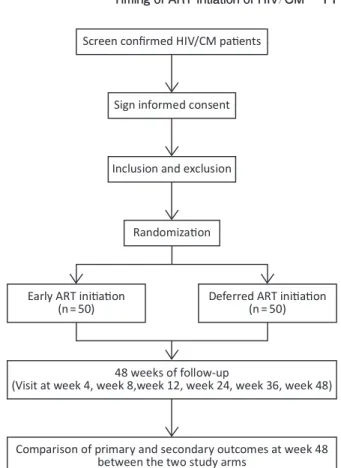
We will randomize our cohort of 100 HIV/CM patients into two arms: (a) an early ART group, defined as receiving the initiation of ART at 2 to 5 weeks after the initiation of antifungal therapy, and (b) a deferred ART group, defined as undergoing the initiation of ART at over 5 weeks after antifungal therapy initiation. The efficacy and safety of treatment in each group will be assessed by a comparison of the groups’ mortality rates and the incidence of IRIS between the 2 study arms. The flow diagram of the study is provided as Fig. 1.
Ethics approval and consent to participate. This study has been approved by The Ethics Committee of Chongqing Public Health Medical Center (2019-003-02-KY) and has been registered as one of the 12 trials under a general project at clinicaltrials. gov. The registration number of the general project is ChiCTR1900021195. The approval of the Ethics Committees from each par-ticipating site will be secured before the initiation of patient recruitment.
We will share the results of this study through pub-lished medical journal articles and conference presenta-tions after the study’s completion.
Before randomization, all patients will sign an informed consent form before their enrollment in the study.
Treatment Methods
Follow-up. The study time points of patient screening, enrollment and follow-up and the
assess-ment items at each visit are shown in Table 1.
Intervention. All of the patients will receive con-ventional drug treatments for both CM and HIV in accordance with the recommendations of the Chinese
Guidelines for the Diagnosis and Treatment of HIV/AIDS (2018) [6].
Antifungal therapy
In light of local Chinese guidelines regarding the management of HIV/CM, we will use amphotericin B deoxycholate combined with flucytosine in the induc-tion phase of treatment. Fluconazole or voriconazole may also be used as an alternative therapy at the induc-tion phase. The attending physician may adjust regi-mens based on the patient’s clinical condition.
ART therapy
In accord with local guidelines, the preferred anti- retroviral regimen of tenofovir disoproxil fumarate (TDF) (300 mg/d)+lamivudine (3TC) (300 mg/d)+efavirenz (EFV) (600 mg/d) will be used for the treatment of HIV infection, while other regimens are optional.
Screen confirmed HIV/CM pa�ents
Sign informed consent
Inclusion and exclusion
48 weeks of follow-up
(Visit at week 4, week 8,week 12, week 24, week 36, week 48) Randomiza�on
Early ART ini�a�on
(n= 50) Deferred ART ini�a�on(n = 50)
Comparison of primary and secondary outcomes at week 48 between the two study arms
Fig. 1 Flow diagram for patient enrollment, randomization, and
Statistical Considerations
Randomization. A specific random number sequence will be generated by Medical Research Platform (a website which can be available at http://www. 51yyt.org/FrontPage/Index.aspx, Copyright ©2016-2020 SJS TECH) for each patient with consent. Those who are enrolled will be randomized into one of the two study arms at a 1:1 ratio.
Sample size. The sample size will be 50 per treat-ment arm in order to provide at least 80% power and an overall two-side alpha level of 0.05. The expected loss-to-follow-up rate will be 15%.
Data collection and quality assurance. In order to ensure the highest standard of research, the follow-ing steps will be taken to maintain the integrity of the data collected. All participating investigators for this study will be comprehensively trained based on a stan-dard operating procedure (SOP) manual.
(1). Data collection
All data will be recorded in case report forms (CRFs) and also immediately recorded into the investigation database by Medical Research Platform. Significantly abnormal data and data that are outside clinical accept-able ranges (e.g., laboratory items >20% of the normal value) must be explained by the attending physician.
Investigators must also record and explain the occur-rence of adverse events and patient drop-outs.
(2). Quality assurance
We envisage that a stable pool of study investigators will persist with this study during the trial period. The investigators will record CRFs meticulously to ensure that the contents of the database are true and reliable. We will implement a two-stage quality control protocol for this study: each investigator will be responsible for the primary quality control, and the Chongqing Public Health Medical Center will be responsible for the sec-ondary quality control. Quality control personnel at all levels will regularly supervise the access to research units in order to ensure that the contents of the research plan have been strictly abided by, and that research data entries are valid and correct. The data monitor will review CRFs, check the inclusion and exclusion criteria for each patient, and ensure that the information on the CRFs is in agreement with those in the source medical records.
(3). Data retention
CRFs are considered to be original data, and they will be stored for ≥5 years after the completion of this investigation. Access to the research data will require written informed consent from the principal investigator.
Data analyses. Primary and secondary outcomes
Table 1 Time points of the patient screening, enrollment, and follow-up
Visit 1 Visit 2 Visit 3 Visit 4 Visit 5 Visit 6 Visit 7 Visit 8 Time window -28 to 0 daysScreen Baseline 0 day 4 weeks ±
14 days 8 weeks ± 14 days 12 weeks ± 14 days 24 weeks ± 14 days 36 weeks ± 14 days 48 weeks ± 14 days Sign consent × Enrolment × Demography ×
Signs & Symptoms × × × × × × ×
Hematological analysis × × × × × × ×
Clinical chemistry studies × × × × × × ×
Serum Amylase levels ×
Myocardial enzymes ×
Urinalysis ×
Urine pregnancy test ×
CD4+ counts × × × × × ×
Quantitative plasma HIV-RNA × × ×
Electrocardiogram (ECG) ×
Brain CT/MRI × ×
IRIS (yes or no) × × × × × ×
Concomitant medications × × × × × × × ×
analyses will be conducted for all of the randomized patients, whether they complete the study protocol or not. Both the intent-to-treat exposed (ITT-E) analysis set and the per-protocol (PP) analysis set will be used to assess the primary and secondary outcomes. Patients who do not follow the treatment regimens will be excluded from the PP analysis set. If any data are not recorded, the last observation carried forward (LOCF) method will be used. We will compare the mortality rate in the two groups using time-to-event methods with Cox proportional-hazards models, and the cumu-lative incidence function will be used to compare the incidence of adverse events and IRIS between the two groups [8]. The confidence interval will be established at 95%, and the significance level will be set at 5%.
Discussion
Most of the clinical research regarding HIV/CM patients has been conducted in African cohorts in Africa. It is not clear whether the results of those stud-ies can be safely and faithfully extrapolated to Asian populations and specifically to Chinese populations. Our proposed study will be a randomized, controlled, multicenter trial of the timing of ART initiation in Chinese patients with CM, involving 17 hospitals in ten provinces in China; the results of our study will thereby be applicable and generalizable to the entire Chinese population, and indeed to all Asian populations.
We expect that there will be challenges during the implementation of this study. Our study has a follow-up period of 48 weeks, and this lengthy period may well be overly onerous and exhausting for some enrolled patients. There may be costs related to presenting to a hospital for follow-up that may not be able to be met by some patients in the cohort. We also acknowledge that it cannot be guaranteed that the therapeutic drugs and drug regi-mens, testing kits and laboratory reagents being used for diagnostic purposes in the 17 different hospitals in our study will originate from one specific company, and although we will endeavor to mitigate this variable to the best of our ability, we are unable to guarantee abso-lute uniformity of therapeutic drugs and regimens, lab-oratory testing methods, reagents and results.
To ensure the highest standards of quality of this trial we will: (1) comprehensively counsel the enrolled patients regarding the aims and objectives of the study so that each patient understands the value and importance of
their role in the study; (2) provide a superior standard of consulting service excellence to participants during the study period and after the study; (3) strive to ensure diagnostic and therapeutic uniformity among the enrolled patients at the 17 hospitals during the course of the study. With these steps, we hope to conduct a high-quality clinical trial, the results of which will ben-efit Chinese patients as well as patients around the world.
Funding. This work is supported by the National Science and Technology Major Project of China of the 13th Five-Year Plan (2018ZX10302104). The funding bodies have no role in the trial design or interpretation of the data.
References
1. Williamson PR: The relentless march of cryptococcal meningitis. [J]. Lancet Infect Dis (2017) 17: 790-791.
2. Scriven JE, Rhein J, Hullsiek KH, von Hohenberg M, Linder G, Rolfes MA, Williams DA, Taseera K, Meya DB, Meintjes G, Boulware DR and COAT Team: Early ART After Cryptococcal Meningitis Is Associated With Cerebrospinal Fluid Pleocytosis and Macrophage Activation in a Multisite Randomized Trial. J Infect Dis (2015) 212: 769-778.
3. Boulware DR, Meya DB, Muzoora C, Rolfes MA, Huppler Hullsiek K, Musubire A, Taseera K, Nabeta HW, Schutz C, Williams DA, Rajasingham R, Rhein J, Thienemann F, Lo MW, Nielsen K, Bergemann TL, Kambugu A, Manabe YC, Janoff EN, Bohjanen PR, Meintjes G and COAT Trial Team: Timing of Antiretroviral Therapy after Diagnosis of Cryptococcal Meningitis. N Engl J Med (2014) 370: 2487-2498.
4. Eshun-Wilson I, Okwen MP, Richardson M and Bicanic T: Early versus delayed antiretroviral treatment in HIV-positive people with cryptococcal meningitis. Cochrane Database Syst Rev (2019) 6: CD012962 (2018) 7: CD009012. Published 2018 Jul 24.
5. Jarvis JN, Bicanic T, Loyse A, Namarika D, Jackson A, Nussbaum JC, Longley N, Muzoora C, Phulusa J, Taseera K, Kanyembe C, Wilson D, Hosseinipour MC, Brouwer AE, Limmathurotsakul D, White N, van der Horst C, Wood R, Meintjes G, Bradley J, Jaffar S and Harrison T: Determinants of Mortality in a Combined Cohort of 501 Patients With HIV-Associated Cryptococcal Meningitis: Implications for Improving Outcomes. Clin Infect Dis (2014) 58: 736-745.
6. AIDS and Hepatitis C Professional Group, Society of Infectious Diseases, Chinese Medical Association, Chinese Center for Disease Control and Prevention (2018). Chinese guidelines for diagnosis and treatment of HIV/AIDS (2018). Chinese Journal of AIDS & STD. 24: 1266-1282 (in Chinese).
7. Society of Infectious Diseases. Consensus of experts in diagnosis and treatment of cryptococcal meningitis. Chinese Journal of Infectious Diseases (2018) 36: 193-199 (in Chinese).
8. Longley N, Muzoora C, Taseera K, Mwesigye J, Rwebembera J, Chakera A, Wall E, Andia I, Jaffar S and Harrison TS: Dose response effect of high-dose fluconazole for HIV-associated crypto-coccal meningitis in southwestern Uganda. Clin Infect Dis (2008) 47: 1556-1561.