I
ntroductionApert syndrome is a congenital syndromic craniosyn- ostosis first described by Eugène Apert in 1906. This syn- drome is characterized by craniosynostosis, midfacial hypo- plasia, complex syndactyly affecting multiple digits of the hands, and complex syndactyly of the feet
1. In addition, this syndrome is associated with mental retardation in most pa- tients
2. Apert syndrome is uncommon, with an incidence of approximately 15 per one million newborns
3. Apert syn-
drome is caused by a mutation in the fibroblast growth fac- tor receptor 2 gene on chromosome 10. Although the muta- tion can be inherited as an autosomal dominant trait is most often a de novo mutation
4.
The deformity of hands in Apert syndrome (Apert hand) includes a wide spectrum of bone (complex) and skin (simple) syndactyly and symphalangism. Typical deformi- ties include complex syndactyly between the index, middle, and ring fingers ; simple syndactyly between the ring and little fingers ; a shortened and radially inclined thumb ; and
Received for publication, June 6, 2017
西村 礼司,松浦愼太郎,宮脇 剛司,内田 満
Mailing address : Reiji N
ishimura, Department of Plastic and Reconstructive Surgery, The Jikei University School of Medicine, 3
-25
-8 Nishishin- bashi, Minato
-ku, Tokyo 105
-8461, Japan.
E
-mail : [email protected]
45
Apert Hand : A Follow
-up Study of 7 Patients for 10 or More Years
reiji N
ishimura, shintaro m
atsuura, takeshi m
iyawaki, and mitsuru u
chidaDepartment of Plastic and Reconstructive Surgery, The Jikei University School of Medicine
ABSTRACT
Background : Apert syndrome is characterized by craniosynostosis, midfacial hypoplasia, and severe deformities of the hands. The deformities of hands significantly affect the daily activities of pa- tients, and to correct the hands many procedures have been reported. However, the effects of proce- dures are unclear because previous studies have had few patients and short follow
-up periods. In the present study, we observed patients with Apert syndrome followed up for ≥ 10 years after complete separation of syndactyly.
Methods : The subjects were 7 patients with Apert syndrome (deformity of Upton classification type I in 2 patients, type II in 4 patients, and type III in 1 patient). Their mean age was 21 years, and the mean follow
-up period after digital separation was 19 years. The range of motion, radiographic findings, the Disabilities of the Arm, Shoulder, and Hand Questionnaire (DASH) score, and the mo- tion of digits in daily tasks were investigated.
Results : Because of their impaired tip pinch, all patients had difficulties dealing with small ob- jects. An inverse relationship between intelligence quotient and the DASH score was suggested.
Conclusions : The complete separation of syndactyly might be insufficient for the handling of small objects. An additional procedure to enhance tip pinch motion is required.
(Jikeikai Med J 2017 ; 64 : 45
-51) Key words : Apert syndrome, Apert hand, postoperative function, developmental disorder, long
-term
study
symphalangism. Other anomalies observed are of the intrin- sic muscles, vessels, nerves, and tendon insertions
5. Apert hands are most often divided with the Upton classification on the basis of their severity into 3 basic categories : type 1, the flat, spade
-like hand ; type 2, the constricted, cupped, mitten hand ; and type 3, the tightly coalesced hoof or rosebud hand
1,5. These hand deformities severely affect the activities of daily living and are challenging for hand surgeons to repair.
Although Apert syndrome is rare, many procedures for treating Apert hand have been reported. Most procedures have been described with only expert opinions based on small numbers of patients and limited terms of follow
-up.
Therefore, each procedure’s precise effect on hand function is unknown, and the borderline between correctable and uncorrectable abnormalities remains unclear
6.
The basic procedure for treating Apert hand is the digi- tal separation of syndactyly. This separation enables inde- pendent motion of the metacarpophalangeal joints and im- proves the function of the hand. Recently, the effect of early syndactyly release on carpal and digital growth has been shown on the basis of radiographic evidence
7. To maximize the hand’s potential for growth, complete separation should be performed before the age of 2 years
8,9. After digital sepa- ration, additional procedures are controversial. Because Apert syndrome is rare, large comparative studies are ex- tremely difficult to perform. Therefore, the precise records of long
-term follow
-up and the accumulation of these re- cords are especially important to choose the optimal proce- dure for Apert hand.
The purpose of the present study was to obtain data suggesting the optimal procedures for treating Apert hands by assessing 7 patients followed up for ≥ 10 years after complete separation of syndactyly.
M
ethodsPatients
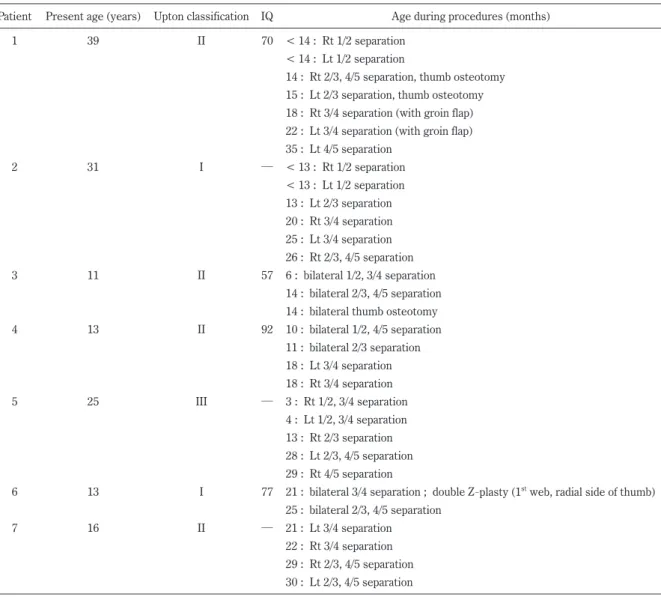
From 1974 through 2013, we performed surgery for 42 patients with Apert hand. Of these patients, 7 had been fol- lowed up for ≥ 10 years and were the subjects of the pre- sent study (Table 1). Their present mean age was 21 years (range, 11
-39 years), and the mean length of follow
-up after digital separation was 19 years (range, 10
-36 years). The Upton classifications of the deformities were type I in 2 pa-
tients, type II in 4 patients, and type III in 1 patient. The in- telligence quotient (IQ) was measured in 4 patients. The mean age at completion of digital separation was 23.6 months (range, 14
-35 months).
Most patients were able to perform all activities of dai- ly living but lived with their parents and did not have a job.
Exceptions were patient 2, who stayed at day care facilities after graduating from a school for the handicapped, and pa- tient 5, who worked at a facility for disabled workers by washing dishes and delivering boxed lunches.
Objective variables
Objective variables investigated were range of motion (ROM) and radiographic findings.
Subjective variables
The subjective variables investigated were Disabilities of the Arm, Shoulder, and Hand Questionnaire (DASH) scores. The DASH score ranges from 0 to 100. A higher score indicates a more severe level of disability, and a lower score indicates a lower level of disability. To fill out the questionnaire, patients with developmental disorders were assisted by their parents.
Additional tasks
Patients were observed while performing daily tasks : writing with a pen, picking up coins and clips, handling chopsticks, typing on a computer, turning the pages of a book, and peeling a sticker. The patients’ use of their digits during these tasks was observed. In particular, the ability to peel a sticker from its backing is a helpful assessment tool for measuring the function of the thumb
10.
Correlations
Correlations between Upton classification/DASH score, DASH score/IQ, and Upton classification/ROM were determined by calculating Spearman’s correlation coeffi- cients. If P < 0.05, differences were considered statistically significant.
This study was approved by the ethics committee of
The Jikei University School of Medicine (approval num-
ber : 26
-378).
R
esultsObjective variables
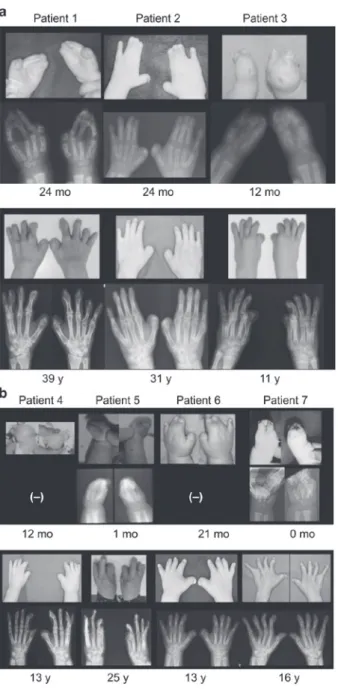
Photographs and radiographs were obtained before digital separation and during the present study (Fig. 1). Al- though some interphalangeal joints were preserved before surgery, all such joints, including those of the little finger, were ankylosed at the time of investigation. In addition, synostosis between the proximal fourth and fifth metacar- pals was observed in all patients.
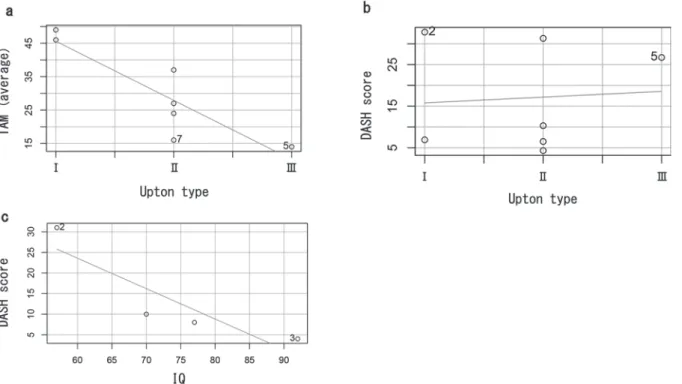
The ROM was markedly limited in all patients, but 2 patients with type I deformities (patients 2 and 6) showed good total active motion (TAM) (Table 2). Mean TAM was correlated with the Upton classification (r = 0.896, p =
0.003, Fig. 2a). Because almost all interphalangeal joints were stiff, TAM reflects the ROM of the metacarpophalan- geal joints.
Subjective variables
The DASH scores were highly variable in 2 patients with type I deformities and in 3 patients with type II de- formities. However, the DASH score was not found to be correlated with the Upton classification (r = -0.139, p = 0.382, Fig. 2b). In patients 1, 4, and 6, the IQ was > 60, and DASH scores were low and favorable. Conversely, patient 3 had an IQ < 60 and a high, poor DASH score. The DASH score was found to be correlated with the IQ (r = -1.000, p = 0.042, Fig. 2c).
Table 1.
Patient characteristics
Patient Present age (years) Upton classification IQ Age during procedures (months)
1 39 II 70 < 14 : Rt 1/2 separation
< 14 : Lt 1/2 separation
14 : Rt 2/3, 4/5 separation, thumb osteotomy 15 : Lt 2/3 separation, thumb osteotomy 18 : Rt 3/4 separation (with groin flap) 22 : Lt 3/4 separation (with groin flap) 35 : Lt 4/5 separation
2 31 I
─< 13 : Rt 1/2 separation
< 13 : Lt 1/2 separation 13 : Lt 2/3 separation 20 : Rt 3/4 separation 25 : Lt 3/4 separation 26 : Rt 2/3, 4/5 separation
3 11 II 57 6 : bilateral 1/2, 3/4 separation
14 : bilateral 2/3, 4/5 separation 14 : bilateral thumb osteotomy
4 13 II 92 10 : bilateral 1/2, 4/5 separation
11 : bilateral 2/3 separation 18 : Lt 3/4 separation 18 : Rt 3/4 separation
5 25 III
─3 : Rt 1/2, 3/4 separation
4 : Lt 1/2, 3/4 separation 13 : Rt 2/3 separation 28 : Lt 2/3, 4/5 separation 29 : Rt 4/5 separation
6 13 I 77 21 : bilateral 3/4 separation ; double Z
-plasty (1
stweb, radial side of thumb) 25 : bilateral 2/3, 4/5 separation
7 16 II
─21 : Lt 3/4 separation
22 : Rt 3/4 separation
29 : Rt 2/3, 4/5 separation
30 : Lt 2/3, 4/5 separation
IQ : intelligence quotient ; Lt : left ; Rt : rightAdditional tasks in each patient
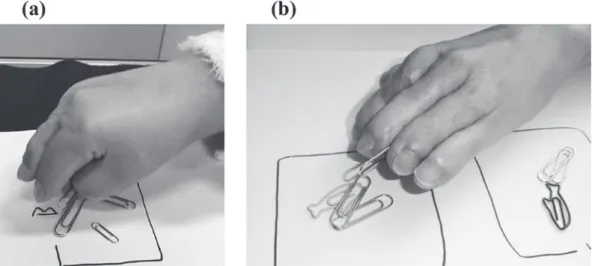
All patients were able to smoothly perform most daily tasks. Furthermore, some patients were able to perform hand tasks that were more difficult. One patient was able to pick up small pieces of food with chopsticks (Fig. 3). Two patients were able to type and use E
-mail, and 1 patient was able to play a piano and a wind synthesizer.
However, all patients had difficulty dealing with small
objects, such as shirt buttons and coins. One patient picked up small objects using a pinch between the ring finger and thumb, and the other patients used mainly a scissor pinch (Fig. 4).
Peeling tasks were observed in 3 patients (patients 1, 4, and 6). All 3 patients were able to peel a sticker from a plastic sheet, but their method of peeling was not uniform.
Patient 1 peeled a sticker by first raising an edge of the sticker using the tip of the right little finger or left index finger and then removing the sticker using a scissor pinch between the left index and middle finger. Patient 4 peeled a sticker by first raising an edge of the sticker using the tip of the little finger, then peeling little by little using a scissor pinch between the middle and ring fingers, and finally re- moving the sticker using a key pinch (Fig. 5). Patient 6 ini- tially raised an edge of the sticker using the tip of the index finger and then pronated the forearm and peeled the sticker using a key pinch.
D
iscussionTo the best of our knowledge, almost no studies have examined the long
-term outcome of Apert hand ; the only study to do so included 5 patients with a mean age of 50 years and suggested that early digital separation is crucial for improving hand function
11. This digital separation is the basic procedure for treating Apert hand. To clarify the ef- fect of this procedure on hand function, long
-term results should be evaluated because the function of a congenitally malformed hand is determined both by surgery and by the growth from childhood to adulthood. An effective treatment for symphalangism has not been established ; as a result, ROM in Apert hand is difficult to normalize. Therefore, af- Fig. 1. Photographs and radiographic images obtained before
digital separation (upper row) and during the present study (lower row) of (a) patients 1
-3 and (b) patients 4
-7.
Table 2.
Total active range of motion in degrees Digits of the right hand Digits of the left hand
Patient 1 2 3 4 5 1 2 3 4 5
1 30 30 30 30 0 30 30 30 30 0
2 30 50 65 50 50 20 65 60 60 40
3 46 20 18 24 50 70 30 40 30 40
4 35 30 30 10 10 60 40 15 30 5
5 26 10 10 14 2 30 30 16 4 2
6 60 70 35 30 60 50 40 40 30 45
7 15 13 20 10 15 10 30 16 14 15
Digits : 1, thumb ; 2, index ; 3, middle ; 4, ring ; 5, little
ter complete digital separation, the main targets of the op- erations are the shapes and fixed angles of the deformed digits.
In the present study, all patients, who had been fol- lowed up for ≥ 10 years after the digital separation, had dif- ficulties handling fine objects, most often with a scissor pinch. The scissor pinch is inferior to a tip pinch for finesse and strength. If a tip pinch can be performed, the hand will be more useful. Upton has repeatedly demonstrated that
excision of fourth
-fifth metacarpal synostosis allows pinch- ing between the thumb and little finger
5,12. However, we consider the thumb
-to
-index finger pinch to be a more physiologic and potentially stronger pinch. Patient 6 used a pinch between the thumb and ring finger to handle small clips and used a key pinch to peel stickers. The pinches the patient used might be due to the difference in strength needed to perform each task. In addition, we found that the ROM of the little finger, which is considered to be the most mobile digit in Apert hand
8, was not better than that of oth- er fingers.
To allow the thumb to be opposed in patients with Ap- ert hand, we have recently started to more aggressively correct its deformities. We expand the first web by a local flap, correct the radial deviation of the thumb by an osteoto- my, and elongate the thumb by distraction osteogenesis.
After these procedures, flexion osteotomy of the index fin- ger might be needed. A recent example of our procedures is on the hand of a 4
-year
-old child with type II deformity (Fig. 6), who was not a subject of this study. To determine the effect of these procedures on hand function, an adequate number of patients treated with the same procedures must Fig. 2. The mean total active movement (TAM) score was correlated with the Upton classification (r = 0.896, p = 0.003, a). The
Disabilities of the Arm, Shoulder, and Hand Questionnaire (DASH) score was not found to be correlated with the Upton classification (r = -0.139, p = 0.382, b). The DASH score was found to be correlated with the intelligence quotient (r =
-1.000, p = 0.042, c).