The Family Drawing Test by Children with Psychosomatic Disease
著者 Terashima Shigenori, Miyajima Chizuru, Ninomiya Hitomi, Tanaka Hidetaka
journal or
publication title
関西大学社会学部紀要
volume 30
number 2
page range 87‑97
year 1998‑12‑25
URL http://hdl.handle.net/10112/00022407
ISSN 0287-6817
The Family Drawing Test by Children with Psychosomatic Disease
Shigenori TERASHIMA (1), Chizuru MIY AJIMA (2), Hitomi NINOMIY A (3), Hidetaka TAN AKA (3)
Abstract
We examined the clinical usefulness of the Family Drawing Test (FDT) with pictures titled "my family".
More information can be obtained by adopting this drawing method according to the Japanese Association of Clinical Drawings. This method readily allows projection of feelings or desires concerning family members, and the family relationship subjectively recognized by the subject can be understood more extensively. However, if the flexibility in the contents drawn increases, the method of interpretation may become extremely complicated. Therefore, to effectively employ the FDT in a clinical setting, the type of picture must be clarified in various groups, and basic data for interpreting the drawing must be collected.
We quantitatively investigated the features of the FDT drawn by children with psychosomatic disease.
Key words : Family drawing test, Psychosomatic disease, Projective technique
(1) Kansai University
(2) Tamano Institute of Health and Human Services (3) Osaka Medical College
- 8 7 -
The Family Drawing Test by Children with Psychosomatic Disease
The drawing test is an effective method to understand personality of children. This test is based on interpreting the drawing obtained by a regular procedure according to a regular theory. As various behavioral problems in children have been increasing, arbitrary interpre- tation of pictures on which an original theme is given and drawn is increasing. These inadequate interpretations even cause aggravation of the behavioral problems.
In clinical practice, many fundamental studies to verify the reliability and validity of drawing as a psychological test have been performed. O'Brien & Patton (197 4), Sims (197 4), Levenberg (1975), Raskin & Baker (1977) and Meyrs (1978) conducted empirical rf;)searches concerning the reliability and validity of the Kinetic Family Drawing Test(KFD) in the 19-70s. In Japan, Fukada (1958,.1961), Kato(1977, 1978), Hibi(1974, 1977, 1980) and Akitani et al.(1982) clarified the features of the KFD in various groups. These studies have shown that the KFD is effective as a psychological test to understand family relationships, and the KFD is currently widely used in clinical practice.
We examined the clinical usefulness of the Family Drawing Test(FDT) titled "my family". This drawing method follows the procedure defined by the Japanese Association of Clinical Drawings. In this method, since the instruction consists of "drawing a picture with the title, my family", various items other than people may be drawn. Moreover, as the instruction " draw your all family members" is not used, the family drawn changes with the subject. With this method, an increased amount of information can be expected compared to the conventional drawing method. This method allows the feelings and desires regarding family members to be projected and the family relationship subjectively recognized by the subject can be understood more extensively. However, as the flexibility of the contents expressed on the drawing increases, the interpreting method may become more compli- cated. Therefore, to effectively use the FDT in a clinical setting, pictures to be drawn must be clarified beforehand in various groups, and basic data for interpreting the drawings must be collected. The FDT drawn by school children were collected and their features were reported as previously described by Terashima et al. (1996). We quantitatively examined the features of the FDT drawn by children with psychosomatic disease.
[The method]
(I)
Subjects
The Family Drawing Test by Children with Psychosomatic Disease(TERASHIMA • MIYA]IMA • NINOMIYA • TANAKA)
The subjects were 270 school children (128 boys, 142 girls) between 6 and 12 years of age who consulted the department of pediatrics or psychiatry in a university hospital or a public hospital, and were diagnosed as having psychosomatic disease. Table 1 shows the number of subjects and table 2 shows their condition.
Table 1 Number of subjects in each grade
Low Grade Middle Grade Upper Grade M
F
44 46
52 60
Table 2 Condition of subjects Tic
Enuresis Headache Abdominal Pain
Orthostatic Dysregulation Psychogenic Fever Obesity
Sleep Disturbance
Psychogenic Visual Impairment Trichotillomania
Alopecia Conduct Disorder Others
32 36
24( 8.9) 16( 5.9) 34(12.6) 28(10.4) 34(12.6) 26( 9.6) 10( 3. 7) 6( 2.2) 22( 8.1) 6( 2.2) 20( 7.4) 18( 6.7) 26( 9.6)
( ) %
(2) The administration method for the FDT
Total 128 142
The instruments required for the test were B4 seal drawing paper, an HB pencil, and 12 JIS standard colored pencils. The test was started with the instruction "please draw a picture titled my family". No time restriction was established, but the time required was recorded. An explanation about the contents of the drawing was requested by the tester after drawing, and the contents were recorded. The FDT was performed by a clinical psychologist by the individual method within 1-2 weeks after diagnosis.
(3) Analytical items of the FDT
A method of investigating the frequency of the analytical items, such as the size of the drawing, has been conventionally used for quantitative analysis of the drawing test. The frequency of 30 analytical items outlined by Terashima et al.(1996) were examined. Most
-89-
Table 3 List of analytical items
<I> Items of formal analysis for all FDT (Al -AlO)
A-1 Direction of drawing paper: The item shows the direction of the drawing paper.
A-2 Number of colors used: The item shows the number of colors used to draw the FDT.
A-3 Deviation in the drawing position: The item shows whether or not deviation was seen in the drawing position.
A-4 Transparency: The item indicates whether transparency, such as "seeing the indoors through a wall"
was seen.
A-5 Perspective: The item shows whether perspective perception is expressed in the drawing.
A-6 Line in the lower part of the drawing paper: The item shows whether a line was drawn indicating a baseline, foundation, floor or ground in the lower part of the drawing paper.
A-7 Line in the upper part on the drawing paper: The item shows whether a line was drawn indicating a ceiling or sky in the upper part of the drawing paper.
A-8 Erasion: The item shows whether the picture was erased repeatedly.
A-9 Lack of people: The item which shows whether animals, plants, figures or patterns were drawn instead of people.
A-10 Character and sentence: The item shows whether characters or sentences were written on the picture.
However, characters used for a calendar, clock or television channel were excluded.
---
(2) Analytical items for the FDT on which the people were drawn (Bl - B9)
B-1 Separation: The item shows whether a partition with a line was drawn.B-2 Capsulization: The item shows whether the people were surrounded by a swing, rope jump, car and so on.
B-3 Line under the specific persons: The item shows whether a baseline showing a foundation, floor or ground was drawn on the bottom of a specific person.
B-4 Edging: The item which shows whether people were drawn along the edge of the paper.
B-5 Cutting: The item shows whether people were drawn only in the middle or on the edge of the paper.
B-6 Appearance of specific people: The item shows whether people other than family members living together were drawn.
B-7 Grouping: The item shows whether the family was divided into groups.
B-8 How people are drawn: The item shows how the people were drawn. For example, "stick persons".
B-9 Abbreviation of the person's portion: The item shows whether some portion of the bodies, such as abbreviations of hands or legs, were omitted.
---
(3) Analytical items for the FDT on which the people were drawn by a subject living in
a standard family (Cl)
C-1 Family member not drawn: The item shows family members not drawn.
---···-···---···---
<4> Analytical items for the FDT on which parents, brothers/sisters and the subject were drawn by a child living in a standard family (Dl-D5)
D-1 Person drawn first: The item shows the person drawn first.
D-2 Person drawn biggest: The item shows the biggest person drawn.
D-3 Person drawn smallest: The item shows the smallest person drawn.
D-4 Person drawn nearest: The item shows the person drawn nearest to the subject.
D-5 Person drawn farthest: The item shows the person drawn farthest from the subject.
---
(5) Analytical items for each family member drawn on the FDT(El-E2)
E-1 Direction of the person: The item shows which direction the faces turned.E-2 Facial expression: The item shows the facial expression of the people drawn.
--- (6) Analytical items for the contents drawn on the FDT (Fl-F3)
F-1 Place: The item shows the place drawn as a background in the FDT.
F-2 Interaction between family members: The item shows the interaction between family m~bers. For example, "cooperating", "opposed to each other", "no interaction".
F-3 Theme: The item shows the theme in the FDT.
of these analytical items were observable and evaluated objectively. However, the item
"Facial expression" was estimated by 3 clinical psychologists with at least 5 years of
The Family Drawing Test by Children with Psychosomatic Disease(TERASHIMA • MIYAJIMA • NINOMIYA • TANAKA)
clinical experience.
Table 3 shows the definition of the analytical items. The items were classified according to the contents of 6 item groups. The 1st group consisted of items of formal analysis for all FDT, and the 2nd group consisted of items for the FDT on which the people were drawn.
The 3rd group consisted of items for the FDT on which the people were drawn by a subject living with parents and brothers/sisters(a subject from a standard family). The 4th group consisted of items for the FDT on which parents, brothers/sisters, and the subject were drawn by a child living in a standard family. The 5th group consisted of items for each family member drawn on the FDT, and the 6th group consisted of the contents drawn on the FDT.
[Result]
Table 4-1-1 to 4-6-3 show the frequency of 30 analytical items in the 270 school children with psychosomatic disease. In these tables, the low grade group included children in grades 1 to 2, the middle grade group included grades 3 to 4, and the upper grade group included grades 5 to 6.
Table 4-1-1 Frequency of items of formal analysis for all FDT (A-l~A-6)
Low Grade Middle Grade Upper Grade Total
M(N =44) F(N =46) M(N =52) F(N =60) M(N =32) F(N =36) M(N=128) F(N =142) A-1: Direction of drawing paper
Width 44(100.0) 46(100.0) 52000.0) 60000.0) 32000.0) 36000.0) 128000.0) 142000.0) Length 0( 0.0) 0( 0.0) 0( 0.0) 0( 0.0) 0( 0.0) 0( 0.0) 0( 0.0) 0( 0.0) Slanting 0( 0.0) 0( 0.0) 0( 0.0) 0( 0.0) 0( 0.0) 0( 0.0) 0( 0.0) 0( 0.0) A-2: Number of colors used
Only pencil 4( 9.1) 0( 0.0) 10( 19.2) 6( 10.0) 0( 0.0) 2( 5.6) 14( 10.9) 8( 5.6) One or 2 colors 10( 22. 7) 2( 4.3) 10( 19.2) 8( 13.3) 12( 37.5) 4( 11.1) 32( 25.0) 14( 9.9) 3or5 colors 12( 27.3) 6( 13.0) 6( 11.5) 6( 10.0) 8( 25.0) 12( 33.3) 26( 20.3) 24( 16.9) 6or more colors 18( 40.9) 38( 82.6) 26( 50.0) 40( 66. 7) 12( 37.5) 18( 50.0) 56( 43.8) 96( 67.6) A-3: Deviation in the drawing position
Appearance 18( 40.9) 8( 17.4) 28( 53.8) 14( 23.3) 8( 25.0) 18( 50.0) 54( 42.2) 40( 28.2) No appearance 26( 59.1) 38( 82.6) 24( 46.2) 46( 76. 7) 24( 75.0) 18( 50.0) 74( 57 .8) 102( 71.8) A-4: Transparency
Appearance 2( 4.5) 2( 4.3) 4( 7.7) 4( 6. 7) 4( 12.5) 0( 0.0) 10( 7.8) 6( 4.2) No appearance 42( 95.5) 44( 95. 7) 48( 92.3) 56( 93.3) 28( 87 .5) 36000.0) 118( 92.2) 136( 95.8) A-5: Perspective
Bird's-eye-view 0( 0.0) 0( 0.0) 4( 7.7) 6( 10.0) 2( 6.3) 0( 0.0) 6( 4.7) 6( 4.2) Bottom to top 0( 0.0) 0( 0.0) 0( 0.0) 0( 0.0) 0( 0.0) 0( 0.0) 0( 0.0) 0( 0.0) Nothing 44(100.0) 46000.0) 48( 92.3) 54( 90.0) 30( 93.8) 36000.0) 122( 95.3) 136( 95.8) A-6: Line in the lower part of the drawing paper
Appearance 4( 9.1) 2( 4.3) 2( 3.8) 0( 0.0) 0( 0.0) 0( 0.0) 6( 4.7) 2( 1.4) No appearance 40( 90.9) 44( 95. 7) 50( 96.2) 60000.0) 32000.0) 36000.0) 122( 95.3) 140( 98.6) ( )%
- 9 1 -
Table 4-1-2 Frequency of items of formal analysis for all FDT (A-7~A-10)
Low Grade Middle Grade Upper Grade Total
M(N =44) F (N =46) M(N =52) F (N =60) M(N =32) F (N =36) M(N =128) F (N =142) A-7: Line in the upper part of the drawing paper
Appearance 2( 4.5) 0( 0.0) 0( 0.0) No appearance 42( 95.5) 46(100.0) 52(100.0) A-8: Erasion
Appearance No appearance
8( 18.2) 36( 81.8)
4( 8.7) 42( 91.3) A-9: Lack of people
Appearance 4( 9.1) 0( 0.0) No appearance 40( 90.9) 46(100.0) A-10: Character and sentence
Appearance 10( 22. 7) No appearance 34( 77 .3)
14( 30.4) 32( 69.6)
12( 23.1) 40( 76.9)
4( 7.7) 48( 92.3)
14( 26.9) 38( 73.1)
0( 0.0) 60(100.0)
6( 10.0) 54( 90.0)
0( 0.0) 60(100.0)
14( 23.3) 46( 76. 7)
0( 0.0) 32(100.0)
2( 6.3) 30( 93.8)
8( 25.0) 24( 75.0)
12( 37.5) 20( 62.5)
0( 0.0) 2( 1.6) 0( 0.0) 36(100.0) 126( 98.4) 142(100.0)
4( 11.1) 22( 17.2) 14( 9.9) 32( 88.9) 106( 82.8) 128( 90.1)
6( 16. 7) 16( 12.5) 6( 4.2) 30( 83.3) 112( 87.5) 136( 95.8)
24( 66. 7) 12( 33.3)
36( 28.1) 92( 71.9)
52( 36.6) 90( 63.4) ( )%
Table 4-2 Frequency of analytical items for the FDT on which people were drawn
Low Grade Middle Grade Upper Grade Total
M(N =40) F (N =46) M(N =48) F (N =60) M(N =24) F (N =30) M(N =112) F (N =136) B-1: Separation
Appearance No appearance
2( 5.0) 38( 95.0)
0( 0.0) 46(100.0)
4( 8.3) 44( 91. 7)
6( 10.0) 54( 90.0)
4( 16.7) 20( 83.3) B-2: Capsulization
Appearance 4( 10.0) 4( 8.7) 4( 8.3) 8( 13.3) 2( 8.3) No appearance 36( 90.0) 42( 91.3) 44( 91. 7) 52( 86.7) 22( 91.7) B-3: Line under the specific persons
Appearance 2( 5.0) 0( 0.0) 0( 0.0) 2( 3.3) 0( 0.0) No appearance 38( 95.0) 46(100.0) 48(100.0) 58( 96.7) 24(100.0) B-4: Edging
Appearance No appearance
0( 0.0) 0( 0.0) 0( 0.0) 0( 0.0) 40 (100. 0) 46 (100. 0) 48 (100. 0) 60 (100. 0) B-5: Cutting
Appearance No appearance
0( 0.0) 40(100.0)
4( 8.7) 42( 91.3) B-6: Appearance of the specific people
2( 4.2) 46( 95.8)
Appearance 2( 5.0) 2( 4.3) 0( 0.0) No appearance 38( 95.0) 44( 95. 7) 48(100.0) B-7: Grouping
Appearance No appearance
6( 15.0) 34( 85.0)
2( 4.3) 2( 4.2) 44( 95.7) 46( 95.8) B-8: How people are drawn
Normal 40(100.0)
Stick 0( 0.0)
Shade 0( 0.0)
Other 0( 0.0)
46(100.0) 0( 0.0) 0( 0.0) 0( 0.0) B-9: Abbreviation of the people's portion
Appearance 22( 55.0) 14( 30.4) No appearance 18( 45.0) 32( 69.6)
46( 95.8) 2( 4.2) 0( 0.0) 0( 0.0)
20( 41.7) 28( 58.3)
10( 16.7) 50( 83.3)
0( 0.0) 60(100.0)
6( 10.0) 54( 90.0)
58( 96. 7) 2( 3.3) 0( 0.0) 0( 0.0)
18( 30.0) 42( 70.0)
2( 8.3) 22( 91. 7)
6( 25.0) 18( 75.0)
4( 16.7) 20( 83.3)
0( 0.0) 24(100.0)
24(100.0) 0( 0.0) 0( 0.0) 0( 0.0)
2( 8.3) 22( 91. 7)
0( 0.0) 10( 8.9) 6( 4.4) 30(100.0) 102( 91.1) 130( 95.6)
2( 6. 7) 10( 8.9) 14(10.3) 28( 93.3) 102( 91.1) 122(89.7)
0( 0.0) 2( 1.8) 2( 1.5) 30(100.0) ll0( 98.2) 134(98.5)
2( 6. 7) 2( 1.8) 2( 1.5) 28( 93.3) ll0( 98.2) 134(98.5)
0( 0.0) 8( 7.1) 14( 10.3) 30(100.0) 104( 92.9) 122( 89. 7)
2( 6. 7) 6( 5.4) 4( 2.9) 28( 93.3) 106( 94.6) 132(97.1)
4( 13.3) 8( 7.1) 12( 8.8) 26( 86. 7) 104( 92.9) 124( 91.2)
28( 93.3) 2( 6.7) 0( 0.0) 0( 0.0)
6( 20.0) 24( 80.0)
ll0( 98.2) 2( 1.8) 0( 0.0) 0( 0.0)
44( 39.3) 68( 60:7)
132(97.1) 4( 2.9) 0( 0.0) 0( 0.0)
38(27.9) 98(72.1) ( )%
The Family Drawing Test by Children with Psychosomatic Disease(TERASHIMA • MIYAJIMA • NINOMIYA • TANAKA) Table 4-3 Frequency of analytical items for the FDT on· which the people were drawn by a subject
living in a standard family
Low Grade Middle Grade Upper Grade Total
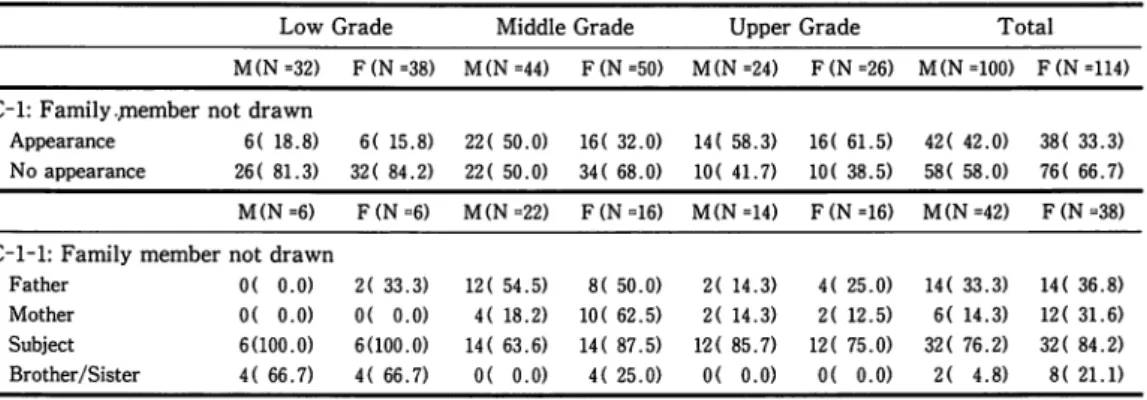
M (N =32) F (N =38) M (N =44) F (N =50) M (N =24) F (N =26) M (N =100) F (N =114) C-1: Family .,member not drawn
Appearance 6( 18.8) 6( 15.8) 22( 50.0) 16( 32.0) 14( 58.3) 16( 61.5) 42( 42.0) 38( 33.3) No appearance 26( 81.3) 32( 84.2) 22( 50.0) 34( 68.0) 10( 41. 7) 10( 38.5) 58( 58.0) 76( 66. 7) M (N =6) F (N =6) M (N =22) F (N =16) M (N =14) F (N =16) M (N =42) F (N =38) C-1-1: Family member not drawn
Father 0( 0.0)
Mother 0( 0.0)
Subject 6(100.0)
Brother /Sister 4 ( 66. 7)
2( 33.3) 0( 0.0) 6(100.0) 4( 66.7)
12( 54.5) 4( 18.2) 14( 63.6) 0( 0.0)
8( 50.0) 10( 62.5) 14( 87.5) 4( 25.0)
2( 14.3) 2( 14.3) 12( 85. 7) 0( 0.0)
4( 25.0) 2( 12.5) 12( 75.0) 0( 0.0)
14( 33.3) 6( 14.3) 32( 76.2) 2( 4.8)
14( 36.8) 12( 31.6) 32( 84.2) 8( 21.1) ( )%
Table 4-4 Frequency of analytical items for the FDT on which parents, brother/sister and the subject were drawn by a child living in a standard family
Low Grade Middle Grade
D-1: Person drawn first
Father 12( 42.9)
Mother Subject Brother /Sister Other
4( 14.3) 4( 14.3) 8( 28.6) 0( 0.0) D-2: Person drawn biggest
Father 12( 42.9)
Mother 10 ( 35. 7)
Subject Brother /Sister Other
2( 7.ll 4( 14.3) 0( 0.0) D-3: Person drawn smallest
Father 4( 14.3)
Mother Subject Brother/Sister Other
2( 7.1) 8( 28.6) 12( 42.9) 2( 7.1) D-4: Person drawn nearest
Father 6 ( 21. 4)
Mothe Brother /Sister Other
4( 14.3) 12( 42.9) 6( 21.4)
D-5: Person drawn farthest
Father 8( 28.6)
Mother 6( 21.4)
Brother/Sister 12( 42.9)
Other 2( 7 .1)
F (N =32)
10( 31.3) 8( 25.0) 4( 12.5) 10( 31.3) 0( 0.0)
10( 31.3) 16( 50.0) 2( 6.3) 2( 6.3) 2( 6.3)
4( 12.5) 0( 0.0) 12( 37.5) 16( 50.0) 0( 0.0)
6( 18.8)
M(N =22)
4( 18.2) 2( 9.1) 2( 9.1) 12( 54.5) 2( 9.1)
8( 36.4) 4( 18.2) 2( 9.1) 6( 27.3) 2( 9.1)
0( 0.0) 4( 18.2) 8( 36.4) 10( 45.5) 0( 0.0)
2( 9.1) 10( 31.3) 10( 45.5) 12( 37.5) 10( 45.5) 4( 12.5) 0( 0.0)
12( 37.5) 8( 25.0) 12( 37.5) 0( 0.0)
4( 18.2) 6( 27.3) 6( 27.3) 6( 27.3)
F(N =34)
6( 17.6) 8( 23.5) 6( 17.6) 14( 41.2) 0( 0.0)
12( 35.3) 10( 29.4) 4( 11.8) 8( 23.5) 0( 0.0)
4( 11.8) 2( 5.9) 10( 29.4) 18( 52.9) 0( 0.0)
2( 5.9) 10( 29.4) 18( 52.9) 4( 11.8)
16( 47.ll 8( 23.5) 6( 17.6) 4( 11.8)
-93-
Upper Grade M(N =10)
0( 0.0) 4( 40.0) 4( 40.0) 0( 0.0) 2( 20.0)
6( 60.0) 2( 20.0) 0( 0.0) 0( 0.0) 2( 20.0)
0( 0.0) 0( 0.0) 2( 20.0) 6( 60.0) 2( 20.0)
2( 20.0) 4( 40.0) 2( 20.0) 2( 20.0)
2( 20.0) 6( 60.0) 0( 0.0) 2( 20.0)
F(N =10)
2( 20.0) 0( 0.0) 4( 40.0) 4( 40.0) 0( 0.0)
6( 60.0) 2( 20.0) 0( 0.0) 2( 20.0) 0( 0.0)
0( 0.0) 0( 0.0) 2( 20.0) 8( 80.0) 0( 0.0)
4( 40.0) 2( 20.0) 2( 20.0) 2( 20.0)
4( 40.0) 2( 20.0) 4( 40.0) 0( 0.0)
Total M(N =60)
16( 26. 7) 10( 16.7) 10( 16. 7) 20( 33.3) 4( 6.7)
26( 43.3) 16( 26. 7) 4( 6.7) 10( 16.7) 4( 6.7)
4( 6. 7) 6( 10.0) 18( 30.0) 28( 46. 7) 4( 6.7)
10( 16. 7)
F(N =76)
18( 23. 7) 16( 21.1) 14( 18.4) 28( 36.8) 0( 0.0)
28( 36.8) 28( 36.8) 6( 7.9) 12( 15.8) 2( 2.6)
8( 10.5) 2( 2.6) 24( 31.6) 42( 55.3) 0( 0.0)
12( 15.8) 18( 30.0) 22( 28.9) 24( 40.0) 32( 42.1) 8( 13.3) 10( 13.2)
14( 23.3) 18( 30.0) 18( 30.0) 10( 16.7)
32( 42. ll 18( 23. 7) 22( 28.9) 4( 5.3) ( )%
00gg:k$ H:l:~$llB*c~J ~ 30 ~~ 2 -%
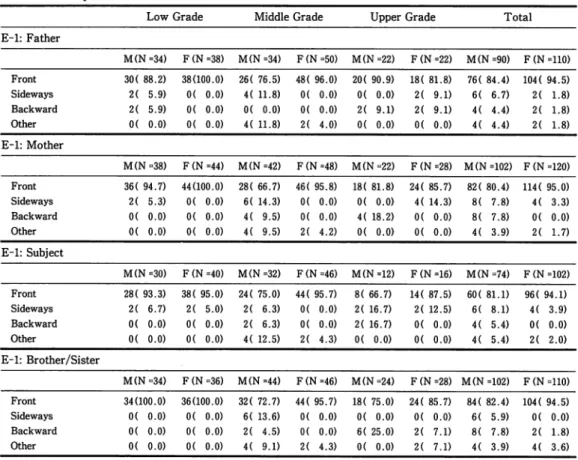
Table 4-5-1 Frequency of analytical items for each family member drawn on the FDT: Direction of the person
Low Grade Middle Grade Upper Grade Total
E-1: Father
M(N =34) F (N =38) M(N =34) F (N =50) M(N =22) F (N =22) M(N =90) F(N =110) Front 30( 88.2) 38(100.0) 26( 76.5) 48( 96.0) 20( 90.9) 18( 81.8) 76( 84.4) 104( 94.5) Sideways 2( 5.9) 0( 0.0) 4( 11.8) 0( 0.0) 0( 0.0) 2( 9.1) 6( 6. 7) 2( 1.8) Backward 2( 5.9) 0( 0.0) 0( 0.0) 0( 0.0) 2( 9.1) 2( 9.1) 4( 4.4) 2( 1.8) Other 0( 0.0) 0( 0.0) 4( 11.8) 2( 4.0) 0( 0.0) 0( 0.0) 4( 4.4) 2( 1.8) E-1: Mother
M(N =38) F (N =44) M(N =42) F(N =48) M(N =22) F (N =28) M(N=102) F (N =120) Front 36( 94. 7) 44(100.0) 28( 66. 7) 46( 95.8) 18( 81.8) 24( 85. 7) 82( 80.4) 114( 95.0) Sideways 2( 5.3) 0( 0.0) 6( 14.3) 0( 0.0) 0( 0.0) 4( 14.3) 8( 7.8) 4( 3.3) Backward 0( 0.0) 0( 0.0) 4( 9.5) 0( 0.0) 4( 18.2) 0( 0.0) 8( 7.8) 0( 0.0) Other 0( 0.0) 0( 0.0) 4( 9.5) 2( 4.2) 0( 0.0) 0( 0.0) 4( 3.9) 2( 1. 7) E-1: Subject
M(N =30) F (N =40) M(N =32) F(N =46) M(N=12) F(N =16) M(N =74) F (N =102) Front 28( 93.3) 38( 95.0) 24( 75.0) 44( 95. 7) 8( 66. 7) 14( 87.5) 60( 81.1) 96( 94.1) Sideways 2( 6.7) 2( 5.0) 2( 6.3) 0( 0.0) 2( 16. 7) 2( 12.5) 6( 8.1) 4( 3.9) Backward 0( 0.0) 0( 0.0) 2( 6.3) 0( 0.0) 2( 16. 7) 0( 0.0) 4( 5.4) 0( 0.0) Other 0( 0.0) 0( 0.0) 4( 12.5) 2( 4.3) 0( 0.0) 0( 0.0) 4( 5.4) 2( 2.0) E-1: Brother/Sister
M(N=34) F (N =36) M(N =44) F(N =46) M(N =24) F(N =28) M(N =102) F(N =110) Front 34(100.0) 36(100.0) 32( 72.7) 44( 95. 7) 18( 75.0) 24( 85. 7) 84( 82.4) 104( 94.5) Sideways 0( 0.0) 0( 0.0) 6( 13.6) 0( 0.0) 0( 0.0) 0( 0.0) 6( 5.9) 0( 0.0) Backward 0( 0.0) 0( 0.0) 2( 4.5) O( 0.0) 6( 25.0) 2( 7 .1) 8( 7.8) 2( 1.8) Other 0( 0.0) 0( 0.0) 4( 9.1) 2( 4.3) 0( 0.0) 2( 7 .1) 4( 3.9) 4( 3.6) ( )%
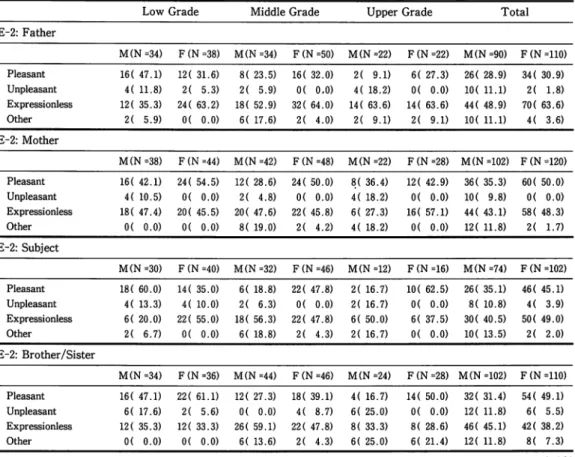
The Family Drawing Test by Children with 'Psychosomatic Disease(TERASHIMA • MIYAJIMA • NINOMIYA • TANAKA) Table 4-5-2 Frequency of analytical items for each family member drawn on the FDT: Facial
expression E-2: Father
Pleasant Unpleasant Expressionless Other E-2: Mother
Pleasant Unpleasant Expressionless Other E-2: Subject
Pleasant Unpleasant Expressionless Other
E-2: Brother/Sister Pleasant
Unpleasant Expressionless Other
Low Grade Middle Grade Upper Grade Total
M(N =34) F (N =38) M(N =34) F (N =50) M(N =22) F (N =22) M(N =90) F (N =110) 16( 47.1)
4( 11.8) 12( 35.3) 2( 5.9)
M(N=38) 16( 42.1) 4( 10.5) 18( 47.4) 0( 0.0)
12( 31.6) 2( 5.3) 24( 63.2) 0( 0.0)
8( 23.5) 2( 5.9) 18( 52.9) 6( 17.6)
F (N =44) M (N =42) 24( 54.5) 12( 28.6) 0( 0.0) 2( 4.8) 20( 45.5) 20( 47.6) 0( 0.0) 8( 19.0)
16( 32.0) 0( 0.0) 32( 64.0) 2( 4.0)
2( 9.1) 4( 18.2) 14( 63.6) 2( 9.1)
F (N =48) M (N =22) 24( 50.0)
0( 0.0) 22( 45.8) 2( 4.2)
~( 36.4) 4( 18.2) 6( 27.3) 4( 18.2)
6( 27.3) 0( 0.0) 14( 63.6) 2( 9.1)
26( 28.9) 10( 11.1) 44( 48.9) 10( 11.1)
34( 30.9) 2( 1.8) 70( 63.6) 4( 3.6)
F (N =28) M(N =102) F (N =120) 12( 42.9)
0( 0.0) 16( 57 .1) 0( 0.0)
36( 35.3) 10( 9.8) 44( 43.1) 12( 11.8)
60( 50.0) 0( 0.0) 58( 48.3) 2( 1. 7)
M(N =30) F (N =40) M(N =32) F (N =46) M(N =12) F (N =16) M(N =74) F (N =102) 18( 60.0)
4( 13.3) 6( 20.0) 2( 6.7)
14( 35.0) 4( 10.0) 22( 55.0) 0( 0.0)
6( 18.8) 2( 6.3) 18( 56.3) 6( 18.8)
22( 47 .8) 0( 0.0) 22( 47 .8) 2( 4.3)
2( 16.7) 2( 16. 7) 6( 50.0) 2( 16.7)
10( 62.5) 0( 0.0) 6( 37.5) 0( 0.0)
26( 35.1) 8( 10.8) 30( 40.5) 10( 13.5)
46( 45.1) 4( 3.9) 50( 49.0) 2( 2.0)
M(N =34) F (N =36) M(N =44) F (N =46) M(N =24) F (N =28) M(N =102) F (N =110) 16( 47.1)
6( 17.6) 12( 35.3) 0( 0.0)
22( 61.1) 12( 27.3) 18( 39,1) 2( 5.6) 0( 0.0) 4( 8. 7) 12( 33.3) 26( 59.1) 22( 47.8) 0( 0.0) 6( 13.6) 2( 4.3)
4( 16. 7) 6( 25.0) 8( 33.3) 6( 25.0)
14( 50.0) 32( 31.4) 0( 0.0) 12( 11.8) 8( 28.6) 46( 45.1) 6( 21.4) 12( 11.8)
54( 49.1) 6( 5.5) 42( 38.2) 8( 7.3) ( )%
Table 4-6-1 Frequency of analytical items for the contents drawn on the FDT: Place
F-1: Place Appearance No appearance
F-1: Place Outside Nature Living room Own room Kitchen Workplace Other
Low Grade Middle Grade Upper Grade Total
M(N =44) F (N =46) M(N =52) F (N =60) M(N =32) F (N =36) M(N =128) F (N =142)
10( 22.7) 34( 77.3) M(N =10)
8( 80.0) 0( 0.0) 0( 0.0) 0( 0.0) 0( 0.0) 0( 0.0) 2( 20.0)
8( 17.4) 24( 46.2) 38( 82.6) 28( 53.8) F (N =8) M (N =24)
2( 25.0) 0( 0.0) 6( 75.0) 0( 0.0) 2( 25.0) 0( 0.0) 0( 0.0)
4( 16.7) 0( 0.0) 8( 33.3) 0( 0.0) 2( 8.3) 4( 16. 7) 12( 50.0)
18( 30.0) 42( 70.0)
12( 37.5) 20( 62.5) F (N =18) M (N =12)
4( 22.2) 2( 11.1) 8( 44.4) 4( 22.2) 2( 11.1) 2( 11.1) 2( 11.1)
4( 33.3) 2( 16. 7) 4( 33.3) 0( 0.0) 2( 16.7) 4( 33.3) 4( 33.3)
-95-
12( 33.3) 48( 37.5) 38( 26.8) 24( 66. 7) 80( 62.5) 104( 73.2) F (N =12) M(N =48) F (N =38)
·o< o.o>
0( 0.0) 6( 50.0) 0( 0.0) 2( 16.7) 4( 33.3) 4( 33.3)
16( 33.3) 2( 4.2) 12( 25.0) 0( 0.0) 4( 8.3) 8( 16.7) 18( 37.5)
6( 15.8) 2( 5.3) 20( 52.6) 4( 10.5) 6( 15.8) 6( 15.8) 6( 15.8) ( )%
~~*$r~~$$~~Jffi3o~m2~
Table 4-6-2 Frequency of analytical items for the contents drawn on the FDT: Interaction between family members
Low Grade Middle Grade Upper Grade Total
M(N=44) F(N =46) M(N =52) F(N =60) M(N =32) F(N =36) M(N =128) F (N =142) F-2: Interaction between family members
Uncooperative 2( 4.5) 6( 13.0) 10( 19.2) 8( 13.3) 6( 18.8) 6( 16. 7) 18( 14.1) 20( 14. lJ Cooperative 2( 4.5) 0( 0.0) 6( 11.5) 2( 3.3) 2( 6.3) 2( 5.6) 10( 7.8) 4( 2.8) Confronting 0( 0.0) 0( 0.0) 0( 0.0) 0( 0.0) 0( 0.0) 2( 5.6) 0( 0.0) 2( 1.4) No interaction 40( 90.9) 38( 82.6) 34( 65.4) 44( 73.3) 20( 62.5) 20( 55.6) 94( 73.4) 102( 71.8) Other 0( 0.0) 2( 4.3) 2( 3.8) 6( 10.0) 4( 12.5) 6( 16.7) 6( 4. 7) 14( 9.9) ( )%
Table 4-6-3 Frequency of analytical items for the contents drawn on the FDT: Theme
Low Grade Middle Grade Upper Grade Total
M(N =44) F(N =46) M(N=52) F(N =60) M(N =32) F (N =36) M(N =128) F (N =142) F-3: Theme
Appearance 22( 50.0) 32( 69.6) 36( 69.2) 42( 70.0) 18( 56.3) 22( 61.1) 76( 59.4) 96( 67 .6) No appearance 22( 50.0) 14( 30.4) 16( 30.8) 18( 30.0) 14( 43.8) 14( 38.9) 52( 40.6) 46( 32.4) M(N =22) F (N =38) M(N =52) F (N =52) M(N =28) F (N =30) M(N =102) F (N =120) F-3: Theme
Working 0( 0.0) 0( 0.0) 4( 7 .7) 2( 3.8) 4( 14.3) 4( 13.3) 8( 7.8) 6( 5.0) Studying 0( 0.0) 0( 0.0) 4( 7. 7) 4( 7 .7) 2( 7 .1) 2( 6.7) 6( 5.9) 6( 5.0) Recreation 2( 9.1) 4( 10.5) 8( 15.4) 6( 11.5) 6( 21.4) 2( 6.7) 16( 15. 7) 12( 10.0) Taking a rest 0( 0.0) 0( 0.0) 2( 3.8) 2( 3.8) 2( 7.1) 4( 13.3) 4( 3.9) 6( 5.0) Having a Meal 0( 0.0) 2( 5.3) 4( 7. 7) 2( 3.8) 0( 0.0) 0( 0.0) 4( 3.9) 4( 3.3) Housekeeping 0( 0.0) 2( 5.3) 4( 7. 7) 4( 7. 7) 2( 7 .lJ 2( 6. 7) 6( 5.9) 8( 6.7) Sleeping 0( 0.0) 2( 5.3) 4( 7. 7) 0( 0.0) 2( 7 .1) 2( 6.7) 6( 5.9) 4( 3.3) Standing 20( 90.9) 28( 73.7) 14( 26.9) 30( 57.7) 8( 28.6) 10( 33.3) 42( 41.2) 68( 56.7) Other 0( 0.0) 0( 0.0) 8( 15.4) 2( 3.8) 2( 7.1) 4( 13.3) 10( 9.8) 6( 5.0) ( )%
Reference
Akitani, T.(1982) The family assessment test. The family psychiatry. 4:77-88
Fukada, N.(1958) The method of the drawing test in clinical setting. The Japanese Journal of Psychology.
29:117-123.
Fukada, N.(1958) Family drawings in school children. The Japanese Journal of Psychology. 29:264-267.
Hibi, Y.(1974) The investigation of the Kinetic Family Drawing Test( I). Memoirs of Shiga Woman's Junior College. II :79-113.
Hibi, Y.(1977) The investigation of the Kinetic Family Drawing Test(II). Memoirs of Shiga Woman's Junior College. III:71-110.
Hibi, Y.(1980) The investigation of the Kinetic Family Drawing Test(III). Memoirs of Shiga Women's Junior College. V:31-42.
Ishikawa, G (1984) Family Dynamics and Art Therapy. Clinical Psychiatry. 26(5):452-463.
Levenberg, S. (1975) Professional training, psychodiagnostic skill, and Kinetic Family Drawings. Journal of Personality Assessment. 39 (4):389-393.
The Family Drawing Test by Children with Psychosomatic Disease(TERASHIMA • MIYAJIMA • NINOMIYA • TANAKA) Kato, T. & Shimizu, T.(1977) Relationship between the Kinetic Family Drawings and attitude for family
members. The Japanese Journal of Art Therapy. 8:33-38.
Kato, T. & Shimizu, T.(1978) Movement in the Kinetic Family Drawings and attitude for family members.
The Japanese Journal of Art Therapy. 9:25-32.
Myers, D.(1978) Toward an objective evaluation procedure of the Kinetic Family Drawings (KFD).
Journal of Personality Assessment. 42(4):358-365.
O'Brien, R. & Patton, W.(1974) Development of an objective scoring method for the Kinetic Family Drawing. Journal of Personality Assessment. 38(2):156-164.
Raskin, L. & Pitcher-Baker, G.(1977) Kinetic Family Drawings by children with perceptual-motor delays.
Journal of Learning Disabilities. 10(6):370-374.
Sims, C.(1974) Kinetic Family Drawings and the family relations indicator. Journal of Clinical Psychology.
30(1):87-88.
Takahashi, M.(1987) The basic assessment of family drawings. Studies in Clinical Application of Drawings. II:6-17.
Terashima, S.(1996) The characteristics of children's Family Drawings. Bulletin of the Faculty of Sociology Kansai University. 28(1):81-109.
-1998. 10. 30:!/l:ffi-
- 9 7 -