Modern Biology in Tropical Medicine
Akira IGARASHI
Department of Virology, Institute of Tropical Medicine, Nagasaki University, Japan
INTRODUCTION
It is no need to mention that remarkable advance in modern biology, particularly in molecular biology in this century, has brought about revolutionary changes in various aspects of biomedical science. Analysis of the gene structure, function and expression has led to the central dogma that fundamental principle is universal to all forms of lives, from bacteria up to human beings. Based on this principle, we are now able to understand complex biological phenomena at a molecular level, and researchers in different specialized fields are able to talk in commonlanguage.
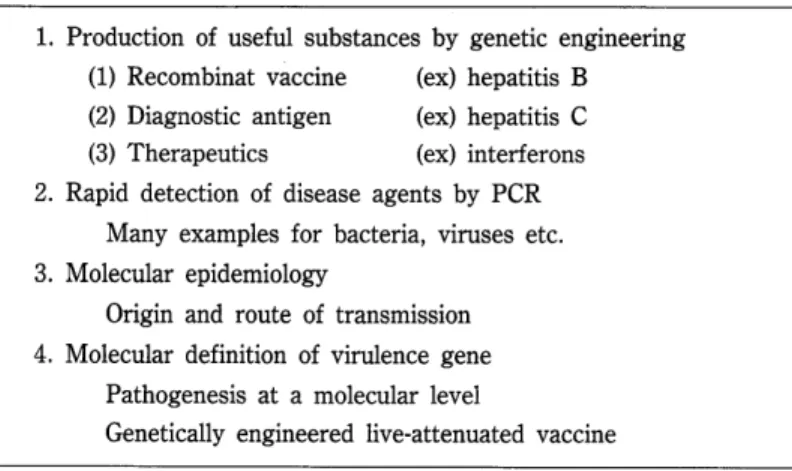
Fruitful results in basic molecular biology were then successfully applied in various practical aspects, as shown in Table 1. Biologically valuable substances were produced by recombinant DNA technologies. For example, second generation hepatitis B vaccine and diagnositc antigens for hepatitis C virus were produced even though these viruses were never cultivated by classical methods. Also recombinant human interferons are currently available for therapeutic purposes. Recently, many disease agents including various viruses are rapidly and precisely detected by polymerase chain reaction. Some of the examples were presented by our group at the Annual Meeting of Japanese Society of Tropical Medicine. Molecular epidemiology is able to tell the origin and route of transmission of disease agents to the pa- tients. Analysis of virulence gene will elucidate the pathogenesis of the disease at a
Table 1. Application of Modern Biology
1
. Production of useful substances by genetic engineering (1) Recombinat vaccine (ex) hepatitis B (2) Diagnostic antigen (ex) hepatitis C (3) Therapeutics (ex) interferons 2. Rapid detection of disease agents by PCR
Many examples for bacteria, viruses etc.
3. Molecular epidemiology
Origin and route of transmission 4. Molecular definition of virulence gene
Pathogenesis at a molecular level
Genetically engineered live-attenuated vaccine
molecular level, and lead to the development of genetically engineered attenuated vaccines in the future.
Problems encountered to use modern biology in tropical medicine
Why should Tropical Medicine be an exception for such a trend of modern biology? It would be easy to understand the usefulness of modern biology particularly molecular biological approach in laboratory studies、 For example, uncleotide sequence analysis of the genome will provide accurate information on the genomic structure of the disease agents, which were never dreamed several years age. Nowadays, such analytical studies can be per‑
formed in any well・equipped laboratories in developed countries, once study materials were
provided、 However, in the case of Tropical Medicine, we have to understand that the subject and materials of our study exist in Tropical Countries, not in our Developed Countries・ Scien、
tists in Topical Countries in general are reluctant for the investigators of developed countries to exploit their materials for scientific research, without any compensation・ More and more, the scientists in Tropical Countries would rater like to perform studies by themselves and are trying to establish such institutions or laboratories. Most of the Tropical Count∬ies belong to so・called developing countries in contrast to our Developed Countries, however, they are real‑
1y developing. I have just come back from my WHO mission to Vietnam from 2 to 19 November 1992・ But during this short stay, I recognized a remarkable change which took place in Vietnam since my previous visit in July 1991. For example, Vietnam with per capita income of only US$ 250, has, already established Department of Molecular Biology at the Na・
tional Center for Scientific Research, and Pasteur Institute in Ho Chi Mmh City is going to set up Laboratory of Molecular Biology next year.
If we neglect such a significant and rapid advance m developing countries and remain at the present level sticking to classical ways of thinking, we may be left behind of these developing countries sometime in the future・ In such a situation, we cannot even discuss with young scientists in presently developing countries in terms of modern biology"
Collaborative studies in tropical medicine
At present, our Developed Countries possess advanced scientific knowledge and technologies, which can successfully be exchanged with plenty of study subjects and
materials in Tropical Countries. When both are successfully combined in cooperative studies, fruitful results will be expected, which would eventually be utilized for practical control of the disease or promotion of health situation in Tropical Countries・
How to combine advanced knowledge and techniques in developed countries with study subjects and materials in developing countries is the next problem. We may be able to invite scientists from Tropical Countries to our welトestablished laboratories in Developed Coun‑
tries for technical transfer of modern biology. This has been performed under several
technical cooperation projects sponsored by Japan International Cooperation Agency (JICA)
in Japan. The technical transfer itself is all right, together with scientific knowledge and
background. However, real problem will occur after the trained personnels come back to
their own countries, where the subject and materials are present but basic condition of the studies are not yet established. Therefore, good follow‑up is essential for the trained person‑
nels・
Even the scientists in Developed Countries, application of modern biology in Tropical Countries is not so easy task. Insufficient infrastructures and available human resources and funds make it difficult to introduce existing fine technologies or equipments of modern biology as they are in our developed countries to the Tropical Countries. For example, sim・
pie fluctuation of line voltage may sometimes cause irregular outcome of the tests and could cause irreversible damage to fine equipments for high technologies.
Therefore, the study program to utilize modern biological techniques in Tropical Medicine in Tropical Areas should carefully be assessed depending on the existing situation in respective areas, together with evaluation on their cost‑effectiveness. Appropriate modifica‑
tion of existing techniques and equipments should also be worked out m order to fit in un‑
favorable conditions in Tropical Countries. It would also be necessary to clarify the target of the study, what we should achieve, as well as the final goal and objectives of the study・ W・e should not be satisfied by playing around scientific data which can be obtained using high technologies・
From this year, I have involved in a JICA's Medical Cooperation Project entitled as the Research on Selected Tropical Diseases in Malaysia. In this project, final goal is the control of tropical diseases, particularly malaria, dengue and Japanese encephalitis. Objective is the application of molecular biology and biotechnology to strengthen diagnostic capability on (1) malaria, and (2) dengue and Japanese encephalitis. These subjects will be coordinated by the lnstitute of Medical Research, Tokyo University, for malaria, and by our Institute of Tropical Medicine, Nagasaki University, for dengue and Japanese encephalitis, respectively.
In this Project, we are expecting scientific outputs along with technical transfer in modern biology as shown m Table 2.
Somebody may argue that modern biology, particularly molecular biology and biotechnology are just extravagant for Tropical Countries since most of them cannot afford for their expenditure・ In my limited experience, however, introduction of advanced scientific knowledge and technologies will eventually bring about fruitful results even in developing countries・ I have been invited to the Overseas Research Project in Karachi, Pakistan. This Project was organized by Professor Toshiaki Takasu of Nihon University Medical School and supported by the Grant in Aid from the Ministry of Education Science and Culture of Japanese Government. My responsibility is to clarify the causative agents of acute
encephalitis. For several years, the study could not provide definite answer by classicalserology because of the cross「reaction between Japanese encephalitis and 「West Nile virus・
Also virus isolation from cerebrospinal fluid (CSF) specimens gave just terrible results
because of bacterial and fungal contamination in the specimens、 In this year, I examined
cerebrospmal fluid specimens collected from 24 acute encephalitis cases. The PCR which was
performed by Ms. Tanaka in our department could detect West Nile viral genome in 8
specimens and Japanese encephalitis viral genome in another specimen as shown in Fig・ 1・Table 2. JICA's medical cooperation project: research on selected tropical diseases in Malaysia
1
. Goal: Control of tropical diseases in Malaysia, particularly malaria, dengue and Japanese encephalitis
2. Objective: Application of molecular biology & biotechnology to strengthen diagnostic capability on:
(1) Malaria: Institute of Medical Research, Tokyo University (2) Dengue & Japanese encephalitis:
Institute of Tropical Medicine, Nagasaki University 3. Expected output:
1) Malaria
(1) Development & application of DNA probe for diagnosis (2) Identification & characterization of protective antigen (3) Analysis of mitochondrial gene
(4) Molecular analysis of vectorial capacity of mosquitoes 2) Dengue & Japanese encephalitis
(1) Strengthening of diagnostic capability by using molecular biology & biotechnology
(2) Molecular epidemiology of dengue & Japanese encephalitis (3) Analysis of pathogenesis of dengue hemorrhagic fever (DHF)
at a molecular level
9 8 7 6 5 4 3 2 1
267bp
Figure 1. Detection of West Nile and Japanese encephalitis viral genome by reverse transcriptase-polymerase chain reaction (RT-PCR) in cerebrospinal fluid specimens from acute encephalitis cases, Karachi, Pakistan, 1992
Cerebrospinal fluid specimens were collected from 24 acute encephalitis cases in Karachi, Pakistan, 1992. These sepcimens were screened by RT- PCR using flavivirus cross-reacting primer pairs, and positive specimens were reexamined by using West Nile (WN) and Japanese encephalitis (JE) virus-specific primer pairs. WN viral genome was detected in 8 specimens:
lanes 1 to 8, while JE viral genome wasdetected in a single specimen: lane 9.
Extreme right lane shows DNA molecular weight marker.
This is the first positive result for the presence of Japanese encephalitis viral genome in Karachi, Pakistan, and positive indication that West Nile virus could be a causative agent of acute encephalitis・ Moreover, our effort during the past several years in Karachi eventually gave a strong impact to local administrative personnels. This year, our counterpart, Professor Akhtar Ahmed was successful to receive a financial support from the local Government of Sind State totaling US $ 2 million; the amount which can never be imagined in the develop‑
mg countries.
Particular attention should be paid for the cost‑effectiveness when we plan to apply modern biology to Tropical Medicine. For example, it is easy to mention that second genera‑
tion Japanese encephalitis vaccine should be developed for mass‑vaccination in currently epidemic areas, most of which are developing Asian countries・ However, when we think about its implementation, the second generation vaccine should not only be inexpensive and available in large quantities, but also it should be as safe and effective as the current vaccine.
Until these requirements are satisfield, I shall be involved in the Project to produce current Japanese encephalitis vaccine of international standard in Vientnam. This objective was recommended in my mission report of WHO short・term consultant in 1986, and gradually came out into reality to produce 50,000 doses in 1993. I would like to express my sincere ap‑