The Effects of a Year-Long English for Academic Purposes Program: The SCAS Program in 2018-19
Jesse CONWAY
Center for Language Studies, Nagasaki University
Abstract
The purpose of this report is to disseminate results of the Special Course in Academic Skills (SCAS) Program, an optional English for Academic Purposes preparation course for Nagasaki University undergraduate students. In the 2018-19 academic year, TOEFL ITP tests were administered prior to, during, and after completion of the SCAS Program to measure receptive language abilities (i.e., reading, listening, structure and written expression of English). Additionally, students completed pre and posttests to measure productive language abilities (i.e., writing, speaking) prior to instruction and following completion of the program. Results from these assessments were examined using paired sample t-tests, which revealed statistically significant improvements in student abilities following completion of the SCAS Program. Effect sizes observed through calculation of Cohen’s d displayed a range of results from small to large, indicating that while SCAS Program instruction was responsible for change in students’ language skills, that change was not seen to be consistent throughout all language skill areas.
Keywords: EAP, TESOL, TOEFL ITP, EFL
Introduction
This report introduces the SCAS Program, an optional year-long intensive English
for Academic Purposes (EAP) instructional program offered to students of Nagasaki
University (NU). The program’s curriculum design is elaborated on to familiarize the
reader with each course including relevant activities and methods of language learning
assessment. Following this introduction of the program, methods of assessing student and program success for the 2018-2019 academic year (AY) are introduced, with relevant results presented. The report concludes with discussion of the 2018-19 AY results and their implications on future iterations of the SCAS Program.
It should be noted that this analysis uses a one group pretest-posttest design, meaning that all instruction given in the SCAS Program is evaluated solely by its effects on SCAS Program students. A control group was unavailable due to the unique structure of the SCAS Program compared to standard General Education English language courses offered to NU students.
Background
The first section of this report answers the question – What is the SCAS Program? – and briefly details the development of the program before it describes the curricula that were implemented in the 2018-19 AY.
What is SCAS?
The SCAS Program began in September 2015 as a component of the Global+ (i.e., Global Plus) course which is offered to NU students through the department currently known as the Center for Japanese Language and Student Exchange. The program’s curriculum was designed to address the stated goals of the Global+ course:
(1) Raise student TOEFL ITP scores
(2) Increase students’ academic English skills
(3) Increase instances of study abroad participation among students of the program SCAS Curricula and Materials
The SCAS Program is a year-long continuous program, beginning in the fall semester (i.e., September 2018, for the data examined in this report) and concluding the following summer (i.e., August 2019). Due to this ability to work with the same students for an entire year, the SCAS Program makes use of a linear approach to sequencing its curricula to achieve their academic goals and objectives. While a linear approach may indicate a straight line in which students travel along the curriculum, it should be noted that the journey is similar to a spiral or matrix-styled approach in which students have the opportunity to repeatedly encounter and solidify aspects of language introduced throughout the course of one year (Nation & Macalister, 2010). It is not only the length of the program that allows this approach, but also the frequency of instruction given to SCAS students.
The SCAS Program consists of five classes per week for students with each class
occupying one 90-minute period. These classes are delivered for a total of 13 weeks during each semester, amounting to 97.5 hours of English-mediated instruction (EMI) classroom time per semester. The curriculum consists of two integrated skills classes which students take each semester: Reading & Writing (twice a week) and Listening
& Speaking (twice a week). In the Fall semester, students take a TOEFL ITP preparation course (once a week) and in the Spring semester, take Bridge course (once a week), a course designed to help students prepare for and participate in academic experiences should they decide to study abroad following the program.
Additionally, students are offered an Introduction to TOEFL ITP course prior to beginning their year as a SCAS student which is offered in September and consists of nine hours of classroom instruction. Students are also required to attend an intensive TOEFL ITP preparation course in March which consists of 15 hours of classroom instruction. Finally, students are required to attend an English Camp, an intensive semi-immersive language experience which takes place prior to SCAS classes. The camp equates to approximately 17 hours of EMI from SCAS instructors and English language use with other SCAS students. For a SCAS student who chooses to attend the optional Introduction to TOEFL ITP course, approximately 236 hours of EAP language instruction is received throughout the course of one year, all delivered using EMI.
These varied environments, paired with an ample amount of instruction, allow SCAS students to encounter language in a multitude of contexts. The goal of this approach is to both revisit and revise previously learned information, as well as to understand the contextuality of language. Furthermore, in line with current language curriculum design theory, the program’s curriculum is continually evaluated, revised, and re-evaluated to adapt to changing student populations, instructor specialties, and other environmental factors (Nation & Macalister, 2010). This allows instructors to recalibrate curricula between semesters to adjust to various factors that may have been identified as either beneficial or detrimental to students’ learning in previous classes.
SCAS instructors realize that it is rare to have such control over their curricula and strive to take advantage of these opportunities as best they can to craft a rewarding course of study for SCAS students.
The next section will briefly describe the four main SCAS classes delivered in the 2018-19 AY, their student learning outcomes, assessment breakdowns, and materials:
Listening & Speaking
The SCAS Program’s Listening & Speaking course aimed to improve students’
abilities in academic listening (e.g., classroom lectures, informational listening texts, discussions with classmates, requests to/from instructors and administrative staff, decoding of segmental and suprasegmental features of speech) and speaking (e.g., presentations, discussions with classmates, requests to/from instructors and administrative staff, fluency building) contexts. This class met twice a week, generally in two consecutive days, for a total of 26 classes per semester.
The course utilized Lecture Ready 2 (Sarosy & Sherak, 2013) as its main textbook.
This coursebook supplied semi-authentic videotaped academic lectures on a variety of topics which are used for in-class practice. Additionally, Lecture Ready 2 was used to introduce academic lecture language, group discussion techniques, and unit content- based vocabulary. To supplement this textbook, instructors developed a variety of materials throughout the year to address its lacks in the areas of vocabulary, pronunciation (both segmental and suprasegmental), authentic content, presentation skills, and presentation topics.
Assessment of student learning in the course consisted of four categories:
(1) Quizzes – tests of listening comprehension of short academic lectures, vocabulary knowledge, and pair speaking tasks (introduced in the second semester).
(2) Speaking assignments/video blogs – short speaking assignments performed by students. Speaking assignments are similar to TOEFL speaking test prompts (e.g., read a prompt and respond in 45 seconds). Video blogs are free-response tasks requiring one minute of speaking. Students are responsible for 10 submissions of each assignment, with speaking assignments in the first semester and video blogs in the second semester.
(3) Presentations – short (5-10 minute) academic presentations to accompany projects (e.g., administer a survey and report on its results) that are performed individually or in pairs/small groups. Students are responsible for three presentations per semester.
(4) Participation – attendance in class and participation in in-class activities.
Reading & Writing
The Reading & Writing course’s aims were to improve academic reading (e.g.,
identifying information in texts, recognizing patterns, using reading strategies,
building vocabulary) and academic writing (e.g., building cohesive texts, using
academic tone, writing documents commonly associated with higher education)
abilities. In addition to these aims, it also endeavored to develop 21st century learning
skills (e.g., word processing, collaboration with peers, knowledge of proper citation
methods). This class met twice a week, generally in two consecutive days, for a total of 26 classes per semester.
The course utilized two textbooks: Academic Writing Skills Student’s Book 1 (Chin, Koizumi, Reid, Wray, & Yamazaki, 2012) and More Reading Power 3 (Jeffries &
Mikulecky, 2011) for writing and reading skills, respectively. Academic Writing Skills was relied on for teaching the basics of academic writing such as structure, tone, coherence, and citation procedures. It was supplemented by writing assignments developed by SCAS instructors. More Reading Power provided vocabulary, reading strategy instruction, and reading fluency practice. It was supplemented with additional readings from authentic sources which were adapted by SCAS instructors to fit the needs of the course. Instruction on 21st century learning skills was developed by SCAS instructors and consisted of lessons utilizing Google Docs for collaborative writing and using common Microsoft Word formatting functions to prepare documents for submission.
Assessment of student learning in the course consisted of four categories:
(1) Writing assignments – in-class assignments designed to replicate authentic academic tasks (e.g., writing emails, summaries, argumentative essays) in a timed environment. Students were responsible for three writing assignments over the course of a semester.
(2) Quizzes – tests of reading comprehension, writing skills, vocabulary, grammar, and reading/writing strategy use.
(3) Writing fluency practice – regular 10-minute writing fluency journal entries which were collected regularly and presented on at the end of the semester.
(4) Participation – attendance in class and participation in in-class activities such as reading fluency practice and collaborative writing.
TOEFL
The SCAS TOEFL course was designed to introduce students to the format of the TOEFL ITP test, its component sections, academic vocabulary, and strategy use for TOEFL ITP and academic standardized testing in general. This class met once a week in the fall semester, for a total of 13 classes.
The course utilized The Complete Guide to the TOEFL Test PBT Edition (Rogers,
2010) as its main textbook. The textbook is an exhaustive resource and provided a
variety of strategies, sample listening texts, reading texts, and structure and written
expression items for students to practice with in the class. Instructors rarely
supplemented the textbook’s materials for instruction but did create materials to
streamline their approach to teaching the contents of the book in a manner they found conducive to student success, such as active, communicative use of language normally encountered only in a receptive mode.
Assessment of learning in the TOEFL course consisted of four categories:
(1) TOEFL Test Improvement – students completed two practice TOEFL ITP tests during the course (one delivered mid-term, the other as a final test).
Improvements made in test scores were assessed and converted to a standardized score.
(2) Vocabulary quizzes – students were given a list of 20 vocabulary words in each class session. The first three quizzes focused on sets of 60 words each, while the final quiz was a cumulative quiz featuring a selection of vocabulary encountered over the semester.
(3) Homework – students completed weekly homework to practice different grammatical features tested in the Structure and Written Expression section of the test.
(4) Participation – students were expected to attend all classes, be engaged in pair/group work, and occasionally complete classwork.
Bridge Course
The SCAS Bridge course was originally designed in the 2017-18 AY as an adjunct instruction-styled course (Brinton, Snow, & Wesche, 1989) which provided SCAS students assistance in completing the Global Module courses (EMI content courses required for students in the Global+ course) that they were taking concurrently with the Bridge course. However, due to student reports that this approach was of minimal assistance to their work in the Global Module courses following the 2017-18 AY course evaluation, the approach of the Bridge course in 2018-19 AY was altered. The course was designed around the tasks required of students in study abroad contexts, such as group discussions, critical thinking exercises, digital literacy, and note-taking of academic lectures. This class met once a week during the spring semester, for a total of 13 classes.
Student success in the Bridge course was measured by:
(1) Round Tables – mini-presentations delivered to a small group, followed by discussion questions prepared by presenters and simulation of an academic group discussion. Students were assessed on their presentation creation, delivery, and discussion participation.
(2) Vocabulary Power! – weekly academic vocabulary-building practice which
focused on both receptive and productive use of 20 new words per week.
Vocabulary acquisition was measured with weekly tests.
(3) Critical Thinking Portfolio – a critical analysis of a written text and a visual text.
This was a multi-step project designed to encourage learner autonomy.
(4) Participation – attendance and participation in group activities throughout the semester.
This course did not utilize a textbook and most materials were developed by SCAS instructors for the course. Vocabulary Power! materials were adapted from 4000 Essential English Words 4 Second Edition (Nation, 2018) to take advantage of its sequencing of words from the Academic Word List (Coxhead, 2000).
These courses formed the main structure of the 2018-19 AY SCAS Program with the express purpose of increasing students’ academic English language skills. The next section details how the program measured change in students’ skills and points to whether these courses and their associated curricula were successful in achieving the academic goals of the SCAS Program.
Method Purpose of the Study
Since the SCAS Program’s inception, it has been required to measure student success and consequently, program success, through the use of the TOEFL ITP test.
This test assesses receptive language ability in academic listening, structure and written expression (i.e., grammatical knowledge), and reading. Speaking and writing abilities are not directly measured by the test.
Therefore, to monitor and measure student speaking and writing ability, SCAS instructors were responsible for creating speaking and writing assessments to measure student success in these areas. When combined with results from the TOEFL ITP test administrations, the outcome of the 2018-19 AY SCAS Program’s approach to language instruction can be observed from three separate standpoints which represent an objectively complete view of SCAS students’ language proficiency gains.
To wit, the purpose of this report is to answer two following questions:
(1) How did SCAS Program instruction affect students’ receptive language skills (i.e., TOEFL ITP scores)?
(2) How did SCAS Program instruction affect students’ productive language skills?
The following sections provide more information about SCAS students who were
enrolled in the program in the 2018-19 AY and the instruments used to measure their
language gains.
Participants
SCAS students whose TOEFL ITP scores were analyzed for this report (N = 37) represented eight different faculties at NU and came to the program with a varying range of language proficiencies. All began the program in the second semester of their first year at NU and finished at the end of their first semester of their second year as a student. Most students speak Japanese as a first language, have received approximately six years of secondary-level English as a Foreign Language (EFL) education prior to joining SCAS, and are products of the Japanese public or private school system. A further breakdown of demographics can be seen in Table 1 below.
Table 1 2018-19 AY SCAS Student Demographics (TOEFL ITP analysis)
Faculty Number of students Gender breakdown
School of Global Humanities and Social Sciences 4 Female: n = 1 Male: n = 3
Dentistry 1 Female: n = 1
Economics 7 Female: n = 4
Male: n = 3
Education 7 Female: n = 5
Male: n = 2
Engineering 6 Female: n = 1
Male: n = 5
Environmental Science 5 Female: n = 4
Male: n = 1
Medicine 3 Female: n = 3
Pharmacy 4 Female: n = 3
Male: n = 1
Total 37 Female: n = 22
Male: n = 15
Instruments
The TOEFL ITP test is a standardized language test published by the Educational Testing Service (ETS). According to ETS materials, the TOEFL ITP test, “measures the English proficiency of test takers whose native language is not English. TOEFL ITP test questions primarily assess understanding of academic language” (ETS, p. 3).
The test features three sections:
(1) Listening – a section measuring the ability to understand spoken English in academic settings.
(2) Structure and Written Expression – a section testing recognition of correct and incorrect sentence structure in standard written English.
(3) Reading – a section measuring the ability to understand academic reading passages in English.
The test is delivered in a classroom setting by a proctor and lasts for approximately two hours. ETS provides an internally generated reliability measurement of 0.96 for the test (Test and Score Data Summary for the TOEFL ITP Test, 2019).
The speaking and writing measurement instruments created by SCAS instructors were modeled after TOEFL iBT speaking and writing components in order to closely adhere to the scoring standards and content delivery that students encountered when taking the TOEFL ITP test. The speaking component developed by SCAS instructors mirrored the independent speaking task of the TOEFL iBT test; it provided test takers with a prompt (e.g., Would you prefer to live in a small town or a big city? Why?) to respond to. Test takers were given 15 seconds to prepare their response and 45 seconds to respond. Responses were recorded with personal audio recording devices for raters to assess independent of the task. The task is designed to measure the test takers’ ability to make and defend a choice concerning items in the prompt (Pusey, 2018).
Following the completion of the task, performance was rated using the TOEFL iBT Speaking Rubric for general description, delivery, language use, and topic development. The rubric measures these criteria on a scale of 0 (the speaker makes no attempt to respond to the prompt) to 4 (an excellent response). Responses were rated by two raters whose ratings were then averaged to create a final score for the student.
Inter-rater reliability was good with a measure of 86 percent agreement.
The writing measurement instrument was similar to the independent writing task on
the TOEFL iBT test; it provided test takers with a short prompt, similar to one given
in the aforementioned speaking task. Test takers were then given 30 minutes to
prepare and handwrite a response to the prompt. Following the task, writing was
evaluated using the TOEFL iBT Independent Writing Rubric for development,
organization, and appropriate and precise use of grammar and vocabulary. The rubric
measures these criteria in a holistic manner on a scale of 0 (a response that copies
words from the prompt) to 4 (an excellent response). Responses were rated by two
raters whose ratings were then averaged to create a final score for the student. Inter-
rater reliability was extremely high at 97 percent agreement for this task.
Examples of both the speaking and writing independent task rubrics can be obtained from the ETS website (https://www.ets.org) for further descriptions of task performance ratings.
Procedure
For the 2018-19 AY, the TOEFL ITP test was first administered in September 2018, on the final day of the optional Introduction to TOEFL ITP course offered by SCAS instructors. This first administration occurred prior to instruction in order to set a point of reference for the effects of the SCAS Program’s instruction on student learning throughout the AY. After taking the first TOEFL test, students first attended English Camp, then began a full semester of classes in the SCAS program and an additional Spring Intensive TOEFL Preparation course before the second administration of the TOEFL ITP test. A second TOEFL ITP test was administered for language proficiency monitoring purposes. Following the second administration of the TOEFL ITP, a second semester of instruction was conducted with a third TOEFL ITP test administered in September of 2019, approximately two months after students attended their last SCAS English language course. Scoring was administered by ETS and score reports were returned to the program approximately one month following a test administration.
Speaking and writing tests were given at the beginning of the Fall 2018 semester during the first week of class (i.e., prior to instruction), and again in the final class of the Spring 2019 semester. The same tests were used during each test administration (pre and post) in order to account for possible differences in task difficulty and thereby avoid threats to the validity of the statistical tests we planned to run. Although the same speaking and writing tests were used for the pre and posttests, the instructors believe that students had no recollection of the task, nor what they had previously written. Student writing was done by hand on paper, and speaking responses were digitally recorded and sent to SCAS instructors electronically as was done in Pusey (2018).
Student identification was anonymized to reduce any potential bias or knowledge of
the test-taker on the rater’s part when rating the pre and posttests. Furthermore, test
materials were randomized so that a rater was unaware as to whether a performance
was from the beginning of SCAS or from the end. Before scoring began, SCAS
instructors conducted a norming session to familiarize themselves with the TOEFL
iBT rubrics and reach a consensus on what was required to achieve certain scores.
Following norming, student responses were rated by two different instructors and the two scores were averaged to provide a final score for each response.
To compare differences in test scores between the first and final TOEFL ITP test administrations, a paired sample t-test was used. A threshold for probability (p) was set at .05 for these tests. In addition to initial statistical analyses to determine the possibility of significant effects from instruction in the SCAS Program, it was important to determine the strength of association between variables in the data.
Cohen’s d is a common method of measuring effect size when comparing means and indicates how much of the variance in student scores was due to SCAS instruction.
For within-groups analysis such as that performed for this report, the current proposed benchmarks for Cohen’s d are .60 to indicate a small effect, 1.00 to indicate a medium effect, and 1.40 to indicate a large effect (Plonsky & Oswald, 2014).
Results TOEFL ITP Measurements
Table 2 shows the result of the paired sample t-test administered to determine the overall change in student scores with the effect size of instruction represented as Cohen’s d.
Table 2 Overall TOEFL Group Mean Comparison (N = 37)
Test Administration Mean SD t d
September 2018 Test 465.19 37.53
-2.50* 0.37 September 2019 Test 478.62 34.52
Note. *Scores were determined to be statistically significant (df=36, p ≤ .001)
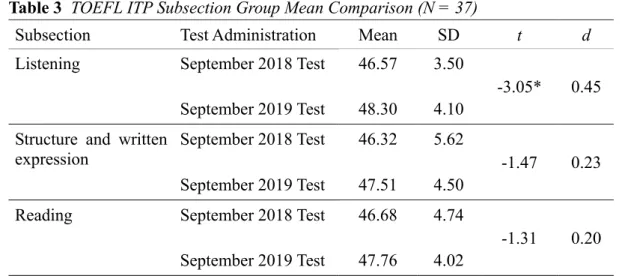
In addition to analyzing overall mean scores, it was prudent to measure changes in
students’ listening, structure and written expression, and reading knowledge levels
between test administrations. As can be seen in Table 3, students’ listening scores
improved significantly with a small effect size (t = 3.05, p < .001, d = .45). However,
their structure and written expression and reading scores, while showing overall
improvement in mean values and a narrowing of standard deviations, failed to show
statistically significant change in those values (t = 1.47 and t = 1.31, respectively).
Table 3 TOEFL ITP Subsection Group Mean Comparison (N = 37)
Subsection Test Administration Mean SD t d
Listening September 2018 Test 46.57 3.50
-3.05* 0.45 September 2019 Test 48.30 4.10
Structure and written
expression September 2018 Test 46.32 5.62
-1.47 0.23 September 2019 Test 47.51 4.50
Reading September 2018 Test 46.68 4.74
-1.31 0.20 September 2019 Test 47.76 4.02
Note. *Scores were statistically significant (df=36, p ≤ .001)
Speaking and Writing Measurements
Similar to the TOEFL ITP test score analysis, a paired sample t-test was used to analyze the change in student performance on the pre and posttests administered to measure speaking and writing ability. Table 4 shows the results of these tests in addition to effect size as measured by Cohen’s d. Students’ speaking scores improved significantly with a large effect (t = -7.88, p < .001, d = 1.38) as did their writing scores, with a medium effect (t = -3.77, p < .001, d = 0.68).
Table 4 Speaking and Writing Pre and Posttest Group Mean Comparison (N = 37) Pretest mean SD Posttest mean SD t d Speaking
Test 2.40 0.75 3.33 0.56 -7.88* 1.38
Writing
Test 2.82 0.71 3.34 0.80 -3.77* 0.68
Note: *Scores were determined to be statistically significant (df=36, p ≤ .001)