endovascular therapy in patients with peripheral artery disease due to femoropopliteal lesions
Kei Sato, MD,
a,bOsamu Iida, MD,
cMitsuyoshi Takahara, MD, PhD,
dYoshimitsu Soga, MD,
eKenji Suzuki, MD,
fTakashi Tanigawa, MD, PhD,
gMasaaki Ito, MD, PhD,
band
Masaaki Uematsu, MD, PhD,
cFuchu, Tsu, Amagasaki, Suita, Kitakyushu, Sendai, and Matsusaka, Japan
Objective: Despite wide use, high initial success, and acceptable durability of endovascular therapy (EVT) for femo- ropopliteal (FP) lesions, the frequency of 30-day perioperative complications (POCs) and their effect on clinical outcomes have not been systematically evaluated, which is the subject of this study.
Methods:We used a multicenter database of 2145 consecutive patients (70% male; overall mean age, 7369 years) who successfully underwent EVT for FP lesions to investigate independent predictors of POCs (logistic regression analysis) and effect of POCs on prognostic outcomes (Cox proportional regression).
Results: POCs were observed in 209 patients (10%). In multivariate logistic regression analysis, body mass index<18.5 kg/m2, critical limb ischemia, and TransAtlanic Inter-Society Consensus for the Management of Peripheral Arterial Disease class D lesions were independently associated with POCs (adjusted odds ratios [95% confidence in- tervals], 2.0 [1.3-2.9], 2.5 [1.9-3.3], and 1.6 [1.2-2.1], respectively). After risk stratification of POCs according to the number of these risk factors, the incidence of POCs was higher in the groups with higher scores. Follow-up for>30 days (mean, 2.361.8 years) was available for 2079 of 2145 patients. A Cox hazard regression model adjusted for baseline clinical characteristics showed POCs were negatively and independently associated with future occurrence of major adverse limb events (defined as major amputation and major reintervention) or death (hazard ratio [95% confidence interval], 1.6 [1.2-2.1];P<.05).
Conclusions:Body mass index<18.5 kg/m2, critical limb ischemia, and TransAtlantic Inter-Society Consensus for the Management of Peripheral Arterial Disease class D lesion were positively associated with POCs after EVT for FP lesions.
The occurrence of POCs may adversely affect clinical outcomes in the chronic phase. (J Vasc Surg 2015;61:1272-7.)
Femoropopliteal (FP) lesions are found in 60% to 70%
of patients with symptomatic peripheral artery disease.
1-3Endovascular therapy (EVT) has proven efficacious and safe in treatment of TransAtlantic Inter-Society Consensus (TASC) II A-B localized atherosclerotic FP lesions, for which it is considered first-line therapy because of its less invasive nature and high initial technical success.
4Bypass surgery is standard treatment for TASC II C-D extensive FP lesions because of its durable patency rate at 5 years of 39% to 52% and 74% to 76% with prosthetic and autog- enous vein conduit, respectively.
4Although long-term outcomes after EVT for TASC II C-D lesions had been far from satisfactory, recent de- vice improvement has led to better midterm outcomes and widespread use in this setting. In addition, a lower perioperative complications (POCs) rate after EVT compared with bypass surgery supports the current trend. The incidence of POCs after bypass surgery was 21% to 41% (myocardial infarction [MI], 1%-7%;
wound infection, 7%-16%; and acute occlusion, 3%-4%),
5-7in contrast with 2% to 17% after EVT (MI, 0%-2%; puncture site complication, 2%-6%; and distal embolization, 1%-2%).
8-12In the current era of endo- vascular predominance, the incidence of 30-day POCs and its effect on long-term clinical outcomes has not been systematically studied. We, therefore, investigated predictors of 30-day POCs after EVT with a provisional stenting strategy for FP lesions and compared prog- nostic outcomes between patients with and without POCs.
METHODS
The protocol for this study was designed according to the Declaration of Helsinki and approved by the Ethics Committee of each participating institution. The protocol was registered with the University Hospital Medical Informa- tion Network-Clinical Trial Registry (UMIN000010986).
All patients provided written informed consent.
From the Department of Cardiology, Sakakibara Heart Institute, Fuchua; the Department of Cardiology, Mie University Graduate School of Medicine, Tsub; the Cardiovascular Center, Kansai Rosai Hospital, Amagasakic; the Department of Metabolic Medicine, Osaka University Graduate School of Medicine, Suitad; the Department of Cardiology, Kokura Memorial Hospital, Kitakyushue; the Department of Cardiology, Sendai Kosei Hospital, Sendaif; and the Department of Cardiology, Matsusaka General Central Hospital, Matsusaka.g
Author conflict of interest: none.
Reprint requests: Kei Sato, MD, Sakakibara Heart Institute, 3-16-1 Asahi- chou, Fuchu, Tokyo 183-0003, Japan (e-mail:[email protected]).
The editors and reviewers of this article have no relevantfinancial relationships to disclose per the JVS policy that requires reviewers to decline review of any manuscript for which they may have a conflict of interest.
0741-5214
CopyrightÓ 2015 by the Society for Vascular Surgery. Published by Elsevier Inc.
http://dx.doi.org/10.1016/j.jvs.2014.12.051
1272
Study population. Data were collected retrospectively from January 2004 to December 2011 in 13 Japanese car- diovascular centers, and 2145 consecutive patients who un- derwent EVT with provisional stenting strategy for de novo FP disease were finally enrolled for analysis. Exclusion criteria were asymptomatic patients or patients with un- known symptoms before the procedure, restenotic lesions, lesions secondary to a nonatherosclerotic lesion, previous lower extremity bypass surgery or EVT, acute limb ischemia, failed endovascular revascularization, or inade- quate data. Independent predictors of 30-day POCs after EVT for FP lesions and the effect of 30-day POCs on prognostic outcomes were assessed.
Interventional procedure. Vascular specialists, including interventional cardiologists, vascular surgeons, and interventional radiologists, decided on the indication for and strategy of the endovascular approach based on computed tomography, duplex ultrasound imaging, or diagnostic angiography. An endovascular-first concept was used in this study.
In most cases, an ipsilateral antegrade or crossover approach was chosen, and a 6F sheath or guiding sheath was inserted through femoral access, followed by 5000 units of unfractionated heparin injection. A 0.035-, 0.018-, or 0.014-inch wire was used based on lesion morphology. If a wire crossing was not successful, espe- cially in totally occlusive lesions, a bidirectional approach was used with distal superficial femoral artery, popliteal ar- tery, or below-the-knee arteries as additional puncture sites to achieve wire crossing.
Balloon angioplasty was performed after wire crossing, and a self-expanding nitinol stent was implanted in cases of flow-limiting dissection or residual stenosis >30%. Stent se- lection and intravascular ultrasound use was at operator’s discretion. Additional balloon angioplasty was done after stent implantation. An Angio-Seal STS Plus closure device (St. Jude Medical, St. Paul, Minn) was used whenever possible.
Dual-antiplatelet therapy with aspirin (100 mg/d) and cilostazol (200 mg/d) or ticlopidine (200 mg/d) was administered to all patients before EVT.
Follow-up was conducted at 1 and 4 weeks and every 3 months thereafter with routine assessment of restenosis by duplex ultrasound imaging and ankle-brachial index (ABI). Target lesion revascularization was planned when symptoms recurred secondary to restenosis or reocclusion.
Definitions. Cardiovascular disease was defined as a history of MI or revascularization or symptomatic status of coronary artery disease or cerebrovascular disease. Crit- ical limb ischemia (CLI) was defined as patients presenting with typical ischemic rest pain or ischemic skin lesions, either ulcer or gangrene. CLI diagnosis was confirmed by ABI with an ankle pressure <50 mm Hg or a toe pressure <30 mm Hg in patients with rest pain;
and <70 mm Hg or <50 mm Hg, respectively, in patients
with ischemic skin lesions. MI was defined as significant elevation of levels of serum biomarkers (troponin T
>0.1 ng/mL or twice normal creatine kinase level). Stroke
was defined as a sustained neurologic deficit confirmed by computed tomography or magnetic resonance imaging. In- testinal bleeding was defined when patients presented bloody stool.
Major adverse cardiovascular events (MACE) included all-cause death, MI, and stroke. Major adverse limb events (MALE) included major amputation or any major reinter- vention. Major amputation was defined as above-ankle amputation. Surgical reintervention was defined as a surgi- cal procedure (bypass surgery). Any reintervention, including endovascular procedures (balloon angioplasty, atherectomy, stenting) without thrombectomy or throm- bolysis in addition to surgical reintervention, was per- formed only when indicated clinically by symptomatic recurrence. Restenosis was defined as >50% diameter ste- nosis as determined by angiography or a peak systolic ve- locity >2.4 m/s.
13Outcome measure. The outcome measure of this study was predictors of POCs by logistic regression anal- ysis. We also used the Cox proportional model to assess the effect of POCs on clinical outcomes, including rates of MACE, all-cause death, MI, and stroke, MALE, major amputation, and restenosis.
Statistical analysis. Statistical analysis was performed with SPSS software (SPSS Inc, Chicago, Ill). Descriptive data are reported as means 6 standard deviation for contin- uous variables or as percentages for dichotomous variables.
Between-group differences were evaluated by the unpaired t-test for continuous or the Fisher exact test for dichoto- mous variables. P < .05 was considered statistically significant.
Independent predictors of POCs were determined by multivariate logistic regression analysis using three multi- variate models for each outcome: model 1 included all vari- ables in the univariate model; model 2 included all significant variables in the univariate model; and model 3 included significant variables in multivariate model 1. The risk of POCs was stratified by the number of risk factors.
The Kaplan-Meier method and the Cox proportional haz- ard regression model were used to analyze the effect of POCs on prognostic outcomes.
RESULTS
POCs. In the overall population, POCs presented
#30 days in 209 patients (9.7%; Table I). Death occurred in 25 patients (1.2%) during the perioperative period: 11 deaths were from infectious death, 5 from car- diac death, 2 from cerebrovascular death, 3 from fatal bleeding, 1 from ischemic colitis, 1 from renal failure, and 2 from unknown reasons. MI, stroke, and intestinal bleeding occurred in 4 (0.2%), 12 (0.6%), and 3 patients (0.1%), respectively. Postprocedural worsening renal function requiring dialysis was documented in one patient (<0.1%).
Distal embolism, a limb-threatening complication during
EVT, was observed in 22 patients (1.0%). A bidirectional
approach was conducted in 305 patients (14%), including
popliteal in 256, tibial in 35, and distal superficial femoral
artery in 15. Puncture site bleeding complication, which
was managed without surgical repair but required trans- fusion or prolonged hospitalization, occurred most frequently (92 patients [4.3%]). Site occlusion was treated
#30 days in 36 patients (1.7%).
Baseline characteristics of patients with and without POCs. Baseline characteristics of patients with (POCþ) and without (POC) POCs are reported in Table II. Body mass index (BMI) was lower (22.3 6 3.3 vs 21.4 6 3.4 kg/m
2; P < .001) and frequency of male gender was lower (61.2% vs 70.5%; P ¼ .007) in the POCþ group than in the POC group. Distribution of risk fac- tors, except for hyperlipidemia (51.3% in POCþ vs 41.1%
in POC; P ¼ .006) and cardiovascular disease, was not significantly different between the two groups. Compared with the POC group, the POCþ group was associated with higher frequency of CLI (55% vs 31%: P < .0001), TransAtlantic Inter-Society Consensus for the Manage- ment of Peripheral Arterial Disease (TASC II) class D lesions (36.8% vs 25.9%; P ¼ .001), and poorer below-the- knee runoff (1.5 6 0.9 vs 1.7 6 0.9 vessels; P ¼ .004), indicating more severe limb and vessel status in the POCþ group.
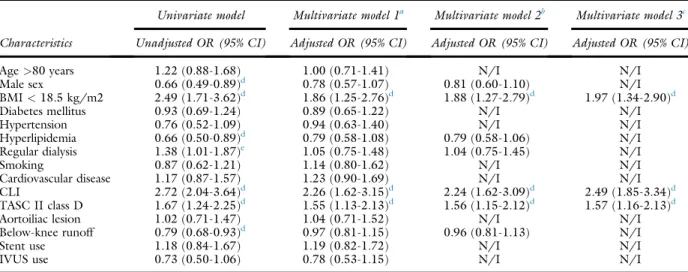
Independent predictors for POCs and risk stratifi- cation. Table III reports predictors of POCs. In multi- variate logistic regression analysis, BMI <18.5 kg/m
2, CLI, and TASC II class D lesions were independently associated with POCs (adjusted odds ratios [95% confi- dence intervals], 2.0 [1.3-2.9], 2.5 [1.9-3.3], and 1.6 [1.2-2.1], respectively). After risk stratification of POCs according to number of these risk factors, the POC inci- dence was higher in the groups with higher scores (Fig 1).
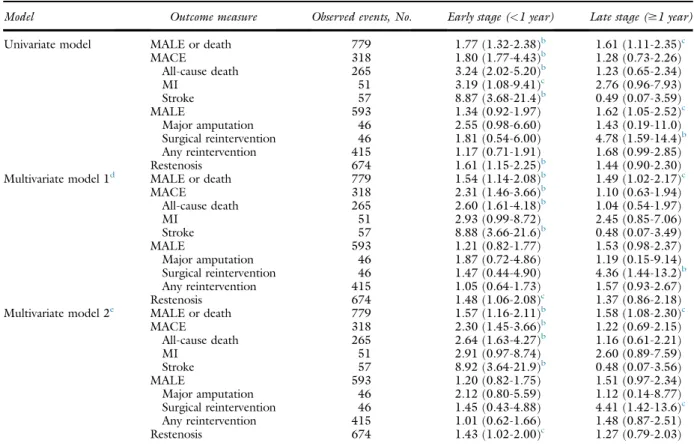
Prognostic effect of POCs on follow-up out- comes. The prognostic effect of POCs on follow-up outcomes is reported in Table IV. Mean follow-up period was 2.3 6 1.8 years. The Cox hazard regression model adjusted for baseline clinical characteristics showed POCs at an early stage were positively and independently associated with future occurrence of MALE or death, MACE, and restenosis (hazard ratio [95% confidence in- terval], 1.6 [1.2-2.1], 2.3 [1.5-3.7] and 1.4 [1.0-2.0], respectively; P < .05). Fig 2 shows the effect of POCs
on MALE-free survival up to 5 years, which was higher in the POC group than in the POCþ group (45% 6 2% vs 28% 6 5%; P < .001).
DISCUSSION
The study documented 30-day POCs in w10% of the patients. Multivariable analysis showed BMI <18.5 kg/m
2, CLI, and TASC II class D lesions were positively associated with POC incidence, which was higher in groups with higher risk score. In addition, POCs negatively affected clinical outcomes.
According to the TASC II guideline, first-line therapy for TASC II A-B and C-D FP lesions is EVT and bypass surgery, respectively,
4whereas the latest 2013 American College of Cardiology/American Heart Association guide- line recommends EVT only for extremely localized TASC II A lesions, with stent implantation only indicated for sub- optimal results after balloon angioplasty, and evidence class III level for primary stenting in FP lesion.
14In the clinical setting, however, stent-supported EVT is widely used because of the low operative complication rate and favor- able long-term outcome.
15Patency rate, MACE, and amputation-free survival were used as efficacy and safety end points in several studies,
5-11,16but the incidence of 30-day POCs and the effect on clinical outcomes have not been systematically studied, especially in the current advanced endovascular era.
Estimating POC occurrence is clinically important when deciding on an EVT strategy. We, therefore, investi- gated factors associated with 30-day POCs after EVT for Table II. Baseline characteristics
Variablesa POC
(n¼1936) POCþ (n¼209)
P value Patient characteristics
Age, years 7369 73610 .260
Age$80 years 455 (23.5) 57 (27.3) .232
Male sex 1364 (70.5) 128 (61.2) .007
BMI, kg/m2 22.363.3 21.463.4 <.001 BMI<18.5 kg/m2 173 (8.9) 41 (19.6) <.001 Diabetes mellitus 1193 (61.6) 125 (59.8) .602 Hypertension 1650 (85.2) 170 (81.3) .154 Hyperlipidemia 994 (51.3) 86 (41.1) .006 Regular dialysis 502 (25.9) 68 (32.5) .048
Smoking 524 (27.1) 51 (24.4) .460
Cardiovascular disease 1181 (61.0) 135 (64.6) .332 Limb and lesion characteristics
CLI 600 (31.0) 115 (55.0) <.001
TASC II class D 502 (25.9) 77 (36.8) .001 Aortoiliac lesion 356 (18.4) 39 (18.7) .925 Below-the-knee
runoff, vessels
1.760.9 1.560.9 .004
Stent use 1462 (75.5) 164 (78.5) .395
IVUS use 441 (22.8) 37 (17.7) .097
BMI,Body mass index;CLI,critical limb ischemia; IVUS,intravascular ultrasound; POC, without postoperative complications; POCþ, with postoperative complications; TASC II, TransAtlantic Inter-Society Consensus for the Management of Peripheral Arterial Disease.
aData are presented as mean6standard deviation or number (%).
Table I. Details of perioperative complications (POCs)
Variables No. (%)a
Overall 209 (9.7)
Death 25 (1.2)
MI 4 (0.2)
Stoke 12 (0.6)
Renal function requiring dialysis 1 (<0.1)
Intestinal bleeding 3 (0.1)
Stent thrombosis 36 (1.7)
Pseudoaneurysm 14 (0.7)
Distal embolization 22 (1.0)
Puncture site bleeding/hematoma 92 (4.3)
Others 28 (1.3)
MI,Myocardial infarction.
aData are the number (%) of POCs in 2145 cases.
FP lesions and compared prognostic outcomes between pa- tients with and without POCs. In this study, POCs were observed in 209 patients (10%). BMI <18.5 kg/m
2, CLI, and TASC II class D legions were independently associated with POCs after multivariate logistic regression analysis, and the POC rate linearly increased with the num- ber of predictors. The obesity paradox had suggested poor outcomes in both overweight and underweight patients, with a relative shortage of medication in underweight pa- tients.
17-20CLI status and TASC II class D lesions reflected
baseline patient background and lesion severity, which along more complex endovascular procedures might have resulted in complications.
21MACE, MALE, and restenosis were documented more frequently in the POCþ group than in the POC group. Occurrence of POCs may adversely affect clinical outcomes in the chronic phase.
The population at high risk for POCs in this study might also be at high risk for POCs with bypass surgery.
It is potentially and clinically important to consider the revascularization indication and to predict short-term and long-term outcome when treating patients. Results of this study have indicated an association between POCs and clinical outcomes, which might inform decision making on EVT strategy. This study included a large number of pa- tients from multiple centers; however, it was limited by its retrospective nature and selection bias for intervention, even though intervention was decided by consensus using an EVT-first approach. In addition, the actual number of patients undergoing FP bypass could not be determined because of data collection limitations in this study.
Recent trials reported better patency with device improvement and development
9,22that have led to wider application of EVT to FP lesions. Our results potentially play an important role in predicting outcomes and choice of devices.
CONCLUSIONS
A BMI <18.5 kg/m
2, CLI and TASC II class D le- sions were positively associated with POCs after EVT for FP lesions. The occurrence of POCs may adversely affect clinical outcomes in the chronic phase.
Table III. Association of baseline characteristics with the risk for perioperative complications (POCs)
Characteristics
Univariate model Multivariate model 1a Multivariate model 2b Multivariate model 3c Unadjusted OR (95% CI) Adjusted OR (95% CI) Adjusted OR (95% CI) Adjusted OR (95% CI)
Age>80 years 1.22 (0.88-1.68) 1.00 (0.71-1.41) N/I N/I
Male sex 0.66 (0.49-0.89)d 0.78 (0.57-1.07) 0.81 (0.60-1.10) N/I
BMI<18.5 kg/m2 2.49 (1.71-3.62)d 1.86 (1.25-2.76)d 1.88 (1.27-2.79)d 1.97 (1.34-2.90)d
Diabetes mellitus 0.93 (0.69-1.24) 0.89 (0.65-1.22) N/I N/I
Hypertension 0.76 (0.52-1.09) 0.94 (0.63-1.40) N/I N/I
Hyperlipidemia 0.66 (0.50-0.89)d 0.79 (0.58-1.08) 0.79 (0.58-1.06) N/I
Regular dialysis 1.38 (1.01-1.87)e 1.05 (0.75-1.48) 1.04 (0.75-1.45) N/I
Smoking 0.87 (0.62-1.21) 1.14 (0.80-1.62) N/I N/I
Cardiovascular disease 1.17 (0.87-1.57) 1.23 (0.90-1.69) N/I N/I
CLI 2.72 (2.04-3.64)d 2.26 (1.62-3.15)d 2.24 (1.62-3.09)d 2.49 (1.85-3.34)d
TASC II class D 1.67 (1.24-2.25)d 1.55 (1.13-2.13)d 1.56 (1.15-2.12)d 1.57 (1.16-2.13)d
Aortoiliac lesion 1.02 (0.71-1.47) 1.04 (0.71-1.52) N/I N/I
Below-knee runoff 0.79 (0.68-0.93)d 0.97 (0.81-1.15) 0.96 (0.81-1.13) N/I
Stent use 1.18 (0.84-1.67) 1.19 (0.82-1.72) N/I N/I
IVUS use 0.73 (0.50-1.06) 0.78 (0.53-1.15) N/I N/I
CI,Confidence interval;CLI,critical limb ischemia;IVUS,intravascular ultrasound;N/I,not included in the model;OR,odds ratio;TASC II,TransAtlantic Inter-Society Consensus for the Management of Peripheral Arterial Disease.
aMultivariate model 1: all variables were entered.
bMultivariate model 2: Variables withP<.05 in the univariate model were entered.
cMultivariate model 3: Variables withP<.05 in multivariate model 1 were entered.
dP<.01.
eP<.05.
Fig 1. Occurrence of perioperative complications (POCs) accord- ing to the number of risk factors. POCs occurred in 209 patients (9.7%). Risk factors for POCs were body mass index (BMI) <18.5 kg/m2, critical limb ischemia (CLI), and Trans- Atlantic Inter-Society Consensus for the Management of Peripheral Arterial Disease (TASC II) class D lesions (Table I). According to the number of risk factors for POCs, incidence of POCs was higher in the groups with higher scores (0: 5.0% [50 of 995], 1: 11.6% [97 of 835], 2: 18.4% [50 of 272], and 3: 27.9% [12 of 43]).
AUTHOR CONTRIBUTIONS
Conception and design: KS, OI, MT, YS, MU Analysis and interpretation: KS, OI, MT Data collection: KS, OI, MT, YS, KS Writing the article: KS, OI, MT
Critical revision of the article: KS, OI, MT
Final approval of the article: KS, OI, MT, YS, KS, TT, MI, MU
Statistical analysis: KS, OI, MT Obtained funding: Not applicable Overall responsibility: KS
REFERENCES
1. Morris-Stiff G, Ogunbiyi S, Rees J, Davies CJ, Hicks E, Lewis MH.
Variations in the anatomical distribution of peripheral vascular disease according to gender. Ann R Coll Surg Engl 2011;93:306-9.
2. Zeller T. Current state of endovascular treatment of femoropopliteal artery disease. Vasc Med 2007;12:223-34.
3. Balzer JO, Thalhammer A, Khan V, Zangos S, Vogl TJ, Lehnert T.
Angioplasty of the pelvic and femoral arteries in PAOD: results and review of the literature. Eur J Radiol 2010;75:48-56.
Table IV. Hazard ratios of perioperative complications (POCs) for various future outcomes
aModel Outcome measure Observed events, No. Early stage (<1 year) Late stage ($1 year)
Univariate model MALE or death 779 1.77 (1.32-2.38)b 1.61 (1.11-2.35)c
MACE 318 1.80 (1.77-4.43)b 1.28 (0.73-2.26)
All-cause death 265 3.24 (2.02-5.20)b 1.23 (0.65-2.34)
MI 51 3.19 (1.08-9.41)c 2.76 (0.96-7.93)
Stroke 57 8.87 (3.68-21.4)b 0.49 (0.07-3.59)
MALE 593 1.34 (0.92-1.97) 1.62 (1.05-2.52)c
Major amputation 46 2.55 (0.98-6.60) 1.43 (0.19-11.0)
Surgical reintervention 46 1.81 (0.54-6.00) 4.78 (1.59-14.4)b
Any reintervention 415 1.17 (0.71-1.91) 1.68 (0.99-2.85)
Restenosis 674 1.61 (1.15-2.25)b 1.44 (0.90-2.30)
Multivariate model 1d MALE or death 779 1.54 (1.14-2.08)b 1.49 (1.02-2.17)c
MACE 318 2.31 (1.46-3.66)b 1.10 (0.63-1.94)
All-cause death 265 2.60 (1.61-4.18)b 1.04 (0.54-1.97)
MI 51 2.93 (0.99-8.72) 2.45 (0.85-7.06)
Stroke 57 8.88 (3.66-21.6)b 0.48 (0.07-3.49)
MALE 593 1.21 (0.82-1.77) 1.53 (0.98-2.37)
Major amputation 46 1.87 (0.72-4.86) 1.19 (0.15-9.14)
Surgical reintervention 46 1.47 (0.44-4.90) 4.36 (1.44-13.2)b
Any reintervention 415 1.05 (0.64-1.73) 1.57 (0.93-2.67)
Restenosis 674 1.48 (1.06-2.08)c 1.37 (0.86-2.18)
Multivariate model 2e MALE or death 779 1.57 (1.16-2.11)b 1.58 (1.08-2.30)c
MACE 318 2.30 (1.45-3.66)b 1.22 (0.69-2.15)
All-cause death 265 2.64 (1.63-4.27)b 1.16 (0.61-2.21)
MI 51 2.91 (0.97-8.74) 2.60 (0.89-7.59)
Stroke 57 8.92 (3.64-21.9)b 0.48 (0.07-3.56)
MALE 593 1.20 (0.82-1.75) 1.51 (0.97-2.34)
Major amputation 46 2.12 (0.80-5.59) 1.12 (0.14-8.77)
Surgical reintervention 46 1.45 (0.43-4.88) 4.41 (1.42-13.6)c
Any reintervention 415 1.01 (0.62-1.66) 1.48 (0.87-2.51)
Restenosis 674 1.43 (1.02-2.00)c 1.27 (0.79-2.03)
BMI,Body mass index;CLI,critical limb ischemia;MACE,major adverse cardiac event;MALE,major adverse limb events;MI,myocardial infarction;TASC II,TransAtlantic Inter-Society Consensus for the Management of Peripheral Arterial Disease.
aData are adjusted hazard ratios and their 95% confidence intervals.
bP<.01.
cP<.05.
dMultivariate model 1: adjusted for BMI<18.5 kg/m2, CLI, and TASC II class D lesions (risk factors for POCs).
eMultivariate model 2: adjusted for BMI<18.5 kg/m2, CLI, and TASC II class D lesions, as well as sex, age$80 years, diabetes mellitus, hypertension, hyperlipidemia, regular dialysis, smoking, history of cardiovascular diseases, aortoiliac lesion, below-the-knee runoff, stent use, and intravascular ultrasound use.
Fig 2. Effect of perioperative complications (POCs) on survival free of major adverse limb events (MALE). The MALE-free sur- vival rate was higher in the group without POCs (POC) than in the group with POCs (POCþ) up to 5 years (45%62% vs 28%6 5%;P<.001).SE,Standard error.
4. Norgren L, Hiatt WR, Dormandy JA, Nehler MR, Harris KA, Fowkes FG. Inter-Society Consensus for the Management of Periph- eral Arterial Disease (TASC II). J Vasc Surg 2007;45(Suppl S):S5-67.
5. Abbruzzese T, Havens J, Belkin M, Donaldson MC, Whittemore AD, Liao JK, et al. Statin therapy is associated with improved patency of autogenous infrainguinal bypass grafts. J Vasc Surg 2004;39:1178-85.
6. Simons J, Schanzer A, Nolan B, Stone DH, Kalish JA, Cronenwett JL, et al. Outcomes and practice patterns in patients undergoing lower extremity bypass. J Vasc Surg 2012;55:1629-36.
7. Siracuse J, Giles K, Pomposelli F, Hamdan AD, Wyers MC, Chaikof EL, et al. Results for primary bypass versus primary angioplasty stent for intermittent claudication due to superficial femoral artery occlusive disease. J Vasc Surg 2012;55:1001-7.
8. Schillinger M, Sabeti S, Loewe C, Dick P, Amighi J, Mlekusch W, et al.
Balloon angioplasty versus implantation of nitinol stents in the super- ficial femoral artery. N Engl J Med 2006;354:1879-88.
9. Lammer J, Zeller T, Hausegger KA, Schaefer PJ, Gschwendtner M, Mueller-Huelsbeck S, et al. Heparin-bonded covered stents versus bare-metal stents for complex femoropopliteal artery lesions: the ran- domized VIASTAR trial (Viabahn endoprosthesis with PROPATEN bioactive surface [VIA] versus bare nitinol stent in the treatment of long lesions in superficial femoral artery occlusive disease). J Am Coll Cardiol 2013;62:1320-7.
10. Laird JR, Katzen BT, Scheinert D, Lammer J, Carpenter J, Buchbinder M, et al. Nitinol stent implantation vs. balloon angioplasty for lesions in the superficial femoral and proximal popliteal arteries of patients with claudication: three-year follow-up from the RESILIENT randomized trial. J Endovasc Ther 2012;19:1-9.
11. Rabellino M, Zander T, Baldi S, Garcia NL, Aragon-Sanchez FJ, Zerolo I, et al. Clinical follow-up in endovascular treatment for TASC C-D lesions in femoro-popliteal segment. Catheter Cardiovasc Interv 2009;73:701-5.
12. Ratnam L, Raza S, Horton A, Taylor J, Markose G, Munneke G, et al.
Outcome of aortoiliac, femoropopliteal and infrapopliteal endovascular interventions in lesions categorised by TASC classification. Clin Radiol 2012;67:949-54.
13. Rocha-Singh KJ, Jaff MR, Crabtree TR, Bloch DA, Ansel G; VIVA Physicians, Inc. Performance goals and endpoint assessments for clinical
trials of femoropopliteal bare nitinol stents in patients with symptom- atic peripheral arterial disease. Catheter Cardiovasc Interv 2007;69:
910-9.
14. Anderson JL, Halperin JL, Albert NM, Bozkurt B, Brindis RG, Curtis LH, et al. Management of patients with peripheral artery disease (compilation of 2005 and 2011 ACCF/AHA Guideline Recommen- dations): a report of the American College of Cardiology Foundation/
American Heart Association Task Force on Practice Guidelines. Cir- culation 2013;127:1425-43.
15. Tendera M, Aboyans V, Bartelink ML, Baumgartner I, Clement D, Collet JP, et al. ESC Guidelines on the diagnosis and treatment of peripheral artery disease. Eur Heart J 2011;32:2851-906.
16. Antoniou G, Chalmers N, Georgiadis G, Lazarides MK, Antoniou SA, Serracino-Inglott F, et al. A meta-analysis of endovascular versus sur- gical reconstruction of femoropopliteal arterial disease. J Vasc Surg 2013;57:242-53.
17. Steinberg B, Cannon C, Hernandez A, Pan W, Peterson ED, Fonarow GC. Medical therapies and invasive treatments for coronary artery disease by body mass: the“obesity paradox”in the Get With The Guidelines Database. Am J Cardiol 2007;100:1331-5.
18. Galal W, Gestel Y, Hoeks S, Sin D, Winkel T, Baz J, et al. The obesity paradox in patients with peripheral arterial disease. Chest 2008;134:
925-30.
19. Lavie CJ, Ventura HO, Milani RV. The “obesity paradox”dis smoking/lung disease the explanation? Chest 2009;134:896-8.
20. Lavie CJ, Milani RV, Ventura HO. Obesity and cardiovascular diseasedrisk factor, paradox, and impact of weight loss. J Am Coll Cardiol 2009;53:1925-32.
21. Iida O, Takahara M, Soga Y, Suzuki K, Hirano K, Kawasaki D, et al.
Shared and differential factors influencing restenosis following endo- vascular therapy between TASC (Trans-Atlantic Inter-Society Consensus) II class A to C and D lesions in the femoropopliteal ar- tery. JACC Cardiovasc Interv 2014;7:792-8.
22. Rogers J, Liard J. Overview of new technologies for lower extremity revascularization. Circulation 2007;116:2072-85.
Submitted Jun 1, 2014; accepted Dec 11, 2014.