Hirosaki Med.J.
64(Suppl.):S6―S8,2013PRETREATMENT OF RENAL SUPSCAPULAR ADMINISTRATION OF ADIPOSE TISSUE-DERIVED STEM CELLS AMELIORATE ISCHEMIA-
REPERFUSION-INDUCED ACUTE KIDNEY INJURY
Tokunori Yamamoto,Yasuto Funahashi,Yoshihisa Mastukawa,Masashi Kato,
Yasushi Yoshino, and Momokzu Gotoh
AbstractBackground
Acute renal ischemic injury (AKI) represents a major clinical problem with renal arterial clamp at partial nephrectomy. The use of therapy using adipose tissue-derived stem cells(ASCs) has been suggested as a potential modality to attenuate the ischemic renal damage.
Methods
We investigated the possible reno-protection of pretreatment of ASCs before and after in a rat ischemia–reperfusion
(I–R) model of AKI. Twenty-four hours post-ischemia, blood flow in peritubular capillaries (PTC) was measured using intravital videomicroscopy.
Results
We demonstrated that ADRC therapy significantly reduced serum creatinine and BUN. Histological analysis further validated a significantly attenuated tubular damage. Intravital videomicroscopy and measurement of red blood cell velocity in peritubular capillaries showed ASCs-injected kidneys displayed significant hemodynamic improvement.
Conclusions
The subscapular administration of ASCs to the kidney attenuates I/R renal injury though anti-inflammation, anti- apotoyic effect and peritubular capillary microcirculation. The present study suggests that ASCs would be a useful tool in preventing ischemic kidney damage in the clinical setting.
Hirosaki Med.J. 64, Supplement:S6―S8,2013
Key words: ADIPOSE TISSUE-DERIVED STEM CELLS; ISCHEMIA-REPERFUSION-INDUCED
ACUTE KIDNEY INJURY; RENAL PROTECT; CYTOKINES
Department of Urology, Nagoya University
Corresponding Author: Tokunoti Yamamoto, Department of Urology, Nagoya University
Tel: 052-744-2985 Fax: 052-744-2319
Email: [email protected]
Background
Previous studies have demonstrated that administration of mesenchymal stromal cells
(MSCs) accelerates the recovery of tissue injury in several organs including heart, liver, neuron, and pancreas. Administration of bone marrow- derived stromal cells (BMSCs) has also been shown to protect the kidney from AKI induced by cisplatin, glycerol, and ischemia-reperfusion injury. Recently, it has been demonstrated that MSCs can be obtained from adipose tissue.
Like BMSCs, adipose tissue-derived stromal
cells (ASCs) have the potential to differentiate into various types of cells and tissues. Previous studies suggest that ASCs may have an advantage over BMSCs. Firstly, adipose tissue is abundant, and can be obtained repeatedly with minimal invasive procedure. Secondly, the number of stem cells in the fat is greater than that in the bone marrow. Lastly, in general ASCs grow faster than BMSCs.
In a previous study, we reported renoprotection
on and low serum cultured and non cultured
ASCs and a transplanted endothelial cell for folic
acid
2)and cisplathin induced
5)AKIs and acute
S 7
ischemia induced AKI
1)and. Aim is to cralify the renoprotection of ASCs for ischemia induced AKI.
MATERIALS AND METHODS
Culture conditions
The basal culture medium was prepared as previously described
4).
In vivo experimental subcapsular administration of hASCs
Subcapsular injection of 2×10⁶ of rat (r)
-ASCs and control medium (Dulbecco’s modified Eagle’s medium, DMEM; Sigma-Aldrich) (each group n=6) was given to the left kidney of Acute kidney injury (AKI) rats. Blood samples were collected and blood urea nitrogen (BUN)
and serum creatinine levels were measured by Mitsubishi Chemical Medience Co. Ltd (Tokyo, Japan). Rats were euthanized and renal cortical microcirculation was assessed using CCD video microscope
3)and kidney samples were taken for the study.
Morphological analysis
To evaluate tubulointerstitial injury, Hematoxin Eosin (HE) and periodic acid Schiff (PAS)
stained kidney sections were analysed using a quantitative grading.
Renal function
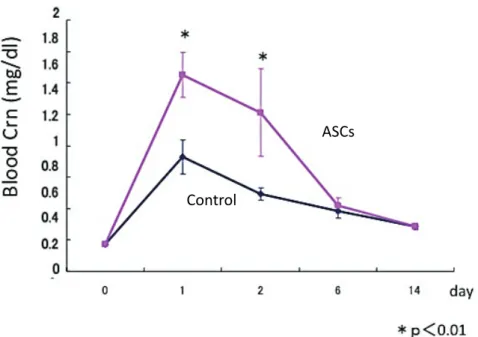
Rats treated with control medium demonstrated a marked rise in BUN and serum creatinine and, r-ASCs further suppressed the increase of serum creatinine (Figure 1) .
Tubular injury
Examination of PAS stained kidney sections taken from AKI rats treated with control medium showed severe tubular cell degenerative changes with necrosis and luminal casts. A r-ASCs greatly attenuated the tubular injury.
The severity of the tubular damage, including tubular dilatation, degeneration and cast formation was scored. Treatment with r-ASCs resulted in significantly better scores than the control. In contrast, the r-ASCs-treated group failed to show significantly better scores than the control group.
Fig 1. Renal function after the intravenous injection of low serum cultured human adipose tissue-derived stromal cells (hLASCs).
Control
ASCs
Fig1
S 8 T. Yamamoto, et al.
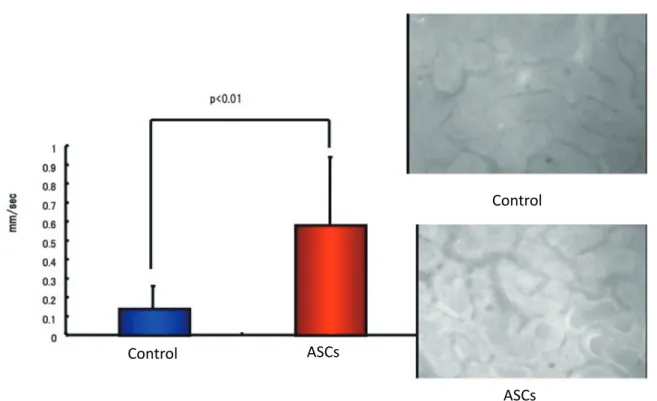
Direct visualization of the renal cortical capillaries The effects of r-ASCs on renal cortical microcirculation were examined by analyzing the direct images obtained with a CCD video microscope system. The blood flow velocity was significantly faster and the blood flow volume was greater in the r-ASCs group than in the control (Figure 2).
In conclusion, we demonstrate that subcapsular administration of r-ASCs protects the kidney via peritubulra microcircutaion from acute tubular injury.
References
1)Brodsky SV, Yamamoto T, Tada T, Kim B, Chen J, Kajiya F, Goligorsky MS. Endothelial dysfunction in ischemic acute renal failure: Rescue by transplanted endothelial cells. Am J Physiol Renal Physiol 2002;282:F1140-9.
2)Katsuno T, Ozaki T, Furuhashi K, Kim H, Yasuda
Fig 2. Renal cortical microcirculation. Velocity of the capillary blood flow and the capillary blood flow volume were significantly higher in AKI rats given subcapsular injection of hLASCs than those given the control medium.
K, Yamamoto T, Sato W, et al. Low serum cultured adipose tissue-derived stromal cells ameliorate acute kidney injury in rats. Cell Transplantation 2012 Sep 7. [Epub ahead of print]
3)Yamamoto T, Tada T, Brodsky SV, Tanaka H, Noiri E, Kajiya F, Goligorsky MS. Intravital videomicroscopy of peritubular capillaries in renal ischemia. Am J Physiol Renal Physiol 2002;282:
F1150-5.
4)Iwashima S, Ozaki T, Maruyama S, Saka Y, Kobori M, Omae K, Yamaguchi H, et al. Novel culture system of mesenchymal stromal cells from human subcutaneous adipose tissue. Stem Cells Dev 2009;18(4):533-43.
5)Yasuda K, Ozaki T, Saka Y , Yamamoto T, Gotoh M , Ito Y, Yuzawa Y, Matsuo S Maruyama S, Autologous cell therapy for cisplatin induced acute kidney injury by using non-expanded adipose tissue derived cells Cytotherapy. 2012 2012 Oct;14(9):1089- 100. doi: 10.3109/14653249.2012.693157. Epub 2012 Jun 25.