Investigating a minimal condition to induce illusory body ownership using virtual reality
( バーチャルリアリティを用いた身体所有感錯覚誘発 における最小条件の解明 )
January 2021
Doctor of Philosophy (Engineering)
Ryota Kondo 近藤 亮太
Toyohashi University of Technology
別紙4-1(課程博士(英文))
Date of Submission(month day,year): January 8th, 2021
Department of Computer Science and Engineering
Student ID Number D121823
Supervisors Michiteru Kitazaki
Applicant’s name Ryota Kondo Shigeki Nakauchi
Abstract ( Doctor )
Title of Thesis Investigating a minimal condition to induce illusory body ownership using virtual reality
Approx. 800 words
Humans have a desire to have an ideal body. It seems that we want to change our self-image or self-consciousness by changing their own body. However, it has not been understood how to change the self-image. I assumed that the self-image could be updated by accumulating a temporary change of bodily self-consciousness. To investigate this issue, it is firstly required to investigate how to ch ange bodily self-consciousness. Several studies have shown that we can change our body through illusory body ownership induced by visual-tactile and visual-motor synchronizations. A recent invisible body study has shown that stroking an empty space with a brush and stroking the subject's body at the same time produce body ownership in an empty space. This finding suggests a minimal condition for body ownership in visual-tactile synchronization. However, a minimal condition in the visual-motor synchronization is still unclear. It is one of the most fundamental issues to identify minimal conditions for the body ownership because we can change our bodily self-consciousness based on those minimal conditions. Therefore, the aim of this thesis was to investigate a minimal condition to induce illusory body ownership by visual-motor synchronization.
Study I aimed to test whether the illusory ownership of an invisible body could be induced by the method of visual-motor synchronicity and if the illusory invisible body could be experienced in front of the observer similar to the full-body ownership illusion. Participants observed left and right white gloves and socks in front of them, at a distance of 2 m, in a virtual room through a head-mounted display. The white gloves and socks were synchronized with the observers’ actions. In the experiments, we tested th e effect of synchronization, and compared this to a whole -body avatar, as measuring self-localization drift.
We observed that visual hands and feet were sufficient to induce illusory body ownership, and this effect was as strong as using a whole-body avatar. The illusory ownership was also supported by a shift of proprioceptive self-localization.
Study II aimed to develop a method to separate the body ownership of full-body from that of body parts. Scrambled stimuli that disrupt the spatial relationship by randomizing the positions of body parts from the original/normal body part layout stimulus was developed to induce only body part ownership. We found that participants felt as if the space between the gloves and socks was their bodies only in the normal layout condition. They felt as if the gloves or socks were part of their bodies in both normal and scrambled conditions, but the feeling was stronger in the normal la yout condition than in the scrambled body condition.
Study III aimed to investigate whether we can have illusory ownership of the invisible body with an elongated arm by presenting only hands and feet with modifying the position of the hands. As a result, the illusory body ownership to the body with a long arm was induced to an invisible body by synchronizing only gloves and socks with participants' movement. Learning of the invisible long arm gradually changed the reaching behavior to use the long arm more frequently than the normal arm. Thus, the body scheme could be changed by changing the position of the hand by maintaining the spatial relationship of body parts and visual-motor synchronicity in the same directions between the virtual body and the actual body.
Study IV aimed to see whether a re-association of the different body parts is induced by visual-motor synchrony in healthy adults. We focused on the re-association of the real right thumb with a virtual left arm because although the right thumb and the left arm are different in size and laterality, the directions of their movements are similar. We found that participants felt as if their right thumb had become the left arm and illusory body ownership of the virtual left arm was induced more in the vi sual-motor synchronous condition than in the asynchronous one.
To summarize minimal conditions to induce body ownership by the visual-motor method, the full-body illusion needs a spatial relationship and the synchronous movement of the hands and feet, while the body part ownership needs the synchronous movement of the body parts in motion directions and angles. The size, symmetry, or laterality does not have to be identical between the actual body and the virtual body. It has been proved that the body scheme can be changed by maintaining the minimal condition by modifying other parameters. The final goal is to update the self-image by accumulating temporary changes in bodily self-consciousness, and our findings should contribute to developing a method to change our bodily self-consciousness.
Contents
Chapter 1 Introduction ...1
1.1 Desire to change the body ...1
1.2 A world where we can change our body freely ...1
1.3 How can we change the self completely? ...2
1.4 General aim ...2
Chapter 2 Literature review ...4
2.1 Illusory body ownership ...4
2.2 Full-body illusion (FBI): from body part to full body...5
2.3 Full-body illusion vs. body part ownership ...6
2.4 Visual-tactile synchronization vs. visual-motor synchronization: effect of agency ...7
2.5 Semantic constraints in illusory body ownership ...8
2.6 Invisible body illusion: minimal condition by the visual-tactile synchronization ...9
2.7 Overview ...9
Chapter 3 Study I: Dynamic Invisible Body Illusion ... 11
3.1 Introduction ... 12
3.2 Experiment 1-1... 15
3.2.1 Methods ... 15
3.2.2 Results ... 17
3.3 Experiment 1-2... 18
3.3.1 Methods ... 18
3.3.2 Results ... 19
3.4 Experiment 1-3... 20
3.4.1 Methods ... 20
3.4.2 Results ... 21
3.5 Discussion ... 22
Chapter 4 Study II: Scrambled Body Illusion ... 25
4.1 Introduction ... 26
4.2 Experiment 2-1... 30
4.2.1 Methods ... 30
4.2.2 Results ... 32
4.3 Experiment 2-2... 35
4.3.1 Methods ... 35
4.3.2 Results ... 37
4.4 Experiment 2-3... 41
4.4.1 Methods ... 41
4.4.2 Results ... 41
4.5 Discussion ... 42
Chapter 5 Study III: Invisible Long Arm Illusion ... 45
5.1 Introduction ... 46
5.2 Experiment 3-1... 48
5.2.1 Methods ... 48
5.2.2 Results ... 50
5.3 Experiment 3-2... 52
5.3.1 Methods ... 52
5.3.2 Results ... 54
5.4 Experiment 3-3... 56
5.4.1 Methods ... 56
5.4.2 Results ... 57
5.5 Discussion ... 60
Chapter 6 Study IV: Re-association of Body Parts ... 62
6.1 Introduction ... 63
6.2 Methods ... 64
6.3 Results ... 67
6.4 Discussion ... 70
Chapter 7 General Discussion ... 74
7.1 Summary of Results ... 74
7.2 Minimal condition to induce the illusory body ownership by visual-motor method ... 75
7.3 Static invisible body vs. Dynamic invisible body: semantic constraints and perception of the invisible body ... 76
7.4 Limitations ... 77
7.5 To update the narrative self ... 78
Chapter 8 Conclusions ... 79
Acknowledgments ... 81
References ... 82
List of Figures
Figure 1: Methods to induce illusory body ownership ... 7
Figure 2: Schematic of the visual-motor synchronous stimuli. (Left) Participants wore white gloves and white socks, and moved freely. (Center) White gloves and white socks were presented as the invisible body stimuli in Experiments 1–1, 1-2, and 1-3 using an HMD. (Right) A whole body avatar was presented in the visible body condition in Experiment 1-2. ... 16
Figure 3: Results of Experiment 1-1. Subjective ratings of questionnaires. The error bars indicate SE. .. 18
Figure 4: Results of Experiment 1-2. Subjective ratings of questionnaires. The error bars indicate SE. .. 20
Figure 5: Results of Experiment 1-3. Drifts in the self-localization task. ... 22
Figure 6: An example of a participant’s posture (left), the corresponding normal layout stimulus (middle), and the scrambled stimulus (right). ... 29
Figure 7: A virtual wheel cutter and virtual gloves and socks in a virtual mirror. ... 30
Figure 8: Range of body part positions in the scrambled condition (white), and the range of ball appearance positions (orange). ... 31
Figure 9: Results of the questionnaire in Experiment 2-1. Error bars indicate SE. ... 33
Figure 10: Results of self-localisation drift in Experiment 2-1. Error bars indicate SE. ... 35
Figure 11: Results of the questionnaire in Experiment 2-2. Error bars indicate SE. ... 39
Figure 12: Results of the SCR in Experiment 2-2. Error bars indicate SE. ... 40
Figure 13: Results of the SCR in Experiment 2-3. Error bars indicate SE. ... 42
Figure 14: White full-body avatar. These images were from the third-person view as schematic. However, actually participants viewed the stimuli from the first-person view of the avatar in front of a mirror. ... 49
Figure 15: Results of subjective ratings (Q1) ... 51
Figure 16: Center of gravity (x) ... 52
Figure 17: Invisible body of socks and gloves. These images were from the third-person view as schematic. However, actually participants viewed the stimuli from the first-person view in front of a mirror. ... 53
Figure 18: Results of subjective ratings (Q1) ... 55
Figure 19: Results of proprioceptive pointing bias (x) ... 56
Figure 20: Results of subjective ratings ... 57
Figure 21: Time series data of ratio touched with right hand in learning block and test blocks ... 59
Figure 22: Time series data of total-path length ... 59
Figure 23: Apparatus. ... 65
Figure 24: Joint correspondence of the thumb and the virtual arm ... 66
Figure 25: A virtual left arm and a virtual knife. ... 66
Figure 26: Self-localization task. ... 67
Figure 27: Results of the questionnaire. The error bars indicate standard errors (SE). *, ** indicate statistical significance at the 0.05 (p < 0.05) and 0.01 (p < 0.01) levels with Wilcoxon signed-rank test, respectively. ... 69
Figure 28: Result of startle response (mean). The error bars indicate SE. ... 69
Figure 29: Results of self-localization drift (A) and perceived length of the finger (B). ... 70
Figure 30: Relationships between our studies and invisible body studies ... 76
List of Abbreviations
RHI Rubber hand illusion BPO Body part ownership FBI Full-body illusion HMD Head-mounted display SCR Skin conductance response VR Virtual reality
1PP First-person perspective
3PP Third-person perspective
1
Chapter 1
Introduction
This thesis hypothesized that the self-concept can be updated by accumulating temporary change of body and investigated the minimum conditions for temporary body modification. Specifically, we investigated what factor is important to body ownership (feel that the body belongs to me) that caused through the integration of multisensory bodily signals by presenting and controlling several bodies using virtual reality (VR). Solving this question find the optimal method for a long-term change of body.
1.1 Desire to change the body
Many people are not satisfied with their current physical body. They are working hard every day to get close to their ideal body with muscle training, diet, plastic surgery, or makeup. However, the human body does not change immediately, nor does it change strikingly. Besides, when changing the body, the current physical restrictions are greatly affected. Thus, changing the body was extremely difficult, despite many people striving to achieve it.
1.2 A world where we can change our body freely
On the other hand, VR technology which has been rapidly developing in recent years has made it possible to modify the body without restriction of the original body. Capturing the movement of the body with a motion capture system and reflecting it in an avatar, it became possible to move the avatar like a self-body. These technologies have been generally used not only for research but also for entertainment. As a result, VR makes it easier and safer to change the body to become the ideal one.
However, the current method for changing the body is temporary.
2
1.3 How can we change the self completely?
Gallagher discussed the self in two: the narrative self and the minimal self (Gallagher, 2000). The narrative self is a self that is consistently continuous from the past to the future and is the self that is told as the main character of the story. The minimal self is a self that appears temporarily rather than continuously and appears by sensory information and body movements. Minimal self can be divided into a sense of body ownership that the moving body belongs to oneself and a sense of agency that the movement belongs to oneself when moving the body.
If we can change the narrative self and the minimal self, we will be able to completely change the self. If we use VR to present a virtual body that moves in conjunction with our movement, the virtual body feels as if our own body (Body ownership), and the movement of the virtual body feels as if our movement (Agency). Therefore, the minimal self can be modulated by VR. On the other hand, it is difficult to change a consistent self as the narrative self because it is temporary that we can change our body in VR at present, and we use the real body for most of our life. Also, the coherence of the narrative self that the past self, the present self, and the future self are the same is related to memory, and it seems that memory manipulation is also necessary to update the narrative self. In summary, current technology allows update the minimal self, and to update the narrative self completely is difficult. It should not be pessimistic that the narrative self cannot be completely changed. For example, if memories can be changed, we cannot believe the consistency between ourselves yesterday and ourselves now. Changing all narrative self is difficult and dangerous. What about partially updating the narrative self from the present to the future by accumulating a minimal self?
This guarantees the coherence of the self before and after the change. Some studies suggest that the update of the minimal self affects the narrative self, such as people become more childish by owning a child's body (Banakou et al., 2013), people help others after the Superman experience (Rosenberg et al., 2013), and gender identity is changed fluidly by perceptual body-sex change illusion
(Tacikowski et al., 2020). Therefore, there is a possibility that the narrative self can be updated by accumulating the minimal self for a long period.
1.4 General aim
First of all, we need to understand the minimal self to update the narrative self. Minimal self is thought to be caused by the integration of multisensory bodily signals. However, it is not clear which element is important. To update the minimal self for the long term, it is necessary to find out the
3
important elements for the minimal self and to update the body effectively and efficiently. In this thesis, we focused on body ownership in the minimal self, and we aimed to investigate the minimal conditions for inducing illusory body ownership. Agency is different from body ownership, and it is easy to occur if the temporal synchronization of movement is maintained. Therefore, we focused on extracting the minimum condition from the body ownership which has complicated occurrence conditions. The next chapter reviews the conditions to induce illusory body ownership and discuss the minimal condition that is currently known.
4
Chapter 2
Literature review
2.1 Illusory body ownership
Humans can have illusory ownership of part of a fake body. In the rubber hand illusion (RHI), an experimenter simultaneously strokes a rubber hand and the participant’s hand with a brush. The participants feel as if the rubber hand is their own hands when they observe only the rubber hand (Botvinick & Cohen, 1998; Manos Tsakiris & Haggard, 2005). When the RHI is induced, the proprioceptive sensation of the hand drifts toward the rubber hand. However, Rohde et al., (2011) suggest that proprioceptive drift does not correlate with the illusion. The RHI does not occur when the rubber hand is rotated 90 degrees or replaced with a wood-stick, suggesting that the RHI is not based on purely bottom-up processes, but also modulated by top-down influences originating from the appearance of one's own body (Manos Tsakiris & Haggard, 2005). Ide (2013) showed that the anatomical plausibility of hand posture affects the RHI; For the left hand, the illusion was stronger when the rubber hand was placed at 0°, 45°, 90° (easy to mimic with the actual left hand), and 315°
than 180°, 225°, 270° (difficult to mimic with the actual left hand by the anatomical constraint). Thus, the incongruence in bottom-up visual and proprioceptive signals could explain why the RHI is eliminated or decreased with the rotated rubber hand. The similar finding has been reported in the fMRI study(H Henrik Ehrsson et al., 2004); When the rubber hand is put in the same posture as the real hand, the illusion is induced and the premotor cortex showed stronger activation than when the rubber hand is rotated 180 degrees. In those studies, the illusion is induced by visual-tactile synchronicity. The virtual hand illusion(Sanchez-Vives et al., 2010) and the moving rubber hand illusion (Kalckert & Ehrsson, 2012, 2014) have both been reported using visual-motor synchronicity.
In the virtual hand illusion, a virtual arm is presented on a screen synchronized with the participant’s hand movements. The participants then feel as if the virtual arms are their own.
5
2.2 Full-body illusion (FBI): from body part to full body
The RHI induces the illusory ownership of body parts (BPO: body part ownership) but does not induce that of a whole body. The illusory ownership of a full-body has been investigated (FBI: full-body illusion). In the FBI, participants feel as if a mannequin (Petkova & Ehrsson, 2008) or a full-body avatar (Gonzalez-Franco et al., 2010; Maselli & Slater, 2013b; Slater et al., 2010) is their own body due to visual-motor or visual-tactile synchronicity. The FBI using a mannequin is induced by stroking the mannequin and the participant’s body at the same time, while the participant observes the stroked abdomen from the position of the mannequin’s head through a head-mounted display (HMD). In a FBI of a virtual reality avatar, the avatar moves synchronously with a participant’s movements (Gonzalez- Franco et al., 2010), or visual-tactile stimuli are presented using virtual balls and vibrations (Maselli
& Slater, 2013b). The FBI is stronger and more likely to be induced through a visual-tactile experience from the first-person perspective (1PP) than the third-person perspective (3PP) (Maselli & Slater, 2013b; Slater et al., 2010). In the 1PP, participants observed the virtual room and the virtual body from the point of view of the virtual body's eyes. In the 3PP, the position of participants (the point of view) was horizontally shifted 1 m (Slater et al., 2010) or 40 cm (Maselli & Slater, 2013b) away to the right of the virtual body; Participants could see the virtual body when they turn their head left. When participants observe a fake body from the front (facing each other), the FBI does not occur (Petkova, Khoshnevis, et al., 2011; Preston et al., 2016). On the other hand, the FBI can be induced when participants observe a body from the 3PP under certain conditions (Aspell et al., 2009; Lenggenhager et al., 2007; Lenggenhager et al., 2009). Participants observe a fake body from behind using an HMD while an experimenter simultaneously strokes the back of the fake body and that of the participant.
When the visual and tactile strokes are synchronized, participants experience the FBI with the fake body, and their self-location drifts towards the fake body. In these studies, participants observe the fake body from behind. However, the self-localization effect has not been replicated in some studies (Hänsel et al., 2011; Heydrich et al., 2013; Bigna Lenggenhager et al., 2011), and thus it is controversial. The FBI from the 3PP is a kind of self-recognition similar to recognizing oneself in a mirror according to Petkova, et al. (2011) and Ehrsson (2012). Also, proprioception contributes to the FBI from the 1PP because the virtual body or mannequin can be presented in the same position as the physical body position. Some studies reported the FBI by mere visual observation (Carey et al., 2019;
Keenaghan et al., 2020). These studies suggest that visual-proprioception is enough to induce the FBI and proprioception is also an important factor for the illusion. Considering the difference between 1PP
6
and 3PP from the perspective of proprioception, the inconsistency between proprioception and the visual body may be the cause of the weakening of the FBI in 3PP.
2.3 Full-body illusion vs. body part ownership
As mentioned above, the FBI and BPO are induced by visual-tactile synchronization or visual-motor synchronization (Figure 1). Is the FBI simply a collection of BPOs? Are these fundamentally different phenomenon? Several studies have discussed the difference between BPO and the FBI. Blanke &
Metzinger (2009) and Blanke (2012) claim that body part ownership and the FBI are fundamentally different in terms of bodily self-consciousness. They proposed the following components of bodily self-consciousness: self-identification (this body belongs to me), self-position (I am here), and first- person perspective (I am looking at the world from this position), and the FBI satisfies all of these and can experimentally manipulate the components of bodily self-consciousness.
In brain activity, the bilateral premotor cortex, intraparietal sulcus, and cerebellum are associated with the RHI (Ehrsson et al., 2005; Ehrsson et al., 2004). Activity in the right posterior insula and right frontal operculum correlates with the proprioceptive drifts in the RHI, although the activation in these areas does not increase in the synchronous illusion condition compared to the control conditions (M.
Tsakiris et al., 2007). Activity in the extrastriate body area reflects the intensity of the RHI (Limanowski et al., 2014). On the other hand, activity in the ventral premotor cortex reflects the FBI;
the FBI is only induced using visual-tactile stimuli when the body segment connects to a body (Gentile et al., 2015; Petkova, Björnsdotter, et al., 2011). These studies suggest that the FBI and BPO are essentially different in the aspects the bodily-self consciousness and brain activity. In this thesis, we also discuss body ownership in terms of body parts and full-body.
7
Figure 1: Methods to induce illusory body ownership
2.4 Visual-tactile synchronization vs. visual-motor synchronization: effect of agency
What about the difference between visual-tactile synchronization and visual-motor synchronization?
In the Visual-motor method, a sense of agency (the feeling that this movement is one's own (Gallagher, 2000)) is induced because participants move and the virtual body follows it. Agency is induced even under the condition that the body ownership is not elicited such as rotating the rubber hand 180 degrees (Kalckert & Ehrsson, 2012), classical RHI (Botvinick & Cohen, 1998; Manos Tsakiris & Haggard, 2005) leads only the body ownership, therefore, these senses are considered to independent. Several studies have investigated the relationship between the agency and body ownership. Some studies indicated the strongness of body ownership is equal between the visual-tactile method and the visual- motor method (Kalckert & Ehrsson, 2014; Riemer et al., 2013; Manos Tsakiris et al., 2006). However, some studies implied the visual-motor method leads to strong body ownership (Dummer et al., 2009;
Kalckert & Ehrsson, 2012; Kokkinara & Slater, 2014), and some studies have opposite results (Walsh
8
et al., 2011). Thus, this topic is under discussion. According to Kalckert & Ehrsson (2014) consideration, the visual-motor method has a large amount of information, therefore there is also a lot of information that causes conflicts. For these reasons, it is considered that there is no difference between the visual-motor method and the visual-tactile method. It is also claimed that multiple sensory integrations are important, the type of sensory information is not important. The procedure differs depending on the paper, and even with the visual-motor method, some have tactile stimulation by touching the desk during exercise, and some that do not. The difference between the visual-motor method and the visual-tactile method might be caused by the difference in experimental conditions and experimental environment.
Some studies suggest that the agency is important for the unitary bodily experience. Kilteni et al.
(2012) mentioned that the sense of embodiment (The sense that emerges when the properties of a body are processed as if they were the properties of one's own physical body) in VR is induced by conjunction with body ownership, self-location, and agency. Additionally, Tsakiris et al. (2006) reported that voluntary action of one finger gave body ownership to other fingers, and it was not induced by passive movement. This result suggests that voluntary action creates a unitary bodily experience. In this thesis, we used the visual-motor method because the agency is important for creating a unitary bodily experience, this method is standard in VR application, and our goal is to acquire a body in VR. In this method, the body can move freely and interact with others and the environment.
2.5 Semantic constraints in illusory body ownership
Several studies showed that body ownership is induced by visual-tactile synchronization or visual- motor synchronization, but semantic information also affects the illusory body ownership. In the rubber band illusion, the illusion does not occur when the position is anatomically impossible (the rubber hand rotated 90 degrees (Manos Tsakiris & Haggard, 2005) or 180 degrees (Ehrsson et al., 2004; Kalckert & Ehrsson, 2012)). When an object such as a wood stick is presented instead of the rubber hand, body ownership is not induced (Tsakiris & Haggard, 2005). Similarity with the real body also affected the illusion, and the strength of the illusion decreased if the texture of the fake hand did not resemble the participant’s hand (Haans et al., 2008). Tsakiris (2010) proposed a model of how these semantic constraints work in body ownership. Firstly, a comparison of the body model (visual, anatomical, and structural characteristics of the body) with the appearance of the object. Secondly, the posture of the body and the posture of the object are compared. Finally, multisensory bodily signals integrated and body ownership occur. These studies indicated that semantic factors affect body
9
ownership. However, some studies have reported that the illusion can be induced in different genders (Slater et al., 2010) or skin (Maister et al., 2013; Peck et al., 2013). In summary, the anatomical position and human-like fake body are necessary for illusory body ownership, and the similarity between a fake body and a real body seems to be not critical.
2.6 Invisible body illusion: minimal condition by the visual-tactile synchronization
As mentioned above, body ownership is affected by semantic factors. On the other hand, invisible body illusions suggest that semantic factors are not necessary for inducing body ownership. In the invisible hand illusion (Guterstam et al., 2013), an experimenter stroked the participant's hand and the empty space at the same time with a brush. Then, body ownership is induced in an empty space. The invisible hand illusion can be extended to the whole body by stroking the space corresponding to the body part of the participant, the FBI is induced in an empty space (D’Angelo et al., 2017; Guterstam et al., 2015). Interestingly, the size of the invisible body can also be changed, the size perception of an object is affected by the size of the invisible body participants perceived (van der Hoort & Ehrsson, 2016). This result suggests that our body perception affects other perceptions even in the absence of a visual body. These invisible body studies imply a minimal condition to induce body ownership in the visual-tactile method.
2.7 Overview
Invisible body by visual-tactile method suggests that visual information of the body is not necessary for inducing the illusory body ownership. Thus, the synchronous stroke of body and space by brush is a minimal condition in the visual-tactile method to induce illusory body ownership. The general aim of this thesis was to investigate a minimal condition of the illusory body ownership by the visual-motor method. We discuss the BPO and FBI separately in terms of bodily self-consciousness (Blanke, 2012; Blanke & Metzinger, 2009).
Study I: Dynamic Invisible Body Illusion Aim
Study I aimed to test whether the illusory ownership of an invisible body could be induced by the method of visual-motor synchronicity and if the illusory invisible body could be experienced in front of the observer similar to the full-body ownership illusion.
10 Study II: Scrambled Body Illusion Aim
Study II aimed to develop a method to separate the FBI and BPO. Scrambled stimuli that disrupt the spatial relationship by randomizing the positions of body parts from the original/normal body part layout stimulus to induce only BPO.
Study III: Invisible Long Arm Aim
Study III aimed to investigate whether we can have illusory ownership to the invisible body with an elongated arm by presenting only hands and feet with modifying the position of the hands.
Study IV: Re-association of Body Parts Aim
Study IV aimed to see whether a body-part re-association is induced by visual-motor synchrony in healthy adults. We focused on the re-association of the real right thumb and a virtual left arm because although the right thumb and the left arm are at different laterality and size, the directions of their movements are similar.
To summarize, Study I and III investigated the minimal condition in the FBI, Study IV investigated the minimal condition in the BPO, and Study II investigated the difference between the FBI and BPO.
11
Chapter 3
Study I: Dynamic Invisible Body Illusion
Abstract
Body ownership can be modulated through illusory visual-tactile integration or visual-motor synchronicity/contingency. Recently, it has been reported that illusory ownership of an invisible body can be induced by illusory visual-tactile integration from a first-person view. We aimed to test whether a similar illusory ownership of the invisible body could be induced by the active method of visual- motor synchronicity and if the illusory invisible body could be experienced in front of and facing away from the observer. Participants observed left and right white gloves and socks in front of them, at a distance of 2 m, in a virtual room through a head-mounted display. The white gloves and socks were synchronized with the observers’ actions. In the experiments, we tested the effect of synchronization, and compared this to a whole-body avatar, measuring self-localization drift. We observed that visual hands and feet were sufficient to induce illusory body ownership, and this effect was as strong as using a whole-body avatar.
12
3.1 Introduction
Illusory body ownership (Blanke, 2012; Blanke & Metzinger, 2009; Kilteni et al., 2015) can be induced to a virtual body by visual-tactile contingent stimulation (Armel & Ramachandran, 2003;
Bertamini & O’Sullivan, 2014; Botvinick & Cohen, 1998; H. H. Ehrsson, 2007; Farmer et al., 2012;
Guterstam et al., 2013, 2015; Guterstam & Ehrsson, 2012; Haans et al., 2008; Kilteni et al., 2016; B.
Lenggenhager et al., 2007; Bigna Lenggenhager et al., 2009; Maister et al., 2013; Petkova & Ehrsson, 2008; Pomés & Slater, 2013; Rohde et al., 2011; Manos Tsakiris et al., 2010; Manos Tsakiris &
Haggard, 2005; van der Hoort & Ehrsson, 2016) or visual-motor congruent actions (Banakou et al., 2013; Gonzalez-Franco et al., 2010; Peck et al., 2013; Sanchez-Vives et al., 2010). The Rubber Hand Illusion is representative of visual-tactile-stimulation induced illusory body ownership. Stroking a participant’s hand and a rubber hand with paintbrushes at the same time causes illusory body ownership of the rubber hand if the participant sees only the rubber hand and paintbrush (Botvinick &
Cohen, 1998; Manos Tsakiris & Haggard, 2005). Virtual Reality systems have often been used for induction of visual-motor-contingent body ownership. When visual body movements are presented using a head-mounted display (HMD) and are synchronized with a participant’s actual body movements, he/she feels the virtual body as his/her own body (Gonzalez-Franco et al., 2010; Sanchez- Vives et al., 2010). The methods to cause illusory body ownership can be categorized into passive contingent visual-tactile stimulation and active synchronicity of visual body stimuli and motor actions. The active method induces a sense of agency in addition to body ownership and generally induces stronger body ownership than the passive method (Kokkinara & Slater, 2014).
The conscious experience of ownership of body parts such as the Rubber Hand Illusion (Armel &
Ramachandran, 2003; Bertamini & O’Sullivan, 2014; Botvinick & Cohen, 1998; Farmer et al., 2012;
González-Franco et al., 2014; Guterstam et al., 2013; Haans et al., 2008; Kilteni et al., 2016; Kilteni, Normand, et al., 2012; Maister et al., 2013; Martini et al., 2015; Rohde et al., 2011; Sanchez-Vives et al., 2010; Tieri et al., 2015; Manos Tsakiris et al., 2010; Manos Tsakiris & Haggard, 2005) and the experience of global ownership such as Full-body Ownership (Banakou et al., 2013; Gonzalez-Franco et al., 2010; Guterstam et al., 2015; Kilteni et al., 2013; Kokkinara & Slater, 2014; B. Lenggenhager et al., 2007; Maselli & Slater, 2013a; Normand et al., 2011; Peck et al., 2013; Petkova & Ehrsson, 2008; Pomés & Slater, 2013; Slater et al., 2010; van der Hoort & Ehrsson, 2016) should be considered separately to understand self-consciousness (Blanke & Metzinger, 2009). The studies of Full-body Ownership contribute to investigate the idea of “minimal phenomenal selfhood”, that is, the conscious experience of being a self, and relate to the embodiment and the simplest form of self-consciousness (Blanke & Metzinger, 2009). The out-of-body experience has been investigated in neurological and
13
clinical studies (Blanke et al., 2002, 2004; Metzinger, 2005). During an out-of-body experience, a person has the feeling of seeing their own body and the environment from a viewpoint that is distant from the physical body. It has been observed that brain damage and stimulus to the temporo-parietal junction can induce the out-of-body experience. Thus, the temporo-parietal junction is a critical region for the conscious experience of the normal self and its embodiment (Blanke & Arzy, 2005).
Out-of-body experiences can be linked to illusory body ownership using passive visual-tactile stimulation (H. H. Ehrsson, 2007; Guterstam & Ehrsson, 2012; B. Lenggenhager et al., 2007; Pomés
& Slater, 2013). Lenggenhager et al. (2007) presented a virtual body in front of the participant, and visually synchronized tactile sensation to his/her back to induce the full-body ownership illusion. The illusory body ownership of the virtual body caused the participant’s proprioceptive self-localization to drift toward the virtual body (B. Lenggenhager et al., 2007; Bigna Lenggenhager et al., 2009). Pomés
& Slater (2013) replicated the study of Lenggenhager et al. (2007) by measuring behavioral responses to a threat to a virtual body and included a questionnaire on the proprioceptive drift. They found significant perceptions of both a participant’s own body drifting toward the virtual body placed in front, and the virtual body moving backward in the synchronous condition. A significant positive correlation was observed between the feeling of illusory-body drift forward and responses to the threat, although the feeling of illusory body ownership and response to the threat were not significantly different between the synchronous and asynchronous conditions. Thus, the proprioceptive drift forward is associated with a greater response to the threat, while the feeling that the virtual body is moving backward decreases the response to the threat.
The proprioceptive drift of own body-part location was originally reported in the Rubber-Hand- Illusion studies (Botvinick & Cohen, 1998; Manos Tsakiris & Haggard, 2005). Thus, the drift of proprioceptive self-body or body-part location has been considered as one of the behavioral measurements of illusory body ownership. However, it is reported that proprioceptive drift depends on the duration of visual-tactile sensations; the drift occurs with synchronous, asynchronous, or no tactile stimulation using short and frequent stimulations, and is prevented only by continuous exposure to asynchronous stimulation (Rohde et al., 2011). Thus, the feeling of ownership cannot be measured by the proprioceptive drift alone.
Body ownership can be induced in a wide variety of bodies (Farmer et al., 2012; Kilteni, Normand, et al., 2012; Maselli & Slater, 2013a; Normand et al., 2011; Slater et al., 2010) or still objects (Armel &
Ramachandran, 2003). Various studies have investigated how the experience of body ownership to different bodies changes human behavior and implicit social attitudes (Banakou et al., 2013; Kilteni et al., 2013; Maister et al., 2013; Peck et al., 2013; Rosenberg et al., 2013). Illusory body ownership
14
in different skin colors decreases implicit racial bias (Maister et al., 2013; Peck et al., 2013). Adults’
illusory body ownership to a child body avatar modulates child-like implicit attitudes as well as object- size perception (Banakou et al., 2013). Thus, illusory body ownership can be induced to various bodies in different shapes, colors, and ages. In passive visual-tactile contingent stimulations, the synchronicity of visual and tactile stimuli is critical to induce such illusions, while in active visual- motor stimulations, the synchronicity of visual stimuli and motor action is critical.
Recently, it has been reported that body ownership can be induced to an empty space by presenting visual-tactile stimuli (Guterstam et al., 2013, 2015; van der Hoort & Ehrsson, 2016). An entire invisible body ownership is induced when participants observe a paintbrush moving in an empty space and by defining the contours of an invisible body through an HMD from a first-person perspective while receiving simultaneous touches on the corresponding parts of their real body. The illusory ownership of an entire invisible body reduces autonomic and subjective social anxiety responses caused by standing in front of an audience (Guterstam et al., 2015). In contrast, an illusion of missing body parts through illusory ownership of an amputated virtual body can be induced by eliminating a virtual (visual) body part and not applying physical touches to the body part corresponding to the missing part (Kilteni et al., 2016). This illusory experience of amputation decreases corticospinal excitability of the illusory amputated body part.
The purpose of our study was to test whether the illusory ownership of an invisible body could be induced by the active method of visual-motor synchronicity, and if the illusory invisible body could be experienced in front of the observer similar to the full-body ownership illusion.
In Experiment 1-1, we tested whether illusory body ownership can be induced by presenting only visual gloves and socks in synchrony and consistent with the observer’s own movements. The gloves and socks were presented in front of and facing away from the observers, in third-person perspective.
We compared the synchronous condition, i.e. the virtual gloves and socks moved synchronously with the observer’s action, with the asynchronous condition, i.e. the gloves and socks moved independently of the observer’s action. In Experiment 1-2, we compared the invisible condition, i.e. where only gloves and socks were presented, with the visible body condition so that a whole-body avatar was presented. The whole-body avatar was also presented in front of and facing away from the observers.
In these experiments, after participants moved their own body by observing the avatar stimuli for 5 min, a threat stimulus appeared suddenly (see the Methods section for details). Then, participants answered a questionnaire (see Figs 1 and 2). Finally, in Experiment 1-3, we tested whether self-localization drift could occur with illusory body ownership induced by only visual gloves and socks. When illusory body ownership occurs with the virtual invisible body in front of the participant, self-location will drift toward the virtual invisible body similar to the full-body ownership illusion (B. Lenggenhager et al., 2007). All experiments were conducted in within-group designs where all subjects (20, 20, and 10
15
naïve participants for Experiment 1-1, 1-2, and 1-3, respectively) performed all conditions (synchronous vs asynchronous conditions in Experiment 1-1 and 1-3, and visible and invisible bodies in Experiment 1-2).
3.2 Experiment 1-1
3.2.1 Methods
Participants
Twenty naïve volunteers (all male, mean 21.9 years old ± 0.91 standard deviation (SD)) participated in Experiment 1-1. They were recruited using posters placed on walls in the Toyohashi University of Technology, and by an announcement made in an undergraduate course lecture ‘Human Information Processing’ of the university irrespective of course credit. All participants were undergraduate or graduate students of Toyohashi University of Technology. All participants for all experiments gave written informed consent, and had healthy vision and were physically healthy. All experiments were approved by the Ethical Committee for Human-Subject Research at Toyohashi University of Technology, and all experiments were performed in accordance with the committee’s guidelines and regulations.
Apparatus
Visual stimuli were presented by an HMD (Oculus Rift DK2, 1920 × 1080 pixel, 90 × 110-degree field of view, refresh rate 75 Hz), and appropriately updated with the observer’s head motion. Head-tracking was 6 degrees of freedom. Yaw, roll, and pitch of participants’ heads were sensed by a gyro sensor embedded in the HMD (sampling rate 1 kHz). Positions of the head (x, y, z) were sensed by an optical motion sensor (Microsoft Kinect v2; sampling rate 30 Hz, 512 × 424 pixel resolution). The optical motion sensor also captured the participants’ body movements. A computer (DELL XPS 8700, OS:
MS-Windows 8.1, RAM: 16.0 GB, CPU: Intel Core i7-4790 @ 3.60 GHz, GPU: AMD Radeon R9 270) controlled the stimuli and motion sensor.
Stimuli and conditions
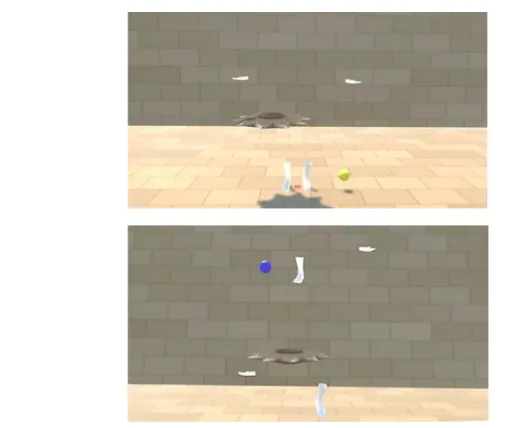
Participants observed visual motions of white gloves and socks 2 m in front of and facing away from them in a virtual room (Figure 2). There was no virtual body in their actual body position. They actually put on white gloves and socks during the experiments. The stimuli were presented either synchronously or asynchronously with the observer’s actions in real time. In the synchronous condition, the gloves and socks moved synchronously with participant’s hands and feet motions.
16
However, there was a system delay of approximately 80 ms and the spatial discrepancy (error) was within 10 cm. In the asynchronous condition, the stimuli were replayed from recordings of another person’s actions.
Figure 2: Schematic of the visual-motor synchronous stimuli. (Left) Participants wore white gloves and white socks, and moved freely. (Center) White gloves and white socks were presented as the invisible body stimuli in Experiments 1–1, 1-2, and 1-3 using an HMD. (Right)
A whole body avatar was presented in the visible body condition in Experiment 1-2.
Procedures
Participants observed virtual white gloves and socks through the HMD, while they moved their arms and legs freely for 5 min. Then, a knife intended to stimulate the startle response appeared and rotated to cut between the gloves and socks. Participants were asked to answer a questionnaire after each trial to evaluate the illusory body ownership. Each participant performed four trials (2 conditions × 2 repetitions) in either SAAS (S: synchronous condition, A: asynchronous condition) or ASSA order.
Thus, the experiment was conducted in within-group design.
In the questionnaire, participants were asked to rate eight items on a seven-level Likert scale ranging from −3 (I did not feel that at all) to 3 (It felt extremely strong) after observing the virtual scene.
1. It felt as if the space between the socks and gloves was my body.
2. It felt as if my body was drifting toward the space between the socks and gloves.
3. It seemed as if I might have more than one body.
4. It felt as if my body became transparent.
5. It seemed as if there is a whole body between the socks and gloves.
6. The movement of the socks and gloves seemed to be my movement.
17
7. The movement of the socks and gloves seemed to be another person’s movement.
8. It felt as if I was cut by a knife.
3.2.2 Results
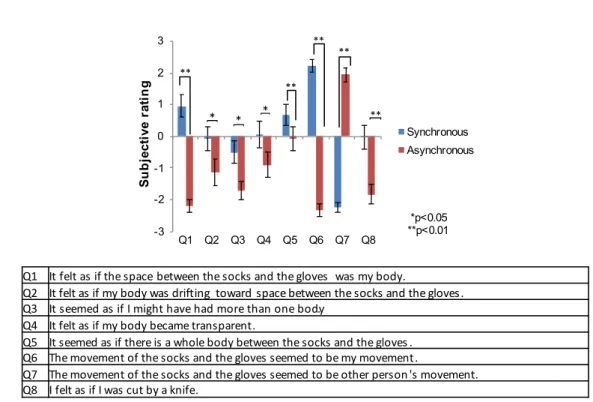
Participants (n = 20) rated the illusory body ownership higher when the virtual gloves and socks moved synchronously with their own movements than the asynchronous condition (Q1 in Figure 3). The feeling of proprioceptive drift toward the invisible body was higher in the synchronous than the asynchronous condition (Q2). They felt as if their own body became transparent (Q4) more in the synchronous than the asynchronous condition. However, the result of Q4 (transparency) in the synchronous condition was approximately 0 (neutral) so the feeling of a transparent body was not obviously stronger relative to the asynchronous condition, although participants did perceive the illusory (invisible) body between the gloves and the socks (Q5) more strongly in the synchronous than the asynchronous condition. Overall, participants did not feel as if they were cut by the knife that suddenly appeared in the asynchronous condition (Q8); although the response in the synchronous condition was higher than the asynchronous condition, its score was approximately 0 (neutral).
These findings were supported by statistical tests, where the Wilcoxon signed-rank test indicated that the ratings of seven questions were significantly higher in the synchronous condition than the asynchronous condition. The probability of superiority of dependent measures (PSdep) indicated the effect size. The findings were; (Q1 [body ownership]: z = 3.84, p < 0.0001, PSdep = 0.95; Q2 [proprioceptive drift]: z = 1.96, p = 0.050, PSdep = 0.6; Q3 [multiple bodies]: z = 2.41, p = 0.015, PSdep = 0.65; Q4 [transparent body]: z = 2.23, p = 0.024, PSdep = 0.6; Q5 [illusory body perception]:
z = 3.12, p = 0.001, PSdep = 0.75; Q6 [synchronous movement]: z = 3.94, p < 0.0001, PSdep = 1; Q8 [body cut]: z = 3.45, p < 0.0001, PSdep = 0.85). The rating of Q7 [asynchronous movement] was significantly higher in the asynchronous condition than the synchronous condition (Q7: z = −3.93, p < 0.0001, PSdep = 1). The participants answered that the gloves and socks moved synchronously with their actions in the synchronous condition (Q6) and moved asynchronously in the asynchronous condition (Q7).
18
Figure 3: Results of Experiment 1-1. Subjective ratings of questionnaires. The error bars indicate SE.
3.3 Experiment 1-2
3.3.1 Methods
Participants
Twenty naïve volunteers (all male, mean 22.55 years old ± 1.36 SD) participated in Experiment 1-2.
None of them participated in Experiment 1-1.
Stimuli and conditions
Apparatus was identical to Experiment 1-1. There were two conditions: the invisible body condition and visible body condition (see Figure 2). The invisible body condition was identical to the synchronous condition in Experiment 1-1. In the visible body condition, a whole-body avatar was presented and moved synchronously with the participant’s actions, in front of and facing away from the participants similarly to the invisible condition. We chose an adult male model in solid white as the whole-body avatar because the participants were all male adults, and its color was identical to the socks and gloves in the invisible condition.
Procedures
19
The stimulus for the startle response was changed to the colliding motion of a table because it was more natural. After 5 min observation for each trial, a similar questionnaire as in Experiment 1-1 was used to evaluate the illusory body ownership. Each participant performed four trials (2 conditions × 2 repetitions) in either IVVI (I: invisible condition, V: visible condition) or VIIV order (within-group design).
In the questionnaire, participants were asked to rate eight items on a seven-level Likert scale ranging from −3 (I did not feel that at all) to 3 (It felt extremely strong) after observing the virtual scene. Q3 and Q8 were changed from Experiment 1-1.
1. It felt as if the space between the socks and gloves was my body.
2. It felt as if my body was drifting toward the space between the socks and gloves.
3. It seemed as if my body became a floor.
4. It felt as if my body became transparent.
5. It seemed as if there is a whole body between the socks and gloves.
6. The movement of the socks and gloves seemed to be my movement.
7. The movement of the socks and gloves seemed to be another person’s movement.
8. It felt as if I collided with the table.
3.3.2 Results
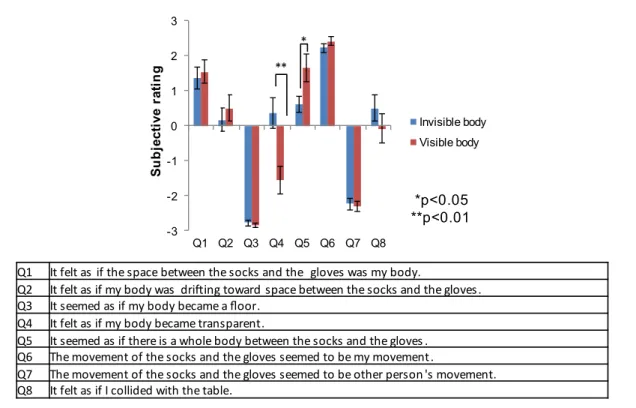
The results of the experiments (n = 20) did not indicate statistical differences between the invisible body condition, i.e. only the gloves and socks were presented, and the visible body condition, i.e. a whole-body avatar was presented, in any questions except for Q4 [transparent body] (z = 3.42, p < 0.001, PSdep = 0.75) and Q5 [illusory body perception] (z = −1.98, p = 0.048, PSdep = 0.75;Figure 4). As there were no differences in the feelings of body ownership (Q1: z = −0.77, p = 0.459, PSdep = 0.6) and proprioceptive drift (Q2: z = −1.13, p = 0.283, PSdep = 0.55), the illusory body ownership of the invisible body seems equivalent to the visible body. However, the visible avatar was not perceived as transparent, and was more clearly perceived as a whole body rather than an invisible body.
Q3 [Body is floor] was a control question to check random responses, and overall scores were close to the minimum value of −3, irrespective of the visibility condition. The participants answered that the virtual stimuli moved synchronously with their actions irrespective of the visibility condition because the virtual stimuli were synchronized with the participants’ actions in all trials of Experiment 1-2 (Q6 [synchronous movement]: z = −1.3696, p = 0.212, PSdep = 0.5; Q7 [asynchronous movement]: z = 0.26, p = 0.826, PSdep = 0.3).
The scores of Q8 [collision with a table] were generally 0, irrespective of the visibility condition (z = 1.49, p = 0.151, PSdep = 0.5). Thus, the feeling of threat was not different between the visible and
20 invisible conditions, and feelings were not strong or clear.
Figure 4: Results of Experiment 1-2. Subjective ratings of questionnaires. The error bars indicate SE.
3.4 Experiment 1-3
3.4.1 Methods
Participants
Ten volunteers (all male, mean 22.2 years old ± 0.87 SD) who participated in Experiment 1-1 participated in Experiment 1-3.
Stimuli and conditions
Stimuli and conditions were identical to Experiment 1-1 except for the control trials. We added two control trials that presented only a virtual room without gloves and socks at the beginning and end of the experiment.
Procedures
21
After observing the stimuli for 5 min, the participants’ proprioceptive self-location was measured. The participants in a black scene of the HMD were moved backward by the experimenter immediately after observing the stimuli in the manner identical to that of Lenggenhager et al. (2007). The moving distance was random, between 2.5 m to 3.5 m. The participants were asked to actually walk and return to the original position where they were observing the virtual scene. In the walking return period, the scene in the HMD remained black. Thus, this task was performed without vision. Each participant performed two control trials (the beginning and the final trials), and four experimental trials (2 conditions × 2 repetitions) in ether SAAS (S: synchronous condition, A: asynchronous condition) or ASSA order. Thus, there were in total six trials (within-group design). In the control trials that were conducted before and after the experimental trials, participants performed the self-localization task after observing the identical room without the socks or gloves by moving their body for 5 min. The self-location data measured in the synchronous and asynchronous conditions were subtracted by the self-location data in the control condition (calibration).
3.4.2 Results
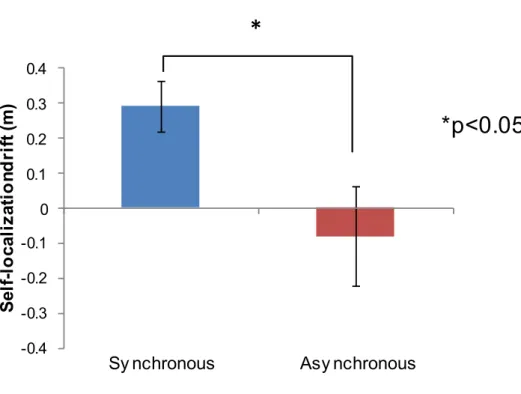
We found that the proprioceptive self-location drifted forward more clearly in the synchronous condition than the asynchronous condition (n = 10, t(9) = 3.101, p = 0.013, d = 0.98; Figure 5). Thus, proprioceptive self-location drift to the invisible body was perceived only for the gloves and socks.
22
Figure 5: Results of Experiment 1-3. Drifts in the self-localization task.
3.5 Discussion
We tested whether body ownership could be induced to an invisible body using virtual socks and gloves synchronized with a participant’s movement. We evaluated body ownership by subjective ratings and the self-localization task. We found that in the body ownership induced by only socks and gloves, observers perceived a complete body between socks and gloves, and the proprioceptive self- localization drift toward the invisible body was similar to the one observed in the full-body ownership illusion (B. Lenggenhager et al., 2007).
In both Experiments 1-1 and 1-2, the feelings of threat to the invisible body and the visible body were not clear, even in the synchronous condition. This may have been caused by the weak illusory body ownership; the score of body ownership was 0.95 (of 3.0 maximum) for the invisible body in Experiment 1-1, 1.38 for the invisible body and 1.55 for the visible body in Experiment 1-2. In the experiments, the exposure time for the visual-motor synchronicity was 5 min. Prolonged exposure may enhance illusory body ownership and feelings toward the threat. Furthermore, one may argue that the low score of the threat is reasonable because the illusory owned body is invisible and the space where the knife cuts is empty. In Experiment 1-2, however, we did not find any difference between the invisible body and the visible body. The participants perceived the invisible body as being interpolated
23
between gloves and socks, similar to the illusory contour or the amodal completion phenomena (Michotte et al., 1991). Thus, invisibility cannot account for the low feelings toward the threat. In a further study, as another measure of the startle response, physiological measures (Armel &
Ramachandran, 2003; González-Franco et al., 2014; Martini et al., 2015) such as skin conductance response (Armel & Ramachandran, 2003) or event-related cortical potentials (González-Franco et al., 2014) should be employed to clarify these findings.
One may argue that the first-person perspective of the virtual body should be used instead of the third- person perspective (rear view of own body). In experiments for illusory body ownership from the first- person perspective, participants are looking down at their own body and/or looking at a mirror placed in front of them. However, in our preliminary observations, we could feel illusory body ownership to the invisible body from the socks and gloves both from the first-person view and from a viewpoint behind the invisible body. By using the latter, we can measure the proprioceptive self-localization drift.
Thus, we adopted the third-person perspective (rear view of own body).
We found that the proprioceptive self-localization drifted to the invisible body area ahead of the participant. This result supports the conclusion that illusory body ownership occurs owing to the invisible body being interpolated between gloves and socks, as do the results of the subjective ratings.
Recently, it has been reported that the size perception of external objects is modulated by changing the size of the illusorily owned invisible body (van der Hoort & Ehrsson, 2016). Therefore, we should try to conduct similar experiments on size perception by using our visual-motor active method.
We showed that visual hands and feet are enough to induce illusory body ownership. However, it is unclear whether hands and feet are a minimal or necessary condition for body ownership. This is a limitation of our study and should be investigated in a future study to understand the cognitive mechanism of body ownership.
The illusion of full-body ownership is useful to investigate the idea of minimal phenomenal selfhood for understanding self-consciousness. Virtual-reality techniques enable illusory body ownership to be more flexible. For example, the strength of the body ownership illusion decreases when the virtual body is more transparent, while the pain sensitivity increases as the strength of body ownership in the semi-transparent condition increases (Martini et al., 2015). The feeling of ownership of a virtual arm and its vicarious agency were decreased by the visual discontinuity of the arm for both static and dynamic postures (Tieri et al., 2015). However, we did not find a significant difference between the gloves and socks condition and the whole body condition. These contradictory results may be owing to the difference between a discontinuity or relatively small gap in a body part for body-part ownership and the empty space between hands and feet for full-body ownership, but we need further study in the future.
Relevant to the present study, we may be able to identify the minimal or necessary condition of the Full-body Illusion or the border between the Full-body Illusion and the body-part ownership illusion
24
by visual-motor synchronicity. Neural mechanisms of body-part ownership and full-body ownership seem different1. We presented only the gloves (hands) and socks (feet) as body parts, but obtained the Full-body Illusion. If we can identify the border between the Full-body Illusion and the body-part ownership illusion and manipulate it without varying the visual stimuli by using a simple experimental parameter, the experimental paradigm would contribute to clarify the difference in neural mechanisms by combining it with a brain imaging technique in future research.
25
Chapter 4
Study II: Scrambled Body Illusion
Abstract
Illusory body ownership can be induced in a body part or a full-body by visual-motor synchronisation.
A previous study indicated that an invisible full-body illusion can be induced by the synchronous movement of only the hands and feet. The difference between body part ownership and the full-body illusion has not been explained in detail because there is no method for separating these two illusions.
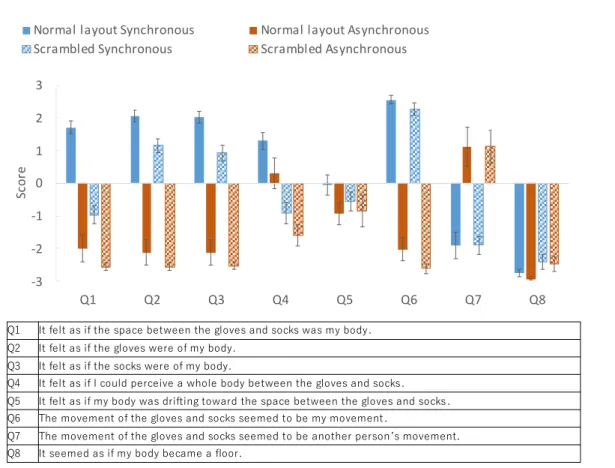
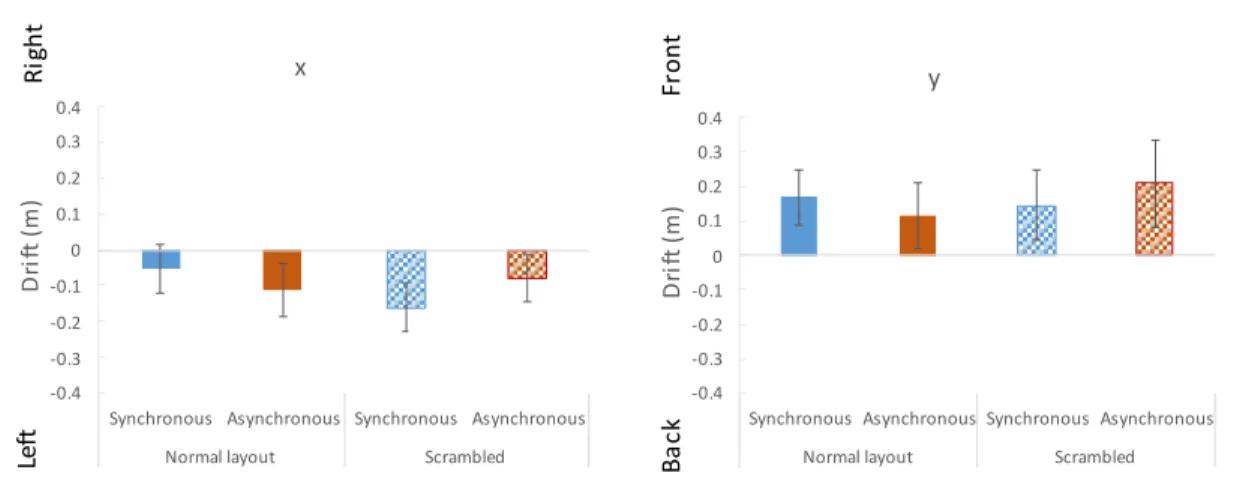
To develop a method to do so, we scrambled or randomised the positions of the hands and feet and compared it with the normal layout stimulus by manipulating visual-motor synchronisation. In Experiment 2-1, participants observed the stimuli from a third-person perspective, and the questionnaire results showed that the scrambled body stimulus induced only body part ownership, while the normal layout stimulus induced both body part ownership and full-body ownership when the stimuli were synchronous with participants’ actions. In Experiment 2-2, we found similar results as with the first-person perspective stimuli in a questionnaire. We did not find significant skin conductance response difference between any conditions in either Experiment 2-2 or 2-3. These results suggest that a spatial relationship is necessary for the full-body illusion, but not for body part ownership.
26
4.1 Introduction
Body part ownership. Humans can have illusory ownership of part of a fake body. In the rubber hand illusion, an experimenter simultaneously strokes a rubber hand and the participant’s hand with a brush.
The participants feel as if the rubber hand is their own hands when they observe only the rubber hand (Botvinick & Cohen, 1998; Manos Tsakiris & Haggard, 2005). When the rubber hand illusion is induced, the proprioceptive sensation of the hand drifts toward the rubber hand. However, Rohde et al., (2011) suggest that proprioceptive drift does not correlate with the illusion. The rubber hand illusion does not occur when the rubber hand is rotated 90 degrees or replaced with a wood-stick, suggesting that the rubber hand illusion is not based on purely bottom-up processes, but also modulated by top-down influences originating from the appearance of one's own body(Manos Tsakiris
& Haggard, 2005). Ide (2013) showed that the anatomical plausibility of hand posture affects the rubber-hand illusion; For the left hand, the illusion was stronger when the rubber hand was placed at 0°, 45°, 90° (easy to mimic with the actual left hand), and 315° than 180°, 225°, 270° (difficult to mimic with the actual left hand by the anatomical constraint). Thus, the incongruence in bottom-up visual and proprioceptive signals could explain why the rubber-hand illusion is eliminated or decreased with the rotated rubber hand. The similar finding has been reported in the fMRI study(H Henrik Ehrsson et al., 2004); When the rubber hand is put on the same posture as real hand, the illusion is induced and the premotor cortex showed stronger activation than when the rubber hand is rotated 180 degrees. In those studies, the illusion is induced by visual-tactile synchronicity. The virtual hand illusion(Sanchez-Vives et al., 2010) and the moving rubber hand illusion (Kalckert & Ehrsson, 2012, 2014) have both been reported using visual-motor synchronicity. In the virtual hand illusion, a virtual arm is presented on a screen synchronised with the participant’s hand movements. The participants then feel as if the virtual arms is their own.
Full-body illusion (FBI). The rubber hand illusion induces the illusory ownership of body parts, but does not induce that of a whole body. The illusory ownership of a full-body has been investigated (full-body illusion). In the full-body illusion, participants feel as if a mannequin (Petkova & Ehrsson, 2008) or a full-body avatar(Gonzalez-Franco et al., 2010; Maselli & Slater, 2013b; Slater et al., 2010) is their own body due to visual-motor or visual-tactile synchronicity. The full-body illusion using a mannequin is induced by stroking the mannequin and the participant’s body at the same time, while the participant observes the stroked abdomen from the position of the mannequin’s head through a head-mounted display (HMD). In a full-body illusion of a virtual reality avatar, the avatar moves synchronously with a participant’s movements(Gonzalez-Franco et al., 2010), or visual-tactile stimuli are presented using virtual balls and vibrations(Maselli & Slater, 2013b). The full-body illusion is stronger and more likely to be induced through a visual-tactile experience from the first-person
27
perspective than the third-person perspective (Maselli & Slater, 2013b; Slater et al., 2010). In the first- person perspective, participants observed the virtual room and the virtual body from the point of view of the virtual body's eyes. In the third-person perspective, the position of participants (the point of view) was horizontally shifted 1 m(Slater et al., 2010) or 40 cm (Maselli & Slater, 2013b) away to the right of the virtual body; Participants could see the virtual body when they turn their head left. When participants observe a fake body from the front (facing each other), the full-body illusion does not occur (Petkova, Khoshnevis, et al., 2011; Preston et al., 2016). On the other hands, the full-body illusion can be induced when participants observe a body from the third-person perspective under certain conditions (Aspell et al., 2009; B. Lenggenhager et al., 2007; Bigna Lenggenhager et al., 2009).
Participants observe a fake body from behind using an HMD while an experimenter simultaneously strokes the back of the fake body and that of the participant. When the visual and tactile strokes are synchronised, participants experience the full-body illusion with the fake body, and their self- localisation drifts towards the fake body. In these studies, participants observe the fake body from behind. However, the self-localisation effect has not been replicated in some studies (Hänsel et al., 2011; Heydrich et al., 2013; Bigna Lenggenhager et al., 2011), and thus it is controversial. The full- body illusion from the third person perspective is a kind of self-recognition similar to recognising oneself in a mirror according to Petkova, et al. (2011) and Ehrsson (2012). Also, Maselli & Slater (2013) discussed that the difference in the illusion strength between the first-person perspective and the third-person perspective can be explained by their theory.
Invisible body illusion. Illusory body part ownership and the full-body illusion can be adapted to create an invisible body illusion. The invisible body illusion is induced by visual-tactile synchronicity (invisible hand (Guterstam et al., 2013), invisible full-body (Guterstam et al., 2015), and invisible small or large body(van der Hoort & Ehrsson, 2016)) or visual-motor synchronicity(Kondo et al., 2018). In the visual-tactile method, an experimenter strokes a participant’s body with a brush and the participant observes the corresponding movement of the brush in empty space through an HMD. In the visual-motor method, participants observe virtual gloves and socks that move synchronously with their own movements. They then feel as if the space between the gloves and socks is their own body, and the invisible body is perceived by interpolating the body parts. This result suggests that the spatial relationship of body parts and the synchronous movement of the hands and feet are important to induce the full-body illusion.
Body part ownership versus the full-body illusion. Several studies have discussed the difference between body part ownership and the full-body illusion. Blanke & Metzinger (2009) and Blanke (2012) claim that body part ownership and the full-body illusion are fundamentally different in terms