Abstract
This article investigates the findings of communication classes in a Japanese university where students were required to speak English outside the classroom environment as part of their homework assignments. A survey was carried out at the end of several semesters over a 5-year period, and completed by 579 students.
The results confirmed that the participants saw the activity as benefiting their study of English. In spite of most Japanese students only speaking English within the confines of a classroom, this research asserts that the homework activity aided the learners in building their fluency levels.
Introduction
As is widely acknowledged, English is most frequently used as a “contact language” between speakers from different linguistic and cultural backgrounds (Baker, 2011, p. 2). In Japan however, the traditional method of grammar-translation instruction within secondary education has resulted in many learners displaying a lack of confidence in their spoken English communication. The emphasis on accuracy and preoccupation with improving test scores in high school classes, has not aided the development of communicative skills in the L2 (Yashima et al, 2004, p. 121). It can therefore be challenging for learners to make the necessary adjustments to develop oral fluency skills when they commence university communication classes. Furthermore, it is suggested that at the tertiary level, opportunities for spoken communication in the L2 within an average classroom setting are limited.
Why Speaking Homework?
Until the author’s current teaching position started, most of her classes were academic writing. Being allotted principally oral communication classes, she was keen to explore methods which would encourage greater fluency amongst her students. As Brown
(2003) specifies, it is essential for teachers to create opportunities in which learners are able to practise English (p. 8), so after talking to a colleague, the author decided to implement a new style of communicative homework, hopeful it would result in greater fluency both inside and outside the classroom. Within a year, an entirely new approach to oral communication homework was adopted, whereby students were asked to conduct Speaking Homework outside the classroom setting for the duration of the semester
(Provenzano and Yue, 2011). This generated many more opportunities to speak the target language than regular teacher-fronted activities.
How Speaking Homework was initially conducted Most of the students in this investigation were in their first year of university; the majority had previously only experienced the grammar-translation method of language learning in school, the original purpose of which is “to help students read literature rather than develop fluency” (Lighthouse and Spada, 2013, p. 154). As Barker (2004) maintains, it is important that learners regard any new activity as helpful in their language development (p. 81). Therefore, prior to commencing this new style of speaking assignment, the procedure, its potential benefits for the learners and expectations of the teacher were explained clearly, reinforcing Greer’s recommendations (Greer 2000, p. 189).
Concurring with Brown’s (2007) firm belief that in order for language learners to become fluent,
Sorrell Yue
On Speaking Terms! Learners’ Views on an Evolving
Out-of-class Activity
they must leave the four walls of the classroom (p. 1), this speaking assignment was completed outside the classroom environment. The students were given the freedom to choose where, with whom, and when they spoke; a few people who lived far from the university used Skype to video chat with one another online. The only stipulation given was that the speaking partner should be someone from the same class. In the case of classes with an odd number of students, two scenarios were documented; either one person would have two separate conversations, or one conversation would involve three participants.
As reported in research conducted by Yue and Provenzano (2010), Speaking Homework comprised three main parts. The first was preparation time, whereby learners spent approximately ten minutes formulating what they wanted to say. After that section was finished, the student and her partner spoke for a specified amount of time, usually on a prescribed topic without any intervention by the teacher. Finally, the speakers completed a reflection section and commented on what they or their partner said in the conversation.
One year later
The author believed she saw and heard a marked difference in the level of the students’ communicative skills. It was therefore decided to conduct research on the topic of Speaking Homework and distribute a survey to all the students in classes where this activity was being used to ascertain the learners’
views regarding the assignment. From the results, it became clear that the majority of students remarked that Speaking Homework had benefitted their spoken English, as discussed by Provenzano and Yue (2011).
Having noted the perceived efficacy of this activity by the students, the author further developed the use of Speaking Homework in her classes. The learners were asked to record and upload two conversations per semester for the instructor to listen to as part of their class assessment. There was no written script or practice prior to the conversation.
However, the participants were given time to think about the topic and asked to prepare three questions they wanted to ask their partner, and make brief notes on things to share on the given topic. After their conversations ended, the students were instructed to listen to the recordings and transcribe precisely what they had said, including any use of the L1. Similar to
Lynch’s reasoning for utilising transcripts, the author wanted the conversations to be visible so the students found it easier to notice different components of their communication (Lynch, 2007, p. 312).
After transcribing their dialogues, the students were asked to review them and remark on what they observed about how they spoke, paying particular attention to their use, or lack, of communication strategies. Although the participants were encouraged to modify any incorrect grammar, the main objective was to establish whether they noticed how they communicated with one another in the target language.
Where appropriate, recommendations were made on how any unnatural aspects of the conversation could be altered to sound more natural. This was a different way of using transcripts from Lynch (2007), who required his learners to reformulate their transcripts and then repeat the corrected dialogue.
Since the first year of implementing Speaking Homework, the activity has evolved and the initial
“preparation” and “noticing” sections in particular have changed significantly.
Modifications to the “Preparation” stage of the activity
For the first few years of conducting Speaking Homework, students were asked to spend time preparing questions before starting their conversation.
The majority used their prepared questions in addition to extending their conversations naturally.
For some learners however, rather than aiding their conversation, the interlocutors restricted themselves to merely asking what was written on their paper. In addition, some learners rehearsed their conversations, contrary to the directions given by the instructor.
From the survey results of a total of 488 participants, over 60% noted their enjoyment of the activity (Yue and Provenzano, 2010, Provenzano and Yue, 2011). The author therefore decided to assess whether students, without having prepared questions on which to fall back, would consider the activity as enjoyable as their counterparts.
Speaking
In class, students were taught to listen actively and show comprehension, in addition to using a variety of other gambits. These communication strategies were
added to on a regular basis and used in conversations throughout class time. The learners were then encouraged to practise this style of communication during their Speaking Homework. In the early days of this assignment, students were asked to speak without recording any conversations. This progressed into recording two or three conversations per semester for assessment purposes. Nevertheless, the logistics of over 100 students borrowing university IC recorders within a one-week period to record their conversations outside class time, and then having the data uploaded, resulted in a lot of extra work before the teacher could listen to the conversations. Nevertheless, thanks to advances in technology, recording conversations has become much less complex since the majority of students now have smartphones.
Most weeks a topic was given to the learners which had been central to that week’s classroom activities. Periodically, students were given the freedom to choose a subject which appealed to both speakers. The instructor told the students the minimum amount of time they should speak
(between two and three minutes at the outset), and the length requirement gradually increased (up to a minimum of eight minutes). The learners recorded the conversations on their smartphones and saved the data. The author wanted to investigate the extent to which her students tried to use only English during the activity.
Noticing
Requiring students to reflect on their conversations has been a principal tenet of Speaking Homework since its inception. As Peak (1991), explains, the concept of evaluation, or hansei, is a central part of Japanese culture and commonly used after a task has been completed(p. 107). Even though hansei may be perceived as negative by those less familiar with Japanese culture, the author concurs with Peak’s view that it instills “an independent ability for self-evaluation”
(Peak, 1991, p. 107) which is easily adopted to benefit L2 learners of English. This reflective style of learning amongst Japanese school children has been further documented by Nelson (1995). Similar to Hunter’s research into developing fluency and accuracy, the interlocutors in the Speaking Homework assignment reflected on how they communicated (Hunter, 2012, p.
33).
Whereas in previous years students had relied on their memory to remark on what they noticed in their conversations, the author questioned whether it might not be more beneficial for them to listen to a recording of their conversations and subsequently write answers to specific questions about their interaction. In order for the participants to adapt to the task, the first
“noticing” section was completed in class time with the instructor monitoring what was written. When learners were absent from class, a copy of that week’s Speaking Homework was made available on the class blog, which could be downloaded by the students. In this way, everyone was given the same opportunity to complete the assignments. The Speaking Homework paper was adjusted throughout the semester as the learners became more competent at using different strategies taught in class (see Figures 1 and 2). Furthermore, students were required to note down how many minutes they spoke, and save the recorded data to show the instructor in class.
The instructor collected the assignment papers and returned them in the following class. One potential reservation of non-native speakers communicating without any interference from the teacher is in regard to incorrect linguistic features becoming fossilised.
Therefore, any grammar mistakes written on the Speaking Homework papers were corrected, and where applicable, teacher feedback about the dialogue or use of communication strategies and other linguistic features were noted down. It soon became evident that the learners responded to the feedback and actively used corrected forms in their communication both inside and outside the classroom.
What did you say to start your
conversation? Did you return questions? How did you end the conversation?
A:
B:
A:
B:
A:
B:
A:
B:
Figure 1. Week 2 Noticing Section
What did you say to start your
conversation? How did you return questions? Give
two examples. How did you end the conversation?
A:
B:
A:
B:
A:
B:
A:
B:
Write examples of where you used
shadowing: Write at least 2 follow-up questions
you asked: Write extra information you gave in
at least two of your answers?
What did you say to show interest or
surprise in what your partner said? What did you say to show your
partner you were listening? How did you show your partner when you were thinking what to say?
Did you use any Japanese? If you spoke Japanese, what did you say? (Write an English translation too please!)
Any other conversation strategies you used:
Figure 2. Week 13 Noticing Section
Revising
Twice a semester, the learners recorded and then transcribed a complete and unrehearsed conversation on a given topic. This conversation was recorded not only on the students’ devices, but also on the instructor’s IC recorders. In this way, the dialogues could be uploaded and listened to by the teacher. The following week, the students brought their complete transcripts to class. Similar to studies conducted by Lynch (2007) and Mennim (2012), the author’s students were asked to work with their partner and complete different tasks during class time. In this way, the learners were verbalising “the process by which they were deciding how to improve their transcribed performance” (Lynch, 2007, p. 317).
Before they reformulated any part of their dialogue, the students read their original conversation out loud verbatim to help raise awareness of any language structures they used correctly, or grammatical errors they made. The learners then highlighted and labelled strategies which had been learnt in class and used correctly. Subsequently, they corrected errors they noticed and adjusted parts of the conversation that sounded unnatural to them. One example of where learners sometimes made alterations related to having changed the topic mid-conversation in a stilted way. Finally, the particpants gave written feedback on their thoughts about the conversation.
Wanting to ascertain if there were any noticeable differences in the students’ perceptions of the
activity from previous research (Yue, 2013), further investigations were conducted and the overall results compared.
The Survey
A bilingual (English and Japanese) survey, adapted from those administered in previous research carried out by the author (Yue and Provenzano, 2010, Provenzano and Yue, 2011, Yue 2013), was conducted in the 2015 spring semester to determine student response to the Speaking Homework assignment. The survey comprised 17 statements and used a 5-point Likert Scale format;
from strongly agree to strongly disagree. Although the survey was anonymous, students were asked to indicate whether they were male or female.
Questions for research
The purpose of the study was to investigate the students’ own perceptions of the enjoyment and efficacy of different aspects of this further updated method of Speaking Homework.
In relation to their counterparts who had previously completed Speaking Homework surveys:
ⅰ Did the students consider the speaking activity enjoyable?
ⅱ To what extent did the participants try to use English?
ⅲ Did the learners feel their spoken English
improved?
ⅳ Did the students consider the time spent speaking English outside class valuable?
ⅴ How did the students respond to the transcription activities?
Method
Survey respondents
The participants were a heterogeneous group of 93 students, enrolled in oral communication classes in their first year at a large private university.
Because the students were from four different departments, economics, mathematics, pharmacy and technology, there was a range of confidence and ability represented in each classroom. While the average class size was 25 students, a few did not attend on a regular basis. 91 of the learners completed the aforementioned survey in the penultimate class of the 15-week semester. The students comprised 52 males and 39 females, who were required to take the class in their first semester of university, after having completed 6 years of compulsory English education in junior and senior high school.
Results and Analysis
(See Appendix1 and 2 for a complete list of the data discussed here.) This research compares the survey results from 2015 with previous data collected between 2010 and 2011. The survey was regularly adapted to match the content and focus of the particular courses being taught. As a result, there are varying numbers of respondents depending on the questions asked in each survey. The data relates to the students’ observations of six aspects of Speaking Homework.
1. The enjoyment factor
Statement 1. I enjoyed doing Speaking Homework.
Of the 2105 respondents, 68.13% stated that they enjoyed doing Speaking Homework and 18.68%
disagreed. Of the data collected previously, 62.30%
agreed with the statement while only 10.65%
disagreed. The more recent data demonstrates a greater proportion of students enjoying the activity, yet there was also a visible difference in those who demonstrated a lack of enjoyment. It is difficult to
assess whether the reason for the higher percentage of students who disagreed with the statement lies with the lack of preparation time before speaking, or if they merely did not want to speak English outside class time.
2. Use of the L2 during the assignment
Statement 2. I tried to use only English in my Speaking Homework times.
While 62.38% of the 2015 students agreed with this statement, almost 20% (19.78%) disagreed. These figures differ from previous research where 67.99%
agreed and 14.38% disagreed. Both groups of learners used English during most of class time, so the author was interested that a relatively large percentage of students admitted to using their L1 during the activity.
Although impossible to prove, it is conceivable that these differences relate to a lack of preparation time for the more recent learners. Previously, learners had been able to consult a dictionary and were afforded the opportunity to note down vocabulary items, in addition to questions they wanted to ask, before speaking.
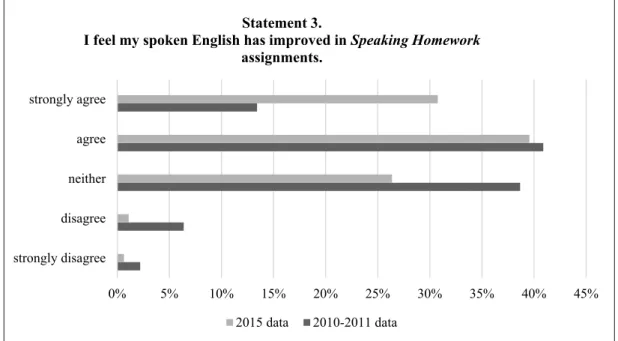
3. Perceived improvement by the students Statement 3. I feel my spoken English has improved in Speaking Homework assignments.
Of all the data compared with previous studies on Speaking Homework, this statement had the greatest variance. In 2015, a total of 70.33% of the learners stated that they perceived an improvement in their speaking assignments and only 3.3% disagreed. In previous studies however, a total of 54.31% agreed with the statement, while 7.03% disagreed. The author speculates whether the difference in results is associated with the 2015 learners adapting to having no prompts to rely on, but rather needing to employ the strategies taught in class time.
Figure 3. Results for Statement 3 (404 respondents)
4. Perceived value of the assignment
Statement 4. I found the time spent speaking English outside class valuable.
In the latest research, over 62% of the respondents stated that speaking outside the class environment was of value, compared with over 55% in the combined previous research. Only 39 people out of data accumulated from all 465 respondents disagreed with this statement. This reinforced the author’s view that students recognised the significance of using their spoken English beyond the confines of the classroom.
Figure 4. Total results (2010 ~ 2015) for Statement 4 (465 respondents)
5. Noticing
Statement 5. Listening to my recorded conversations helped me to identify my weaknesses in my oral English communication.
0% 5% 10% 15% 20% 25% 30% 35% 40% 45%
strongly disagree disagree neither agree strongly agree
Statement 3.
I feel my spoken English has improved in Speaking Homework assignments.
2015 data 2010-2011 data
strongly agree, 12.90%
agree, 43.87%
neither, 34.84%
disagree, 7.53%
strongly disagree, 0.86%
Statement 4.
I found the time spent speaking English outside class valuable Figure 3. Results for Statement 3 (404 respondents)
4. Perceived value of the assignment
Statement 4. I found the time spent speaking English outside class valuable.
In the latest research, over 62% of the respondents stated that speaking outside the class environment
was of value, compared with over 55% in the combined previous research. Only 39 people out of data accumulated from all 465 respondents disagreed with this statement. This reinforced the author’s view that students recognised the significance of using their spoken English beyond the confines of the classroom.
Figure 3. Results for Statement 3 (404 respondents)
4. Perceived value of the assignment
Statement 4. I found the time spent speaking English outside class valuable.
In the latest research, over 62% of the respondents stated that speaking outside the class environment was of value, compared with over 55% in the combined previous research. Only 39 people out of data accumulated from all 465 respondents disagreed with this statement. This reinforced the author’s view that students recognised the significance of using their spoken English beyond the confines of the classroom.
Figure 4. Total results (2010 ~ 2015) for Statement 4 (465 respondents)
5. Noticing
Statement 5. Listening to my recorded conversations helped me to identify my weaknesses in my oral English communication.
0% 5% 10% 15% 20% 25% 30% 35% 40% 45%
strongly disagree disagree neither agree strongly agree
Statement 3.
I feel my spoken English has improved in Speaking Homework assignments.
2015 data 2010-2011 data
strongly agree, 12.90%
agree, 43.87%
neither, 34.84%
disagree, 7.53%
strongly disagree, 0.86%
Statement 4.
I found the time spent speaking English outside class valuable
Figure 4. Total results (2010〜2015) for Statement 4 (465 respondents)
5. Noticing
Statement 5. Listening to my recorded conversations helped me to identify my weaknesses in my oral English communication.
When the previous data was compiled, the students
completed most noticing tasks by relying on what they could remember from the conversation once it had finished. Therefore, when the former respondents selected an answer for this statement, they were only reflecting on their recorded conversations conducted in week 2 and week 13 or 14 of the semester. Just over
80% of the former learners agreed with the statement.
The author was encouraged to note from the 2015 data, that a very similar number of respondents
(79.12%) also indicated their agreement. The latter group of students was required to record and listen to their conversations on 10 different occasions during the semester.
6. Transcribing conversations
Statement 6. Writing a transcript helped me to see how I communicate in English.
In both the 2015 group and those who completed the surveys previously, a total of over 88% agreed with this statement. For the conversations at the beginning and end of semester, students were asked to transcribe the entire conversation verbatim.
Furthermore, the 2015 learners were required to listen to their conversations each week and select segments to transcribe which answered the questions on their Speaking Homework paper. While this took time at the beginning, the students quickly comprehended the necessary techniques to help identify strategies which had been practised in class time. The author believes this aspect of noticing aided the students in developing their use of communication strategies, which resulted in noticeably extending their conversations.
Statement 7. Reviewing the transcript helped me to see how I could improve my English oral communication skills.
An important principle of Speaking Homework is when learners reflect on what they have said in order to develop greater fluency and more natural linguistic features. Approximately 65% of all the respondents indicated their agreement with this statement and only 6% disagreed. As Stillwell et al (2010) explain, the author likewise concludes “transcription provides valuable opportunities for students to gain insight into their language development” (p. 453). By reading what was actually spoken, the learners are able intentionally to insert exchanges or avoid unnatural utterances in their future assignments, thereby enhancing their communication.
Discussion
This assessed data from 579 respondents and collated over the last five years, illustrates how, for the most part, Speaking Homework has been positively
received. The pedagogical aim of Speaking Homework was to improve oral fluency among learners of English.
In spite of using an atypical method of study, students considered it beneficial in developing different aspects of their second language acquisition. After employing this communicative activity outside the class environment, the author noted an increase in fluency amongst the students, which corroborates Barker’s findings (Barker 2004, p. 83).
Whereas the prevalence of smartphones has been a huge aid in the Speaking Homework classrooms, it is still problematic to send or upload longer conversations from smartphones. Even though the author has attempted various ways to overcome this issue, she has yet to find a reliable method that can be implemented in the classroom.
The “time factor” is one aspect which has not been adequately addressed here. Teaching multiple communication classes, each with an average of 25 students, conducting Speaking Homework on a regular basis presents some challenges for the instructor.
Although it would be ideal for the teacher to listen to students’ recorded conversations on a monthly basis to assess their entire content, this takes time and is not practical for those with a full teaching schedule.
Furthermore, in this study, as the learners grew in confidence and spoke for much longer than the minimum time requirement, listening to their recorded conversations to complete the noticing activities took a considerable amount of time.
There will always be students who struggle with more unconventional forms of teaching, and particularly those who question the validity of emphasising oral interaction in the L2 between non-native learners without intervention from the instructor. In Long and Porter’s study (1985)
however, the researchers concluded “learners’ speech showed no differences across contexts” (Long &
Porter, 1985, cited in Lightbrown and Spada, 2013, p. 167). As McDonough (2004) explains however, instructors benefit by discussing their learners’ ideas and thoughts about how the L2 is learnt and taught (p. 222). In this way, students can better understand how activities, class procedures and course objectives benefit their language acquisition process.
Conclusion
This investigation revealed that the majority
of respondents believed Speaking Homework had benefitted their language development in various ways.
The instructor’s premise that the learners had become distinctly more fluent in class was supported by the increasing length of the recorded dialogues in the L2.
The rationale for requiring segments of the dialogues to be transcribed on a regular basis was to build noticing skills with a view to the students acquiring new language and developing their spoken language skills. There are aspects of the activity nevertheless, which need improvement, especially with regard to facilitating the uploading of conversations. It is also important to note, that in this study there was no control group, therefore any results presented should be considered suggestive rather than conclusive.
References
Baker, Will (2011). From cultural awareness to intercultural awareness: culture in ELT, ELT Journal. Doi:10.1093/elt/ccr017. Retrieved from https://eltj.oxfordjournals.org/
Barker, David. (2004). Encouraging students to take their language learning outside the classroom.
JALT Hokkaido Journal (8), 79-86.
Brown, H. Douglas. (2007). Principles of language learning and teaching (5th ed). New York: Longman.
Brown, James Dean. (2003). Promoting fluency in EFL classrooms. Proceedings of the 2nd annual JALT Pan-SIG conference. Retrieved from https://jalt.
org/pansig/2003/HTML/Brown.htm
Greer, David L. (2000). “The Eyes of Hito”: A Japanese Cultural Monitor of Behavior in the Communicative Language Classroom, JALT Journal, 22(1), 183-195.
Hunter, James (2012). “Small Talk”: developing fluency, accuracy, and complexity in speaking, ELT Journal Volume 66(1), 30-41.
Lighthouse, Patsy M. and Spada, Nina (2013). How Languages are Learned (4th edition). Oxford: Oxford University Press.
Long, Michael H. and Porter, Patricia (1985). Group work, interlanguage talk, and second language
acquisition. TESOL Quarterly, 19(2), 207-228.
Lynch, Tony (2007). Learning from the transcripts of an oral communication task. ELT Journal, Volume 61(4), 311-319.
McDonough, Kim (2004). Learner-learner interaction during pair and small group activities in a Thai EFL context, System, 32, 207-224.
Mennim, Paul (2012). Learner negotiation of L2 form in transcription exercises. ELT Journal, Volume 66
(1), 52-61.
Nelson, Gayle, L. (1995). Cultural Differences in Learning Styles in Learning Styles in the ESL/
EFL Classroom, ed. Reid, Joy, M. Boston: Heinle and Heinle.
Peak, Lois (1991). Training learning skills and attitudes in Japanese early education settings. In A. Imamura
& J. Tobin (Eds), Transcending stereotypes:
Discovering Japanese culture and education. 96-108.
Yarmouth, ME: Intercultural Press.
Provenzano, Christie and Yue, Sorrell (2011). Take it Outside! -Speaking Homework for English Communication Classes. International Communication Studies, 20(2), 220-238.
Stillwell, Christopher, Curabba, Brad, Alexander, Kamsin, Kidd, Andrew, Kim, Euna, Stone, Paul, and Wyle, Christopher (2010). Students transcribing tasks: noticing fluency, accuracy and complexity.
ELT Journal, 64(4), 445-455.
Yashima, Tomoko, Zenuk-Nishide, Lori, Shimizu, Kazuaki, (2004). The Influence of Attitudes and Affect on Willingness to Communicate and Second Language Communication. Language Learning, 54
(1), 119-152.
Yue, Sorrell and Provenzano, Christie (2010). Tried and Tested: Expanding Speaking Opportunities for EFL Students. FULERC Annual Review of Language Learning and Teaching, 9, 145-155.
Yue, Sorrell (2013), Transcription: A Tool In Aiding EFL Communication. Fukuoka University Review of Literature and Humanities, XLV (176.177), 71- 86.
APPENDIX 1. Results of Speaking Homework as percentages
Strongly agree Agree Neither Disagree Strongly disagree
1. I enjoyed doing Speaking Homework
2015 (91) 21.98 46.15 13.19 17.58 1.10
2010〜2011 (488) 12.30 50.00 27.05 8.81 1.84
2. I tried to use only English in my Speaking Homework times.
2015 (91) 15.38 47.25 17.58 15.38 4.40
2010〜2011 (313) 18.85 48.24 18.54 13.74 0.64
3. I feel my spoken English has improved in Speaking Homework assignments.
2015 (91) 30.77 39.56 26.37 1.10 2.20
2010〜2011 (313) 13.42 40.89 38.66 6.39 0.64
4. I found the time spent speaking English outside class valuable.
2015 (91) 21.98 40.66 30.77 4.40 2.20
2010〜2011 (374) 10.70 44.65 35.83 8.29 0.53
5. Listening to my recorded conversations helped me to identify my weaknesses in my oral English communication.
2015 (91) 31.87 47.25 17.58 3.30 0
2011 (175) 34.86 45.71 14.29 4.57 0.57
6. Writing transcripts helped me to see how I communicate in English.
2015 (91) 36.26 49.45 9.89 2.20 2.20
2011 (175) 38.29 51.43 7.43 2.86 0
7. Reviewing the transcripts helped me to see how I could improve my English oral communication skills.
2015 (91) 17.58 47.25 28.57 6.59 0
2011 (175) 24.57 42.86 26.86 4.57 1.14
APPENDIX 2. Results of Speaking Homework as number of respondents
Strongly agree Agree Neither Disagree Strongly disagree
1. I enjoyed doing Speaking Homework
2015 (91) 20 42 12 16 1
2010〜2011 (488) 60 244 132 43 9
2. I tried to use only English in my Speaking Homework times.
2015 (91) 14 43 16 14 4
2010〜2011 (313) 59 151 58 43 2
3. I feel my spoken English has improved in Speaking Homework assignments.
2015 (91) 28 36 24 1 2
2010〜2011 (313) 42 128 121 20 2
4. I found the time spent speaking English outside class valuable.
2015 (91) 20 37 28 4 2
2010〜2011 (374) 40 167 134 31 2
5. Listening to my recorded conversations helped me to identify my weaknesses in my oral English communication.
2015 (91) 29 43 16 3 0
2011 (175) 61 80 25 8 1
6. Writing transcripts helped me to see how I communicate in English.
2015 (91) 33 45 9 2 2
2011 (175) 67 90 13 5 0
7. Reviewing the transcripts helped me to see how I could improve my English oral communication skills.
2015 (91) 16 43 26 6 0
2011 (175) 43 75 47 8 2