東北公益文科大学総合研究論集第36号 抜刷 2019年7月30日発行
An empirical analysis of the relationship between remittances and the real effective exchange rate for Tajikistan
SULTONOV Mirzosaid
研究論文
An empirical analysis of the relationship between remittances and the real effective exchange rate for Tajikistan
SULTONOV Mirzosaid
Abstract
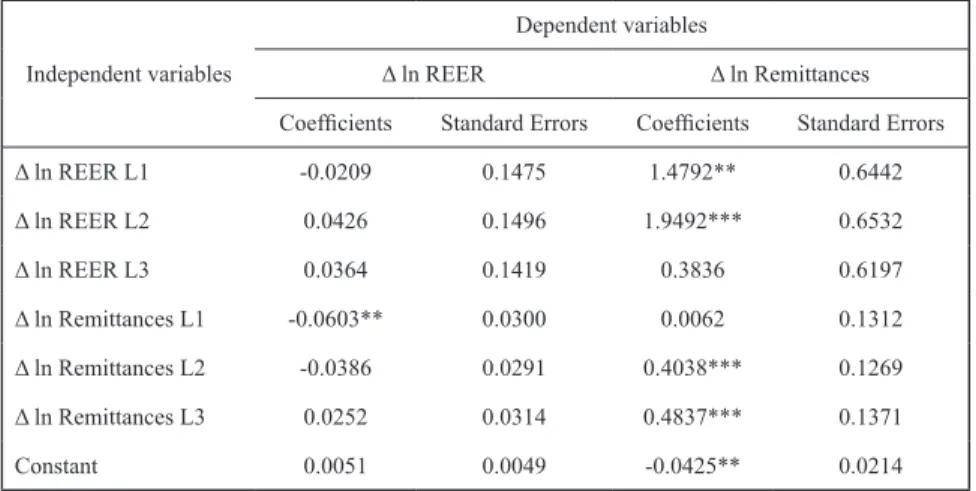
Using a combination of vector autoregressive (VAR) modelling and the Granger causality test, this study examines the relationship between remittances and the real effective exchange rate (REER) in the case of Tajikistan. The paper contributes to empirical studies on the relationship between remittances and REER in a country with remittance inflows equal to a significant share of its gross domestic product (GDP). The research results are based on the logarithmic difference of seasonally adjusted quarterly data demonstrating a short term bidirectional causality between remittances and REER.
Keywords: remittances, REER, Tajikistan
1. Introduction
In Tajikistan, personal remittances received from abroad, comprised of personal transfers and employee compensation, were equal to 20.2% to 49.3% of the gross domestic product (GDP) for the period 2005 to 2016, fluctuating between 26.9% to 49.3% of GDP from 2007 to 2016
1. Such a vast inflow of foreign currency could be associated with changes in important macroeconomic fundamentals.
The relationship between remittance inflow and the exchange rate in remittance- recipient countries has attracted many researchers. The existing studies show depending on the specifics of the economy an inflow of remittances could be associated with the appreciation or depreciation of the exchange rate, or the relationship could be statistically insignificant (e.g., Amuedo-Dorantes and Pozo, 2004; Lopez, Bussolo, and
1
Source: World Bank
Molina, 2007; Acosta, Lartey, and Mandelman, 2009; Ball, Cruz-Zuniga, Lopez, and Reyes, 2008; Barajas, Chami, Hakura, and Montiel, 2010; Kamar, Bakardzhieva, and Naceur, 2010).
Due to the lack of data and low number of observations, the relationship between remittances and the real effective exchange rate (REER) in the case of Tajikistan has not been researched properly. The National Bank of Tajikistan does not report REER time series in a manner appropriate for use in estimates. The REER data used in this paper are calculated by the author.
The paper contributes to empirical studies on the relationship between remittances and REER in the case of a country with remittance inflows equal to a significant share of the GDP.
The next two sections present the empirical analysis and concluding remarks.
2. Empirical analysis
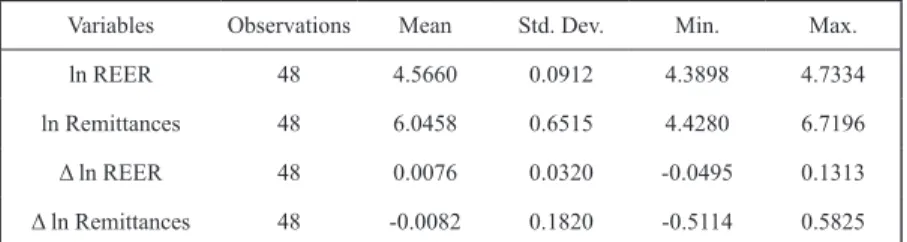
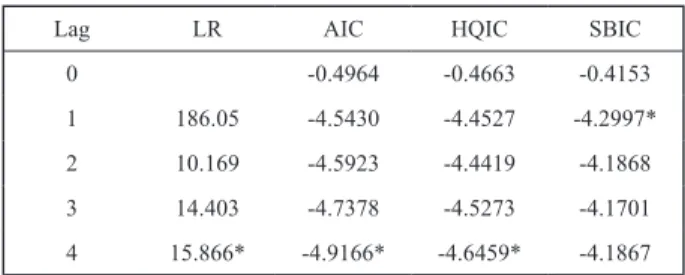
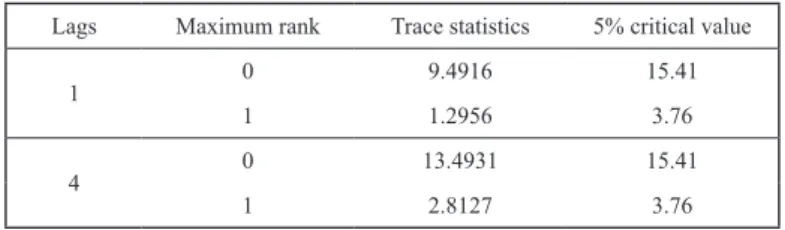
In estimation, logarithmic differences of seasonally adjusted quarterly data were used on remittance inflows and REER for the period of 2005 Q1 to 2016 Q4. REER is measured as the nominal exchange rate of the national currency of Tajikistan (the Somoni) against a weighted average of four foreign currencies (main trade partners Russia, China, Turkey and Kazakhstan) adjusted by the relative price (foreign price divided by domestic price).
The nominal exchange rate is as reported by the National Bank of Tajikistan. The price level and the weight of trade with the main trade partners are as reported by the national statistics of Tajikistan. The price levels for trading partners are as reported by the national statistics of Kazakhstan and the Organisation for Economic Co-operation and Development (OECD) statistics
2. The nominal exchange rates are used as amount of national currency (the Somoni) per unit of foreign currency, and an increase in REER is a depreciation for the Somoni.
The remittance data are valued in millions of USD. The data on remittances are
2