Received July 23, 2012
** Center for Geo-Environmental Science, Graduate School of Engineering and Resource Science, Akita University
*** Department of Earth Science and Technology, Graduate School of Engineering and Resource Science, Akita University
**** Mining and Metallurgy Institute Bor, Serbia
***** Department of Materials-Process Engineering and Applied Chemistry for Environments, Graduate School of Engineering and Resource Science, Akita University
****** International Center for Research and Education on Mineral and Energy Resources, Akita University
Geochemical Characteristics of Mine Drainage Water and River Water in the Bor Mining Area, Serbia:
Results of Study in 2011
Daizo Ishiyama**, Hiroshi Kawaraya**, Hinako Sato***, Ljubisa Obradovic****, Branko Blagojević****, Jelena Petrovic****,
Vojka Gardic****, Zoran Stevanovic****, Atsushi Shibayama*****, Nobuyuki Masuda****** and Yasushi Takasaki******
Abstract
Investigation was carried out in the region from the Bor mining area through Timok River to the Danube to evaluate the usefulness of a handy-type chromometer for chemical analyses in the field in environmental study and to understand the environmental impact caused by mining activities in the Bor mining area.
The handy-type chromometer is useful for chemical analyses in the field because (1) it is possible to obtain data for environmental evaluation even if there is not enough advanced apparatus for chemical analyses and (2) planned sampling points before the field survey can be changed easily to optimize sampling points for the survey according to the progress of investigation.
Variation in the chemical composition of river water containing mine drainage water is large at some points in the Bor mining area. The variation is thought to have been caused by the development plan for exploitation at the open pit.
River water from the Bor mining area to a point (P-15) of the lower reach of Bela River (approximately 25 km) contains high copper and iron contents. The copper content of river water in the lower reach of Timok River was lower than that of the water quality standard, suggesting that the impact of mine drainage water from the Bor mining area on the environment of the lower reach of Timok River was small and that the effect on quality of river water of the Danube was also small in August 2011.
1. Introduction
Iron hydroxide and aluminum hydroxide are important because these speices absorb heavy metals and harmful elements in river and lake waters and precipitate with these elements at the bottom of rivers and lakes(1). As a result of this mechanism, purity of water is improved in the natural environment. When properties of heavy metals
and harmful elements are examined to evaluate the environmental impact in a natural system such as mine drainage water and river water around a mine, data on the chemical compositions of iron and aluminum are necessary.
Recently, a handy-type chromometer has been improved due to developments in electronics. As a result, measurements of the concentrations of some chemical species such as total Fe, Fe2+ and Al in the field have been easy. These improvements also allow us to conduct a preliminary study on environmental evaluation in countries in which there is not sufficient equipment such as atomic absorption spectroscopy (AAS), inductively-coupled plasma optical emission spectrometry (ICP-OES) and inductively-coupled plasma mass spectrometry (ICP-MS) for chemical analyses. The aims of this study are to determine the validity of a handy-type chromometer in the field for environmental study and to clarify the present impact of mine drainage water from overburden and wastewater from mining facilities on the natural environment in the region from the Bor mining area to the Danube.
研究報告
Fig. 1 Map showing the river system and sampling sites from the Bor mining area to the Danube. The enlarged illustration in Fig. 1 is a map shown in the report of Waterpackage 4(2). The long axis of Bor open pit is approximately 1 km.
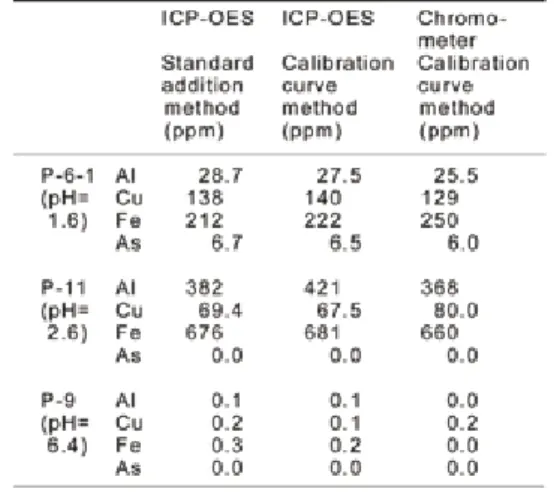
Table 1 Chemical compositions of mine drainage water determined by the chromometer and ICP-OES.
2. Area studied and samples
The Bor mining area is one of the important copper-producing areas in Serbia (Fig. 1). The ore deposits in the mining area are porphyry copper deposits.
Mine drainage water and wastewater from mining development can affect the human and natural environments around a mining area. Investigation was carried out in the region from the Bor mining area through Timok River to the Danube from August 10 to 24 in 2011.
Surveys and sampling were carried out at 20 sites in total (Fig. 1). Samples collected at each site were solutions for chemical analyses of cations and anions (mine drainage water, wastewater from mineral processing plants, urban wastewater and river water), residues of the solution trapped on a 0.45-m filter and sediments on the riverbed.
Mine drainage water from the Bor mine and overburden, wastewater from the smelter, and urban wastewater from Bor City were collected around the Bor mine. Other samples in this study were river water collected from Bor River, Veliki Krivelj River, Bela River, Timok River and the Danube.
3. Analytical procedure
Color, flow rate, temperature, pH, value of oxidation/reduction potential (Eh), and concentration of
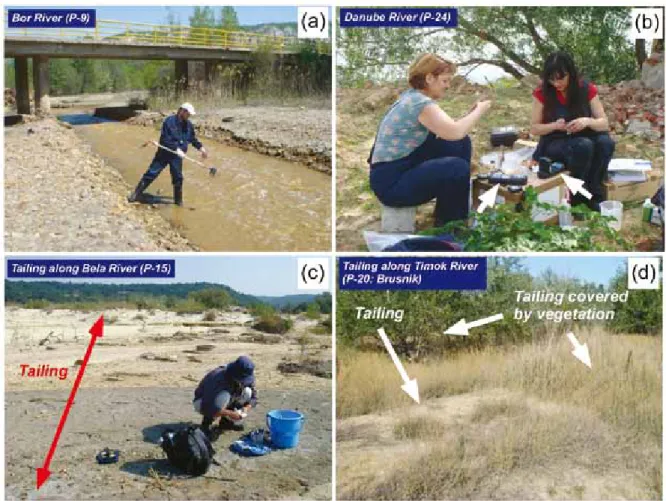
Fig. 2 Field survey in the field in the Bor mining area. (a) Sampling of river water from Bor River. (b) Chemical analyses by the chromometer (white arrows) in the field along the Danube. (c) Large tailing at P-15 along Bela River. (d) Tailing (light brown part similar to sand) and tailing covered by vegetation at P-20 (Brusnik) along Timok River.
dissolved oxygen in the solutions in this study were determined in the field (Fig. 2). Samples for chemical analyses were collected up to a depth of 30 cm from surface.
The samples were filtered by a 0.45-m filter. Containers for sample solution (cells for chromometer and plastic bottles) were washed with filtrated solution three times.
Cu, Fe2+, total Fe (T-Fe), Mn, Si and Al contents in the solutions were also measured using a chromometer (HACH Company, DR-890) after filtration in the field (Fig. 2b).
Detection limits of concentrations of those elements determined by the chromometer were 1 ppm for Si and 30 ppb for Al, T-Fe, Mn, Cu and Mo. Concentrations of impurities in a blank solution were examined by ICP-MS of Actlabs in Canada. The concentrations of Si, Al, T-Fe, Mn, Cu, Mo and As in the blank solution were < 0.2 ppm, 3 ppb, 10 ppb, < 0.1 ppb, < 0.2 ppb, < 0.1 ppb and < 0.03 ppb, respectively. Those concentrations were below the detection limit, and effect of contamination from the container was negligible for chemical analyses determined by the chromometer. Fe3+ content was calculated by subtracting Fe2+ content from T-Fe content. Arsenic
content was also measured in the field using a test kit produced by LaMotte Company. The detection limit was 4 ppb. When concentration in water samples were measured using the chromometer in the field, samples were diluted with distilled water 10 to 1000 times to obtain a suitable range of concentrations and suitable pH (around 4) for the measurements, especially in acidic solutions.
Accuracy of results of chemical analyses using the chromometer was examined on the basis of comparison of the results obtained by the chromometer and ICP-OES (SPECTRO Ciros Vision made in Germany) in the Mining and Metallurgy Institute of Bor for samples P-6-1 (pH=1.6), P-11 (pH=2.6) and P-9 (pH=6.4) (Table 1). The most reliable data are thought to be data obtained by the standard addition method of ICP-OES in the comparison. Al, Cu and Fe concentrations determined by the chromometer were similar to the concentrations of those elements determined by the ICP-OES. Although there were small differences between the concentrations determined by ICP-OES and the chromometer, the differences are thought to have been caused by inaccuracy of dilution carried out by use of a
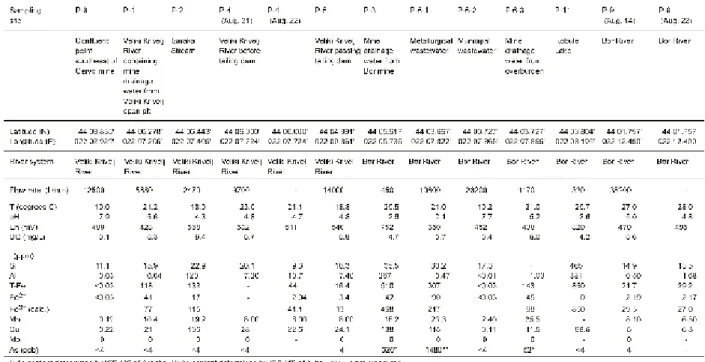
Table 2 Chemical compositions of mine drainage water, wastewater and river water from the Bor mining area to the Danube.
Fig. 3 Diagram showing relations between pH and flow rate of mine drainage water, wastewater and river water in the Bor mining area.
measuring cylinder in the field and interference caused by
other elements coexisting with a sample solution. The handy-type chromometer is useful in the field because (1) it is possible to obtain data for environmental evaluation even if there is no advanced apparatus for
Table 2 (continued)
chemical analyses and (2) planned sampling points before the field survey can be changed easily to optimize sampling points for the survey according to the progress of investigation.
4. Results
4.1 Characteristics of mine drainage water and wastewater around the Bor mine
Water in the Bor mining area that has an impact on the environment is divided into four types: mine drainage water flowing out from the Bor underground mine and overburden, wastewater from the smelter, municipal water from Bor City, and mine drainage water-bearing river water.
The chemical compositions of waters are summarized in Table 2. Acidic waters related to mining activity in the Bor mining area are water of P-11 (Robule Lake), P-3 (mine drainage water from the underground of the Bor mine), P-2 (Saraka Stream, overburden), P-6-1 (wastewater from the smelter) and P-6-2 (overburden south of Bor City) in the Bor mining area (Figs. 1 & 3). Water from the smelter (P-6-1) has low pH, high Fe and Cu contents and large flow rate (Fig. 4). Loss of Cu through wastewater from the smelter is estimated to be over 1,000 g/min (525 tons/year). The water from the smelter also has a large environmental impact on the river system from Bor River
to Bela River because of the low pH value, high copper content and large flow rate.
Flow rate and pH value of river water in the Bor mining area range from 5,900 to 58,000 L/min and from 3.6 to 8.2, respectively (Fig. 4). The pH value of river water of Veliki Krivelj River at P-10 (approximately 13 km downstream from the Veliki Krivelj open pit) became acidic from 6.7 on August 14 to 3.6 on August 22, suggesting that the pH value of Veliki Krivelj River at P-10 changed according to the development plan for exploitation at the open pit (Figs. 3 & 4).
Total Fe content in the mine drainage water and wastewater (smelter) related to mining development ranges from 132 to 850 ppm (Fig. 4). Total Fe content in river water in the Bor mining area varies from 0.03 to 118 ppm.
Water having both large flow rate and high Fe concentration is wastewater from the smelter (P-6-1) and mine drainage water from overburden (P-2) (Fig. 4). The river water at P-1 containing mine drainage water from the Veliki Krivelj open pit also has a large flow rate and high Fe content.
Copper content in water flowing out from the mine drainage water and wastewater ranges from 11.5 to 138 ppm (Fig. 4c). The range of Cu content of river water in the Bor mining area is 0.1 to 31.1 ppm. Water having
Fig. 4 Diagrams showing degree of environmental impact caused by mine drainage water, wastewater and river water in the Bor mining area. (a) Relation between total Fe and pH. Solid marks in Fig. 4a are data shown in the report of Workpackage 4(2). (b) Relation between total Fe and flow rate. Thin dashed lines show amount of Fe transported per unit time by water. The thick dashed line with arrows shows degree of environmental impact.
(c) Relation between Cu and pH. Solid marks in Fig. 4c are data shown in the report of Workpackage 4(2). (d) Relation between Cu and flow rate. Thin dashed lines show amount of Cu transported per unit time by water.
The thick dashed line with arrows shows degree of environmental impact.
both large flow rate and high Cu concentration is wastewater from the smelter (P-6-1) and mine drainage water from overburden (P-2) (Fig. 4d). The river water at P-1, P-4, P-5 and P-10 (sampling sites along Veliki Krivelj River) also has a large flow rate and high Cu content.
Presence of As was confirmed in wastewater from the smelter, mine drainage water from the Bor underground mine and overburden of P-6-3, and river water of Bor River
at P-9 (Table 2). The As content of wastewater from the smelter was high (1480 ppb). The origin of As in the Bor River water is thought to be wastewater. As was not detected in river water at points downstream of P-9.
There is a possibility that arsenic is absorbed on the surface of iron hydroxide (III) suspended in river water and is removed from the river water.
Fig. 5 (a) Diagram showing variation in pH of river water from the Bor mining area to the Danube.
(b) Diagram showing variation in copper content of river water from the Bor mining area to the Danube.
4.2 Characteristics of river water containing mine drainage water and wastewater from the Bor mining area to the Danube
The pH values of river water without effects of mine drainage water of the Bor mining area are around 8 (P-8 (pH=7.9): intermediate point between the Cervo open pit (no operation in August 2011) and the Veliki Krivelj open pit of Veliki Krivelj River, P-12 (pH=8.2): Ravna River) (Fig. 5a). The river water of Veliki Krivelj River containing mine drainage water has acidic pH ranging from 3.6 to 5.6. The pH at P-10 of Veliki Krivelj River before the confluence of Veliki Krivelj River and Bor River changed from 6.7 on August 14 to 3.6 on August 22 as stated in the previous section. The river water of Bor River also has an acidic pH value. The wastewater (pH=2.1, flow rate=10,000 L/min) from the smelter has an
impact on the quality of river water of Bor River. The pH value of river water of Bela River is around 5.6 (P-13 (upper stream): 5.5, P-15 (lower stream): 5.6) (Fig. 5a).
The pH value of river water (P-14) of Timok River before the confluence to Bela River was 7.6. The river water of Bela River merges with the river water of Timok River at a point 400 meters downstream of P-15 near Zajecar (Fig. 5a). The pH values of river water of Timok River containing mine drainage water from Bela River are 7.5, 8.1 and 7.9 at points near Gradskovo (P-16), Brusnik (P-20) and Mokranje (P-23), respectively (Fig. 5a). The impact of mine drainage water from the Bor mining area is greatly reduced in the middle to lower reaches of the Timok River as a result of the mixing of a large amount of neutral-pH river water from Timok River with mine drainage water-bearing river water of Bela River. The pH value of river water of the Danube before confluence with Timok River is 8.4. The pH values of Timok River measured in this study are close to pH=8 and similar to the pH value of river water of the Danube (Fig. 5a).
Total Fe content of river water at P-4, P-5 and P-10 along Veliki Krivelj River shows variation from 44 to 16.4 ppm except for 0.05 ppm at P-10 on August 14 (Table 2).
T-Fe contents of river water at P-9 of Bor River were 31.7 ppm on August 14 and 29.2 ppm on August 22. T-Fe content of river water of Bela River, which is a river after the confluence of Veliki Krivelj River and Bor River, decreased from the upper stream (P-13: 24.8 ppm) to downstream (P-15: 5.7 ppm). The river water of Bela River merges into the river water of Timok River. Total Fe content of the river water of Timok River ranges from 0.07 ppm to a concentration below the detection limit (0.03 ppm) of the chromometer. Presence of ferrous iron was confirmed in river waters of Veliki Krivelj River, Bor River and Bela River. Total Fe content of river water of the Danube was a concentration below the detection limit (0.03 ppm) of the chromometer (Table 2).
Copper content of river water at P-4, P-5 and P-10 along Veliki Krivelj River shows variation from 31.1 to 22.6 ppm except for 0.5 ppm at P-10 on August 14 (Fig. 5b). Copper contents of river water at P-9 of Bor River were 5 ppm on August 14 and 6.3 ppm on August 22.
Copper contents of river water of Bela River were 4 ppm at P-13 (upper stream: after confluence of Veliki Krivelj River and Bor River) on August 17 and 10.5 ppm at P-15 (downstream: before confluence of Bela River and Timok River) on August 18. Copper content of river water of Bela River was 15 ppm at a point of Vrazogrnac settlement about 2 km upstream of P-15. The copper content of Bela River at P-15 is high, although P-15 is located about 25 km downstream from the Bor mining area (Fig. 5b). The reasons for the high Cu content in river water of Bela River
are thought to be 1) dissolution of Cu-rich precipitate on the riverbed of Bela River and 2) discharge of Cu-rich groundwater from the tailing along Bela River. It is necessary to clarify the mechanisms controlling high Cu content in the river water to prevent impact on the environment.
Copper content of the river water of Timok River (Gradskovo (P-16), Brusnik (P-20) and Mokranje (P-23)) ranges from 0.15 ppm to 0.08 ppm, suggesting that the environmental impact of Cu in mine drainage water is small in Timok River. Copper content of river water of the Danube was 0.11 ppm. Presence of mine tailings from the Bor mine was confirmed along the banks of Timok River near Brusnik (P-20) and Mokranje (P-23) in this study (Fig.
2). Copper contents of river water of Timok River at P-20 and P-23 were close to or below the Serbia water quality-based limitation (Fig. 5b). The effect of Cu dissolution from mine tailings along the banks of Timok River is thought to be small.
5. Summary
1. A handy-type chromometer is useful in the field because (1) it is possible to obtain data for environmental evaluation even if there is no advanced apparatus for chemical analyses and (2) planned sampling points before the field survey can be changed easily to optimize sampling points for the survey according to the progress of investigation.
2. The Cu content of river water in the lower reach of Timok River was lower than that of the water quality standard in August 2011, suggesting that the impact of mine drainage water from the Bor mining area on the environment was small and that the effect on quality of river water of the Danube was also small in August 2011.
3. Variation of the chemical composition of river water containing mine drainage water is large at some points
in the Bor mining area. The variation is thought to have been caused by the development plan for exploitation at the open pit. Systematic control of the discharge of mine drainage water would reduce the impact on the environment.
4. River water from the Bor mining area to a point (P-15) of the lower reach of Bela River (approximately 25 km) contains high Cu and Fe contents. The cause of these high Cu and Fe contents must be clarified to reduce the environmental impact on Bela River basin.
References
(1) Ogawa, Y., Ishiyama, D., Shikazono, N., Iwane, K., Kajiwara, M. and Tsuchiya, N. (2012): The role of hydrous ferric oxide precipitation in the fractionation of arsenic, gallium, and indium during the neutralization of acidic hot spring water by river water in the Tama River watershed, Japan, Geochim.
Cosmochim. Acta, vol. 86, 367-383.
(2) Kamberovic, Z. and Korac, M. (2005): WP 4 - Wastewaters management and treatment technologies, Report of INTREAT (EU Project), No. 1, 182p.
Acknowledgments
This study was undertaken as a program of dispatch of Science and Technology Researches named “Management of mining waste-tailing dump in the Bor region” supported by the Japan Society for the Promotion of Science and Japan International Cooperation Agency. This study would not have been possible without the generous cooperation and logistic support of the Ministry of Environment, Mining and Spatial Planning of the Serbian Government, RTB Bor and Mining & Metallurgy Institute Bor. We would like to express our deep appreciation to the Ministry of Environment, Mining and Spatial Planning of the Serbian Government, RTB Bor and Mining &
Metallurgy Institute Bor.
セルビア国ボール鉱山地域の鉱山廃水と河川水の地球化学的特徴
石山大三**・ 川原谷 浩**・ 佐藤比奈子***・オブラドビッチ ルビシャ****・ ブラゴェビッチ ブランコ****・ペトロビッチ イエレナ****・ ガルディッチ ヴォイカ****・ステノバノビッチ ゾラン****・
柴山 敦*****・増田信行******・高崎康志 ******
要 旨
野外での携帯型比色計を用いた化学分析の有効性の検討とボール鉱山地域の鉱山活動に伴う環境への影響 を知るために,ボール鉱山地域からティモック川,ドナウ川にかけての地域の調査が実施された.携帯型比色
計を用いた化学分析では,十分な機材がない地域でも環境影響評価が可能であること,調査前に計画された調 査地点を調査の進行に伴い変更し最適化できることが確認され,本分析法は有効であると考えられる.
ボール鉱山地域の鉱山廃水を含む河川水の化学組成は,いくつかの地点で採取日時が異なると大きく変化す る.この変化は,露天掘りでの採掘計画の進捗に依存していると思われる.ボール鉱山地域から下流 25 km のベラ川下流地点(P-15)の河川水の銅・鉄濃度は高い.ベラ川が合流するティモック川下流域では,河川水 の銅含有量は水質基準より低く,ボール鉱山からの鉱山廃水によるティモック川下流域の環境への影響は小さ く,2011 年 8 月におけるドナウ川の河川水への影響も小さいと考えられる.
** 秋田大学大学院工学資源学研究科附属環境資源学研究 センター
*** 秋田大学大学院工学資源学研究科地球資源学専攻
**** セルビア国ボール鉱山冶金研究所
***** 秋田大学大学院工学資源学研究科環境応用化学専攻
****** 秋田大学国際資源学教育研究センター