腸管病原性細菌に対する Enterococcus faecium BIO の 増殖抑制効果の検討
1)
目黒研究所,
2)大阪大学微生物病研究所感染症国際研究センター病原微生物資源室,
3)同 細菌感染分野
忽那 圭子
1)余 明順
2)薮内 寛次
1)本田 武司
3)(平成 20 年 5 月 20 日受付)
(平成 20 年 11 月 28 日受理)
Key words : probiotics, enteropathogen, lactic acid bacteria, growth inhibition, enterohemorrhagic E. coli
要 旨
Enterococcus faecium BIO は健康食品の原体として用いられている乳酸菌である.本菌の抗菌活性を検討
するため,増殖抑制効果を簡易に判別する方法,寒天重層抗菌テスト法を開発した.この方法では E. faecium BIO と供試菌が直接接触することがないので,抗菌活性は E. faecium BIO の産生する物質によることが予測 される.この方法で腸管出血性大腸菌(EHEC)をはじめ,多くの腸管感染原因菌に対して BIO が増殖抑 制効果を示すことが明らかになった.抗菌活性を有する物質の検討を行った結果,E. faecium BIO が産生す る乳酸が主たる要因であろうと推測されたが,それ以外の抗菌物質の産生の可能性も示された.
〔感染症誌 83:101〜106,2009〕
序 文
プロバイオティクスというのは,宿主の腸管内の環 境をよくすることで健康に良い影響を与える生菌製剤 や生菌,あるいは菌成分を含んだ食品を指す言葉であ る.多くの乳酸菌やビフィドバクテリウムがプロバイ オティクスとしてヒトや家畜の整腸作用や下痢に有効 であることが報告されている.そのメカニズムとして は,腸管病原菌による腸管上皮細胞への定着を乳酸菌 等が阻害する
1)〜4),免疫の賦活化(抗炎症作用の活性
化)
5)〜8),抗菌活性
9)〜12)等が報告されている.近年,特
に乳酸菌による抗菌作用が注目されている.
そこで今回われわれは,プロバイオティクスとして,
健康食品の原体に用いられている Enterococcus faecium BIO の腸管病原性細菌に対する抗菌活性を検討する ことと,寒天培地上での簡易な抗菌活性確認法の開発 を目的とした.さらに多くの乳酸菌について種々の抗 菌物質を産生している報告がみられるので, E. faecium BIO の産生する抗菌物質についても検討を行うこと とした.
材料と方法
1.使用菌株
被検菌として Enterococcus faecium RIMD 3116004
(E. faecium BIO)を用いた.以下の菌株を供試菌とし た.Aeromonas sobria RIMD 0111003,Escherichia coli
(EPEC)RIMD 0509229,Escherichia coli(ETEC)
RIMD 0509273,Escherichia coli(EHEC, O157 : H7)
RIMD 0509939,Escherichia coli(EHEC, O157 : H7)
RIMD0509952,Salmonella enterica serovar Enteritidis
(S. enteritidis)RIMD 1933001,Staphylococcus aureus subsp. aureus(S. aureus)RIMD 3109007,Listeria monocytogenes RIMD 1205001,Vibrio cholerae RIMD 2203326,Vibrio cholerae (non-O1)RIMD 2214108,Vi- brio parahaemolyticus RIMD 2211694.
2.使用培地
被検菌,供試菌の培養には,2% 乳糖・0.22% 酵母 エキス加 Tryptic Soy Broth(MERCK)(以下 LYTSB と 略 す)と 2% 乳 糖・0.22% 酵 母 エ キ ス 加 Tryptic Soy Agar(MERCK)(以下 LYTSA と略す)を用い た.予備実験の結果,被検菌の増殖・保存に上記培地 が適していたため今回の実験で使用した.
3.寒天重層抗菌テスト
LYSTB 1mL で 37℃,一 夜 培 養 し た 被 検 菌 を LYSTA 15mL で混釈し,平板を作成した.37℃ で 2
原 著別刷請求先:(〒565―0871)吹田市山田丘 3―1
大阪大学微生物病研究所感染症国際研究セン
ター・病原微生物資源室 余 明順
Fi g. 2 BI O gr owt h i nhi bi t i on t es t on l ayer ed agar medi um ( LYTSA) .
Fi g. 3 Four pH as s ay poi nt s on agar medi um.
日間培養後,平板の半分を切り取り除き,ここに新鮮 な LYSTA 20mL を重層した(空の半分を埋め,さら に混釈培養した部分と新鮮培地の上に重層する形にな る).混釈培養した培地と新鮮培地の境界線に対して 垂直に供試菌を画線した.供試菌は LYSTB 1mL で 37℃,一夜培養し,Phosphate Buffered Saline(PBS,
pH7.0)で希釈後,その 5µL を画線に用いた.供試菌 を画線した平板は 37℃ で一夜培養し,供試菌の増殖 を目視判定した.Fig. 1に方法を図示した.
4.有機酸の定量
LYTSB 1mL に E. faecium BIO を植菌し,37℃ で
一夜回転培養(26rpm)し,50 µ L を新鮮な LYTSB 1
mL に植菌した.6 時間,および 24 時間回転培養を行
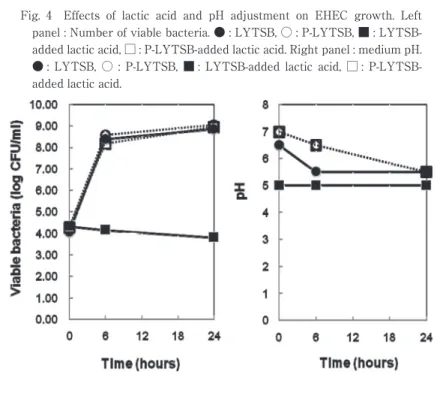
Fi g. 4 Ef f ec t s of l ac t i c ac i d and pH adj us t ment on EHEC gr owt h. Lef t panel : Number of vi abl e bac t er i a. ● : LYTSB, ○ : P- LYTSB, ■ : LYTSB- added l ac t i c ac i d, □ : P- LYTSB- added l ac t i c ac i d. Ri ght panel : medi um pH.
● : LYTSB, ○ : P- LYTSB, ■ : LYTSB- added l ac t i c ac i d, □ : P- LYTSB- added l ac t i c ac i d.
Tabl e 1 BI O gr owt h i nhi bi t i on t es t on l ayer ed agar me- di um
St r eak c el l c onc ent r at i on ( c el l s /mL) Tes t or gani s ms
10
510
7RI MD Spec i es
+
+ 111003
Ae r o mo na s s o b r i a
+
- 509229
Es c he r i c hi a c o l i ( EPEC)
+
- 509273
Es c he r i c hi a c o l i ( ETEC)
+
- 509939
Es c he r i c hi a c o l i ( EHEC)
+
- 509952
Es c he r i c hi a c o l i ( EHEC)
+
+ 1933001
Sa l mo ne l l a e nt e r i t i di s
+
+ 3109007
St a phyl o c o c c us a ur e us
+
+ 1205001
Li s t e r i a mo no c yt o ge ne s
+
+ 2203326
Vi b r i o c ho l e r a e
+
- 2214108
Vi b r i o c ho l e r a e ( non- O1)
+
- 2211694
Vi b r i o pa r a ha e mo l yt i c us
* + : I nhi bi t ed - : Not i nhi bi t ed
い,培養液を 15,000×g,4℃ で 5 分間遠心分離した 後,0.22µm のフィルターでろ過除菌した.嫌気性培 養の検体は同様に前培養した培養液 2mL をフラスコ に入れた新鮮 LYTSB 40mL に植菌し,嫌気性ジャー で 37℃,6 時間,12 時間,24 時間静置培養後,同様 の操作で培養上清を得た.有機酸(コハク酸,乳酸,
ギ酸,酢酸,酪酸)の定量は(財)日本食品分析セン ターに依頼した.
5.培地 pH の中和
有機酸による培地 pH の低下を中和する目的 で,
LYTSB 培地作成時に水の代わりにリン酸緩衝液(1!
15M)を用いた(P-LYTSB).また,LYTSA 平板作 成時にリン酸緩衝液(1 ! 3M)を用いた(P-LYTSA).
結 果
1.寒天重層抗菌テスト法
寒天重層抗菌テストの結果の一部を Fig. 2に示し た.画線する菌液の濃度は 3 段階とし,左から培養液 原液(1〜3×10
9! mL),100 倍希釈液,1,000 倍希釈液 各 5 µ L を画線に用いた.対照の平板は E. faecium BIO の混釈を加えてないものである.寒天重層抗菌テスト に用いた菌濃度が 10
5cell! mL では供試菌すべてに対 して増殖抑制効果が見られたが,10
7cell! mL では A.
sobria,S. enteritidis,S. aureus,L. monocytogenes,V.
cholerae に対して増殖抑制が認められた(Table 1).E.
faecium BIO はグラム陽性菌にも陰性菌にも強い抗菌
活性を示すことがわかった.また,この方法では,E.
faecium BIO と供試菌が直接接触しないので,観察さ
れた抗菌活性は E. faecium BIO が培地中に産生した物 質によるものであることが推測され,さらに詳細な検 討を行った.
2.pH 測定
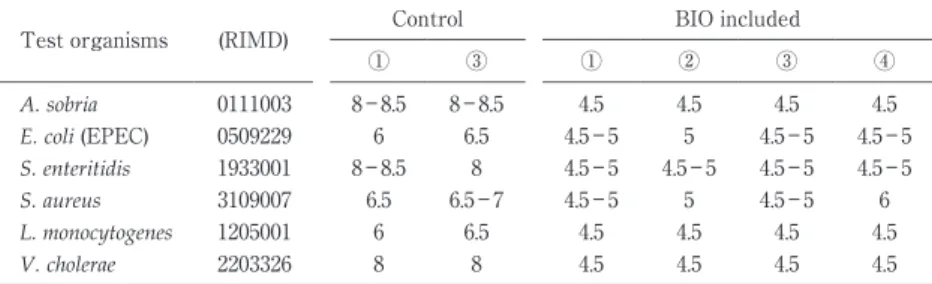
乳酸菌は有機酸を産生して,pH を低下させること が知られているので,培地の pH を測定した.供試菌 を塗抹して 2 日培養後,Fig. 3に示した培地部位につ いて pH 試験紙を用いて測定した.結果を Table 2に 示した.E. faecium BIO の重層がない対照の平板は,
使用した菌種によって多少異なるが,pH6〜8 の範囲 にあった.一方,E. faecium BIO 重層の平板では,平
板の E. faecium BIO 培地を重層してない場所も含め
て,どの場所でも 4.5〜5 であった.E. faecium BIO 重
層によって培地全体の pH は低下したが,場所による
差が見られなかったことから,pH 低下だけが増殖抑
Fi g. 5 EHEC gr owt h i nhi bi t i on by BI O on P- LYTSA. Cont r ol : wi t hout l ay- er ed BI O
Tabl e 2 Four pH poi nt s
*on LYSTA medi um BI O i nc l uded Cont r ol
( RI MD) Tes t or gani s ms
④
③
②
①
③
①
4. 5 4. 5 4. 5 4. 5 8― 8. 5 8― 8. 5 0111003
A. s o b r i a
4. 5― 5 4. 5― 5 5
4. 5― 5 6. 5
6 0509229 E. c o l i ( EPEC)
4. 5― 5 4. 5― 5 4. 5― 5 4. 5― 5 8
8― 8. 5 1933001
S. e nt e r i t i di s
6 4. 5― 5 5
4. 5― 5 6. 5― 7
6. 5 3109007
S. a ur e us
4. 5 4. 5 4. 5 4. 5 6. 5
6 1205001 L. mo no c yt o ge ne s
4. 5 4. 5 4. 5 4. 5 8
8 2203326 V. c ho l e r a e
*
s hown i n Fi g. 3
Tabl e 3 BI O or gani c ac i ds pr oduc t i on i n aer obi c c ul t ur e
Or gani c ac i ds pr oduc ed ( M) Or gani c ac i ds BI O s uper nat ant Cont r ol
LYTSB medi um 24h c ul t ur e
6h c ul t ur e
0. 001 0. 001
0. 001 Suc c i ni c
< 0. 001 0. 031
0. 024 Lac t i c
0. 001 0. 001
0. 002 For mi c
0. 004 0. 004
0. 004 Ac et i c
< 0. 001
< 0. 001
< 0. 001 But yr i c
Tabl e 4 BI O l ac t i c ac i d pr oduc t i on i n anaer obi c c ul t ur e
Lac t i c ac i d pr oduc t i on ( M)
Cont r ol BI O s uper nat ant
LYTSB medi um 24h c ul t ur e
12h c ul t ur e 6h c ul t ur e
< 0. 001 0. 039
0. 033 0. 027
制の原因ではないと考えられた.
3.抗菌活性を有する物質の検討
抗菌物質のおおまかな分子サイズ推測のため,寒天 重層抗菌テストを行う際,重層した寒天の上に滅菌し た透析膜(透析分子サイズ;10,000 以下)をのせ,膜 の上から供試菌を画線した.その結果,透析膜上であっ ても,重層した E. faecium BIO による増殖抑制効果が 見られた.従って,抗菌性を有する物質は分子量 10,000 以下の低分子であることが推察された.
4.有機酸の測定
抗菌性物質が E. faecium BIO の産生する有機酸であ る可能性を考えて培養上清中の有機酸の定量を行っ た.Table 3は LYTSB で E. faecium BIO を 6 時間,24 時間回転培養(26rpm : 37℃)した結果である.測定
した 5 種類の有機酸の中で,乳酸の産生が確認された.
産生に関する詳細な経時観察は行っていないが,培養 6 時間後にはすでに産生されていることが明らかに なった.また,実際の腸管内での乳酸の産生の可能性 を裏付けるために,嫌気的条件で培養した上清中の乳 酸産生も定量した(Table 4).嫌気培養下においても
E. faecium BIO は乳酸を産生することがわかった.
5.乳酸による増殖抑制
乳酸添加による供試菌の増殖への影響をみるため に,供試菌の一つである E. coli (EHEC)RIMD 0509939 を,乳酸 0.28% 加 LYTSB で培養した結果,対照(乳 酸非添加)と比較して増殖は著しく抑制された(Fig.
4).乳酸添加によって培地 pH が低下するため,培地
にリン酸緩衝液を加え(P-LYTSB)pH 中和機能を持
たせた結果,乳酸を添加しても増殖は抑制されなかっ た.即ち,乳酸が存在しても,pH が中性であれば増 殖は抑制されないことが示された.次に寒天重層抗菌 テ ス ト に お け る pH の 影 響 を 調 べ た.BIO 重 層 LYSTA 平板の pH は,Table 2でみられたように,対 照(BIO 非含有平板)に比較していずれの供試菌に おいても低かった.pH 中和機能をもった BIO 重層 P- LYSTA 平板で,E. coli(EHEC)RIMD 0509939 に対
する E. faecium BIO の抗菌効果を検討した結果,Fig.
5に示すように LYTSA 平板で見られたのと同様に抗 菌効果が見られ,培地 pH は,ポイント 2,4 ともに 6.5 であった.
考 察
E. faecium BIO は健康食品の原体として広く利用さ
れているが,その抗菌効果についての詳細な検討はな されていない.抗菌効果を調べる方法はいろいろ開発 されているが,今回われわれが開発した方法は,1.操 作・判定が簡易である,2.被検菌と供試菌が直接接 触しないので被検菌の分泌物による抗菌効果が観察で きる,3.供試菌に対して被検菌の増殖が遅い場合も,
供試菌の培養時間を長くすることで可能である等利点 がある.この方法を用いて E. faecium BIO の腸管感染 原因菌に対する抗菌効果を調べた結果,グラム陽性菌,
陰性菌を含む供試菌すべてに対して抗菌効果を示し た.E. faecium BIO による抗菌性物質の産生を確認す るため,分子量 10,000 以上の分子を通過させない透 析膜を使って寒天重層抗菌テストを行った結果,分子 量 10,000 以下の物質による抗菌効果であることが確 認された.供試菌増殖培地の pH 低下が見られたが,
乳酸菌であるため有機酸産生の可能性が考えられ,培 地中の有機酸の定量を行った結果,乳酸産生が明らか になった.同様の結果が嫌気性培養においても見られ,
腸管内での乳酸産生の可能性を示すものであった.こ
の事から E. faecium BIO による抗菌活性の主体は乳酸
であろうと予測された.
多くの乳酸菌は乳酸を産生し,pH を下げることに よって病原細菌の増殖を抑えるが
13),pH を中性にす ることでその活性が消失する
14)15)という報告がある一 方,その抑制作用は pH 低下だけによるものではない とする報告
16)もみられる.乳酸による pH 低下以外の 抗菌メカニズムとして,グラム陰性菌の外膜の透過性 を亢進し,それによって宿主の産生する抗菌物質(ディ フェンシン等)の侵入が容易になり,病原菌のこれら 抗菌物質に対する感受性が高くなること
17)や,乳酸が 病原菌の病原因子遺伝子の発現に関与して病原性を低 下させること
18)が報告されている.
しかし,E. faecium BIO によって示された病原細菌 増殖抑制作用が,乳酸だけによるものか,それ以外の
物質の関与もあるのか確認するために,乳酸を加えた 培地,および乳酸を加え,且つ培地 pH の中和機能を もった培地での抗菌活性を比較したところ,乳酸添加 で見られた抗菌活性が培地 pH を中和することで消失 した(Fig. 4).この事は,乳酸が存在しても,培地 pH が中性付近であれば抗菌活性を示さないということで あるが,これは酸の殺菌力と pH の関係で報告
19)され ているように,非解離状態と解離状態では殺菌力に大 きな違いが見られ,pH 依存的に非解離から解離に移 行するため,低 pH(非解離状態)で殺菌力が高いと いう現象と一致する.そこで,乳酸以外の抗菌物質の 産生を確認する目的で,乳酸による殺菌力を減弱した 状態での抗菌テスト,即ち,pH 中和機能をもった培 地で寒天重層抗菌テストを行ったところ,それでも抗 菌活性が確認された(Fig. 5).この事から,E. faecium BIO は乳酸以外の抗菌性物質をも産生している可能 性が示された.また,供試菌の接種菌濃度が高いと増 殖抑制は一部の菌でしか認められなくなるので,乳酸 および抗菌物質による抗菌活性は濃度依存性であると 考えられた.この抗菌物質に関しては,現時点で明確 にできていないが,今後検討を重ねる予定である.
文 献
1
)Gopal PK, Prasa J, Smart Gill HS:In vitro ad- herence properties of Lactobacillus rhamnosus DR 20 and Bifidobacterium lactis DR10 strains and their antagonistic activity against an enterotoxi- genic Escherichia coli. I J Food Microbiol 2001;
67:207―16.
2
)Forestier C, Champs CD, Vatoux C, Joly B:
Probiotic activities of Lactobacillus casei rhamno- sus : in vitro adherence to intestinal cells and antimicrobial properties. Res Microbiol 2001;
152:167―73.
3
)Servin AL, Coconnier MH:Adhesion of probi- otic strains to the intestinal mucosa and interac- tion with pathogen. Best Prac Res Clin Gastro- ent 2003;17:741―54.
4
)Sherman PM, Johnson-Henry KC, Yeung HP, Ngo PSC, Goulet J, Tompkins TA:Probiotics reduce enterohemorrhagic Escherichia coli O157 : H7- and enteropathogenic E. coli O127 : H6- induced changes in polarized T84 epithelial cell , monolayers by reducing bacterial adhesion and cytoskeletal rearrangements. Infect Immun 2005;73:5183―8.
5
)Madsen K, Cornish A, Soper P, McKaigney C, Jijon H, Yachimec C, et al.:Probiotic bacteria enhance murine and human intestinal epithelial barrier function. Gastroenterology 2001;121:
580―91.
6
)Shu Q, Gill HS:Immune protection mediated
by the probiotic Lactobacillus rhamnosus HN001
(DR20) against Escherichia coli O157 : H7 infection
in mice. FEMS Immunol Med Microbiol 2002;
34:59―64.
7
)Jijon H, Backer J, Diaz H, Yeung H, Thiel D, McKaigney C, et al.:DNA from probiotic bacte- ria modulates murine and human epithelial and immune function. Gastroenterology 2004;126:
1358―73.
8
)Hatr AL, Lammers K, Brigidi P, Vitali B, Rizzerro F, Gionchetti P, et al.:Modulation of human dendritic cell phenotype and function by probiotic bacteria. Gut 2004;53:1602―9.
9
)Bernet-Camard MF, Lievin V, Brassart D, Neeser JR, Servin AL, Hudault S:The human Lactobacillus acidophilus strain LA1 secrets a nonbacteriocin antibacterial substance (s) active in vitro and in vivo. Appl Env Microbiol 1997;
63:2747―53.
10
)Cintas LM, Casaus P, Fernandez MF, Hernan- dez PE:Comparative antimicrobial activity of enterocin L50, pediocin PA-1, nisin A and lacto- cin S against spoilage and foodborne pathogenic bacteria. Food Microbiol 1998;15:289―98.
11
)Nilsen T, Nes IF, Holo H:Enterolysin A, a cell wall-degrading bacteriocin from Enterococcus fae- calis LMG 2333. Appl Environ Microbiol 2003;
69:2975―84.
12
)Servin AL:Antagonistic activities of lactobacilli and bifidobacteria against microbial pathogens.
FEMS Microbiol Rev 2004;28:405―40.
13
)Vandenbergh PA:Lactic acid bacteria, their metaolic products and interference with micro-
bial growth. FEMS Microbiol Rev 1993;12:
221―38.
14
)Hudault S, Lievin V, Bernet-Camard MF:An- tagonistic activity exerted in vitro and in vivo by Lactobacillus casei (strain GG) against Salmo- nella typhimurium C5 infection. Appl Environ Mi- crobiol 1997;63:513―8.
15
)Lehto EM, Salminen SJ:Inhibition of Salmonella typhimurium adhesion to Caco-2 cell cultures by Lactobacillus strain GG spent culture supernate : only a pH effect? FEMS Immunol Med Micro- biol 1997;18:125―32.
16
)Apella MC, Gonzalez SN, Macias MEN, Romero N, Oliver G:In vitro studies on the inhibition of the growth of Shigella sonnei by Lactobacillus ca- sei and Lact. Acidophilus. J Appl Bacteriol 1992;
73:480―3.
17
)Alakomi HL, Skytta E, Saarela M, Mattila- Sandholm T, Latva-Kala K, Helander IM:Lac- tic acid permeabilizes gram-negative bacteria by disrupting the outer membrane. Appl Envi- ron Microbiol 2000;66:2001―5.
18
)Durant JA, Corrier DE, Stanker LH, Ricke SC:
Expression of the hilA Salmonella typhimurium gene in a poultry Salm. Enteritidis isolate in re- sponse to lactate and nutrients. J Appl Micro- biol 2000;89:63―9.
19
)Eklund T:The antimicrobial effect of dissoci- ated and undissociated sorbic acid at different pH levels. J Appl Bacteriol 1983;54:383―9.
Enterococcus faecium BIO Effect on Enteropathogen Growth Inhibition Keiko KOTSUNA
1), Myonsun YOH
2), Kanji YABUUCHI
1)& Takeshi HONDA
3)1)