Rural Reforms and Household Economies in the Dike‑Pond Area of the Zhujiang Delta, China
著者(英) Kenneth Ruddle journal or
publication title
国立民族学博物館研究報告
volume 10
number 4
page range 1145‑1174
year 1986‑03‑29
URL http://doi.org/10.15021/00004390
RUDDLE Rural Reforms and Household Economies
Rural Reforms and Household Economies in the Dike-Pond Area of the Zhujiang Delta, China
Kenneth RUDDLE*
INTRODUCTION
Since April, 1979, following the official adoption of economic reforms passed by the third plenum of the Eleventh Central Committee of the Communist Party, in December, 1978, China has gradually begun to create a mixed economic system in which collectivist and household enterprises co-exist within a socialist frame-
work. Economic reforms first began in the countryside, where, in essence, they decollectivized many agricultural practises, via a responsibility system transformed from de facto to de jure the status of the individual household as the fundamental rural economic unit, and removed the controls that prevented households from fully marketing their surplus production {RuDDLE 1985; RUDDLE et al. n.d.].
As a consequence of those reforms most places in rural China now practise some form of responsibility system, with land and production responsibility contracted either to the household or to the production team. In the economically more advanced provinces more than 90 percent of the farmers employ the house- hold responsibility system [DELFS 1984].
Economically the rural reforms have been highly successful. During the period 1979-83 the value of agricultural production grew at an average annual rate of 7.9 percent, compared with 3.2 percent during the preceding 25 years.
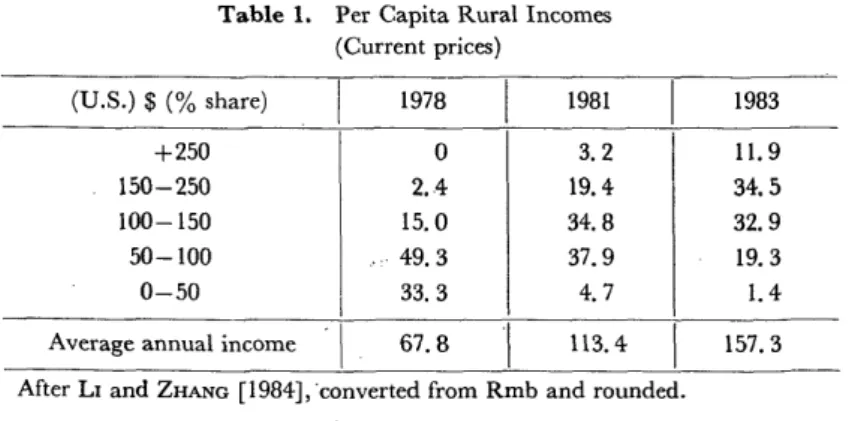
Further, rural incomes more than doubled in current prices during the same period. Average rural per capita net income increased by 98.5 percent during
Table 1. Per Capita Rural Incomes (Current prices) (U.S.) $ (% share)
+250 150— 250 100-150 50 — 100
0-50 Average annual income
1978 0 2.4 15.0 49. 3 33. 3 67.8
1981 3.2 19.4 34.8 37.9 4.7 113.4
1983 11.9 34.5 32.9 19.3 1.4 157. 3
After Li and ZHANG [1984], converted from Rmb and rounded.
* 5th Research Department
, National Museum of Ethnology.
1145
国立民族学博物館研究報 告 10巻 4号
the period 1978-1983, an average annual growth rate of 14.7 percent (Table 1) [Li and ZHANG 1984]. As a consequence the total value of agricultural and sideline products sold on the free market throughout China reached U.S.$ 46.8 billion in 1983. This was 58 percent greater than in 1978, when the reforms began. In addition, 24 million "specialist households" which concentrate on the production of a single commodity, such as pigs or cotton cloth, have emerged since the reforms.
AGRO-ECOSYSTEMS AND IMPLEMENTATION OF RURAL REFORMS
IN THE ZHU JIANG DELTA
In the Zhujiang Delta of South China an old established and elaborate integrated system of intensive agriculture and the polyculture of carps and other freshwater fishes, which has evolved over the last two millenia, is operated on a geographic and economic scale unmatched elsewhere in the world [RuDDLE 1985; RUDDLE et al. 1983; RUDDLE et al. n.d.]. This system has been developed over an area of 800 km2 and supports an estimated population of 1.2 million persons. The system is best developed in the central part of the delta, south of the city of Guangzhou, where it focuses principally on Shunde County and parts of the neighboring counties (Figure 1).
The system is composed of three essential components : fish ponds, mulberry dikes and sugar cane dikes. The ecological heart of this dike-pond system is the fish pond, which is devoted mainly to the polyculture of Cyprinids, the so-called Major or Chinese carps.l) Each species has distinct feeding habits and occupies a different niche. Traditionally the ponds were sanitized with quicklime and teaseed cake,2) and fertilized to promote the growth of plankton with human, pig and silkworm excrement. The traditionally used fish feeds are Elephant grass (Pennisetum purpureum) and sugar refinery waste. Vegetable waste from household kitchens and the crop dikes is also an occasionally used traditional fish feed. Until recently, naturally-occurring fry ("seed fish") were obtained from local rivers, raised to fingerling size in special ponds operated by the brigade, and then reared to marketable size in the production ponds of each production team.
A range of linked agricultural sub-systems functions on the dikes that surround each pond. In Leliu Commune of Shunde County mulberry (Morus atropurpurea), which is inextricably linked with silkworm-rearing (Bombyx mori),
1) These are the Grass carp (Ctenopharyngodon idellus), Silver carp (Hypophthalmichthys molitrix), Bighead carp (Aristichtlys nobilis), Black or Snail carp (Mylopharyngodon piceus), Mud carp (Cirrhinus molitorella) and Common carp (Cyprinus carpio).
2) Teaseed cake is produced from the crushed seeds of the oil-tea camellia (Camellia oleosa). It is composed of 7-8 percent saponin, a hemolytic toxin that kills unwanted, naturally-occurring
fish, frog eggs, tadpoles, snails and various aquatic insects that either predate on the stocked
fish, are vectors of fish diseases or compete with the fish for feed.
RUDDLE Rural Reforms and Household Economies
Figure 1. Location of the Dike-Pond System in the Zhujiang Delta
and sugar cane (Saccharum officinarum) are the main crops cultivated. A wide range of vegetables together with bananas and some fruits is also cultivated [RuDDLE
1985; RUDDLE et al. 1983; RUDDLE et al. n.d.].
The individual components of the dike-pond system are tightly linked together by energy and materials cycles : plant and animal wastes feed the fish and fertilize the pond; organically rich mud is dug from the pond bottom and spread three times a year as a fertilizer over the dikes; and throughout the year runoff from the dikes gradually returns the mud to the pond bottom, where its nutrients are restored. Apart from natural processes of dissipation, energy and materials are removed from the system only in such economically useful forms such as the fish, silkworm cocoons, sugar cane, vegetables and pigs sent to market
[RuDDLE et al. n.d.].
Gradually, however, this traditional tight recycling within the dike-pond system is being supplemented by an import of energy and materials from outside sources. This is particularly evident for the pond component, where, increasingly,
1147
国立民族学博物 館研究報告 10巻 4号
the chem i cal prophyl act i c di pterex i s r epl aci ng qui ckl i m e and t ea− seed cake, and 魚 ct ory−produced concentr at ed f i s h f eeds are suppl anti ng s ugar ref i ner y w as t e.
N ow adays, too, al l ponds ar e s tocked w i t h f i ngerl i ngs rear ed f rom f ry produced i n a hatchery operat ed by t he com m une, s i nce,長) r econom i c reas ons, bri gade. l evel pr oduct i on has been di s cont i nued.
A l s o i n t he l at e−1970s, coi nci di ng approxi m at el y w i th t he announcem ent of the nati onw i de rural r ef ( ) rm s t hat i nt roduced the hous ehol d res pons i bi l i t y s ys tem and t he f ヒ ee m arket, G uangdong Provi nce w as gr ant ed consi der abl e aut onom y 最) r econom i c pol i c y− m aki ng. In com bi nat i on bot h t hes e event s 1 ed.to m ajor socio.
econom i c changes throughout t he Z huji ang D el ta. U nl i ke m any ot her par ts of C hi na, i n the Zhuji ang D el ta duri ng t he peri od l979−1983 the hous ehol d respons i bi l i t y s ys tem w as put i nt o operat i on w i t hi l l t he l ong− est abl i shed t hree.
ti ered com m unal sys tem of com m une, bri gade and pr oduct i on t eam . In thi s rel ati vel y w eal t hy and hi ghl y speci al i zed r egi on of com m erci al agri cul t ure the adopti on of t he househol d responsi bi ht y s yst em has been sl ow er t han i n l es s com m erc董 al i zed and poorer regi ons , and l ocal vari at i ons i n t he rat e of i nt roduct i on of the new sys t em ar e cl os el y rel at ed to l and use patt erns and crop
reqUl rem ent S・
In areas of丘sh and ri ce cul t i vat i on, f br exam pl e, the t hree−t i er organi zat i on rem ai ns predom i nant i n m aki ng s uch m ajor deci s i ons as t he s t ri ct schedul i ng of the phas es of t he croPPi ng cycl e and i n s et t i ng quotas・ For且sh, a hi ghl y peri s h−
abl e com m odi t y, f i rm del i very dates and preci se quanti ti es t o be suppl i ed are speci 且ed i n t he pr oduct i on cont ract. W here ri ce i s the dom i nant crop pr oduct i on t eam respons i bi l i t y has been ret ai ned, s i nce i t i s f ear cd that devol uti on of re.
spons i bi l i t y t o t he indi vi dual househol d i n areas of ext rem el y hi gh popul at i on dens i t y w oul d l ead t o t he f r agm entat i on of ri cef i el ds, a decl i ne i n yi el ds ahd m a j or i nf rast ruct ur a1 and adm i ni s trat i ve probl em s [ R uDDLE l 985;R uDDLE et al .
n. d. ]. N evert hel ess , as a consequence of the rural re長) rp ns i ndi vi dual hous ehol ds i n the Zh円θ i ang D el ta now e川 oy consi derabl e f reedom i n decidi ng how t o al l ocat e t hei r ow n capi tal, l abor and m anagem ent res ources, and si nce l 980 t he f brm al rel at i ons hi p col l cerni ng pr oduct i ve act i vi t i es bet w een the producti on team and
t he i l l di vi dual househol d has changed dr am at i cal l y.
T he Fi rs t Product i on T eam of t he N anshui Bri gade, L el i u C om m une, on w hi ch thi s s t udy f bcus es, i m pl em ent ed the househol d res pons i bi l i t y sys t em oh a t ri al bas i s i n 1978, w hen 7 percent of t he t eam , s fi s h pond area w as cont ract ed t o i ndi vi dual hous ehol ds。 By l 981,70 per cent of t he ponds had been cont ract ed in t hat f as hi on. Si nce the r es ul ts of t he experi m ent w i t h the ponds w ere so s ucces s f hl , i n l 982 al l the sugar cane and m ul berr y di kes w ere f arm ed under hous ehol d contr act s, and al l s i l kw or m producti on had been converted t o t he new s ys tem [unpub. s tats. , Procurem cnt and R ecords O 伍 ce, N anshui Bri gade, 1983].
By 1984 al l t he pr oduct i on t eam s l and w as cont ract ed to i ndi vi dual househol ds .
A s a consequence of adopt i pg the new s yst em , producti vi t y and househol d i ncom es
RUDDLE Rural Reforms and Household Economies
have risen considerably. Household activity schedules and labor inputs have also become more flexible.
THE FUNCTIONING OF THE HOUSEHOLD RESPONSIBILITY SYSTEM
Implementation of the household responsibility system in the First Production Team of the Nanshui Brigade began with the formation of an informal committee composed of the two team leaders plus several representatives of farmers engaged in the different sub-systems of the dike-pond system. Since the committee is informal and functions only within the production team, it has no fixed period of operation and no strict legal terms of reference. Its function is to advise the formal quota-fixing and other decision-making processes that operate at the brigade level. The committee has four main advisory functions :—
(i) To determine the dike and pond quality types;
(ii) To establish minimum productivity levels;
(iii) To implement and supervise the allocation process; and (iv) To negotiate contract periods with individual households.
(i) THE DETERMINATION OF DIKE AND POND QUALITY
Through long experience all households are familiar with the quality and productive capacity of each pond and dike belonging to the team. Decisions on quality and minimum productivity levels are therefore perceived of as being easily reached.
Two quality-productivity classes are distinguished in this team, based on the following criteria :
(a) Fish ponds close to the village and therefore highly fertilized through the regular application of human and animal excrement and household waste;
(b) Ponds further from the village and therefore less highly ,and regularly fertilized; and
(c) and (d) Since dike soil fertility depends on that of the adjacent ponds, owing to the quality of the pond mud applied to them, those closer to the village are more
fertile than distant dikes.
(ii) FIXING PRODUCTIVITY LEVELS
Again, through long experience, concensus is easily reached among the team members on this subject. The committee fixes the minimum fish yield of each pond, a quota of fish that must be sold to the team at a uniform "public price", as well as a minimum monetary quota ("bid price") that a contracting household must guarantee through its tender to pay to the team from the free market sale of production beyond the quota (vide infra). It also establishes the production rate for sugar cane from a specific dike and the silkworm cocoon production rate
1149
国立民族 学博物館研究報告 10巻 4号
based on the quantity of mulberry leaves available from a specific dike area.
(iii) THE ALLOCATION PROCESS
Different processes are employed to allocate dikes and ponds. Dike for mulberry and sugar cane cultivation is allocated by a two-step process. First, the household heads wishing to cultivate these crops draw lots to decide on the quality of land they will receive. Based on that the first quality dikes are then divided among the households entitled to them; apportioned according to house- hold size. The area allocated is based on the "number of mouths to be fed,"
rather than on the size of the household labor force available. Second quality land is then apportioned in the same fashion. A straightforward formula is applied. If, for example, only two households one having 7 members and the other three are to be allocated first class dike, then 70 percent of the area would be allocated to the first household and the remainder to the second.
Ponds are allocated by calling for separate public tenders for each pond.
In its tender a household wishing to operate a pond must specify the amount of fish it will produce from a specific pond during the contract period. The basic minimum quantity of fish established by the committee for each pond must be guaranteed to fulfill the quota for the production team established by the brigade.
Any excess beyond that figure belongs to the producing household, which can sell it privately on the free market and at the prevailing and uncontrolled price.
In addition, in its public tender a household must guarantee to give the production team a specific amount of money ("bid price") derived from this private sale of the surplus fish. Since there is normally no problem in meeting minimum fish production quota for each pond, it is the amount of cash from the private sales that a household guarantees to give the team that determines whether a tender is accepted.
(iv) NEGOTIATING CONTRACT PERIODS
Contract periods for this team vary from 1-5 years and are negotiated by the committee and individual households based on the time required to maximize productivity from a particular pond or dike. For example, usufruct to a mulberry dike newly replanted by a household will be contracted for a longer period than will an older planting, so that the household may obtain full benefit from its large investment of replanting labor [RUDDLE 1985]. Contract periods are generally negotiated to coincide with the full production cycle of the dominant crop on a particular dike.
Contract Provisions
In the Nanshui Brigade contracts between the production team and house-
holds are straightforward yet comprehensive. Those for mulberry cultivation,
for example, contain eleven basic clauses :-
RUDDLE Rural Reforms and Household Economies
(1) mulberry dikes are to be distributed according to household size and labor force;
(2) The silkworm cocoon quota is to be determined by the area of mulberry dike contracted;
(3) The household must follow the mulberry crop management plan establish- ed by the production team;
(4) The production team will sell to the household a portion of the total amount of hybrid seedlings required for planting ;
(5) The production team will sell to the household an amount of fertilizer appropriate to its mulberry dike area;
(6) The perimeter of the mulberry dike may be planted to bananas, spaced 2.5-3 m apart;
(7) Pond mud must be spread over the dike three times a year, in two "thin"
and one "thick" applications;
(8) The household is eligible for a $1.6 (U.S.) subsidy for the "rational interplanting" of other crops with its mulberry;
(9) The household is eligible for a $2.7 (U.S.) subsidy to purchase the tools required for silkworm-raising for every $53.7 (U.S.) worth of cocoons produced;
(10) All silkworm excrement produced by the household's stock belongs to the household; and
(11) On expiration of the contract period mulberry plants are to be left in situ and weeds eradicated from the dike.
The contract system as operated in the Nanshui Brigade is relatively simple.
It establishes levels of productivity and the economic relationship between the contracting household and the production team. It allows for households to establish flexible schedules, all within the agronomic constraints of the crops and crop cycle, while adhering to the team's management plans for each crop. It also affords scope for individual households to improve their economic situation via free market sales (e.g., of bananas).
The contract also provides for the ecological maintenance of the dike-pond system in terms of both pond and dike quality (fertility levels). This is ensured since the mulberry farmer, for example, is legally required to spread pond mud over his land three time a year. Moreover, because of the fast ecological cycling of materials through the dike-pond system, it is impossible for a contractor to capitalize on the inherent fertility of a pond without making the requisite inputs, since the ecological value of the inputs only lasts for one year (i.e., the pond water is changed annually and the fertile pond mud will be entirely excavated for use on the dikes during the course of a year). Peer pressure acts as a further in- surance, for in such a small, tightknit community prying eyes are everywhere and the shirker is quickly taken to task.
1151
国立民族学博物館研究報告 10巻 4号
THE CONTRACTING HOUSEHOLD AND THE DIKE-POND SYSTEM
The traditional dike-pond system of the central Zhujiang Delta is now undergoing simultaneously two distinct, comprehensive and continuously deepening changes. In terms of the social organization of production, during the last eight years there has occurred a profound change from a collectivist to a household system of dike-pond management. Hitherto all ponds and dikes within a production team were managed uniformally, whereas now, in response to the new socio-economic conditions, the details of management vary among households.
This is, of course, a response to the circumstances of individual household that affect their physical and financial capacity of supply different inputs at different rates, as well as of differing perceptions of the comparative worth of traditional and modern inputs.
The second main change was the institution, as an integral part of the rural reforms, of the free marketing of production beyond established quotas. This has resulted in differential rates of return on household labor, and thus of differences in the ability of individual households to raise capital for investment in the dike- pond system. It has also deepened the differences in the details of dike-pond management practises.
In a previous article [RUDDLE 1985] I have analyzed the labor demand of and supply to the dike-pond system of the Zhujiang Delta under both the col- lectivized economy and the household responsibility system. With reference to dike-pond capitalization and management, the rate of economic return on labor and household economies, the emerging differences among households as a consequence of the rural reforms are examined in this article for the First Production Team of the Nanshui Brigade, Leliu Commune. Emphasis is placed on the fish pond, since this constitutes the ecological core of the entire dike-pond system. Data were derived from four households, and for continuity and com- parison the same households as were analyzed previously are also utilized here
[RUDDLE 1985]. The interviews were conducted in August 1983 and all economic data are for 1982, the last complete financial year prior to the time of the interview and the mid-point in the transition from a collectivist economy to the household responsibility system.
In that production team land use is distributed as follows : fish ponds 9.97 ha, sugar cane 6.2 ha, mulberry 2.84 ha, miscellaneous crops 0.66 ha, "dry land"
crops 0.92 ha, private plots 0.59 ha, lotus pool 0.26 ha, and bananas 0.13 ha [RUDDLE 1985].
HOUSEHOLD NO. 1 (HH 1)
Land, Pond and Input Resources of Household
This small , household, consisting of two adult workers who operate the
RIJ DDLE
Rural Reforms and Household Economies
dike-pond system in their spare time plus three dependents [RUDDLE 1985], has contracted for only a 0.33 ha fish pond.3) It also has a private plot of 0.0059 ha.
All farming activities conducted by this household are geared to fulfilling the requirements of its pond (Fig. 2). The private plot and the banks of the pond are planted exclusively to Elephant grass, used as fish feed. In 1982 2.5 t of Elephant grass was put into the pond, 1.5 t from the private plot (254 t/ha) and 1 t from the pond perimeter (Table 2). The household raises 14-15 pigs/yr, principally to supply excrement for its pond. When of marketable size pigs are sold on the free market. Together with human excrement and urine, as well as kitchen and field waste, these two items comprise the inputs to the fish pond
GENERAL ENVIRONMENT
Figure 2. Inputs and Outputs of the Dike-Pond System of HH 1 (Rates in t/ha and ($ U.S./ha); arrowhead indicates flow direction.)
3) In this article all data have been converted from local units and extrapolated as follows:
1 mu=0.066 ha; 1 jin =0.5 kg; and 1 yuan Rmb=0.5076 $ U.S. (Sept., 1983).
1153
国立民族学博物 館研究報告 10巻 4号
supplied by HH 1 itself.4)
Since this household is too small to produce itself all the inputs necessary for even a small pond of 0.33 ha, additional material must be obtained from outside
Table 2. Supply of Inputs to Household Fis h Ponds
Input
Extrapolated Application Rate
(t/ha/yr)
Actual Application Rates Produced by
Household
(t) ($) (0/0)
Supplied Externally
(t) ($) (0A )
HOUSEHOLD 1
Elephant grass Pig excrement Human excrement Kitchen and field waste Sugar cane waste Concentrates Fingerlings TOTALS
7.58 151. 50
10.60 13.60 60.60 0.27
2. 50 42. 00 1.84 2.25 0. 00 0.00 0.00
50, 76 127.92 24. 24
0.76 0.00 0.00 0.00 203.68
100.0 84.0 52.5 50.0 0.0 0.0 0.0
0. 00 8. 00 1. 66 2.25 20. 00
0.09
0.00 24. 36 21.94 0.76 253. 80
13.70 338.41 652.97
0.0 16.0 47. 5 50.0 100. 0 100.0 100.0
HOUSEHOLD 2
Elephant grass Pig excrement Human excrement Silkworm waste Sugar cane waste Concentrates Fingerlings TOTALS
12.60 113.60 25.60 8.30 25.20 8.83
2.50 22.50 5.07 1.66 0.00 0.00 0.00
50. 76 101.52 66.98 42. 26
0.00 0.00 0.00 261. 52
100.0 100.0 100.0 100.0
0.0 0.0 0.0
0.00 0.00 0.00 0.00 5. 00 1.75
0.00 0. 00 0.00 0.00 50. 76 507.61 203.05 761.42
0.0 0.0 0.0 0.0 100.0 100.0 100.0
HOUSEHOLD 3
Elephant grass Pig excrement Human excrement Concentrates Fingerlings TOTALS
25. 25 229. 50 30. 10 10. 10
2.50 22.72 2.98 0.00 0.00
50. 76 45. 68 39. 26 0.00 0.00 135. 71
100.0 100.0 100.0
0.0 0.0
0.00 0.00 0.00 1.00
0.00 0.00 0.00 152.28 101.52 253.80
0.0 0.0 0.0 100.0 100.0
HOUSEHOLD 4
Elephant grass Pig excrement Human excrement Fingerlings Dipterex Teaseed cake
TOTALS
28.40 34. 09 34. 84
15. 15(kg) 60. 60(kg)
3. 75 4.50 4. 60 0. 00 0. 00 0.00
76. 14 13. 71 61.04 0. 00
0. 00 0.00 150.89
100.0 100.0 100.0 0.0 0.0 0.0
0.00 0.00 0.00 2. 00 (kg) 8. 00 (kg)
0.00 0.00 0.00 135. 36 3. 55 0.73 139.64
0.0
0.0
0.0
100.0
100. 0
100.0
RUDDLE Rural Reforms and Household Economies
the household and the production team, but still from within the dike-pond system. In 1982 the inputs supplied by the household were supplemented by 8 t of purchased pig excrement (16 percent of the total), 1.66 t of human excrement (47.4 percent) and 2.25 t of kitchen and field waste (50 percent).
This household also uses sugar cane waste and concentrated feed, acquired from outside the dike-pond system. The former is obtained from a refinery in the commune that processes sugar cane from the dike-pond system, and the latter, although produced in the commune, is prepared from raw materials from other parts of China. In 1982, 20 t (60.6 t/ha/yr) of sugar waste, and 0.09 t (0.27 t/ha/
yr) of concentrated feed were used.
Household Expenditures for the Fish Pond
In 1982 this household had a total cash expenditure of $1760 for its pond.
Of this, $1107 (63 percent) was paid to the production team as the "bid price"
for the pond contract. The remaining cash outlay was for the purchase of pond inputs. Of these, the two main costs were $338 for fingerlings (19 percent of expenses) and $254 for sugar cane waste (14 percent). Other expenditures were
$24 (1.3 percent) and $21 (1.1 percent) for additional pig and human excrement, respectively, $0.76 for additional kitchen and field waste, and $13.7 (0.8 percent) for concentrated feed.
Of the total material inputs made to the pond, 23.8 percent (by value) were generated by the household itself. These entailed an opportunity cost of $204.
The inputs comprised all the Elephant grass ($51), 84 percent of the pig excrement ($127), 52.5 percent of the human excrement ($24) and 50 percent of the field and kitchen waste ($0.76) (Table 2).
Pond Production and Rate of Return
The 0.33 ha pond of HH 1 produced 2.53 t of fish in 1982 (7.67 t/ha/yr) (Fig. 2).5) To fulfill the quota established for this pond, 0.74 t (29 percent) of the fish was sold to the brigade at the mandatory price of 0.498 $/kg. This yielded an income of $368.5 from the entire pond. The balance of 1786.8 kg was then sold at the prevailing free market price of 1.12 $/kg.6) This provided an income of $2001.2. The total income of HH 1 from fish production in 1982 was $2369.7, and the net profit yielded by the pond was $406 (1848 $/ha) (Table 3).7)
4) Based on data supplied by the Biogas Research Unit of Xinbu Brigade, Leliu Commune, the following annual rates by age group have been assumed for human excrement and urine
production: 0-7 yrs, 175 kg; 8-15yrs, 350 kg; 16 +yrs, 700 kg. Data from the same Unit give
2.7 t/yr per animal as the average production of pig excrement.
5) Production figures for the individual species cultivated were not recorded by any of the households interviewed.
6) These quota and free market prices are applied to all households.
7) Net profit (i.e., return on labor) equals total income less cash costs and opportunity costs.
1155
t t 国立 民 族 学 博 物 館 研究 報 告 1 0巻 4号
Table 3. Economic Balance Sheet of Household Pond Production
HH No.
1 2 3 4
1 2 3 4
1 2 3 4
Costs ($)
Cash
MU
351.9 342. 1 257. 0 184. 7
ha 5333.2
5183.5 3893.9 2798.5
Opportunity
mu
40. .7 87.2 90.4 75.4
ha 617.2 1320. 7 1370.0 1143. 1
Total
mu
392.6 429.3 347.4 260. 1
ha 5950.4
6504. 2 5263.9 3940.9 Income ($)
Quota Sales
MU
73.7 73.7 66.6 73.5
ha 1116.6 1116.6 1009.6 1113.6 Net Profit
mu
122.0 38.6 75.1 39.6
ha 1847.7
585. 8 1137.5 600.6
Free Market Sales
mu
400. 2 394. 2 355.9 226. 2
ha 6064. 2
5973. 3 5392. 4 3427.9
Total Sales
MU
473.9 467.9 422.5 299.7
ha 7180.9
7090.0 6401.4 4541.5
The Household Economy
The 1982 economy of HH 1 is summarised in Table 4. This small household is somewhat atypical in that the "farm" component of its economy is essentially as a lucrative, spare-time sideline. Of a total income of $1340, 54.5 percent or
$731, consists of the two salaries of the son and daughter-in-law of the household head, neither of which is derived from the dike-pond system.
Nevertheless, the 45.4 percent of the annual income derived from the dike- pond is of major importance to the economy of HH 1. The $406 derived from fish sales represents 30.3 percent of the total household income, and the $203 earned by pig sales-essentially a bonus, since they are fed on waste produced by the system and their principal function is to supply waste to the system- constitutes slightly in excess of 15 percent.
The principal expenses incurred, other than those for pond inputs, are also described in Table 4.8) The main outlay is for daily foodstuffs other than those
8) Owing to abnormally high medical and hospitalization expenses incurred for the youngest child that year, they must also be regarded as atypical, since these items together, at $ 310,
accounted for about 30 percent of the 1982 expenditures of this household.
RUDDLE Rural Reforms and Household Economies
Table 4. Annual Income, Expenditures and Savings of HH 1
(U.S.$)
Item sources of income
Net profit on fish sales Net profit on pig sales
Son's salary
Daughter-in-law's salary TOTAL expenditures Food
Chinese New Year Consumer durables
Clothing
Hospitalization Medicines
TOTAL savings
Amount
406 203 487 243 1340
365.4 162.4 142,1 55.8 106.6 203.4 1035.7
305
% of income/
expenditure
30. 3 15. 1 36.3 18.2 99.9*
(27. 2) (12. 1) (10.6)
( 4. 1) ( 7.9)
(15.1)
35.2 15.6 13.7 5.3 10.3 19.6 (77. 0)* 99.7*
(22.7) * Computation and currency conversion rounding error ( ) Percentage of income
produced by the household. At $365 (approximately $1/day) this item accounted for 35 percent of household expenditures. The second largest was for special foods and ritual requisites needed to celebrate Chinese New Year, the highpoint in the annual cycle of the Chinese family. This item absorbed $162, or nearly 16 percent of the annual household expenditure.9) Consumer durables, now avidly sought throughout the region, accounted for $142, or almost 14 percent of total expenditures and $55, 5 percent, was spent on clothing.
About $305, or some 23 percent, of the net annual income was saved in 1982.
Savings and the amount spent on consumer durables would have been greater were it not for abnormal medical bills.
HOUSEHOLD NO. 2 (HH 2)
Far more complex and representative of the dike-pond system than those of HH 1 are the family farming operations and ancillary occupations of HH 2.
This is a large, 9-member household only three members of which are fully 9) Costs for celebrations other than the New Year might also be included, although none were
specifically mentioned by the informant (the daughter-in-law), unlike the informants in
other households.
1157
国立民族学博物館研究報告 10巻 4号
involved in the dike-pond system. The members of HH 2 perform a varied range of economic activities both directly related to and quite separate from the dike- pond system. Three other adults work full-time as laborers outside the system and there are three dependents [RuDDLE 1985].
Land, Pond and Input Resources of the Household
The area contracted to this household is fully representative of the dike-pond
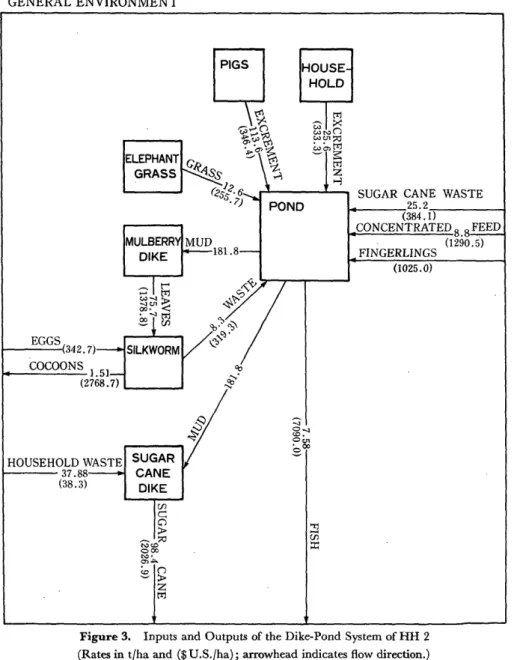
GENERAL ENVIRONMENT
Figure 3. Inputs and Outputs of the Dike-Pond System of HH 2
(Rates in t/ha and ($ U.S./ha); arrowhead indicates flow direction.)
RUDDLE Rural Reforms and Household Economies
system since it operates all the essential components of the system and all are linked by material, energy and labor flows (Fig. 3). The total dike-pond area of HH 2 is 0.515 ha, of which 0.198 ha (38.5 percent) is pond, 0.165 ha (32 percent) under sugar cane, 0.132 ha (25.6 percent) planted to mulberry and 0.02 ha (3.9 percent) is the private plot.
This household is large enough to supply from its own activities all pond inputs except sugar cane waste, concentrated feed and fingerlings (Table 2).
Twelve pigs are reared each year on the private plot, mainly to supply excrement for the pond. They produce 22.5 t/yr of excrement, all of which is input to the pond (at 113.6 t/ha/yr). The entire 5.07 t/yr of human excrement produced by HH 2 also goes into the pond (at 25.6 t/ha/yr). The 1.66 t/yr of silkworm excre- ment and mulberry leaf waste from the household's silkworms is also put into the pond (at 8.38 t/ha/yr). No kitchen and field waste is applied to this pond.
Two-and-a-half tons of Elephant grass, cultivated around the perimeter of the pond, is used as fish feed (at 12.6 t/ha/yr). No additional quantities of these inputs are purchased.
All other pond inputs are purchased. Five tons of sugar cane waste is sup- plied (at 25.2 t/ha/yr) and 1.75 t of concentrated feed is used (at 8.8 t/ha/yr).
Fingerlings are also purchased from the brigade.
Apart from the application of mud dug from its own pond, household waste is the only input made to the 0.165 ha of sugar cane dike contracted by HH 2.
The entire annual supply of 6.25 t is purchased and applied to the dike at a rate of 37.88 t/ha/yr.
Inputs for the mulberry dike, which has not been replanted since the imple- mentation of the household responsibility system, are limited to pond mud and fertilizer. The latter is obtained free of charge from the production team. The 0.132 ha of mulberry dike contracted to HH 2 yields 3.0 t/yr of leaves. HH 2 meets the entire silkworm feed requirements from its own mulberry dike. Sixteen sheets of silkworm eggs, the other principal input required for silkworm pro-
duction, are purchased from the commune.
The 0.02 ha private plot allocated to HH 2 is planted to bananas and vegetables. All vegetables are consumed by the household whereas most of the
bananas are sold on the free market.
Household Expenditures for System Inputs
As exemplified by HH 2, input costs are relatively low in the traditional form of this highly integrated dike-pond system, where the waste outputs of one com- ponent constitute inputs for others. Only now that the dike-pond system is becoming more open are large cash expenses being incurred for inputs.
In 1982 the total cash outlay by HH 2 for its pond was $1026.3. Of this,
$264.9 (25 percent) was the bid price for the contract and $761.4 was for material inputs (Table 2). The largest expense, $507.6 (50 percent), was for concentrated
1159
国立民族学博物館研究報告 10巻 4号
feed. Fingerlings cost $203 (20 percent) and sugar cane waste $50.8 (5 percent).
An opportunity cost of $261.5 was incurred on the four principal pond inputs (i.e., for Elephant grass, pig excrement, human excrement and silkworm waste).
Expenses for purchased inputs for the dike components of the system were relatively minor. Household waste, the only purchased input made to the sugar cane dike, cost 1.01 $/t. This household applied 6.25 t at a total cost of $6.3 (38.3 $/hafyr). No purchased inputs were made in 1982 to the mulberry dike, but $22.6 was spent for 16 sheets of silkworm eggs.
Pond Production and Rate of Return
The 0.198 ha pond of HH 2 yielded 1.5 t of fish in 1982 (7.58 t/ha/yr).
Quota sales of 0.44 t (about 30 percent of the total production) produced an income of $221, and the balance sold on the free market produced $1182.7. The total income from fish production in this household was $1403.7. The net profit earned on the pond was therefore $116 (Table 5).
Production and Rate of Return of the Sugar Cane Dike
This household contracted for 0.165 ha of sugar cane dike, from which it
Table 5. Annual Income, Expenditures and Savings of HH 2 (U.S.$)
Item Amount % of income/
expenditure
sources of income Net profit on fish sales Net profit on cocoon sales Net profit on sugar cane sales Net profit on pig sales Net profit on banana sales First son's salary
Fourth son's salary Daughter-in-law's salary
166.0 407.0 328.0 152.2 152.2 761. 4 761.4 304. 5
3.9 13.6 11.0 5. 1 5. 1 25.5 25. 5
10.2
TOTAL 2982.7 99.9*
expenditures
Food and consumer items Chinese New Year Clothing
Consumer durables
1827.4 507.6 203.0 137.0
(61.3) (17.0) ( 6.8) ( 4.5)
68. 3 19.0 7.6 5. 1
TOTAL 2675. 1 (89.6)* 100.0
savings 307.7 (10.3)*
* Computation and currency conversion rounding errors
( ) Percentage of income
RIJDDLE Rural Reforms and Household Economies
Table 6. Economic Balance Sheet of the Dike Component of HH 2 Item
(1) sugar cane Cash costs Opportunity costs
Total costs Income
Net profit
(2) mulberry-silkworms Cash costs
Total costs Income from cocoons Net profit
Total costs for dike component Total income from dike component Total net profit on dike component
$/mu
2.53 0.00 2.53 133.77
131.24
11.40 11.40 182.74 171.34 13.93 316.51 302.58
$/ha
38. 33 0.00 38.33 2026.92 1988.59
342.70 342.70 2768.70
2426.09 381.03 4795.71 4414.68
produced 16.25 t of cane in 1982 (98.49 t/ha/yr). With that of all other house- holds in the production team the sugar cane from HH 2 was sold to the local refinery at a controlled price of 20.58 $/t. This yielded an income of $334.4
($2026.9/ha/yr).
At $6.3 ($38.3/ha/yr), expenses incurred for purchased inputs to the sugar cane dike were minimal. Thus HH 2 made a net profit of $328 ($1988.5/ha/yr) on the sugar cane component of its dike-pond operation (Table 6).
Production and Rate of Return of the Mulberry Dike and Silkworm Component
HH 2 operates a 0.132 ha tract of mulberry dike, the leaf production of which is consumed entirely by the household's silkworms. Although the principal objective is to produce leaves, an important secondary product is silkworm excrement and mulberry leaf waste for the pond.10)
HH 2 produces 10.0 t of leaves (75.8 t/ha/yr). This, in turn, converts into 0.2 t of silkworm cocoons (1.51 t cocoons/ha of mulberry/yr).11) In addition, 1.67 t of waste is produced annually by the 8 crops of silkworms reared. This has an opportunity cost of $42.26.
Five crops of multivoltine worms are raised. Each requires a total of 0.3 t 10) This objective has now less important for many households since concentrated fish feeds became
locally available.
11) This is a valid extrapolation, since in the Zhujiang Delta cocoon production potential is reckoned empirically in terms of mulberry area.
1161
国立民族学博物館研究報告 10巻 4号
of mulberry leaves and yields 0.153 t of waste for pond use. Three crops of bivoltine worms are also raised. Each requires 1.0 t of leaves and produces 0.3 t of waste.
Income from cocoon sales averages $45.7 per harvest, or $365.5 for the year.
Since $42 is saved by not having to purchase silkworm waste for the pond, in HH 2 the total value of silkworm-raising $407/yr. The household's mulberry leaf production is thus worth 41 $/t ($3088.73/ha/yr) (Table 6 and Fig. 3).
Private Plot Yields
The 0.02 ha private plot of HH 2 is used to satisfy the household's vegetable requirements and to produce bananas for sale. Production rates were not determined. A dozen pigs are also raised for excrement production and sold on the free market each year. They are fed with kitchen and field waste from the household (which in HH 2 is not applied directly to the pond).
For the integrated dike-pond system operated by HH 2, total costs (cash and opportunity) were $1316.7 and total income was $2408.1. The net profit in 1982 was therefore $1091.4 (4677 $/ha).
The Household Economy
The economy of HH 2 is summarised in Table 5. Noteworthy is that the three full-time wage earners together generate 61.3 percent of the household's total annual income. Further, if the 9.5 percent of the household income derived from the sales of bananas and pigs is subtracted, the dike-pond system generates only 28.5 percent of the income of HH 2. In this household the three dike-pond components contribute almost equally to the total income : pond 12 percent, sugar cane 11 percent and mulberry-silkworm 10 percent.
As in HH 1, food is the principal item of expenditure in HH 2. Together with other daily consumer items, food accounts for 68 percent of all household expenditures and absorbs 57 percent of the total income. Expenses for Chinese New Year celebration comprise the second largest item in the budget, although in this case this item included the expenses of birthdays and other celebrations.
Relatively minor items in the budget of HH 2 are clothing and consumer durables.
The former accounted for 7 percent of income or 5 percent of expenses and the latter for 4 and 5 percent, respectively. In this household almost 10 percent of the income ($307.7) was saved in 1982.
HOUSEHOLD NO. 3 (HH 3)
Another relatively simple dike-pond operation is conducted by the small
HH 3. Although the dike-pond area contracted is also small, unlike HH 1
this household operates the complete range of dike-pond activities, except
silkworm-raising. Like HH 1, in this one, too, the dike-pond is operated part-
RUDDLE
Rural Reforms and Household Economies
time, since its two "able-bodied" members have other full-time occupations.
Four dependents comprise the remaining members of this household.
Land, Pond and Input Resources of the Household
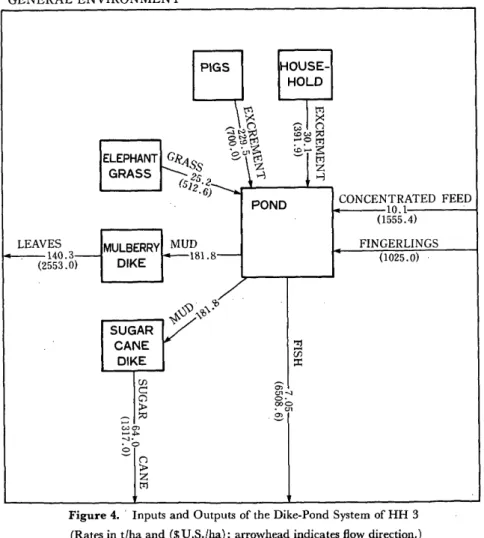
As in HH 2, this household's dike-pond operations are representative of the system in that they constitute the full assemblage of linked, complementary components (Fig. 4). The total area contracted for amounts to 0.245 ha. In addition, the household has an allocated 0.01 ha private plot. The contracted area comprises 0.146 ha of dike, 0.106 ha (72.6 percent) of which is under sugar cane and 0.04 ha (27.4 percent) planted to mulberry. The pond area is 0.099 ha.
Other than the purchase of fingerlings and concentrated fish feed (Table 2), this household generates all pond inputs from its own activities. Apart from the application of pond mud, neither purchased nor household-generated inputs are
GENERAL ENVIRONMENT
Figure 4. Inputs and Outputs of the Dike-Pond System of HH 3 (Rates in t/ha and ($U.S./ha); arrowhead indicates flow direction.)
1163
国立民族学博物館研究報 告 10巻 4号
made to its dikes. Since HH 3 does not rear silkworms there is no purchase of eggs.
Ten pigs are raised per annum on the private plot and their total excrement production of 22.72 t is input to the fish pond, (229.5 t/ha/yr). To that is added the household yield of 2.98 t of human excrement (30.1 t/ha/yr). No other waste products are applied to this pond.
The fish are fed with Elephant grass and concentrated feed. The total supply of the former, 2.5 t (25.25 t/ha/yr), is cultivated around the perimeter of the pond. The 1.0 t (10.1 t/ha/yr) of concentrated feed supplied is purchased from the commune factory. As with all other households in this team, fingerlings are purchased from the brigade. No other pond inputs are supplied, and in common with the preceding two households, HH 3 uses no prophylactics in its pond.
Household Expenditures for System Inputs
In 1982, HH 3 incurred cash costs of $385.5 for the operation of its pond.
Of this, $132.5 (34 percent) was paid as the bid price and $253 was spent for pond inputs: $101 (26 percent) for fingerlings and $152 (39 percent) concentrates.
An opportunity cost of $135 was incurred on the inputs generated by the household (Table 2). Total costs for the pond thus amounted to $520.5 (5263.9 $/ha) . Pond Production and Rate of Return
This 0.099 ha pond produced 0.7 t of fish (7.05 t/ha/yr) in 1982. Quota obligations were fulfilled by the sale of 0.222 t (31.7 percent), which yielded an income of $110. The balance sold on the free market for a total of $533.8. Thus the total income of fish sales was $644.3, and the net profit was $123.8 (1137.5 $/
ha) (Table 7).
Production and Rate of Return of the Dike Component and Private Plot The remainder of the income of HH 3 from the system was derived from the sale of sugar cane and mulberry leaves to the production team. Since the private plot is entirely planted to sugar cane, the total area under this crop is 0.116 ha.
It yielded a total of 7.42 t (64 t/ha/yr), which was sold at 20.58 $/t and produced an income of $152 (1317 $/ha/yr). This was all net profit since no inputs were made to the dike.
The 0.04 ha planted to mulberry yielded 5.6 t of leaves (140.3 t/ha/yr), which was sold at the public price of 18.2 $/t. This produced a net profit of
$101.5 (2553 $/ha).
In addition to sugar cane, 10 pigs were produced on the private plot. Ex- cluding the value of their excrement for the pond, they yielded a profit of $330, since other than kitchen and field waste no inputs were made for them.
Total costs of the integrated dike-pond operation of HH 3 were $520.5,
and income was $1227.8. The net profit was $707.3 (2896.6 $/ha) .
RUDDLE Rural Reforms and Household Economies
Table 7. Annual Income, Expenditures and Savings of HH 3 (U.S.$)
Item sources of income
Net profit on fish sales Net profit on pig sales Net profit on sugar cane sales Net profit on mulberry leaf sales Household head's salary Wife's salary
TOTAL expenditures
Food
Chinese New Year Consumer durables Clothing
TOTAL savings
Amount
123. 8 329.9 152.2 101.5 507.6 304.5 1519.5
609. 1 152. 2 50. 7 76. 1 888.3 631.4
% of income/
expenditure 8. 1 21.7 10.0 6. 7 33.4 20. 0 99. 9*
(40.0) (10.0) ( 3.3) ( 5.0)
68. 5 17. 1 5.7 8. 5
(58.3) 99.8461 (41.5)
* Computation and currency conversion rounding errors.
( ) Percentage of income.
The Household Economy
The economy of HH 3 is summarized in Table 7. As in the previous two households, salaries earned outside the dike-pond system play a major role in the budget. In this case those of the household head and his wife combined provide
$812, or 53 percent of the total income. The spare time operation of the dike- pond system added $645 (24 percent), and pigs provided $329 (21 percent) of the total income.
Like the previous two households, food is the principal expense incurred.
In this case additional food purchased beyond that produced by the household, together with such consumer items as tobacco, matches, candles and the like (specified by the informant as included within this category) required the expendi- ture of $609. This was nearly 69 percent of total expenditure and slightly more than one-third of the household's income.
Again, the second largest expense was for the Chinese New Year and other celebrations. This absorbed $152, or 8 percent of the household income and accounted for 17 percent of expenditure.
Clothing and consumer durables were rather minor items in the budget of HH 3. Only $76 was spent for the former (5 percent of income and 9 percent of total expenditures), and $51 (3 percent of income and 5 percent of total expenses) was spent on the purchase of consumer durables.
11flS
国立民族学博物館研究報告 10巻 4号
In all this household spent $888 or 58 percent of its annual income in 1982.
The remaining 42 percent was saved.
HOUSEHOLD NO 4 (HH 4)
Household Composition and Occupations
All members of this household are involved in dike-pond operations at least part-time. There are also three dependents, and two adults have full-time local employment outside the dike-pond system [RuDDLE 1985].
Land, Pond and Input Resources of the Household
The dike-pond area contracted by HH 4 amounts to 0.548 ha. Of this,
GENERAL ENVIRONMENT
Figure 5. Inputs and Outputs of the Dike-Pond System of HH 4
(Rates in t/ha and ($ U.S./ha); arrowhead indicates flow direction.)
RUDDLE Rural Reforms and Household Economies
0.132 ha (24.09 percent) is the pond, 0.119 ha (21.71 percent) is dike planted to mulberry and 0.297 ha (54.19 percent) is dike under sugar cane. Bananas are cultivated along the edges of the dikes and together with sugar cane on the 0.09 ha private plot.
Other than fingerlings and pond prophylactics, which are purchased, all pond inputs are generated by this household (Table 2, Fig. 5). Only three tra-
ditional inputs are used in fish production; elephant grass, pig excrement and human excrement. Since HH 4 does not raise silkworms, no waste from that operation is available. Neither sugar cane waste nor concentrated feed is used.
Unlike the other three households, however, HH 4 does apply two prophylactics to its pond; the traditionally used teaseed cake and the modern dipterex.
The entire 3.75 t (28.4 t/ha/yr) of Elephant grass supplied to this household's pond is, as usual, cultivated around the pond perimeter. Similarly, the full 4.5 t (34.09 t/ha/yr) of pig excrement and the entire 4.6 t (34.84 t/ha/yr) 'of human excrement applied to the pond are supplied by the household. Only small amounts of pond prophylatics are used; 8.0 kg of teaseed cake (60.6 kg/ha/
yr) and 2.0 kg of dipterex (15.15 kg/ha/yr). Other than pond mud supplied from the household's own pond no inputs are made to the dikes.
Household Expenditures for System Inputs
Cash costs incurred by HH 4 for its dike-pond operation amounted to
$369.6. Of this, $230 (62 percent) was the bid price. The balance was for material inputs; $135.3 (36 percent) for fingerlings and $4.3 for pond prophy- lactics. An opportunity cost of $150.8 was incurred for the Elephant grass and human and pig excrement generated by the household. The total operating cost for this pond in 1982 was therefore $520.
Pond Production and Rate of Return
The 0.132 ha pond contracted by this household' produced 0.75 t of fish in 1982 (5.68 t/ha). To meet the quota for this pond, 296 kg (39.47 percent) was sold at the public price. This produced an income of $147.4. Forty kilograms were consumed by the household (at an opportunity cost of $19.9) and the balance of 404 kg (54 percent of the total yield) was sold on the free market. This yielded an income of $452.4. HH 4 thus obtained a total income from fish sales of $600 (4544.5 $/ha/yr). Since costs amounted to $540, the net profit on this household's pond operation was $80 (Table 8).
Production and Rate of Return on the Dike Component and Private Plot The balance of this household's income from the dike-pond system is obtained from the sale of sugar cane, mulberry leaves and bananas. The 0.387 ha of dike and private plot planted to sugar cane produces 20.9 t (53.87 t/ha/yr). The entire production was sold to the production team at the fixed price of $20.58/t
1167
国立民族学博物館研究報告 10巻 4号