内 容
総 説
住民主体の健康づくり: 熱帯医学の知のモラル(英文)
石川 信克 ‑
原 著
インドネシアのスマトラにおけるブユ(双翅目: ブユ科)相調査成績(予報)(英文)
高岡 宏行,Mohamad Yunus,Upik K. Hadi,Singgih H. Sigit,宮城 一郎 ‑ タイで採集されたブユ(双翅目:ブユ科)1新種の記載および新しく記録された
9種について(英文)
Chaliow Kuvangkadilok,高岡 宏行 ‑
Role of Anopheles subpictus as a Primary Vector of Malaria in an Area in India
Soumendranath Chatterjee and Goutam Chandra ‑
The Effect of Repeated Four Monthly Treatments on the Prevalence and Worm Burden of Ascaris, Trichuris and Hookworm Infections in an Endemic Area
Norhayati Binti Moktar,Pakeer Oothuman and Fatmah Mohd Salleh ‑
短 報
酸処理とQC‑PCR法を用いたToxoplasma gondiiのtachyzoiteとbradyzoiteの同定(英文)
畑 英一,青才 文江,Mun Hye‑Seong,Chen Mei,小林 仁,
Anuar Abdullah Khairul,窪沢 仁,矢野 明彦 ‑
会報・記録
2000(平成12年)年度日本熱帯医学会役員名簿(2000年6月9日現在)
日本熱帯医学会雑誌編集委員名簿 ‑
投稿規定 ‑
著作権複写に関する注意
………
…………
………
………
………
………
………
………
………
………
Japanese Journal of Tropical Medicine and Hygiene Vol.28 No.3
CONTENTS
Review Ishikawa, N.
Ethics of Tropical Medicine: People‑Centered Health Promotion Reflections from
20 Years Experiences of Medical Cooperation in Bangladesh ‑
Original article
Takaoka, H., Yunus, M., Hadi, U.K., Sigit, S.H. and Miyagi, I.
Preliminary Report of Faunistic Surveys on Black Flies(Diptera: Simuliidae)
in Sumatra, Indonesia ‑
Kuvangkadilok, C. and Takaoka, H.
Taxonomic Notes on Simuliidae(Diptera)from Thailand:Description of a
New Species and New Distributional Records of Nine Known Species ‑
Chatterjee, S. and Chandra, G.
Role of Anopheles subpictus as a Primary Vector of Malaria in an Area in India ‑ Moktar, N.B., Oothuman, P. and Salleh, F.M.
The Effect of Repeated Four Monthly Treatments on the Prevalence and Worm
Burden of Ascaris, Trichuris and Hookworm Infections in an Endemic Area ‑
Research Note
Hata, H., Aosai, F., Mun, H‑ S., Chen, M., Kobayashi, M., Khairul, A.A., Kubosawa, H. and Yano, A.
Identification of Toxoplasma gondii Tachyzoites and Bradyzoites by a Quantitative
Competitive Polymerase Chain Reaction Method after the Acid Treatment ‑
………
………
………
…………
………
………
September 2000
Review
ETHICS OF TROPICAL MEDICINE:
PEOPLE ‑ CENTERED HEALTH PROMOTION
REFLECTIONS FROM 20 YEARS EXPERIENCES
OF MEDICAL COOPERATION IN BANGLADESH
NOBUKATSU ISHIKAWA MD, MSc, Ph.D.
The Research Institute of Tuberculosis Japan Anti‑Tuberculosis Association
I would like to approach this giant theme from my own experience in Bangladesh and the ethical reflec- tions for the last 20 years for tuberculosis control. I would especially address to young people who are inter- ested in studying for the health promotion in the tropics.
My talk can be summarized with the following 4 key terms:1)Go to the people, 2 )Health by the people, 3) DOTS and HSSR, and 4) Institutional Capacity in Japan.
Go to the People
To make an effective work or study, we need always to have a close contact with the fields where people live, and to keep learning from the fields. For example, if we want to do any study in the tropics and prepare a questionnaire in Japan,we need to know that our knowledge may be limited and needs to be largely changed according to the real needs of the people. Our attitude should be that we are trying to listen to the people and to find the problems and share the findings together with the people. In other words, our work or study should not beʻour program ‑orientedʼ,but ʻpeopleʼs problem orientedʼ.
(Fig. 1)
I once made a health awareness survey in a south- ern district of Bangladesh, asking people about their health problems in their villages with a semi ‑open questionnaire. The answers were recorded as they said, and classified later as ʻpreventiveʼ, ʻcurativeʼor ʻno interestʼ. For example, ʻno toiletʼor ʻ no safe drinking waterʼwas classified as preventive, and ʻ no doctorʼor ʻno drugsʼwas as curative. They were analyzed accord- ing to community group activity with or without health
volunteer. It was then found that people in a group activity with health volunteer had more preventive idea than those without health volunteer. People not in a group had the least preventive ideas. I have learned that health awareness grows more in the peopleʼ s own activ- ities for improvement of their living condition or life style.
( ) I have once assisted a survey for a Japanese bacteri- ologist to conduct a tuberculosis prevalence survey by the bacteriological examination in rural Bangladesh.
The study area(Manikganj Sub‑district)was typically rural,50 km away from Dhaka and had a population of 150,000. I made a sampling of 50 villages,and 7,000 adult population was selected randomly. Sputum specimens were collected from people who were screened by a symptomatic survey. The bacteriologist made both
Figure 1 What is the health problems in your village?
Health awareness rises by group activity and health volunteer.
(Ishikawa et al.: Promotion of PHC in Rural Bangladesh, NATAB, 1995 )
smear and culture examination of the specimen for acid fast bacilli, especially Mycobacterium tuberculosis. It was then estimated that the sputum smear AFB positive rate was 0.3‑0.5%, and the culture positive tuberculosis rate was 0.4‑0.6%. Nearly 30% of them had a resistance to any anti‑TB drug, and all of them had a previous treatment history. Among the cultured specimen, Atypical Mycobacteria(AM or MOTT)grew in high proportion possibly due to contamination. They were of course excluded from the analysis. The findings were of great value and are useful still now as there has been no other study like this since then. The study result was first reported in Japanese local journal,but the bacteri- ologist lost his interest in publishing it internationally as he was a laboratory oriented researcher and disap- pointed too much with the partial contamination in the field survey. I myself was also not much motivated in the publication simply because I was then busy in pri- mary health project though assisting the survey as a collaborator. Another weakness was that there was no local ownership for this survey. The results should have been shared more in Bangladesh and internationally as well. In this sense, we made a big mistake.
Health by the People
After the survey in Manikganj people asked us how we would deal with the detected 24 TB patients. They requested us to make a better system of treating TB patients. I proposed them that I would be ready to help them if they wanted to develop a system of TB control in the community with active participation of the com- munity. This was a great chance for me too, as I had wanted to try a community based TB program some- where. A chance often comes before us when we are really looking for it.
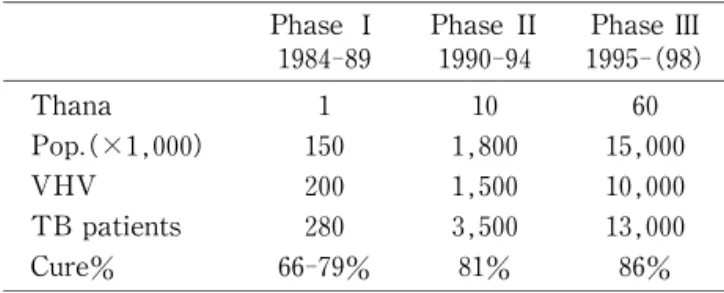
(Table 1)
The Manikganj sub‑district consists of 147 villages with 150,000 population. The medical services were very limited and the majority of people were using unquali- fied practitioners for the medical care. A local NGO called BRAC(Bangladesh Rural Advancement Commit- tee)was actively organizing group activities and about 200 health volunteers(HVs )were already working as bare‑foot doctors in the BRAC health program. But nothing had been yet done for TB. We planned to make a system of utilizing the HVs. They could screen the suspects with a chronic cough and give drugs to the patients. With my minimum advice,this program start- ed in 1984 and it has been continuously sustained in the sub‑district even after I left the country in 1986. Since
then I visited there only twice a year, and my local assistant made monthly supervisory visits (Phase I). I never thought that the expansion to other areas in different settings was possible without the guidance by a specialist like me. However BRAC, using the experi- ence in Manikganj applied the approach to 10 sub‑dis- tricts(Phase II), and then to 60 sub‑districts covering over 600,000 population currently as a part of national program(Phase III). As of 1998, the number of the treated TB patients counts over 13,000, and that of the HVs involved is about 13,000. This approach has been very useful in rural and remote areas where the access to the government health facilities is limited. WHO has recognized it and the achievements have been published in Lancet by BRAC staff two times. Though I could not publish any paper on this topic with my name,I am very proud that the local people have gained the ownership of the program. We could say ultimately that the local people are the subjects for their health improvement.
DOTS(national TB program package)and HSSR The current global strategy for TB control called as Directly Observed Treatment,short course( DOTS)has been derived from the analysis of the successful pro- grams in the world. This package program has an excellence as policy science in that the government commitment is given the highest importance;cost effec- tive idea for the available technology is applied; for example, diagnosis is made simply by microscopic examination of sputum smear, but most costly but effective short course regimen of anti ‑TB drugs are used; a regular monitoring system is included in the program and a simplified ʻ cure rateʼis used for the criteria of successful program. The DOTS however needed an operational research on how it could be applied in Bangladesh.
When I went to see Dr.Ahsan Ali,then the director
Table 1 Community based TB Program Development (BRAC:1984‑98)
PhaseⅠ 1984‑89
PhaseⅡ 1990‑94
PhaseⅢ 1995‑(98)
Thana 1 10 60
15,000 10,000 13,000 86% 1,800
1,500 3,500 81% 150
200 280 66‑79% Pop.(×1,000)
VHV TB patients Cure%
of national TB program in 1991 for my regular visit to Bangladesh,he asked for my help to conduct a research, as he was a professor of medicine. Then I proposed him to do an operational research through a pilot model area development, as the new TB project had been prepared under the World Bank and WHO. This big scale project was being introduced by WHO initiative but no proper pilot area had been tried.
Two thanas(sub‑districts)near Dhaka were then chosen for the model trial and TB services were introduced at the thana health center. Participatory action research(PAR)was used for the duration of 2 years. This is a kind of operational research method, used for finding a suitable way of proposed program and it is also useful to make the staff and people involved lively through their active participation. The process and outcomes in this PAR was excitingly greater than we expected. Some new ideas were introduced in the main project,and above all,the central managerial staff gained the experience of supervising the periphery cen- ters and understanding the local reality more deeply through periodical workshops.
From the above experience, I come to realize that the health systems and services research (HSSR)is very important to make a real impact to the country. At the same time the real empowerment of the people both in the government and community can be made through health research.
Institutional capacity in Japan
The last key term is institutional capacity. This means the need for strengthening the institutional capac- ity in Japan as a base for the field activities. In my case, the Research Institute of Tuberculosis has been a base for my work in Bangladesh. But generally speaking, this capacity is still weak in Japan.
Ethics of Tropical Medicine
Ethics is an attitude to think of the oneʼ s own deeds by standing on the otherʼs standpoint. It can be also an attitude of the dialogue or interaction between the subject and the object of any action (The Ethics of Knowledge, by Y. Kobayashi and Y. Funabiki, Tokyo University Press, 1996). Here lies a basis for hope, peace or social justice. I would like to discuss what tropical medicine is through ethical reflections based on my own experiences in Bangladesh in the area of tuber- culosis control.
The experiment in the laboratory or analysis at the study room is one, and the field experiment or field study is the other. Some people spent most of the time in the laboratory under the name of tropical medicine, and others are too busy working in the fields under the same name or international health. But I would say that both are equally needed for tropical medicine.
The subject or actor of tropical medicine is usually a researcher outside the tropics or community. In this case,local people in the tropics are just an object of the study. However a local researcher, workers and even people should be the subject of any research as well.
The external researcher and local people need to cooper- ate and collaborate equally. There are various kinds of local people, including local researchers, supervisors, community level workers, and community people. We need to clarify for whom and with whom we are work-
ing, and to whom we should feed back the outcomes of the research. And we need to be aware that the local rich or local researcher cannot often represent the local people.
(Table 2)
Conventionally tropical medicine has been positivist science. This characteristic is basically important but we need to know its limitation as well. It has a danger that the importance of the knowledge often lies only in the authorship. A new horizon for tropical medicine to overcome this is to strengthen the aspects of applied science, social science or qualitative analysis, and to change of our awareness that the knowledge belongs to the people or the people have the ownership of the knowledge.
Table 2 Perspectives of Tropical Medicine
Scientific ground:
Purpose:
Methods:
Owner:
Present Future adoption/correction
・Positivist Science ・Applied, Practical Science
・Creation of new knowledge
・Publication
・Health promotion
・Health system improvement
・positivism
・Qualitative
・Action oriented
・Social science
・Qualitative
・Researcher (Authorship)
・People (Ownership)
CONCLUSION
In summary, the aims of tropical medicine are;to work or conduct a study for better health collabor- atively with the people in the tropics;to share equally the study results;to support the people in the tropics to
work and study by themselves for their own health promotion;and to share internationally the health prob- lems in the tropics through our work in the laboratory or publications. For this we need to strengthen more the institutional capacity in Japan.
PRELIMINARY REPORT OF FAUNISTIC SURVEYS ON BLACK FLIES ( DIPTERA:SIMULIIDAE )
IN SUMATRA, INDONESIA
HIROYUKI TAKAOKA , MOHAMAD YUNUS, UPIK K. HADI, SINGGIH H. SIGIT AND ICHIRO MIYAGI
Received February 23, 2000/Accepted June 21, 2000
Abstract:Collections of pupae and larvae of black flies(Diptera:Simuliidae)were carried out in 1992 and 1994 at 59 sites in four provinces of Sumatra,Indonesia. As a result,22 simuliid species including 12 species newly recorded from Sumatra were identified, bringing the total number of simuliid species recorded from Sumatra to 26. All these species were assigned to the genus Simulium s.l.and placed into three subgenera, i.e.,Gomphostilbia(12 spp.),Nevermannia(3 spp.),and Simulium s.str.(11 spp.). Further groupings were made at the species‑group level within each subgenus. The simuliid fauna of Sumatra is Oriental in character,being very closely related to those of Peninsular Malaysia and Java. Infections with mermithids, microsporidians and/or fungi due to Coelomycidium sp. were found in the larvae of 10 of the 22 black‑fly species examined.
Key words: Simuliidae, fauna, Sumatra, mermithid, microsporidian fungus
The simuliid fauna of Sumatra,Indonesia was first studied by Edwards (1925, 1934 ), who reported nine black‑fly species. Later in 1977 Dr. Rolf Glatthaar collected several simuliid species including a new species from North Sumatra,which was described later as Simulium glatthaari by Takaoka and Davies( 1995a). In 1992 and 1994 we made surveys on black flies at various localities of four provinces in Sumatra, and collected 22 species, of which three new taxa were already described(Takaoka and Sigit, 1997 ).
In this paper we report the results of preliminary identification of these 22 black ‑fly species including 12 ones newly recorded from Sumatra,together with those of the examinations of larval specimens for infections with mermithids, microsporidians and fungi due to Coelomycidium sp.
COLLECTION METHODS AND CLASSIFICATION
The methods of collecting simuliid pupae and larvae in flowing waters and rearing pupae until adults emer- ged were mentioned in Takaoka(1983). The classifica- tion of each black‑fly species was done at the generic and subgeneric levels by the definitions and keys made
by Crosskey(1967,1969),and at the species‑group level by those proposed by Takaoka and Davies (1996).
The black‑fly larvae collected were examined under a dissecting microscope for mermithid,microspor- idian and fungal infections. These infections were diagnosed in appearance by the signs of symptoms of the larval body characteristic for each group of pathogens (Crosskey, 1990).
COLLECTION DATA
For each site surveyed, collection data such as a brief description of flowing water, water temperature, altitude, its location, and date, are given below by provinces(only available data are shown ). All samples were collected by H. Takaoka.
Lampung
Surveys were carried out at two sites (L‑1 and L‑2) near Mutaralam, and five sites(L‑3 to L‑7)along the road between Liwa and Gunungkemala in the Barisan Range.
L‑1. An outlet small stream 0.3 cm wide slowly running from the pond,shaded,water temperature 23 °C, 1 Department of Infectious Disease Control, Oita Medical University, Hasama, Oita 879‑5593, Japan *:Correspondent author 2 Department of Parasitology and Pathology, Faculty of Veterinary Medicine, Bogor Agricultural University, Taman Kencana 3,
Bogor 16151, Indonesia
3 Laboratory of Medical Zoology, Faculty of Medicine, University of the Ryukyus, Nishihara, Okinawa 903‑0215, Japan
altitude ca.900 m,at Batu Kebayan,west of Mutaralam, 30.Ⅶ.1992.
L‑2. An irrigation ditch ca.1.0 m wide,exposed to the sun,slowly flowing in a paddy field,water tempera- ture 23°C,altitude ca.900 m,at Batu kebayan,nearer to Mutaralam than L‑1, 30.Ⅶ.1992.
L‑3. A brook ca. 0.5 m wide, shaded, slowly flow- ing,water temperature 20°C,just south‑west of Liwa,31.
Ⅶ.1992.
L‑4. A brook 0.3‑1.0 m wide,partially shaded,fast flowing down on the rocky streambed, just south ‑west of L‑3, 31.Ⅶ.1992.
L‑5. A rivulet 0.2‑0.3 m wide, shaded, moderately flowing on the rocky streambed, water temperature 21°C, near L‑4, 31.Ⅶ.1992.
L‑6. A creek 2.0‑3.0 m wide, partially shaded, rapidly or moderately flowing down among large stones, near L‑5, water temperature 22°C, 31.Ⅶ.1992.
L‑7. An irrigation ditch 0.3 m wide,exposed to the sun, slowly flowing in a paddy field,water temperature 23°C, 31.Ⅶ.1992.
Bengkulu
Surveys were maded at six sites around the north- ern shore of the Lake Ranau.
B‑1. An outlet river 10‑20 m wide,originated from the Lake Ranau, exposed to the sun, moderately flow- ing, water temperature 26°C, at Bandingagung, 29.Ⅶ.
1992.
B‑2. A small stream 0.3‑0.5 m wide,partially shad- ed,running in a paddy field,water temperature 22°C,at Desa Surabaya, near Bandingagung, 31. Ⅶ.1992.
B‑3. A rivulet 0.5‑1.0 m wide,shaded,slowly flow- ing down in a palm forest and a cultivated land for coffee plantation, water temperature 26 °C, altitude ca.
350 m, at Dusun Pelawi, along the road from Simpang- sender to Muaradua, 29.Ⅶ.1992.
B‑4. A small stream 0.2 m wide,shaded,moderate- ly flowing in the bush down to the Lake,water tempera- ture 23.5°C, altitude ca. 500 m, near Simpangsender, along the road from Simpangsender to Liwa,29.Ⅶ.1992.
B‑5. A ditch 0.2‑0.3 m wide, exposed to the sun, slowly flowing,water temperature 24°C,altitude ca.500 m, near B‑4, 29.Ⅶ.1992.
B‑6. A creek, called Air Mujin, 2.0‑3.0 m wide, partially shaded,moderately flowing down to the Lake, water temperature 24°C,altitude ca.500 m,at Tanjung- jati, along the road between Simpangsender and Liwa, 29.Ⅶ.1992.
West Sumatra
Surveys were carried out in two areas, one around Padang and the other around Bukittinggi. In the Padang area,collections were made at three sites (W‑1 to W‑3) along the road between Painan and Taratak running along the Indian Ocean coast,at seven sites( W‑4 to W‑
10)along the road going up from Lubukbargalung to Lubuksulasih, at one site( W‑11)along the road from Lubuksulasih to Talang, and at six sites (W‑12 to W‑
17) along the road between Lubuksulasih and Ala- hanpanjang, and at five sites(W‑18 to W‑22)between Alahanpanjang and Surian.
W‑1. A small stream 0.3‑1.0 m wide, shaded, fast running down on the rocky streambed, water tempera- ture 24°C,altitude ca.120 m,just north of Painan,10.Ⅷ.
1994.
W‑2. A ditch 0.2‑0.4 m wide, slowly flowing along the road, shaded, water temperature 25 °C, altitude ca.
140 m, approximately half way between Painan and Pasarkuok, 10.Ⅷ. 1994.
W‑3. A brook 1.0 m wide, exposed to the sun, slowly flowing,water temperature 30°C,altitude ca.120 m, at Tigosakato, Tanjung Kandis, 10. Ⅷ.1994.
W‑4. An irrigation ditch 0.8 m wide,slowly running along the road, exposed to the sun, water temperature 22°C,altitude ca.260 m,about half way from Lubukbar- galung to Lubuksulasih, 11.Ⅷ.1994.
W‑5. A rivulet 0.3 m wide, shaded, moderately running in the bush,water temperature 19° C,altitude ca.
960 m, just north of W‑4, 8.Ⅷ.1994.
W‑6. A rivulet 0.3‑0.5 m wide, shaded, slowly or moderately flowing in a pine forest, water temperature 19°C,altitude ca.1,060 m,just before the mountain pass, back of the restaurant, 8.Ⅷ.1994.
W‑7. A ditch 0.3 m wide, shaded by bush, slowly flowing, water temperature 19° C, altitude ca. 1,100 m, near the mountain pass, 8.Ⅷ.1994.
W‑8. A creek 1.0‑3.0 m wide, shaded, moderately flowing in the forest, water temperature 20 °C, altitude ca. 1,000 m, just over the mountain pass, 8. Ⅷ.1994.
W‑9. A stream ca.1.0 m wide,exposed to the sun, moderately flowing, water temperature 19°C, altitude ca. 980 m, near Lubuksulasih, 8. Ⅷ.1994.
W‑10. A stream ca. 1.0 m wide, partially shaded, moderately flowing in an open land,water temperature 20°C, altitude ca. 950 m, at Lubuksulasih, 8. Ⅷ.1994.
W‑11. A river 4.0‑5.0 m wide, exposed to the sun, moderately flowing in a paddy field,water temperature 20°C, altitude 970 m, near Talang, 9. Ⅷ.1994.
W‑12. A ditch 0.2 m wide,slowly flowing along the road, exposed to the sun, water temperature 21 °C, alti-
tude ca. 1,230 m, near Lubuksulasih, along the road to Alahanpanjang, 9.Ⅷ.1994.
W‑13. A ditch 0.3 m wide, exposed to the sun, slowly flowing, 19.5°C, altitude ca. 1,230 m, 9.Ⅷ.1994.
W‑14. An irrigation ditch 0.3 m wide, exposed to the sun, slowly or moderately running, water tempera- ture 20°C,altitude 1,280 m,just south of W‑13,9.Ⅷ.1994.
W‑15. A stream 2.0‑5.0 m wide,exposed to the sun, slowly flowing in a swampy land, water temperature 18°C, altitude 1,450 m, at Dusun Rawang Godang, Lem- bang Jaya, Solak, 11.Ⅷ.1994.
W‑16. A ditch 0.2‑0.4 m wide, exposed to the sun, slowly flowing,water temperature 23°C,altitude ca.1,500 m, at Sungai Silah, Lembang Jaya, Solak, 22. Ⅷ.1994.
W‑17. A stream 0.4‑0.6 m wide,shaded,moderately running in a natural forest, water temperature 16 °C, altitude ca. 1,580 m, near W‑16, just south of the Lake Dibawah, 21.Ⅷ.1994.
W‑18. A stream 3‑4 m wide, exposed to the sun, moderately running in a paddy field,water temperature 21°C, altitude ca. 1,460 m, just south of Alahanpanjang, along the road to Surian, 12.Ⅷ.1994.
W‑19. A small stream 0.3‑0.5 m wide, exposed to the sun, slowly running down from a forest and joining W‑18, water temperature 20 °C, altitude ca. 1,470 m, 12.
Ⅷ.1994.
W‑20. A stream 0.4‑1.0 m wide,exposed to the sun, moderately flowing, water temperature 20°C, altitude ca. 1,090 m, south‑east of W‑ 18, 11.Ⅷ.1994.
W‑21. A stream ca.1.0 m wide,shaded,moderately flowing, water temperature 22 °C, altitude ca. 1,110 m, south‑east of W‑20, 11.Ⅷ.1994.
W‑22. A ditch 0.2‑0.3 m wide, exposed to the sun, moderately running along the roadside, water tempera- ture 23°C, altitude ca. 1,110 m, at Surian, 11.Ⅷ.1994.
In the Bukittinggi area, collections were made at eight sites (W‑23 to W‑30 )in and around the Mt.
Singkarak,at four sites(W‑31 to W‑34)along the road from Payakumbuh to Kotoalam,and at four sites( W‑35 to W‑38)along the road from Bukittinggi to Lubuksi- kaping.
W‑23. An irrigation channel 0.4‑0.6 m wide, exposed to the sun, slowly flowing in a paddy field, water temperature 25°C, altitude ca. 190 m, at Pasir, Kekambil, Kayutanam, 14.Ⅷ.1994.
W‑24. A river ca. 10 m wide, exposed to the sun, moderately or rapidly flowing,water temperature 20°C, altitude ca. 560 m, at Airmancuur, along the road from Kayutanam to Padangpanjang, 14. Ⅷ.1994.
W‑25. An irrigation channel 0.2‑0.3 m wide, par-
tially shaded by bush, moderately flowing, water tem- perature 17°C, altitude ca. 1,400 m, at Sawararas, near Koto Rarang, on the northern slope of Mt. Singkarak, 15.Ⅷ.1994.
W‑26. A small stream 0.3 m wide, shaded, moder- ately flowing down in a natural forest, ca. 300 m south from W‑25, water temperature 16 °C, altitude ca. 1,460 m, 15.Ⅷ.1994.
W‑27. A brook 2.0‑3.0 m wide,exposed to the sun, moderately flowing, water temperature 19°C, altitude ca. 1,400 m, in the Mt. Singkarak, at Ganting Sing- galang, Tanahdatar, 19.Ⅷ.1994.
W‑28. A creek 4.0‑6.0 m wide,exposed to the sun, moderately flowing, water temperature 20°C, altitude ca. 1,100 m, on the way from Kotabaru to the peak of Mt. Singkarak, 16.Ⅷ.1994.
W‑29. An irrigation ditch 0.5‑0.7 m wide, exposed to the sun, slowly flowing, water temperature 26 °C, altitude ca. 1,000 m, near W‑28, 16.Ⅷ.1994.
W‑30. A ditch 0.3‑0.4 m wide, exposed to the sun, slowly flowing along the roadside, at the eastern shore of the Lake Maninjau, just south of Maninjau, altitude ca. 500 m, 12.Ⅷ.1994.
W‑31. A ditch 0.2‑0.3 m wide, exposed to the sun, slowly flowing along the roadside, water temperature 23°C, altitude ca. 530 m, near Kotoalam, 17. Ⅷ.1994.
W‑32. A rivulet 0.4‑0.6 m wide, shaded, slowly flowing in a natural forest, water temperature 22 °C, altitude ca. 570 m, just south of W‑31, 17.Ⅷ.1994.
W‑33. A brook 1.0 m wide, exposed to the sun, slowly flowing,water temperature 21°C,altitude ca.600 m, 17.Ⅷ.1994.
W‑34. A rivulet 0.5 m wide, exposed to the sun, slowly flowing, water temperature 21°C,altitude 820 m, half way between Payakumbuh and Kotoalam,south of W‑33, 20.Ⅷ.1994.
W‑35. A river 10‑15 m wide, partially shaded, moderately or fastly flowing in a natural forest, water temperature 23°C, altitude ca. 340 m, in Pasaman, half way between Bonjol and Lubuksikaping, 18. Ⅷ.1994.
W‑36. A ditch 0.3 m wide, exposed to the sun, slowly flowing along the roadside, water temperature 23.5°C, altitude ca. 240 m, at Bonjol, Pasaman, 18. Ⅷ.
1994.
W‑37. A ditch 0.3 m wide,exposed to the sun,very slowly flowing in a paddy field,water temperature 29° C, altitude ca. 300 m, at Tanjung Bunga, just south of W‑
36, 18.Ⅷ.1994.
W‑38. A rivulet 0.3‑0.4 m wide,exposed to the sun, moderately flowing, water temperature 24°C, altitude ca. 300 m, at Tanjung Bunga, near W‑ 37, 18.Ⅷ.1994.
North Sumatra
Surveys were carried out at eight sites along the north‑eastern shore of the Lake Toba.
N‑1. A creek 4.0‑6.0 m wide, shaded, moderately flowing in a forest,water temperature 22 °C,altitude ca.
880 m, at Bandar Baru, Sibolangit, 25.Ⅷ.1994.
N‑2. A creek 6.0‑8.0 m wide, exposed to the sun, moderately flowing, water temperature 24.5°C, altitude ca. 650 m, foot of the Mt. Meriah, at Deliserdang, near Sondi, along the road from Pematangsiantar to Pematang Purba, 26.Ⅷ.1994.
N‑3. A small stream 1.0 m wide,exposed to the sun, slowly flowing, water temperature 22.3°C, altitude ca.
680 m, near N‑2, 26.Ⅷ.1994.
N‑4. An irrigation ditch 0.4 m wide,exposed to the sun,slowly flowing in the paddy rice field,water temper- ature 25°C, altitude ca. 960 m, near Seribudolok, 26.Ⅷ.
1994.
N‑5. A creek 2.0‑3.0 m wide, exposed to the sun, moderately flowing, water temperature 19°C, altitude 1,130 m, at Aek Nauli, near Parapat, 27. Ⅷ.1994.
N‑6. A brook 1.0 m wide,partially shaded,moder- ately flowing in a pine forest, water temperature 20°C, altitude ca. 950 m, at Sualan, near Prapat, 27.Ⅷ.1994.
N‑7. An irrigation ditch 0.5 m wide,exposed to the sun,fastly flowing,water temperature 19° C,altitude ca.
1,100 m,at Junggadolok,along the road between Porsea and Prapat, 26.Ⅷ.1994.
N‑8. A creek ca. 4.0 m wide, exposed to the sun, moderately flowing in the paddy rice field, water tem- perature 21°C,altitude ca.920 m,at Lunbanjulu,Siruur, Porsea, 26.Ⅷ.1994.
RESULTS OF COLLECTIONS OF BLACK FLIES AND
EXAMINATIONS OF PATHOGENS IN THE LARVAE
Overall, 22 black‑fly species including 12 species newly recorded from Sumatra were identified;and these were all assigned in the genus Simulium Latreille s. l., and further placed into three subgenera,i.e.,Gomphostil- bia Enderlein,Nevermannia Enderlein and Simulium Latreille s. str., as treated below. Brief remarks on taxonomy, distribution and infections were given for each species following the numbers of specimens examined. The present results bring the total number of black‑fly species recorded from Sumatra to 26,of which seven are indigenous to Sumatra, six, six, and one are common to Java, Peninsular Malaysia, and Thailand, respectively, four are common to all these three areas, and two are common to the latter two areas. The simuliid fauna of Sumatra is thus very similar to those
of neighbouring areas,in particular,to those of Peninsu- lar Malaysia and Java, both of which are known to be Oriental in elements(Takaoka and Davies,1995b,1996 ). Infections with mermithids, microsporidians and fungi were detected in 10 of the 22 black ‑fly species examined. These are first records of these pathogens in these 10 black‑fly species from Indonesia. Of these,four simuliid species harboured all these three categories of pathogens, three had both microsporidians and fungi, two had either of the latter two pathogens, as noted below. Most of infected larvae were at the immature stage, but some were at the mature stage.
Abbreviations used below are as follows:♀for the reared female adult and its pupal exuvia; ♂ for the reared male adult and its pupal exuvia;P for pupa;PE for pupal exuvia;ML for mature larva;IL for immature larva. Localities, where black‑ fly samples were col- lected, are shown by the initial of the provinceʼs name with the site number, which correspond to those shown in the collection data. Numbers of larva (e)infected,if present among the total larvae examined, are shown in parenthesis: larva(e)infected with mermithid( s), mi- crosporidians and fungi due to Coelomycidium sp. are abbreviated as NE, SP, and FU, respectively.
1 ( ) Takaoka
and Davies, 1995
Simulium (Gomphostilbia)cheongi Takaoka and Davies,1995b:37(female,male,pupa and larva ). Specimens examined. L‑4:2P, 1PE, 3ML.
Remarks. This species was described from Peninsu- lar Malaysia(Takaoka and Davies,1995b). This is the first record of this species from Sumatra.
No infection was found.
2 ( ) Takaoka
and Davies, 1995
Simulium (Gomphostilbia) duolongum Takaoka and Davies, 1995b: 19 ( female, male, pupa and larva).
Specimens examined. N‑2:1♂,1P,5ML,13IL;N‑
3:1PE;N‑5:12♀, 13♂, 2PE, 9ML, 19IL;W‑8:1IL.
Remarks. S. duolongum was also described from Peninsular Malaysia (Takaoka and Davies, 1995b ). This is the first record of this species from Sumatra.
No infection was found.
3 ( ) Edwar-
ds, 1934
Simulium (Eusimulium)friederichsi Edwards,1934:
118(male).
Simulium (Gomphostilbia) friederichsi: Crosskey, 1973: 425; Datta, 1983: 229; Crosskey, 1987: 450;
Takaoka and Davies, 1995b: 161; Takaoka and Davies, 1996:26.
Specimens examined. W‑3:1♀;W‑10:12♀,18♂, 6ML,9IL;W‑15:2♀,2♂,2ML,4IL;W‑21:1♂;W‑36:
9♀, 15♂, 26ML, 31IL.
Remarks. S. friederichsi was described from a single male adult collected from Java (Edwards, 1934). The female, pupa and larva of this species have remained unknown for a long time. The male of this species is characterized by the presence of the unique ornamentation on the scutum, i.e., an elongate median black vitta and two submedian black spots on the greyish pruinose ground color. The male specimens reared from the pupae collected in this survey show several such scutal patterns, of which one is almost the same as illustrated for S. friederichsi (Takaoka, 1991). However,some other scutal patterns are also in a good agreement with those found in S. siamense from Thailand (Takaoka and Suzuki, 1984 ) and S.
yaeyamaense from Japan(Takaoka, 1991). The pupae and mature larvae collected from Sumatra are also very similar to those of S. siamense. Under these situations, it should be remembered that the present identification is tentative until additional samples of S. friederichsi from the type locality in Java become available for detailed comparison.
No infection was found.
4 ( ) Takaoka
and Davies, 1996
Simulium (Gomphostilbia)gyorkosae Takaoka and Davies, 1996:28(female, male, pupa and larva ). Specimens examined. W‑15:1♂;W‑18:1♀;W‑25:
13♀, 10♂, 3PE, 12ML, 21IL; W‑27: 9♀, 6♂, 29ML, 89IL(1SP);L‑2:2P, 1ML, 3IL.
Remarks. S. gyorkosae was originally described from Java(Takaoka and Davies,1996 ). This is the first record of S. gyorkosae from Sumatra. This species is very similar to S. asakoae described from Peninsular Malaysia(Takaoka and Davies, 1995b )and there is a possibility that the latter species is mixed in the present specimens. Further studies are now under way.
Only 1 of the 89 immature larvae collected at W‑27 was infected with microsporidians.
5 ( ) Takao-
ka and Sigit, 1997
Simulium (Gomphostilbia) padangense Takaoka and Sigit,1997:69(female,male,pupa and larva ).
Specimens examined. W‑6: 1♀, 3♂, 1P, 21ML, 38IL.
Remarks. This species was fully described from the female,male,pupal and larval specimens collected from West Sumatra by Takaoka and Sigit (1997). Its distri- bution is now restricted to the type locality in West Sumatra.
No infection was found.
6 ( )
Takaoka and Sigit, 1992
Simulium (Gomphostilbia) parahiyangum Takaoka and Sigit, 1992: 135 (female, male, pupa and larva);Takaoka and Davies, 1995b:50.
Specimens examined. W‑9:3ML,19IL;W‑15:6♀, 5♂, 3P, 4ML, 1IL;W‑38:1P.
Remarks. Edwards(1934)incorrectly associated the larva of this species collected from South Sumatra with S. varicorne,which was described based upon the unique male specimen collected at the same locality (Edwards, 1925). S. parahiyangum was originally de- scribed from Java(Takaoka and Sigit, 1992), and was later recorded from Peninsular Malaysia( Takaoka and Davies, 1995b).
No infection was found.
7 ( ) Takaoka and
Davies, 1995
Simulium (Gomphostilbia) sheilae Takaoka and Davies,1995b:60(female,male,pupa and larva ). Specimens examined. N‑1:1♀;N‑5:1♂, W‑2:2
♀, 1♂, 1PE, 5ML; W‑13: 1♀, 1♂; W‑15: 3♀, 2♂, 3ML, 4IL;W‑16:1♀, 1ML;W‑35:1♀;L‑4:5♀, 5♂, 3P, 7ML, 4IL.
Remarks. S. sheilae was originally described from Peninsular Malaysia (Takaoka and Davies, 1995b ). This is the first record of S. sheilae from Sumatra.
No infection was found.
8 ( ) Edwards,
1934
Simulium(Eusimulium)sundaicum Edwards,1934:
122(female, male, pupa and larva).
Simulium (Gomphostilbia) sundaicum: Crosskey, 1973:425;Datta, 1983:230;Takaoka and Davies, 1995b:161;Takaoka and Davies,1996:19(female, male, pupa and larva).
Specimens examined. N‑1: 2♂, 1ML; N‑2: 2ML, 1IL;N‑3:1♀, 1♂, 1PE, 5IL;N‑4:1♂, 1P, 1PE, 2ML, 45IL;N‑5:2PS,1ML,5IL;N‑6:1P,1ML;N‑7:2♀,1♂;
W‑1:28♀, 20♂, 21ML, 88IL;W‑3:8♀,3♂,2P,2ML,
4IL; W‑4: 2♀, 11♂, 9ML, 49IL (1NE); W‑10: 1♂, 2ML, 13IL;W‑12:2♀, 1♂, 2ML, 5IL;W‑14:9♀, 7♂, 28ML,13IL;W‑15:10♀,10♂,27ML,134IL(2SP);W‑
18: 1♀, 1♂; W‑19: 1♀, 3IL; 1PE; W‑20: 7♀, 6♂, 14ML, 42IL (1NE, 1SP); W‑21: 2♂, 2P, 3ML, 19IL (2NE);W‑22:20♀,20♂,10ML,30IL;W‑27:3ML,6IL;
W‑29:1♀,1♂;W‑30:1♂,1ML;W‑33:2♀,1♂,4ML, 17IL;W‑34:1ML, 1IL;W‑36:1♀, 4♂, 9ML, 34IL;W‑
37: 2IL; W‑38: 2P, 8IL; B‑2: 5♀, 4♂, 30ML, 20IL (2NE);B‑3:23♀,18♂,2P,43ML,87IL(8NE,5FU);B‑
5:8♀, 13♂, 11ML, 46IL(3NE);B‑6:3♀, 3♂, 1ML, 14IL(3NE);L‑2:5♀, 5♂, 6ML, 10IL;L‑5:2♀, 3♂, 3ML, 7IL;L‑6:1PE, 1ML;L‑7:6♀, 9♂,14ML(1NE), 21IL(2NE).
Remarks. S. sundaicum was originally described from Java and South Sumatra (Edwards,1934). This is one of the common species in Sumatra.
Mermithid, microsporidian and fungal infections were found in several sites.
9 ( ) Takaoka
and Davies, 1995
Simulium (Gomphostilbia)whartoni Takaoka and Davies,1995b:32(female,male,pupa and larva) . Specimens examined. W‑17: 1♀, 1P, 7ML, 13IL;
W‑27:1♀;W‑30:2PE,4ML,15IL;W‑35:4♀,4♂,1P, 4ML, 11IL;L‑4:1♀, 1♂, 2PE, 2ML.
Remarks. This species was described from Peninsu- lar Malaysia(Takaoka and Davies,1995b). This is the first record of this species from Sumatra.
No infection was found.
10 ( ) Brunetti,
1911
Simulium aureohirtum Brunetti, 1911: 283(male); Edwards, 934:134(female, pupa and larva). Simulium(Nevermannia)aureohirtum:Ogata,1956:
61;Ogata,1966:129;Crosskey,1987:459;Takaoka and Roberts,1988:194;Crosskey and Lowry,1990:
204;Takaoka and Davies,1995b:87;Takaoka and Davies, 1996:5.
Simulium (Eusimulium)aureohirtum:Puri 1933:1;
Ogata and Sasa,1954:325;Ogata,Sasa and Suzu- ki, 1956:73;Crosskey, 1973:423;Takaoka, 1976:
170;Takaoka, 1979:382(female, male, pupa and larva); Datta, 1983: 225; Takaoka and Suzuki, 1984:11;Davies and Gyorkos, 1987:1485.
Eusimulium aureohirtum:Orii, Uemoto and Onishi, 1969:1.
Simulium (Eusimulium) tuaranense Smart and Clifford, 1969:40. Syn. by Crosskey 1973.
Simulium (Eusimulium) philippinense Delfinado 1962:47. Syn. by Takaoka 1983.
Specimens examined. N‑3:1♀,1P,1ML,18IL;N‑
4:1IL;W‑3:4ML, 2IL;W‑12:8♀, 7♂, 5ML, 44IL;W‑
14: 25♀, 10♂, 24ML(1FU), 43IL (1SP); W‑15: 1♀, 17IL;W‑21:3IL;W‑22:4♀,3♂,8ML,10IL;W‑31:2♀, 3♂, 2ML, 8IL;W‑35:1ML;W‑37:2♀, 1♂, 1P, 2ML, 29IL;B‑1:1PE;B‑2:1IL;B‑5:4♀, 8♂;L‑1:6♀, 1♂, 40ML, 98IL;L‑2:1IL.
Remarks. S. aureohirtum is known to be widely distributed in the Oriental and the southern part of the Palaearctic Regions (Takaoka and Davies, 1995b ). This species extends its distribution eastwards to the Halmahera Island in the Australasian Region (Takao- ka,1996). This species is distinctive among the Oriental Simuliidae by its autogenous ovarian development (Takaoka, 1989). This physiological feature of this species was also confirmed in the populations of Sumatra by dissecting female flies kept alive in small plastic tubes with 5% sugar solution for 3 ‑5 days after they emerged from the pupae (data not shown).
Microsporidian and fungal infections were found, each in one immature larva.
11 ( ) Edwards,
1934
Simulium feuerborni Edwards, 1934: 129 (male, pupa and larva).
Simulium(Eusimulium)feuerborni:Crosskey,1969:
64;Datta, 1973:367;Datta, 1983:226.
Simulium (Nevermannia) feuerborni: Crosskey, 1987:458;Crosskey and Lowry,1990:213;Takao- ka and Davies, 1995b: 86; Takaoka and Davies, 1996:10(female, male, pupa and larva).
Specimens examined. N‑6:1♂,1P,20IL(1FU);N‑
7:3♀, 1♂, 2ML, 16IL;W‑14:1♀,1IL;W‑25:15♀,26
♂, 1P, 12ML, 24IL.
Remarks. This species was originally described based on the male,pupal and larval specimens collected from East Java and Bali by Edwards (1934), and the female was later described from specimens collected from West Java by Takaoka and Davies (1996). This species was also recorded from West Malaysia( Takao- ka and Davies, 1995b)and from Thailand (Kuvang- kadilok et al.,1998). The present specimens are indis- tinguishable morphologically from the Javanese ones.
This is the first record of this species from Sumatra.
A fungal infection was found in one immature larva.
12 ( ) de Mei- jere, 1913
Simulium argyrocinctum de Meijere, 1913: 332 (female and male); Edwards, 1934: 108(female, male, pupa and larva).
Simulium (Simulium) argyrocinctum: Crosskey, 1969:115;Takaoka and Davies, 1996;44(female, male, pupa and larva).
Specimens examined. W‑24: 7♀, 8♂, 1P, 7PE, 7ML, 7IL;W‑28:5IL(1SP, 3FU);B‑6:4♀, 5♂, 8ML, 13IL.
Remarks. This species was described from adult specimens collected from Java (de Meijere, 1913), and its pupa and larva were described based on the speci- mens collected from Java and South Sumatra(Edwards, 1934). It is noted that some pupae collected from West and South Sumatra in this survey showed some varia- tions in the branching schemes of the ten respiratory filaments on each side. The pupal respiratory filaments of this species are arranged in five pairs in most pupae, but in two pairs plus two triplets in some, and even in four pairs plus two individuals in a few others.
Microsporidian and fungal infections were found in one site.
13 ( ) Takaoka and
Davies, 1995
Simulium (Simulium)bishopi Takaoka and Davies, 1995b:111(female, male, pupa and larva). Specimens examined. L‑3:2IL;L‑4:3♀;L‑6:1♂, 2ML.
Remarks. This species was originally described from Peninsular Malaysia (Takaoka and Davies, 1995b). The present specimens agree morphologically with the original descriptions. This is the first record of S. bishopi from Sumatra.
No infection was found.
14 ( ) Takaoka and
Davies, 1995
Simulium (Simulium) brevipar Takaoka and Davies,1995b:132(female,male,pupa and larva) ; Takaoka and Saito, 1996:168.
Specimens examined. L‑5:1♀,1♂,2P,3ML,20IL.
Remarks. This species was originally described from Peninsular Malaysia( Takaoka and Davies,1995b) and also recorded from Thailand(Takaoka and Saito, 1996). Our survey shows that this species extends its distribution to South Sumatra.
No infection was found.
15 ( ) Edwards,
1934
Simulium fenestratum Edwards, 1934: 110 (male, pupa and larva).
Simulium (Simulium)fenestratum:Crosskey, 1969:
115;Takaoka and Saito, 1996:166.
Specimens examined. N‑1:1♀,1P,1PE,1ML,9IL (1SP); N‑2: 2IL; N‑6: 11♀, 13♂, 1PE, 15ML, 71IL (1FU);N‑7:1IL(1FU);N‑8:5♀,4♂,6ML,33IL;W‑6:
1♀;W‑8:1♀,3♂,1PE,2ML,1IL;W‑9:3♀,7♂,1PE, 12ML, 41IL(2SP, 1FU); W‑10: 18♀, 12♂, 3P, 1PE, 28ML, 72IL(2NE, 1SP); W‑11: 14♀, 10♂, 5P, 5ML, 58IL(1NE,1SP,3FU);W‑13:2♀,3♂,1PE,3ML,13IL (4FU); W‑14: 1♂, 1ML; W‑15: 1♂, 1IL; W‑19: 1♀, 4ML, 27IL (5FU); W‑20: 5♀, 8♂, 5P, 20ML, 52IL (1NE, 2SP);W‑21:2♂, 2ML, 32IL(2NE, 1SP);W‑24:
1♀, 1♂, 3IL(1FU);W‑25:4♀, 8♂, 2PE, 3ML, 2IL;
W‑27:18♀,21♂,33ML,236IL(3NE,2SP);W‑28:1♀, 1PE,1ML,14IL(3NE);W‑29:1♀,1ML,8IL(1NE);W‑
33: 1♀, 1♂, 2ML, 24IL; W‑38: 4♀, 5♂, 2PE, 2ML, 76IL(2SP);L‑2:8♀,8♂,13ML,58IL(35NE):L‑4:1P, 2PE, 1IL;L‑6:3♂, 1P, 4ML, 23IL;L‑7:2IL.
Remarks. S. fenestratum was described from West and North Sumatra(Edwards,1934 ),and later recorded from Thailand(Takaoka and Saito,1996 ). The present larval specimens show bimorphism with regard to the dorsal protuberances on the abdomen,which are present in one type, but absent in the other type. This bimor- phism was found even in the same populations. In addition, some males had bicolored hind basitarsi while most of the other males examined in this survey had almost darkened ones. Therefore, the possibility is not ruled out that more than one species are involved in the present specimens, representing a species complex.
Further studies are now under way.
Larvae of this species were frequently infected with mermithid,microsporidians and fungi. It is noteworthy that as high as 60% of the immature larvae examined were infected with mermithid parasites at L ‑2.
16 ( ) de Meijere,
1913
Simulium iridescens de Meijere, 1913: 333(female and male); Edwards, 1934; 112 (female, male, pupa and larva).
Simulium (Simulium)iridescens: Crosskey, 1973:
427; Crosskey, 1987: 475; Takaoka and Davies, 1996:67(female, male, pupa and larva).
Specimens examined. N‑1:4♀,6♂,1P,2PE,3ML (1NE), 18IL(8NE);N‑2:3ML, 1IL;W‑8:1♀;W‑9:8
♀, 5♂, 2P, 8ML, 56IL(2NE, 2FU); W‑10: 3♀, 1♂,
13ML, 63IL(13SP, 6FU);W‑11:2♀, 4♂;W‑17:1♂;
W‑20:2P, 2ML, 1IL;W‑21:1P, 2ML, 10IL;W‑22:1♀;
W‑24:6♀,9♂,3P,2PE,7ML,14IL;W‑28:1PE;W‑35:
3♂,3PE,2ML,1IL;W‑38:1P,3ML,6IL;L‑3:26ML;L‑
4:1♀,1♂,3P,4ML,3IL;L‑5:1IL;L‑6:1♀,5♂,2ML.
Remarks. This species appears to be one of the widely distributed species in Sumatra since many sam- ples were collected from North and West Sumatra, as well as from South Sumatra.
Mermithid, microsporidian and fungal infections were found.
17 ( ) Takaoka
and Sigit, 1997
Simulium (Simulium) minangkabaum Takaoka and Sigit,1997:76(female,male,pupa and larva ). Specimens examined. W‑11:6♀, 6♂, 2PS, 1ML, 18IL;W‑15:1♀,1♂;W‑18:5♀,5♂,8P,28ML,151IL (1SP).
Remarks. This species was already described based on the female, male, pupal and larval specimens col- lected from West Sumatra by Takaoka and Sigit (1997).
The microsporidian infection was found in one larva.
18 ( ) Edwards,1934
Simulium nebulicola Edwards, 1934:114 (male). Simulium (Simulium) nebulicola: Takaoka and
Davies, 1996:71(female, male, pupa and larva ). Specimens examined. W‑5:1♂, 1PE, 1IL;W‑6:1
♀, 8IL;W‑7:1P, 1IL;W‑13:1♂;W‑26:1P, 6IL.
Remarks. This species was originally described from the male specimen collected from East Java by Edwards(1934). The female, pupa and mature larva were described by Takaoka and Davies (1996). The present specimens collected from West Sumatra agree well morphologically with the descriptions given by Takaoka and Davies(1996 ). This represents the new distributional record of this species from Sumatra.
No infection was found.
19 ( ) de Meijere, 1907
Simulium nobile de Meijere, 1907: 206 (male); Edwards, 1934: 115 (female, male, pupa and larva).
Simulium (Simulium)nobile: Crosskey, 1973: 428;
Crosskey, 1988:475;Takaoka and Davies, 1995b:
123;Takaoka and Davies,1996:61(female,male, pupa and larva).
Specimens examined. N‑1:2IL;N‑6:1♀,1♂,1PE;
W‑:2♀,1♂,1P,1ML,1IL;W‑4:3P,2ML;W‑10:1♀, 1♂,1ML;W‑11:1♀,1P,1ML,3IL;W‑20:1ML;W‑21:
7IL(2NE);W‑23:4♀, 5♂, 11ML, 27IL;W‑24:1♀, 1
♂;W‑28:10♀,11♂,76ML,95IL(1NE,1SP,2FU);W‑
29:2♀, 3♂, 1PE, 3ML, 16IL(2NE);W‑35:1♀, 2♂, 2PE, 1ML, 3IL; W‑36: 1♂, 2ML, 1IL; W‑38: 1♀, 2P, 2PS,2ML,6IL;B‑1:7♀,5♂,3P,2PE,1ML,14IL;B‑6:
18♀, 17♂, 14ML, 19IL; L‑2:2♀, 1♂, 3ML.
Remarks. S. nobile was originally described from Java(de Meijere, 1907),and later recorded from South Sumatra(Edwards,1934). This species was also record- ed from Peninsular Malaysia and Sabah (Crosskey, 1973). This is one of the common black‑fly species in Sumatra.
Mermithid, microsporidian and fungal infections were found.
20 ( ) Takaoka
and Sigit, 1997
Simulium (Simulium)sumatraense Takaoka and Sigit, 1997:72(female, male, pupa and larva ) Specimens examined. W‑17: 1♀, 1♂, 1P, 3ML, 19IL;W‑19:1♀,1ML,3IL;W‑26:1P,6IL;W‑27:4♀,1
♂, 1PE;W‑30:1♂, 1PE, 9IL.
Remarks. S. sumatraense was described based on the female, male, pupal and larval specimens collected from West Sumatra by Takaoka and Sigit (1997). This species is very similar to S. nebulicola but differs from the latter species by the longer pupal respiratory fila- ments and the presence of the terminal hooks on the pupal abdomen, as mentioned by Takaoka and Sigit (1997).
No infection was found.
21 ( ) Takaoka and Davies,
1995
Simulium (Simulium)tani Takaoka and Davies, 1995b:137(female, male, pupa and larva). Specimens examined. W‑9:1♀;W‑11:1PS, 1ML;
W‑19:1♀, 1ML, 2IL;W‑27:1IL;W‑33:1ML.
Remarks. This species was originally described from Peninsular Malaysia( Takaoka and Davies,1995b) and also recorded from Thailand(Takaoka and Saito, 1996). It is noted that there are slight differences in the thickness of six pupal respiratory filaments on each side between the present specimens and Malaysian ones.
This is the first record of this species from Sumatra.
No infection was found.
22 ( )sp. nr. Edwar ds, 1934
- Specimens examined. N‑6:1P;W‑24:2♀,3♂,2P, 1PE, 5ML, 46IL(1SP);W‑27:1IL;W‑35:4♀, 8♂, 4P, 8ML, 82IL;B‑6:15♀, 15♂, 1PE, 11ML, 39IL(1FU).
Remarks. This species is almost indistinguishable morphologically from S. eximium reported from Java (Takaoka and Davies, 1996)except a few characters including the adult male abdomen with five pairs of dorsolateral silvery spots each on segments 2,4,5,6,and 7 in this species(c.f. four pairs of such spots each on segments 2,5,6,and 7 in S. eximium) . Interestingly,the adlut male specimens collected from Flores in the Lesser Sunda Islands have the same spot pattern as found in this species from Sumatra (Takaoka, unpub- lished data). Hadi et al.(1996)have given a cytotax- onomical evidence that this species from Sumatra is a sibling species differing from S. eximium from Java.
Further morphotaxonomic studies on the species status of this species are now in progress.
Two immature larvae were infected with mi- crosporidians and fungi, respectively.
A SUMMARIZED LIST OF BLACK‑FLY SPECIES IN
SUMATRA
The 22 black‑fly species identified in this survey were further placed in the species ‑groups within each subgenus, as follows. The four species previously known from Sumatra and not collected in this survey (shown by an asterix)were also included in this list.
Genus Simulium Latreille
Subgenus Gomphostilbia Enderlein batoense species ‑group
1.S. cheongi 2.S. duolongum 3.S. friederichsi 4.S. flavocinctum 5.S. whartoni 6.S. padangense 7.S. parahiyangum 8.S. sundaicum 9.S. zonatum
ceylonicum species‑group 10.S. gyorkosae 11.S. sheilae
varicorne species ‑group 12.S. varicorne
Subgenus Nevermannia Enderlein feuerborni species ‑group
13.S. feuerborni ruficorne species ‑group
14.S. aureohirtum 15.S. glatthaari
Subgenus Simulium Latreille s. str.
eximium species‑group 16.S.sp. nr.eximium melanopus species ‑group
17.S. bishopi 18.S. iridescens
multistriatum species‑group 19.S. fenestratum nobile species ‑group
20.S. nobile striatum species‑group
21.S. argyrocinctum tuberosum species‑group
22.S. brevipar 23.S. tani unplaced speices
24.S. minangkabaum 25.S. nebulicola 26.S. sumatraense
ACKNOWLEDGEMENTS
We are grateful to Dr. D.M. Davies, Professor Emeritus, McMaster University, Ontario, Canada, for reading the manuscript and giving valuable suggestions.
This study was supported by Indonesian Institute of Sciences (LIPI)and by the Ministry of Education, Science and Culture,Japan(grant no.03041065 to Prof.
I. Miyagi, and no. 11670246 to H. Takaoka).
REFERENCES
1)Crosskey, R.W.(1967): The classification of Simulium Latreille(Diptera: Simuliidae )from Australia, New Guinea and the Western Pacific. J.Natur.Hist.,1,23 ‑51 2)Crosskey, R.W. (1969): A re‑classification of the Simuliidae(Diptera)of Africa and its islands. Bull.Br.
Mus.(Natur. Hist.)(Entomol.)Suppl. 14, 1‑195 3)Crosskey, R.W.(1973): Family Simuliidae. p. 423‑430.
In:Delfinado, M.D. and Hardy, D.E. eds., A catalog of the Diptera of the Oriental Region. Vol. I. Suborder Nematocera. University Press of Hawaii, 618p.
4)Crosskey, R.W.(1990): The natural history of black- flies. ix+711p., John Wiley & Sons, Chichester, UK.
5)De Meijere, J.C.H.(1907): Studien uber Sudostasiatis- che Dipteren I. Tijdschr. Ent. 50, 196‑264
6)De Meijere, J.C.H.(1913): Studien uber Sudostasiatis- che Dipteren VII. Tijdschr. Ent. 56, 317‑354
7)Edwards, F.W.(1925): Diptera Nematocera from the Dutch East Indies. Treubia, 6, 154 ‑172
8)Edwards, F.W.(1934): The Simuliidae(Diptera)of Java and Sumatra. Arch.Hydrobiol.13 Suppl.( “Tropis- che Binnengewusser”5, 92‑138
9)Hadi, U.K., Takaoka, H., Kondo, K., Hirai, H.(1996): Larval polytene chromosomes of Simulium(Simulium) eximium(Diptera:Simuliidae)from Java and Sumatra, Indonesia, with implication of sibling speciation. Med.
Entomol. Zool., 47, 139‑144
10)Kuvangikadilok, C., Boomkemtong, C. and Phayu- hasena, S.(1999): C‑banding in polytene chromosomes of six Simulium species(Diptera:Simuliidae )from Doi Inthanon National Park,northern Thailand. J.Sci.Soc.
Thailand, 24, 215‑230
11)Takaoka H.(1977): Studies on black flies of the Nansei Islands,Japan(Simuliidae,Diptera )I.On six species of the subgenus Eusimulium Roubaud, with the descrip- tions of Simulium (E.)satsumense sp. nov. and S.(E.) subcostatum koshikiense ssp. nov. Jpn. J.Sanit.Zool.,27, 163‑180
12)Takaoka,H.(1979): The black flies of Taiwan(Dipte- ra:Simuliidae). Pacific Insects, 20, 365‑403
13)Takaoka,H.(1983): The blackflies(Diptera:Simuliidae) of the Philippines. xi+199p., Japan Society for the Promotion of Science, Tokyo
14)Takaoka, H. (1989): Further observations on the autogeny of Simulium aureohirtum Brunetti(Diptera:
Simuliidae)in the Ryukyu Islands. Jpn. J. Sanit. Zool., 40, 21‑28
15)Takaoka, H.(1991): A revisionary note on the black fly, hitherto called “Simulium (Gomphostilbia)batoense Edwards, 1934”from the Ryukyu Islands,Japan (Dipte- ra:Simuliidae). Jpn. J. Trop. Med. Hyg., 19, 265‑273 16)Takaoka H.(1996): The geographical distribution of
the genus Simulium Latreille in the Oriental and Aus- tralasian Regions. Jpn. J. Trop. Med.Hyg.,24,113‑124 17)Takaoka,H.and Davies,D.M.(1995a): A new black fly species of Simulium(Nevermannia )from Sumatra, In- donesia. Jpn. J. Trop. Med. Hyg., 23, 127‑131
18)Takaoka,H.and Davies,D.M.(1995b): The black flies (Diptera: Simuliidae)of West Malaysia. viii+175p., Kyushu University Press, Fukuoka
19)Takaoka, H. and Davies, D.M.(1996): The black flies (Diptera: Simuliidae)of Java, Indonesia. viii+81p., Bishop Mus. Bul. Entomol. 6, Bishop Museum Press, Hawaii
20)Takaoka, H. and Saito, K.(1996): A new species and new records of black flies (Diptera: Simuliidae)from Thailand. Jpn. J. Trop. Med. Hyg., 24, 163 ‑169 21)Takaoka, H. and Sigit, S.H.(1992): A new blackfly
species of Simulium (Gomphostilbia) from Java, In- donesia(Diptera:Simuliidae). Jpn.J.Trop.Med.Hyg., 20, 135‑142
22)Takaoka, H. and Sigit, S.H.(1997): Three new black fly species of Simulium (Diptera: Simuliidae)from Sumatra, Indonesia. Jpn. J. Trop. Med. Hyg., 25, 69‑ 80 23)Takaoka, H. and Suzuki, H.(1984): The blackflies (Diptera: Simuliidae)from Thailand. Jpn. J. Sanit.
Zool., 35, 7‑45