Lessons Learned or Still High Political Temptation? The Case of Mongolia
Otgochuluu Chuluuntseren*
Abstract
Over the last decade Mongolia has navigated stormy global economic and financial times.
However, state institutions are still not mature enough to adapt to the free market challenges they face. With its past socialist inertia, Mongolian policy-makers are still dealing with voters who lack modern education on how a liberal state should function. While Mongolia has a young vibrant democracy, this has encouraged short-term election-motivated (even debt fueled)
“policies” rather than providing long-term, solid reforms that would encourage healthier state regulation. The biggest lesson for Mongolia is that too much politicization of economic and fiscal issues leads to a cyclical and unstable monetary and budgetary policy. Mongolia should have invested more in public education and policy liberalization to avoid volatility and extreme shifts in its political landscape. Open and participatory policy-making, with stable implementation and routine evaluation can better serve encompassing growth.
Keywords: Mongolia, macroeconomic policy, liberalization, public education, independent policy review councils, think tanks
JEL classification codes: E52, E61, O23
1. Introduction
Mongolia is rich in natural resources. Known reserves valued at US$300–500 billion are underground and waiting to be exploited over the next few decades. Taking into account this current subterranean wealth, Mongolia with a small economy of US$11 billion, with a population of only three million, has great potential to achieve prosperity. Yet the resources alone are not a guarantee for winning a ticket to the dreamed-of economic success. Prudent macroeconomic policy and management is required to direct natural resource wealth to social welfare and rapid development. Currently, Mongolian macroeconomic indicators are showing signs of the resource curse in terms of a high dependence on commodity prices, a lack of competitiveness, especially in non-mining sectors, and the high volatility in inflation and exchange rates, etc. On top of this economic basis, the young democracy of Mongolia is pursuing short-term election policies rather than long-term policies based on research. With this paper, I attempt to address the following key questions:
a) Economically a mining nation. But is a political and social consensus established?
b) Fiscal policy is in place. But how has it been implemented, especially in terms of discipline?
c) Is there coexistence between monetary and SME policy?
d) Should Mongolia be an “Inflation Targeter” as well as a “Free Floater”?
e) Diversification, Yes. But how? Does Mongolia have a clear strategy?
2. New Minerals Policy Seeking Predictability
Mongolia is perceived by investors as “unpredictable” due to its frequently changing policy and
legal environment
1. Examples are the so-called “long-named” law
2, the “Khan Resources dispute”, the “106 suspended licenses”, and SEFIL
3, etc. The sharp drop in FDI from 2012 to 2015 was not only caused by international price falls, but also by homemade political mistakes brought on by short-term populist election promises. In reaction to this negative development, Mongolia has approved a new state policy for the minerals sector
4and changed key laws aiming to enable a more investor friendly environment. The amendments were made in the fields of mining and petroleum, and an investment law aimed at making Mongolia more competitive in attracting FDI.
However, the consistency of policy implementation is the key to achieving the desired goal.
McKinsey
5created criteria for defining resource-driven countries. A country can be (economically) considered a mining nation, if: 1) resource exports account for more than 20 % of total exports; 2) resources account for more than 20 % of government revenue, and; 3) resource rents are more than 10 % of GDP. Mongolia is definitely a mining nation (or resource-driven country) by these criteria. However, politically the nation is divided and controversial debate dominates.
The Mongolian survey company “Sant Maral Foundation” publishes poll results annually
6. The surveys not only reveal the rankings and ratings of political figures, but also include questions addressing socioeconomic issues. Respondents in Mongolia do not show a common consensus on big mining projects (Oyu Tolgoi, Tavan Tolgoi, etc.), state participation in mining, and public revenue management. The lack of an educated public creates favorable conditions for the rise of populist politicians.
Figure 1: Mongolia's Coal Exports and Inward FDI
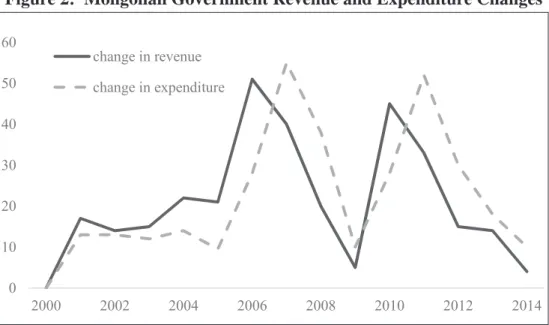
3. Cyclical Fiscal Policy
Besides the election cycles, Mongolia is exposed to a commodity cycle. The latest super-
cycle driven by Chinese demand is over and this is revealing Mongolia’s weakness in fiscal management. The so-called “pro-cyclical fiscal policy” was sharply criticized even in the early 2000s. To tackle this problem the Mongolian parliament has adopted laws aiming toward fiscal stability and better debt management. However, lack of fiscal discipline is calling into question the effectiveness of such laws.
Figure 2: Mongolian Government Revenue and Expenditure Changes
Source: International Monetary Fund, 2014 0
10 20 30 40 50 60
2000 2002 2004 2006 2008 2010 2012 2014
change in revenue change in expenditure
The budget is highly dependent on commodity exports, basically copper and coal, and therefore the prices for these commodities play a major role. An increasing contribution from the developing oil and gas sectors was expected to bring success in regard to the diversification of exports. Yet the actual oil price has been more than disappointing. Price risk exposure is high due to the openness of the economy (foreign trade volume to GDP). Increased foreign debt bears the risk of triggering default.
Figure 3: Mongolian Government Revenues and Expenditures
Source: International Monetary Fund, 2014.
0 1,000 2,000 3,000 4,000 5,000 6,000 7,000 8,000
2000 2002 2004 2006 2008 2010 2012 2014
Budget expenditure
Budget revenue
Mongolian policymakers were interested in increasing budget expenditure when the expected budget income was not realized. Because of election cycles, Mongolia is one of the worst examples in terms of managing fiscal revenues. Strong pro-cyclical fiscal policy fueled by populist promises for short-term election purposes has triggered high inflation. To sustain expenditure, which was initiated by the boom times, the government of Mongolia was pushed to borrow and increase debt in the bust times.
Another factor which may be supporting undisciplined and unconsolidated budget policy might be the new Mongolian election law. According to this election law, Mongolia has 76 electoral districts. The plurality-at-large system gives a strong incentive to candidates (and parliamentarians) to focus on local (micro-) issues rather than macro-policy. This inconsistency between the election system and fiscal policy-making encourages fractional budget expenditure rather than consolidated policy.
4. Monetary Policy in Mongolia and Its Impact on SMEs
Mongolia has an independent central bank which operates under its own dedicated law
7. The law says the Bank of Mongolia (BoM) must safeguard the value of the national currency, the togrog (MNT)
8. Over the last few years, the policy rate was kept consistently high (Mongolia:
12%; Australia: 1.75%; Canada: 0.5%; China: 4.35%, and; Russia: 10.5%), aiming to fight inflation. Inflation peaked at almost 40% in 2008–2009, due to the sudden expansionary budget policy targeting the election in 2008. One of the other negative side effects is the high lending costs to SMEs. The normal loan requirements of the commercial banks of Mongolia have been marginalizing the SME sector, which is believed to be the main motor of job creation. Usual commercial loans have a duration of 2–5 years, interest rates of between 17 and 20% per annum, and collateralization of 150%.
Tax collection in Mongolia is weak and the few largest companies contribute the majority of the state budget. To increase its tax base, any developing country should support the SME sector with cheap capital. Because of populist and expansionary budget policy, Mongolian governments (2004–2012) were not able to lower the cost of capital to fight inflation. In addition, unemployment is high because of the weak SME sector. An international study shows Mongolians are entrepreneurial
9. The high inflationary environment hampers this creativity.
5. Can Mongolia be an ‘Inflation Targeter’ and a ‘Free Floater’ at the Same Time?
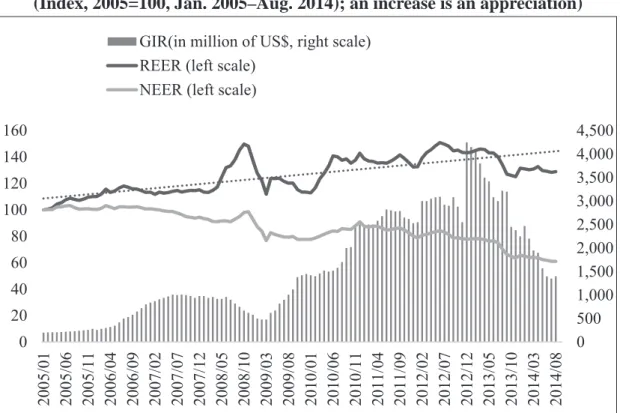
To avoid a pass-through effect, Mongolia has tried to fight inflation by exchange rate policy over the last decade. Mongolia was de jure a free floater but de facto a hard pegger. The reasons for Mongolia declaring itself as a floater are the following. A flexible exchange rate better supports the independence of a central bank. With a fixed exchange rate a central bank should sustain exchange rate parity, and so the ability to react to a domestic situation is weakened.
Theoretically, a flexible exchange rate should function as an adjustment mechanism (buffer) in
case of shocks. However, in reality that is not the case, especially for small open economies. If a
small open economy tends toward a more discretionary monetary policy, then the exchange rate
can destabilize domestic price levels. As discussed in Calvo and Reinhart (2002) the discretionary
Central Bank lacks credibility. Hakura (2005) argues that such countries 1) try to stabilize the exchange rate (“Fear of Floating”) or 2) the Central Banks should pursue clear and transparent policy to earn credibility. These are two ways to avoid pass-through effects.
But is this just a normal reaction for small open economies (as in Svensson (2000))? To answer this question, more research in the field (especially for Mongolia) is needed.
Figure 4: Exchange Rates for the Mongolian Togrog
(Index, 2005=100, Jan. 2005–Aug. 2014); an increase is an appreciation)
Source:Mongolian authorities and IMF staff estimates
Monetary policy is hard enough to maintain in an advanced economy. With its high cyclical volatility and high dollarization (30–40%) Mongolia has to solve more complicated problems.
The cost of capital is high, and the policy rate is high due to combating inflation (a pro-cyclical expansionary policy).
Some economists (Calvo, etc.) argue that an emerging market country is macroeconomically better off if it behaves as a real floater to avoid the “pass-through effect”. But politically, volatility in exchange rates might be seen as a byproduct of weak government. Consequently, political pressure on central banks is high, bearing the next election in mind. The BoM should be confident and accountable as a policy-maker to earn credibility.
6. Diversification? Yes! But How?
Almost all economic reports, recommendations and political party agendas emphasize the
importance of economic diversification. But how to do it? In my opinion, Mongolia still has no
clear policy-maker. The role of parliament in policy-making is questionable. The Ministry of
Finance prepares policy drafts for the following year which are to be approved by the parliament.
The policy drafts can dramatically change during the discussion process in parliament (including its standing committees).
Also, in the Mongolian language, the word “policy” can have two different meanings. First as “бодлого” [ bodlogo], implying a long-term policy that declares some goals. Second, every year parliament approves “мөнгөний бодлого” [ mongonii bodlogo] (monetary policy) and
“төсвийн тухай хууль” [ tosviin tukhai khuuli] (law on the state budget) for the following year.
In this context “policy” (“бодлого” [ bodlogo]) means more like a program or a one-year plan.
The Ministry of Finance and the BoM develop the policy drafts and parliament approves them separately. On the one hand, parliament approves low inflation goals, while on the other hand it can approve overly expansionary budget plans. It gives a confusing message to the economy and makes the life of the BoM’s governor harder. High inflation through excessively expansionary fiscal policy forces the BoM to increase the lending rate, which drives up the capital cost to the SME sector. Additionally, some economists criticize the Mongolian parliament for lacking professionalism and that the political tug of war between political groups (anecdotal evidence of business group interests) takes the upper hand in decision making.
Policy democratization and supporting think tanks are essential for creating a sound environment for long-term policy and public education. A few new young think tanks in Mongolia still need strong financial support and also trained professional researchers. Under the democratization of policy-making, I understand the participation of independent boards (or think tanks), not only in the creation but also in the evaluation of key policies. Mongolians can adopt the Chilean example and create independent expert boards on state budget planning and price forecasting. Such a mechanism of public (or expert) consultation on budget discussions prior to final approval by parliament might be a good tool for Mongolian macroeconomic policy.
An educated public is fundamental in any democracy. Mongolia should invest in its public (voters’) education to strengthen its institution building. Germany has a center for political education (Bundeszentrale für politische Bildung)
10. Such an organization or initiative might be worth starting here in Mongolia.
Another serious issue is so-called “politicized mega-projects”. Instead of commercially- driven policy some Mongolian politicians use mining projects as an opportunity to appear
“patriotic”. The Mongolian constitution clearly deals with a secular state and religion. However a clear separation between politics and business is not stated. According to the constitution of Mongolia, the state can regulate the market and owns the resources. So far liberalization as a tool for reaching goals has not achieved a national consensus.
7. Conclusion
In 2013 Mongolia raised bonds (Chinggis and Samurai) for investment focusing on infrastructure and energy. In the coming years, restructuring debt will be the main challenge.
However, this event (issuing international bonds) was a significant milestone for Mongolia, showing the ability and capability of Mongolia having access to international financial markets.
The parliamentary election (June 2016) surprisingly resulted in a landslide majority for
the Mongolian People’s Party (MPP), the oldest and most disciplined party in Mongolia, with a
strong heritage in its post-communist history. Without a powerful opposition, the MPP now has
the chance to roll back or postpone the legal reform which was completed under the formerly dominant Democratic Party (DP). Also, the plurality-at-large electoral mechanism gives strong incentives to elected parliamentarians to follow a “circular” (fractional) policy. The MPP is recognized as rooted in the countryside
11. Consequently, the parliamentarians interested in being reelected will support circular investments rather than seeking a long-term comprehensive budgetary procedure for the whole country.
Mongolia has started dozens of initiatives to support employment in non-mining sectors.
Yet often forgotten fundamental issues remain unsolved. Mongolia is learning from its near past as a young vibrant democracy and conducting a paradigm shift from short-term cyclist policy to long-term predictability. The institutions and Mongolia as a whole should learn to address the issues and determine solutions before repeatedly starting new initiatives.
Finally, Mongolia must strengthen itself as a mining nation and a frontier market. Therefore, preparing for the next super-cycle (if it ever happens) is a wise path.
* Chief Economist, Erdenes Mongol LLC, Mongolia
1
Behre Dolbear’s annual political risk assessment.
2
Law on Prohibiting Mineral Exploration and Extraction Near Water Sources, Protected Areas and Forests. The law came as a great surprise to miners and created a long-time dispute between companies (which lost their licenses) and the Government of Mongolia.
3
Mongolia's Strategic Entities Foreign Investment Law (SEFIL), passed in May 2012 (just before the parliamentary election), was blamed for deterring foreign investment. However, the law was replaced by a more liberal investment law in 2013.
4
Ch. Otgochuluu, 2016, EBRD, Law in Transition, “Mongolia’s State Policy on the Minerals Sector and Its Application in the Promotion of Sustainable Development”. See more at: http://2016.lit-ebrd.com/
en/in-focus/#13-6
5
McKinsey Global Institute, December 2013, “Reverse the Curse: Maximizing the potential of resource- driven economies”
6
The politbarometer, www.santmaral.mn
7
Law of Mongolia on the Central Bank (Bank of Mongolia) https://www.
mongolbank.mn/documents/law/Law_on_Central_Bank.pdf
8
Article 4. Objective of the Bank of Mongolia. 1. The main objective of the Bank of Mongolia shall be to ensure stability of the togrog.
9
Nikolova et al., 2012, “Entrepreneurship in the Transition Region: An analysis based on the Life in Transition Survey”, Working Paper No. 141, EBRD
10
Federal Agency for Civic Education, https://www.bpb.de/
11