New Parameter to Predict Recurrence of Paroxysmal Atrial Fibrillation after Pulmonary Vein Isolation by the P-Wave
Signal-Averaged Electrocardiogram
Yumi MUNETSUGU1), Mitsuharu KAWAMURA*1), Kaoru TANNO2) and Youichi KOBAYASHI1)
Abstract : Noninvasive methods for predicting the recurrence of atrial fibrillation
(AF) after initial pulmonary vein isolation (PVI) have not been well described.
The aim of the present study was to evaluate the usefulness of the P-wave signal- averaged electrocardiogram (P-SAECG) in predicting the recurrence of AF after initial PVI. The P-SAECG was recorded before and after (within 1 week) the initial PVI session. The filtered P-wave duration (FPD) and root mean square voltage of the last 20 ms of the filtered P-wave (LP20) were measured in 87 consecutive idiopathic AF patients (ejection fraction ≥ 50%, B-type natriuretic peptide ≤ 200 pg / ml). During the follow-up period (12 7 months), 22 of 87
(25%) patients had recurrence of AF (11 with paroxysmal AF and 11 with persistent AF). In the group with recurrence of paroxysmal AF, the post-PVI FPD was significantly shorter and the post-PVI LP20 was significantly larger than in the non-recurrence group. Furthermore, the post-PVI LP20 / FPD ratio was significantly higher in the group with paroxysmal AF recurrence than in the non- recurrence group (0.024 0.009 vs 0.015 0.007 µV / ms, respectively ; P<0.05). Recurrence of paroxysmal AF was more frequently observed in patients with a post-PVI LP20 / FPD >0.015 µV / ms than in those with a post-PVI LP20 / FPD
≤ 0.015 µV / ms. The optimal post-PVI LP20 / FPD cut-off value of 0.015 µV / ms had a sensitivity of 90% and a specificity of 60%. The data also suggest that the post-PVI LP20 / FPD may be a new parameter for predicting successful PVI in patients with idiopathic paroxysmal AF after PVI.
Key words : P-wave signal-averaged electrocardiogram, late potential, atrial fibrillation, pulmonary vein isolation, recurrence
Introduction
Atrial fibrillation (AF) is the most frequently encountered arrhythmia in clinical practice, occurring in 1%–2% of the general population1). The pulmonary veins (PVs) play an important role in both the initiation and maintenance of AF2, 3). Recently, PV isolation (PVI) has been shown to be effective for curing paroxysmal and persistent AF4, 5). Furthermore, PVI for Original
1)Department of Medicine, Division of Cardiology, Showa University School of Medicine, 1–5-8 Hatanodai, Shinagawa- ku, Tokyo 142-8666, Japan.
2)Cardiovascular Diseases Center, Showa University Koto Toyosu Hospital.
* To whom corresponding should be addressed.
paroxysmal AF results in the maintenance of sinus rhythm (SR) without any antiarrhythmic drugs in 70%–90% of patients6). However, AF recurs in 10%–30% of patients after successful PVI. The recurrence rate is higher in patients with structural heart disease7) or prolonged AF duration, such as persistent AF8). Persistent AF has been shown to lead to atrial interstitial fibrosis, resulting in an increased atrial conduction time9). This structural remodeling, in addition to electrophysiological remodeling such as a shortening or loss of the rate adaptation of the atrial refractory period10) or prolonged atrial conduction times11, 12), may increase the recurrence of AF after PVI. The signal-averaged electrocardiogram (SAECG) is a simple non-invasive method that has been used for years, initially to evaluate ventricular late potentials, but now is extended to the P-wave to provide a more accurate evaluation of atrial conduction. Many studies have used this method to evaluate reductions in P-wave duration to predict the recurrence of AF after PVI13, 14). In a previous report14), patients with recurrence of AF after PVI, short filtered P-wave duration (FPD) and elevation of root mean square voltage of the last 20 ms of the filtered P-wave (LP20) are sometimes recorded. In these cases, the P-wave SAECG
(P-SAECG) was recorded within 1 week after PVI ; however, in a another previous report13)
the day of recording P-SAECG was not clear. Based on these observations, we thought that the FDP and LP20 within 1 week after PVI may be different from those reported in previous stud- ies13, 14). Thus, the aim of the present study was to evaluate the usefulness of P-SAECG within 1 week after the initial PVI to establish a new parameter of the recurrence of AF after the initial PVI.
Materials and methods Study population
The present study was a retrospective analysis of consecutive patients with AF. From April 2008 to November 2012, 87 consecutive patients [67 males, 20 females ; mean ( SD) age 60 12 years] who underwent an initial PVI session for paroxysmal (n=65) or persistent
(n=22) AF in the Division of Cardiology, Department of Medicine, Showa University School of Medicine were evaluated. In the present study, paroxysmal AF was defined as AF terminating within 7 days, and persistent AF was defined as non-self-terminating AF lasting more than 7 days and requiring pharmacologic or electrical conversion to restore SR. Patients were excluded from the study if the P-SAECG was not properly recorded. Other exclusion criteria were as follows : structural heart disease, prior PVI, implanted pacemaker, mitral or aortic valve disease, left ventricular dysfunction [left ventricular ejection fraction (LVEF)<50%], and congestive heart failure [plasma B-type natriuretic peptide (BNP) concentrations >200 pg / ml]. P-SAECG was recorded before and after (within 1 week) the initial PVI in all patients.
Signal-averaged P-wave electrocardiography
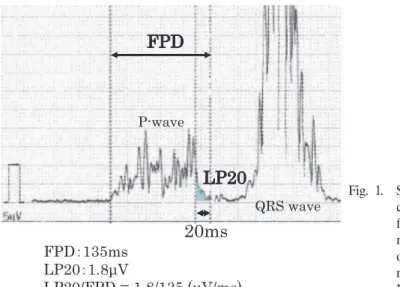
Fig. 1 shows an example of a P-SAECG. This P-SAECG was recorded in the P-wave-trig- gered mode (FDX-6500 ; Fukuda Denshi Co., Tokyo, Japan). The P-wave signals (>200 beats)
were recorded from a standard 12-lead electrocardiogram (ECG) until the noise amplitude was
reduced to <0.4 µV. The signal from Lead II was filtered bidirectionally (with forward and backward filters) through a filter setting of 60 Hz, and a backward filter was used for the analy- sis in the present study. The filtered signals from Leads I, aVF, and V1 were combined into a vector magnitude of the P-wave. The FPD and LP20 were measured and the ratio LP20 / FPD was calculated. Measurements of FPD and LP20 were made automatically and, if necessary, cor- rected manually by two physicians blinded to the clinical information of the patient.
Ablation procedure
A straight decapolar catheter was positioned in the high right atrium and coronary sinus.
After trans-septal puncture at the fossa ovalis, the venous anatomy and location of the left atrial
(LA)–PV junction were determined using a three-dimensional (3D) mapping system (CARTO, Biosence Webster Inc., Diamond Bar, CA, USA or NaVX, St. Jude Medical, St. Paul, MN, USA). Then, a circular catheter was placed first at the superior LA–PV junction and then at the contralateral LA–PV junction. The PVI was performed guided by the 3D mapping system.
An irrigated ablation catheter was used for the mapping and ablation. Radiofrequency energy was applied for 15–30 s at each site using a maximum temperature of 40 C, maximum power of 35 W, and flow rate of 30 ml / min. An atrial circumferential ablation was performed to encircle the left- and right-sided PVs. The procedural endpoint was the electrical isolation of all PVs from the LA.
Follow-up
After the PVI session, patients were followed up for a period up to 2 years. The mean
( SD) follow-up period was 12 7 months. Oral anticoagulant drugs were continued in all patients and antiarrhythmic drugs were continued in 69 patients (79.3%). During the follow- up period, a surface 12-lead ECG was performed once a month and a 24-h ECG recording was performed at intervals of several months, as well as at any time that the patient had any
Fig. 1. Sample P-wave signal-averaged electro- cardiogram (P-SAECG) trace. FPD, filtered P-wave duration ; LP20, root mean square voltage of the last 20 ms of the filtered P-wave. Recordings were made using the FDX-6500 (Fukuda Denshi Co., Tokyo, Japan).
symptoms suggestive of AF, such as palpitations, dizziness, or syncope. The recurrence of AF was evaluated by 12-lead ECG recordings and a 24-h ECG recording. The blanking period was defined as the 3 months after PVI.
Statistical analysis
Patients were divided into three groups : a non-recurrence group (Non-Re), a group with recurrence of paroxysmal AF (Paroxy-Re) and a group with recurrence of persistent AF (Persis-
Re). Comparisons were made between two groups, namely Non-Re vs. Paroxy-Re and Non- Re vs. Persis-Re, and the significance of differences in continuous variables was determined using Studentʼs unpaired t-test, whereas the χ2 or Fischerʼs exact test was used in comparisons of categorical data. To obtain an index of the overall FPD and RMS20 in the patients with and without recurrence of paroxysmal AF, a receiver operating characteristic (ROC) curve was gener- ated and the area under the curve was calculated. The AF-free rates in the patients with an LP20 / FPD 0.015 µV / ms and >0.015 µV / ms were calculated using the Kaplan-Meier method, and the difference between them was detected using the log-rank test. The duration of AF, left atrial dimension, LVEF, (of which the P values were less than 0.05 using the Studentʼs t-test and χ2 test) were evaluated by the Coxʼs multivariate regression analysis. Statistical significance was
accepted at a P<0.05. Where appropriate, data are given as the mean SD.
Results
Clinical characteristics
The clinical characteristics of patients in the Non-Re, Paroxy-Re, and Persis-Re groups are given in Table 1. There were no significant differences in the age, gender, duration of AF, LVEF, BNP, CHADS2 score, or CHA2DS2-VASc score between the Non-Re and recurrence groups
(Paroxy-Re or Persis-Re). The long axis of the left atrial diameter (LAD) was significantly lon- ger in patients in the Persis-Re group compared to those in the Non-Re and Paroxy-RE groups
(63.5 10.7 vs. 53.4 8.5 and 53.1 10.3 mm, respectively ; P<0.05).
Signal-averaged P-wave electrocardiography
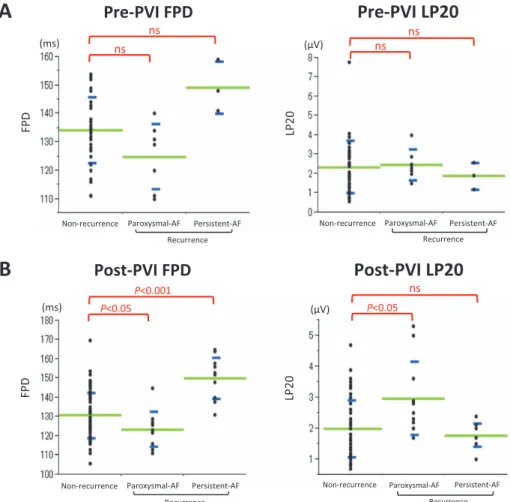
There were no significant differences in FPD and LP20 before PVI between the Non-Re and Paroxy-Re or Persis-Re groups (pre-PVI FPD 134 11.6 vs. 125 11.5 and 149 9.0 ms, respectively ; Fig. 2A). Conversely, the post-PVI FPD in the Paroxy-Re group was significantly shorter than in the Non-Re group (123 9.1 vs. 131 11.7 ms, respectively ; P<0.05 ; Fig. 2B). The post-PVI LP20 in the Paroxy-Re group was significantly larger than in the Non-Re group
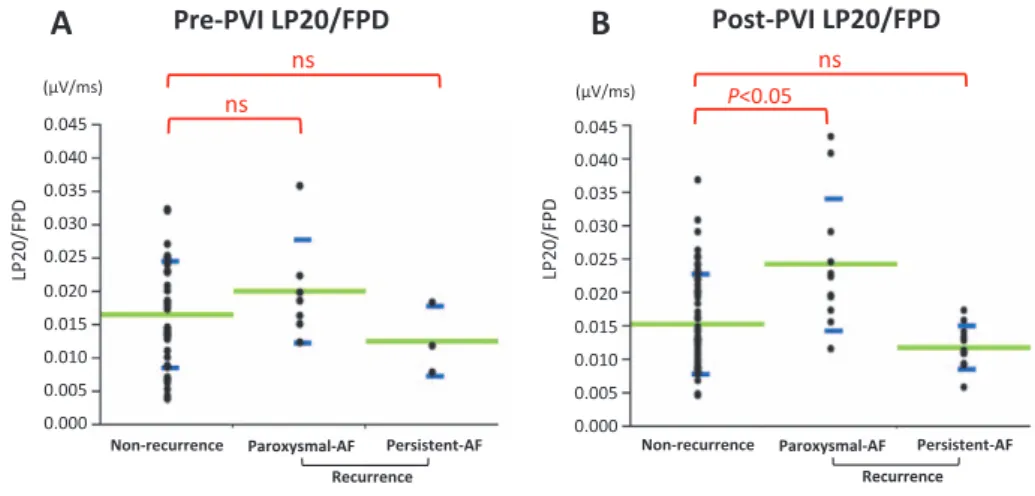
(2.9 1.1 vs. 2.0 0.9 µV, respectively ; P<0.05 ; Fig. 2B). There was no significant difference in the pre-PVI LP20 / FPD between the Non-Re and Paroxy-Re groups (0.018 0.011 vs. 0.02
0.007 µV / ms, respectively ; Fig. 3A), but there was a significant difference in the LP20 / FPD ratio between these two groups after the initial PVI (0.015 0.007 vs. 0.024 0.009 µV / ms, respectively ; P<0.05 ; Fig. 3B).
Predictors of AF recurrence
To evaluate the total predictive performance of the post-PVI LP20, post-PVI FPD, and post- PVI LP20 / FPD for predicting Paroxy-Re, receiver operating characteristic (ROC) analyses were performed, revealing that the post-PVI LP20 / FPD was a more useful predictor of Paroxy-Re than either the post-PVI FPD or post-PVI LP20 (Fig. 4A). The optimal post-PVI LP20 / FPD cut-off value of 0.015 µV / ms had a sensitivity of 90% and a specificity of 60%. Fig. 4B shows the AF-free rate curve for patients with Non-Re (n=65) or Paroxy-Re (n=11) with a post- PVI Lp20 / FPD of ≤ 0.015 or >0.015 µV / ms. Paroxy-Re was more frequently observed in patients with a post-PVI LP20 / FPD >0.015 µV / ms than in those with a post-PVI LP20 / FPD
≤ 0.015 µV / ms (P=0.0027, log-rank test).
Clinical characteristics of patients with post-PVI LP20 / FPD ≤ 0.015 or >0.015 µV / ms
The clinical characteristics of patients with a post-PVI LP20 / FPD ≤ 0.015 µV / ms (n=41) or
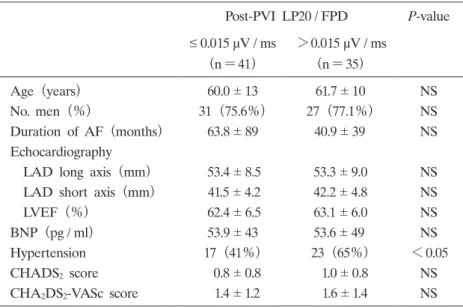
>0.015 µV / ms (n=35) are given in Table 2. There were no significant differences in the age, gender, duration of AF, LVEF, BNP, CHADS2 score, and CHA2DS2-VASc score between patients with a post-PVI LP20 / FPD of ≤ 0.015 and >0.015 µV / ms. However, hypertension was signifi- cantly more frequent in the group with post-PVI LP20 / FPD >0.015 µV / ms (n=23) than in
Table 1. Clinical characteristics of patients with non-recurrence and recurrence of paroxysmal or persistent atrial fibrillation (Paroxy-Re or Persis-Re, respectively) after initial pulmonary vein isolation
Non-Re
(n=65)
Recurrence P-value
Paroxy-Re
(n=11)
Persis-Re
(n=11)
Age (years) 61 12 57 12 57 16 NS
No. men (%) 49(75.3%) 9(81%) 9(81%) NS
Duration of AF (months) 53.0 74* 54.9 52 84.9 55* <0.05
Echocardiography
LAD long axis (mm) 53.4 8.5* 53.1 10.3† 63.5 10.7*† <0.05 LAD short axis (mm) 41.7 4.4 42.8 4.9 44.9 5.3 NS LVEF (%) 62.9 6.3* 61.9 5.5 57.6 5.6* <0.05 BNP (pg / ml) 51.3 44 68.9 52 68.6 59 NS
Hypertension 33(50%) 7(63%) 7(63%) NS
CHADS2 score 0.8 0.9 1.1 0.7 1.0 1.1 NS
CHA2DS2-VASc score 1.5 1.3 1.7 1.2 1.6 1.5 NS
Persistent AF (%) 12(18.4%)* 3(27.2%)† 7(63.6%)*† <0.05
Data are presented as the mean SD or as n (%). *P<0.05 compared with Non-Re group and Persis-Re group ; †P<0.05 compared with Paroxy-Re group and Persis-Re group.
non-recurrence, Non-Re ; paroxysmal AF recurrence, Paroxy-Re ; Persistent recurrence AF, Persis-Re ; AF, atrial fibrillation ; LAD, left atrial diameter ; LVEF, left ventricular ejection fraction ; BNP, plasma B-type natriuretic peptide.
the group with post-PVI LP20 / FPD ≤ 0.015 µV / ms (n=16 ; P<0.05 ; Table 2). Discussion
The present study is the first to describe the usefulness of the post-PVI LP20 / FPD for pre- dicting Paroxy-Re after initial PVI. The main findings of the present study are the following :
(i) the post-PVI FPD was significantly shorter and the post-PVI LP20 was significantly larger in the Paroxy-Re compared with the Non-Re group ; and (ii) the post-PVI LP20 / FPD was useful for predicting Paroxy-Re after PVI, with a cut-off value of 0.015 µV / ms.
The findings in the present study of a significantly shorter post-PVI FPD and a significantly larger post-PVI LP20 in the Paroxy-Re versus Non-Re group are the opposite of those reported
Fig. 2. Comparison of the filtered P-wave duration (FPD) and root mean square voltage of the last 20 ms of the filtered P-wave (LP20) before (A) and after (B) the initial pulmonary vein isolation (PVI) in patients without any recurrence (Non-Re) and in those with recurrence of paroxysmal or persistent atrial fibrillation (Paroxy-Re or Persis-Re, respectively). (A) There were no significant differences in the pre-PVI FPD and pre-PVI LP20 between the Non- Re and recurrence (Paroxy-Re or Persis-Re) groups. (B) The post-PVI FPD was significantly shorter in the Paroxy-Re than in the Non-Re group, whereas the post-PVI LP20 was significantly larger in the Paroxy-Re than in the Non- Re group. Green lines indicate the mean, with blue lines indicating the SD.
previously. Previous studies14, 15) reported that FPD is significantly reduced in patients without AF recurrence during the follow-up period. Okumura et al15) measured SAECG before and after both ostial and circumferential PVI (CPVI ; n=51) in patients with paroxysmal and per- sistent AF. Patients with a successful outcome after CPVI had significant shortening of the FPD
(from 146 13 to 136 12 ms ; P<0.01) compared with those in whom recurrence occurred
Fig. 3. Ratio of the root mean square voltage of the last 20 ms of the filtered P-wave (LP20) to filtered P-wave duration (FPD) before (A) and after
(B) the initial pulmonary vein isolation (PVI) in patients without any recurrence (Non-Re) and in those with recurrence of paroxysmal or persistent atrial fibrillation (Paroxy-Re or Persis-Re, respectively). (A) There were no significant differences in pre-PVI LP20 / FPD between the Non-Re and Paroxy-Re or Persis-Re groups. (B) However, there was a significant difference in post-PVI LP20 / FPD between the Non-Re and Paroxy-Re groups. Green lines indicate the mean, with blue lines indicating the SD.
Fig. 4. (A) Receiver operating characteristic (ROC) curve for the various cut- off levels of the ratio of the root mean square voltage of the last 20 ms of the filtered P-wave (LP20) to filtered P-wave duration (FPD) after the initial pulmonary vein isolation (post-PVI) for predicting recurrence of atrial fibrillation (AF). (B) Kaplan–Meier curves for the survival-free rate from recurrence of paroxysmal AF in patients with a post-PVI LP20 / FPD >0.015 and ≤ 0.015 µV / ms. Patients with a post-PVI LP20 / FPD >0.015 µV / ms had a higher risk of recurrence of paroxysmal AF than those with a post- PVI LP20 / FPD ≤ 0.015 µV / ms (P=0.027, log-rank test).
(from 167 15 to 157 15 ms ; P=0.2). Furthermore, Ogawa et al14) measured SAECG before and after segmental ostial catheter ablation (n=27) in patients with paroxysmal and persistent AF. Patients without AF recurrence during the follow-up period had a significant reduction in FPD (from 161 7 to 151 8 ms ; ΔFPD 10 7 ms ; P<0.0001), whereas there was no significant shortening in FPD in patients with AF recurrence (ΔFPD 2 9 ms ; P=NS). A cut- off value of ≥ 5 ms for the reduction in the P-wave had a sensitivity of 92% and a specificity of 71% to predict a good clinical outcome. For that reason, shortening of the FPD after PVI was reported to be a predictor of successful AF ablation16, 17). In the present study, the results were the opposite of those reported in these previous studies. We suppose that the shortening of the FPD after PVI in the present study may be due to the complete electrical isolation of all four PVs at the time of the PVI session. However, during the follow-up period, there was a recon- nection of the electrical conduction between the PV and LA in some patients. We suppose that consideration of other factors is necessary to predict the electrical reconnection of PVs.
The P-SAECG is useful for identifying individuals at risk of developing AF and those likely to change from paroxysmal to chronic AF18). Previous studies have shown that patients with chronic AF have a lower LP20 than those with paroxysmal AF19). However, the usefulness of the LP20 for the prediction of AF recurrence after PVI was not proven. Ogawa et al14)
performed computer simulation studies using a realistic 3D atrial activation model, and the results confirmed a reduction in P-wave duration and changes in the terminal portion of the P-wave morphology after simulated PVI. These findings suggest that the PV muscle sleeves are
Table 2. Clinical characteristics of patients with values of ≤ 0.015 and
>0.015 µV / ms for the ratio of the root mean square voltage of the last 20 ms of the filtered P-wave (LP20)/ filtered P-wave duration (FPD) after initial pulmonary vein isolation (post-PVI)
Post-PVI LP20 / FPD P-value
≤ 0.015 µV / ms
(n=41)
>0.015 µV / ms
(n=35)
Age (years) 60.0 13 61.7 10 NS
No. men (%) 31(75.6%) 27(77.1%) NS
Duration of AF (months) 63.8 89 40.9 39 NS
Echocardiography
LAD long axis (mm) 53.4 8.5 53.3 9.0 NS LAD short axis (mm) 41.5 4.2 42.2 4.8 NS LVEF (%) 62.4 6.5 63.1 6.0 NS BNP (pg / ml) 53.9 43 53.6 49 NS
Hypertension 17(41%) 23(65%) <0.05
CHADS2 score 0.8 0.8 1.0 0.8 NS
CHA2DS2-VASc score 1.4 1.2 1.6 1.4 NS
Data are presented as the mean SD or as n (%).
AF, atrial fibrillation ; LAD, left atrial diameter ; LVEF, left ventricular ejection fraction ; BNP, plasma B-type natriuretic peptide.
responsible for the terminal portion of the P-wave, and they contribute to the late potentials on the P-SAECG. Furthermore, Ogawa et al14) documented that the LP20 increased significantly after the PVI procedure, both in patients with either successful or failed ablation. Therefore, the LP20 was not proven as a useful parameter for prognostication after AF ablation. However, in the present study, in the case of only those patients with paroxysmal AF recurrence (the study population was limited to idiopathic AF patients with LVEF ≥ 50% and BNP ≤ 200 pg / ml), the post-PVI LP20 was significantly larger than in patients without recurrence, and these results proved that the LP20 was a useful parameter for the prediction of recurrence of paroxysmal AF after PVI.
The notable finding of the present study is that the shorter FPD and larger LP20 after initial PVI were significantly associated with a recurrence of paroxysmal AF, as indicated by univariate analysis, with multivariate analysis revealing that a post-PVI LP20 / FPD >0.015 µV / ms was a predictor of the recurrence of paroxysmal AF. However, post-PVI LP20 / FPD is not a useful predictor of the recurrence of persistent AF. We believe that the likely explanation for this finding is related to the different mechanisms of initiation and maintenance of AF. Activity triggered from the LA–PV junction initiates AF and causes paroxysmal AF. Atrial structural remodeling, in addition to electrophysiological remodeling, is responsible for the maintenance of AF, and causes paroxysmal AF. Modifications in FPD and LP20 after PVI reflect the electrical isolation of the LA–PV junction. For this reason, the post-PVI FDP and LP20 are not associ- ated with the recurrence of persistent AF.
Study limitations
The present study has several limitations. First, measurement of the P-SAECG is sometimes difficult because of noise, inappropriate cardiac rhythms, or overlap between the end of the P-wave and the beginning of the QRS complex. Our definition of atrial late potentials was arbitrary because there are no established criteria for atrial late potentials. In addition, pre-abla- tion antiarrhythmic drug therapy was not discontinued and the treatment was maintained after the procedure ; some drugs may have affected FPD. Furthermore, asymptomatic recurrence may have occurred during the follow-up period and the rate of recurrence may have been underes- timated. Such limitations are also applicable to all studies of PVI for AF. Further prospective studies are needed to ascertain the relationship between AF recurrence and LP20 / FPD.
Conclusions
The post-PVI LP20 / FPD may be useful for predicting paroxysmal AF recurrence in patients with idiopathic AF after PVI.
Acknowledgements
We thank the Division of Cardiology, Department of Medicine, Showa University School of Medicine for allowing us to undertake this study.
Conflict of interest disclosure
The authors have declared no conflict of interest.
References
1) Tzou WS, Marchlinski FE, Zado ES, et al. Long-term outcome after successful catheter ablation of atrial fibrilla- tion. Circ Arrhythm Electrophysiol. 2010;3:237-242.
2) Haissaguerre M, Jais P, Shah DC, et al. Spontaneous initiation of atrial fibrillation by ectopic beats originating in the pulmonary veins. N Engl J Med. 1998;339:659-666.
3) Kumagai K, Yasuda T, Tojo H, et al. Role of rapid focal activation in the maintenance of atrial fibrillation origi- nating from the pulmonary veins. Pacing Clin Electrophysiol. 2000;23:1823-1827.
4) Haissaguerre M, Jais P, Shah DC, et al. Electrophysiological end point for catheter ablation of atrial fibrillation initiated from multiple pulmonary venous foci. Circulation. 2000;101:1409-1417.
5) Oral H, Knight BP, Tada H, et al. Pulmonary vein isolation for paroxysmal and persistent atrial fibrillation. Circu- lation. 2002;105:1077-1081.
6) Pappone C, Rosanio S, Oreto G, et al. Circumferential radiofrequency ablation of pulmonary vein ostia: a new anatomic approach for curing atrial fibrillation. Circulation. 2000;102:2619-2628.
7) Yasuda T, Kumagai K, Ogawa M, et al. Predictors of successful catheter ablation for atrial fibrillation using the pulmonary vein isolation technique. J Cardiol. 2004;44:53-58.
8) Thomas SP, Aggarwal G, Boyd AC, et al. A comparison of open irrigated and non-irrigated tip catheter ablation for pulmonary vein isolation. Europace. 2004;6:330-335.
9) Allessie M, Ausma J, Schotten U. Electrical, contractile and structural remodeling during atrial fibrillation. Cardio- vasc Res. 2002;54:230-246.
10) Wijffels MC, Kirchhof CJ, Dorland R, et al. Atrial fibrillation begets atrial fibrillation. A study in awake chroni- cally instrumented goats. Circulation. 1995;92:1954-1968.
11) Fukunami M, Yamada T, Ohmori M, et al. Detection of patients at risk for paroxysmal atrial fibrillation during sinus rhythm by P wave-triggered signal-averaged electrocardiogram. Circulation. 1991;83:162-169.
12) Manios EG, Kanoupakis EM, Chlouverakis GI, et al. Changes in atrial electrical properties following cardioversion of chronic atrial fibrillation: relation with recurrence. Cardiovasc Res. 2000;47:244-253.
13) Van Beeumen K, Houben R, Tavernier R, et al. Changes in P-wave area and P-wave duration after circumferen- tial pulmonary vein isolation. Europace. 2010;12:798-804.
14) Ogawa M, Kumagai K, Vakulenko M, et al. Reduction of P-wave duration and successful pulmonary vein isolation in patients with atrial fibrillation. J Cardiovasc Electrophysiol. 2007;18:931-938.
15) Okumura Y, Watanabe I, Ohkubo K, et al. Prediction of the efficacy of pulmonary vein isolation for the treatment of atrial fibrillation by the signal-averaged P-wave duration. Pacing Clin Electrophysiol. 2007;30:304-313.
16) Masuda M, Inoue K, Iwakura K, et al. Impact of pulmonary vein isolation on atrial late potentials: association with the recurrence of atrial fibrillation. Europace. 2013;15:501-507.
17) Blanche C, Tran N, Rigamonti F, et al. Value of P-wave signal averaging to predict atrial fibrillation recurrences after pulmonary vein isolation. Europace. 2013;15:198-204.
18) Abe Y, Fukunami M, Yamada T, et al. Prediction of transition to chronic atrial fibrillation in patients with parox- ysmal atrial fibrillation by signal-averaged electrocardiography: a prospective study. Circulation. 1997;96:2612-2616.
19) Budeus M, Felix O, Hennersdorf M, et al. Prediction of conversion from paroxysmal to permanent atrial fibrilla- tion. Pacing Clin Electrophysiol. 2007;30:243-252.
[Received January 5, 2017 : Accepted January 18, 2017]