Overview of the Sixth Dialog System Technology Challenge: DSTC6
Chiori Horia, Julien Perezb, Ryuichi Higasinakac, Takaaki Horia, Y-Lan Boureaud, Michimasa Inabae, Yuiko Tsunomorif, Tetsuro Takahashig,
Koichiro Yoshinoh, Seokhwan Kimi
aMitsubishi Electric Research Laboratories, Cambridge, MA, USA
bNaver Labs Europe, Grenoble, France
cNTT Corporation, Japan
dFacebook AI Research, New York, USA
eHiroshima City University, Japan
fNTT DOCOMO, Inc., Japan
gFujitsu Laboratories. LTD., Japan
hNara Institute of Science and Technology, Ikoma, Nara, Japan
iAdobe Research, San Jose, CA, USA
Abstract
This paper describes the experimental setups and the evaluation results of the sixth Dialog System Technology Challenges (DSTC6) aiming to develop end-to-end dialogue systems. Neural network models have become a recent focus of investigation in dialogue technologies. Previous models required training data to be manually annotated with word meanings and dialogue states, but end-to-end neural network dialogue systems learn to directly out- put natural-language system responses without needing training data to be manually annotated. Thus, this approach allows us to scale up the size of training data and cover more dialog domains. In addition, dialogue systems require a meta-function to avoid deploying inappropriate responses gener- ated by themselves. To challenge such issues, the DSTC6 consists of three tracks, 1. End-to-End Goal Oriented dialogue Learning to select system re- sponses, 2. End-to-End Conversation Modeling to generate system responses using Natural Language Generation (NLG) and 3. Dialogue Breakdown De- tection. Since each domain has different issues to be addressed to develop di- alogue systems, we targeted restaurant retrieval dialogues to fill slot-value in Track 1, customer services on Twitter by combining goal-oriented dialogues and ChitChat in Track 2 and human-machine dialogue data for ChitChat in Track 3.
DSTC6 had 141 people declaring their interests and 23 teams submit-
ted their final results. 18 scientific papers were presented in the wrap-up workshop. We find the blending end-to-end trainable models associated to meaningful prior knowledge performs the best for the restaurant retrieval for Track 1. Indeed, Hybrid Code Network and Memory Network have been the best models for this task. In Track 2, 78.5% of the system responses auto- matically generated by the best system were rated better than acceptable by humans and this achieves 89% of the number of the human responses rated in the same class. In Track3, the dialogue breakdown detection technologies performed as well as human agreements, in both data-sets of English and Japanese.
Keywords: DSTC, end-to-end dialogue system, conversation model, sequence-to-sequence model, Natural Language Generation, dialogue breakdown
1. Introduction
Recent advancements in artificial intelligence have contributed to closing the gap between the technologies and their uses in our daily life. One of the practical successes is that natural language dialogues have been used as a means of human machine interface implemented in many consumer devices. However, the current dialogue systems still have limited capabilities of conducting natural interactions which is generally taken for granted in human-human conversations.
As a collaborative effort towards further advancements in dialogue tech- nologies, Dialog State Tracking Challenges (DSTCs) have provided common test beds for various research problems focusing on, but not limited to, the task of dialog state tracking. Given the complexity of the dialogue phe- nomenon and the interest of the research community in a wider variety of dialogue related problems, the DSTC has rebranded itself as Dialog System Technology Challenges for its sixth edition.
Starting as an initiative to provide a common testbed for the task of dialogue state tracking, the first Dialog State Tracking Challenge (DSTC) was organized in 2013, followed by Dialog State Tracking Challenges 2 & 3 in 2014. More recently, Dialog State Tracking Challenge 4 and Dialog State Tracking Challenge 5 have been completed in 2015 and 2016. Since 2014, the challenge as evolved in several ways. First, from human-computer in- teractions, the challenges started to investigate human-human interactions.
Then, the event started to offer pilot tasks on Spoken Language Understand- ing, Speech Act Prediction, Natural Language Generation and End-to-end System Evaluation which increased the reach of the challenge into the re- search community of dialogue systems and AI.
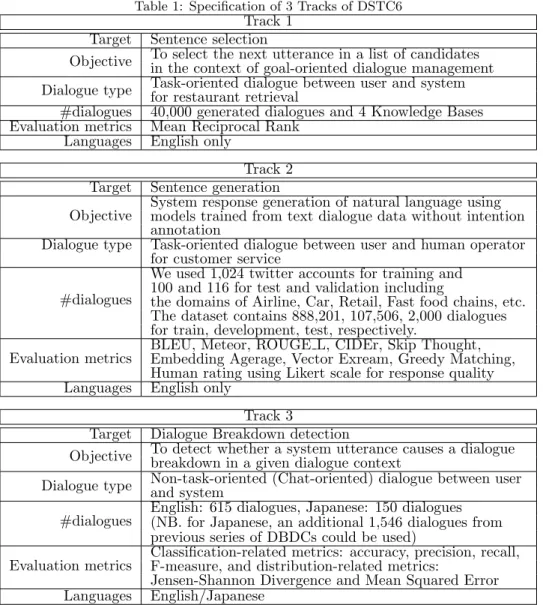
Given the remarkable success of the first five editions of the DSTC, and understanding both, the complexity of the dialogue phenomenon and the interest of the research community in a wider variety of dialogue related problems, the DSTC rebrands itself as ”Dialog System Technology Chal- lenges” for its sixth edition. In this sixth edition of the DSTC, the call for task proposals has resulted into three tracks, 1. End-to-End Goal Oriented Dialogue Learning, 2. End-to-End Conversation Modeling and 3. Dialogue Breakdown Detection as shown in Table 1. The objective of the tracks is to invite interested organizations conduct dialogue related challenges in specific areas of research and under the umbrella of the DSTC.
These three tasks are selected from the viewpoints of impact and diffi- culty for dialogue research community. The first track for End-to-End Goal Oriented Dialogue Learning task inherits previous dialogue state tracking
Table 1: Specification of 3 Tracks of DSTC6 Track 1
Target Sentence selection
Objective To select the next utterance in a list of candidates in the context of goal-oriented dialogue management Dialogue type Task-oriented dialogue between user and system
for restaurant retrieval
#dialogues 40,000 generated dialogues and 4 Knowledge Bases Evaluation metrics Mean Reciprocal Rank
Languages English only
Track 2 Target Sentence generation
Objective System response generation of natural language using models trained from text dialogue data without intention annotation
Dialogue type Task-oriented dialogue between user and human operator for customer service
#dialogues
We used 1,024 twitter accounts for training and 100 and 116 for test and validation including
the domains of Airline, Car, Retail, Fast food chains, etc.
The dataset contains 888,201, 107,506, 2,000 dialogues for train, development, test, respectively.
Evaluation metrics BLEU, Meteor, ROUGE L, CIDEr, Skip Thought, Embedding Agerage, Vector Exream, Greedy Matching, Human rating using Likert scale for response quality Languages English only
Track 3
Target Dialogue Breakdown detection
Objective To detect whether a system utterance causes a dialogue breakdown in a given dialogue context
Dialogue type Non-task-oriented (Chat-oriented) dialogue between user and system
#dialogues
English: 615 dialogues, Japanese: 150 dialogues (NB. for Japanese, an additional 1,546 dialogues from previous series of DBDCs could be used)
Evaluation metrics
Classification-related metrics: accuracy, precision, recall, F-measure, and distribution-related metrics:
Jensen-Shannon Divergence and Mean Squared Error Languages English/Japanese
challenges, especially the second challenge, with modern approaches of end- to-end learning that try the direct prediction of next system action to the user utterance and its dialogue history. The second track for End-to-End Conversation Modeling is standing on other recent trends of the dialogue system area, which tries to model a conversation as directly generating sen- tences given a user query in the open domain. Due to the rises of neural conversation modeling, the task attracts much attentions from the research community of dialogue system. The third track for Dialogue Breakdown De-
tection stands on more practical viewpoint. Controlling statistical dialogue models to suppress unexpected responses becomes an important task due to the development of statistical dialogue models, especially if we want to use dialogue systems on real products.
Since each domain has different issues to be addressed to develop dia- logue systems, we targeted restaurant retrieval dialogues to fill slot-value in Track 1, customer services on Twitter by combining goal-oriented dialogues and ChitChat in Track 2 and human-machine dialogue data for ChitChat in Track 3. It is noted that ChitChat doesn not have a specific goal to accomplish such as a slot filling task that sets values in a table of backend systems. Furthermore, the content structure of ChitChat is not as restricted and most answers can be accepted by humans.
1.1. Workshop summary and future DSTCs
The workshop for the Dialog System Technology Challenge (DSTC) was held on December 10th, 2017 at long beach, CA, USA. The organizers had pre-survey to know interests of dialogue community people, and 141 peo- ple declared their interests to the proposed three tasks. Finally, 23 teams submitted their final results for tasks and 18 scientific papers are presented in the workshop. The workshop also had 53 participants including on-site registrations. Detailed results are described in the sections below. The workshop also had many supporting organizations including sponsors, and the challenge data was created with their supports.
2. End-to-End Goal Oriented Dialogue Learning (Track 1)
2.1. Introduction
Goal-oriented dialogue requires reasoning competencies that go beyond language modeling. For example, asking questions to clearly define a user request, querying Knowledge Bases (KB’s), interpreting results from queries to display options to users or completing a transaction are some of the important competencies a dialogue system has to master in order to be useful. On the one hand, such difficulties make it hard to ascertain how well end-to-end dialogue models would do, and whether they are in a position to replace traditional dialogue methods in a goal-directed setting. On the other hand, because end-to-end dialogue systems make no assumption on the domain or dialogue state structure, they are holding the promise of easily scaling up to new domains. This challenge aims to make it easier to analyze the performance of end-to-end systems in a goal directed setting, using an expanded version of the Facebook AI Research open resource proposed in [4]. The goal of the challenge is to assess the capabilities of the proposed systems to fulfill a set of four basic tasks related to transactional dialogues.
The capability of accomplishing all four tasks on a single dialogue corpus has been tested as a final task.
2.2. The task - Restaurant Reservation
The transactional dialogue simulation system is based on an underlying KB. The facts contain the restaurants that can be booked and their proper- ties queried. Each restaurant is defined by a type of cuisine (10 choices, e.g., French, Thai), a location (10 choices, e.g., London, Tokyo), a price range (cheap, moderate or expensive), a rating (from 1 to more than 200), and other characteristics like dietary restrictions and atmosphere. For simplic- ity, we assume that each restaurant only has availability for a single party size (2, 4, 6 or 8 people). Each restaurant also has an address and a phone number listed in the KB.
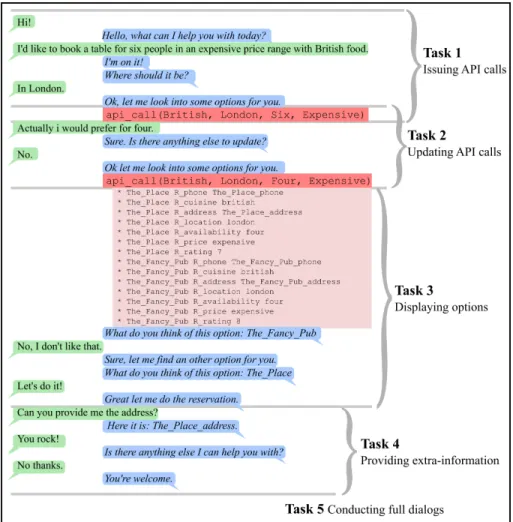
The KB can be queried using API calls, which return the list of facts related to the corresponding restaurants. Each query must contain a certain number of slots: a location, a type of cuisine, a price range, a party size, and possibly other required slots like dietary restriction, depending on the set used. Each data file has the same set of required slots for every dialogue. A query can return facts concerning one, several or no restaurant (depending on the party size). Using the KB, conversations are generated in the format shown in Figure 1. Each example is a dialogue comprising utterances from a user and a bot, as well as API calls and the resulting facts. dialogues
are generated after creating a user request by sampling an entry for each of the required slots: e.g. the request in Figure 1 is [cuisine: British, location:
London, party size: six, price range: expensive]. We use natural language patterns to create user and bot utterances. There are more patterns for the user than for the bot. Indeed, the user can use several ways to say something, while the bot always uses the same way to make it deterministic. Those patterns are combined with the KB entities to form thousands of different utterances. We split types of cuisine and locations in half, and create two KB’s, one with all facts about restaurants within the first halves and one with the rest. In [4], the two KB’s had 4,200 facts and 600 restaurants each (5 types of cuisine × 5 locations × 3 price ranges × 8 ratings). The data provided here has been expanded to comprise more slots and thus yield many more restaurants, but the two KB still have disjoint sets of restaurants, locations, types of cuisine, phones and addresses, while sharing all other sets of values. We use one of the KB’s to generate train and test dialogues, using only one of the extra slots in the queries. There are 4 sets of test dialogues:
(1) one that uses the same KB as for the train dialogues, and the same set of slots in the queries; (2) one that uses the second KB (with disjoint sets of restaurants, locations, cuisines, phones and addresses), termed Out-Of- Vocabulary (OOV), but the same set of slots in the queries; (3) one that uses the same KB as for the train dialogues, but one additional slot for the queries; and (4) one that uses the second KB (OOV) and an additional required slot.
For training, systems have access to the training examples and both KBs.
Evaluation is conducted on all four test sets. Beyond the intrinsic difficulty of each task, the challenge on the OOV test sets is for models to generalize to new entities (restaurants, locations and cuisine types) unseen in any training dialogue – something natively impossible for embedding methods. Ideally, models could, for instance, leverage information coming from the entities of the same type seen during training.
We generate five datasets, one per task. Training sets are relatively small (10,000 examples) to create realistic learning conditions. The dialogues from the training and test sets are different, never being based on the same user requests. Thus, we test if models can generalize to new combinations of fields.
2.3. End-to-end dialogue learning as sentence-selection
The task of end-to-end dialogue learning has been recently formalized as next-sentence prediction. One of the main motivation of such approach is the abundance of human-to-human dialogue in industrial systems which
contrasts with the lack of annotated data due to the cost and challenge of such process. Formally, a transaction dialogue system based on a sentence selection model needs to choose, among a potentially large number of avail- able utterances extracted from a corpus of dialogues, the most adequate answer with respect to a current dialogue. Several challenges can be iden- tified (1) dialogue representation (2) Reasoning capabilities (3) Back-end system handling. A series of models have been proposed.
First, Long Short Term Memory (LSTM) [17] is a recurrent neural net- work that has recently known important success in most of the classic Nat- ural Language Processing task. LSTM has become a common model for sentence encoding. In the context of utterance selection, several models have leverage its expressive capability of learn sentence ranking models [26].
Second, Memory Networks [39] are a recent class of models that have also been applied to a range of natural language processing tasks, including question answering [5], language modeling and non-goal-oriented dialogue [8]. By first writing and then iteratively reading from a memory component (using layers called hops) that can store historical dialogues and short-term context to reason about the required response, they have been shown to perform well on those tasks and to outperform some other end-to-end archi- tectures based on simpler Recurrent Neural Networks.
Then, Hybrid Code Networks [48] (HCNs) learns an recurrent neural network but also allow a developer to express domain knowledge via soft- ware and action templates. Indeed, simple operations like sorting a list of database results or updating a dictionary of entities can expressed in a few lines of software, yet may take thousands of dialogues to learn. In addition, this neural network can be trained with supervised learning or reinforcement learning, by changing the gradient update applied.
Regarding the learning strategies, the use of pairwaise ranking loss has been proposed. As an alternative, reinforcement learning has been investi- gated in order to leverage non-diffentiable loss through policy gradient [47].
More recently, adversarial loss has been studied and compared to human choice [27].
2.4. Description of the Dialogue Dataset
We broke down a goal-directed objective into several sub-tasks to test some crucial capabilities that dialogue systems should have (and hence pro- vide error analysis by design). All the tasks involve a restaurant reservation system, where the goal is to book a table at a restaurant. Solving our tasks requires manipulating both natural language and symbols from a KB. The tasks are generated by a simulation. Grounded with an underlying KB of
restaurants and their properties (location, type of cuisine, etc.), these tasks cover several dialogue stages and test if candidate models can learn various abilities such as performing dialogue management, querying KB’s, interpret- ing the output of such queries to continue the conversation or dealing with new entities not appearing in dialogues from the training set.
Task 1: Issuing API calls. A user request implicitly defines a query that can contain from 0 to 4 of the required fields (sampled uniformly; in Figure 1, it contains 3). The bot must ask questions for filling the missing fields and eventually generate the correct corresponding API call. The bot asks for information in a deterministic order, making prediction possible.
Task 2: Updating API calls. Starting by issuing an API call as in Task 1, users then ask to update their requests. The order in which fields are updated is random. The bot must ask users if they are done with their updates and issue the updated API call.
Task 3: Displaying options. Given a user request, the KB is queried using the corresponding API call and the resulting facts are added to the dialogue history (if too many facts satisfy the call, a random subset is returned to avoid overly lengthy data). The bot must propose options to users by listing the restaurant names sorted by their corresponding rating (from higher to lower) until users accept. For each option, users have a 25% chance of ac- cepting. If they do, the bot must stop displaying options, otherwise propose the next one. Users always accept the option if this is the last remaining one. We only keep examples with API calls retrieving at least 3 options.
Task 4: Providing extra information. Given a user request, we sample a restaurant and start the dialogue as if users had agreed to book a table there. We add all KB facts corresponding to it to the dialogue. Users then ask for the phone number of the restaurant, its address or both, with proportions 25%, 25% and 50%, respectively. The bot must learn to use the KB facts correctly to answer.
Task 5: Conducting full dialogues. For Task 5, we combine Tasks 1-4 to gen- erate full dialogues just as in Figure 1. Unlike in Task 3, we keep examples if API calls return at least 1 option instead of 3.
The dataset is organized in 5 JSON files corresponding to each of the tasks previously mentioned. Basically, a dialogue piece is followed by a list of next-utterance candidates. In the training set, the answer (the single correct candidate) is provided. The goal is to rank the candidates. Precisions
@{1,2,5} will be used to evaluate the models. These measures correspond to the probability of the correct utterance to be the 1st best, part of the
2-best and 5-best hypotheses output by each model, respectively. Rank of candidate utterances will be 1-indexed. Evaluation uses per-response accuracies. Evaluation is conducted in a ranking, not a generation, setting:
at each turn of the dialogue, the participants have to test whether they can predict bot utterances and API calls by selecting a candidate, not by generating it.1 Candidates are ranked from a set of candidate utterances and API calls.
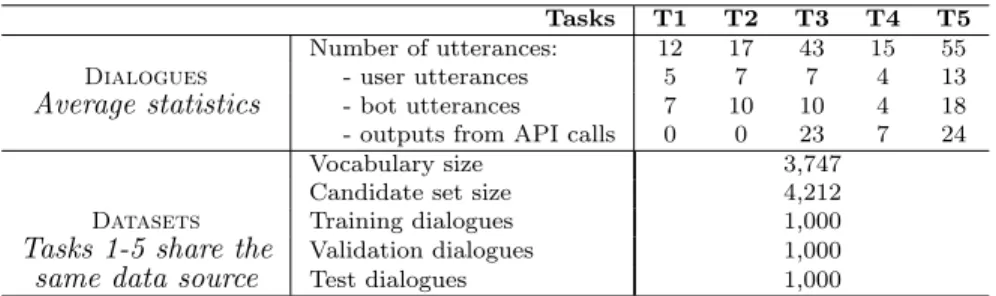
Table 2: Provided data for Track 1. Tasks 1-5 were generated using our simulator and share the same KB. Each task have two test sets, one using the vocabulary of the training set and the other using out-of-vocabulary words.
Tasks T1 T2 T3 T4 T5 Number of utterances: 12 17 43 15 55
Dialogues - user utterances 5 7 7 4 13
Average statistics - bot utterances 7 10 10 4 18 - outputs from API calls 0 0 23 7 24
Vocabulary size 3,747
Candidate set size 4,212
Datasets Training dialogues 1,000
Tasks 1-5 share the Validation dialogues 1,000
same data source Test dialogues 1,000
2.5. Results
Table 3 introduces methods proposed during the challenge. End-to-End Memory Network [40], Dynamic Memory Network [20] and Hybrid Code Networks [48] were the main trainable building blocks of the proposed sys- tems. In addition contextual rules were proposed to improve performances.
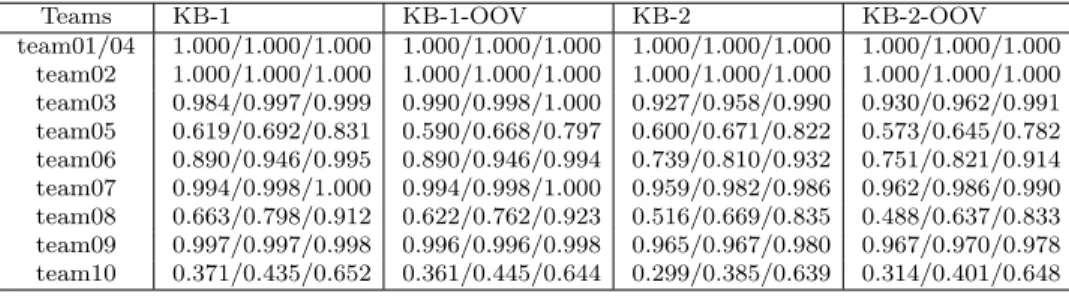
Table 4 details the results obtained for the participating teams. The two first teams managed to solve the task by obtaining 1.0 precision in the test- set. KB-2 introduced a novel request table slot (ambiance) in the test-set.
This slot is available in the knowledge base in both the train and test set.
3. End-to-End Conversation Modeling using NLG (Track 2)
3.1. Introduction
End-to-end training of neural networks is a promising approach to au- tomatic construction of dialogue systems using a human-to-human dialogue corpus. Recently, Vinyals et al. tested neural conversation models using
1[28] termed this setting Next-Utterance Classification.
Table 3: Methods implemented in submitted systems for Track 1.
Teams Method
1/4 Extended Hybrid Code Networks
2 A hierarchical Long Short-Term Memory (LSTM) based ranking module, a Conditional Random Field (CRF)
3 End-to-End Slot-Value Independent Recurrent Entity Network 5 Memory Network with Negative Sample
6 Memory Network with an extra output memory representation named D-Layer with Knowledge based enhancement
7 End-to-End Memory Networks with named entities abstraction and contextual numbering
8 Embedding projection of the text and candidate with rankloss optimization
9 Quantized language model
Table 4: Summaries of the team performances for Track 1 using Precision1, Precision2 and Precision5.
Teams KB-1 KB-1-OOV KB-2 KB-2-OOV
team01/04 1.000/1.000/1.000 1.000/1.000/1.000 1.000/1.000/1.000 1.000/1.000/1.000 team02 1.000/1.000/1.000 1.000/1.000/1.000 1.000/1.000/1.000 1.000/1.000/1.000 team03 0.984/0.997/0.999 0.990/0.998/1.000 0.927/0.958/0.990 0.930/0.962/0.991 team05 0.619/0.692/0.831 0.590/0.668/0.797 0.600/0.671/0.822 0.573/0.645/0.782 team06 0.890/0.946/0.995 0.890/0.946/0.994 0.739/0.810/0.932 0.751/0.821/0.914 team07 0.994/0.998/1.000 0.994/0.998/1.000 0.959/0.982/0.986 0.962/0.986/0.990 team08 0.663/0.798/0.912 0.622/0.762/0.923 0.516/0.669/0.835 0.488/0.637/0.833 team09 0.997/0.997/0.998 0.996/0.996/0.998 0.965/0.967/0.980 0.967/0.970/0.978 team10 0.371/0.435/0.652 0.361/0.445/0.644 0.299/0.385/0.639 0.314/0.401/0.648
Figure 1: Task design of goal-oriented dialogue for Track 1. A user (in green) chats with a bot (in blue) to book a table at a restaurant. Models must predict bot utterances and API calls (in dark red). Task 1 tests the capacity of interpreting a request and asking the right questions to issue an API call. Task 2 checks the ability to modify an API call. Task 3 and 4 test the capacity of using outputs from an API call (in light red) to propose options (sorted by rating) and to provide extra-information. Task 5 combines everything.
OpenSubtitles [43]. Lowe et al. released the Ubuntu Dialogue Corpus [26]
for research in unstructured multi-turn dialogue systems. Furthermore, the approach has been extended to accomplish task oriented dialogues to provide information properly with natural conversation. For example, Ghazvinine- jad et al. proposed a knowledge grounded neural conversation model [10], where the research is aiming at combining conversational dialogues with
task-oriented knowledge using unstructured data such as Twitter data for conversation and Foursquare data for external knowledge. However, the task is still limited to a restaurant information service, and has not yet been tested with a wide variety of dialogue tasks. In addition, it is still unclear how to create intelligent dialogue systems that can respond like a human agent.
In consideration of these problems, we proposed a challenge track to the 6th dialog system technology challenges (DSTC6) 2. The focus of the challenge track is to train end-to-end conversation models from human-to- human conversation in order to accomplish end-to-end dialogue tasks for a customer service. The dialogue system plays the role of a human agent and generates natural and informative sentences in response to users questions or comments given a dialogue context.
3.2. Tasks
In this challenge track, a system has to generate sentence(s) in response to a user input in a given dialogue context, where it can use external knowl- edge from public data, e.g. web data. The quality of the automatically generated sentences is evaluated with objective and subjective measures to judge whether or not the generated sentences are natural and informative for the user (see Fig. 2).
Figure 2: Sentence generation and evaluation in the end-to-end conversation modeling track.
This track aims to generate system responses for Customer service dia- logue using Twitter data:
Task A: Full or part of the training data will be used to train conversation models.
Task B: Any open data, e.g. from web, are available as external knowledge to generate informative sentences. But they should not overlap with the training, validation and test data provided by organizers.
2http://workshop.colips.org/dstc6/
Challenge attendees can select either A or B, or both. The tools to download Twitter data and extract the dialogue text were provided to all attendees at the challenge track in DSTC6 [18]. The attendees needed to collect the data by themselves. Data collected before Sep. 1st, 2017 was available as trial data, and the official training, development and test data were collected from Sep. 7th to 18th, 2017. The dialogues were used for the test set was not disclosed until Sep. 25th.
3.3. Data Collection 3.3.1. Twitter data
In the Twitter task, we used dialogue data collected from multiple Twit- ter accounts for customer service. Each dialogue consisted of real tweets between a customer and an agent. A customer usually asked a question or complained something about a product or a service of the company, and an agent responded to the customer accordingly. In this challenge, each participant is supposed to develop a dialogue system that mimics agents behaviors. The system will be evaluated based on the quality of generated sentences in response to customers tweets. For the challenge, we provided a data collection tool to all participants so that they could collect the data by themselves because Twitter does not allow distribution of Twitter data by a third party In this task, it is assumed that each participant continued to collect the data from specific accounts in the challenge period. To acquire a large amount of data, the data collection needed to be done repeatedly, e.g. by running the script once a day, because the amount of data we can download is limited and older tweets cannot be accessed after they expire.
At a certain point of time, we provided an additional tool to extract subsets of collected data for training, development (validation), and evaluation so that all the participants were able to use the same data for the challenge.
Until the official data sets were fixed, trial data sets were available to de- velop dialogue systems, which were selected from the data collected by each participant. But once the official data sets were determined, the system needed to be trained from scratch only using the official data sets.
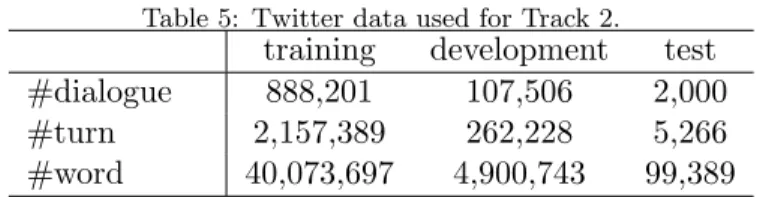
Challenge attendees need to use a common data collection tool included in the provided package. The trial data sets can be extracted from down- loaded twitter dialogues using a data extraction script in the package. The official data are collected through the period of Sep. 7th to 18th in 2017, us- ing the data collection tool. The official training, development and test sets can also be extracted using another data extraction script. Finally, the par- ticipants are supposed to collect the data sets summarized in Table 5. More
Table 5: Twitter data used for Track 2.
training development test
#dialogue 888,201 107,506 2,000
#turn 2,157,389 262,228 5,266
#word 40,073,697 4,900,743 99,389
information can be found in ”https://github.com/dialogtekgeek/DSTC6- End-to-End-Conversation-Modeling”.
We trained the data from 1024 twitter accounts for training, 100 accounts for test and 116 account for validation, respectively. The business domain contains Airline, Car, Retail, Fast food chains, etc. The lists of accounts used for the challenge can be found in the following link3.
3.4. Text Preprocessing
Twitter dialogues contain a lot of noisy text with special expressions and symbols. Therefore, text preprocessing is important to clean up and normalize the text. Moreover, all the participants need to use the same pre- processing at least for target references to assure fair comparisons between different systems in the Challenge.
3.4.1. Twitter data
Twitter data contains a lot of specific information such as Twitter ac- count names, URLs, e-mail addresses, telephone/tracking numbers and hash- tags. This kind of information is almost impossible to predict correctly unless we use a lot of training data obtained from the same site. To alle- viate this difficulty, we substitute those strings with abstract symbols such as<URL>, <E-MAIL>, and <NUMBERS> using a set of regular expressions. In addition, since each tweet usually starts with a Twitter account name of the recipient, we removed the account name. But if such names appear within a sentence, we leave them because those names are a part of sentence. We leave hashtags as well for the same reason. We also substitute user names with<USER>e.g.
hi John, can you send me a dm ?
→ hi <USER>, can you send me a dm ?
3https://github.com/dialogtekgeek/DSTC6-End-to-End-Conversation- Modeling/tree/master/tasks/twitter officialaccountnames{train|dev|test}.txt
Table 6: Submitted systems for Track2.
Team (Entry) Model type Objective function Additional tech- niques
Paper
baseline LSTM Cross entropy
team 1 (1) team 1 (2)
team 2 (1) 2LSTM+LSTM Adversarial Example method
team 2 (2) LSTM Cross entropy Example method
team 2 (3) 2LSTM+LSTM Adversarial + Cosine Similarity
Example method [46]
team 2 (4) 2LSTM+LSTM Adversarial team 2 (5) 2LSTM+LSTM
+HRED
Cross entropy MBR System
combination
team 3 (1) LSTM Cross entropy
team 3 (2) 2LDTM+Atten. Cross entropy on diver- sified data
team 3 (3) 2LSTM+Atten. Cross entropy on trial data+
[23]
team 3 (4) GWGM+Atten. Cross entropy
team 3 (5) SEARG Cross entropy Knowledge
enhanced model
team 4 (1) LSTM Cross entropy Word embedding
initialization
[2]
team 5 (1) LSTM MMI maxdiv MERT
team 5 (2) LSTM MMI maxBLEU MERT
team 5 (3) LSTM MMI mixed (maxdiv +
maxBLEU)
MERT [9]
team 5 (4) LSTM MMI uniform
team 5 (5) LSTM Cross entropy Greedy search
for decoding team 6 (1)
+Trial data cannot be used for official evaluation. The results are not officially accepted.
Since the user’s name can be extracted from the attribute information of each tweet, we can replace it. Note that the text preprocessing is not perfect, and therefore there may remain original phrases, which are not replaced or removed successfully. The text also includes many abbreviations, e.g. “pls hlp”, special symbols, e.g. “(-:” and wide characters “ c♥♣” including 4-byte Emojis. These are left unaltered.
3.5. Submitted Systems
We received 19 sets of system outputs for the Twitter task, from six teams, and four system description papers were accepted [46, 23, 2, 9]. In this section, we summarize the techniques used in the systems, including the baseline system for the challenge track.
The baseline system is an LSTM-based encoder decoder in [18], but this is a simplified version of [43], in which back-propagation is performed only up
to the previous turn from the current turn, although the state information is taken over throughout the dialogue.
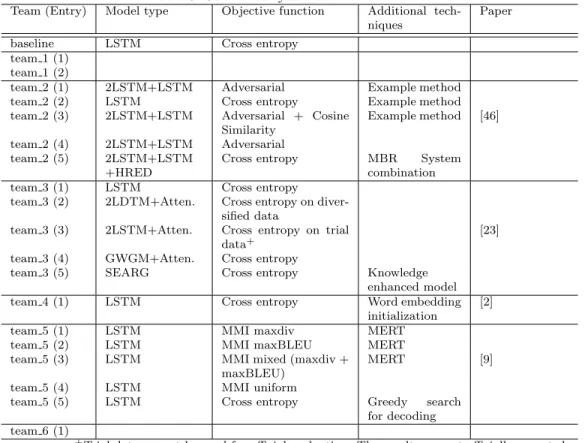
Table 6 shows the baseline and submitted systems with their brief specifi- cations including model type, objective function, and additional techniques.
An empty specification means that the team did not submit any system description paper to the DSTC6 workshop.
Most systems employed a LSTM or BLSTM (2LSTM) encoder and a LSTM decoder. Some systems used a hierarchical encoder decoder (team 2 (5) and team 3 (5)) and attention-based decoder (team 3 (2–4)). Several types of objective functions were applied for training the models, where cross en- tropy, adversarial method, cosine similarity, and maximum mutual informa- tion (MMI) were used solely or combined. The objective functions except cross entropy were designed to increase the diversity of responses. This hopefully led to more realistic and informative responses.
Furthermore, several additional techniques are introduced to improve the response quality. In [46], an example-based method is used to return real human responses if a similar context exists in the training corpus, and minimum Bayes risk (MBR) decoding is used to improve objective scores.
The knowledge enhanced encoder decoder [23] searches for relevant doc- uments in the web using the keywords in the dialogue context, and the relevant documents are used to enhance the decoder. In [2], different types of word-embedding vectors are used for initialization of the models.
3.6. Evaluation
Challenge participants were allowed to submit up to 5 sets of system out- puts. The outputs were evaluated with objective measures such as BLEU and METEOR, and also evaluated by rating scores collected by humans us- ing Amazon Mechanical Turk (AMT). The human evaluators rate the system responses in terms of naturalness, informativeness, and appropriateness.
3.6.1. Objective evaluation
For the challenge track, we used nlg-eval4 for objective evaluation of system outputs, which is a publicly available tool supporting various unsu- pervised automated metrics for natural language generation. The supported metrics include word-overlap-based metrics such as BLEU, METEOR, ROUGE L, and CIDEr, and embedding-based metrics such as SkipThoughts Cosine Similarity, Embedding Average Cosine Similarity, Vector Extrema Cosine
4https://github.com/Maluuba/nlg-eval
Similarity, and Greedy Matching Score. Details of these metrics are de- scribed in [37].
We prepared 10 more references for a ground truth of each response by humans to operate reliable objective evaluation. The references included a real human response in the Twitter dialogue and 10 human-generated re- sponses. We asked 10 different Amazon Mechanical Turkers for each dialogue to compose a sentence for the final response given the dialogue context. We provided the real human response as an example and asked them to make their responses to be different from the example while keeping to the di- alogue topic. We also asked them not to copy and paste the example in their response. When multiple references are available,nlg-evalcomputes the similarity between the prediction and all the references one-by-one, and then selects the maximum value.
3.6.2. Subjective evaluation
We collected human ratings for each system response using 5 point Likert Scale, where 10 different Turkers rated system responses given a dialogue context. We listed randomly 21 responses below the dialogue context, which consists of 19 submitted outputs, a baseline output, and a human response for each dialogue.
The Turkers rated each response by 5 level scores as
Level Score
Very good 5
Good 4
Acceptable 3
Poor 2
Very poor 1
we instructed to the Turkers to consider naturalness, informativeness, and appropriateness of the response for the given context. If there were identical responses in the list, we reduced them into one response so that they were rated consistently. The average score was computed for each system and reported in Table 7.
3.6.3. Results
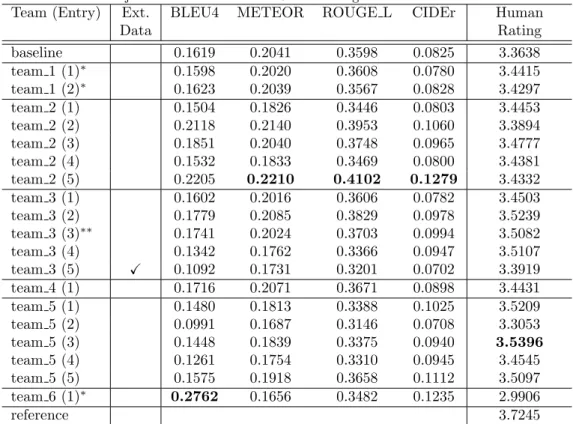
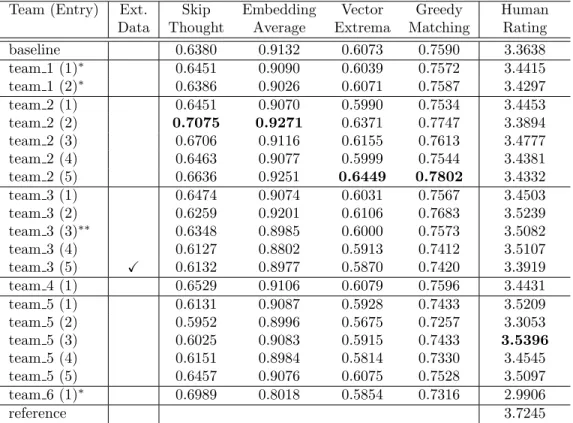
Tables 7 and 8 show evaluation results of 21 systems: the 19 submitted systems, the baseline and the reference. Systems are listed as team M (N), where M is the team index and N is an identifier for a particular system submitted by that team. “Ext. Data” in the table denotes whether or not the system used external data for training and/or testing, where only team 3 (5) used external data (web data) for response generation.
Table 7: Evaluation results with word-overlapping-based objective measures based on 11 references and a subjective measure based on 5-level ratings for Track 2.
Team (Entry) Ext. BLEU4 METEOR ROUGE L CIDEr Human
Data Rating
baseline 0.1619 0.2041 0.3598 0.0825 3.3638
team 1 (1)∗ 0.1598 0.2020 0.3608 0.0780 3.4415
team 1 (2)∗ 0.1623 0.2039 0.3567 0.0828 3.4297
team 2 (1) 0.1504 0.1826 0.3446 0.0803 3.4453
team 2 (2) 0.2118 0.2140 0.3953 0.1060 3.3894
team 2 (3) 0.1851 0.2040 0.3748 0.0965 3.4777
team 2 (4) 0.1532 0.1833 0.3469 0.0800 3.4381
team 2 (5) 0.2205 0.2210 0.4102 0.1279 3.4332
team 3 (1) 0.1602 0.2016 0.3606 0.0782 3.4503
team 3 (2) 0.1779 0.2085 0.3829 0.0978 3.5239
team 3 (3)∗∗ 0.1741 0.2024 0.3703 0.0994 3.5082
team 3 (4) 0.1342 0.1762 0.3366 0.0947 3.5107
team 3 (5) X 0.1092 0.1731 0.3201 0.0702 3.3919
team 4 (1) 0.1716 0.2071 0.3671 0.0898 3.4431
team 5 (1) 0.1480 0.1813 0.3388 0.1025 3.5209
team 5 (2) 0.0991 0.1687 0.3146 0.0708 3.3053
team 5 (3) 0.1448 0.1839 0.3375 0.0940 3.5396
team 5 (4) 0.1261 0.1754 0.3310 0.0945 3.4545
team 5 (5) 0.1575 0.1918 0.3658 0.1112 3.5097
team 6 (1)∗ 0.2762 0.1656 0.3482 0.1235 2.9906
reference 3.7245
∗Results are not officially accepted since any system description paper has not been submitted.
∗∗Results are not officially accepted since the system was tuned with the trial data [23].
Table 9 shows cross-validation results of 11 ground truths generated by humans. Each manually generated sentence was evaluated by comparing with other 10 ground truths using leave-one-out method.
In most objective measures, the system of team 2 (5) achieved highest scores, where the system employed MBR decoding for system combination.
This result indicates that explicit maximization of objective measures and the complementarity of multiple systems bring significant improvement for the objective measures.
On the subjective measure with human rating, the system of team 5 (3) achieved the best score (3.5396). Although there were no big differences between the human rating scores, we can see that techniques for improving human rating actually contributed to increase the rating scores. For exam- ple, adversarial training (team 2 (3)), use of diversified data (team 3 (2)),
Table 8: Evaluation results with embedding-based objective measures based on 11 refer- ences and a subjective measure based on 5-level ratings for Track 2.
Team (Entry) Ext. Skip Embedding Vector Greedy Human Data Thought Average Extrema Matching Rating
baseline 0.6380 0.9132 0.6073 0.7590 3.3638
team 1 (1)∗ 0.6451 0.9090 0.6039 0.7572 3.4415
team 1 (2)∗ 0.6386 0.9026 0.6071 0.7587 3.4297
team 2 (1) 0.6451 0.9070 0.5990 0.7534 3.4453
team 2 (2) 0.7075 0.9271 0.6371 0.7747 3.3894
team 2 (3) 0.6706 0.9116 0.6155 0.7613 3.4777
team 2 (4) 0.6463 0.9077 0.5999 0.7544 3.4381
team 2 (5) 0.6636 0.9251 0.6449 0.7802 3.4332
team 3 (1) 0.6474 0.9074 0.6031 0.7567 3.4503
team 3 (2) 0.6259 0.9201 0.6106 0.7683 3.5239
team 3 (3)∗∗ 0.6348 0.8985 0.6000 0.7573 3.5082
team 3 (4) 0.6127 0.8802 0.5913 0.7412 3.5107
team 3 (5) X 0.6132 0.8977 0.5870 0.7420 3.3919
team 4 (1) 0.6529 0.9106 0.6079 0.7596 3.4431
team 5 (1) 0.6131 0.9087 0.5928 0.7433 3.5209
team 5 (2) 0.5952 0.8996 0.5675 0.7257 3.3053
team 5 (3) 0.6025 0.9083 0.5915 0.7433 3.5396
team 5 (4) 0.6151 0.8984 0.5814 0.7330 3.4545
team 5 (5) 0.6457 0.9076 0.6075 0.7528 3.5097
team 6 (1)∗ 0.6989 0.8018 0.5854 0.7316 2.9906
reference 3.7245
∗Results are not officially accepted since any system description paper has not been submitted.
∗∗Results are not officially accepted since the system was tuned with the trial data [23].
Table 9: Cross validation results of 11 references for Track2.
BLEU4 METEOR ROUGE L CIDEr Skip Embedding Vector Greedy
Thought Average Extrema Matching Original 0.5264 0.3885 0.6559 0.7566 0.7160 0.9483 0.7625 0.8679
Ref (1) 0.2758 0.2357 0.4525 0.3615 0.7091 0.9308 0.6643 0.7958
Ref (2) 0.2626 0.2313 0.4501 0.3477 0.7142 0.9300 0.6646 0.7951
Ref (3) 0.2651 0.2335 0.4499 0.3571 0.7064 0.9328 0.6626 0.7958
Ref (4) 0.2683 0.2358 0.4509 0.3622 0.7039 0.9313 0.6637 0.7951
Ref (5) 0.2682 0.2390 0.4464 0.3611 0.7104 0.9301 0.6632 0.7925
Ref (6) 0.2786 0.2323 0.4476 0.3577 0.7005 0.9291 0.6642 0.7925
Ref (7) 0.2729 0.2382 0.4523 0.3678 0.7049 0.9319 0.6687 0.7971
Ref (8) 0.2593 0.2256 0.4430 0.3488 0.7082 0.9306 0.6604 0.7921
Ref (9) 0.2529 0.2348 0.4436 0.3440 0.7202 0.9325 0.6621 0.7944
Ref (10) 0.2707 0.2364 0.4527 0.3750 0.7105 0.9333 0.6679 0.7968
Average 0.2910 0.2483 0.4677 0.3945 0.7095 0.9328 0.6731 0.8014
and MMI-based objective function with maximum diversity (team 5 (1), (3))
1 1.5 2 2.5 3 3.5 4 4.5 5
referen ce
team _5(3)
team _3(2)
team _5(1)
team _3(4)
team _5(5)
team _3(3)
team _2(3)
team _5(4)
team _3(1)
team _2(1)
team _4(1)
team _1(1)
team _2(4)
team _2(5)
team _1(2)
team _3(5)
team _2(2)
baseline team
_5(2) team
_6(1)
Human Ra;ng
Systems
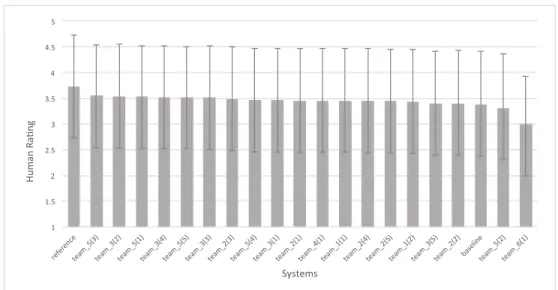
Figure 3: Mean and standard deviation of human rating score for Track 2.
Figure 4: Distribution of human scores averaged sentence by sentence for Track 2.
Ref T5(3) T3(2) T5(1) T3(4) T5(5) T3(3) T2(3) T5(4) T3(1) T2(1) T4(1) T1(1) T2(4) T2(5) T1(2) T3(5) T2(2) Base T5(2) T6(1) Systems
1 2 3 4 5
Human Rating
Figure 5: Distribution of human rating score for each level of scores for Track2.
Table 10: Example of System output for Track 2.
Example 1: The worst system does not show sympathy to the user’s troubles.
Context U: it ’s currently raining on me inside of a bus @njtransit
Best 4.0 S: we ’re sorry to hear this . please submit a report here so we may further assist you . <URL>
Worst 1.0 S: good luck !
Reference 3.9 S: hi <USER> , would you please provide me with your origin , destination , bus line , 4 digit vehicle # & time of travel ?
Example 2: The best system shows much deeper sympathy to show how they will solve the user’s troubles than the reference. The worst system totally misunderstands the negative context for the positive one.
Context U: flight canceled . stuck . rebooked 8hrs later in a middle seat and then asked to pay more to change it back to originally booked aisle
Best 4.5 S: sorry to hear about this , <USER> . could you dm us your confirmation code so we can take a closer look into this for you ?
<URL>
Worst 1.2 S: we ’re happy to hear that , <USER> . we hope to see you again soon
!
Reference 3.3 S: sorry to hear about your flight woes . did you know you may be eligible for compensation ? visit <URL>
Example 3: The best system shows much deeper sympathy using emotional expressions for the user’s troubles than the reference. The worst system totally misunderstands the negative context for the positive one.
Context U: savannah was the worst stay over the weekend !
Best 4.8 S: oh no ! what happened ? we ’d like to look into this for you . please send us a direct message with your reservation number . Worst 1.5 S: that ’s what we like to hear , <USER> ! we ’ll be sure to pass
this on to the team . have a great day !
Reference 4.0 S: we are sorry to hear of your experience . please email us at
<E-MAIL> so we can assist you w / this matter .
had some improvement compared to the other systems. The automatic gen- eration have not yet reached the score of the reference (3.7245), but some of them were better responses than the reference in terms of human rating.
The conversation modeling techniques applied to this challenge track for Twitter dialogues are better than we expected.
Figures 3-5 show the human ratings for each system in several ways.
The systems are shown in the same order on the X axis for all three figures.
Figure 3 shows the mean and the standard deviation of the human ratings for each system (across all responses and all raters for that system). Figure 4 shows the distributions of the mean human rating score for each sentence for each system. Figure 5 shows the distribution of all human rating scores for each system across all sentences. In this Figure, the area for each score of the violinplot shows a count of the number of scores of each level on the Likert scale. The ”Reference” system (at the far left of each figure)
Table 11: Example of System output for Track 2.
Example 4: It’s difficult to compare the best response sentences assuming the information from a back-end system with the reference waiting for a response from a database.
Context U: when are the kaws tee shirts gonna restock again online ? Best 4.7 S: hi <USER> , we don ’t have a restock date at this time . please
keep an eye on our social media pages for updates . Worst 1.3 S: it does not .
Reference 3.7 S: we are checking on the restock date for the kaws tee ’s rn . Example 5: The benefits for users and company agents who wants to get more information are different.
Context U: honestly can ’t wait to use my lush bath bomb ♥
Best 4.4 S: hi <USER> , we ’re so pleased to hear that you ’re happy with your purchase . enjoy your new goodies !
Worst 1.4 S: we have great post-workout meals ! give us a try next ! get 40 % off : <URL> <URL>
Reference 3.6 S: nice which bath bomb ? :D Example 6: More options are good for users.
Context U: is queen sold out ? you website seems unable to tell me if it is . desperate to know ...
S: hi <USER> , limited tickets still available . thanks U: thanks for the response . so , how does one procure them ? Best 4.4 S: hi , you can order them from our website <URL> or by calling
<NUMBERS> . thanks , Worst 1.1 S: hi <USER> ,
Reference 3.9 S: you can follow this link to purchase > > > <URL>
is ratings for the sentences extracted from the original (Twitter) dialogue data. The Reference system had the best human ratings: it had the highest mean rating in Fig. 3, the highest median sentence rating in Fig. 4 and the most sentences rated as level 5 (”Very good”) in Fig. 5. The worst system (at the right) had a much lower mean rating, and a long tail of poorly rated sentences.
78.5% (1570/2000) of the system responses automatically generated by the best system were rated better than acceptable and 88.3% (1765/2000) of human’s responses were rated in the same class. The best system achieved 89% of the upper-bound given by he human responses.
Tables 10 and 11 show examples of the system outputs. The humans prefer more supportive responses with sympathy. The system responses are sometimes rated better than the original human responses.
3.7. Summary
This article described the end-to-end conversation modeling track of the 6th dialog system technology challenges (DSTC6). We received 19 system outputs from six teams, and evaluated them based on several objective mea- sures and a human-rating-based subjective measure. The final results are summarized in the article. Objective and subjective measures were not al- ways consistent across systems. Some mismatches between objective and subjective measures have also been reported in [22]. Deeper analysis will be necessary on these results to enable us to design a better objective function and perform practical automatic evaluation.
4. Track 3: Dialogue Breakdown Detection 4.1. Introduction
Although voice agent services and smart speakers are beginning to ap- pear on the market, the limited capabilities of these systems mean that humans and machines still cannot converse as naturally as two humans.
The main problem is that systems typically make inappropriate utterances that lead to dialogue breakdowns. By dialogue breakdown, we mean a sit- uation in a dialogue where users cannot proceed with the conversation [29].
To avoid this situation, technology for dialogue breakdown detection is es- sential because such technology will enable systems to avoid the creation of inappropriate utterances and also to identify dialogue breakdowns when they occur and perform the necessary recovery procedures.
The task of dialogue breakdown detection [13] is to detect whether a system utterance causes a dialogue breakdown in a given dialogue context.
The participants of the dialogue breakdown detection track (Track 3) of the Dialog System Technology Challenges (DSTC) developed a dialogue breakdown detector that outputs a dialogue breakdown label (B: breakdown, PB: possible breakdown, or NB: not a breakdown) and a distribution of these labels. The definitions of the labels are defined as follows.
NB: It is easy to continue the conversation.
PB: It is difficult to continue the conversation smoothly.
B: It is difficult to continue the conversation.
Similar tasks to detect problematic situations in dialogue have been tack- led mainly in task-oriented dialogue systems [45, 21, 25, 30]. In these studies, features, such as speech recognition results, language understanding results, and prosodic information, are extracted from user/system utterances and used to train a model that can detect problematic situations (also called miscommunication or hotspot). On the contrary, there are only a few stud- ies that work on chat-oriented dialogue systems [49, 14], and their reported accuracies are not that high (about 60% accuracy). In addition, these stud- ies use a dataset of a single dialogue system, which raises the generality issue. This track uses the data of multiple dialogue systems in multiple lan- guages in order to obtain more general conclusions. Recently, a study that annotates chat-oriented dialogue systems with three kinds of labels (invalid, acceptable, valid), has been underway in the WOCHAT initiative5; however,
5http://workshop.colips.org/wochat/
the labels are currently used for annotation purposes and not for automatic detection [6, 7].
Dialogue breakdown detection is closely related to user satisfaction esti- mation in dialogue [44, 31, 15, 36, 1]. The difference is that these approaches aim to estimate user satisfaction after the dialogue so that the system can be improved later by analyzing unsatisfactory dialogues, whereas dialogue breakdown detection aims to detect a system’s possible error in real-time so that the system can avoid dialogue breakdown. Since underlying techniques can be similar, we believe methods for user satisfaction estimation can also be useful for dialogue breakdown detection.
In this track, we prepared datasets in two languages: English and Japanese.
We used four systems in English (NB. one of the datasets comprises dialogues of several dialogue systems) and three systems in Japanese. Overall, seven teams participated in this track, in which five teams worked on English6 and four teams on Japanese with two teams working on both. In this paper, we describe the task setting, datasets, and evaluation metrics as well as the results of the submitted runs of the participants.
4.2. Task setting
The task of dialogue breakdown detection is to detect whether a system utterance causes a dialogue to break down in a given dialogue context [13].
For example, consider the following piece of dialogue.
S1: It’s nice to go shopping alone.
U1: I agree. That’s nice.
S2: Shopping takes time.
U2: Window shopping is also fun.
S3: It’s fun to go shopping with somebody.
Here, system utterances are prefixed with S and user utterances with U. The dialogue context is from S1 to U2, and the target utterance for dialogue breakdown detection is S3 (underlined). In this example, S3 is likely to be causing a dialogue breakdown because S3 contradicts S1. Therefore, a detector that classifies this as a dialogue breakdown will be regarded as accurate. The reason we say “likely” is that a human’s decision on dialogue breakdown is highly subjective, and it is difficult to decide on a single gold
6Although six teams submitted their runs in English, one team did not submit a techni- cal paper; therefore, their run is not regarded as an official run and thereby is not included in this paper.
label. For this reason, we use many annotators for dialogue breakdown annotation and opt for majority voting and their probability distribution as references.
Dialogue breakdown detector Input
Output Probability distribution
of breakdown labels
NB PB B
Dialogue Context:
S1: It’s nice to go shopping alone.
U1: I agree. That’s nice.
S2: Shopping takes time.
U2: Window shopping is also fun.
Succeeding system utterance:
S3: It’s fun to go shopping with somebody.
B
Single dialogue breakdown label
Figure 6: Illustration of task setting for Track 3.
Given pairs of dialogue context and a succeeding system utterance, the participants submit, for each pair, (1) a single dialogue breakdown label and (2) the probability distribution of breakdown labels (see Fig. 6). Note that, although some utterances may exist after the target utterance, they cannot be used for prediction because, for this track, we focus on avoiding dialogue breakdown rather than recovery. Currently many dialogue systems hold multiple utterance candidates for utterance generation; for example, retrieval-based methods typically have top-N candidates retrieved from a database, and generation-based methods have distributions over utterances which can be considered as multiple utterance candidates. We believe, good dialogue breakdown detection technology will make it possible to select ap- propriate system utterances from the candidates, which will realize smooth conversation with users. We are not making little of recovery, but, we con- sider that it is more important for the system not to cause severe problems in dialogue (i.e., dialogue breakdown) as a first step.
In this track, each participant can submit up to three runs for each language, so several parameters for dialogue breakdown detection can be tested.