PAPER Special Section on Cryptography and Information Security
Efficient Attribute-Based Signatures for Unbounded Arithmetic Branching Programs ∗
Pratish DATTA†a),Nonmember, Tatsuaki OKAMOTO†b),Fellow, andKatsuyuki TAKASHIMA††c),Senior Member
SUMMARY This paper presents the first attribute-based signature (ABS) scheme in which the correspondence between signers and signatures is captured in anarithmeticmodel of computation. Specifically, we design afullysecure, i.e.,adaptivelyunforgeable andperfectlysigner-privateABS scheme for signing policies realizable byarithmetic branching programs (ABP), which are aquite expressivemodel of arithmetic computations. On a more positive note, the proposed scheme placesno boundon thesizeand input lengthof the supported signing policyABP’s, and at the same time, supports the use of an input attribute for anarbitrarynumber of times inside a signing policyABP, i.e., the so calledunbounded multi-useof attributes.
The size of our public parameters isconstantwith respect to the sizes of the signing attribute vectors and signing policies available in the system.
The construction is built in (asymmetric) bilinear groups of prime order, and its unforgeability is derived in the standard model under (asymmetric version of) thewell-studied decisional linear(DLIN) assumption coupled with the existence of standardcollision resistant hash functions. Due to the use of the arithmetic model as opposed to the boolean one, ourABSscheme not onlyexcels significantlyover the existing state-of-the-art constructions in terms ofconcrete efficiency, but also achievesimproved applicabilityin various practical scenarios. Our principal technical contributions are (a) ex- tending the techniques of Okamoto and Takashima [PKC 2011, PKC 2013], which were originally developed in the context of boolean span programs, to the arithmetic setting; and (b) innovating new ideas to allow unbounded multi-use of attributes insideABP’s, which themselves are of unbounded size and input length.
key words: attribute-based signatures, arithmetic branching programs, arithmetic span programs, concrete efficiency, unbounded multi-use of at- tributes, bilinear groups
1. Introduction
Attribute-based signatures(ABS), introduced in the seminal work of Maji et al.[2], is an ambitious variant of digital sig- natures[3]that simultaneously enforce fine-grained control over authentication rights and conceal the identity of sign- ers. AnABSscheme is associated with a predicate family
Manuscript received March 13, 2020.
Manuscript revised July 3, 2020.
†The authors are with the NTT Research, Inc., Sunnyvale, CA 94085, U.S.A.
††The author is with the Mitsubishi Electric Corporation, Kamakura-shi, 247-8501 Japan.
∗An extended abstract of this paper[1]appeared in the pro- ceedings of PKC 2019. This paper provides significant technical contribution over[1], namely, the complete proof of existential un- forgeability of the proposedABSconstruction, the most technically challenging part of this work, only a sketch of which was provided in[1]. Please refer to Lemmas11–26in Sect.5.
a) E-mail: [email protected] b) E-mail: [email protected]
c) E-mail: [email protected] DOI: 10.1587/transfun.2020CIP0003
R = {R(Y,·) : X → {0,1} | Y ∈ Y }, where X is a uni- verse of possible signing attributes and Y is a collection of admissible signing policies over the attributes of X. A central authority holds a master signing key and publishes system public parameters. Using its master signing key, the authority can issue restricted signing keys to individual signers corresponding to the attributesX ∈ Xpossessed by them. Such a constrained signing key associated with some attributeX ∈ Xallows a signer to sign messages under only those signing policiesY ∈ Ywhich are satisfied byX, i.e., for which R(Y,X) =1. The signatures can be verified by any one using solely the public parameters.
In anABS scheme, by verifying a signature on some message with respect to some claimed signing policy, a ver- ifier gets convinced that the signature is indeed generated by someone holding some attributes satisfying the policy.
In particular, generating a valid signature on any message under any signing policy is (computationally) infeasible for any group of colluding signers, none of whom individually possesses a signing attribute that satisfies the signing pol- icy, by pooling their attributes together. This is the so called unforgeabilityproperty of anABSscheme. The second prop- erty of anABSscheme, which ensures that given a signature, it is impossible to trace the exact signer or signing attributes used to create it, is known assigner privacy.
We refer the above notion of ABSas signature-policy ABSin recognition of the fact that in this notion ofABSsign- ing policies are associated with signatures. Another flavor of this notion that interchanges the roles of signing attributes and signing policies, i.e., where signing policies are attached to signing keys and signatures are produced with respect to signing attributes, is usually termed askey-policyABS. In ad- dition to being an exciting cryptographic primitive in its own right,ABShas found countless important practical applica- tions ranging from attribute-based messaging and attribute- based authentication to anonymous credential systems, trust negotiations, and leaking secrets (see [2],[4]–[6]for more details). In this paper, we will deal with the signature-policy variant since this variant is more natural and better suited in most of the aforementioned real-life applications ofABS.
Since their inception,ABShave been intensively stud- ied in a long sequence of interesting works, and just like any other access-control primitive, a central theme of research in those works has been to expand the expressiveness of the allowable class of signing policies in view of implement- ing this delicate signature paradigm in scenarios where the Copyright © 2021 The Institute of Electronics, Information and Communication Engineers
relationship between the signing attributes and policies is more and more sophisticated. Starting with the early works [2],[6]–[9], which can handle threshold signing policies, the class of admissible signing policies has been progressively enlarged to boolean formulas or span programs by Maji et al. [4], Okamoto and Takashima [10],[11] as well as El Kaafarani et al.[12],[13], and further to general circuits by Tang et al.[14], Sakai et al. [15], Tsabary [16], as well as El Kaafarani and Katsumata[17], based on various compu- tational assumptions on bilinear groups and lattices, as well as in different security models such as random oracle model, generic group model, and standard model. Very recently, Datta et al.[18]and Sakai et al.[19]have constructedABS schemes which can even realize Turing machines as signing policies. On the other hand, Bellare and Fuchsbauer [20]
have put forward a versatile signature primitive termed as policy-based signatures(PBS) and have presented a generic construction of anABSscheme from aPBSscheme. This generic construction, when instantiated with their proposed PBSscheme for general NP languages, results in an ABS scheme which can realize anyNPrelation as signing policy.
Two other important parameters determining the quality and applicability ofABSschemes are (a) supporting signing policies of unbounded polynomial size and input length, and (b) allowing the use of a signing attribute for an unbounded polynomial number of times inside a signing policy, i.e., the so called unbounded multi-use of attributes. Here, the term “unbounded” means not fixed by the public parame- ters. Out of the existingABSschemes mentioned above, the only schemes which achieve both these parameters simulta- neously and are somewhat practicable are the constructions due to Sakai et al.[15],[19]. While Okamoto and Takashima were able to realize unbounded multi-use of attributes in an updated version of their ABS scheme [10], namely, [21], their scheme cannot handle signing policies of unbounded size and input length. On the other hand, theABSscheme of Datta et al.[18]features both the above properties, but are based on heavy-duty cryptographic tools such as indis- tinguishability obfuscation.
From the above review of the availableABSschemes, it is evident that research in the field of ABS has already reached the pinnacle in terms of expressiveness and un- boundedness of the supported signing policies, as well as in terms of accommodating unbounded multi-use of attributes.
Despite of this massive progress, one significant limitation that still persists in the current state of the art in this area is that all the existingABSconstructions consider the rela- tionship between the signing attributes and policies only in somebooleanmodel of computation, i.e., in those schemes the signing attributes are treated as bit strings and the poli- cies are defined by sets of boolean operations. This raises the following natural question:
Can we construct anABSscheme which captures the rela- tionship between the signing attributes and policies in some arithmetic model of computation, while at the same time, supports signing policies having unbounded size and input length, as well as unbounded multi-use of attributes?
In an arithmetic-model-based ABS scheme, signing at- tributes are considered to be elements of some finite field Fq, and signing policies are represented by collections of field operations, i.e., additions and multiplications over the field Fq. The above question is not only intriguing from a theoretical perspective as the arithmetic model is a more structured one compared to its boolean counter part, it is also of a high significance from several practical view points.
Most importantly, since arithmetic computations arise in many real-life scenarios, this question has a natural moti- vation when the concrete efficiency of most of the applica- tions of ABSdiscussed above is considered. For instance, note that it is possible to capture any arithmetic relationships between the signing attributes and policies by employing the state-of-the-artABSschemes of Sakai et al. for general circuits and Turing machines[15],[19]by representing an arithmetic computation by an equivalent boolean computa- tion that replaces each field operation by a corresponding boolean sub-computation. Given the bit representation of the signing attributes, this approach can be used to simu- late any arithmetic relation with an overhead which depends on the boolean complexity of the field operations. While providing reasonable asymptotic efficiency in theory (e.g., via fast integer multiplication techniques[22]), the concrete overhead of this approach is enormous. Moreover, scenar- ios may arise where one does not have access to the bits of the signing attributes and must treat them as atomic field elements. Note that in view of similar efficiency and applica- bility issues with boolean computations, arithmetic variants of various important cryptographic primitives have already been considered in the last few years. Examples include arithmetic garbled circuits[23], arithmetic multi-party com- putations[24], verifiable arithmetic computations[25], and so on. An even more fascinating aspect of the above ques- tion is to simultaneously support unbounded signing policies and unbounded multi-use of attributes in the arithmetic set- ting. These properties are especially significant for making the scheme resilient to potential usage situations which may arise after the scheme is setup. It can be readily inferred from the scarcity of existingABSschemes supporting unbounded signing policies and unbounded multi-use of attributes si- multaneously, even in the boolean setting, that achieving both these properties at the same time is a rather challenging task in any computational model.
Our Contribution
In this paper, we provide anaffirmativeanswer to the above important question. For the firsttime in the literature, we design anABSscheme where the relationship between the signing attributes and policies are considered in anarithmetic model of computation. More specifically, we construct an ABSscheme in which signing attributes are represented as elements of a finite fieldFq and the signing policies are ex- pressed asarithmetic branching programs(ABP)[26],[27]
of unbounded polynomial size and input length over Fq. While not capable of capturing most general relations like
Table 1 Comparison of concrete efficiency for 128-bit primeq. Schemes Computational
Assumptions Signature Size Exponentiations Needed
in Signing Pairings Needed
in Verification
[15] SXDH At least 4102|g| At least 5860 At least 4102
Ours SXDLIN 26|g| 138 30
The values presented in this table is for the signing policyABPf:Fq→Fqdefined byf(x1)=x1−a1, wherea1 is a constant belonging toFq.
In this table,|g|represents the size of a group element.
arbitrary circuits or Turing machines,ABP’s are aquite pow- erfulmodel for realizing a wide range of relations that arise in practice, namely, the relations which can be expressed as polynomials over some finite field. In particular, note that there is a linear-time algorithm that can convert any Boolean formula, Boolean branching program, or arithmetic formula to anABPonly with a constant blow-up in the representation size. Thus, in terms of expressiveness of supported sign- ing policies, ourABSscheme subsumes all the existingABS schemes except those for general circuits or Turing machines.
On a more positive note, we placeno restrictionon thenum- ber of timesan attribute can be used inside the description of a signing policyABP.
The proposed scheme enjoysperfectsigner privacy and unforgeability against adversaries which are allowed to make anarbitrarypolynomial number of signing key and signature queriesadaptively. Our scheme is built in asymmetric bilin- ear groups of prime order, and its unforgeability is derived under thesimultaneous external decisional linear(SXDLIN) assumption[28], which is the asymmetric version of and in fact equivalent to thewell-studied decisional linear(DLIN) assumption, coupled with the existence of standardcollision resistant hash functions. Observe that asymmetric bilinear groups of prime order are now considered to be both faster and more secure in the cryptographic community following the recent progress of analysing bilinear groups of composite order[29],[30]and symmetric bilinear groups instantiated with elliptic curves of small characteristics[31]–[34].
While ourABSconstruction is less expressive compared to the state-of-the-art schemes of Sakai et al.[15],[19], due to the use of the arithmetic model as opposed to the boolean one, our schemeoutperformsthose constructions by alarge marginin terms ofconcrete efficiency. In fact, as we demon- strate in Table1 and explain in Remark2, even for a very simple signing policy such as an equality test over some fi- nite fieldFq, whereqis a 128-bit prime integer, our scheme can give more than 136 times better results from the view points of signature size and verification time while at least 42 times better performance on the signing time ground compared to the one of[15], which is also built in asymmet- ric prime-order bilinear group setting under the symmetric external Diffie-Hellman (SXDH) assumption. Hence, it is evident that our scheme is a far advantageous choice in most real-life applications ofABS, which often do not require the most general forms of signing policies but do require high performance.
Our ABS construction is developeddirectly from the scratch. On the technical side, our contribution is two fold: Firstly, we extend the ABS construction techniques devised by Okamoto and Takashima[10],[11]in the con- text of boolean formulas to the arithmetic setting. Secondly and more interestingly, we develop new ideas to support unbounded multi-use of attributes inside arithmetic signing policies, which themselves can be of an arbitrary size and input length.
2. Preliminaries
In this section we present the backgrounds required for the rest of this paper.
2.1 Notations
Let λ ∈ N denotes the security parameter and 1λ be its unary encoding. LetFq for any prime q ∈ Ndenotes the finite field of integers moduloq. Ford∈Nandc∈N∪ {0} (withc<d), we let [d]={1, . . . ,d}and [c,d]={c, . . . ,d}. For any set Z,z ←U− Z represents the process of uniformly sampling an elementzfrom the setZ, and #Z signifies the size or cardinality of the setZ. For a probabilistic algorithm P, we denote byΠ←R− P(Θ)the process of samplingΠfrom the output distribution ofPwith a uniform random tape on inputΘ. Similarly, for any deterministic algorithmD, we writeΠ=D(Θ)to denote the output ofDon inputΘ. We use the abbreviationPPTto mean probabilistic polynomial- time. We assume that all the algorithms are given the unary representation 1λ of the security parameterλas input, and will not write 1λ explicitly as input of the algorithms when it is clear from the context. For any finite field Fq and d ∈ N, let ⃗v denote the (row) vector (v1, . . . , vd) ∈ Fdq, where vi ∈ Fq for all i ∈ [d]. The all zero vector in Fqd
will be denoted by ⃗0d, while the canonical basis vectors in Fdq will be represented by ⃗e(d,i) = (
i−1
z }| { 0, . . . ,0,1,
d−i
z }| { 0, . . . ,0) for i ∈ [d]. For any two vectors⃗v,w⃗ ∈ Fdq,⃗v·w⃗ stands for the inner product of the vectors⃗v andw⃗, i.e.,⃗v·w⃗ =
P
i∈[d]viwi ∈ Fq. For any s ∈ N and any collection of s vectors{⃗v(i)}i∈[s]⊂Fdq, we denote byspan⟨⃗v(i)|i∈[s]⟩the subspace ofFdqspanned by{⃗v(i)}i∈[s]. For any multiplicative group G, let v represents a d-dimensional (row) vector of
group elements, i.e., v = (gv1, . . . , gvd) ∈ Gd for some d ∈ N, where⃗v = (v1, . . . , vd) ∈ Fqd. We use M =
mk,i to represent ad×rmatrix for somed,r ∈ Nwith entries mk,i ∈ Fq. By M⊤ we will signify the transpose of the matrixM and by det(M)the determinant of the matrixM. LetGL(d,Fq)denote the set of alld×dinvertible matrices overFq. A functionnegl:N→R+is said to benegligible if for everyc∈N, there existsT ∈Nsuch that for allλ∈N withλ >T,|negl(λ)|<1/λc.
2.2 Arithmetic Branching Programs and Arithmetic Span Programs
Here we formally define the notions of arithmetic branching programs (ABP) and arithmetic span programs (ASP), and explain the connection between them. These computational models will be used to represent the signing policies in our ABSconstruction.
Definition 1 (Arithmetic Branching Programs: ABP [26], [27]): A branching program (BP) Γ is defined by a 5-tuple Γ = (V,E,v0,v1, ϕ), where (V,E) is a directed acyclic graph, v0,v1 ∈ V are two special vertices called the source and the sink respectively, and ϕ is a labeling function for the edges in E. Anarithmetic branching pro- gram (ABP) Γ over a finite field Fq computes a function f : Fnq → Fq for somen ∈ N. In this case, the labeling function ϕ assigns to each edge in E either a degree one polynomial function in one of the input variables with co- efficients inFq or a constant in Fq. Let℘be the set of all v0-v1paths inΓ. The output of the function f computed by theABPΓon some input⃗x= (x1, . . . ,xn) ∈ Fnq is defined as f(⃗x) = P
P∈℘
"
Q
e∈P
ϕ(e)|⃗x
#
, where for anye ∈ E,ϕ(e)|⃗x represents the evaluation of the functionϕ(e)at⃗x. We refer to #V +#Eas the size of theABPΓ.
Ishai and Kushilevitz [26],[27] showed how to relate the computation performed by anABPto the computation of the determinant of a matrix.
Lemma 1 ([27]): Given anABPΓ = (V,E,v0,v1, ϕ) com- puting a function f :Fnq→Fq, we can efficiently and deter- ministically compute a functionLmapping an input⃗x∈Fnq
to a(#V−1)×(#V−1)matrixL(⃗x)overFqsuch that the following holds:
• det(L(⃗x))= f(⃗x).
• Each entry ofL(⃗x)is either a degree one polynomial in a single input variable xi (i ∈ [n])with coefficients in Fqor a constant inFq.
• L(⃗x)contains only−1’s in the second diagonal, i.e., the diagonal just below the main diagonal, and 0’s below the second diagonal.
Specifically, L is obtained by removing the column corre- sponding tov0and the row corresponding tov1in the matrix
AΓ−I, whereAΓis the adjacency matrix forΓandIis the identity matrix of the same size as AΓ.
Note that there is a linear-time algorithm that converts any Boolean formula, Boolean branching program, or arith- metic formula to an ABP with a constant blow-up in the representation size. Thus,ABP’s can be viewed as a stronger computational model than all the others mentioned above.
Definition 2 (Arithmetic Span Programs: ASP [35], [36]): An arithmetic span program (ASP) S = (U, ρ) over n variables is a collection of pairs of vectors U = {(⃗y(j),⃗z(j))}j∈[m] for somem ∈ N, where for all j ∈ [m], (⃗y(j),⃗z(j)) ∈ (Fℓq)2 for some ℓ ∈ N, and a function ρ : [m] → [n]. We say that ⃗x ∈ Fnq satisfies S if and only ife⃗(ℓ,ℓ)∈span⟨xρ(j)⃗y(j)+⃗z(j) | j ∈[m]⟩.
The following lemma shows a connection between the two arithmetic computational models defined above.
Lemma 2 ([36]): There exists an efficient algorithm that given anABPΓ =(V,E,v0,v1, ϕ)of sizem+1computing some function f : Fnq → Fq for somen,m ∈N, constructs anASPS=(U={(⃗y(j),⃗z(j))}j∈[m]⊂(Fq(m+1))2, ρ: [m]→ [n])such that for all⃗x∈Fnq, f(⃗x)=0 ⇐⇒ Saccepts⃗x. Proof: The algorithm starts with constructing a modified ABPΓ′for f from the inputABPΓ, by first replacing each edge e ∈ E with a pair of edges labeled ϕ(e) and 1, and then adding an edge labeled 1 connecting the sink inΓto a newly created sink node. Clearly, the modifiedABPΓ′has m+2 vertices, where every vertex has at most one incoming edge having a lable of degree 1. Next, it applies the trans- formation of Lemma1toΓ′to obtain the(m+1)×(m+1) matrix representationLofΓ′. By Lemma1, we clearly have det(L(⃗x)) = f(⃗x)for all⃗x ∈Fnq, andLis of the following form:
L=
* . . . . . . . . . . ,
⋆ ⋆ ⋆ . . . ⋆ ⋆ 0
−1 ⋆ ⋆ . . . ⋆ ⋆ 0
0 −1 ⋆ . . . ⋆ ⋆ 0
... ... ... . .. ... ... ...
0 0 0 . . . −1 ⋆ 0
0 0 0 . . . 0 −1 1
+ / / / / / / / / / / - ,
where the ⋆’s indicate polynomial functions of degree at most 1 in some input variable xi (i ∈ [n]). Also, observe that since each vertex in Γ′has at most one incoming edge having a label of degree one, for all j ∈ [m], each entry of the jth column of the matrixL depends on one and the same input variablexi(i∈[n]) and hence can be expressed as xi⃗y(j)+⃗z(j)for some pair of vectors(⃗y(j),⃗z(j))∈(Fq(m+1))2. Further, it is immediate from the structure ofLthat the first mcolumns ofLare linearly independent. Now, observe that
f(⃗x) =0 ⇐⇒ det(L(⃗x)) =0 ⇐⇒ ⃗e(m+1,m+1), which
is the (m+1)th column ofL, lies in the linear span of the firstmcolumns ofL, i.e.,⃗e(m+1,m+1) ∈span⟨xi⃗y(j)+⃗z(j) | j ∈[m]∧the jthcolumn ofLdepends onxi (i∈[n])⟩. The
algorithm outputs theASPS = (U = {(⃗y(j),⃗z(j))}j∈[m] ⊂ (F(m+1)q )2, ρ : [m] →[n]), where ρ: [m]→ [n] is defined by ρ(j)=iif thejthcolumn ofLdepends onxi. ThisASP Sis clearly the desired one by the above explanation. This
completes the proof of Lemma2. ■
2.3 Bilinear Groups and Dual Pairing Vector Spaces In this section, we will provide the necessary backgrounds on bilinear groups and dual pairing vector spaces, which are the primary building blocks of ourABSconstruction.
Definition 3 (Bilinear Group): A bilinear groupparamsG= (q,G1,G2,GT, g1, g2,e) is a tuple of a prime q ∈ N;
cyclic multiplicative groupsG1,G2,GT of orderqeach with polynomial-time computable group operations; generators g1 ∈G1,g2 ∈G2; and a polynomial-time computable non- degenerate bilinear mape:G1×G2 →GT, i.e.,esatisfies the following two properties:
• Bilinearity: e(g1Υ, g2Υˆ)=e(g1, g2)ΥˆΥfor allΥ,Υˆ ∈Fq.
• Non-degeneracy: e(g1, g2) ,1GT, where 1GT denotes the identity element of the groupGT.
Abilinear groupis said to be asymmetric if no efficiently computable isomorphism exists between G1 andG2. Let Gbpg be an algorithm that on input the unary encoded security parameter 1λ, outputs a description paramsG = (q,G1,G2,GT, g1, g2,e)of a bilinear group.
Definition 4 (Dual Pairing Vector Spaces: DPVS [37], [38]): Adual pairing vector space (DPVS) paramsV = (q,V,V∗,GT,A,A∗,e) formed by the direct product of a bilinear group paramsG = (q,G1,G2,GT, g1, g2,e) is a tuple of a prime q ∈ N; d-dimensional vector spaces V = Gd1, V∗ = G2d overFq for some d ∈ N, under vec- tor addition and scalar multiplication defined component- wise in the usual manner; canonical bases A = {a(i) = (
i−1
z }| { 1G1, . . . ,1G1, g1,
d−i
z }| {
1G1, . . . ,1G1)}i∈[d] and A∗ = {a∗(i) = (
i−1
z }| { 1G2, . . . ,1G2, g2,
d−i
z }| {
1G2, . . . ,1G2)}i∈[d] of V and V∗ respec- tively, where 1G1 and 1G2 are the identity elements of the groupsG1 andG2respectively; and a pairinge:V×V∗→ GT defined by e(v,w) = Q
i∈[d]e(g1vi, g2wi) ∈ GT for all v = (g1v1, . . . , g1vd) ∈ V, w = (g2w1, . . . , g2wd) ∈ V∗. Ob- serve that the newly defined mapeis also non-degenerate bilinear, i.e.,ealso satisfies the following two properties:
• Bilinearity: e(Υv,DΥw) = e(v,w)ΥΥˆ for allΥ,DΥ ∈ Fq, v∈V, andw∈V∗.
• Non-degeneracy: Ife(v,w) =1GT for all w∈ V∗, then v = (
d
z }| {
1G1, . . . ,1G1). Similar statement also holds with the vectorsvandwinterchanged.
For any ordered basisW = {w(1), . . . ,w(d)}of V(or V∗), and any vector⃗v ∈ Fdq, let (⃗v)W represent the vector inV (or V∗ accordingly) formed by the linear combination of the members of Wwith the components of⃗v as the coef- ficients, i.e., (⃗v)W = P
i∈[d]viw(i) ∈ V(or V∗ accordingly).
Also, for anys∈Nand any collection ofsvectors{v(i)}i∈[s]
of V (or V∗), we will denote byspan⟨v(i) | i ∈ [s]⟩ the subspace of V(or V∗ accordingly) spanned by the set of vectors {v(i)}i∈[s]. The DPVS generation algorithm Gdpvs takes as input the unary encoded security parameter 1λ, a dimension value d ∈ N, along with a bilinear group paramsG =(q,G1,G2,GT, g1, g2,e) ←R− Gbpg(), and outputs a description paramsV = (q,V,V∗,GT,A,A∗,e) of DPVS withd-dimensionalVandV∗.
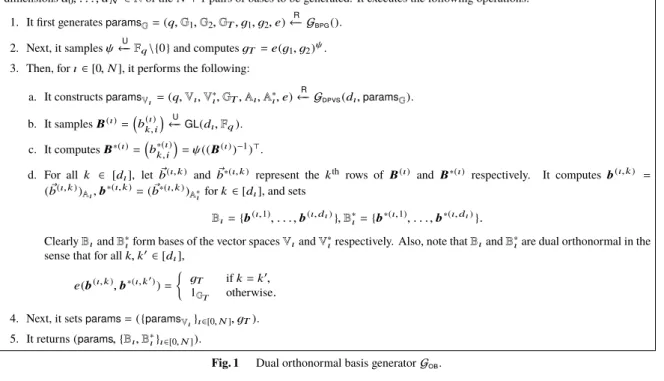
We now describe randomdual orthonormal basisgenerator Gob[37],[38]in Fig.1. This algorithm will be utilized as a sub-routine in ourABSconstruction.
2.4 Complexity Assumption
For realizing ourABSconstruction in asymmetric bilinear groups, we rely on the natural extension of the well-studied decisional linear (DLIN) assumption to the asymmetric bi- linear group setting, called the external decisional linear (XDLIN) assumption.
Assumption (External Decisional Linear: XDLIN [28], [39]): For ȷ ∈ [2], the XDLINȷ problem is to guess the bit Dβ ←U− {0,1} given ϱxdlinȷ
βD =
(paramsG, g1ϖ, g1Υ, g1ℵϖ, g1ςΥ, g2ϖ, g2Υ, g2ℵϖ, g2ςΥ,ℜȷ,
βD), where paramsG=(q,G1,G2,GT, g1, g2,e)←R− Gbpg();
ϖ,Υ,ℵ, ς, ε←U−Fq;
ℜȷ,0=g(ℵȷ +ς),ℜȷ,1=g(ℵȷ +ς)+ε.
TheXDLINȷassumption states that for anyPPTalgorithmS, for any security parameterλ, the advantage ofSin deciding theXDLINȷproblem, defined as
AdvXDLINS ȷ(λ)=
Pr
1←R− S(ϱXDLIN0 ȷ)
−
Pr
1←R− S(ϱXDLIN1 ȷ)
is negligible in λ, i.e., AdvXDLINS ȷ(λ) ≤ negl(λ), where neglis some negligible function. The simultaneousXDLIN (SXDLIN) assumption states that bothXDLIN1 andXDLIN2
assumptions hold at the same time. For any security parame- terλ, we denote the advantage of any probabilistic algorithm SagainstSXDLINasAdvSXDLINS (λ).
Indeed as noted in[28], for all ȷ∈[2], theXDLINȷassump- tion is equivalent to theDLINassumption in the groupGȷin the generic bilinear group model[40]. We now define some
Gob(N,(d0, . . .,dN)): This algorithm takes as input the unary encoded security parameter 1λ, a numberN ∈N, and the respective dimensionsd0, . . .,dN ∈Nof theN+1 pairs of bases to be generated. It executes the following operations:
1. It first generatesparamsG=(q,G1,G2,GT, g1, g2,e)←R− Gbpg(). 2. Next, it samplesψ←U−Fq\ {0}and computesgT =e(g1, g2)ψ. 3. Then, forı∈[0,N], it performs the following:
a. It constructsparamsVı=(q,Vı,V∗ı,GT,Aı,A∗ı,e)←R− Gdpvs(dı,paramsG). b. It samplesB(ı)=
bk,i(ı) U
←−GL(dı,Fq).
c. It computesB∗(ı)= b∗(ı)k,i
=ψ((B(ı))−1)⊤.
d. For all k ∈ [dı], let b⃗(ı,k) and ⃗b∗(ı,k) represent the kth rows of B(ı) and B∗(ı) respectively. It computes b(ı,k) = (b⃗(ı,k))Aı,b∗(ı,k)=(b⃗∗(ı,k))A∗ıfork∈[dı], and sets
Bı={b(ı,1), . . .,b(ı,dı)},B∗ı={b∗(ı,1), . . .,b∗(ı,dı)}.
ClearlyBıandB∗ıform bases of the vector spacesVıandV∗ırespectively. Also, note thatBıandB∗ıare dual orthonormal in the sense that for allk,k′∈[dı],
e(b(ı,k),b∗(ı,k′))=
( gT ifk=k′, 1GT otherwise. 4. Next, it setsparams=({paramsVı}ı∈[0,N], gT). 5. It returns(params,{Bı,B∗ı}ı∈[0,N]).
Fig. 1 Dual orthonormal basis generatorGob.
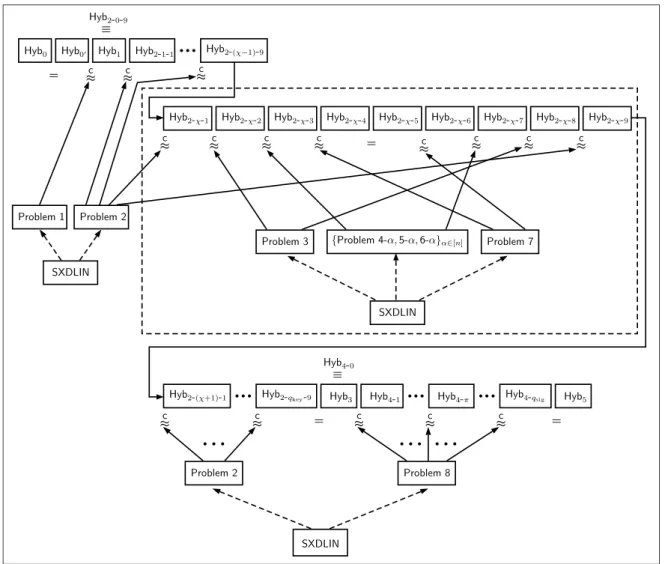
decisional problems. We will rely on the hardness of these decisional problems for deriving the unforgeability property of ourABSconstruction. The hardness of these decisional problems can be reduced to that of theSXDLINproblem, as shown in Lemmas3–8below.
Definition 5 (Problem 1): Problem 1 is to guess the bit βD ∈ {0,1} given ϱP1
βD = (params,{Bı,HB∗ı}ı∈[0,2], {e(α,ν,β)D}α∈[2],ν∈[2],f(0,β)D,{f(1,ν,β)D}ν∈[2]),where
(params,{Bı,B∗ı}ı∈[0,2])←R− Gob(2,(4,14,8));
HB∗0={b∗(0,1),b∗(0,3),b∗(0,4)};
HB∗1={b∗(1,1), . . . ,b∗(1,4),b∗(1,7),b∗(1,8),b∗(1,11), . . . , b∗(1,14)};
HB∗2={b∗(2,1),b∗(2,2),b∗(2,5), . . . ,b∗(2,8)}; δ, τ,{θν, θν′}ν∈[2], γ0←U−Fq,
{⃗γ(ν),⃗γ′(ν),⃗γ′′(ν)}ν∈[2]←U−F2q; e(1,ν,0)=(⃗04,⃗06,⃗02,⃗γ(ν))B1 e(1,ν,1)=(⃗04,⃗04, θν⃗e(2,ν),⃗02,⃗γ(ν))B1 e(2,ν,0)=(⃗02,⃗02,⃗02,⃗γ′(ν))B2 e(2,ν,1)=(⃗02, θν′e⃗(2,ν),⃗02,γ⃗′(ν))B2
forν∈[2];
f(0,0)=(δ,0,0, γ0)B0,f(0,1)=(δ, τ,0, γ0)B0; f(1,ν,0)=(⃗02, δ⃗e(2,ν),⃗06,⃗02,⃗γ′′(ν))B1 f(1,ν,1)=(⃗02, δ⃗e(2,ν), τ⃗e(2,ν),⃗04,⃗02,⃗γ′′(ν))B1
)for ν∈[2]. For any security parameterλ, the advantage of any proba- bilistic adversaryBin decidingProblem 1is defined as
AdvP1B(λ)=
Pr
1←R− B(ϱP10 )
−Pr
1←R− B(ϱP11 )
. Lemma 3: For any probabilistic algorithm B, there exist probabilistic algorithms S1 and S2, whose running times are essentially the same as that ofB, such that for any secu- rity parameterλ,AdvP1B(λ)≤ P
ν∈[2]AdvSXDLINSν (λ)+negl(λ), whereneglis some negligible function.
Proof: Observe thatProblem 1is analogous toProblem 1in [10],[21]. Thus, the proof of Lemma3is analogous to that
of Lemma 1 in[21]. ■
Definition 6 (Problem 2): Problem 2 is to guess the bit βD ∈ {0,1} given ϱP2
βD = (params,{HBı,Bı∗}ı∈[0,1],B2,B∗2, h∗(0,β)D,f(0),{h∗(1,ν,β)D,f(1,ν)}ν∈[2],{h∗(2,ν)}ν∈[2]),where
(params,{Bı,B∗ı}ı∈[0,2])←R− Gob(2,(4,14,8)); HB0 ={b(0,1),b(0,3),b(0,4)};
HB1 ={b(1,1), . . . ,b(1,4),b(1,7), . . . ,b(1,14)}; ϑ,<, δ, τ, ξ0 ←U−Fq,{ξ⃗(ν)}ν∈[2]←U−F2q; h∗(0,0)=(ϑ,0, ξ0,0)B∗
0,h∗(0,1)=(ϑ,<, ξ0,0)B∗
0; f(0)=(δ, τ,0,0)B0;
h∗(1,ν,0)=(⃗02, ϑ⃗e(2,ν),⃗06,ξ⃗(ν),⃗02)B∗
1
h∗(1,ν,1)=(⃗02, ϑ⃗e(2,ν),<⃗e(2,ν),⃗04,ξ⃗(ν),⃗02)B∗
1
f(1,ν)=(⃗02, δ⃗e(2,ν), τ⃗e(2,ν),⃗04,⃗02,⃗02)B1
forν∈[2];
h∗(2,ν)=ϑb∗(2,ν)forν∈[2].
For any security parameterλ, the advantage of any proba- bilistic adversaryBin decidingProblem 2is defined as
AdvP2B(λ)=
Pr
1←R− B(ϱP20 )
−Pr
1←R− B(ϱP21 )
. Lemma 4: For any probabilistic algorithmB, there exists a probabilistic algorithmS, whose running time is essentially the same as that ofB, such that for any security parameter λ,AdvP2B(λ)≤AdvSXDLINS (λ)+negl(λ), whereneglis some negligible function.
Proof: Observe thatProblem 2 is essentially the same as Basic Problem 2 in [41], [42]. Hence, Lemma4 can be proven in the same way as Lemma 35 in[42]. ■
Definition 7 (Problem 3): Problem 3 is to guess the bit Dβ ∈ {0,1} given ϱP3
βD = (params,{Bı,B∗ı}ı∈ {0,2},B1,HB∗1, {e(1,ν,β)D}ν∈[2]),where
(params,{Bı,B∗ı}ı∈[0,2])←R− Gob(2,(4,14,8)); HB∗1={b∗(1,1), . . . ,b∗(1,8),b∗(1,11), . . . ,b∗(1,14)}; {θν}ν∈[2]←U−Fq,{⃗γ(ν)}ν∈[2]←U−F2q;
e(1,ν,0)=(⃗04,⃗06,⃗02,⃗γ(ν))B1 e(1,ν,1)=(⃗04,⃗04, θν⃗e(2,ν),⃗02,⃗γ(ν))B1
)
forν∈[2]. For any security parameterλ, the advantage of any proba- bilistic adversaryBin decidingProblem 3is defined as
AdvP3B(λ)=
Pr
1←R− B(ϱP30 )
−Pr
1←R− B(ϱP31 )
.
Lemma 5: For any probabilistic algorithm B, there exist probabilistic algorithms S1 and S2, whose running times are essentially the same as that ofB, such that for any secu- rity parameterλ,AdvP3B(λ) ≤ P
ν∈[2]AdvSXDLINSν (λ)+negl(λ), whereneglis some negligible function.
Proof: Observe thatProblem 3 is similar to Problem 1 in [10],[21]. Thus, the proof of Lemma5is analogous to that
of Lemma 1 in[21]. ■
Definition 8 (Problem 4-α (α ∈ [n = p(λ)])): Prob- lem 4-α is to guess the bit βD ∈ {0,1} given ϱP4-α
βD = (params,{Bı,B∗ı}ı∈ {0,2},HB1,B∗1,f(0), {h∗(1,α,ν,β)D,f(1,ν),g(1,ν)}ν∈[2]),where
(params,{Bı,B∗ı}ı∈[0,2])←R− Gob(2,(4,14,8)); HB1={b(1,1), . . . ,b(1,6),b(1,11), . . . ,b(1,14)}; τ,{σ˘α,ν}ν∈[2],{θα,ν}ν∈[2]←U−Fq,{⃗ξ(α,ν)}ν∈[2]←U−F2q;
f(0)=(0, τ,0,0)B0;
h∗(1,α,ν,0)=(σ˘α,ν(1, α),⃗02,⃗06,⃗ξ(α,ν),⃗02)B∗
1
h∗(1,α,ν,1)=(σ˘α,ν(1, α),⃗02,−θα,ν⃗e(2,ν), θα,ν⃗e(2,ν),⃗02,ξ⃗(α,ν),⃗02)B∗
1
f(1,ν)=(⃗04, τ⃗e(2,ν), τ⃗e(2,ν),⃗02,⃗02,⃗02)B1 g(1,ν)=(⃗04,⃗04, τ⃗e(2,ν),⃗02,⃗02)B1
forν∈[2].
For any security parameter λ, for anyn = p(λ), where p is an arbitrary polynomial, for any α ∈ [n], the advantage of any probabilistic adversaryBin decidingProblem 4-αis defined as
AdvP4-B α(λ)=
Pr
1←R− B(ϱP4-0 α)
−Pr
1←R− B(ϱP4-1 α)
.
Lemma 6: For any probabilistic algorithmB, there exists a probabilistic algorithmS, whose running time is essentially the same as that ofB, such that for any security parameter λ and any n = p(λ), AdvP4-B α(λ) ≤ P
ν∈[2]AdvSXDLINSα-ν (λ) + negl(λ)for allα ∈ [n], whereSα-ν(·) =S(α, ν,·)for any α, ν∈N, andneglis some negligible function.
Proof: Observe that Problem 4-α is essentially the same as Basic Problem 3-p in [41],[42]. Hence, the proof of Lemma6is analogous to that of Lemma 36 in[42]. ■
Definition 9 (Problem 5-α (α ∈ [n = p(λ)])): Prob- lem 5-α is to guess the bit βD ∈ {0,1} given
ϱP5-α
βD = (params,{Bı,B∗ı}ı∈ {0,2},B1,HB∗1,h∗(0),{h∗(1,α,ν)}ν∈[2], {f(1,ι,ν,β)D}ι∈[n]\ {α},ν∈[2],{h˘∗(ν)}ν∈ {5,6,9,10}),where
(params,{Bı,B∗ı}ı∈[0,2])←R− Gob(2,(4,14,8)); HB∗1 ={b∗(1,1), . . . ,b∗(1,6),b∗(1,9), . . . ,b∗(1,14)};
<,{σ˘α,ν}ν∈[2],{µ˘ι,ν}ι∈[n]\ {α},ν∈[2]←U−Fq,{ξ⃗(α,ν)}ν∈[2], {⃗θ(ι,ν)}ι∈[n]\ {α},ν∈[2],{⃗γ(ι,ν)}ι∈[n]\ {α},ν∈[2]←U−F2q; h∗(0)=<b∗(0,2);
h∗(1,α,ν)=(σ˘α,ν(1, α),⃗02,⃗02,<⃗e(2,ν),⃗02,ξ⃗(α,ν),⃗02)B∗
1
forν∈[2];
f(1,ι,ν,0)=(µ˘ι,ν(ι,−1),⃗02,⃗06,⃗02,⃗γ(ι,ν))B1 f(1,ι,ν,1)=(µ˘ι,ν(ι,−1),⃗02,⃗02,⃗θ(ι,ν),⃗02,⃗02,
⃗γ(ι,ν))B1
forι∈[n]\{α}, ν∈[2];
h˘∗(ν)=<b∗(1,ν)forν∈ {5,6,9,10}.
For any security parameter λ, for anyn = p(λ), where p is an arbitrary polynomial, for any α ∈ [n], the advantage of any probabilistic adversaryBin decidingProblem 5-αis defined as
AdvP5-B α(λ)=
Pr
1←R− B(ϱP5-0 α)
−Pr
1←R− B(ϱP5-1 α)
.
Lemma 7: For any probabilistic algorithm B, there is a probabilistic algorithm S, whose running time is es- sentially the same as that of B, such that for any se- curity parameter λ and any n = p(λ), AdvP5-B α(λ) ≤
P
ι∈[n]\ {α},ν∈[2]AdvSXDLINSα-ι-ν (λ)+negl(λ)for allα∈[n], where Sα-ι-ν(·)=S(α, ι, ν,·)for anyα, ι, ν ∈Nandneglis some negligible function.
Proof: Observe thatProblem 5-αis essentially the same as