Journal of the Operations Research Society of Japan
Vo1.2l, No.2, June, 1978
THE BEHAVIOR OF SOME DESIGN FACTORS
IN A PARALLEL PRODUCTION LINE
Toshirou Iyama [wate University
(Received July 27, 1977; Revised December 22, 1977)
Abstract The effect of the various design factors on the production rate in a parallel line is discussed by a Markov model and the difference of the effect between parallel lines and series lines is represented. A simple and effective scale is proposed to evaluate the availability of a parallel line and the production rate of a parallel line is approximately estimated by the scale and the relation between the production rates and the buffer capacities in a series line.
1. Introduction
One of the difficult problems for industrial engineers is the design of production lines. When the line is for high volume products, the engineers must estimate particularly the obtainable maximum production rate. Therefore
the effects of ~arious design factors on the rate must be considered. Many papers have been published concerning such problems by Hunt [5], Hillier & Boling [3], [4] and others [1], [2], [6], but most of them discuss only about series lines and there remained many unsolved problems about paral-lel lines which are designed for line balancing or increasing the production rate.
In this paper we shall consider the fundamental effects of design factors in parallel lines and provide better insight into designing parallel lines. First the effects of buffer capacity and number of stations in each stage on the production rate are discussed and the effectiveness of parallel lines is represented especially by an imaginary buffer capacity. This imaginary ca-pacity is introduced to compare the availability of parallel line with that of series line and to show the effectiveness of parallel lines in a simple form. Secondly the effect of unbalanced operation times on the production rate is discussed. It is very difficult to design a perfect balanced line and an unbalanced line is designed in several cases. From this viewpoint, it
226
is inevitable to study this effect. We shall find out the optimal assignment of the mean operation time which yields the maximum production rate and the range of unbalance which yields the rate as high as or higher than the rate of a balanced line. Thus we educe if the bowl phenomina represented in the series line by Hillier & Boling [3] is also preserved in parallel lines.
2. Model and Formulation
The parallel line to be studied here consists of the buffer storages holding in-process works temporarily and thE! stages with some stations to ope-rate the work practically, as shown in Fig. 2.1. Each station in one stage has the same operation and operation rate, Then the line is defined by the number of stages, the numbers of stations in each stage, the interstage buffer capacities and the operation rates of stations in each stage, which are denotE!d by L, Si. Mj and ~ (i=1.2 .. ·.L; j = 1.2., .. ·• L-1), respectively. The operation rate
'Ai
is the reciprocal of the mean operation timeai
of the sta'"' tion in stagei.
r--,
,L-
~1_J
r=::J
Stage/1
,
r- - - - 1 I I I Station I "- __ .J , I0
"',
I Buffer Storage,
,
~3S~; L- _ _ ...I
-
Work Flow Fig. 2.1 Parallel production lineIn the special case in which we show the difference of the effectiveness between the parallel line and the series line, these two lines have to be compared under the condition that their desi.gn factors are the same, For this purpose, in Section 3 the production rate yi.elded by S of the series lines defined by the number of stages
L,
the interstage buffer capacity Ms and the operation rate of stage Asi is compared with the rate by the equivalent paral-lel line denoted by Si = S. Mj= SMs and Ai = Asi.Assume that there is always a supply of works ready to be operated at the first stage and there is an infinite buffer capacity just behind the last stage, so that idling due to lack of input works is never occurred in the first stage and blocking is never occurred in the last stage because of eject-ing a completed work from the stage. However the other stages except the last one must hold the completed work without beginning to operate next work, if the buffer space is not available and all the stations in the next stage are
228 T. /yama
in operating works. And assume that the variation of the operation time is described by an exponential distribution at each station and the operation times are mutually independent. This means that there is no breakdown at stations or, alternatively, downtime is included in the operation time and that the total time expended in the station to complete a work has an expo-nential distribution.
Now we formulate the parallel line by a Markov model. The states occurred in each station are W, 1- and B which denote the state in operating a work, in idling and in blocking respectively. Generally in a parallel line the priority of station must be interested, because the stage has
Si
stations and it is re-quired to decide in which station idling or blocking is occurred and released first. For example, when the two works are completed at the same time in the two stations of the first stage and the following buffer has only one work space, we must decide which work is ejected into the buffer and which work blocks the station. We adopt the random priority in the present model, since the stations in one stage have the same operation rate and the priority does not have any effect on the production rate.The state of the system for the parallel line in a steady state condition is defined by the numbers of stations being in
W, I
andB
respectively in each stage and the numbers of in-process works in each buffer storage.In a two-stage production line, the state probabilities of the system are represented by the following notations;
P(i I2
I
0)i stations in Stage I are in blocking, the others in Stages I and 2 in operating and Ml in-process works are in the buffer (1
f
if
Sl),all the stations in Stages I and 2 are in operating and m1
in-process works are in the buffer (0
f
m1f
M1 ),i stations in Stage 2 are in idling, the others in Stages I and 2 in operating and no in-process work is in the buffer (1 ~ i (;; S2).
In these notations, the affixed number to B and I denotes the stage number. The total number N of the states of the system is
(2.1)
In a three-stage production line, the state probabilities of the system are represented in the same way as follows;
P(iBl
I
Ml,m2) p(iB2I
ml,M2) P( iB l ..i
B2I
Ml .M2) P(WI
ml,m2) P( i I2I
0.m2) P(i I 3l ml,O) P(iI 2·jI3 10,0)P(iB l ,jI3
I
MbO) P(ihjB 2I
O,M2) 1 ~ if
SI , O f m2f
M2 1f
if
S2 0f
mlf
Ml 1 ~ if
SI 1f
jf
S2o
'-=
ml'-=
MI, 0f
m2f
M2 1f
if
S2 1f
if
S3 1f
if
S2 1f
if
SIo
f
m2f
Mzo
f
mlf
Ml 1f
jf
S3 1f
jf
S3In these notations the variables or constants after
"I"
denote the numbers of in-process works in the buffers between stages 1 and 2, and between stages 2 and 3. For example, P(iBlI
Ml,m2) means the state probability that i sta-tions in stage 1 are in blocking, all the other stasta-tions in stages 1, 2 and 3, Le. (SI-i)+
Sz +S3 stations, in operating a.nd Ml, m2 in-process works are in the buffers between stages 1 and 2, and between stages 2 and 3 respectively. The total number of the states of the system is(2.2)
Consider the steady state probability equations. These equations are given by the above state probabilities and the transition matrix. In a two-stage production line, they are
(2.3)
Sl/'lP(S2h
I
0)=
AzP((S2- 1 JIZI
0)(iA2+S1Al)P((Sz-iJIz 10) = SlAIP((/3z-i+1JI2 10) + (i+VAZ
((S2-VA2+S1Al)P(1Iz 10) = SlAIP(2h 0)
+
SzA2P(W 1 0 ) (S2AZ+SIAl)P(WI
0) = SlAIP(lIZ 0)+
SzAzP(WIv
(S2Az+SIAl)P(WI
ml) = SlAIP(WI
ml-1) + S2AzP(WI
ml+1)(1
f
mlf
Ml-l) (SZA2+S1Al)P(WI
Ml ) = SIAjP(WI
Ml -1) + SzAzP(lBlI
Mj )230 T. /yamJl
P((i+l)B1
I
M1 )S2A 2P(SlBl
I
Ml) = >'lP((Sl-l)BlI
M1 )Normalizing, so all state probabilities sum to one, gives the actual proba-bilities, and as a result the production rate
Rp
of the parallel line and the mean numberLq
of in-process works in the buffer are represented by(2.4) (2.5) where Ml SI L = L mlP(W
I
ml) + Ml L P(iBlI
Ml) q ml=l i=l K= [
+
1iT
1_(Sl<P/S2)M1+l 1-(SI<P/S2) 1 i! 1 i!i
(Sl<P) ), S2 • ]-1 ( _ )1-<PIn a three-stage production line, the steady state probability equations are given in the same way. However there are numerous states and it is very diffi-cult to solve the actual probabilities and the rate
Rp
in a general form. In this paper their numerical values are calculated by Gaussian Elimination Method to apply to the following study.3. The Effect of Buffer Storages
3.1
In a two-stage production line
We discuss what effects the buffer capac:ity and the number of stations have on the production rate and demonstrate the availability of paralleling. This availability and the effectiveness of paralleling are shown by the imagi-nary buffer capacity which is introduced to c:ompare the parallel line with the original series line.
Consider the parallel line which is desi.gned by paralleling S of the series lines. When each of them has the buffer capacity Ms, this parallel line is defined by Si=S and Mj=SMs , and the production rate Rp is from (2.4)
(3.1) where S-2 Rp = XS1'l L
i=1
S-l K = [ L i=O = [ 2 S-l + SA2 {l-lC Li=0
1_,,)SMS+1-~---l-·ep
(ep '"
1)(ep=1J.
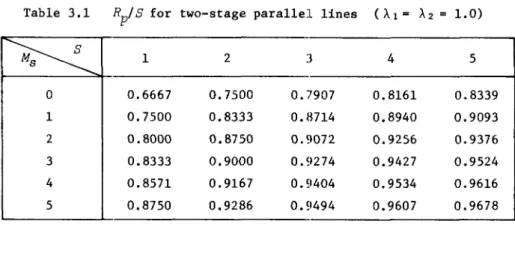
The values of the mean production rate per station Rp/S for various S and Ms are given in Table 3.1, where the values for S=l represent the production rates of the original series lines.
On the other hand, the production rate Rs of the series line is presented by Hunt [5] as follows;
Therefore the increase Mp/S of the production rate by paralleling is repre-sented by the difference between the mean production rate per station Rp/ Sand the production rate Rs of the original series line, and it is for the balanced line, i.e.
A1=A2,
232 (3.2) Ms+2 - A2
t:1+3
s T.lyama S! S-li
Ms(S-V-2+2 JJ z:: . ,-s-
i=O 'l-. S' S-li
(Ms+:3) (SMs+1+2 ~S z:: - . - , - )s-
i=O 'l-.Let us introduce the imaginary buffer capacity
MI
in order to evaluate the effectiveness of paralleling. The imaginary capacity is the capacity which is required to yield the same production rate RplS in the original series line, and by substituting Rpl8 to Hunt's equation we have1 Rp/S - 1..1 M = Log<jJ Log R /S - 1..2 - :3 I p S! S (S/<jJ)i 1 - (l-<jJ) (S/<jJ)S z::
.
,
_l_-Lo i=O 'l-. - 4 ] + SMs Log<jJ g S (S<jJ)i 1 -(l-1/<jJ)~
z::.
,
(3.3) (S<jJ)S i=O 'l-. 1..2 (<jJ ~ V M = - :3 I 1..2 - Rp/S[~-
S-l si=
2 1:.
,
- 1 ]+SMsi'
i=O 'l-. (<jJ = 1).These imaginary buffer eapacities are calculated for various Ms and
S,
and are represented in Table 3.2.Now we discuss the important results presented by the above equations. The most important one is that we can expect the increase of the production rate by paralleling. This is demonstrated by (3.2), since ~p
/S
is always positive forS~2.
The others are as follows. The production rate RplS of the parallel line monotonously increases as the buffer capacity Ms increases, but the increase of the rate is not so large as that in the series line and decreases as the number of stations S increases. And Rpl S also monotonously increases as S increases, and the increase of the rate becomes smaller as Ms increases. Therefore the effectiveness of paralleling is especially large and we can expect the availability of paralleling when the buffer capacity is small. The imaginary buffer capacity also suggests us useful facts and pre-sents the quatitative effect of paralleling in a simple form. First it isthat paralleling gives the higher production rate to each of the original series lines than the rate which is represented by the series line monopo-lizing the total buffer capacity SMs because the first term in square brackets in (3.3) is always positive for S~2. Second it is that the imaginary capaci-ty is estimated by the sum between SMs and the imaginary capacity for Ms = 0
because the first term in square brackets in (3.3) is independent of Ms.
Consequently the imaginary buffer capacity by paralleling is described simply as follows;
(3.4)
and only the imaginary buffer capacity for Ms = 0 must be solved to estimate
MI and as a result to estimate the production rate for various Ms and S. Thus we can use the imaginary buffer capacity as the scale to evaluate the
effec-tiveness of paralleling.
3.2 In a three-stage production line
Consider the three-stage parallel line which is designed by paralleling
S of the balanced series lines. When this parallel line has the operation rate
Ai = A
and the buffer capacity Mj=
M, the production rates Rp/S and the imaginary buffer capacities MI for various N' and S are shown in Tables 3.3 and 4. The imaginary capacity is calculated by applying the Hillier & Boling's numerical results for the three-stage series line [4] to Newton's forward in-terporation formula, since the exact formula for the production rate of the general three-stage series line has not been obtained and the approximate formula by Knott [6] is not appropriate to estimate the imaginary buffer ca-pacity within a small error.These results show that the effects of the buffer capacity M and the number of stations S are the same with the effects in the two-stage parallel line and that the effectiveness of paralleling can be expected in the three-stage line too. And as shown in Table 3.4 this effectiveness is that the each original series line can yield the higher production rate than the rate pre-sented by the series line monopolizing the buffer capacity
M.
Therefore it is the same with the effectiveness in the two-stage line. The effects of the buffer capacity and the number of stations on the imaginary buffer capacity are as follows. From the comparison between the imaginary capacities in Table 3.2 and 4, it is appeared that the imaginary capacity for the three-stage parallel line is a little smaller than the imaginary capacity for the two-stage parallel line if the buffer capacity is small and is almost equal to it if M~5. And these differences of the imaginary capacities are very small and234 T. /yama
only about 6% at most. Therefore we can educe that the imaginary capacity for the three-stage line is approximately equal to the imaginary capacity for the two-stage line and estimated by (3.3). This indicates that the effects of the buffer capacity and the number of stations on the imaginary buffer capacity are approximately the same with the effects in the two-stage line and are repre-sented by (3.4). Consequently the production rate of the three-stage parallel line is able to be estimated by (3.3) and the relation between the buffer ca-pacity and the production rate for the original three-stage series line within a small error. And at a same time it appears that the imaginary buffer capaci-ty for the parallel line with many stages becomes less dependent on the number of stages as the buffer capacity
M
increases. This result is important because the imaginary buffer capacity and the production rate for the parallel line with many stages and the large buffer capacity will be approximately estimated like the three-stage parallel line.4. Various Paralleling in a Two-Stage Production Line
When we consider line balancing under the situation that the operations assigned to the stations or the productivities of the stations are unequal, various parallel lines with unequal numbers of stations in each stage will be designed. In this section we study what effect the number of stations have on
the production rate in the basic two-stage parallel line and find out the opti-mal assignment of the stations which yields the maximum production rate under
the condition that the total number of stations assigned to the stages is constant.
Consider the parallel line which is defined by the numbers of stations
8i
and the buffer capacityMI. Then the production rate Rp for the balanced line in which each stage has the equal operation rate, i.e. Al 81 = A282 • is(401) 81- 1 8 Ii S2! 82-1 S2
i
~.
,
+ - - ~ + MI+1 ] -1 }.
S2.
,
i=O
-z.,. i=0 -z.,. 82This equation is given by substitution of <P
=
Ar/A2=
8 2 / SI into (2.4). And the imaginary buffer capacityMI
is from the above equation and Hunt's equation(4.2) +~-S I S2-1 L
S2.
i=O
S2
- 2 ] + Ml •
In this case the imaginary buffer capcity is the capacity which is required to yield the above production rate in the corresponding balanced series line with the same operation rate SlAl.
These equations show that Rp for the balanced parallel line with unequal numbers of stations in each stage is always higher than the production rate for the corresponding series line. This is demonstrated by the fact that the term in square brackets in (4.1) is always larger than Ml + J if S1 + S2
~3.
And these equations show that Rp is proportional to the operation rate of the stage like the series line and is independent of the operation rate of the station in each stage. The effect of the number of stations on the production rate is appeared by the imaginary buffer capacity. First
MI
is the symmetrical and monotone increasing function with respect to SI and S2. Therefore the change of the stages has no effect on the production rate and the increase of the numbers of stations always increases the production rate. This suggests us that installing the higher productive machines may decrease the production rate because it decreases the number of stations. SecondMI
is the function of the numbers of stations and the buffer capacity, and is estimated by the sum be-tween the buffer capacity Ml and the imaginary capacity for Ml=
O.
And as shown in (4.2) the numbers of stations SI and 32 have the independent effect on the imaginary buffer capacity in the same functional form. ConsequentlyMI
is estimated by the imaginary capacity for Ml=
0 and 32=
1, the imaginary ca-pacity for Ml=
a
and 31=
1, and the buffer capacity M1 , and is represented by(4.3)
- 1 ] + - 1 ]
+
M1 •Now find out the optimal assignment of the stations. This problem is dis'-cussed under the balancing condition, Le. A ISl = A232, and S1
+
32 = constant. From (4.3) it is appeared that the first and the second term in square brackets are monotone increasing functions with respect to 31 and 32 respectively andopti'-236
mal assignment is given by
(4.4) S2 2 C
T.lyama
HC
even numberodd number
where C is the total number of stations and
[C/2]
is the integral part ofC/2.
From this it is c.oncluded that the maximum production rate can be ob-tained by balancing the number of stations in each stage. However it is also appeared from (4.3) that the total number of stations and the way of assignment have the large effect on the production rate if Ml is small but have little effect if Ml is large.5. The Effect of Unbalanced Operation Times
5.1
In a two-stage production 1 ine
One of the important design factors in a parallel line is the mean opera-tion time and this factor will have particularly large effect when the un-balanced line is designe!d. In this section we shall discuss what effect the unba1ance of the mean operation times has on the production rate. This is dis-cussed under the condition that Si
=
S, Mj=
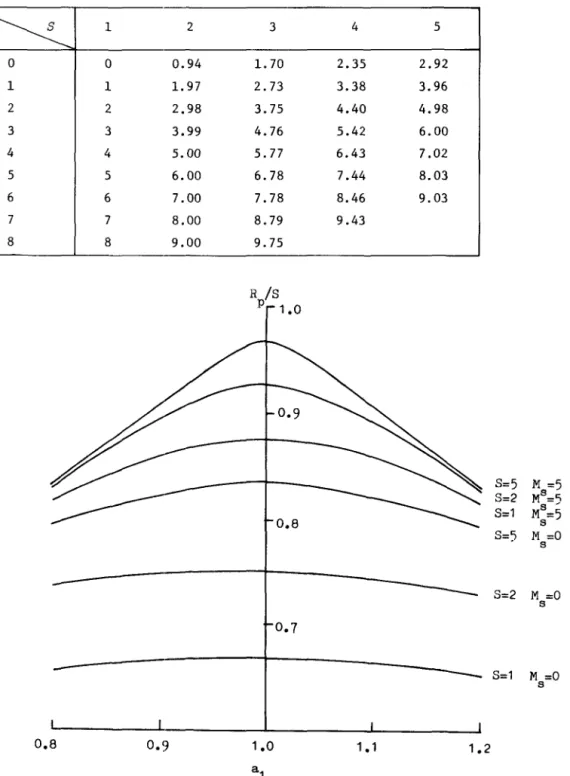
SMs and a l +a2= constant in order to find out the optimal assignment of the total mean operation time.The effect of unbalanced operation times in the parallel line is immedi-ately derived from (3.1). The various representative results for the unbal-anced parallel lines and the comparison of the effects between the series lines and the parallel lines are shown in Fig. 5.1.
This figure appears that the effect of unbalanced operation times is the same with the effect in the series line, i.e. the mean operation times of the stations in each stage al and a2 have the symmetrical effect on the production
rate and the rate is maximized when the line is balanced. This symmetrical effect is also demonstrated directly from (3.1). Furthermore it is appeared that the decrease of the production rate Rp / S by unbalancing is promoted as
S and Ms increase. This indicates that as S and Ms increase the effect of idling and blocking by the variation of the operation time is reduced and the production rate is importantly affected by the slowest mean operation time. Therefore, if S and Ms are large, the unbalanced assignment must be avoided in the parallel line.
5.2 In a three-stage production line
The effect of unbalanced operation times is remarkably appeared in a three-stage parallel line. In this case we study it under the condition that
Si =
s,
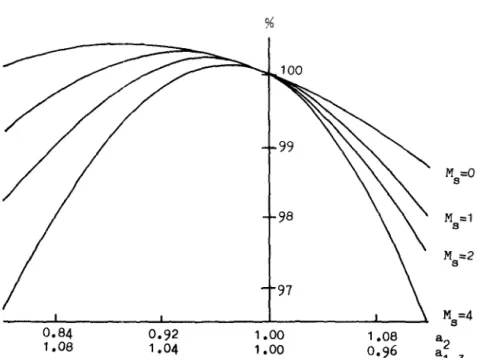
Mj = SMa and a1 + a2 + a3 = constant 0The various representative results for a1 + a2 + a3=3.0 are shown in Fig.s S.2'V 4. In these figures the production rates Rp / S for the unbalanced line are represented by the ratios to the rate for the balanced line and the mean operation times to be assigned to the stations in stage i and j are represented by ai and ajo Fig. 5.2 shows the relation between the stage where the minimum operation time is assigned and the production rate, and appears where the mini-mum operation time should be assigned to yield the maximini-mum production rate. In
this case the production rate Rp/S are also presented in Table 5.1. Fig.s 5.3 and 4 show what effect the buffer capacity Ms and the number of stations Shave on the production rate Rp/ S in the unbalanced parallel line.
These results demonstrate that the unbalanced parallel line can yield the higher production rate than the rate of the balanced parallel line and that the maximum rate is obtained by assigning a little smaller mean operation time to the stations in the middle stage of the line than to the stations on the both ends. Consequently there is some range of unba1ance which can yield the pro-duction rate as high as or higher than the rate of the balanced line and there is flexibility in assigning the total operation time. In other words the un-balanced line instead of the un-balanced line may be designed in the above range of unba1ance if balancing is very difficult. As shown in Table 5.1 the effect of the mean operation times a1 and a3 is as follows. These mean times a1 and a3 have not the symmetrical effect on the production rate RplS unlike the series line presented by Hillier & Bo1ing [3] and have a little different ef·-fect, but this difference is very small so that we can consider that a1 and <13 have almost the symmetrical effect on Rp/S. The effect of the buffer capacity
Ms and the numbE!r of stations S is that as Ms or S increases the maximum pro-duction rate by unba1ancing approaches the rate of the balanced line and the range of unba1ance which can yield the rate no less than the rate of the ba1·-anced line is narrowed. And the production rate sharply decreases as the un·-balance increases. Therefore the availability of unba1ancing can not be ob-tained and unbalancing of the parallel 1in'~ should be avoided when the buffer capacity and the number of stations are large. This appears that the variation of the operation time is absorbed by the buffer storages and the maximum mean operation time becomes the primary limitation on the production rate. The same thing is appeared about the increase of th,~ number of stations, since the in--crease of the number of stations imaginarily have the same effect as increasing
238 T./yama
the buffer capacity.
These effects are the same with the effects presented in the series line by Hillier & Boling and it is concluded that the bowl phenomina is preserved in the parallel line.
6. Conclusion
We have discussed the effects of various design factors in the parallel lines by a Markov model. The important conclusion is that the production rate in the parallel lines is estimated by the imaginary buffer capacity and the production rate of the series lines and that the bowl phenomina represented in the series line is preserved in the parallel line too.
However there remained many unsolved problems for the large scale parallel lines and the network lines. These problems are important for the industrial engineers and will be a subject for near future research.
Acknowledge
The auther sincerely thanks Prof. Ko Sato, Assistant Prof. T. Teshima and Dr. Ro Setoguchi of Tohoku University for their helpful advices and encourage-ment.
Table 3.1 Rp/ S for two-stage parallel lines ( Al
=
1..2=
1. 0)~
1 2 :I 4 5 0 0.6667 0.7500 0.7907 0.8161 0.8339 1 0.7500 0.8333 0.8714 0.8940 0.9093 2 0.8000 0.8750 0.9072 0.9256 0.9376 3 0.8333 0.9000 0.9274 0.9427 0.9524 4 0.8571 0.9167 0.9404 0.9534 0.9616 5 0.8750 0.9286 0.9494 0.9607 0.9678Table 3.2
MI
for two-stage parallel lines (AI=
1.. 2)~
1 2 :3 4 5 0 0 1 1. i'78 2.438 3.021 1 1 3 4.n8 6.438 8.021 2 2 5 7. n8 10.438 13.021 3 3 7, 10.n8 14.438 18.021 4 4 9 13.n8 18.438 23.021 5 5 11 16. n8 22.438 28.021Table 3.3 Rp/ S for three-stage parallel lines ( Al
=
1..2=
1..3=
1. 0)~
1 2 3 4 5 0 0.5641 0.6657 0.7176 0.7505 0.7739 1 0.6705 0.7323 0.7666 0.7895 0.8063 2 0.7340 0.7761 0.8006 0.8176 0.8304 3 0.7767 0.8072 0.8258 0.8389 0.8490 4 0.8075 0.8307 0.8452 0.8557 0.8639 5 0.8308 0.8490 0.8607 0.8693 0.8760 6 0.8490 0.8637 0.8733 0.8805 0.8861 7 0.8637 0.8758 0.8838 0.8899 8 0.8757 0.8859 0.8927240 T. /yama
Table 3.4 MI for three-stage parallel lines (A 1 = A z = A 3)
~
1 2 3 4 5 0 0 0.94 1. 70 2.35 2.92 1 1 1. 97 2.73 3.38 3.96 2 2 2.98 3.75 4.40 4.98 3 3 3.99 4.76 5.42 6.00 4 4 5.00 5.77 6.43 7.02 5 5 6.00 6.78 7.44 8.03 6 6 7.00 7.78 8.46 9.03 7 7 8.00 8.79 9.43 8 8 9.00 9.75R /S
p 1.0 8=5 S=2 S=1 0.8 S=5-
S=2 0.7-
S=1 0.8 1 .1 1.2Fig. 5.1 RplS for two·-stage unbalanced series lines and parallel lines
(al + az
=
2. 0) M =5 MS=" MS=5 s M =0 s M =0 S M =0 s0.84 1.08 0.92 1.04
%
1.00 1.00 101 1.08 0.96 i=1, j=2,3 h3, j=1,2 i=2, j=1,3 a. 1 a. JFig. 5.2 Rpl3 for three-stage unbalanced parallel lines without buffer
(3 = 2, Ms = 0)
Table 5.1 Rp/3 for three-stage unbalanced parallel lines without buffer
(3 = 2, Ms = 0)
Mean Operation Rp/3 Percent Rp/S Percent Rp/3 Percent Times ai a· J i = 2 j = 1,3 i = 1 j = 2,3 i = 3 j = 1,2 1. 08 0.96 0.6606 99.2 0.6657 100.0 0.6655 100.0 1.04 0.98 0.6635 99.7 0.6662 100.1 0.6661 100.1 1.00 1.00 0.6657 100.0 0.6657 100.0 0.6657 100.0 0.96 1.02 0.6672 100.2 0.6643 99.8 0.6643 99.8 0.92 1.04 0.6680 100.3 0.6618 99.4 0.6620 99.4 0.88 1.06 0.6681 100.4 0.6585 98.9 0.6587 98.9 0.84 1.08 0.6675 100.3 0.6543 98.3 0.6545 98.3 0.80 1.10 0.6661 100.1 0.6494 97.6 0.6496 97.6
242 0.84 1.08 0.92 1.04 T. Iyama q! , a 1.00 1.00 M =0 s M =1 s M ==2 s
Fig. 5.3 The effect of Ms for three-stage unbalanced parallel lines
(8
=
2)---8=1 - -
-:::::;::=~_
0.84 1.08 0.92 1.0497
1.00 1.00 1.08 0.96S=4
Fig. 5.4 The effect of 8 for three-stage unbalanced parallel lines
Referencl~s
(1) Anderson, D. R. and Moodie, C. L., Opt1"-mal Buffer Storage Capacity in
Production Line System, International Journal of Production Research,
7, 3 (1969), 233-240.
(2) Barten, K. A., A Queueing Simulator fOl' Determining Optimum Inventory
Levels in a Sequential Process, Journal of Industrial Engineering, 3, 4
(1962), 245-252.
(3) Hillier, F. S. and Boling, R. W., The Effects of Some Design Factors on
the Efficiency of Production Lines with Variable Operation Times, Journal.
of Industrial Engineering, 17, 12 (1966), 651-658.
(4) Hillier, F. S. and Boling, R. W., Finit;e Queues in Series with
Exponen-tial or Erlang Service Times - A Numeri:cal Approach, Operations Research,
15, 2 (1967), 286-303.
[5) Hunt, G. C., Sequential Arrays of WaiUng Lines, Operations Research, 4, 6 (1956), 674-683.
(6) Knott, A. D., The Inefficiency of a Se:r'ies of Work Stations - A Simple
Formula, International Journal of Production Research, 8, 2 (1970),
109-119.
[7) Wild, R. and Slack, N. D., The Operating Characteristics of 'Single' and
'Double' Non - Mechanical Flow Line System, International Joruna1 of
Production Research, 11, 2 (1973), 139-·145.
Toshirou IYAMA
Department of Mechanical Engineering
n,
Faculty -of Engineering, Iwate University, 4-3-5, Ueda, Morioka 020, Japan