Obstructions to deforming curves on a 3-fold, II:
Deformations of degenerate curves on a del Pezzo 3-fold
Hirokazu Nasu
∗Abstract
We study the Hilbert scheme HilbscV of smooth connected curves on a smooth
del Pezzo 3-fold V . We prove that every degenerate curve C, i.e. every curve con-tained in a smooth hyperplane section S of V , does not deform to a non-degenerate curve if the following two conditions are satisfied: (i) χ(V, IC(S)) ≥ 1 and (ii) for every line ` on S such that ` ∩ C = ∅, the normal bundle N`/V is trivial (i.e. N`/V ' OP1⊕2). As a consequence, we prove an analogue (for HilbscV ) of
a conjecture of J.O. Kleppe which is concerned with non-reduced components of the Hilbert scheme HilbscP3 of curves in the 3-dimensional projective space P3.
1
Introduction
This paper is a sequel to a joint work [7] with Shigeru Mukai. In [7] the embedded deformations of smooth curves C on a smooth projective 3-fold V have been studied under the presence of a smooth surface S such that C ⊂ S ⊂ V , especially when V is a uniruled 3-fold. In this paper, the same subject is studied in detail especially when V is a del Pezzo 3-fold.
It is known that even if the deformations of C ⊂ S and S ⊂ V behave well, those of
C ⊂ V behave badly in general. For example, even if Hilb V and Hilb S are nonsingular
of expected dimension χ(NS/V) and χ(NC/S) at [S] and [C] respectively, Hilb V can be
generically non-reduced along some component passing through [C] (cf. Mumford’s ex-ample in [8]). Such a non-reduced component of the Hilbert scheme HilbscV of smooth
connected curves on V has been constructed for many uniruled 3-folds V in [7]. The non-reducedness is originated from the non-surjectivity of the restriction map
H0(S, NS/V) |C −→ H0(C, NS/V ¯ ¯ C). (1.1)
∗Supported in part by the 21-st century COE program “Formation of an International Center of
If (1.1) is surjective, then C is stably degenerate, i.e. every (small) deformation of C in
V is contained in a divisor S0 of V which is algebraically equivalent to S. If moreover
Hilb V and Hilb S are respectively nonsingular at [S] and [C], then so is Hilb V at [C]. In this paper, we study the behavior of the deformation of C in V to answer the following problem raised by Mukai:
Problem 1.1. Suppose that (1.1) is not surjective and χ(V, IC(S)) > 0. Then (1) Is C stably degenerate? (2) Is HilbscV singular at [C]?
J. O. Kleppe [6] and Ph. Ellia [1] considered this problem for the case where V is the 3-dimensional projective space P3, S ⊂ P3 is a smooth cubic surface and C is a smooth
connected curve on S. Kleppe gave a conjecture (cf. Conjectures 5.1), which can be reformulated as follows:
Conjecture 1.2. Let C ⊂ S ⊂ P3 be as above and assume that χ(P3, IC(3)) ≥ 1. If C
is linearly normal, then every (small) deformation C0 ⊂ P3 of C is contained in a cubic
surface S0 ⊂ P3, i.e. C is stably degenerate.
As a testing ground of his conjecture, we consider Problem 1.1 for the case where V is a smooth del Pezzo 3-fold of degree n (cf. §2.2) and S is a smooth polarization of V (i.e. a smooth hyperplane section of V when n ≥ 3) and C is a smooth connected curve on S. The following theorem is an analogue of Kleppe’s conjecture.
Theorem 1.3 (Main). Let C ⊂ S ⊂ V be as above and assume that χ(V, IC(S)) ≥ 1. If every line ` on S such that C ∩ ` = ∅ is a good line on V (i.e. the normal bundle N`/V of ` in V is trivial), then:
(1) C is stably degenerate, and
(2) HilbscV is nonsingular at [C] if and only if H1(V, I
C(S)) = 0.
Let d and g be the degree (= (C · S)V) and genus of C, respectively. Then the
condition χ(V, IC(S)) ≥ 1 is equivalent to g ≥ d − n. If g < d − n, then it follows from
a dimension count that C is not stably degenerate (Remark 4.3). If some ` is a bad line on V (i.e. N`/V 6' OP1⊕2) then C is not necessarily stably degenerate (Proposition 5.4).
If g ≥ 2, then the dimension of HilbscV at [C] is equal to d + g + n, while its tangential
dimension at [C] is equal to d + g + n + h1(V, I
C(S)). As a corollary to Theorem 1.3,
we give a sufficient condition for a maximal family W of degenerate curves on V to be an irreducible component of the Hilbert scheme HilbscV and decide whether HilbscV is
generically non-reduced along W or not (Theorem 4.8).
One of the main tools used in this paper is the infinitesimal analysis of the Hilbert scheme developed in [7]. As is well known, every first order infinitesimal deformation ˜C
of C ⊂ V determines a global section α ∈ H0(N
C/V) and a cohomology class ob(α) ∈ H1(N
C/V) (called the obstruction) such that ˜C lifts to a deformation over Spec k[t]/(t3)
if and only if ob(α) = 0 (cf. §2.3). Let πS : NC/V → NS/V
¯ ¯
C be a natural projection of
normal bundles. In [7] Mukai and Nasu studied the exterior component of α and ob(α), i.e. the images of α and ob(α) by the induced maps Hi(π
S) : Hi(NC/V) → Hi(NS/V
¯ ¯
C)
(i = 0, 1), respectively. They showed that if the exterior component of α lifts to a global section v ∈ H0(N
S/V(E))\H0(NS/V) for some curve E on S, then that of ob(α) is nonzero
provided that certain additional conditions on E, C and v hold (cf. [7, Theorem 1.6]). Such a rational section v of NS/V admitting a pole along E is called an infinitesimal deformation with a pole. In §3 we see that an infinitesimal deformation with a pole induces
an obstructed infinitesimal deformation of S◦ := S \ E in V◦ := V \ E (Theorem 3.1). By
virtue of this obstruction, we prove the main theorem in §4. In §5 we give some examples of generically non-reduced components of the Hilbert scheme of curves on a del Pezzo 3-fold as an application.
Acknowledgements I should like to express my sincere gratitude to Professor Shigeru Mukai. He showed me the example of non-reduced components of the Hilbert scheme of canonical curves given in §5.2 as a simplification of Mumford’s example of a non-reduced component of HilbscP3. This led me to research the topic of this paper. Throughout
the research, he made many suggestions which are useful for obtaining and improving the proofs. In particular, according to his suggestion, the deformation theory of an open surface in an open 3-fold is organized in §3 to improve the crucial part of the proof of Proposition 4.6. I am grateful to Professor Jan Oddvar Kleppe for giving me useful comments about the Hilbert-flag scheme, one of which helped me to correct a mistake in the proof of the main theorem.
Notation and Conventions For a given closed subscheme X ⊂ V of a scheme V , we denote by IX the ideal sheaf of X in V and denote by NX/V the normal bundle (IX/IX2)∨
of X in V . For a sheaf F on V , we denote the restriction map Hi(V, F) → Hi(X, F¯¯ X)
by ¯¯X. We denote the Euler-Poincar´e characteristic of F by χ(V, F) or χ(F). HilbscV
denotes the subscheme of the Hilbert scheme Hilb V whose point corresponds to a smooth connected curve on V . We work over an algebraically closed field k of characteristic 0.
2
Preliminaries
2.1
Del Pezzo surfaces
A del Pezzo surface is a smooth surface S with ample anti-canonical divisor h := −KS.
Except for P1× P1, every del Pezzo surface can be realized as a blow-up of P2 at fewer
than 9 points. We denote the blow-up of P2 at (9 − n)-points by S
n. A (−1)-P1 on Sn is
called a line. We obtain a del Pezzo surface Sn by blowing down a line from Sn−1.
Lemma 2.1. Let D be a divisor on a del Pezzo surface S. If D is nef and χ(−D) ≥ 0,
then H1(S, −D) = 0.
Proof. If D is big (i.e. D2 > 0), then it follows from the Kawamata-Viehweg vanishing
theorem. Hence we assume that D is not big. If S = Sn, then D is a multiple mq
(m ≥ 0) of conic q (i.e. q ∼ (1; 1, 0, . . . , 0) under a suitable blow-up Sn → P2). By the
Riemann-Roch theorem, we have
χ(−D) = 1
2(−mq) · (−mq + h) + χ(OS) = −m + 1,
since q2 = 0 and q · h = 2. Thus we have m = 0 or 1 by assumption. This implies
H1(−mq) = 0. If S = P1× P1, then D is of bidegree (m, 0) or (0, m) with m ≥ 0. Again
by the Riemann-Roch theorem, we have χ(−D) = −m + 1 ≥ 0. Thus H1(O
P1×P1(−D)) =
0.
Lemma 2.2. Let D be an effective divisor on a del Pezzo surface S. Then the lines `
such that D · ` < 0 are mutually disjoint. Moreover the fixed part Bs |D| of |D| is equal to
− X
D·`<0
(D · `)`.
Proof. It is clear that a line ` satisfying D · ` < 0 is contained in Bs |D|. On the other
hand, every irreducible curve C on S except for a line can move on S since χ(C) ≥ 2 and
H2(C) = 0. Therefore the linear system |D| is decomposed into the sum
|D| = |D0| + k
X
i=1
mi`i, (mi > 0)
of a linear system |D0| without base components and union of lines `
1, . . . , `k. If `i∩`j 6= ∅,
then |`i+ `j| can move by χ(`i + `j) = 2. Thus `i’s are mutually disjoint. Since mi =
(D0 − D) · `
we have (D0)2 ≥ 0. Moreover, since −K
S is ample, D0− KS is nef and big, Thus we have H1(D0) = H1((D0− K
S) + KS) = 0. If D0· `i ≥ 1, then it follows from the exact sequence
0 −→ OS(D0) −→ OS(D0+ `i) −→ OS(D0 + `i) ¯ ¯ `i −→ 0 that h0(D0 + ` i) > h0(D0).
Lemma 2.3. Let S be a del Pezzo surface and let ε : S → F be the blow-down of m lines
(i.e. (−1)-P1’s) `i (1 ≤ i ≤ m) from S. If a divisor D on F satisfies h0(F, D) ≥ m, then
we have h0(S, ε∗D − m X i=1 `i) = h0(F, D) − m. Proof. Put Dj := ε∗D − P
1≤i≤j`i. Since the images of `i on F are points, we have h0(D
j) ≥ h0(D) − j for every 1 ≤ j ≤ m. Moreover since Dj−1· `j = 0, Lemma 2.2 shows
that `j is not contained in Bs |Dj−1|. Hence dim |Dj| decreases one by one and we have h0(D
m) = h0(D) − m.
Let C be a smooth curve of degree d and genus g > 0 on S. We consider the restriction of the anti-canonical linear system | − KS| on S to C. The restriction map H0(−KS) → H0(−K
S
¯ ¯
C) is not surjective in general. We define an effective divisor E on S to be the
sum of all lines Ei (1 ≤ i ≤ m) on S such that Ei∩ C = ∅. We put E = 0 if there exists
no such line Ei.
Proposition 2.4. If g ≥ d − n, then the restriction map
H0(S, −K S + E)) |C −→ H0(C, −K S ¯ ¯ C) (2.1) is surjective.
Proof. It suffices to show that H1(−K
S+ E − C) = 0 by the exact sequence
0 −→ OS(−KS+ E − C) −→ OS(−KS+ E) −→ OS(−KS)
¯ ¯
C −→ 0.
Claim. D := C + KS− E is nef.
Since S is regular (i.e. H1(K
S) = 0), the restriction map
¯ ¯
C : H
0(C + K
S) → H0(KC)
is surjective. Since g > 0 by assumption, the linear system |C + KS| on S is non-empty.
Let l be a line on S. Since C is not a line, C is nef. Therefore we have C · ` ≥ 0 and hence (C + KS) · ` ≥ −1. If ` is contained in Bs |C + KS|, then by Lemma 2.2, ` is disjoint to C and hence coincides with some Ei. Thus we have E = Bs |C + KS| and |D| does not
have base components. In particular, D is nef.
By the Riemann-Roch theorem, we have χ(−D) = g − d + n + m ≥ 0, where m ≥ 0 is the number of lines Ei. By Lemma 2.1, we have H1(−D) = 0.
Remark 2.5. If C is not elliptic, then the map (2.1) is an isomorphism. Indeed, since
KC 6∼ 0, we have C + KS 6∼ E by adjunction. Hence D 6∼ 0 and H0(−D) = 0.
Lemma 2.6. If C is not elliptic and g ≥ d − n, then the restriction map
H0(S, C + 2KS− 2E) |E −→ H0(E, (C + 2KS− 2E) ¯ ¯ E) is surjective.
Proof. Let ε : S → F be the blow-down of E from S. Then C + 2KS − 2E is a pull
back ε∗D of a divisor D on F . By the Riemann-Roch theorem, we have χ(S, ε∗D) = g − d + n + m ≥ m. Since (KS − ε∗D) · C = (−KS − C) · C = 2 − 2g < 0, we have H2(S, ε∗D) ' H0(S, K
S − ε∗D)∨ = 0. Hence h0(F, D) = h0(S, ε∗D) ≥ χ(S, ε∗D) ≥ m.
Consider the exact sequence
0 −→ OS(ε∗D − E) −→ OS(ε∗D) −→ OE −→ 0.
Since h0(ε∗D)−h0(ε∗D−E) = h0(O
E) by Lemma 2.3, the restriction map is surjective.
Let S be a smooth projective surface and let L be a line bundle on S.
Lemma 2.7. Let E be a disjoint union of irreducible curves Ei (i = 1, . . . , m) on S with E2
i < 0 and let ι : S◦ := S \ E ,→ S be the open immersion. If deg(L
¯ ¯
Ei) ≤ 0 for every i,
then the map
H1(S, L) → H1(S◦, L¯¯ S◦)
induced by the sheaf inclusion L ,→ L ⊗ ι∗OS◦ is injective.
The proof is similar to that of [7, Lemma 2.3] and we omit it here. Lemma 2.7 allows us to identify H1(S, L(nE)) (n ≥ 0) with their images in H1(S◦, L¯¯
S◦). As a result, under
the identification we obtain a natural filtration
H1(S, L) ⊂ H1(S, L(E)) ⊂ H1(S, L(2E)) ⊂ · · · ⊂ H1(S◦, L¯¯ S◦)
on H1(S◦, L¯¯ S◦).
2.2
Del Pezzo threefolds
A del Pezzo threefold is a pair (V, H) consisting of a (smooth) irreducible projective variety
V of dimension 3 and an ample Cartier divisor H on V such that −KV = 2H. Here H is
called the polarization of V and sometimes omitted. The self-intersection number n := H3
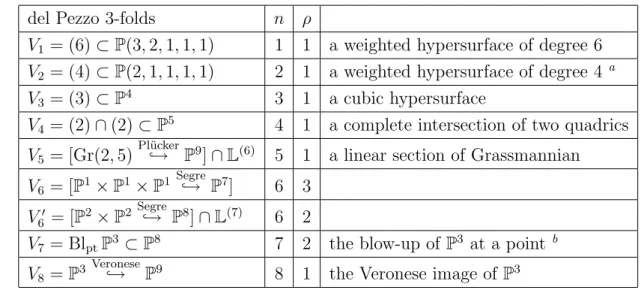
is called the degree of V . It is known that the linear system |H| on V determines a double cover ϕ|H| : V → P3 if n = 2, and an embedding ϕ|H| : V ,→ Pn+1 if n ≥ 3. If S is a
Table 1: Del Pezzo 3-folds del Pezzo 3-folds n ρ
V1 = (6) ⊂ P(3, 2, 1, 1, 1) 1 1 a weighted hypersurface of degree 6
V2 = (4) ⊂ P(2, 1, 1, 1, 1) 2 1 a weighted hypersurface of degree 4a
V3 = (3) ⊂ P4 3 1 a cubic hypersurface
V4 = (2) ∩ (2) ⊂ P5 4 1 a complete intersection of two quadrics
V5 = [Gr(2, 5) Pl¨ucker
,→ P9] ∩ L(6) 5 1 a linear section of Grassmannian
V6 = [P1× P1× P1 Segre,→ P7] 6 3
V0
6 = [P2× P2 Segre,→ P8] ∩ L(7) 6 2
V7 = BlptP3 ⊂ P8 7 2 the blow-up of P3 at a point b
V8 = P3 Veronese,→ P9 8 1 the Veronese image of P3
aAnother realization of V2is a double cover of P3branched along a quartic surface.
bV
7 is realized as the projection of V8⊂ P9 from one of its point.
smooth member of |H|, then the pair (S, H¯¯S) is a del Pezzo surface of degree n. Every smooth del Pezzo 3-fold is one of Vn (1 ≤ n ≤ 8) or V60 in Table 1, in which L(i) denotes a
linear subspace of dimension i, and n and ρ respectively denote the degree and the Picard number of Vn (and of V60) (cf. [2],[3],[4]). It is known that a smooth 3-fold V ⊂ Pn+1
(n ≥ 3) is a del Pezzo 3-fold of degree n if a linear section [V ⊂ Pn+1] ∩ H
1∩ H2 with two
general hyperplanes H1, H2 ⊂ Pn+1 is an elliptic normal curve in Pn−1.
We briefly review the basics of the Hilbert scheme of lines on a del Pezzo 3-fold. We refer to Iskovskih ([4],[5]) for the detail. Let (V, H) be a smooth del Pezzo 3-fold of degree n. By a line on (V, H), we mean a reduced irreducible curve ` on V such that (` · H)V = 1 and ` ' P1. If n ≤ 7 then V contains a line `. Then there are only the
following possibilities for the normal bundle of ` in V :
(0,0): N`/V ' OP1⊕2, · · · (good line) (1,-1): (2,-2): (3,-3): N`/V ' OP1(−1) ⊕ OP1(1), N`/V ' OP1(−2) ⊕ OP1(2) (only if n = 1 or 2), N`/V ' OP1(−3) ⊕ OP1(3) (only if n = 1). (bad line)
The Hilbert scheme Γ of lines on V is called the Fano surface of V , and in fact every irreducible (non-embedded) component of Γ is of dimension two. Let Γi ⊂ Γ be an
have a natural diagram. Si p −−−→ V y π Γi.
By [5, Chap.III, Proposition 1.3], if n ≥ 3 then either (a) or (b) holds:
(a) p is surjective; in this case a general line in Γi is a good line;
(b) p(Si) ' P2 is a plane on V ⊂ Pn+1; in this case every line in Γi is a bad line.
The proof works fine for the case n ≤ 2 as well∗. If n 6= 7 then every irreducible
component of Γ is of type (a). If n = 7 then Γ consists of two irreducible components Γi ' P2(i = 0, 1), one of which satisfies (a) and the other satisfies (b). Therefore there
exists a good line on V if n 6= 8.
Lemma 2.8. Let (V, H) be a smooth del Pezzo 3-fold of degree n and let S be a general
member of |H|. If n 6= 7 then S does not contain a bad line. If n = 7 then S contains three lines, one of which is bad, while the others are good.
Proof. There exists no line on V8. If n 6= 7, then the locus B of bad lines in the Fano
surface Γ is of dimension one. Let pi denote the projection of
©
(`, S)¯¯ ` ⊂ Sª⊂ Γ × |H|
to the i-th factor. Since the fiber of p1 is of dimension n − 1, p2(p−11 (B)) is a proper closed
subset of |H| ' Pn+1. Hence every general member S ∈ |H| contains no bad line.
Suppose that V = V7. Then S is a del Pezzo surface S7 and isomorphic to a blow-up
of P2 at two distinct points. Hence there are three lines (i.e. three (−1)-P1’s) `
0, `1, `2 on
S forming the configuration in Figure 1:
Here `0 is distinguished by the fact that it intersects both of the other lines. Recall
that V7 is isomorphic to the blown-up of P3 at a point. Then the exceptional divisor
P ' P2 is a unique plane on V
7 and `0 is exactly the intersection of S with P (cf. [5,
Chap II, §1.4]). Since N`0/P ' OP1(1), `0 is a bad line on V7. On the other hand, `1 and
`2 are good lines on V7 since S is general.
∗Indeed, they assume n ≥ 3 only for showing the existence of smooth hyperplane section S of V which
contains l. Then there exists an exact sequence
0 −→ OP1(−1) −→ N`/V −→ OP1(1) −→ 0.
`1 `2
`0
Figure 1: (−1)-P1’s on S 7
2.3
Infinitesimal deformations and obstructions
Let V be a smooth variety and X ⊂ V a smooth closed subvariety. An (embedded) first
order infinitesimal deformation of X ⊂ V is a closed subscheme ˜X ⊂ V × Spec k[t]/(t2)
which is flat over Spec k[t]/(t2) and whose central fiber is X ⊂ V . It is well known
that there exists a one to one correspondence between the group of homomorphisms
α : IX → OX and the first order infinitesimal deformations ˜X of X ⊂ V . In what follows,
we identify ˜X with α and abuse the notation. The standard exact sequence
0 −→ IX −→ OV −→ OX −→ 0 (2.2)
induces δ : Hom(IX, OX) → Ext1(IX, IX) as a coboundary map. Then α ∈ Hom(IX, OX)
(i.e. ˜X) lifts to a deformation over Spec k[t]/(t3) if and only if
ob(α) := δ(α) ∪ α ∈ Ext1(I
X, OX)
is zero, where ∪ is the cup product map
Ext1(IX, IX) × Hom(IX, OX)−→ Ext∪ 1(IX, OX).
Then ob(α) is called the obstruction of α (i.e. ˜X). Since both X and V are smooth, ob(α)
is contained in H1(N
X/V) ⊂ Ext1(IX, OX).
Since Hom(IX, OX) ' H0(NX/V), we regard α as a global section of NX/V from now
on. If X is a hypersurface of V , then ob(α) becomes a simpler cup product.
Lemma 2.9. Let X be a smooth hypersurface of V . Let †
dX : H0(X, NX/V) −→ H1(X, OX) (2.3)
be the composite map of the coboundary map δ : H0(N
X/V) → H1(OV) of the exact sequence (2.2)⊗OV(X) and the restriction map
¯ ¯
X : H
1(O
V) → H1(OX). Then ob(α) is equal to the cup product dX(α) ∪ α, where ∪ is the cup product map
H1(X, O
X) × H0(X, NX/V)−→ H∪ 1(X, NX/V).
†The map d
Proof. Since IX ' OV(−X) is a line bundle on V , we have Exti(IX, OX) ' Hi(NX/V)
(i = 0, 1) and Ext1(IX, IX) ' H1(OV). Hence the coboundary map δ appearing in the
definition of ob(α) is a map from H0(N
X/V) to H1(OV). Since α is a cohomology class
on X, the cup product map H1(O
V) → H1(NX/V) with α factors through the restriction
map ¯¯X.
We introduce the exterior component defined in [7]. Let Y be a smooth hypersurface of V containing X. Then the natural projection πY : NX/V → NY /V
¯ ¯
X ' OX(Y ) of
normal bundles induces the maps Hi(π
Y) of their cohomology groups for i = 0, 1.
Definition 2.10. We denote the images H0(π
Y)(α) and H1(πY)(ob(α)) by πY(α) and
obY(α), respectively and call them the exterior component of α and ob(α) (with respect
to Y ).
3
Infinitesimal deformations with a pole
Let V be a smooth projective 3-fold, S a smooth surface in V , E a smooth curve on S. We put V◦ := V \ E and S◦ := S \ E, the complemental open subvarieties. We study the first
order infinitesimal deformations of S◦ ⊂ V◦ when the self-intersection number of E on S
is negative. We are interested in a rational section v of NS/V having a pole only along E and of order one, that is, v ∈ H0(N
S/V(E)) \ H0(NS/V). Let ι : S◦ ,→ S be the open
immersion. Then ι∗OS◦ contains OS(nE) as a subsheaf for any n ≥ 0. Hence the natural
sheaf injection NS/V(nE) ,→ ι∗NS◦/V◦ induces H0(S, NS/V(nE)) ,→ H0(S◦, NS◦/V◦) for
each n. In particular, v determines a first order infinitesimal deformation of S◦ ⊂ V◦.
The main theorem of this section is the following.
Theorem 3.1. Assume that E2 < 0 and det N
E/V :=
V2
NE/V is trivial. If the exact sequence
0 −→ NE/S −→ NE/V −→ NS/V
¯ ¯
E −→ 0 (3.1)
does not split, then the first order infinitesimal deformation of S◦ ⊂ V◦ determined by v does not lift to a deformation over Spec k[t]/(t3).
We identify H0(N
S/V(nE)) with its image in H0(NS◦/V◦) from now on. We shall
show that the obstruction ob(v) ∈ H1(N
S◦/V◦) of v ∈ H0(NS◦/V◦) is nonzero. By
Lemma 2.9, ob(v) is equal to the cup product of dS◦(v) ∈ H1(OS◦) with v. A natural
injection OS(2E) ,→ ι∗OS◦ of sheaves on S induces a map H1(S, OS(2E)) → H1(S◦, OS◦)
of cohomology groups. Since deg OE(2E) < 0, this is injective by Lemma 2.7.
Sim-ilarly there exists a natural injection from H1(S, N
S/V(3E)) to H1(S◦, NS◦/V◦), since
deg NS/V(3E)
¯ ¯
E = deg(det NE/V)+2E
2 = 2E2 < 0. From now on we identify H1(O
and H1(N
S/V(3E)) with their images in H1(OS◦) and H1(NS◦/V◦), respectively. Then by
[7, Proposition 2.4 (1)], we have
dS◦(H0(NS/V(E))) ⊂ H1(OS(2E)).
Hence by the commutative diagram,
H1(O
S◦) × H0(NS◦/V◦) −→∪ H1(NS◦/V◦)
S S S
H1(O
S(2E)) × H0(NS/V(E)) −→ H∪ 1(NS/V(3E)),
the image of H0(N
S/V(E)) by ob is contained in H1(NS/V(3E)).
The following lemma is essential to the proof of Theorem 3.1. Lemma 3.2 ([7, Proposition 2.4 (2)]). Let v ∈ H0(N
S/V(E)) and let dS◦(v)
¯ ¯
E ∈ H
1(O
E(2E)) be the restriction of dS◦(v) ∈ H1(OS(2E)) to E. Then we have dS◦(v)
¯ ¯ E = ∂(v ¯ ¯ E) in H1(O E(2E)), where ∂ : H0(NS/V(E) ¯ ¯ E) −→ H 1(O
E(2E)) ' H1(NE/S(E)) is the coboundary map of the exact sequence (3.1)⊗OS(E).
Proof of Theorem 3.1. It suffices to show that the restriction ob(v)¯¯E ∈ H1(N
S/V(3E)
¯ ¯
E)
of ob(v) ∈ H1(N
S/V(3E)) to E is nonzero. By the definition of v, we have v
¯ ¯ E 6= 0 in H0(N S/V(E) ¯ ¯ E). Here NS/V(E) ¯ ¯
E ' det NE/V is trivial. Since (3.1) does not split by
assumption, we have ∂(v¯¯E) 6= 0. Hence by Lemma 3.2, we conclude that
ob(v)¯¯E = dS◦(v) ¯ ¯ E ∪ v ¯ ¯ E = ∂(v ¯ ¯ E) ∪ v ¯ ¯ E 6= 0. If E is a (−1)-P1 on S with det N
E/V ' OP1, then the exact sequence (3.1) does not
split if and only if NE/V is trivial.
Example 3.3. Let E be a good line on a smooth cubic 3-fold V3 (i.e. NE/V3 is trivial.
cf. §2.2). Let S3 ⊃ E be a smooth hyperplane section of V3 and let ε : S3 → S4 be the
blow-down of E from S3. Since NS3/V3 ' −KS3 and NS3/V3(E) ' ε
∗(−K
S4), NS3/V3(E)
has one more global section than NS3/V3. Thus there exists an obstructed infinitesimal
deformation of S◦
3 ⊂ V3◦ by Theorem 3.1.
In the rest of this section, we discuss a generalization of Theorem 3.1, which will be used for the proof of the main theorem. Let E be a disjoint union of smooth irreducible curves Ei (i = 1, . . . , m) on S such that Ei2 < 0 and det NEi/V is trivial. By the same
compute the obstruction map ob : H0(N
S◦/V◦) → H1(NS◦/V◦). Then Lemma 2.7 allows
us to regard H1(O
S(2E)) and H1(NS/V(3E)) as subgroups of H1(OS◦) and H1(NS◦/V◦),
respectively. Then an argument similar to [7, Proposition 2.4 (1)] shows that the image of
H0(N
S/V(E)) by dS◦ is contained in H1(OS(2E)) and hence its image by ob is contained
in H1(N
S/V(3E)). Moreover, we have
ob(v + v0)¯¯ E = ob(v) ¯ ¯ E in H1(N S/V(3E) ¯ ¯
E) for any v ∈ H0(NS/V(E)) and v0 ∈ H0(NS/V). Indeed it follows from
the definition of dS◦ that dS◦(v0) ∈ H1(OS) and hence
ob(v + v0) = (d S◦(v) + dS◦(v0)) ∪ (v + v0) = ob(v) + dS◦(v) ∪ v0+ dS◦(v0) ∪ v + dS◦(v0) ∪ v0 | {z } contained in H1(N S/V(2E)) .
Therefore the obstruction map ob induces a map
ob : H0(NS/V(E)) ± H0(NS/V) −→ H1(NS/V(3E) ¯ ¯ E). Proposition 3.4. If H1(N
S/V) = 0 and the exact sequence
0 −→ NEi/S −→ NEi/V −→ NS/V
¯ ¯
Ei −→ 0 (3.2)
does not split for every i, then ob is injective.
This is an immediate consequence of the next lemma.
Lemma 3.5. Under the assumption of Proposition 3.4, ob is equivalent to the quadratic
map
km −→ kn, (a
1, . . . , am) 7−→ (a21, . . . , a2m, 0, . . . , 0) of diagonal type, where n = dim H1(N
S/V(3E)
¯ ¯
E). Proof. Since H1(N
S/V) = 0, the source of ob is isomorphic to H0(NS/V(E)
¯ ¯
E). Moreover
there exist global sections vi of NS/V(Ei) such that vi
¯ ¯ E 6= 0 in H0(NS/V(Ei) ¯ ¯ Ei) for all
i. Since Ei’s are mutually disjoint, we have NS/V(E)
¯ ¯ E ' Lm i=1NS/V(Ei) ¯ ¯ Ei ' Lm i=1OEi.
Then there exists a commutative diagram 0 → H0(N S/V) → H0(NS/V(E)) → H0(NS/V(E) ¯ ¯ E) → 0 x a1 x a2 x a3 0 → LiH0(N S/V) → L iH0(NS/V(Ei)) → L iH0(NS/V(Ei) ¯ ¯ Ei) → 0,
where ai (1 ≤ i ≤ 3) are defined by addition. Since a1 and a3 are surjective, so is a2.
Hence every element v ∈ H0(N
S/V(E)) is written as a k-linear combination
Pm
vi ∈ H0(NS/V(Ei)) and the expression is unique modulo H0(NS/V). By the commutative
diagram
H1(O
S(2E)) × H0(NS/V(E)) −→∪ H1(NS/V(3E))
y |E y |E y |E L iH1(OEi(2Ei)) × L iH0(NS/V(Ei) ¯ ¯ Ei) ∪ −→ LiH1(N S/V(3Ei) ¯ ¯ Ei), we have ob(v)¯¯E = (dS◦(v) ∪ v) ¯ ¯ E = dS◦(v) ¯ ¯ E∪ v ¯ ¯ E = X i c2idS◦(vi) ¯ ¯ Ei ∪ vi ¯ ¯ Ei. By Lemma 3.2, dS◦(vi) ¯ ¯ Ei is equal to ∂i(v ¯ ¯ Ei) in H 1(O
Ei(2Ei)), where ∂iis the coboundary
map of (3.2). Since (3.2) does not split by assumption, we have ∂i(v
¯ ¯ Ei) 6= 0 and hence dS◦(vi) ¯ ¯
Ei 6= 0 for any i. As a result {dS◦(vi)
¯ ¯ Ei ∪ vi ¯ ¯ Ei, 1 ≤ i ≤ m} is a sub-basis of H1(N S/V(3E) ¯ ¯ E).
We get the following corollary to Proposition 3.4.
Corollary 3.6. Let Ei (i = 1, . . . , m) be mutually disjoint (−1)-P1’s on S such that NEi/V ' OP1
⊕2. If H1(N
S/V) = 0, then ob is injective.
4
Obstructions to deforming curves
The purpose of this section is to prove the main theorem. Let C ⊂ S ⊂ V be a sequence of a smooth projective 3-fold V , a smooth surface S, and a smooth curve C.
4.1
S-maximal family and S-normality
In this subsection, we recall the definition of the S-maximal family introduced in [7, §3.2]. Let US be an irreducible component of Hilb V passing through [S] and let
V × US ⊃ S p2
−→ US
be the universal family of US. Assume that H1(NS/V) = H1(NC/S) = 0, that is, Hilb V
and HilbscS are nonsingular of expected dimensions χ(NS/V) and χ(NC/S) at [S] and [C],
respectively. Then the Hilbert scheme HilbscS, which is the same as the relative Hilbert
scheme of S/US or the Hilbert-flag scheme introduced in [6, §2], is nonsingular at [C].
Let WS,C be the irreducible component of HilbscS passing through [C]. The projection p1 : S → V induces a natural morphism HilbscS → HilbscV . We call the image of WS,C
in HilbscV the S-maximal family of curves containing C and denote it by WS,C. If the
then the answer to the first question of Problem 1.1 is affirmative. By [7, Lemma 3.3] the cokernel (resp. kernel) of the tangential map
κ[C]: tWS,C = H
0(N
C/S) −→ H0(NC/V) (4.1)
of the morphism pr1 at [C] is isomorphic to that of the restriction map (1.1). In what
follows, we use the following convention. Definition 4.1. Let C ⊂ S ⊂ V be as above.
(1) C is said to be stably degenerate if every (small) deformation of C in V is contained in a divisor S0 alg.∼ S of V
(2) C is said to be S-normal if the restriction map (1.1) is surjective.
If C is S-normal, then pr1 is surjective in a neighborhood of [C] and hence C is stably
degenerate. Then HilbscV is nonsingular at [C] as well.
4.2
Deformation of curves on a del Pezzo 3-fold
In what follows, we assume that V is a smooth del Pezzo 3-fold of degree n with polariza-tion H, S is a smooth member of |H| and C is a smooth connected curve on S of degree
d and genus g. Since −KV ∼ 2S, by adjunction we have NS/V = OS(S) ' −KS and NC/S ' −KS
¯ ¯
C + KC. Since −KS is ample, we have H
1(N
S/V) = H1(NC/S) = 0 and
hence Hilb V and Hilb S are nonsingular of expected dimension χ(NS/V) and χ(NC/S) at
[S] and [C], respectively. A natural exact sequence
0 −→ NC/S −→ NC/V πS −→ NS/V ¯ ¯ C −→ 0 (4.2)
of normal bundles induces an isomorphism
H1(N
C/V) ' H1(NS/V
¯ ¯
C). (4.3)
Since IS(S) ' OV and V is del Pezzo, we have Hi(IS(S)) = 0 for i = 1, 2. Hence the
exact sequence
[0 −→ IS −→ IC −→ OS(−C) −→ 0] ⊗ OV(S) (4.4)
on V shows that
H1(V, I
C(S)) ' H1(S, NS/V(−C)), (4.5)
where the right hand side is isomorphic to the cokernel of the restriction map (1.1) since
H1(N
S/V) = 0. Therefore C is S-normal if and only if H1(V, IC(S)) = 0.
The dimension of the S-maximal family WS,C of curves containing C can be computed
Lemma 4.2. If g ≥ 2 or d ≥ n + 1, then we have the following:
(a) the natural morphism pr1 : WS,C → HilbscV is a closed embedding;
(b) dim WS,C = d + g + n.
Proof. (a) The proof is similar to that of [6, Remark 9]. By assumption, we have (−KS − C) · C = 2 − 2g < 0 or (−KS − C) · (−KS) = n − d < 0. Since both C
and −KS are nef, we have H0(NS/V(−C)) = H0(−KS − C) = 0. Similarly we have H0(N
S0/V(−C0)) = 0 for any member (C0, S0) of WS,C. This implies that S0 is the unique
member of |H| containing C0. Hence the map pr
1 is injective. Moreover, since the
restriction map ¯¯C0 : H0(NS0/V) → H0(NS0/V
¯ ¯
C0) is injective, so is the tangential map κ[C0]
of pr1 at [(C0, S0)] in (4.1).
(b) By the Riemann-Roch theorem, we have dim |OS0(C0)| = d + g − 1 for general
member (C0, S0) of W
S,C. Since WS,C is birationally equivalent to Pd+g−1-bundle over an
open subset of |H| ' Pn+1, the dimension of W
S,C is equal to d + g + n. Hence we obtain
dim WS,C = d + g + n by (a).
We denote by Hilbsc
d,gV the open and closed subscheme of HilbscV of curves of degree d and genus g. It is well known that the dimension of every irreducible component of
Hilbsc
d,gV is greater than or equal to the expected dimension χ(NC/V) = (−KV · C)V = 2d.
Remark 4.3. If g < d − n then C is not stably degenerate. In other words, there exists a deformation C0 ⊂ V of C not contained in any hyperplane section of V . Indeed we have
dim WS,C ≤ dim WS,C = d + g + n < 2d. Hence there exists an irreducible component W0 ⊃ WS,C of HilbscV such that dim W0 > dim WS,C. By the definition of W
S,C, this
implies the existence of such C0.
4.3
Stably degenerate curves
We devote this section to the proof of Theorem 1.3. Throughout this section, we assume that χ(V, IC(S)) ≥ 1, which is equivalent to g ≥ d − n.
Lemma 4.4. If H1(N
S/V
¯ ¯
C) = 0 then C is S-normal. Proof. It suffices to show that H1(N
S/V(−C)) = 0 by the exact sequence
0 −→ NS/V(−C) −→ NS/V −→ NS/V ¯ ¯ C −→ 0. Since H2(N S/V) ' H2(−KS) = 0 and H1(NS/V ¯ ¯ C) = 0, we obtain H2(NS/V(−C)) = 0.
Then by (4.4), we have an inequality
0 ≤ χ(V, IC(S)) − 1 = χ(NS/V(−C))
= h0(N
Therefore if H0(N
S/V(−C)) = 0, then H1(NS/V(−C)) = 0. Thus we may assume that H0(N
S/V(−C)) 6= 0. Then there exists an effective divisor D on S such that NS/V(−C) ' OS(D). If D = 0, then H1(NS/V(−C)) = 0. Suppose that D 6= 0. Let h be a general
member of | − KS|. Then h is a smooth elliptic curve on S. Since −KS is ample, we have
deg OS(D) ¯ ¯ h = D · (−KS) > 0 and hence H 1(O S(D) ¯ ¯ h) = 0. Since C is connected, we
obtain H1(D − h) ' H1(−C) = 0 from the exact sequence 0 → O
S(−C) → OS → OC →
0. Therefore it follows from the exact sequence
0 −→ OS(D − h) −→ OS(D) −→ OS(D) ¯ ¯ h −→ 0 that H1(N S/V(−C)) ' H1(D) = 0.
In particular if C is rational (g = 0) or elliptic (g = 1) then C is S-normal, because we have H1(N S/V ¯ ¯ C) ' H1(−KS ¯ ¯
C) = 0 in these two cases.
Let E1, . . . , Em be lines on S disjoint to C and define a divisor E on S as in
Proposi-tion 2.4. If C is not S-normal, then E is responsible for the abnormality. Proposition 4.5. (i) The restriction map
H0(N S/V(E)) |C −→ H0(N S/V ¯ ¯ C) (4.6) is surjective.
(ii) Assume that g ≥ 2. Then C is S-normal if and only if there exists no line ` such
that C ∩ ` = ∅ (i.e. E = 0). Proof. (i) If H1(N
S/V
¯ ¯
C) = 0 then we have the assertion by Lemma 4.4. If H
1(N
S/V
¯ ¯
C) 6=
0 then we have g ≥ 2 and obtain the assertion from Proposition 2.4.
(ii) The ‘if’ part follows from (i). We prove the ‘only if’ part. Suppose that there exist such lines on S. Let ε : S → F be the blow-down of E from S. Then F is also a del Pezzo surface and ε∗(−K
F) = −KS + E. Since deg F > deg S, we have h0(−K
F) > h0(−KS). Hence it follows from NS/V ' −KS that NS/V(E) has more global
sections than NS/V. Since g ≥ 2, the map (4.6) is an isomorphism by Remark 2.5 and
hence we have h0(N S/V ¯ ¯ C) = h 0(N
S/V(E)) > H0(NS/V). Therefore C is not S-normal.
Let WS,C be the S-maximal family of curves containing C and let κ[C] : tWS,C →
H0(N
C/V) be the map (4.1).
Proposition 4.6. Suppose that C is not S-normal. If every Ei is a good line on V , then the obstruction ob(α) is nonzero for any α ∈ H0(N
C/V) \ im κ[C].
Proof. We prove that the exterior component obS(α) of ob(α) is nonzero (cf.
steps. Here we only sketch the proof of each step and refer to [7] for the further detail, especially for the proof of the two equalities (4.7) and (4.9) of cup products. The first step shows that obS(α) is computed from the exterior component πS(α) of α.
Step 1 By Proposition 4.5 (i), there exists a global section v of NS/V(E) whose
restric-tion v¯¯C ∈ H0(N
S/V
¯ ¯
C) coincides with πS(α). Let dS◦ : H
0(N
S◦/V◦) → H1(OS◦) be the
map (2.3) for S◦ ⊂ V◦. As we saw in §3, the image d
S(v) := dS◦(v) for v ∈ H0(NS/V(E))
is contained in H1(O
S(2E)) ⊂ H1(OS◦). Then we have
obS(α) = dS(v) ¯ ¯ C ∪ πS(α), (4.7) where dS(v) ¯ ¯
C ∈ H1(OC) is the restriction of dS(v) ∈ H1(OS(2E)) to C and ∪ is the cup
product map H1(O C) ⊗ H0(NS/V ¯ ¯ C) ∪ −→ H1(N S/V ¯ ¯ C).
The second step relates obS(α) to ob(v) = dS(v) ∪ v ∈ H1(NS/V(3E)) ⊂ H1(NS◦/V◦)
for v ∈ H0(N
S/V(E)), which has been computed in the latter half of §3.
Step 2 Let kC and kE be the extension classes of the two exact sequences
0 → OS(−C) → OS → OC → 0 and 0 → OS(−E) → OS → OE → 0 (4.8)
on S, respectively. Then we obtain two cup product maps
H1(N S/V ¯ ¯ C) ∪ kC −−→ H2(N
S/V(2E − C)) and H1(NS/V(3E)
¯ ¯ E) ∪ kE −−→ H2(N S/V(2E − C)),
which are the coboundary maps of (4.8) tensored with some suitable line bundles on S. Moreover, the following equation of cup products in H1(N
S/V(2E − C)) holds: obS(α) ∪ kC = dS(v) ¯ ¯ E ∪ v ¯ ¯ E ∪ kE. (4.9)
Here the cup product dS(v)
¯ ¯ E∪ v ¯ ¯ E ∈ H 1(N S/V(3E) ¯ ¯
E) is clearly equal to the restriction
ob(v)¯¯E ∈ H1(N
S/V(3E)
¯ ¯
E) of ob(v) to E.
The final step shows that obS(α) 6= 0.
Step 3 Since α 6∈ im κ[C], v ∈ H0(NS/V(E)) does not belong to H0(NS/V). Since every NEi/V is trivial bundle on Ei ' P
1 by assumption, by virtue of Corollary 3.6, we have
ob(v)¯¯E = ob(v¯¯E) 6= 0 in H1(N
S/V(3E)
¯ ¯
E). Note that the cup product map H1(E, N S/V(3E) ¯ ¯ E) ∪ kE −−→ H2(S, N S/V(2E − C))
is injective. Indeed since NS/V ' −KS this map is exactly the Serre dual of the restriction
map H0(S, C + 2K S− 2E) |E −→ H0(E, (C + 2K S − 2E) ¯ ¯ E),
which is surjective by Lemma 2.6. Hence the right hand side of (4.9) is nonzero and we obtain that obS(α) 6= 0 in H1(NS/V
¯ ¯
Proof of Theorem 1.3. If C is S-normal then C is clearly stably degenerate and HilbscV is nonsingular at [C]. Suppose that C is not S-normal. Then by Proposition 4.6,
every first order infinitesimal deformation of C ⊂ V does not lift to a deformation over Spec k[t]/(t3) except for the ones realized as a member of W
S,C. This implies that HilbscV
is singular at [C] and moreover every small deformation of C in V is contained WS,C.
Therefore C is stably degenerate. Since C is S-normal if and only if H1(V, I
C(S)) = 0 by
(4.5), the proof of Theorem 1.3 is completed.
Remark of Theorem 1.3
(1) If n 6= 7 and S is a general member of |H|, then by Lemma 2.8, every line on S is a good line on V . Hence every curve C on S is stably degenerate by the theorem. If
n = 7 then there exists a non-stably degenerate curve C on V7 which is contained
in a general member S of |H| (cf. Proposition 5.4).
(2) There exists no line on V8. Hence if n = 8, then the assumption of the theorem
concerning lines ` on S such that C ∩ ` = ∅ is empty. In fact, every curve C on
V8 ' P3 is S-normal, provided that g ≥ d − 8 and hence stably degenerate. This
coincides with the result obtained in [9, Appendix] for curves on a smooth quadric surface Q2 ' P1× P1 in P3.
The following proposition is more practical than Proportion 4.6 in showing the singu-larity of HilbscV at [C].
Proposition 4.7. Suppose that g ≥ 2. If there exists a good line ` on V such that ` ⊂ S
and C ∩ ` = ∅, then HilbscV is singular at [C].
The proofs of Proposition 4.6 and Proposition 4.7 are very similar. Take a global section v ∈ H0(N
S/V(`)) \ H0(NS/V) and put α ∈ H0(NC/V) as a lift of v
¯ ¯
C ∈ H
0(N
S/V)
by the surjective map πS : H0(NC/V) ³ H0(NS/V
¯ ¯
C). Then it is enough to show that
obS(α) 6= 0 in H1(NS/V ¯ ¯ C) by reducing it to ob(v) ¯ ¯
` 6= 0 as in the proof of Proposition 4.6.
We omit the detail.
The following is an analogue of Conjecture 5.1 due to Kleppe and Ellia.
Theorem 4.8. Let C be the curve in Theorem 1.3. Then the S-maximal family WS,C ⊂
HilbscV containing [C] is an irreducible component of (HilbscV )
red. Then HilbscV is generically smooth along WS,C if H1(V, IC(S)) = 0, and generically non-reduced along WS,C otherwise.
Proof. The first part follows from Theorem 1.3. (In fact, we proved that every small
irreducible closed subset of HilbscV .) Now we prove the second part. Let C0 be a general
member of WS,C. Then C0 is contained in a smooth surface S0 ∼ S in V . Since C0
is general, S0 is a general member of |H|. Suppose that C is S-normal. Then since
(C0, S0) is a generalization of (C, S), we have H1(I
C0(S0)) = H1(IC(S)) = 0 by the upper
semicontinuity. Therefore C0 is S0-normal. Hence HilbscV is nonsingular at [C0] and
hence generically smooth along WS,C.
Suppose that C is not S-normal. Then Lemma 4.4 shows that H1(N
S/V
¯ ¯
C) 6= 0 and
hence g ≥ 2. By Proposition 4.5 (ii), there exists a line ` on S such that C ∩ ` = ∅. Since
H1(O
S) = 0, the Picard group of S does not change under smooth deformation and hence
Pic S ' Pic S0. Since H1(O
S(`)) = 0, the line ` is deformed to a line `0 on S0. We have C0∩ `0 = ∅. Moreover since ` is a good line, so is `0. Hence HilbscV is singular at [C0] by
Proposition 4.7. Since C0 is a general member of W
S,C, HilbscV is everywhere singular
along WS,C and hence generically non-reduced along WS,C.
5
Original motivation and examples
5.1
Kleppe’s conjecture
The original motivation of the present work was to show the following conjecture due to Kleppe. We denote by Hilbscd,gP3 the open and closed subscheme of HilbscP3 consisting of
curves of degree d and genus g.
Conjecture 5.1 (Kleppe, Ellia). Let W be a maximal irreducible closed subset of Hilbscd,gP3
whose general member C is contained in a smooth cubic surface. If d ≥ 14, g ≥ 3d − 18, H1(P3, I
C(3)) 6= 0 and H1(P3, IC(1)) = 0, then W is a component of (HilbscP3)
red and HilbscP3 is generically non-reduced along W .
In the original conjecture [6, Conjecture 4] of Kleppe, the assumption of the linearly normality of C (i.e. H1(P3, I
C(1)) = 0) was missing. However Ellia [1] pointed out that
the conjecture does not hold for linearly non-normal curves C by a counterexample, and suggested restricting the conjecture to linearly normal ones. The most crucial part to prove this conjecture is the proof of the maximality of W in (HilbscP3)
red. Once we prove
that W is a component of (HilbscP3)
red, then the non-reducedness of HilbscP3 along
W naturally follows. Therefore Conjecture 5.1 follows from Conjecture 1.2, where the
condition χ(P3, I
C(3)) ≥ 1 is equivalent to g ≥ 3d − 18. Recently it has been proved in
[9] that Conjecture 5.1 is true when h1(P3, I
C(3)) = 1. Kleppe and Ellia gave a proof for
5.2
Hilbert scheme of canonical curves
In this subsection we prove the following:
Theorem 5.2. The Hilbert scheme HilbscV of smooth connected curves on a smooth del Pezzo 3-fold V has a generically non-reduced component W .
Let n and H be the degree and the polarization of V . The theorem for the cases n = 8 (i.e. V = V8 ' P3) and n = 3 (i.e. V is a smooth cubic 3-fold V3) were already obtained
in [8] and [7], respectively. For the proof, we consider a canonical curve C on a smooth surface S ∈ |H| which is not S-normal. Here we say that a curve C ⊂ V is canonical if
f∗H = K
C, where f : C ,→ V is the embedding. Equivalently C is embedded into V by a
linear subsystem of |KC|. Theorem 4.8 gives us the non-reduced component W such that Wred= WS,C.
Proof of Theorem 5.2. Since V8 ' P3, we may assume that n ≤ 7. Then as we saw
in §2.2, there exists a good line ` on V . Let Sn ∈ |H| be a smooth del Pezzo surface
containing `. We consider the complete linear system Λ := | − 2KSn+ 2`| on Sn. Let Sn+1
be the the blow-down of ` from Sn, which is a del Pezzo surface of degree n + 1. Then Λ is
the pull-back of | − 2KSn+1| ' P3n+3 on Sn+1. Since Λ is base point free, a general member
C of Λ is a smooth connected curve of degree d = 2n + 2 and genus g = n + 2. Therefore
we have g = d − n. Then ` does not intersect C by (−2KSn+ 2`) · ` = 2 − 2 = 0. Moreover
` is the only such line on Sn. By Theorem 4.8, WSn,C is an irreducible component of
(HilbscV )red. Since C ∩ ` = ∅, C is not Sn-normal by Proposition 4.5 (ii). Therefore
HilbscV is generically non-reduced along WSn,C.
Remark 5.3. (1) By construction, C is the image of a canonical curve C0 ∼ −2K Sn+1
on Sn+1 by the projection Sn+1· · · → Sn from a point p ∈ Sn+1 outside C0.
(2) The dimension of the irreducible component WSn,C is equal to d + g + n = 4n + 4
by Lemma 4.2.
(3) The tangential dimension of HilbscV at a general point [C] of W
Sn,C is equal to
h0(N
C/V) = 4n + 5. Indeed the exact sequence (4.2) is
0 −→ OC(2KC) −→ NC/V −→ OC(KC) −→ 0, since NS/V ¯ ¯ C ' −KS ¯ ¯ C ' KC. Hence we have h0(N C/V) = h0(2KC) + h0(KC) = (3n + 3) + (n + 2) = 4n + 5.
The next example shows that the curve C in Theorem 1.3 is not necessarily stably degenerate if there exists a bad line ` on S such that C ∩ ` = ∅.
Let V7 ⊂ P8 be a smooth del Pezzo 3-fold of degree 7 and let S7 ⊂ V7 be a smooth
hyperplane section. Then there exist three lines `0, `1, `2 on S7 forming the configuration
of Figure 1. Consider a general member C of Λ := | − 2KS7 + 2`0|. Then C is a smooth
connected curve of degree 16 and genus 9 = 16 − 7 and not S7-normal by C ∩ `0 = ∅.
Proposition 5.4. Let C be as above. Then there exists a smooth deformation C0 ⊂ V
7
of C not contained in any hyperplane section. In other words, C is not stably degenerate. Proof. Recall that V7 is isomorphic to the blow-up of P3 at a point p. It is realized as
the projection of the Veronese image V8 ⊂ P9 of P3 from p ∈ V8 (cf. §2.2). Then S7 is the
image by the projection of a hyperplane section Q2 ' P1× P1 of V8 containing p. Hence
we have a diagram S7 ' Bl 2ptsP2 ⊂ V7 ' BlpP3 ⊂ P8 y x y πp x Πp x Q2 ' P1× P1 ⊂ V8 ' P3 ⊂ P9, (5.1)
where the down arrows (resp. the up arrows) are the blow-up morphisms at (resp. the projections from) p ∈ Q2 ⊂ V8 ⊂ P9. Let P ' P2 denote the exceptional divisor of πp.
Then its intersection with S7 is equal to the bad line `0.
Since C ∩ `0 = ∅ and C · `i = 4 for each i = 1, 2, πp maps C isomorphically onto
a curve of bidegree (4, 4) on Q2. Let Q02 be a general hyperplane section of V8. Then
Q0
2 ' P1 × P1 is mapped isomorphically onto a surface Q002 on V7 by Πp. Here Q002 is
linearly equivalent to S7+ P as a divisor of V7 and contains a smooth deformation C0 of
C. Then there exists no hyperplane section of V7 containing C0. Suppose that there exists
such a hyperplane section S0
7. Then the image πp(C0) is contained in the intersection of
two hyperplane sections πp(S70) and Q02 of V8. Hence the inverse image of πp(C0) in P3 by
the Veronese embedding is contained in a complete intersection of two quadrics. This is impossible since the degree of the inverse image is equal to 8 > 4.
5.3
Hilbert scheme of curves on a cubic 3-fold
Let V3be a smooth cubic 3-fold. Every smooth hyperplane section S of V3is isomorphic to
a blown-up of P2 at 6 points. Let O
S(a; b1, . . . , b6) denote the line bundle on S associated
to a divisor a` −P6i=1biei on S, where ` is the pullback of a line on P2 and ei (1 ≤ i ≤ 6)
are the six exceptional curves on S. We have an isomorphism Pic S ' Z7 which sends the
class of OS(a; b1, . . . , b6) to a 7-tuple (a; b1, . . . , b6) of integers. When the linear system
|OS(a; b1, . . . , b6)| on S contains a smooth member C, we denote the S-maximal family
Example 5.5. Suppose that S is a general hyperplane section of V3 and let W be one of
the S-maximal families
W(λ+6;λ+1,1,1,1,1,0) ⊂ Hilbscd,2d−16V3 (d = 2λ + 13) and
W(λ+6;λ+2,1,1,1,1,0) ⊂ Hilbscd,3
2d−9V3 (d = 2λ + 12),
where λ ∈ Z≥0. It is clear that g ≥ d − 3 and e6 is the only line on S such that C ∩ S = ∅.
Since S is general, e6 is a good line on V3 by Lemma 2.8. By Theorem 4.8, W is an
irreducible component of (HilbscV
3)red and HilbscV3 is generically non-reduced along W .
Thus HilbscV
3 has infinitely many non-reduced components.
References
[1] P. Ellia: D’autres composantes non r´eduites de Hilb P3, Math. Ann. 277(1987), 433–
446.
[2] T. Fujita: On the structure of polarized manifolds with total deficiency one. I, J.
Math. Soc. Japan 32(1980), 709–725.
[3] T. Fujita: On the structure of polarized manifolds with total deficiency one. II, J.
Math. Soc. Japan 33(1981), 415–434.
[4] V.A. Iskovskih: Fano 3-folds. I, Math. USSR-Izvstija 11(1977), no. 3, 485–527 (En-glish translation).
[5] V.A. Iskovskih: Anticanonical models of three-dimensional algebraic varieties, Cur-rent problems in mathematics, J. Soviet Math. 13(1980), 745–814 (English transla-tion).
[6] J. O. Kleppe: Non-reduced components of the Hilbert scheme of smooth space curves in “Space curves” (eds. F. Ghione, C. Peskine and E. Sernesi), Lecture Notes in Math. 1266, Springer-Verlag, 1987, pp.181–207.
[7] S. Mukai and H. Nasu: Obstruction to deforming curves on a 3-fold, I: A gen-eralization of Mumford’s example and an application to Hom schemes, preprint math.AG/0609284 (2006).
[8] D. Mumford: Further pathologies in algebraic geometry, Amer. J. Math. 84(1962), 642–648.
[9] H. Nasu: Obstructions to deforming space curves and non-reduced components of the Hilbert scheme, Publ. Res. Inst. Math. Sci. 42(2006), 117–141 (see also math.AG/0505413).
Research Institute for Mathematical Sciences, Kyoto University, Ky-oto 606-8502, Japan