鳴門教育大学国際教育協力研究 第1号,53−61,2006
研究論文
HANDS-ON ACTIVITIES OF BATTERY CHEMISTRY
IN SRI LANKAN HIGH SCHOOLS:
APPLICATION OF THE TEACHING MATERIAL DEVELOPED IN JAPAN
Kahandugoda Manage Nadeera S.K., Noriko Saijo and Katsuo Murata
Natural science education, Naruto University of Education
要 約:スリランカでは,個々の人の能力開発を推し進めるために,学習者中心の教育や, 若い世代のそれぞれの技能を高めるような結果指向の教育を必要としている.そ こでテスト中心の教え方を打破し,科学的知識と学習者の日々の活動とを結びつ けることにより,それぞれの技能を改善するために,日本の指導方法を考慮して 開発された結果指向や学習者中心の教材をスリランカの高等学校に適用した. Key words:Sri Lankan high schools, Battery chemistry, English, Exam oriented system,
Learner centered activity.
INTRODUCTION
Education is a one of the main key points of a country indicating peace and the level of the development. Sri Lanka towards a top level of the education among South Asian countries by centralizing the system under public state providing free education for all citizens till the end of the university level, though current exam oriented educational system on advanced theories and concepts doesn't irradiate the different skills as well as the empowerment of the development.
Sri Lankans need to improve different skills through the education which enrich the achievement of better development process empowering the individual strength.
As a developing, agricultural country, Sri Lankan science education system should contain the activities based education on readily available resources in the country focusing technological and agricultural development and sustainable development. The lesson ‘Battery chemistry’ was developed in Japan following Japanese teaching and curriculum- development strategies for the improvement of different skills through a science lesson using the readily available resource
and materials which is suitable for a developing country. The learner centered activity based approach and awareness of the natural environment for the sustainable development, especially overcoming the exam oriented teaching pattern were focused in this activity.
Japanese curriculum development process, lesson studies and teaching strategies were investigated and differentiated from the Sri Lankan system to create a successful lesson. Japanese teaching strategies in the schools, annual lesson studies, and lesson plans especially on science subject, assessments and evaluation procedures, evolution and transitions of the Japanese educational system, Teacher training programs, Improvements of the contents and patterns of the text books were investigated carefully, to get a broad idea about the Japanese current educational system.
PURPOSE OF THE ACTIVITY
The main purposes of the activity is to enhance the learner centered , activity based teaching manner overcoming exam oriented pattern, sustainable development by awareness of the important facts of the nature, improve the technological
skills using readily available resources in Sri Lanka while improving English practicing skills for the individual strength facing globalization.
Introduction of new teaching strategies to Sri Lankan science stream which enhance the eager of the learners for the science education making interesting and successful teaching process.
The lesson ‘Battery chemistry’ was formulated under the main topic of ‘Water’ for high school chemistry students. The contents of the current Chemistry syllabus and relevant previous knowledge were considered to prepare the curricula of ‘Water’. The topic water is not included in detailed in the Sri Lankan Chemistry syllabus and connection of ‘water to battery’ was not considered at all. Water is an important part of the environment which needs to conserve under the sustainable development. Cultivation of positive attitudes on the conservation of ‘water’ and application of ‘water’ in the
‘technology of battery’ were the areas mainly focused in this
activity.
Outcome based lesson plans, Learner centered teaching process, teacher-learner interaction, and introduction of new concepts interestingly, and application of the knowledge in daily life for sustainable and technological development, improvement of different skills through a science lesson, assessments and evaluation are the main key points of the lesson plan.
TEACHING STRATEGIES
● English was selected as the instructional medium because
English was introduced to the Sri Lankan educational system recently as the instructional medium and English practicing skills are in a poor level among the teachers and students.
● The entire lesson plans were based on the experiments
and activities using readily available resources.
● Daily life applications were considered as much as
possible.
● Each concept and theories were planed to explain
according to the experiments or activity results and observations.
● Complex subject maters were explained as simply as
possible.
● Students were encouraged to record each experiment
results in English by them selves and present their results in English after experiments and activities.
● Very simple, Slow and clear English explanations and
loud speaking to the class room were used by the teacher.
● Listening to the students' problems regarding the subject
maters and the language, Friendship between the teacher and students was considered improving teacher -learner interaction for an active class room
● Arrangement of lesson from known to unknown
(bottom-up) and always discussion based teaching method was used to make lesson more understanding.
● Learner centered activity based approach providing
Teacher's attention to each student in the class.
● Introduction of team teaching to Sri Lanka.
● Application of lesson studies by pre-practicing the lesson
to overcome weakness and faults of the entire process.
● Class room arrangements, pre-preparations for activities
and experiments, demonstrations and attractive teaching materials (colorful posters).
● Feeding back and summarizing the lesson by connecting
the subject matters to the daily life.
● Assessment was arranged as a ‘written test’ and
‘presentation competition’ on different topics among
groups to enhance the English speaking and practicing skills.
● Evaluation of the activities, presentations and assessments
by highlighting talents and providing suggestions for weak points.
LESSON PLAN FOR SRI LANKAN HIGH SCHOOLS
● Teachers- Ms.K.M. Nadeera Saman Kumari, Ms. Noriko
Saijo and Prof. Katsuo Murata
● Grade- 12 (High school first year) ● Subject- Chemistry
● Duration- Three periods (120minutes ) ● Main title- Battery chemistry ● Sub titles-
1. Chemical nature of water 2. Electrolytes.
3. Batteries or cells (fruit and coin Cells).
● Objectives
1. Understanding the chemical properties of water and the shape of the water molecule and value of water as an important part of the nature.
2. Understanding the meaning of electrolyte solution and electrolyte property of water and its importance for batteries.
3. Preparation of fruit cells and coin cell improving the technological skills of batteries.
technology in daily life which can act as batteries. (fruits, vegetables, metals and detergents etc)
5. Understanding the subject knowledge in English and improvement of English practicing skills.
● Contents;
1. Chemical nature of water
Molecular arrangement in water, Bonding nature of O and H in a water, Shape of the water molecule, H-bonds in the water, Water as an important part of the nature.
2. Electrolytes.
Introduction and electrolyte property of water, Identification of electrolytes and non electrolytes from daily life materials and check the quality of water and its importance for batteries.
3. Batteries or cells.
What is a battery or cell?, Oxidation and reduction of elements, Different types of batteries (Daniel cell, fruit cell and coin cell) and reactions of electrodes.
● Assessment strategies
Questions and answers, Baseline, Involvement, Diagnostic, Formative.
● Resources
Apparatus and chemicals
Test tubes, beakers, Zn, Cu electrodes, wires, sensor for the electricity, soap water, tap water, lemon juice, Burettes, plastic straws, eraser, pins, ethanol, distilled water, HCl solution, NaCl solution, vinegar solution, fruits, filter papers, coins, posters, paper balls and sticks, Students’ work sheets, Ionization tendency table.
Table 1 Teacher's role and students’ activity for Chemical nature of water. (40 minutes)
Teacher's role Students' activity resources
1. Introduction to the lesson. (5 minutes)
2. Provide resources to make the model of the water molecule probing prior knowledge.(Activity no.1)
(4minutes)
3. Explain the bonding nature of the water molecule reminding molecular bonds.(covalent, ionic, coordinative and polar covalent bonds.)
(5 minutes)
4. Explain the electro positivism of H and electro negativity of O to understand the polarity of the water molecule and explain the bonding nature as polar-covalent bonds.
(6 minutes)
5. Explain the correct shape of the water molecule using the factors which affect to a shape of a molecule such as lone pair-lone pair electron, lone pair electron-bonding electrons, bonding electron- bonding electron repulsion forces and Advice to correct the shape of the early made models (water molecules) according to the gained knowledge.
(7 minutes)
6. Advise to understand the polarity of water experimentally. (Activity no.2) (5 minutes)
7. Ask questions about the inter- molecular forces in water probing the prior knowledge and explain about H- Bonds in water. (3 minutes)
8. Discuss the importance and value of water as a major part of the nature. (5 minutes)
Discuss and answer the questions.
Make the structure of water molecule probing the prior knowledge.
Listen and understand.
Listen, understand, Discuss and give ideas about the bonding nature of water.
Understand the correct shape of the water molecule and correct their early made models.
Follow instructions and test the polarity of water.
Understand the presence of H-bonds in water and its importance.
Give ideas using daily life experience.
posters
paper balls and sticks
posters
Posters, black board
paper balls and sticks
paper balls and sticks Burettes, water., plastic straws, eraser, pins, stands
paper balls and sticks Posters,pictures
Discussing the shape of the water molecule using Students' models.
Students correct the shape of the models After gaining the knowledge
Table 2 Teacher's role and students’ activity for Batteries or cells. (55 minutes)
Teacher's role Students' activity resources
1. Discuss and Explain the meaning of a battery/ a cell.
(3 minutes)
2. Teach the series of Ionization tendency of elements and importance for batteries. (7 minutes)
3. Explain oxidation and reduction reactions in batteries according to the Ionization tendency probing prier knowledge. (5 minutes)
4. Give an idea about different types of cells.(Daniel cell). (4 minutes)
5. Provide fruits and circuits to understand the function of the fruit cell experimentally. (Activity 03)
(5 minutes)
6. Discuss the reactions around electrodes and function of the fruit cell with the students. (5 minutes)
7. Provide coins and circuits to understand the function of the coin cell experimentally. (Activity 04)
(5minutes)
8. Discuss the reactions around electrodes of the coin cell with the students. Explain the difference of the properties in coin cell and fruit cells. Explain the importance of water to conduct electricity in each cell. (6 minutes)
9. Summarize the lesson and assess the students providing worksheets and speech competition.
(15 minutes)
Answer the questions orally and give ideas.
Discuss and answer the questions.
Listen, understand and take down the important facts.
Listen and understand.
Make a fruit cell and understand the function in the fruit cell experimentally. Record the observations, discuss the reasons to the obtained results.
Listen, understand, Discuss and give ideas.
Make a coin cell and understand the function in the coin cell experimentally. Record the observations, discuss the reasons to the obtained results.
Listen, understand, Discuss and give ideas
Listen and answer to the worksheets..
Posters, black board
Posters, black board
Posters, black board
Posters, black board
Fruits, Cu and Zn electrodes,
electric circuit with a sensor
Posters, black board and experimental results. Al and Cu coins, NaCl solution, filter papers and electric circuit with a sensor.
Posters, black board a n d e x p e r i m e n t a l results.
Posters, black board experimental results and Worksheet.
ACTIVITY 01
Making a model of a water molecule
Materials and apparatuses -paper balls (two sizes), sticks
Instructions-Chemical formula of water is H2O. A big ball represents
a O atom and a small ball represents a H atom. A stick represents the bond between O and H molecule.
Activity-Make a model of a water molecule using given materials.
ACTIVITY 02 -
Experimentally understand the polarity of water Materials
Burettes with full of water, beakers, ballpoint pen, plastic straws, rulers, piece of dry clothes, plastic bags, metal clips and erasers.
Method
1. Stand the burettes of water and keep the beakers under the burettes as shown in the demonstration.
2. Stand one straw on the eraser using a clip and make static electricity on it by rubbing on a plastic bag.
3. Make the different static electricity on the other plastic materials using the dry clothe and plastic bag as above.
4. Confirm the attractive and repulsive static electricity of the materials using the stander straw.
5. Open the knob of the burette to make a thin flow of water by the tip of the burette.
6. Observe the deviation of the path of the water flow by keep closing the above tested different static-electric materials.
7. Record the results and discuss the reasons to the different observations with the teacher.
ACTIVITY 03
Preparation of fruit cells
Materials-different types of fruits (lemon, banana, grapes etc), Al and Cu electrodes, circuit (wires), electricity detectors
Procedure-1. Dip two electrodes in one fruit.
2. Connect the electrodes to a circuit and detect the electricity using a music detector.
3. How does the electricity pass through the fruits? Discuss the reasons and reactions around the electrodes.
ACTIVITY 04
Preparation of Coin cell
Materials-4 Al and 4 Cu coins, blotting papers, NaCl solution, circuit (wires), electricity detectors
Procedure-1. Dip a small blotting paper in the NaCl solution and place it between a Cu coin and Al coin. Prepare four sets as above.
2. Keep four sets of coins together and connect two ends to the circuit and detect the electricity using a (music) detector.
3. How does the electricity pass through the coins? Discuss the reasons and reactions around the coins with the teacher.
Work sheets were provided for each student to record the activities and experimental results.
Assessment sheet
Name: Time: 30 minutes
School:
Underline the correct answer.
1. The Chemical formula of water is;
a. 2HO b. HO2 c. H2O d. H3O e. none of the above
2. The shape of a water molecule is;
a. linear b. triangular c. tetrahedral d. angular e. octahedral
3. The bonding nature of a water molecule is explained as;
a. ionic bonds b. covalent bonds c. dative bonds d. polar covalent bonds e. none of the above
4. The electronic configuration of Oxygen is,
a. 1s2, 2s2, 2p3 b. 1s2, 2s2, 2p2 c. 1s2, 2s2, 2p4 d. 1s2, 2s2, 2p1 e. 1s2, 2s2, 2p6
5. One mol of water sample was prepared by using 18g of water. The number of water molecules in the sample under standard temperature and pressure is;
a. 6.02*1023 b. 2.006*1023 c.3.01*1023 d. 6.02*1020 e. none of the above
6. Different kinds of repulsion forces can be found in a molecule such as;
(1). lone pair- lone pair repulsion forces (2) Bonding pair- bonding pair repulsion forces (3). lone pair- bonding pair repulsion forces
Which one of the above will be affected to determine the shape of a molecule?
a.(1) only b. (2) only c. (3) only d.(1) and (3) only e. all of the above
7. The number of lone pairs in the valence shell of Oxygen in a water molecule is;
a. 3 b. 2 c. 4 d. 1 e. 5
8. The number of unpaired electrons in the valence shell of Oxygen in a water molecule is;
a. 2 b. 4 c. 3 d. 1 e. 6
9. Water has unusual features due to the presence of,
a. Van der Waals bonds b. Dipolar attractive forces c. Ionic bonds d. Covalent bonds e. Hydrogen bonds.
10. Why do the ionic compounds easily soluble in water? Because of the ;
a. Polarity b .Hydrogen bonds c .Ionic bonds d .Covalent bonds e. Van der Waals bonds
11. Why do the some organic molecules easily soluble in water? Because of the ;
a. polarity b. Hydrogen bonds c. Ionic bonds d .Covalent bonds e. Van der Waals bonds
12. A student wanted to prepare an I2 solution. He used water and benzene as solvents.
I2 was not dissolved in water and dissolved well in benzene. What are the reasons for the above observations? (1) I2 is a non polar molecule
(2) Benzene is a non polar solvent (3) Water is a polar solvent
(4) non polar- non polar compounds Mix easily to each other.
a. (1) and (2) only b. (2) and (3) only c. (2) and (4) only d. (3) and (4) only e. All of the above reasons.
13. “Electrolytes are compounds that ionize in water to produce aqueous solutions that conduct an electric current.” What are non electrolytes from the following solutions?
1) NaCl solution 2) Lemon juice 3) Distilled water 4) Ethanol solution 5) Soap water a. 1), 2) and 5) only b. 3) only c. 3) and 4) only d. 3), 4) and 5) only e. 1) only.
14. What are electrolytes from the above solutions?
15. “Battery/ cell is a device which creates electric current when two different substances connect to each other by passing electrons.”
A battery is made using Cu and Zn electrodes. Cu electrode is dipped in the CuSO4 solution and Zn electrode is dipped
in the ZnSO4 solution. Both solutions are separated by semi-permeable membrane. When these two electrodes are
connected by a wire;
what is the reaction around the Cu electrode in the battery?
a. Cu2++ 2e- Cu b. Zn Zn2++ 2e- c. Cu Cu2++ 2 e-d. Zn2++ 2e- Zn e. 2H++ 2e- H
2
16. Fruits can act as batteries due to the presence of organic acids inside. (R-COOH RCOO-+ H+)
A battery is made using lemon, Cu and Zn electrodes; when two electrodes are dipped in the fruit and externally connected by a wire, what is the reaction around the Cu electrode?
a. Cu2++ 2e- Cu b. Zn Zn2++ 2e- c. Cu Cu2++ 2 e-d. Zn2++ 2e- Zn e. 2H++ 2e- H
2
17. The hardness of water is caused by;
a. Ca2+ and K+ ions b. Na+ and K+ ions c. Na+ and Mg2+ ions d. Ca2+ and Na+ ions e. Ca2+ and Mg2+ ions.
18. ‘Sea water’ sample was analyzed and the cations were investigated using the flame test. Yellow color was observed in the flame test for sea water sample. What is your conclusion about the color in the flame test?
The yellow color is caused by;
a. Ca2+ and K+ ions b. Na+ and K+ ions c. Na+ ions only d. K+ ions only e. Ca2+ ions only
19. Few drops of AgNO3 solution was added to 50 ml of sea water sample and a clear white precipitate was observed; the
white precipitate is caused by;
a. Na NO3 b. AgCl c. KCl d. KNO3 e. none of the above
20. The reaction between H2 and Cl2 can be explained as follows. H2(g) + Cl2(g) 2HCl(g)
The stoicheometry of the reaction is explained as;
a. 1:2 b. 1:1 c. 1:1:1 d. 1:1:2 e. 2:1:1
REMARKS
● At the beginning of the lesson, shape of the water
molecule was made in linearly by the most of the students and it was corrected into angular shape after gaining the subject knowledge on chemical nature of water.
● Polarity of water was understood well experimentally in
their school life using the activity results.
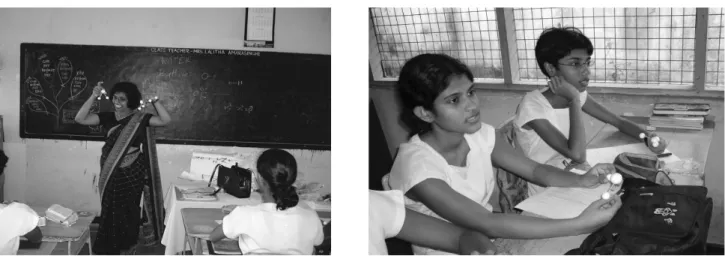
● Students enjoyed well by active participation for
experiments and gained the technological knowledge on batteries by making fruit cell and coin cell. Students performed well in English.
● Applicability of Battery Technology in daily life using
the readily available resources such as fruits, vegetables, detergents and metallic compounds were understood properly by the students and one of the main objectives seems to be achieved.
● Positive attitudes on the subject chemistry and technology
could be cultivated using active based, learner centered lesson.
● Application of proper teaching skills in the class room is
important to enhance the learners’ eager for learning.
● Pre-practicing the teaching process and lesson studies
before the class room was very important for the progress and the success of the duty overcoming weaknesses and faults of the entire process.
● Team teaching was more effective in time managements
as well as the making students’ better understanding by more explanations.
The same lesson was practiced at Jonan high school-Tokushima in Japan within one academic year using the same teaching strategies. The students were assessed successfully by both speech competition and written test.
(Anula College in Colombo on 5th
Jan. 2006, Devi Balika Vidyalaya in Colombo on 6th Jan. 2006 and Darmaraja College
in Kandy on 9th
Jan.2006) within three periods and time was a barrier to assess learners by a speech competition.
The same questioner was used to assess the knowledge of battery chemistry of students in some Sri Lankan High schools (Thangalle Balika Vidyalaya in Hambantota) without practicing the lesson.
Assessment results were evaluated as follows.
More than 70% of the Students in the schools where the lesson has practiced in Colombo and Kandy districts performed well obtaining over 61% marks in the assessment. Ninety percent of the students in Thangalle Balika Vidyalaya where the students have assessed without teaching the lesson obtained less than 40% marks and nobody obtained above
61% marks in the assessment.
Students' performance in the assessment shows the success of the lesson ‘Battery chemistry’ for Sri Lankan high school students providing learner centered activity, improving different skills for sustainable development and Technological improvement.
Students' (120 students-where the lesson has practiced) impression about the lesson was noted on a questioner as follows.
Underline the most suitable answer on your experience.
1. Did you know the importance of ‘Water’ in batteries before this?
a. Yes b. No
2. Did you know ‘how to make batteries using fruits and
coins’ before this? a. Yes b. No
3. Did you know the chemistry of water before this? a. Yes b. No
4. Did you know the importance of water in the nature before this?
a. Yes b. No
5. Can you make ‘fruit cells’ and ‘coin cells’ at home? a. Yes b. No
6. What is your impression on ‘Battery Chemistry' ? a. Learnt the technology on battery of Fruits and Coins,
applicable at home and enjoyed well.
b. Never learnt the technology of battery and not enjoyed at all.
According to the students' impression on the lesson 23% of them had a basic knowledge on ‘water chemistry’ and all of them (100%) knew the importance of water in the nature. But all of them (100%) didn't know the technology of fruit cell and coin cell. According to the students’ impression on question no. 5, the technology is applicable at home using readily available fruits and coins.
Students' pleasure and favor on the activity is important to enhance the skills by repeating and applying the knowledge in daily life. According to their responses on question no. 5
and 6, students were induced to practice the knowledge.
RECOMENDATION
A science lesson like ‘Battery Chemistry’ is successively applicable in Sri Lankan high schools and most of the developing countries using readily available resources in the country such as fruits, vegetables and coins etc. Application of
proper teaching skills is very important to enhance the student favor on the subject inducing learners’ eager on technological skills.
‘Pre-Lesson study’ and ‘Team teaching’ are very effective for a good science lesson overcoming weaknesses and faults of the entire process.
The learner centered activity based science lessons persuade students to apply the gained knowledge in daily life improving different skills and it concretes the individual strength and development. Technological skills of the students in the developing countries should be improved step-vice using readily available resources through science lessons and which empowers the whole development process.
ACKNOWLEDGEMENT
The first author conveys her profound gratitude to JICA and Ministry of Education of Sri Lanka for granting such a valuable opportunity for further studies in Naruto University of Japan. Also she expresses her sincere thank for the professors and lecturers in Naruto University of Education-Japan for their great support and guidance providing a wide knowledge on Japanese teaching strategies and educational system to get this event success.
References:
● Felix Franks, ‘WATER’, - The structure of the water
molecule and the nature of the hydrogen bond in water (p.
12-15), 1983, The Royal society of chemistry
● Felix Franks, ‘WATER’, - Ice- its structure and dynamics
(p. 16-19). 1983, the Royal society of chemistry
● Felix Franks, ‘WATER’, - The structure of liquid water (p.
20-25) ,1983, the Royal society of chemistry
● Felix Franks, ‘WATER’,-; Aqueous solutions of
electrolytes (p.57-68), 1983, the Royal society of chemistry
● Stanly E. Manahan, ‘Environmental Chemistry’ (fourth
edition) - Redox equilibria in natural waters (p. 36-38)
1983, Willard Grant Press, Boston.
● Stanly E. Manahan, ‘Environmental Chemistry’ (fourth
edition) - Water pollution and treatment (pp 146-185)
1983, Willard Grant Press, Boston.
● http://www.mp-docker.demon.co.uk/environmental_chemistry/