1 Onion-like carbon-encapsulated Co, Ni, and Fe magnetic nanoparticles with low cytotoxicity 1
synthesized by a pulsed plasma in a liquid 2
Zhypargul Abdullaeva
1, Emil Omurzak
2, Chihiro Iwamoto
3, Hullathy Subban Ganapathy
2, 3
Saadat Sulaimankulova
4, Chen Liliang
1and *Tsutomu Mashimo
54
1
Graduate School of Science and Technology, Kumamoto University, 860-8555, Japan 5
2
Priority Organization for Innovation and Excellence, Kumamoto University, 860-8555, Japan 6
3
Material Science Department, Kumamoto University, 860-8555, Japan 7
4
Institute of Chemistry and Chemical Technology, National Academy of Sciences, 720071, 8
Bishkek, Kyrgyzstan 9
5
Shock Wave and Condensed Matter Research Center, Kumamoto University, 860-8555, Japan 10
11
Abstract 12
We synthesized onion-like carbon-encapsulated Co, Ni, and Fe (Co-C, Ni-C, and Fe-C) magnetic 13
nanoparticles with low cytotoxicity using pulsed plasma in a liquid. The pulsed plasma is induced 14
by a low-voltage spark discharge submerged in a dielectric liquid. The face-centered cubic Co and 15
Ni, and body-centered cubic Fe core nanoparticles showed good crystalline structures with an 16
average size between 20 and 30 nm were encapsulated in onion-like carbon coatings with a 17
thickness of 2-10 nm. Vibrating-sample magnetometer measurements revealed the ferromagnetic 18
properties of as-synthesized samples at room temperature (Co-C=360 Oe, Fe-C=380 Oe, and Ni- 19
C=211 Oe). Raman-spectroscopy analysis found onion-like carbon shells composed of well- 20
organized graphitic structures. Thermal gravimetric analysis showed a high 21
___________________
22
*Corresponding author. Tel/Fax: +08052593295. E-mail address: [email protected] 23
u.ac.jp (T. Mashimo)
24
2 stability of the as-synthesized samples under thermal treatment and oxidation. Cytotoxicity 1
measurements showed higher cancer cell viability than samples synthesized by different methods.
2 3
1. Introduction 4
Carbon-encapsulated magnetic metal nanoparticles are of great interest due to their unique 5
properties [1] and wide range of practical and clinical applications [2]. Among the various coating 6
materials for Co, Ni, and Fe metal nanoparticles such as silica, organic substances and polymers, 7
carbon is more stable against oxidation, physical and chemical degradation. Carbon can provide 8
good biocompatibility while protecting from agglomeration [3]. Due to their ability to function at 9
the cellular and molecular levels, magnetic nanoparticles can be functionalized to deliver anti- 10
cancer drugs to human cancer tissues [4, 5]. Cobalt, nickel, and iron nanoparticles encapsulated in 11
carbon shells (Co-C, Ni-C, and Fe-C) are applicable in medicine as localized radio frequency 12
absorbers in cancer therapy [6], bio-engineering applications [7], and drug delivery [8]. They also 13
have physical applications such as magnetic data storage, electromagnetic-wave absorption and 14
ferrofluids [9, 10].
15
One key reason to study the cytotoxic effects of magnetic nanoparticles encapsulated in carbon 16
is that they have great potential to contribute to cancer therapy. Recently, magnetic nanoparticles 17
have played a notable role in magnetic hyperthermia, one of the most promising cancer therapies 18
with minimum side effects. In vivo cancer tissues can be exposed to controllable alternating 19
magnetic fields. When heated to 42-46 °C, cancer tissues become more vulnerable and sensitive to 20
anti-cancer drugs and radiation. However, normal cells can survive at this temperature. After the 21
penetration of magnetic particles, membrane blebbing of the cytoplasm can occur, leading to 22
apoptosis and death of the cancer cell [11-13].
23
Several methods have been used for synthesis of carbon-encapsulated magnetic metal
24
3 nanoparticles (Me-C), such as chemical vapor deposition (CVD) [14], conventional arc discharge 1
[15], magnetron and ion-beam co-sputtering [16], laser irradiation [17, 18], spray pyrolysis [19]
2
and explosions [20]. However, most of these methods lead to economic disadvantages including 3
the need to maintain high temperatures, high pressures, and vacuum systems as well as use of 4
expensive equipment. Plasma methods are favorable and conducive to large amount synthesis of 5
carbon encapsulated metal nanoparticles with well-defined crystalline structures [21].
6
In our study, we report the synthesis of cobalt, nickel, and iron nanoparticles encapsulated in 7
onion-like carbon shells (Co-C, Ni-C, and Fe-C) using a pulsed plasma in a liquid [22].
8
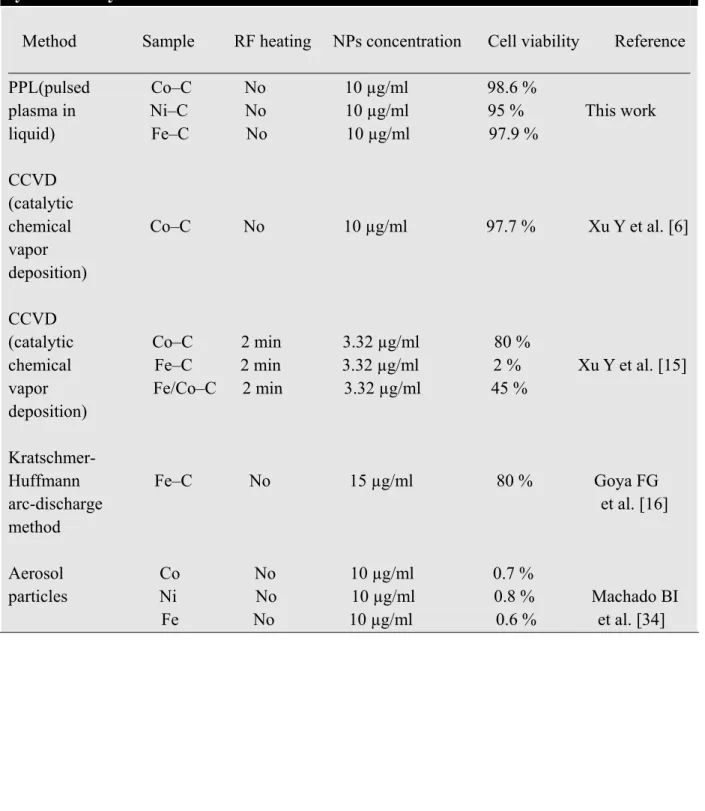
The aims of our study are to synthesize magnetic nanoparticles with low toxicity and to 9
compare the toxicity of our samples with the toxicity of nanoparticles prepared by aforementioned 10
methods. Although cytotoxic properties of nanoparticles are still in the experimental stage, they 11
have great potential in clinical applications.
12 13
2. Experimental 14
2.1. Synthesis of Co-C, Ni-C, and Fe-C nanoparticles 15
The experimental procedure is described in [22]. Here, we briefly give the process. Figure 1 16
shows the experimental setup of the pulsed plasma in liquid method. Pulsed electrical discharge 17
plasma generated by the low voltage spark discharge driven by the capacitor energy. Electrical 18
current duration between pulsed plasma discharges was equal to 10 microseconds (μs). In order to 19
set the optimal conditions for synthesis of Co-C, Ni-C, and Fe-C nanoparticles, different electrical 20
conditions were performed for each experiment (voltage 150-170V, frequency 60 Hz-30 kHz, 21
current 1.5-3 A).
22
For synthesis of Co-C nanoparticles, we purchased electrodes made of carbon rods doped with 23
9 % Co and 1 % Ni, with a diameter of 6 mm and length of 100 mm, from Toyo Tanso. Ethanol of
24
4 99.5% purity, purchased from Kanto Chemical Co, was used as dielectric liquid and source of 1
carbon. We applied pulsed plasma with a voltage of 150 V, current of 3 A, frequency of 60 Hz 2
and single discharge duration of 10 μs.
3
For Ni-C nanoparticle synthesis, Ni metallic rod electrodes with a diameter of 5 mm and length 4
of 150 mm, purchased from Rare Metallic Co, were immersed in 200 ml ethanol (99.5% purity).
5
The power source was applied with a frequency of 30 kHz, current of 1.5 A, voltage of 160 V and 6
discharge duration of 10 μs.
7
For Fe-C nanoparticles preparation, metallic Fe rod electrodes 6 mm in diameter and 140 mm 8
in length, purchased from Rare Metallic Co, were submerged in 200 ml ethanol (99.5% purity).
9
Electrical conditions were as follow: frequency 30 kHz, current 1.5 A, voltage 170 V and single 10
discharge duration 10 μs.
11
One of the electrodes was kept vibrating to hold the discharge process stable. After one hour of 12
continuously applying the pulsed plasma discharge, obtained powder samples were separated from 13
ethanol by centrifuge and evaporation. The sample production rate was 3.5-4.5 g/h. Separated 14
samples of Co-C, Ni-C, and Fe-C were treated by 5 M HCl for 12 hours and washed in water to 15
remove the amorphous carbon and uncoated metallic Co, Ni, and Fe nanoparticles. Then, treated 16
and washed samples were dried at 120° C for 2 hours.
17
For synthesis of Co-C, Ni-C, and Fe-C magnetic nanoparticles, we used different types of 18
electrodes (carbon electrode doped with Co and Ni for Co-C synthesis; and pure Ni, and Fe 19
electrodes for Ni-C, and Fe-C synthesis, respectively) to proceed encapsulation of magnetic metal 20
nanoparticles in carbon.
21
Atomic emission spectra of the plasma discharge during the synthesis were collected by an 22
optical spectrometer SEC2000 UV-VIS installed close to the plasma discharge zone outside the
23
5 quartz beaker. The light coming from outside sources was removed by covering the plasma 1
generation zone with light protective material. Identification of emission spectrum peaks was done 2
according to the NIST
1database.
3
2.2. Sample characterization 4
High-resolution transmission-electron microscopy (HRTEM) analysis was carried out on a Philips 5
Tecnai F20 S-Twin microscope at 200 keV with a point resolution of 0.18 nm. X-ray diffraction 6
(XRD) patterns of samples were taken on a Rigaku RINT-2500VHF diffractometer using Cu Kα 7
radiation. Raman spectra of the samples were recorded at room temperature on a HORIBA Jobin 8
Yvon HR800 spectrometer, using the argon-ion laser beam as the excitation source at wavelength 9
of 514.53 nm. We measured the magnetic properties of Co, Ni, and Fe encapsulated in onion-like 10
carbon at room temperature by using the Vibrating Sample Magnetometer (VSM), (Riken Denshi, 11
Co., Ltd. Japan). Thermal gravimetric analyses (TGA) were conducted on the TG-DTA6300 12
thermogravimeter, (SEIKO Ins. Co. Japan) by using a stainless steel pan in ambient air with a 13
heating temperature rate of 5°C min
-1. 14
15
2.3. Cytotoxicity measurements 16
Cytotoxicity of samples was evaluated by using the A549 cell line (Human lung adenocarcinoma 17
epithelial cells) seeded onto 96-well plate one day before measurement. These cells were 18
maintained as monolayer cultures in Dulbecco's modified eagle medium (DMEM) solution 19
supplemented with 10 % Fetal Calf Serum (Gibco BRL, USA) and 1 % concentration of Penicillin 20
and Streptomycin antibiotics (100 X stock, Sigma). The cells were incubated at 37 ºC in a 5 % 21
_________
22
1