PART2 : COLOCASIA ESCULENTA IN NEW ZEALAND : NGA TARO O AOTEAROA
著者(英) Peter J. Matthews
journal or
publication title
Senri Ethnological Studies
volume 88
page range 22‑91
year 2014‑03‑28
URL http://doi.org/10.15021/00006117
New Zealand consisted of scattered ethnographic records of use and cultivation by the Māori, mainly in the nineteenth century. In previous reports of chromosome numbers in taro, the possibility was raised that New Zealand taro arrived from Melanesia in pre-European times. This suggestion had radical implications for theories of human voyaging and cultural diffusion in the Pacific before written history, since it was (and remains) generally accepted that Māori ancestral and cultural origins lie somewhere in eastern Polynesia.
The research described here was an attempt to determine the historical status of taro present in
New Zealand in the early 1980s. Chapters Four to Eight have been adapted from Matthews (1984).
23 Chapter Four
New Zealand Historical Context and Present Aims
Colocasia esculenta (L.) Schott (taro) is a crop plant not previously described for New Zealand. An initial study of the variation and distribution of taro has been made which provides a basis for future investigation of the plant both within and outside New Zealand. The present research has been directed towards an understanding of the history of taro in New Zealand.
C. esculenta (L.) Schott (taro) is an ancient crop now grown throughout the tropics and sub-tropics in subsistence economies (Plucknett et al. 1970; Herklotts 1972; Leon 1977). Early ethnographic records and Māori traditions (Best 1976) clearly establish that taro was introduced to Aotearoa in pre-European times.
Despite the nineteenth century disintegration of traditional Māori agriculture, taro has retained some economic importance. Diamond (1982) recorded the use of taro by Northland’s bushmen and poor rural transients in the first half of this century, and Ishida (1966) described taro as a component of contemporary subsistence gardening in rural Māori communities of the North Island. Cultivations were also briefly noted in these communities by Yen and Wheeler (1968) and Matthews (1982b).
Some cultivation is found in the Chinese community (Yen and Wheeler 1968) but was not investigated in the present study. Casual observation indicates that taro is quite widespread in the urban Auckland district, where it is cultivated as a leaf crop in the gardens of Pacific Islander households (J. Watson, pers. comm. 1982).
A large demand for imported taro corms exists amongst the various Pacific and Asian ethnic groups in New Zealand. Imports from the Pacific Islands amount to approximately 49 x 10
3kg per week (J. Watson, pers. comm. 1982).
Chromosome numbers have been used to identify likely routes of introduction of taro into the Pacific (Yen and Wheeler 1968). An origin for New Zealand’s taro in Melanesia was indicated by the discovery in both New Caledonia and New Zealand of plants with chromosome numbers of 2n = 42. Taro with this chromosome number also have been recorded in the Solomon Islands of Melanesia (Jackson et al. 1977), and in Timor, the Philippines, the Rykuyus, Japan, China, and India (Yen and Wheeler 1968).
The 2n = 42 number has not yet been reported elsewhere in the South Pacific east of New Caledonia. On the other hand, taro with a chromosome number of 2n = 28 have been found throughout the South Pacific and in Asia (Yen and Wheeler 1968). Yen and Wheeler (1968) drew no definite conclusion from their discussion of whether the possible introduction from Melanesia occurred before, or after, the arrival of Europeans in New Zealand. The present research was undertaken in an attempt to resolve this discussion.
In recent years there has been considerable international interest in the conservation
Peter J. Matthews
of crop genetic resources (Frankel and Hawkes 1975; Simmonds 1979; New Zealand Nature Conservation Council 1980; Plucknett et al. 1983). Apart from the common potato (Solanum tuberosum), little is known about the many important root and tuber crops, including taro. Traditional methods of taxonomy do not appear to work well with root and tuber crop species (Leon 1977). Nevertheless, ethnobotanical studies by botanists and anthropologists have provided important insights into the interactions of cultivators and crop-plant gene pools (for example, Panoff 1972; Yen 1974; Jackson et al. 1980; Sillitoe 1983). Yen (1974) and Jackson et al. (1980) combined observations of cultural practices with botanical observations of morphological and cytological variation, and of distribution, in studies of sweet potato and potato respectively. A similar ethnobotanical approach was taken in the present study of New Zealand taro.
For the present report, observations of natural growth and dispersal of taro were made and, where possible, associated cultural practices were recorded to provide insight into possible historical explanations. These observations were made during wide-ranging field surveys. Botanical descriptions of New Zealand taro are presented in the chapters that follow, based on material observed in the field and in a living plant collection.
Informal nomenclature is adopted and the New Zealand taro are described as ‘variants’.
Observations of root-tip chromosome numbers and karyotypes were made on fully provenanced accessions held in a living plant collection.
Three common variants of taro were found to be widely distributed in the North Island: var. RR (red petiole and rounded blade); var. GR (green petiole and rounded blade); and var. GP (green petiole and pointed blade). The distributions of these variants differ in both geographic range and in relationship to human settlement. Each has a chromosome number of 2n = 42. Two variants with the chromosome number 2n = 28 were found but are rare and have little or no economic importance in the areas surveyed.
These observations lend circumstantial support to the suggestion of a pre-European
introduction of taro with 2n = 42 from the western Pacific, but alternative explanations
are readily apparent. The observations of natural and artificial dispersal have important
implications for future studies of the evolution of taro and its relationship with people.
25 Chapter Five
Taxonomy and General Observations
5.1 Introduction
In the course of field surveys in the North Island of New Zealand, three variants of taro with major distributions were recognised. Observations of growth habit and flowering, and a key for their identification, are presented here. Their cytology is reported in Chapter Six, and their distributions are described in Chapter Seven.
Six other variants of limited known distribution are noted but not discussed. Use of the botanical name Colocasia esculenta (L.) Schott follows Hill (1939) and Purseglove (1972), and refers to a polymorphic species of the tribe Colocasioideae and family Araceae. The term ‘variant’ represents informal nomenclature adopted for the present study of variation in New Zealand taro. Where other authors referenced have used the term ‘variety’ in either a formal or informal sense, that use is retained here.
Taro is the Māori common name for Colocasia in New Zealand, and is cognate and synonymous with Polynesian terms such as kalo and talo. Taro also is presently a common name used generally in the Pacific and in literature, and is applied both collectively and singly to the edible aroids Alocasia, Colocasia, Cyrtosperma, and Xanthosoma.
The taxonomy of Colocasia is highly confused, a situation which is considered characteristic of ancient, vegetatively propagated food crops such as Colocasia (Purseglove 1972; Leon 1977; Plucknett 1983).
Although nine names of botanical varieties are listed by Plucknett (1983) in the most recent review of the taxonomic literature, their use appears to have been limited by the lack of any readily available descriptions for them. Debate has centered on the species or varietal status of the names ‘esculenta’ and ‘antiquorum’.
Haudricourt (1941), Massal and Barrau (1956), Barrau (1957), and Cooper (1969) propose two major subspecies or varieties of Colocasia distinguished on the basis of floral morphology. Cooper (1969) records the flowering of C. esculenta (L.) Schott in New Zealand and describes two varieties as follows:
‘var.
esculenta (formerly typica), in which the sterile appendage of the spadix isshorter in length than the male inflorescence. This variety also has been defined as that in which the sterile appendage is short and is freed when the spathe tube opens. var.
antiquorum (Schott, Hubbard and Rehder), in which the sterile appendage is equal to or
greater than the length of the male flowers. This variety also has been defined as that in
which the appendage is longer, and remains caught in the terminal part of the spathe when
Peter J. Matthewsthe tube opens.’
Further observations of flowering in New Zealand are presented here. Plucknett (1983) states that there are two general types of crop plants in the cultivated Colocasia, and that in general they can be delineated as follows:
(1) Plants that produce a large edible main corm with few cormels (sometimes called sucker corms); e.g. four or eight or so. Generally this group has twenty-eight chromosomes and can be grown under a wide range of water conditions, from flooded (as in Hawai’i and other parts of the Pacific Islands) to rain-fed upland conditions. This plant is C.
esculenta var. esculenta.
(2) Plants that produce a small or medium-sized main corm that often may be inedible because of acridity and a large number (fifteen or twenty or so, to as many as forty or more) of small edible cormels. Some cormels may possess some degree of dormancy.
Generally this group has forty-two chromosomes and is grown as an irrigated crop like many other vegetables or as a rain-fed upland crop. This group of plants probably developed in Japan or China. This plant is C. esculenta var. antiquorum (sometimes called
C. esculenta var. globulifera).In addition to varieties which produce cormels (synonyms: sucker corms, side- corms), Whitney et al. (1939) describe two varieties forming rhizomes or stolons. Stolon formation also is discussed by Wilson (1982). Both growth habits have been observed among the New Zealand variants described here.
Leaf shape in Colocasia ranges from ovate to sagittate, and is entire with an accuminate apex and rounded basal lobes (Strauss 1983). A major diagnostic feature of Colocasia is the presence of peltate leaves in contrast to the leaves of other aroids having marginal petiole insertion (illustrated by Massal and Barrau 1956; Strauss 1983). An exception is the ‘piko’ group of Hawai’ian cultivars, with marginal petiole insertion (Whitney et al. 1939).
The three major variants recognised in the present study were distinguished in the field by leaf shape and colour. A key based on these characters is presented (section 5.3.1), together with a quantitative analysis of leaf shape using data from the field. Only one collection has been made in New Zealand of what may be a ‘piko’ variant of taro.
Whitney et al. (1939) present a botanical classification of 200 taro varieties collected largely from the Hawai’ian Islands and from as far afield as China and Japan. Among these they recognise 84 distinct varieties after observation of the collections, for from one to three generations, under cultivation at the Pensacola Branch Station, Hawai’i.
Accessions thought to be similar were grown side by side for close comparisons.
The authors classify 74 of the varieties in a key based on vegetative characters.
Floral characters could not be observed in all varieties, and observations of some varieties were insufficient for classification.
Observations were made on plants grown under ‘normal’ conditions, and close to the
period of maximum top growth between four to eight months after planting. After this stage, leaves decrease markedly in size until the time of full corm maturity. Whitney et al. (1939) also note that stage of growth affects qualitative characters: the colour and markings of petioles and corm flesh, the development of side-corms and rhizomes, and the branching of corms. Extremes of fertility, moisture, and sunlight also affect both quantitative and qualitative characters.
The above outline of the study by Whitney et al. (1939) is presented for two reasons: (1) it sets a precedent for reducing the number of named varieties when varieties already named according to a traditional folk taxonomy are classified by the Linnaean approach. (In the present study only three variants were recognised, although Best, 1976, presents a list of 45 Māori names of taro varieties; see Appendix 9 for further information); and (2) it identifies environmental and developmental factors affecting phenotype and relevant to the following account of variation in New Zealand taro.
5.2 Materials and Methods
5.2.1 Field measurements and analysis
Field notes and photographs were made to record habitats, growth habits, and flowering.
The measurement of inflorescence parts followed Cooper (1969) except where upper and lower parts of the spathe were measured separately. Inflorescences chosen for measurement were generally at uniform developmental stage, with the upper spathe yellow.
Leaf measurement and sampling
Leaves measured within a patch of taro were individually identified by shoot number and leaf position (innermost first). Sites, site sample sizes, and annotated site descriptions are presented in Appendix 5. The characters measured are illustrated in Figure 5.1 and an example data sheet is shown in Appendix 6.
In general the selection and measurement of leaves was made by the author, with another person recording. The measurements were made in centimetres to one decimal place, in general, and to the nearest centimetre with difficult measurements of larger dimensions.
Twelve leaves were generally measured per site per variant. This number was chosen after a pilot total-population survey of 62 leaves at site NZMS 259/1 (Little Barrier Island) in August, 1981 (data not presented), and was subjectively considered sufficient to describe a patch without taking too much time. Occasionally, greater multiples of twelve were recorded when time and the number of plants permitted. For the analysis of leaf shape, the measurements from sites were pooled for each variant to give large samples incorporating the variation of each variant over a wide geographical range.
Selection of leaves for measurement within a site was not random. Taro generally
form clumps within which individual plants (shoots) vary widely in age and size. The
clumps within sites also vary widely in age and size, and the dispersion of clumps, in
non-cultivated and wild sites, appears highly dependent on characteristics of local water
flow. In this situation, there is no readily apparent random sampling strategy which can be applied with any consistency from site to site.
In order to minimise the chance of creating apparent differences between variants through sample selection, sampling was aimed at maximising intrasite representation of variation. Leaves were selected which were felt to span the full size range of mature leaves present. Size was subjectively judged largely by the dimensions of petiole height, blade width, or blade length — to what degree shape affected judgement cannot be assessed.
Since leaves at the extremes of size range are less common, most leaves were selected from between extremes, and for this range more or less random walks were taken through patches. No consistency could be achieved with respect to within-plant sampling as the number of measurable intact leaves per plant is determined by its age, the degree to which older leaves have suffered weather damage, and other effects of micro-environment. Some sites contained too few intact, mature leaves to allow much choice about which leaves to select.
Figure 5.1 Morphology of C. esculenta. Illustration of terms and the blade dimensions (A to G) measured to describe shape. (A) to (F) are distances measured from the petiole junction (centre of blade) to edge of blade, and (G) is the distance between the tips of the rear lobes.
Intact, mature leaves were chosen to the exclusion of:
(1) young leaves not yet fully unrolled and expanded;
(2) the first, tiny leaves of shooting side-corms, since these have marginal petiole insertion rather than peltate structure — similar to the first leaves of taro seedlings illustrated by Kikuta et al. (1938), and
(3) ripped, rotted, wilted or obviously malformed leaves.
Analysis of leaf shape
The analysis of leaf data was performed with the University of Auckland central IBM computer using the SAS statistical package (SAS Institute 1982 a, b) and the procedures PROC MEANS (for univariate descriptive statistics) and CANDISC (canonical discriminant analysis).
The statistical theory of discriminant analysis assumes that the discriminating variables have a multivariate normal distribution and that they have equal variance- covariance matrices within each group (in this study, within each taro variant). In practice, the technique is very robust and these assumptions need not be strongly adhered to (Klecka 1975).
Descriptive statistics obtained by the PROC MEANS command indicate that the untransformed leaf measurements are approximately normally distributed with generally slight right-skewness for each of the blade characters measured. Bivariate plots of different combinations of blade characters show scatter increasing with size of character (heteroscedasticity). Log transformation of the data linearised the bivariate plots, and was performed prior to the canonical discriminant analysis to help normalise the multivariate frequency distributions, and homogenise the variance-covariance matrices within each group. Nevertheless, it is suggested that the assumptions required for the discriminant analysis are only approximately satisfied. Because taro leaves are highly symmetrical (Appendix 6), redundant information was present in the original set of characters measured (Figure 5.1). Characters C and F were arbitrarily excluded from the discriminant analysis, and their equivalents, characters B and E, retained with the other blade characters A, D, and G.
5.2.2 Living plant collection Collection
Accessions to the living plant collection were collected from a wide range of sites during field surveys and also were received from a number of correspondents and other fieldworkers. The accessions were numbered with the prefix AKL ( = Auckland) in order of their arrival at the Department of Botany (Appendix 3).
Collection of taro for propagation does not require special care as both corms and
side-corms have numerous adaxial meristems in addition to the central meristem. For
transport, whole corms, the cut tops of corms (petiole plus top few centimetres of corm),
side-corms, and stolon nodal sections were either placed with damp soil in unsealed bags
or wrapped without soil in damp newspaper. Under cool or shaded conditions, material
was stored for up to two weeks without rotting or dehydration of meristems.
Maintenance
The collection was held in four areas, as space permitted: glasshouse, poly-house, shade- house, and on an outside scoria bed. The plants were generally potted in black PVC bags of sizes PV 3 (100 × 100 × 200mm) and PV 6 ½ (130 × 130 × 280mm). Potting mixes used were fertilised l : l peat and pumice; and fertilised John Innes soil, peat, and pumice mix (supplied by the Mount Albert Research Centre, Auckland). Plants were multiplied by separation of side-shoots.
Glasshouse plants placed in watering trays were highly prone to spider mite and white fly infestation. Use of insecticide sprays was avoided because leaves were used for a biochemical investigation. Removal of the outermost leaves (usually the most seriously infested) at one- to three-week intervals delayed insect population explosions quite successfully. Periodically all leaves were removed to clear heavy infestations. Plants grown outside and with overhead watering in the poly-house and shade-house remained free of insects.
Observations
Plants were visually checked for constancy in phenotype after removal from the field.
Occurrences of flowering were recorded and the inflorescences measured as described above for the field observations. To compare growth habits in variants RR, GR, and GP (described below), cut tops of each were placed in large PV 40 bags (230 × 230 × 460mm) half-filled with brown garden loam, and placed outside on the scoria bed. These were harvested after approximately one year (23.9.82 to 14.10.83) and photographed.
5.3 Observations
5.3.1 A key for distinguishing three New Zealand variants of Colocasia esculenta (L.) Schott
An initial key was developed after the first field survey in the central Bay of Islands (Matthews 1982), and with material received from a number of collectors prior to later field surveys. The key below recognises variability observed during the course of these later surveys. Anatomical terms are illustrated in Figure 5.1, and the three variants are shown in colour in Figure 5.2.
a. Blade peltate, broadly ovate and entire, with obtuse rear lobes. Margins not undulate.
b. Petioles predominantly greenish bronze to dark carmine, colour development greatest over basal half of petiole (degree of colouration variable within and between plants (younger petioles generally greenish bronze, immature petioles completely green)).
Margin of petiole sinus greenish bronze or carmine (variant RR).
bb. Petioles bright green or yellowish green. Some slight carmine colouring may develop at tip of petiole and along a small distance beneath the blade on the major veins.
Carmine colour also appears in a narrow band of variable width along the margin of the petiole sinus (variant GR).
aa. Blade peltate, ovate and entire, with attenuated rear lobes. Margin coarsely undulate.
Petioles predominantly pale green. Light, greenish bronze colour may develop over more than half the length of the petiole, from base. Some slight carmine colouring may develop at the tip of petiole and along a small distance beneath the blade on the major veins (variant GP).
In practice, variants may be recognised in the field simply as with red petioles and rounded blades (variant RR), green petioles and rounded blades (variant GR) or green petioles and pointed blades (variant GP).
Variants RR and GR are grouped together in the key above because other morphological similarities distinguish them from variant GP (described below).
5.3.2 General observations in the field and the living plant collection:
Areas and dates of fieldwork are set out below:
Northland:
Bay of Islands, May 1982 Cavalli Islands, December 1982 Hokianga to Kaitaia, February 1983
Hauraki Gulf:Little Barrier Island, August 1981 Waiheke Island, February 1983 Kawau Island, January 1983
Northern Great Barrier Island, January 1983 Coromandel Peninsula, August 1983
East Cape:Opotiki to Gisborne, January 1983 Habitat range
The limits of habitat range have not been established, since not all areas known to have taro have been explored.
Taro were encountered in a diverse range of habitats, some of which are noted in Appendix 5, or may be seen in Figures 7.1. and 7.2. The most common attribute of sites with wild taro appears to be a plentiful water supply either seasonally, as in small creek or swamp sites, or year-round, as in bigger creek or swamp sites below larger water catchments. The presence of taro in sites lacking natural water flow can generally be attributed to planting by people.
Growth habits (variants RR, GR, and GP)
In the temperate climate of New Zealand the growth of taro is highly seasonal, with a
major flush of leaf production over the summer months. Plants in areas prone to frosts,
for example parts of Coromandel, were reported by local informants to survive frosts but
with growth set back. Plants with recently rotted and torn leaves were observed in open ground near Waikawau River, Coromandel, during August 1983, and appeared to be damaged by both frost and wind. At other Coromandel sites at this time, plants growing in narrow streams at the entrances of exposed coastal gullies appeared limited in size to the height of the banks which sheltered them.
Conditions that favour large size and a high rate of growth of leaves appear to include shelter, heat, and wet boggy ground (see Figure 7.2).
A clumping growth habit was observed with each of the variants RR, GR, and GP.
Clumps in a patch may contain corms and side-shoots varying widely in age. The leaves produced over the summer by young side-shoots attain a smaller maximum size than do leaves from corms a number of years old. Etiolated petioles were frequently observed on shaded plants.
Petioles observed in the field ranged from only a few centimetres to almost two metres in length. Variants could not be distinguished in the field on the basis of size range, although visual comparisons of potted plants indicate that variant GP may be characterised by longer petioles on average than the variants RR and GR.
Variants RR and GR are similar in both their corm morphology and vegetative propagation. They produce undulating central corms with numerous side-corms where the parent is buried or lies against a damp surface. Side-corm production was observed in potted plants (Figure 5.2), and in the field (Figure 5.3).
Corms which have rotted at the base, and dislodged or abscised side-corms, are readily carried downstream by water flow, so that clumps of taro originating from an upstream site may eventually be dispersed within a watershed over considerable distances (to more than one kilometre).
Variant RR has been seen to produce short stolons, but only under highly artificial conditions: in the glasshouse, with roots highly pot-bound, and watered irregularly.
Stolon production is characteristic of variant GP in the field and under all conditions of potting (Figures 5.2 and 5.3). In the field stolons were not always seen, but in all sites prolific side-shoot formation was observed. These appear to grow without an intermediate cormel stage and develop into large corms similar to the parent corm. These side-shoots do not detach as readily as side-corms and it is sometimes difficult to collect propagating material. This close growing habit may be reflected in the extremely dense clumping seen in some sites, covering large areas (possibly more than 1000m
2at site N14/30, Reena, North Hokianga).
Formation of stolons appears on casual observation to occur only in dry or damp conditions, rather than in bog or submerged in water. The older corms of variant GP often appear massive compared to those of the other variants (Figure 5.3), but also show undulations. The undulating shape of corms is believed to reflect seasonal growth over a number of years.
Other Variants
Six accessions from Rarotonga, Cook Islands (five of these from a collection at the
Totokoitu Research Station, Appendix 3), were maintained in the living plant collection.
Figure 5.2 Growth habits of New Zealand variants of C. esculenta. Plants from potted corms after one year outside (late winter, 1982, to late winter, 1983) at Auckland. Scale bar = 15 cm. (A) Variant RR, AKL 2, tight clump formed with secondary and tertiary side-corms. (B) Variant GP, AKL 29, spreading clump formed with stolons. (C) Variant GR, AKL 37, tight clump formed with secondary and tertiary side-corms. (D) Same as C, dissected.
Figure 5.3 Growth habits of New Zealand variants of C. esculenta, in the fi eld A and B: from same site (N39/6), Coromandel Peninsula, August 1983; non-cultivated, growing at surface of wet, forest topsoil beside small stream. (A) Variant RR, corm with side-corms; (B) Variant GR, corm with side- corms. C and D: Variant GP, non-cultivated, from boggy ground beside. (C) Corm growing above ground, with secondary corm developed from side-shoot, North Hokianga (site N14/30), February 1983; (D) cut top of corm with petiole base, roots, and stolon. A young root has emerged from the second node of the stolon. The shoot above the second node has had leaves removed. Bay of Islands (site N15/4), May 1982. Scale bar = 15 cm
None of these appeared the same as the New Zealand variants, so descriptions will not be presented.
New Zealand variants collected, other than those already described, are AKL 34, AKL 79, AKL 80, AKL 81, AKL 82, and AKL 87. All of these are known only from single garden sites. Cytological observations have been made on only AKL 34 and AKL 79 (Chapter Six).
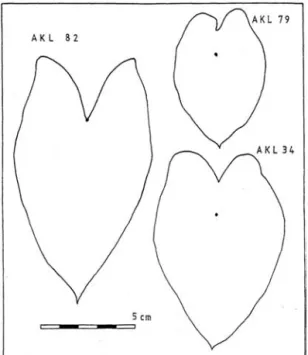
1)AKL 34 appears, on limited observation of potted material, to attain a smaller stature than the variants RR, GR, and GP, with shorter petioles and smaller blades. This may be due to its habit of proliferating rapidly, with many tiny side-corms quickly forming shoots around the small, spherical central corm. The size that would be reached after prolonged growth is not known. The blades and petioles are pale green to yellowish green with no traces of red pigmentation. A traced outline of one blade is shown in Figure 5.4.
AKL 79 is like AKL 34 in growth habit but has purple/carmine colouration up part of the petiole, from the base, and in the veins of the blade. The blade has a rather dark appearance. A traced outline of one blade is shown in Figure 5.2.
AKL 80 and 81 are said to differ in petiole length, blade texture, and venation, and whether or not they flower (G. Fuller, pers. comm. 1982, 1983). However, both flowered while maintained in the Auckland collection, and both have very similar general morphology.
AKL 82 is the only variant with marginal petiole insertion and recorded here as
‘Colocasia (?)’. Only one shoot has been observed: the petiole is completely dark purple/
carmine, with this colour predominant in the veins of the blade. Staff at Pukekura Park, New Plymouth (G. Fuller, pers. comm. 1983) are familiar with Xanthosoma (marginal petiole insertion also) and are certain that AKL 82 is not of this genus. This accession may belong to the ‘piko’ group of cultivars noted in the introduction above. A traced outline of one blade is shown in Figure 5.4.
Mutations
At termination, the living plant collection contained fifty-six accessions of variant RR;
nine accessions of variant GR; ten accessions of variant GP; and twelve single accessions of other variants or varieties from New Zealand and Rarotonga. No obvious vegetative mutations were observed.
Diseases and pests
All taro seen during the field surveys appeared remarkedly free of diseases and pests.
Occasionally, leaf damage like that described as ‘hopper burn’ (Mitchell and Madison 1983) was seen in association with breeding populations of the passionvine hopper, Scolypopa.
Four occurrences of possible virus infection were noted in New Zealand taro:
(1) minor vein banding symptoms (feathering) in a succession of leaf blades of AKL
1 (from Little Barrier Island), variant RR, in January 1982, a number of months after
collection and growing outside at Mount Albert, Auckland;
(2) recurrent interveinal chlorosis and deformed blade development in a potted plant of AKL 2 (from Little Huia, Auckland), variant RR, in August 1982, several months after collection and growing in a glasshouse in some proximity to virus-infected accessions of taro from Rarotonga (most of the Rarotongan varieties show obvious symptoms of virus infection, Figure 5.7),
(3) yellowed veins over one entire blade (Figure 5.7) in a patch of variant GP, growing wild at Omaio, East Cape (site N70/4), in January 1983; and
(4) chlorosis and deformity (Figure 5.7) in two leaf blades in a patch of variant GP growing wild at Herekino, Northland, (site N9+13/5), in February 1983.
Highly tentative diagnoses of these symptoms are, for each occurrence numbered:
(1) dasheen mosaic virus (see Figure 13 in Jackson 1980); (2) dasheen mosaic virus (see Figure 3 in Zettler et al., 1978); (3) small bacilliform virus (see Figure 9 in Jackson 1980); and (4) unknown, symptom unlike previously described symptoms. Re-collection from the original sites, and further diagnostic investigation are needed to confirm these observations as first records of virus infection in New Zealand taro.
In a number of sites the torn ends of petioles indicated browsing by some herbivore.
Pigs, goats, horses, sheep, cattle and pukeko were variously mentioned by informants in the field as animals which attack taro. Generally the large stock only eat the tops and
Figure 5.4 Leaf-blade outlines, each from a single leaf. AKL 34 and AKL 79: C. esculenta, peltate. AKL 82: Colocasia?, marginal petiole insertion. Petiole insertion points shown for each.
only in times of hunger, while pigs and goats may eat both tops and corms. Pukeko, reported only once, apparently slash the plants while searching amongst them for insects.
5.3.3 Flowering
The inflorescences of Colocasia are comprised of a spathe surrounding a spadix that contains zones of female, male, and sterile flowers (Strauss 1983). The structure of an inflorescence and the parts measured are shown in Figure 5.5.
General
Records of taro flowering in New Zealand, both recent and old, are listed in Table 5.l.
During summer field work in North Auckland, in February 1983, prolific flowering by variant GP was observed in five sites.
Floral measurements are recorded in Table 5.2. No fruit formation was observed, and older spadices were seen withered and rotted to various degrees at the same time as younger spathes, on the same plant, were seen emerging (Figure 5.6) or shedding pollen.
As it was nearing the end of summer it was thought likely that increasing coolness would prevent any fruit development later.
Table 5.1 Records of C. esculenta fl owering in New Zealand. For some, site number is given as the origin for collected material, or to specify the location of fl owering. Collected material is identifi ed by the plant accession number. Reference numbers for measured fl owers are given for cross reference to the measurements in Appendix 8. G = garden; c = cultivated; nc = non-cultivated; d = derelict. For defi nitions of terms see Chapter Seven.
Variant Origin Plant acc. no.
Botany Department
site no.
Site description
Flowering
location Region
Date or approx.
period
Flowers measured (ref. no.)
Informant
RR N23/1 G,c Tekawa Stn Dargaville Feb 1983 A. Stilwell pers.
comm. 1983
RR N41/2 AKL 2 Glasshouse
potted Botany Dept Auckland Mar 1982 Yes (1) P. Matthews
RR ? N41/2 G, nc, nd Little Huia Auckland Oct - Nov J. Walsh pers.
comm. 1982
RR NZMS259/1 1 Glasshouse
potted Botany Dept Auckland Mar 1982 Yes (2) P. Matthews
RR NZMS259/1 1 G,c Mt. Albert Auckland July 1982 Yes (3) P. Matthews
RR NZMS259/1 1 G,c Mt. Albert Auckland Dec 1982 P. Matthews
RR NZMS259/1 1 G,c Mt. Albert Auckland Mar 1983 Yes (4) P. Matthews
RR N33/1 G,c Ponsonby Auckland May 1982 Yes (5) I. Lawlor pers.
comm. 1982
GR ? N18+22/2 G, nc, nd Waimamaku
Beach Road Hokianga Feb 1983 P. Matthews
GP ? N14/3 G, nc, d Mitimiti Rd Hokianga Feb 1983 Yes (6) P. Matthews
GP ? N14/30 Wild Reena Hokianga Feb 1983 Yes (7) P. Matthews
GP ? N9+13/1 Wild Herekino Herekino Feb 1983 Yes (8) P. Matthews
GP ? N9+13/10 Wild Tauroa Pt. Kaitaia Feb 1983 P. Matthews
GP ? N9+13/5 Wild Ngaire St. Kaitaia Feb 1983 Yes (9) P. Matthews
? ? ? Waimate Bay of Islands Feb 1895 T.F. Cheeseman 1)
? ? Wild Lava Point Raoul Island June 1956 Yes R.C. Cooper
(1969)
? Samoa Garden Henderson Auckland April 1967 T. Harris 1)
? ? Garden Henderson Auckland March 1964 T. Harris 1)
esculenta Edmund St Garden ? Auckland Feb 1968 A.T. Pycroft 1)
esculenta Bay of Islands Garden Edmund St Auckland April 1962 Yes A.T. Pycroft 1)
esculenta ? ? Ngaire Bay Whangaroa Dec 1963 Yes A. Leahy 1)
esculenta ? ? Kerikeri Beach Bay of Islands Dec 1963 Yes A. Leahy 1)
? ? ? Mataka Beach Bay of Islands Jan 1961 A. Leahy 2)
antiquorum ? ? ? Kaitaia April 1921 Yes R.H. Matthews 1)
antiquorum ? ? Whareora Whangarei Sept 1968 Yes J.C. Nicholson 1)
? ? ? Te Araroa East Cape ʻrecentlyʼ R. McConnell
pers. comm. 1982
? ? ? ? Northland Jan K. Reynolds pers.
comm. 1982
? ? ? ? Northland May K. Reynolds pers.
comm. 1982
? ? ? ? Northland June K. Reynolds pers.
comm. 1982
antiquorum ? ? Remuera Auckland May 1970
Herbarium specimen AK 123004
RR Opotiki ? Remuera Auckland Feb 1974
Herbarium specimen AK 151544
tarohoia Hokianga ? Remuera Auckland Apr 1980
Herbarium specimen AK 151597
AKL 80 N109/2 AKL 80 Glasshouse,
potted Botany Dept Auckland Sept 1983 Yes (10) P. Matthews AKL 80 ? AKL 80 N109/2 outdoors Pukekura Park New Plymouth Apr 1983 Yes (11)
P. Matthews, G.
Puller pers. comm.
1983 AKL 81 ? AKL 81 N109/2 outdoors Pukekura Park New Plymouth Apr 1983
P. Matthews, G.
Fuller pers. comm.
1983
AKL 81 N109/2 AKL 81
AKL 12
Outside,
potted Botany Dept Auckland Dec 1983 P. Matthews
Tonga Sea DSIR
Rarotonga AKL 12 Glasshouse,
potted Botany Dept Auckland Apr 1983 Yes (12) P. Matthews Niukini
Ava'ava
DSIR
Rarotonga AKL 15 Glasshouse,
potted Botany Dept Auckland Apr 1983 Yes (13) P. Matthews
Malahu DSIR
Rarotonga AKL 16 Glasshouse,
potted Botany Dept Auck land Apr 1983 Yes (14) P. Matthews
1) See R.C. Cooper (1969). 2)See New Zealand Archaeological Association Site Record Form (NZMS 1) N11/300.
Variant RR, potted in the glasshouse (Figure 5.5) and outside, has been seen to flower and shed pollen. Prolific flowering in patches, as with variant GP, was not observed. Flowers have not been observed for variant GR. This may be partly due to chance: fewer accessions of this variant were collected than of variant RR. Formation of a flag leaf, however, was seen on one occasion in the field. In all instances of the other variants flowering, each inflorescence was preceded by emergence of a flag leaf. Ghani (1982) described the flag leaf as a ‘morphological indicator’ for flower emergence within the following twelve days. Coarse dissection of variant GR with a flag leaf, however, revealed only young vegetative shoots. Very young or retarded inflorescences may have been missed in this dissection.
Records and measurements of flowering by other taro variants collected are given in
Appendix 8.
Figure 5.5 Flowering of C. esculenta variant RR, in New Zealand. (A) Spathe and peduncle with parts labelled. (B) Spadix with parts labelled. A and B: Accession AKL 2 from Little Huia, Auckland, potted in glasshouse, March 1982. Lower: A full set of four infl orescences from one plant, with the fi rst formed infl orescence at far right. The fl ag leaves are not shown except for one between the second and third infl orescences, and one before the young leaf (rolled) at far left. The return to vegetative growth is accompanied here by the formation of a pseudo-spathe containing no spadix, and an aberrant fl ag leaf with a small growth of lamina tissue at its tip (far left). The spadix of the second infl orescence has become free of the spathe, while that of the third infl orescence remains bound within. Accession AKL 1 from Little Barrier Island, Hauraki Gulf, growing outside at Mount Albert, Auckland. March 1983
Figure 5.6 Flowering of C. esculenta variant GP, in New Zealand. Left: Whole plant with the fi rst-formed infl orescence (outer-most) withered, and the second at the stage marked by yellow colour of the upper spathe. The spadix of the fi rst infl orescence remains bound within the spathe. Plants in a derelict, non-cultivated garden, northern Hokianga (site N14/3). February 1983. Scale bar with centimetres. Right: Spadix revealed by partial dissection of the spathe. The upper spathe is yellow and pollen is being shed (apparent in roughness at surface of the staminate zone). Gynoecia (green) and stigmas are visible in the pistillate zone.
Table 5.2 Floral morphology of C. esculenta. Summary statistics for observations in New Zealand (variants RR and GP, 1982–83; var. esculenta and var. antiquorum from Cooper 1969) and Hawai’i (fi eld- station varietal collection, Whitney et al. 1939). Data: Appendix 8. Note: Some rounding error is apparent in the calculation of means.
Spathe (cm) Spadix (cm) Ratios
Total Length
Lower Part
Upper Part
Total Length
Pistillate Zone
Sterile mid-zone
Staminate Zone
Sterile Appendage
Spathe Spadix
Lower/
Upper Sterile Append./
Spadix Sterile Append./
Staminate Variant RR
n 6 6 6 5 5 6 6 6 6 5 6
X 25.6 5.2 20.5 13.5 3.0 1.8 5.7 3.4 0.24 0.23 0.59
s.d. 3.5 0.7 2.9 3.6 1.0 0.5 1.1 1.2 0.03 0.06 0.17
Variant GP
n 21 21 21 21 21 21 21
X 10.9 3.7 1.7 2.9 2.6 0.24 0.96
s.d. 1.5 0.6 0.7 0.7 0.5 0.03 0.23
var. esculenta
n 6 6 6 3 6 6 6 6
X 23.6 9.3 3.9 1.9 3.0 1.4 0.14 0.53
s.d. 3.8 2.5 1.9 0.7 1.7 0.9 0.08 0.43
var. antiquorum
n 2 2 2 2 2 2 2 2
X 20.3 13.4 3.5 1.7 4.3 3.9 0.29 0.90
s.d. 3.1 2.2 0.5 0.8 0.8 1.0 0.03 0.06
Hawai’i n=No.
of varieties
n 35 34 35 31 31 34 31
X 23.3 4.0 19.2 8.3 0.81 0.21 0.10
s.d. 5.5 1.0 4.7 2.6 0.31 0.03 0.03
Figure 5.7 Leaf blades of C. esculenta with symptoms suggesting virus infection. Upper: Variant RR, AKL 2.
Leaves taken at two times during August 1982, from a potted plant in the Department of Botany collection, Auckland. Lower left: Variant GP. Single diseased leaf in a wild patch at Omaio, East Cape (site N70/4), January 1983. Lower right: Variant GP. One of two diseased leaves observed in a wild patch at Herekino, Northland (site N9+13/5), February 1983.
Measurements
A summary of previously published data and the present observations is given in Table 5.2. Generally, the observations are very scanty and incomplete. While Whitney et al.
(1939) state that their descriptions are based on turgid material, Cooper (1969) reports observations on dried herbarium specimens and the withered samples brought to him. In withered inflorescences disproportionate shrinkage of the male and sterile parts has been observed (Figure 5.5, lower).
5.3.4 Leaf shape analysis
Leaves of the variants RR, GR, and GP were classified prior to the analysis on the basis of leaf shape and colour, as described in the key above. The observations presented here quantify the characteristics of shape upon which the key is partially based.
Univariate statistics
Descriptive statistics for each of the observed leaf characters and some derived characters are given in Appendix 6.
Means and standard deviations for the blade characters used for canonical discriminant analysis are shown in Table 5.3. These statistics are summarised as the mean blade outlines shown in Figure 5.8. The visually most striking features of the outlines are:
(1) the attentuation and spread of the rear lobes in variant GP; and (2) the similarity between RR and GR.
Multivariate statistics
Canonical discriminant analysis creates axes in the multidimensional space defined by the observed characters. The created axes (canonical variates) provide maximal discrimination between the centroid means of each group (taro variant). In this analysis the number of canonical variates that might provide discrimination is limited to two, one less than the number of taro variants, since the number of observed characters is greater than the number of groups (variants). Two canonical variates are sufficient for discrimination between three groups, assuming that all three are different with respect to characters included in the analysis.
With analysis of log
10transformed blade measurements (Figure 5.9) only canonical variate 1 (CV 1) provides discrimination between the three taro variants. Scores for variant GP are clearly distributed lower on CV 1 than are scores for variants RR and GR, while no discrimination is apparent between the latter.
The largest standardised canonical coefficients (Table 5.3) for CV 1 are found with log
10B and log
10D, showing that the characters B and D contribute most to between-group variation along the discriminant function (CV 1).
The reversed signs of these two coefficients show that maximum discrimination is
obtained by contrast of large B and small D values with small B and large D values.
Close inspection of the blade outlines in Figure 5.8 confirms this interpretation:
Variant GP has both longer rear lobes and a shorter sinus-to-petiole distance than variants RR and GR.
Although the spread between rear lobes is noticeably greater for variant GP than the other variants (Figure 5.8), the character (G) proved of minor importance in this analysis.
This may reflect relatively low correlation between measurements of characters G and D (Table 5.4) resulting from the relatively high measurement error associated with G. In the field, difficulty was met in measuring G due to the flexibility of the lobes, while other, internal blade dimensions were more easily measured. On the obtuse rear lobes, the absence of a clear point of maximum lobe extension also contributes to error in measurement of G, and also to the derived character, sinus angle.
The blade sinus-angle, 2.sin
-1(
BGC), is a further quality which distinguishes variant GP from variants RR and GR, (Figure 5.8, Appendix 6).
However, because it is composed of linear leaf-blade characters related in a non-additive fashion, sinus-angle cannot contribute to the discriminant functions (canonical variates) — the present analysis is based only on the raw measurements of linear characters.
Figure 5.8 Leaf blades of three New Zealand variants of C. esculenta. Outlines based on mean values of the linear dimensions shown, depicted relative to the largest dimension of each. The real-size means of the largest dimension range from 20 to 26 cm approximately. Undulation in the margin of variant GP is a characteristic of that variant. The central circle represents the point of petiole insertion.
Figure 5.9 Canonical discriminant analysis of leaf shape in C. esculenta. Frequency histograms of the canonical scores for the New Zealand variants RR, GR, and GP. Arrows indicate mean scores.
Table 5.3 Canonical discriminant analysis of leaf shape in C. esculenta, New Zealand variants RR, GR and GP. Standardised canonical coeffi cients for canonical variates CV 1 and CV 2. The analysis was performed on log10 transformed measurements of leaf blade characters (means and standard deviations of untransformed and transformed data given). Canonical r-squared shows the proportion of variance, in the canonical variate scores, explained by groups.
Units Variant n Character Means and Standard Deviations.
A B D E G
cm
RR 176 20.9 ± 11.3 12.1 ± 6.5 6.7 ± 3.8 11.1 ± 5.9 8.9 ± 4.8 GR 71 24.0 ± 10.2 12.9 ± 4.9 7.3 ± 3.4 12.0 ± 4.7 10.5 ± 4.6 GP 96 25.5 ± 10.3 16.8 ± 6.8 6.6 ± 3.1 12.9 ± 5.5 16.3 ± 7.6
log10 (cm)
RR 176 1.25 ± 0.26 1.00 ± 0.29 0.74 ± 0.3 0.98 ± 0.26 0.88 ± 0.28
Canonical r-squared
(%) GR 71 1.34 ± 0.18 1.08 ± 0.17 0.82 ± 0.19 1.05 ± 0.17 0.97 ± 0.21 GP 96 1.37 ± 0.19 1.19 ± 0.20 0.77 ± 0.22 1.07 ± 0.20 1.18 ± 0.21 Standard canonical
coefficients
CVl -0.12 -4.4 3.9 1.4 -1.1 70.3
CV2 2.3 -4.4 l.5 -0.7 2.1 5.1
5.4 Discussion 5.4.1 Taxonomy Floral Morphology
Despite the paucity of observations on flowering, possible differences can be seen between variants RR and GP in both the absolute and relative sizes of the staminate zones and sterile appendages (Table 5.2). Variant GP, with a mean ratio of sterile appendage to staminate zone length of 0.96, may represent what Cooper (1969) regards as var. antiquorum (Table 5.2) despite the fact that his specimens (mean ratio = 0.90) do not fit his stated criterion of a ratio equal to or greater than one. Further, both variants RR and GP were observed in the present study to retain the sterile appendage in the terminal part of the spathe (Figure 5.5, 5.6), a stated characteristic of var. antiquorum (Massal and Barrau 1956; Barrau 1957; Cooper 1969). Variant RR however, with a mean ratio of sterile appendage to staminate zone length of 0.59, clearly does not fit the stated criterion for var. antiquorum.
Comparison of the New Zealand variants with the observations of Whitney et al.
(1939; and Table 5.2) indicates that varieties in the Hawai’ian collection have, in general, a much shorter sterile appendage which is also shorter relative to the overall length of the spadix. An inflorescence of such proportions is used by Massal and Barrau (1956) to illustrate C. esculenta in distinction from C. antiquorum (Figure 5.10).
2)From the above it appears likely that variant RR (with a sterile appendage of large size but shorter in length than the staminate zone) is like neither esculenta nor antiquorum according to the definitions of these (as either species or varieties) by authors outside New Zealand. On the basis of flower measurements it is not clear that variant GP is of antiquorum kind, and it certainly is not like esculenta. It seems likely that Cooper (1969) attempted to apply criteria developed by previous authors working with examples which did not include flowering types similar to the New Zealand variants.
Variation in floral characters may be greater than previously indicated by their use in the identification of two varieties of C. esculenta, and might have future use in identifying additional varieties. Gross floral morphology may however prove no more stable or useful than vegetative characters. Further, as Plucknett (1983) points out, floral characters are often not useful as many Colocasia cultivars rarely flower.
Table 5.4 Correlations between blade characters in C. esculenta. These were calculated as part of a principal components analysis (SAS command PRINCOMP) of 343 observed leaves (data for taro variants RR, GR, and GP, pooled after log10 transformation; analysis not presented).
log
A B C D E F G
log D 0.92 0.94 0.94 1 0.94 0.95 0.83
General Morphology
While only leaf shape and colour appear sufficient to consistently distinguish three New Zealand variants in the field, a much greater range of vegetative characters was required by Whitney et al. (1939) to classify a large collection of varieties. A greater range of characters has not been described for the New Zealand variants as little practical benefit would result. The variants RR, GR, and GP have been described on the basis of observations over a wide range of non-cultivated habitats in a temperate climate.
Descriptions made outside New Zealand generally apply to plants under various forms of cultivation in tropical climates (Whitney et al. 1939; Purseglove 1972; Plucknett 1983).
These environmental differences do not allow any clear comparisons of growth habit or individual leaf characters.
Leaf shape, rather than size, has been useful in the present study for discriminating between variants. However the shapes cannot be compared usefully with previous descriptions of leaves since these are based on insufficient numbers of characters to describe shape well. Whitney et al. (1939) present only ranges of blade length and width, while Strauss et al. (1979) measure numerous characters but omit the lobe length B (or
Figure 5.10 Two kinds of infl orescence in C. esculenta. The esculenta kind (right) has the following proportions: sterile appendage/staminate zone = 0.27; sterile appendage/total spadix = 0.13. Floral parts: (1) sterile appendage, (2) male fl owers, (3) abortive fl owers, (4) female fl owers, (5) spathe cut lengthwise to show infl orescence. Illustrations and naming from Massal and Barrau (1956).
its equivalent, C) found important for best discrimination between the New Zealand variants.
In any event, leaf shape alone is insufficient to fully identify variants, cultivars, or varieties. Even comparisons using complete raw data sets and multivariate statistical techniques would probably, at best, show only very broad groupings in such an apparently polymorphic genus as Colocasia.
Using Field Keys for Recognition and Comparison
Classification keys based on vegetative characters, whether few or many, appear to have most use for the local recognition (for example, New Zealand or Hawai’i) of variants, cultivars, or varieties. Nevertheless, even crude comparisons between areas may be useful.
In applying the key of Whitney et al. (1939) to the New Zealand variants RR and GR, no progress could be made due to uncertainties in comparisons with corm size, production of side-corms, and petiole colour. Many variations of these characters appear in the key. However, one variety (Aweu) is reported with slender rhizomes which sometimes ‘appear like creeping stolons’ close to the surface, similar to the growth habit of variant GP. Aweu also resembles variant GP in leaf shape and possibly colour (Appendix 7). Although it is not possible to claim identity, the similarity may warrant an attempt to obtain living material from Hawai’i for a side-by-side comparison.
5.4.2 Natural dispersal
The distribution of taro in New Zealand is the outcome of both natural dispersal and transfer by people. The dispersal of corms and side-corms in watersheds (variants RR and GR), and by close side-shoots or spreading stolons (variant GP) has been described.
Cooper (1969), summing up observations of seven spadices from New Zealand sources (variants not identifiable), notes that they have small fruit and white ovules when fresh, but when spathes and stalks wither the fruit fail to ripen seed. Similar observations were made during the summer of 1982–83 for both variants RR and GP. All observations made to date indicate that there is no seed production in New Zealand.
The records of flowering in winter and summer suggest that seasonal control of flowering is poor, though this may differ for different variants. The number of records suggests that flowering is quite common.
Outside New Zealand, seedlings or germinating taro seed have not been observed in areas where the crop is cultivated and it is generally believed that seed rarely or never germinate.
3)Seedlings if formed may perish due to fungal attacks or damping off (Sunell and Arditti 1983). Seed have germinated under a wide variety of controlled conditions (Ghani 1982; Strauss 1983; Sunell and Arditti 1983). Seed production after artificial self- pollination varied from much to little in different varieties (Sunell and Arditti 1983).
Mass flowering may be a general characteristic of stolon-producing Colocasia such as
variant GP, since Wilson (1982) notes from casual observations that natural flowering in
Colocasia appears associated with a tendency towards stolon production.
5.4.3 Archaeology
Finally, good and bad news for archaeologists: taro pollen certainly is produced in New Zealand swamp sites but apparently, in Highland Papua New Guinea, it has proved impossible or extremely difficult to distinguish claimed fossil taro pollen from the pollen of other genera (Spriggs 1982). Encouragingly, the seed is hard and may have useful diagnostic characters. It remains to be tested how easily the seed rots.
5.5 Conclusion
Three major variants of New Zealand taro are readily recognised in the field. These have only been informally named as variants in order to stress that nothing should be assumed about their phylogenetic relationships. The taxonomic descriptions that have been made here, and elsewhere, are inadequate for positive identification of genetically similar taro outside New Zealand.
The present field observations indicate that taro is readily able to survive and self- propagate vegetatively in New Zealand, without human intervention.
Notes
1) Not all attempts to analyse chromosomes were successful. The standard method — described in Appendix 10 — works best when the plants are growing rapidly, eg. in warm conditions with increasing day-length. For tropical cultivars, the day length condition may not be important.
2) While describing a new species of Colocasia in Borneo, Hay (1996) provides a useful review of the naming of C. esculenta and its varieties.
3) A first indication that this view is wrong was provided by Barrau (1959), who found wild taro
with fruit and seeds in Papua New Guinea. See also Figure 9.3, this volume.
49 Chapter Six
Cytology
6.1 Introduction
Here, the chromosome numbers of New Zealand taro are investigated and the observations of previous authors are confirmed. The variants identified on morphological grounds (Chapter Five) are characterised further by chromosome number and karyotype.
Observation of the karyotypes provides a further means for distinguishing the variants and allows limited speculation about the evolution of the nuclear genomes.
Rattenbury (1956, 1957) reported the somatic cell chromosome number of 2n = 42 for untended taro from the Cavalli Islands. Further counts made by Rattenbury for New Zealand taro were reported by Yen and Wheeler (1968). ‘Apparently wild’ taro from Great Barrier Island and Spirits Bay also gave counts of 2n = 42, and the specimen from Great Barrier Island was morphologically similar to that from the Cavallis (Yen and Wheeler 1968). A variety cultivated by the Māori of Northland, and called ‘island taro’, shared some morphological likenesses as well as the 42-chromosome complement with a wild specimen called taro hoia in the same area. Two other cultivated varieties from this district called makatiti and pongu gave counts of 2n = 28. A reputedly Chinese variety grown by a Chinese market gardener in Auckland had the same chromosome number (2n
= 42, implied by Yen and Wheeler 1968) as morphologically identical plants collected from two untended situations near Māori settlements in North Auckland and the Bay of Plenty. In their Pacific-wide study, ‘no obvious morphological correlates were noted in the field during the periods of collection or during the experimental growing in New Zealand of varieties of known chromosome number’ (Yen and Wheeler 1968).
As a consequence of the confusion surrounding the Linnaean nomenclature of Colocasia species and varieties, little significance can be placed on the correspondence between reported species/variety and chromosome number in lists such as presented by Plucknett et al. (1970), Marchant (1971), and Ramachandran (1978). In a particular instance, Rattenbury (1957) reported the New Zealand chromosome number under the name C. antiquorum Schott, while both he (Rattenbury 1956) and Yen and Wheeler (1968) regarded this name as synonymous with C. esculenta (L.) Schott, the name used by the latter authors when reporting the New Zealand chromosome numbers.
As part of a stated attempt to resolve conflicting results among chromosome studies of the Araceae, Marchant (1971), noted the range of counts previously reported for C.
antiquorum (L.) Schott. Summarily, and without discussion, C. antiquorum is identified as a hexaploid (2n = 42) and C. esculenta as diploid [sic] (2n = 28), both with a basic number of x = 7.
Peter J. Matthews