KONAN UNIVERSITY
Implementation of the KONAN Language LOFT : A Self‑Access Center with Dual Functions at
Konan University
著者(英) Shari Yamamoto
journal or
publication title
Memoirs of Learning Utility Center for Konan University Students
number 2
page range 51‑79
year 2017‑03‑22
URL http://doi.org/10.14990/00002413
Implementation of the KONAN Language LOFT: A Self-Access Center with Dual Functions at Konan University
Shari Yamamoto
Konan International Exchange Center 8-9-1 Okamoto, Higashinada-ku, Kobe 658-8501
Abstract
This paper discusses the implementation of the proposal to establish a self-access center which serves a dual function as a place for autonomous language learning and for international exchange. Specifically, a detailed explanation of the creation of the KONAN Language LOFT which is supported by two administrative centers, the Konan International Exchange Center and the Konan Institute of Language and Culture, from planning stages to present, is provided. The initial framework of the center is critically examined over the course of its three semesters, and the rationales for the improvements made to increase the accessibility of independent language learning opportunities for all students are offered. The self-access center provides students with an “on-campus study abroad” experience, and this facet is discussed through an explanation of the integration of international exchange activities with the effective involvement of student staff, consisting of Konan students and exchange students.
Keywords: self-access center, international exchange, autonomous language learning, student development, program management
Background
In 2012, Professor Thomas Mach and some of his colleagues at the Konan Institute of Language and Culture (KILC), proposed the establishment of a self-access center (SAC) which is also referred to as a self-access learning center (SALC) in response to a growing concern of top university officials to improve the English skills of the average student enrolled at the university. The pedagogical rationale behind the
proposal was that “second language acquisition results from a successful combination of two things: 1) time spent diligently studying and practicing the target language within an effective curriculum; and 2) the earnest motivation to improve which the learner relies on when encountering the language” (Mach, 2015, p. 25). Since the number of hours required for language instruction is not determined by the KILC, but rather by each university department, the proposal called for the establishment of “a new environment on campus that offers all students more opportunities to encounter and use English in informal and enjoyable ways, thereby especially helping any students with a residual ‘English Allergy’ to develop more positive attitudes about English study”
(Mach, 2015, p. 26). The SAC would fulfill the “time” and “motivation” necessary for language acquisition by providing outside classroom English usage support and opportunities for autonomous learning beyond the classroom setting thereby creating an environment where students could experience “on-campus study abroad.”
After two years of deliberation and negotiation, the proposal was officially approved in December 2014, and incorporated as one of the priority objectives of the KONAN Global Barrier Free Project1. Specifically, this project paved the way for the establishment of the SAC in the Global Zone Porte, a new multi-purposed facility that would continue to build on the founder of the University, Hachisaburo Hirao’s higher educational philosophy to educate students capable of contributing to globalization as world citizens. Named the KONAN Language LOFT, the SAC would strategically share the large open space of the Global Zone Porte with two other unique and complementary areas: an updated version of the preexisting Ajisai Room2 and the new Global Learning Commons3. It would provide an “on-campus study abroad”
environment where students could communicate freely in English through a comprehensive system linking academic English courses to autonomous learning opportunities; participate in international activities with exchange students in order to foster cross-cultural understanding; and take part in collaborative global education programs that would work in conjunction with the other main elements of the KONAN Premier Project4 enacted by President Yoshiyuki Nagasaka.
Due to the strategic decision to include the KONAN Language LOFT in the Global Zone Porte, organizational management of the SAC was allocated to KIEC in order to most effectively promote the “on-campus study abroad” aspect of the new center as well as to organizationally link it to the office which oversees actual study abroad programs. KIEC’s role is to oversee all of the SAC’s activities, plan and carry out programs that maximize the effectiveness of the facility, manage the budget, recruit and train staff, schedule events, as well as manage day-to-day operation of the SAC.
KILC’s role, on the other hand, is to be responsible for the educational aspect of the SAC by ensuring the involvement of qualified English teachers. As an example of the collaborative effort between the two administrative centers, KILC was instrumental in negotiating the contracts for tokunin (fixed-term contract) English teachers and increasing the budget for student staff.
Eight months after the proposal was initially approved, Global Zone Porte, the new hub of international exchange on campus, opened its doors to the university community on September 19, 2015. To date, the KONAN Language LOFT has recorded approximately 14,000 visits5 from students who have utilized the center since its establishment. This number reflects only the number of students who have signed in when participating in activities. Furthermore, since the KONAN Language LOFT is located in the open space of the Global Zone Porte, the actual number of students who visit and join activities is considerably higher.
Introduction
The main purpose of the KONAN Language LOFT is twofold: to English teachers, it is a self-access language learning center; to top university officials and administrators, it is the focus of on-campus international exchange. In the process of integrating the two perspectives, an original hybrid has emerged. The KONAN Language LOFT offers opportunities not only for English language learning and international exchange, but equally as important, opportunities for student growth and development. It is an innovative self-access center that encourages interactive face-to-face communication and embraces student diversity. It serves to nurture first curiosity and later a deeper interest in cultural differences, varied ways of thinking, and global perspectives for all students at the university. This paper presents the author’s personal perspective as one of the two principle KIEC administrators in charge of implementing the proposal for the establishment of the KONAN Language LOFT. It is a reflection on initial challenges faced and accomplishments achieved thus far.
Planning Stage
The initial goals of implementing the proposal to establish the KONAN Language LOFT were to create a system that would work in conjunction with the University’s required freshmen English courses, to create the materials needed to effectively support and promote the system, to recruit and effectively train exchange
students and Konan students as part-time tutors and assistants, to strategically schedule activities and events that promote language learning and international exchange, and above all to draw a substantial number of students to the new self-access center. A visit to Kinki University’s English Village, E-cube6, provided a helpful glimpse into how one of the most successful and well-known self-access centers in Japan is organized and managed. As the name E-cube suggests, the concept of the all-English facility for language learning capitalizes on “English,” “Enjoyment,” and “Education.” E-cube served as one of our models in the planning stages of implementation.
Initial Start-up
In September 2015, LOFT7 (the terms LOFT and SAC are hereby used interchangeably and refer to the KONAN Language LOFT) opened to provide all Konan students the opportunities to improve their English skills beyond the classroom and to interact with exchange students through international exchange activities. In addition, the SAC provided autonomous language learning activities that were a required part of an English speaking course required for all first-year students.
In the beginning, a strong emphasis on the enjoyment of games and international exchange activities took precedence over activities with explicit language learning objectives. Initially, all activities at the new SAC were divided into four categories: visits, events, activities, and tasks. The SAC began with various kinds of board and card game activities, chat boxes8, English magazine publications, paper-based worksheet activities for independent language learning, two versions of a stamp card, and a monthly activity calendar. In the first semester, staffing support consisted of two tokunin English teachers each scheduled for four hours per week, six sennin (full-time) English teachers each scheduled for a weekly lunch hour shift, 22 exchange students hired as LOFT Tutors and 33 Konan students hired as LOFT Assistants providing the main staffing support for the SAC, and a newly hired KIEC administrative staff member whose main responsibility was to assist with day-to-day operation of the center.
In the process of managing all aspects of the SAC, administrators gained more familiarity with and knowledge about the goals of self-access centers (Tomlinson, 2010).
This resulted in increased efforts to collaborate with English teachers to provide more purposeful language learning options that further developed initial paper-based worksheet activities for independent learning. In addition, a stamp system was created to enable students to record activities and to earn partial course credit for participating in these activities. Forty-five orientation sessions were conducted at the LOFT through
the collaborative efforts of KIEC and KILC for all first-year students enrolled in the freshmen English speaking courses9. The orientation sessions were held during the first two weeks of the LOFT’s opening in order to disseminate information about the SAC and introduce the stamp card and stamp system that counts for ten percent of each student’s course grade.
Stamp System
The stamp system was developed to work in conjunction with the stamp cards by offering stamps to students who participate in activities offered by the SAC. In the initial semester, students earned “visit stamps” each time they spent an hour visiting with English teachers or student staff, an “activity stamp” or “event stamp” each time they participated in an activity or event, and a “task stamp” each time they completed a task worksheet. After a review of activities offered in the initial semester, stamps were streamlined into three categories: visits, tasks, and events. Another modification of the stamp system for students enrolled in freshmen English speaking courses required earning at least two stamps for participating in each of the SAC’s three categories of activities. This decision was made to actively encourage students to try all categories of activities in order to make the best decisions in choosing future activities based on their learning styles and needs (Benson, 2001, p.75). Second edition stamp cards were revised to reflect the changes of the stamp system and used in the second semester of the facility.
The stamp system was further developed in the third semester for three reasons: to systematically organize the growing variety of activities, materials, and resources available at the LOFT based on skill-based language learning outcomes; to serve as a record of activities that students have completed; and to orient students at the outset by asking them to answer a simple question every time they come to the LOFT in order to help them focus on their reason for selecting a visit, task, or event. According to Reinders (Reinders, 2010), identifying needs and setting goals are the primary steps in the development of learner autonomy. In order to record the information within the limited space of the stamp card, tasks were given alphanumeric codes and events were identified by date. The stamp card was redesigned and a space for short messages such as “Good Job!” or “Nice talking with you!” was added in each stamp area for positive feedback from staff. A tri-fold stamp card replaced the original half-fold stamp card in order to provide sufficient space to reflect the changes made to the stamp system and serve as a “mini-personal portfolio” which students can use to reflect on their learning
choices and participation in activities categorized in the stamp system.
Stamp Card
Once the framework for the stamp system was established, cards were designed to record the stamps earned by students. The original idea was to make passports, similar to the passports that Kinki University’s E-cube administrators have incorporated into their program. However, credit card sized LOFT stamp cards were created for two reasons. First, KIEC Global Passports already exists and is issued to students collecting points for participating in KIEC’s Hop, Step, Jump programs10. Needless to say, issuing two types of passports could potentially cause confusion. Secondly, for purely practical purposes, a compact card that students could conveniently carry in their wallets was deemed preferable, and most students are already in the habit of carrying around this type of stamp card for the various businesses that they frequent.
The design of the card was purposefully created with the intention of using it as a marketing tool to brand the LOFT logo and promote the new SAC to students. Special attention was given to differentiate between the KONAN Language LOFT logo and Loft, a popular Japanese franchise company with the similar name. Stamp cards were created to work in conjunction with the KILC freshmen English speaking courses and later for the University’s KONAN Global Certificate program11 managed by KIEC.
All first-year students enrolled in the freshmen English speaking courses are required to participate in activities offered by the SAC. Students’ participation in activities are recorded in a yellow stamp card (see Appendix A1). The yellow stamp card consists of ten stamp spaces and counts towards ten percent of the overall course grade thereby making participation an ostensible requirement for students to utilize the SAC. Note, however, because the card is limited to 10 percent of the overall grade, students who have a resistance to the sort of autonomous learning that the SAC offers can still pass their course with decent performance in the areas that make up the remaining 90 percent of their evaluation. The rationale behind this requirement is that English teachers want to welcome, strongly encourage, and offer incentives to students to use the SAC. Monthly deadlines are included in each stamp space to encourage regular utilization of the SAC and to avoid a rush of students earning stamps to complete their stamp cards at the end of the semester.
A blue stamp card (see Appendix A2) was made for and incorporated into the KONAN Global Certificate (see Appendix B for promotional material in Japanese) program, a certificate that recognizes students’ active involvement in international
activities ranging from on-campus international exchange to overseas study abroad. A completed blue stamp card qualifies as one point in the Certificate’s category of on-campus international exchange, which recognizes the SAC’s activities as one of the approved ways of fulfilling the Certificate’s requirement. The blue stamp card also serves the function of “advancing” students with completed yellow stamp cards to the
“next level” of the SAC’s usage, designating these students as dedicated users of the facility.
A course-related beige stamp card was introduced in the third semester of the SAC in response to requests from English teachers. It can be used with flexibility and is incorporated into courses at faculty discretion. In total, nearly 6,000 yellow, blue, and beige stamp cards have been issued to students to date.
Visit Activities
Visit activity is one of the three categories of activities that students participate in to earn stamps on their stamp cards. Visit activities offer students a wide range of socially interactive activities at the SAC. Konan students have the option of engaging in visit activities with a variety of English teachers and student staff members who work together to create a welcoming and supportive atmosphere. (Mach, 2015, p. 13). These activities mainly focus on improving speaking and listening skills by engaging in casual conversation, playing games, participating in activities, working with tutors, and seeking advice from English teachers.
At the other end of the spectrum, visits also encompass a variety of language learning options ranging from independent study to group activities and include working on English homework or class projects, reading Graded Readers or magazines written in English, and using a computerized writing support system12 created by professors in the University’s Faculty of Intelligence and Informatics. Visit activities give students the freedom to choose from many resources and learning options at the SAC. Specifically, spending time at the LOFT and actively engaging in activities that require using any of the four language skills (listening, speaking, reading, and writing) are considered visits.
In the initial semester, the majority of activities were built upon visit activities and relied heavily on the support and efforts of English teachers and student staff members to play games and engage in activities with students. This often resulted in a single student staff member or English teacher working with as many as eight or more students at the same time during the LOFT’s busiest hours. It became clear to
administrators and English teachers that this was not ideal for quality language learning opportunities. Therefore, modifications were made to increase students’ participation in the two other types of activities, tasks and events which provide other autonomous learning options in the following semesters.
Task Activities
Task activity is the second category of activities which provide language learning materials for students who prefer an independent learning style. Task activities are paper-based worksheet exercises paired with newspaper articles, Graded Readers for extensive reading, and audio-visual materials13 including computer-based and internet-based resources. As more students participated in task activities, emphasis was placed on collaborating with English teachers in order to provide students with new task activities as well as effectively promoting them to students. Tomlinson stresses
“students need to know what is available to them, what it can offer them, and what is required of them. This can be achieved through catalogues, poster promotion of materials, text messages[…]” (Tomlinson, 2010, p.81). Failure to organize materials in a systematic and clearly recognizable manner can lead to serious problems, and Cranker and Servals explain some of the potential hazards:
Reactions can range from simple indecision to anxiety over their inability to locate materials. The sheer amount of presented materials can be particularly overwhelming for students at the lower level, as they are not only faced with a large number of materials but a potential language barrier in asking for help to locate the materials (Cranker and Servals, 2013, p. 98).
The organization of all task activities and resources was necessary to make the SAC more accessible to students by communicating the beneficial learning outcomes of tasks. Geared towards first-year students, the simplest way to accomplish this was to link each activity and resource to the primary language skills that it promotes. Each task activity was therefore categorized by labeling the task with the language skill that students should improve by completing the particular tasks. Tasks were categorized as
“listening tasks,” “reading tasks,” and “writing tasks.” New “speaking tasks” are currently being considered for spring semester 2017.
To make tasks more accessible to students, materials are copied into uniform sizes, laminated, numbered, color-coded, displayed, identified by the appropriate task category in visual appealing ways, and accompanied with brief descriptions in Japanese.
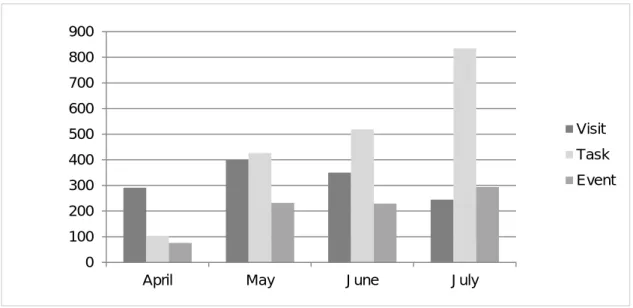
In the second semester, the SAC was successful in promoting new task activities as
Figure 1. LOFT Usage Data for Visit, Task, and Event Activities in Spring Semester 2016
reflected in the usage data in Figure 1 which shows a clear increase in the demand for independent learning materials in spring semester 2016.
Event Activities
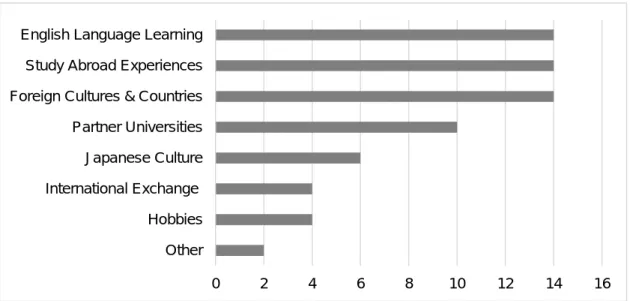
Event activity is the third category of activities available to students at the SAC which highlights the international exchange component as well as the language learning component of the LOFT. Event activities include faculty-led workshops, student-led presentations and activities, presentations by guest speakers, and special events on a wide range of topics advertised in a monthly event calendar. Topics presented in spring semester 2016 have been categorized and include topics about language learning, study abroad, foreign cultures and countries, partner universities, Japanese culture, personal hobbies as well as international exchange activities as shown in Figure 2.
Events geared towards language learning are provided by English teachers and scheduled alongside other activities proposed by student staff members. Initially, there were a limited number of event activities to fill monthly event slots, and thus involved strategic planning and coordination between administrators, English teachers, and student staff members to increase the number and variety of event activities offered. A decision was made to require part-time student tutors and assistants applicants to submit two event proposals with their application materials which were discussed in further detail during job interviews. Before being scheduled into the monthly calendar of
0 100 200 300 400 500 600 700 800 900
April May June July
Visit Task Event
Figure 2. LOFT Events Categorized by Topics in Spring Semester 2016
events, proposals were discussed individually with student staff members to help develop their ideas and prepare for presentations and activities. As a result, the large majority of events scheduled each month are now led by student staff members.
Event Feedback
Once the number of student-led presentations increased, our concern turned toward presentation quality. Specifically, we focused on addressing ways to engage students in the audience by transforming typically one-sided presentations into interactive learning experiences. In an attempt to solve this situation, an event feedback form14 (see Appendix C) was introduced at all events to encourage student participation in the Question and Answer session at the closing of each presentation and activity. Students were asked to write two questions they would like to ask the presenter, three comments about the presentation, and their opinion of the overall presentation using a five-star rating format. The feedback form adds a writing activity component to events and presents an opportunity for student staff members to interact with students in the audience by offering writing support. While many students still prefer to avoid asking questions in front of their peers, the feedback form provides a more deliberated and supportive means of student participation through writing (Mynard, 2011, p. 3) and thus serves as a step towards nurturing an interactive culture at the LOFT. As Tomlinson explains, “Feeling enjoyment, pleasure and happiness, feeling empathy, being amused,
0 2 4 6 8 10 12 14 16
Other Hobbies International Exchange
Japanese Culture Partner Universities Foreign Cultures & Countries Study Abroad Experiences English Language Learning
being excited and being stimulated are most likely to influence acquisition positively
[…]” (Tomlinson, 2010a, p. 89). The questions and comments written by students show that students responded positively to event activities while developing their language skills and global perspectives.
This activity also provided additional benefits. The questions and comments written by audience members offered valuable feedback to the presenters (especially our international student staff) leading the event about how students in the audience were engaged cognitively. The information provided valuable insights prompting a deeper understanding of cultural differences. In particular, the data often showed a marked discrepancy between students’ reticence and seemingly non-verbal behavior during the presentation and their expressive written reactions to the presentation. This was helpful in maintaining the motivation and enthusiasm of student staff. To illustrate this gap, here is a representative list of typical questions and comments from audience members who were not willing to verbally share their questions in front of their peers at an event activity, My Hometown is Brooklyn.
・What is the most famous place in Brooklyn?
・What do you think about Japan compared with Brooklyn?
・How do you think difference between Japanese fireworks and Brooklyn fireworks?
・What famous foods are there in Brooklyn?
・How many Japanese live in Brooklyn?
・Which is the best sightseeing spot you recommend?
・How long Brooklyn Bridge?
・It was so interesting♡.
・Brooklyn has many nice place like bridge, beach, garden, Luna Park, Zoo!
・I want to go there.
・I think Brooklyn is very beautiful city.
・I am surprised at Brooklyn Garden has sakura and hold hanami.
・Brooklyn architecture is very beautiful.
・I can know there are so many places to see and to go.
・The presentation is very nice!
The significance here is that before a written feedback system was implemented, audience reticence was sometimes misinterpreted as cognitive disengagement. This is clearly not the case, and this data allows us to gently address some of the different cultural expectations that might be in play as we prepare presenters and audience for these sorts of event activities.
Calendar
Promotional materials that advertise the SAC’s activities to students took the form of monthly calendars (Kershaw et al., 2010, p. 156). The initial calendar listed all events which included activities and presentations and was designed to draw students’
attention by presenting activities in a visually appealing way. Kinki University’s E-cube monthly activity schedule and other event calendars from English language centers at various partner universities were used as reference for design and content.
When the LOFT was initially established, multiple events led by English faculty, student staff, and guest speakers were scheduled daily to offer a wide variety of event options for students with diverse interests and varying class schedules. A problem encountered with scheduling multiple daily events was low student attendance at some of the activities which was discouraging to English teachers and student staff members who took the time to prepare the event. The decisions made to address this problem were to clearly highlight one main event per day, and to advertise the events to students through the SNS application known as Line, Japan’s most widely used internet messaging service.
In the second semester, the calendar was redesigned to work in unison with the SAC’s streamlined categories of activities: visits, tasks, and events. The calendar featured a monthly schedule of student staff members participating in visit activities, a monthly schedule of English teachers engaging in task activities, and a condensed list of event activities. This design seemed to have been effective when used as a visual aid to explain the three categories of activities to students unfamiliar with the SAC. However, it presented a problem because a complete list of events could not be included in the monthly calendar. Rather than completely revising the calendar format used in the second semester, a decision was made in the subsequent semester to simplify the calendar (see Appendix D) by highlighting one event per day and monthly reminders.
Two new promotional materials were created to compensate for the simplification of the calendar: a separate monthly schedule for English teachers and student staff members (see Appendix E), advertising the comprehensive support available to students at the SAC; and a workshop poster, highlighting the events led by English teachers. Kershaw et al. remind us that “as the center gets bigger, it may be less easy for students to find items so there is need for constant promotion of the materials.
Constant work such as this helps to maintain the positive energy of a SALC[…]”
(Kershaw et al., 2010, p. 158). Promotional materials are continuously assessed and modified to ensure that the materials created effectively inform students of the learning
options available at the SAC.
English Faculty
English faculty members that support the learning environment of the LOFT consist of four tokunin (an abbreviated form of tokutei ninki, meaning “fixed-term contract”) English teachers who each spend two hours a week at the SAC and lead two workshops each semester and six sennin (full-time) English teachers who each conduct counseling sessions and study abroad exit interviews at the SAC once a week during lunch hour. The involvement of English teachers and their contributions of task activities and other independent language learning materials and resources have been crucial in fulfilling the educational aspect of the SAC. Their day-to-day interaction with all students adds to the SAC’s stability and generates a supportive learning environment essential to the success of the SAC. English teachers bear the major responsibility of creating language learning materials as well as correcting task worksheets completed by students. They are also instrumental in bringing the collection of Graded Readers to the SAC and introducing the system used to categorize books by level at the SAC.
LOFT Tutors
Student staff involvement at the SAC is “one way to encourage a maintained focus on learning while developing social relationships at the same time” (Manning, 2014. p. 52). LOFT tutors are international exchange students participating in the Konan University Year-in-Japan (YiJ) Program15, hired for part-time tutoring positions at the SAC to provide peer support. Originally managed by KILC, the tutoring program was transferred to KIEC and expanded when the LOFT was established. Since then, KIEC has taken charge of recruitment as well as the training of students hired for this part-time tutoring position. Job responsibilities of the tutoring positions have broadened to include a wide spectrum of activities ranging from face-to-face peer tutoring to leadership roles such as facilitating groups of students in activities and leading presentations.
Tutors help students improve their English language skills by facilitating casual conversation through the use of games and activities on a day-to-day basis. Tutors also plan special activities and presentations up to two times each semester. Events led by tutors in fall semester 2016 offered many opportunities for students to develop cultural awareness as well as gain global perspectives. The following is a representative list of
actual events that demonstrates the diversity of topics covered: Singapore and Thailand – A glimpse of South East Asia, Learn about Italy, What’s in a Name: Puns and Pokemon, Learn about Lyon in France, Western Australia, Americanized Asian Food, Sights and Sounds of Chicago, Learn about Wales, Hawaiian Music, Beauty in Western vs Asian Societies, The Sport of Wrestling, My Hometown is Brooklyn, Basics of Chess, How to Beatbox & Live Demo, New England in the U.S., University of Hawaii at Manoa, Travel Experiences, Cultural Differences, and Photography.
Recruitment for tutors (see Appendix F) is conducted once a year, and timed at the start of the YiJ program. Tutoring positions offers exchange students the opportunity to interact closely with Konan students at the LOFT. According to data gleaned from application forms, the three most common reasons given for applying for the tutoring positions in September 2016 were: to help Konan students improve language skills; to meet Konan students; and to gain a better understanding of the Japanese culture. In 2016, applications were received from 25 students which represent 86 percent of students participating in the YiJ Program that year. On an average, KIEC hires over 20 exchange students each year. Since the establishment of the LOFT, a total of nearly 50 exchange students representing ten different nationalities (American, Australian, British, Chinese, Ecuadorian, French, German, Indonesian, Italian, and Nigerian) from eleven partner universities have been hired for the tutoring position. Their involvement in the SAC has greatly contributed to the all-English environment and the “on-campus study abroad” experience for Konan students.
LOFT Assistants
LOFT assistants are Konan students who are hired as part-time student staff and possess a higher than average English language ability and generally strong communication skills. A large majority of students hired as assistants have participated in study abroad programs. Assistants demonstrate a strong desire to contribute to on-campus international exchange and work in an all-English environment. Job responsibilities of the part-time assistant positions are similar to the tutoring positions with more emphasis placed on being language learning models for Konan students and less emphasis placed on providing actual linguistic support via tutoring. Assistants offer advice to students gained through personal experience about how to improve English skills and prepare for study abroad. They also serve as initial intermediary “buffers” for newcomers and more hesitant students by joining activities facilitated by tutors together with them. Similar to tutors, assistants facilitate group activities and lead presentations.
Events led by assistants in fall semester 2016 encompassed topics such as language learning activities, study abroad reports, travel experiences, and aspects of Japanese culture. The following is a partial list of actual events offered: My Four Years at Konan, Volunteering in Cambodia, Culture Shock in America, Tips to Study Abroad, My Travels Abroad, How to Use MODAC with a Smart Phone, Windsurfing World Championships in Taiwan, School Life at University of Victoria in Canada, Living with a Host Family, My Experiences in Malaysia, Area Studies in Singapore, Learning English in California, How to Enjoy Studying English, Reasons to Travel, Disney World in Orlando, Study Abroad a Great Opportunity, Japanese Culture Found in America, University of Buffalo, Studio Ghibli and Hayao Miyazaki, Life in Canada, and My Study Abroad at British Columbia. Some activities include the following: Practice Saying Big Numbers, Let’s Learn about SNS Slang, Play Jeopardy, Crossword Puzzles, Let’s Make a Bonsai, Japanese Calligraphy, Learning English with Song Lyrics, Art Therapy, and Learning English from Watching Full House.
Recruitment for LOFT assistants (see Appendix G) is conducted twice a year at the end of each semester, thereby allowing students returning from study abroad to apply for the positions. The assistant position offers students the all too rare opportunity to use their English language skills on campus, beyond the classroom. Over 60 students, representing six of our eight undergraduate faculties (Letters, Economics, Law, Business Administration, Science and Engineering, and the Hirao School of Management) have been hired for the assistant positions since the establishment of the LOFT. On average over 90 percent of students hired for each semester have had study abroad experience.
Data from student application materials indicate that the three most common reasons given for applying for the assistant position were: to improve or maintain English skills, to encourage other students to study abroad, and to make friends with exchange students. Assistants who wish to continue working at the LOFT after their initial semester are required to re-apply. Reasons for continuing to work as an assistant are exemplified by the following excerpt:
I have three main reasons, the first reason is that I would like to motivate the first year students to feel like English is a great tool to interact with people from foreign countries. The second reason is that I would like to keep my English skills sharp. The last reason is that I think it is a good opportunity to give myself a place to share my experience, my interest, and then I think that is going to be so helpful for my future16.
Student Development
Comprised of a multicultural group of students, tutors and assistants play a vital role in creating and maintaining a friendly and supportive learning environment for all Konan students. Functioning as a team, student staff members work together and engage with students individually and in groups while maintaining an environment conducive to learning and international exchange. Manning suggests “encouraging students to interact and collaborate with each other in a learning-centered community of support could be an effective approach to make a SALC environment more dynamic”
(Manning, 2014, pp. 53-54). Student staff members share their experiences with peers while providing the core of international exchange activities that contribute to the on-campus study abroad experience and the internationalization of the university.
Because the SAC relies heavily on student staff, efforts have been made to improve the motivation and enthusiasm of student staff members in order to maximize their effectiveness. Tutors and assistants participated in improved orientation sessions and were asked to write reports reflecting on their experience of leading events (Mynard, 2011, p. 3). In addition, starting in our third semester, newly hired assistants were paired with experienced assistants who served as peer mentors.
Working as tutors at the LOFT gives exchange students the opportunity to interact closely with Japanese students. It is an opportunity for the tutor to learn more about Japanese culture while helping Konan students improve their English skills. The LOFT provides Konan students with opportunities to collaborate with exchange students and interact with English teachers outside the typical classroom setting. It is a valuable opportunity for Konan students, who serve as LOFT assistants, to maintain and improve their English language skills that were gained mostly through study abroad.
Manning reminds us that “students are one of the greatest resources in any given SALC”
(Manning, 2014, p. 54).
Helping Konan students at the LOFT greatly benefits student staff in other ways as well. In the process of working with over 50 student staff members each semester, the growth and development of student tutors and assistants have become increasingly apparent. Student staff members learn how to become self-starters and better leaders as well as problem solvers and team players. Working as a tutor or assistant fosters student development in ways which adhere to the University’s Educational Advisory Board members recommendation to educate students with the
“challenge spirit,” “cross-cultural understanding,” “toughness,” “the power to act independently,” and “ability to communicate in English” that are all deemed as
necessary for today’s global society (KONAN U. VISION 2020, p. 7).
Advertisement & Promotion
From the beginning, strategic promotion of language learning and international exchange activities through visually appealing materials was given importance in order to effectively inform students of the programs available to them at the center.
Promotional materials were created and modified in order to keep up with the growth of the SAC which directly helped to speed its establishment and development. Organizing and promoting KIEC on-campus international exchange activities and programs for students has proven to be a solid foundation for creating the promotional materials used to effectively advertise the various aspects of the LOFT.
Promotional materials are disseminated to students by KIEC administrative staff members in a variety of ways. Promotional materials are sent in digital form to students via the university-wide network system known as My KONAN, as well as to students registered in KIEC’s Ajisai Club mailing list. The materials are also posted on digital signage bulletins on campus, to the KIEC website, and to the Konan University Global Zone Porte page on Facebook. Poster-size hard copies of promotional materials are posted in prominent areas of the Global Zone Porte itself, and leaflets are made available for students and faculty members at the SAC.
In our second semester, a budget for a Line account was approved by the University as a means to advertise daily events. Notices are posted on Line twice a week in Japanese to reach a wide student audience, including students who otherwise might not make the effort to read the information in English. Currently nearly 700 students sign up to receive these regular updates. Line is proving to be an effective means to promote activities and increase the accessibility of the SAC.
Currently in its final editing stages, a new Global Zone Porte page on the KIEC website is scheduled to go online in January 2017. Brief summaries of events led by student staff members will be made accessible on the new format and this will help to promote transparency of the SAC’s activities as well as bring greater attention to the contributions made by student staff members.
Finally, recent presentations given at the Japan Association for Self-Access Learning (JASAL) Conference 201617 at Konan Women’s University and the Japan Association of College English Teacher (JACET) Kansai Chapter 2016 Fall Conference18 at Kansai Gaidai University have also helped to publicize the LOFT to academics and administrators beyond the confines of our own university.
Future Direction
Through the continued integration of the KONAN Language LOFT’s two functions, administrators of the LOFT plan to further develop and refine the ways in which we provide quality learning opportunities that help to improve not only English language skills, but also help to improve the sort of face-to-face communication skills that are becoming increasingly endangered as society becomes more and more dependent on digital forms of communication. As Mach predicts “Emphasizing human-centered learning” and “focusing on something that our students cannot easily find elsewhere is what will ultimately prove most attractive: namely, a welcoming and supportive English learning community beyond the classroom” (Mach, 2015, p. 21).
We also plan to call on the collaborative efforts of administrative staff and faculty members from each corner of the university in order to provide a wider range of relevant learning materials and resources tailored to students belonging to each department. And finally, the LOFT will remain an open and inviting facility that embraces inclusivity by striving to continue to improve our already supportive learning environment. The KONAN Language LOFT is dedicated to student growth and development and will continue to celebrate student diversity as it welcomes the active participation by all students, faculty, and administrators associated with the University.
Acknowledgements
The author would like to acknowledge the collaborative efforts of the other principle administrator, KILC English professor and KIEC Advisor Thomas Mach for his invaluable support and leadership throughout the implementation process.
References
Benson, P. (2001). Teaching and researching autonomy in language learning. Harlow Longman / Pearson Education.
Cranker, K., & Servals, N. (2013). A move towards autonomy: Individualized education
plans for effective materials use. Studies in Self-Access Learning Journal, 4 (2), 96-124.
Kershaw, M., Mynard, J., Promnitz-Hayashi, L., Sakaguchi, M., Sloboniuk, A.,Stillwell, C., & Yamamoto, K. (2010). Promoting autonomy through self-access materials design.
In A. M. Stoke (Ed.), JALT2009 Conference Proceedings. Tokyo: JALT.
KONAN U. VISION 2020 -甲南新世紀ビジョン- (2017.2公開予定). p. 7.
Mach, T. (2015). Promoting learner autonomy through a self-access center at Konan University: from theory to proposal. The Journal of the Institute for Language and Culture, 19, 3-29. (A Konan University Journal.)
Manning, C. (2014). Considering peer support for self-access learning. Studies in Self-Access Learning Journal, 5(1), 50-57.
Mynard, J. (2011). The Role of the Learning Advisor in Promoting Autonomy. Learner Autonomy in Language Learning, January 2011.
Reinders, H. (2010). Towards a classroom pedagogy for learner autonomy: A framework of independent language learning skills. Australian Journal of Teacher Education, 35 (5), 40-55. Retrieved from http://ro.ecu.edu.au/ajte/vol35/iss5/
Tomlinson, B. (2010). Principles and procedures for self-access materials. Studies in Self-Access Learning Journal, 1(2), 72-86.
Tomlinson, B. (2010a). Principles of effective materials development. In N. Harwood (Ed.), English language teaching materials: Theory and practice (pp. 81-108).
Cambridge: Cambridge University Press.
Footnotes
1) The KONAN Global Barrier Free Project is one of eight main elements that comprise the university-wide strategic initiative, the KONAN Premier Project.
2) The Ajisai Room was originally established in 1976 for exchange students participating in the Konan-Illinois Program. Since then, to accommodate the expansion of the program, the location of the Ajisai Room was previously moved once before finally settling in the Global Zone Porte. The program’s name has also been changed to
the Konan University Year-in-Japan Program and welcomes exchange students from partner universities.
3) The Global Learning Commons shares the open space of the Global Zone Porte with the Ajisai Room and Konan Language LOFT. Students can enjoy studying or talking together in an intercultural atmosphere.
4) The KONAN Premier Project enacted by President Yoshiyuki Nagasaka, the 17th president of Konan University, is a comprehensive university-wide strategic initiative comprised of 8 projects and over 40 subprojects aimed to revitalize the university’s educational mission and marks Konan Gakuen’s 100th anniversary in 2019.
5) This figure is the number of times students have signed in to participate in activities and does not imply 14,000 individual students.
6) Kinki University’s English Village, E-cube website: http://www.kindai.ac.jp/e-cube/.
7) LOFT is an acronym for Language Opportunities For Today.
8) Chat boxes are small boxes full of cards on which are written questions contributed by English teachers on a variety of topics. Students use this activity to facilitate language learning.
9) The name of the course was originally Kiso Eigo ⅡB. In April 2016, the name of Kiso Eigo ⅡB was officially change to College English Speaking.
10) Hop programs are on-campus exchange activities. Step programs are short-term study abroad programs at English Language Centers, one-week Area Studies programs, and Japan Studies courses offered through the Year-in-Japan Program. Jump programs are semester or year-long study abroad and exchange programs.
11) The KONAN Global Certificate program was established in 2015. In the first year, eight LOFT Assistants representing four undergraduate faculties (Letters, Economics, Business Administration, and Law) were awarded the Certificate and recognized by the University. Promotional material was created to advertise the program which was slightly revised by KIEC staff members.
12) Associate Professor Ryo Nagata from the Faculty of Intelligence and Informatics was instrumental in issuing ID numbers and passwords which made it possible for students to access the writing support system when utilizing the LOFT.
13) Overreliance on games and activities that could be said to appeal exclusively to extroverted students who enjoy or feel confident to participate in group activities or engage in face-to-face communication proved to be a concern, and led to the addition of another language learning option at LOFT in the second semester. A DVD player and 100 DVDs were borrowed on trial from the KILC Multi-Media Center and placed in the periphery of LOFT. Students are able to watch movies individually or with friends, with
or without earphones depending on their own comfort levels with surrounding activities and noise level. Categorized as a task, students are asked to rank and write their comments about the movies on a worksheet to serve as reference for other students. In that semester, 154 students utilized LOFT for the purpose of watching movies. Although the current semester has not ended, the number has increased to 250 in the first three months alone.
14) The event feedback form was made by Hana Suzuki (a KIEC staff member who assists with day-to-day operations of LOFT) after we discussed the situation and decided that it would help encourage students’ participation at events.
15) Konan University Year-in-Japan Program was established in 1979 with the Illinois Consortium as the Konan-Illinois Program. Since then, the program has grown to accept students from additional partner universities. The program welcomes approximately forty to fifty exchange students from overseas partner universities each year.
16) This excerpt was submitted by Takahiro Ishihara, a fourth-year student who contributed greatly as a LOFT assistant for three semesters. It is included in the text with his written permission.
17) Professor Thomas Mach and I collaborated on a presentation on “Lessons Learned About Effective Organization and Promotion During a Large Scale SAC’s First Year”
presented in December at the JASAL Conference 2016.
18) Ayako Kobayashi, a KILC tokunin English teacher, and I collaborated on a poster presentation on “Thoughts on Making a Self-access Center More Accessible to Every Student” presented in November at the JACET Kansai Chapter 2016 Fall Conference.
Appendix A1
Tri-fold Yellow Stamp Card Used in Conjunction with Freshmen English Speaking Courses in 2016 Fall Semester
(Front) (Back)
Note: The initial yellow stamp card made for the freshmen English speaking course was revised to reflect the modifications made to the stamp system in subsequent semesters.
The tri-fold card replaced the original half-fold stamp which served as a record of activities that students participated in at the LOFT.
Appendix A2
Tri-fold Blue Stamp Card Used in Conjunction with the KONAN Global Certificate Program in 2016 Fall Semester
(Front) (Back)
Note: The tri-fold blue stamp card was revised to further promote the KONAN Global Certificate and includes information about where students can find information relating to the LOFT.
Appendix B
Poster for the KONAN Global Certificate Program
Note: The poster used to promote the KONAN Global Certificate program to students advertises the LOFT blue stamp card as one way to fulfill the requirement for on-campus international exchange.
Appendix C Event Feedback Form
Note: The event feedback form was incorporated as a writing activity to encourage student participation during the Question and Answer session at events.
Appendix D
Monthly Event Calendar for December 2016
Note: The monthly event calendar revised in the LOFT’s third semester highlighted the daily events led by English teachers and student staff members.
Appendix E
LOFT Schedule of English Teachers and Student Staff members in 2016 Fall Semester
Appendix F
Recruitment Poster for Part-time LOFT Tutor Positions
Appendix G
Recruitment Poster for Part-time LOFT Assistant Positions