How students utilize new English conversation skills in an English-only class.
Jason WICKSTRUM
Learning Support Center Okayama University of Science,
1-1 Ridai-cho, Kita-ku, Okayama 700-0005, Japan
This study analyzes how much students incorporate newly learned English skills versus relying on the English they learned before studying at the university level. This study will focus on conversation skills learned in an English-only class at Okayama University of Science. At the beginning of their first year at the university, students were given an assignment with short written conversations. Parts of the conversations were missing and they were asked to write the missing parts. At the end of their first year, they were given the same assignment, and the two entries were compared to their earlier entries to establish if they were using more conversational words and phrases that had been taught in the class.
本稿は、大学レベルでの英語学習が始まる前に身に着けた英語表現に対して、学生が大学で新たに学ん だ英語スキルをどれだけ活用しているのかについて分析することを目的とする。本研究は、岡山理科大学におけ る英語のみで行われる英語クラスで学んだ会話スキルに焦点を当てる。大学1回生授業の学期の初めに、学生は 短い英会話のライティングの課題を与えられた。その英会話は一部が空所となっており、学生はその空所を埋め るために自由記述をするように指示された。そして、1回生の初めに課されたこのタスクを、学生は1回生授業 の学期の終わりにもう一度課された。それにより、1回目に課されたタスクに比べ、2回目に課されたタスクに おいて、当該の英語授業にて学んだ会話表現の語彙やフレーズをより多く活用していたかどうかを分析した。
Keywords: English-only, conversation skills, Communicative English, 発信英語
Introduction
First year students at Okayama University of Science are required to take a year long English course called Communicative English (発信英語), which is taught by a native English speaker using only English. In the spring semester, students take Communicative English I followed by Communicative English II in the fall semester. Each semester consists of 16 classes which are held once a week for 90 minutes. The textbook for the course, Stretch Starter (Oxford University Press) has basic level grammar and vocabulary, but there is often additional information and activities provided by the teacher. Most of the class activities, whether from the textbook or from other sources, focus primarily on conversation skills, which usually involves lots of listening and speaking practice, but there are also some reading and writing tasks that encourage the students to think about different ways to start and continue conversations. Conversation skills include common phrases used in conversations and various strategies for continuing a conversation in English.
One of the purposes of the Communicative English class is to encourage students to use English, especially in conversations. And while most of the vocabulary and grammar used in the class are probably not new for the students, they are expected to use the vocabulary and grammar in a conversation, which many of them have not done in the past. There is no conversation, or even speaking, component of the university entrance exam, and they probably did not have any conversation tests during their high school studies, so many of the
(Received October 23, 2020; accepted December 11, 2020)
conversation skills taught in Communicative English are new for the students, even if the words and grammar are not necessarily new.
In the Communicative English classes taught by the author, the students do not have a conversation test in the first semester (Communicative English I), but they study sample conversations and do lots of practice with asking and answering questions in pair activities, including some conversation practice. Then, in the second semester (Communicative English II), they have conversation tests in Week 7 and Week 15 where they have a 3 minute conversation with another student in English. Throughout both semesters, students often do an activity called “finish the conversation” where they are given the first part of a conversation in writing and they have to write the rest of the conversation. Students can write many different things to finish the conversations, but they are told to write sentences that fit grammatically and thematically with the first part of the conversation that is given to them. Although this is a written activity, it encourages students to think about ways to continue conversations, and it is often a pair activity, so two students work together to write the rest of the conversation and then they memorize and perform their conversation in front of the teacher. However, the “finish the conversation” assignment that was analyzed for this study was not a pair activity. Students were expected to complete the activity alone and without the use of a dictionary or smartphone. Additionally, the assignment analyzed for this study was a simplified form of the “finish the conversation” activity where the conversations were only 3 lines each and students had to write just one or two sentences for each conversation.
Many students seemed to be utilizing the conversation skills taught in Communicative English based on general observation during pair work in the classroom. In an attempt to quantify the extent to which students were incorporating the conversation skills taught in the class into their knowledge base, the simplified “finish the conversation” assignment described above was given at the end of the school year. However, some students may have already known some of the conversation skills taught in the course, so as a base line, they were given the same assignment at the beginning of the school year on the first day of class. Ideally, their conversation skills would have been assessed by an oral conversation test at the beginning and end of the school year, but giving them an oral conversation test in the first week or two of class would have taken an entire class period and would have been quite stressful for the students, especially since many are already nervous about taking an English-only class. The students are eased into having English conversations over the course of the first semester, since many of them have not had much English conversation practice in the past.
The “finish the conversation” assignment at the beginning and end of the school year was analyzed for the use of specific conversation skills taught in the class, as well as for correct use of grammar. It was hoped that at the end of the school year, the students would incorporate the conversation skills taught in class and make fewer grammar and tense mistakes as an indicator that their English skills were continuing to improve rather than them just continuing to rely on the English that they learned before entering the University.
Methods
The short conversations analyzed in this study were given in writing to the students on a worksheet (see Appendix 1) during class and they had to write sentences in the blanks during the allotted time in class (about 10 minutes). They were not allowed to use dictionaries or smartphones. They were told to use English words and grammar that they know. The task was not anonymous, so it was possible to make sure that any student included in this study completed both of the assignments (the first one at the beginning of the school year and the second one at the end of the school year). Students were excluded from the analysis in this study if they received an “D”
or “E” grade in Communicative English I or II, since a grade of “D” (below 60%) indicates that they were not paying attention in class and a grade of “E” means they did not attend a sufficient number of classes. Also, students who left more than one empty blank space on either assignment were excluded since this suggests that they weren’t trying to do the assignment properly. One empty blank was considered acceptable because it suggests they tried to do the assignment, but could not come up with a sentence for just one of the blanks. Based on the criteria above, a total of 62 students were included in this study.
For this analysis, each blank in the short conversations was given a specific code (see Appendix 1). For example, there was only one blank in Conversation #2, so it is referred to as Blank 2. Some conversations had two blanks, so the first blank in conversation #4, for example, is referred to as Blank 4A and the second blank is Blank 4B. Blank 1 and Blank 5B were not included in this analysis. Each blank was analyzed based on the following categories with a score of one or zero (no fractions) for each category, where applicable.
(1) Class skills: One point was given if the sentence used a set phrase or specific grammar point that was covered in class (minor grammar mistakes that did not affect the meaning of the sentence were still given one point). A score of zero was given if the sentence used a phrase or grammar point not covered in class.
More details for each blank are given below. There were a total of 9 blanks analyzed for “Class skills”.
(2) Grammar: One point was given if there were no grammatical errors within the sentence. Each sentence is evaluated by itself, not in the context of the rest of the conversation, so the sentence could get one point even if it did not match the tense of the other parts of the conversation. Misuse of “a” or “the” was considered acceptable as the use of articles was not covered in this class and is a difficult topic for even advanced English learners. A score of zero was given if the sentence contained grammatical errors, including errors in the use of singular and plural nouns. There were a total of 9 blanks analyzed in the category of “Grammar”.
(3) Tense: One point was given if the sentence fit the tense of the other parts of the conversation. The sentences written by students did not always have to be in the same tense as the rest of the conversation as long as it was compatible with the rest of the conversation. For example, “How about you?” does not have a clear tense, but it is compatible with various tenses. Non-tense related grammar errors were not evaluated in this category since they were included in the “Grammar” category. There were a total of 9 blanks analyzed for “Tense”.
(4) Wh- questions: One point was given for questions that used the correct Wh- word (what, where, who, how often, etc.), even if the question contained other errors. If a yes/no question or other type of sentence was used that could fit the rest of the conversation, one point was given. A score of zero was given if the wrong Wh- word was used, or if a yes/no question or other type of sentence was used that did not fit the rest of the conversation. This category was only for Blank 3, 4A, 5A, and 7A for a total of 4 blanks analyzed for “Wh- questions”.
Additional information about “Class skills” for individual blanks:
- For Blank 2, the target class skills included: “I (present tense verb) _____.” or “I like to (present tense verb) _____.”
- For Blank 3, the target class skills included: “What is your favorite movie?” or “What movie(s) do you like?”
- For Blank 4A, the target class skill was: “Where are you from?”
- For Blank 4B, the target class skill was: “How about you?”
- For Blank 5A, the target class skills included: “What sports do you like?” In Communicative English II, students were told that they should not say “kind of sports”, so “What kind of sports do you like?” is not a “class” phrase.
- For Blank 6, the target class skill was: “I study (English) _____ times a _____”
- For Blank 7A, the target class skills included: “Where did you go?”, “What did you do?”, or “Who did you go to Tokyo with?”
- For Blank 7B, the target class skills included: a simple response (aka rejoinder) that could be followed by additional information but was not required to. Some examples taught in class: “That’s great!”, “That sounds nice”, “Terrific!”, “I see”, etc.
- For Blank 8, the target class skills included: “I’m going to (present tense verb) _________.”
The scoring described above only applies to the analysis for this study. For the students' actual grades on this assignment, grading was based only on effort and completion, so that any student who completed the assignment as directed received a grade of 100% on the “finish the conversation” assignments.
Results
The main focus for analysis was the “Class skills” category since the main purpose of this study is to see if students are incorporating conversation skills from class into their conversations. As mentioned above, students may have already learned some of the conversation skills taught in class, so the “finish the conversation”
assignment on the first day of class provides the baseline for comparison. As explained in the Methods above, for this analysis, a student was given a score of 1 if they used a conversation skill taught in class, or they were given a score of 0 if they did not. The highest possible score for an individual student was 9. As shown in Figure 1, the average “Class skills” score was 4.8 (52%) at the beginning of the school year. Looking at the blanks individually, the highest average score was Blank 7B with 78% and the lowest average score was Blank 6 with 13%. When the students did the same assignment at the end of the school year, the average “Class skills” score was 7.6 (84%), which was an increase of 32% including an increased average score for all blanks. Individually, Blank 2 had the highest average score with 94% and Blank 6 again had the lowest average score with 68%, however that was a substantial improvement from the 13% at the beginning of the school year.
The “Grammar” category was analyzed to look for an additional sign that students were making an effort to improve their English. The grammar used in the “finish the conversation” activity was based on grammar covered in Communicative English I and II, which is relatively low level grammar that they should have already learned in middle school or high school. However, some students appear to have forgotten past grammar lessons or they may not have attained proficiency when they first learned it. Nevertheless, it was expected that the average
“Grammar” score would be better than the average “Class skills” score at the beginning of the school year. And this was the case with an average “Grammar” score of 5.5 (61%) at the beginning of the school year (Figure 2).
Individually, the highest average score was for Blank 7B (84%) and the lowest average score was for Blank 6 (41%) The average “Grammar” score at the end of the school year was 7.2 (80%), so there was substantial improvement over the course of the school year. Individually, there was improvement for all of the blanks except Blank 7B, which had the highest average “Grammar” score at the beginning of the school year, so there was not much room for improvement.
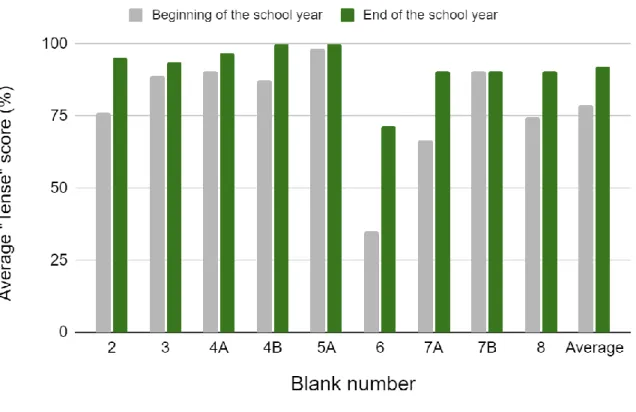
The “Tense” category was another way to look for improvement in basic English skills (Figure 3). The average “Tense” score at the beginning of the school year was 7.1 (79%), which was much higher than the average
“Class skills” and “Grammar” scores, so there was less room for improvement in the “Tense” score. However, there was improvement that resulted in an average “Tense” score of 8.3 (92%) at the end of the school year.
Furthermore, the “Tense” score for all of the blanks was 90% or above at the end of the school with the single exception of Blank 6 (71%).
The “Wh- questions” category only applied to four of the blanks and there was very little change over the course of the school year as the students did well at the beginning of the year. The average “Wh- questions”
score at the beginning of the school year was 3.7 (93%) compared to 3.8 (94%) at the end of the school year (Figure 4).
The results in this study were reorganized into 2 groups (A and B) for additional analysis based on the average grades of the 62 students in Communicative English I and II. In Group A, the results of the 31 students with the highest average grade in Communicative English I and II were analyzed separately from Group B, which used the results of the 31 students with the lowest average grades. The average scores on the “finish the conversation” assignment, as analyzed in this study, correlated with the average grades of the students. In other words, the Group A average scores in this analysis were higher than Group B average scores at both the beginning and end of the school year (Table 1). Both groups showed improvement in their scores with Group B showing greater improvement.
Conclusion
The results of this study show that students did utilize English conversation skills that were learned over the course of their first year at Okayama University of Science. Furthermore, even though the vocabulary and grammar level used in Communicative English I and II are relatively low, the students were still able to show noticeable improvement in grammar accuracy in the “finish the conversation” activity. These results also support the general observation that the students’ actual English conversations improve during their first school year at the university. And looking specifically at the “Class skills” category, the analysis suggests that students are incorporating the lessons taught in class into their English conversations.
The results of this study are also helpful in identifying grammar points that are most difficult for the students, so that more focus can be placed on those topics in the future. For example, in the “Grammar” category, it appears that students had most trouble with Blank 6. For this blank, the students were supposed to write a sentence like, “I study English once a week” or some other frequency, but many students were not able to properly express a frequency for an activity in English. And while there was significant improvement over the course of the school year, the average “Grammar” score for Blank 6 was still relatively low (71%) at the end of the school year. Therefore, it would be beneficial to spend more time on this grammar point in the future.
It is possible that student improvement was actually greater than indicated in this study because some students had high “scores” at the beginning of the school year, so there wasn’t as much room for measurable improvement. In other words, a student with a relatively high English level wouldn’t show much improvement in this study even though a high level student would be more likely to pay attention and try to incorporate new English skills. The scoring used in this analysis was not part of the students’ grade in Communicative English I and II, but the results in Table 1 show that Group A students (those with higher average grades in Communicative English I and II) had higher scores on the “finish the conversation” analysis in this study. However, Group B students showed more improvement over the course of the year, probably because they had more room for improvement, as mentioned above. Regardless, it is encouraging to see that even students who did not get high grades in the class still managed to significantly improve their English. In fact, looking at individual students at the beginning and end of the school year, 57 students (out of 62) showed improvement of 1 point or more in the
“Class skills” category and the remaining 5 students showed no change. In the “Grammar” category, 45 students showed improvement of 1 point or more, 10 students showed no change, and 7 students had a decrease of 1 point.
In the “Tense” category, 41 students showed improvement of 1 point or more, 19 students showed no change, and 2 students had a decrease of 1 point.
In the future, it may be useful to record the students’ conversations during the conversation tests that they take in Communicative English II and then transcribe the results for additional analysis. However, since there are no conversation tests at the beginning of the school year, it would be difficult to measure their improvement over the course of the school year.
Figure 1. The average “Class skill” score from each blank of the “Finish the conversation” assignment.
Figure 2. The average “Grammar” score from each blank of the “Finish the conversation” assignment.
Figure 3. The average “Tense” score from each blank of the “Finish the conversation” assignment.
Figure 4. The average “Wh- question” score from each blank of the “Finish the conversation” assignment.
Table 1. The average “Class skills”, “Grammar”, and “Tense” scores (shown as a percentage) of two groups of students, based on the analysis used in this study. The groups are based on the students’ average grades in
Communicative English I and II, with Group A containing the 31 students who had the highest average grades and Group B containing the 31 students with the lowest average grades.
Beginning of the school year Class skills Grammar Tense
Group A 62 69 85
Group B 42 53 72
Overall 52 61 79
End of the school year
Group A 90 85 96
Group B 80 75 89
Overall 84 80 92
Appendix 1. The “Finish the conversation” assignment given to the students at the beginning and end of the school year. The Blank numbers were not on the students’ worksheets.
Do this activity by yourself. Finish the conversations below.
- Don’t use a dictionary or smartphone
Conversation #1 Conversation #2
A) Hi there, my name’s Scott. A) What do you do in your free time?
B) Hello, I’m John. It’s nice to meet you. B) _________(Blank 2)__________.
A) ____(Blank 1 - not analyzed)______. A) Nice! I also like to read books.
Conversation #3 Conversation #4
A) __________(Blank 3)__________? A) _________(Blank 4A)__________?
B) My favorite movie is The Avengers. B) I’m from Himeji. ____(Blank 4B)__?
A) That’s my favorite movie, too! A) I’m from Yamaguchi.
Conversation #5 Conversation #6
A) __________(Blank 5A)__________? A) How often do you study English?
B) I like basketball and tennis. B) __________(Blank 6)__________.
A) Really? __(Blank 5B - not analyzed)__. A) I see. You should study more often.
Conversation #7 Conversation #8
A) _________(Blank 7A)__________? A) What are you going to do this weekend?
B) I went to Tokyo with my friends. B) __________(Blank 8)___________.
A) _________(Blank 7B)__________. A) That sounds like fun.