Abstract
This paper focuses on the strategies in translation for child readers. When translations are created, translators more or less target a particular readership. The diversity in translations can arise from the selection of readers. This is due to the fact that translators apply different strategies to their translations. The aim of this paper is to investigate what strategies are used in a translation for child readers and to reveal the translator’s intention. For the examination, this paper makes use of two translated versions of Alice’s Adventure in Wonderland by Lewis Carroll as research materials. One is translated for a general audience and the other is for children. Comparing these materials through Critical Discourse Analysis, this paper finds intentional strategies in the translation for child readers.
1. Introduction
In recent years, translations have been an important means to assist the users in understanding foreign language activity. Many people use translation not only for grasping the situations in the world but also for enjoying literary works published all over the world. Historically, many researchers have created some classifications of strategies to reveal the translator’s orientation to their translations. For example, according to Nida (1964), when translators translate, they employ adjustments such as addition, abbreviation and interchange in them. However, the issue in reliability may arise as the adjustments arguably create diversity in translated texts. That is, different translations can be made from a work depending on strategies used by a translator, which can cause
A Critical Discourse Analysis of Translation Strategies for Child Readers
Naruya ABE
misunderstandings. Thus, it should be noted to what extent their adjustments change the original meanings.
The aim of this paper is to explore why the translator utilizes particular ideological strategies, especially focusing on the strategies employed in translating a foreign language for children. In order to examine the translator’s strategies, this paper makes use of Critical Discourse Analysis (CDA) as a methodology. This analytical method can clarify the ideology hidden in texts through observing the process of producing texts. This research is conducted in the framework of the theory proposed by van Dijk (1993). The features in his method focus on grammatical items. The translation more or less reflects the translator’s vocabulary and grammar. Therefore, by combining translation studies and the CDA method, it may be possible to offer a detailed analysis of strategies in translation studies.
2. Methodology
2.1 Translation Studies
Studies related to translation emerged in the 1960s and the academic area was called translation studies in 1972. A lot of approaches to the translation have been offered from several perspectives such as equivalence and norms. Many researchers have attempted to understand translations, utilizing these theories and new ideas. Translators apply strategies to their translations so that they may adjust the source language to the target language. According to Lörscher (1991), when certain translators have a problem in the process of creating their translations, they use these strategies to solve the problem.
Since each translator has different problems, the use of strategies is up to translators.
Because of the differences, the diversity of translation can occur. Therefore, text analysis is necessary to find strategies in translations.
On the other hand, Chesterman (2005) pointed out the problem of the theory
Lörscher had proposed. It means that although each translator deals with different
problems and comes up with different solutions, reseachers consider that the same
strategies are employed in their translations. Lörscher identified the fault of his argument
and restated new ideas: Researchers should analyze strategies in translations based on
the particular strategies they have already known (Lörscher 2005). It shows clearly that researchers must have hypothesis or inference of strategies before investigating strategies in translations.
According to Lörscher (1991), strategies seem to be divided into global and local.
A global strategy generally determines the style of translated texts and highlights or restrains the source text features. On the other hand, a local strategy influences grammatical items and structures in translation.
Regarding a global strategy, literal translation and free translation had been discussed historically as the dominant idea in translation studies. Literal translation is called word- for-word translation and it replaces source words with target words as similar as possible.
Meanwhile, there are various definitions of free translation. It contains translations such as the one based on phonological features and the one made for several media.
Furthermore, assimilation and dissimilation offered by Venuti (1995) made a significant impact on the global strategies. These strategies alter the relationship between readers and authors. The attempt of assimilation is to lead readers to the authors’ culture. Venuti considered that it was possible to constrain ethnocentrism in translations. He claimed that it was one of the ways of intervention between unequal cultural interaction through translations. On the other hand, dissimilation makes authors closer to readers. The goal of dissimilation is to produce a translation that is easy to read for target language readers.
In local strategies, many scholars have advocated several ideas. Nida (1964) claimed that the purpose of adjustments used by translators is as follows: to adjust the form of source texts to the structure of target language, to create the equivalent structure semantically, to produce appropriate stylistic equivalence and to deliver the equivalence to readers. Moreover, He divided the adjustments into the three kinds of procedures:
addition, abbreviation and substitution. The procedure of addition is used by explaining what source texts mean when the contents of source text cannot be understood by the target readers and source texts need to be corrected grammatically in the target language.
In the procedure of abbreviation, repetitions and unnecessary cultural information
tend to be deleted and grammatical items such as conjunctions and idioms also can be
eliminated to achieve equivalence as much as possible. The procedure of substitution
occurs typically when parts of speech change, for example, from noun to verb. Moreover,
the procedure contains the reconstruction of word order, structure and paragraph under the target language grammar.
After the 1990s, a number of researchers have analyzed translations from several frames. In these perspectives, Chesterman (1997) considered that translators use strategies theory not only to solve their problems but also to produce best translations.
It shows that the study of strategies has to be developed to investigate the translations in more detail.
2.2 Critical Discourse Analysis
Critical Discourse Analysis (CDA) developed from critical linguistics in Discourse Analysis. Critical linguistics was initiated by Roger Fowler in the 1970s, the central notion of which is to reveal social structure and power. On the other hand, there is also systemic linguistics developed by M.A.K. Halliday. The field focuses on the language use in social structures. In systemic linguistics, it is argued that the speakers may determine the grammar of a language depending on their intention (Halliday 1973) and that there is ideology behind the decision. Fowler applied systemic linguistics to critical linguistics.
As a result, the purpose of the study is to clarify the ideology hidden in language-use produced in society.
Recently, Norman Fairclough and Teun A. van Dijk have expanded the fields as CDA. They focus on power and inequality in text and talk. According to van Dijk (1993), the aim of CDA is to oppose the inequality in society by understanding the situation.
There are various levels of discourses which produce inequality such as gender, race, class and hegemony. He claimed that those who have dominant power indirectly can control the group through each discourse. They can decide the topic of discourse as well as the amount of information. For example, journalists can control the media discourse and lead the readers to the intention of journalists. Therefore, in order to reveal the inequality and to resist the suppression, it is necessary to analyze particular texts.
Van Dijk proposed two methods both at the macro level and at the micro level.
The first analysis focuses on the organization and structure of texts. It shows us the type
of discourse. The second analysis pays attention to syntax and lexis. Researchers must
investigate what the grammatical features mean.
2.3 Children’s Literature
There have been historical arguments about the definition of children’s literature. The definition is still vague; it can be defined by the writers’ intention or the actual readers.
However, it is clear that there are adult writers involved in the process of producing children’s literature. Literature is regarded as a form of communication between authors and readers. That is, children’s literature always involves the communication between adults and children. The fact that adults write literature for children is a key to defining children’s literature. (O’Sullivan 2000). Adults and children are different in the amount of experience they have in life. Children have not had enough experience in terms of the language skills and knowledge, so adult writers must adjust the texts to let children understand the words and events depicted in the literature. Therefore, children’s literature can be defined as the literature that adults create for children.
The same goes for the translations for child readers. However, translators must take care of another factor; translators are required to understand the point of view of children and adapt the source text to target text for child readers. In regard to the adaptation, when translators work on a translation for child readers, they must take into consideration that the target text reflects the features of the source text such as verbal play and rhyme. According to Hollindale (1997), children are considered to have childness and it is defined as “the quality of being a child…dynamic, imaginative, experimental, interactive and unstable”. If the factor such as verbal play and simple expressions in target language is in harmony with translated texts, the texts will succeed as the translations for child readers. That is, it can be said that the readability is an important factor in translations for children.
3. Research Design
3.1 Research Materials
To research these strategies, I make use of two Japanese versions of the English book
titled Alice’s Adventure in Wonderland (1865) by the British writer Lewis Carroll. While both
materials are translated by Shoichiro Kawai, each book is written for different audiences.
One Target Text 1(TT1) is for a general audience, and the other Target Text (TT2) is for children. TT2 is based on TT1 and the vocabulary used in TT2 is almost the same as the one in used TT1. Therefore, by comparing these two texts translated by one translator and observing the different parts in these texts, this paper investigates the strategies used in translating for children.
3.2 Research Method
My main research is to offer a detailed statistical analysis of the translation for children.
For the investigation, this paper shows the frequency of the strategies found in my research materials. The classification of strategies is based on the Nida’s theory:
addition, deletion, interchange and substitution. Furthermore, the information regarding grammatical features is added to the classification of the strategies (e.g. noun, verb, adjective, adverbial, auxiliary, case, conjunction, reporting clause, reported clause, complete sentence, incomplete sentence, paragraph, repetition, colloquial expression, onomatopoeia)
(1). That is, my paper investigates which grammatical items change in a strategic manner. The implications of my research will be given in discussion section.
4. Results
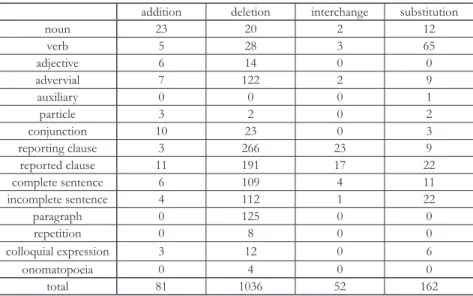
Observing the two Japanese versions, this paper found the differences in them. Table 1 summarized the findings of frequency of strategies Shoichiro Kawai used in the TT2. A total of 1,332 examples were found. Deletion got the highest score in the four categories.
There were more than 1,000 deletions in the TT2, and especially the item ‘reporting
clause’ like Alice ga iu (Alice says) was deleted most frequently. On the other hand,
substitution occurred 162 times in the TT2. In the category, verbs were substituted for
another verb, for example, from iu (to say) to kotaeru (to answer), from the verb anshōsuru
(to recite from memory) to tonaeru (to recite without remembering) and from ossharu
(the polite form of iu) to iu (to say). Moreover, there were 81 additions in TT2 and 21
nouns were added into TT2. These nouns mainly served as subjects. Lastly, the number
of interchange was the smallest in the four categories. The frequency was found with 52
occurrences.
addition deletion interchange substitution
noun 23 20 2 12
verb 5 28 3 65
adjective 6 14 0 0
advervial 7 122 2 9
auxiliary 0 0 0 1
particle 3 2 0 2
conjunction 10 23 0 3
reporting clause 3 266 23 9
reported clause 11 191 17 22
complete sentence 6 109 4 11
incomplete sentence 4 112 1 22
paragraph 0 125 0 0
repetition 0 8 0 0
colloquial expression 3 12 0 6
onomatopoeia 0 4 0 0
total 81 1036 52 162
Table 1: The frequency of strategies and grammatical items in TT2
5. DiscussionAs is shown in the previous section, there were a number of adjustments in TT2 for child readers. Readability is to some extent necessary for children to understand a book as explained in section 2. Since the adjustments depend on the translator, this paper investigates how the translator creates the readability.
First of all, deletion occurred most frequently. In order to let the TT2 readers understand the story more easily, the translator simplified TT1. In the category of deletion, the item ‘reporting clause’ like Alice ga itta (Alice said) was deleted frequently.
We can see the following examples. There was the item ‘reporting clause’ in the original text, and the item ‘reporting clause’ remained in the translated version for general people.
However, in the version for child readers, the ‘reporting clause’ was deleted.
Original Text:
‘Not quite right, I’m afraid’ said Alice timidly;
‘some of the words have got altered.’
‘It is wrong from beginning to end’ said the Caterpillar decidedly,
(Alice’s Adventures in Wonderland P.58-59 underlined by N.A.)
TT1:
「ちょっとちがってたかも。」アリスはおずおずと言いました。
「少し言葉が変わっちゃったかな。」
「始めから終わりまで全部まちがっていた。」青虫はきっぱり言いました。
(
『ふしぎの国のアリス』
P. 82 underlined by N.A.)
TT2:
「ちょっとちがってたかも。少し言葉が変わっちゃったかな。」∅
「はじめから終わりまで全部まちがっていた。」∅
(
『ふしぎの国のアリス』
P. 68 underlined by N.A.)
Generally, a reporting clause is useful to indicate who is speaking. It is sometimes unnecessary when who is talking is obvious. For example, when there are only two characters in the scene, the item ‘reporting clause’ is often deleted. However, the deletions should occur in the version for adults rather than in the version for children because adults can understand situation due to enough experience. We have to consider why the item ‘reporting clause’ was deleted in the version not for general readers but for child readers. One answer is that the translator said that the version for a general audience was a complete translation (Shoichiro Kawai 2010). Nevertheless, the conclusion is not adequate to suggest the reason why the reporting clause tends to be deleted in the version for children. Thus, further research will be needed to discuss the intention of deletion of reporting clause in TT2.
On the other hand, the translator did not delete all reporting clauses in TT2. This
shows that the translator tried to prevent the readers from misunderstanding who the
speaker is in a scene in which some characters appear. The deletions may be taken to be
incomplete in that these examples lack only verbs in the reporting clauses. The deletions
of verbs in reporting clauses were found in the following scene in which the Hatter, the
March Hare, the Dormouse and Alice are talking:
Original Text:
‘You might just as well say,’ added the March Hare, ‘that “I like what I get” is the same thing as “I get what I like”!’
‘You might just as well say,’ added the Dormouse…
(Alice’s Adventures in Wonderland P. 82 underlined by N.A.)
TT1:
「それじゃあ、『手に入れたものが好き』は『好きなものを手に入れる』と同じと言 うようなものだね!」三月ウサギも言いました。
「それじゃあ」と、ヤマネも言いました…
(
『ふしぎの国のアリス』
P. 112 underlined by N.A.)
TT2:
「それじゃあ、『手に入れたものが好き』は『好きなものを手に入れる』と同じと言 うようなものだね!」と、三月ウサギ。
「それじゃあ…」と、ヤマネ。
(
『ふしぎの国のアリス』
P. 92 underlined by N.A.)
As shown above, even though the only verb in the reporting clause was deleted, it is clear who is talking. It is can be said that the reporting clause tends to be maintained when some characters are speaking in a scene in order to show readers who the speaker is. That is, the translator adjusted the reporting clause, assuming that the readers were children who needed some guidance.
Furthermore, the item ‘paragraph’ was deleted the third most frequently in the category of deletion because the translator limits the information, which the TT2 readers may receive, to let TT2 readers understand the story without trouble. This is due to the fact that TT2 readers do not have enough experience or knowledge. I will give some deleted paragraphs which display particular knowledge below.
(1)
前に知っていたことをみんな覚えているか確かめてみよう。ええっと。4×5=12,4×6=13、4×7=…あらら!
これじゃあ、いつまでたっても20にたどりつけないじゃない!
(
『ふしぎの国のアリス』
P. 31 underlined by N.A.)
(2)
(アリスはネズミにこう語りかけるものだと思っていたのです。実際 に語りかけたことがあったわけではありませんが、お兄さんのラテン 語文法書に、「ネズミは――ネズミの――ネズミを――おお、ネズミ よ!」と書いてあったのを見たことがあったのです。)(
『ふしぎの国のアリス』
P. 36 underlined by N.A.)
(3) この質問にはドードー鳥はずいぶん考えないと答えられません でした。指を一本ひたいにあてて長いこと、つっ立っていました。
(シェイクスピアがそういうかっこうをしているのを見たことが あるでしょう? あれです。)
(
『ふしぎの国のアリス』
P. 48 underlined by N.A.)
These paragraphs may require TT2 readers to have particular knowledge. The first example shows the readers need to have knowledge regarding multiplication. The second one refers to grammatical knowledge of case and the third one also mentions Shakespeare’s characteristic pose. Such descriptions as these are hard to understand for child readers and do not seem to influence the plot and thus, in order to gain readability, they tended to be deleted in TT2.
In the category of addition, the item ‘noun’ was added into TT2 most frequently.
These nouns have the function as the subjects in sentences. Take the following scene for an example.
Original Text:
…and after a minute or two she walked on in the direction in which the March Hare was
said to live. (Alice’s Adventures in Wonderland P.78 underlined by N.A.)
TT1:
…そこで、一、二分してから、∅三月ウサギが住んでいるという方角へ歩いてみま した。 『ふしぎの国のアリス』
( P. 108 underlined by N.A.)
TT2:
…アリスは、三月ウサギが住んでいるという方角へ歩いてみました。
(
『ふしぎの国のアリス』
P. 88 underlined by N.A.)
While the original text contains the subject she, the subject was missing in TT1. On the other hand, the subject was added to TT2. This addition serves to tell the readers who is doing the action. Translators often use the strategy of addition when they explain the source text to readers in the target language. For example, if there is a special concept word in the source language culture, translators must explain the concept to target language readers. The translators can lead the readers into understanding the meaning of source texts using this strategy. Therefore, in this case, the translator keeps the readers from misunderstanding the agent, adding the subject into the sentence. Furthermore, most of the sentences in TT2 have a subject and a verb in order to provide simple sentences for child readers. That makes the item ‘noun’ most frequent in the category of addition.
The category of substitution occurred the second most frequently. This strategy is used when translators adapt the source text to the target grammar system. My research put the words under the category of substitution, which substitute other words like iu (to say) for kotaeru (to answer). The changes were observed frequently in the item ‘verb’.
This paper classified the changes of ‘verb’ into the following three patterns. Firstly, as the following example shows, the change from iu (to say) to kotaeru (to answer) was observed in TT2.
Original Text:
‘Treacle,’ said the Dormouse, without considering at all this time.
(Alice’s Adventures in Wonderland P. 88 underlined by N.A.)
TT1:
「シロップだ。」ヤマネは、今度は少しも考えずに言いました。
(
『ふしぎの国のアリス』
P. 123 underlined by N.A.)
TT2:
「シロップの絵。」ヤマネがこんどは少しも考えずに答えると…
(
『ふしぎの国のアリス』
P. 103 underlined by N.A.)
The TT2 verb expresses the action more exactly than the TT1’s one. The translator applies more specific words to TT2 for child readers. Secondly, the translator changes the word anshōsuru (to recite from memory) into tonaeru (to repeat from memory). We can see the example below:
Original Text:
…I’ll try and say “How doth the little -”
(Alice’s Adventures in Wonderland P. 25 underlined by N.A.)
TT1:
『小さな かわいい……』の詩を暗唱してみようっと。(
『ふしぎの国のアリス』
P. 31 underlined by N.A.)
TT2:
『小さな かわいい……』の詩をとなえてみようっと。(
『ふしぎの国のアリス』
P. 29 underlined by N.A.)
The verb anshōsuru may sound more difficult than tonaeru. he uses the plain word in TT2 to let children understand the story. Lastly, there were changes from moushitsukeru (the polite form of meireisuru) to meireisuru (to order). One of the examples is shown below.
Original Text:
The Queen turned angrily away from him, and said to the Knave ‘Turn them over!’
(Alice’s Adventures in Wonderland 95, underlined by N.A.)
TT1:
女王様は怒ってそっぽを向き、ジャックに申しつけました。「こいつらをひっくり 返せ!」
(
『ふしぎの国のアリス』P. 132 underlined by N.A.)
TT2:
女王様は怒ってそっぽをむき、ジャックに命令しました。「こいつらをひっくりか えせ!」
(
『ふしぎの国のアリス』P. 112 underlined by N.A.)
This substitution was the result of dropping the honorific meaning from the verb. In TT2, the translator assumes that the child readers have not learned the honorific yet. As a result, children can understand the story easily.
In regard to the category interchange, the translator adjusted the word order for target language readers. Although the change of word order is considered an important factor to influence readability, there is no interesting examples in the result of my research.
6. Conclusion
My research discovered the strategies used in a particular translation for children and that the translator changed their translations depending on the readers. The translator improved readability for children by these strategies such as deleting redundancy and employing plain and simple expressions. Thanks to them, target language child readers are likely to enjoy this example of foreign literature.
However, further research will be necessary from different perspectives. Firstly, the strategies found in this research should not be generalized. It is necessary to compare another translation for children with the results shown in this research because the result means nothing more than the translator’s strategies. Found in this research. Secondly, a detailed comparison of the the original text and the translated versions should be made.
In current research, the focus has been on only the target texts so the accuracy of TTs
should be examined by comparing original text.
Note
(1) When the items are classified into the categories, I pay special attention to the following points: I count the sentences or paragraphs deleted in reported clauses as the item ‘reported clause’. I take into consideration that the paragraph is divided into the items ‘clause’,
‘sentence’, ‘paragraph’ and ‘adverbial’ according to the contents.
References
Carroll, L. 1865. Alice’s Adventures in Wonderland. England: Penguin Group; 河 合 祥 一 郎( 訳 ) 2010『ふしぎの国のアリス』東京: 角川書店 (TT1), 河合祥一郎(訳)2016『ふしぎの 国のアリス』東京: 角川書店 (TT2).
Chesterman, A. 1997. Memes of Translation: The Spread of Ideas in Translation Theory. Amsterdam &
Philadelphia: John Benjamins Publishing Company.
__________. 2005. “Problems with Strategies”. New Trends in Translation Studies: in honour of Kinga Klaudy. Budapest: Akadémiai kiadó.
Fairclough, N. 1992. Discourse and Social Change. Cambridge: Polity Press.
Halliday, M. A. K. 1973. Explorations in the Functions of Language. London: Edward Arnold.
Hollindale, P. 1997. Signs of Childness of Children’s Book. Stroud: Thimble Press; 猪熊葉子(監 訳)2002『子どもと大人が出会う場所―本のなかの「子ども性」を探る』東京: 柏書房. Lörscher, W. 1991. Translation Performance, Translation Process and Translation Strategies: A
Psycholinguistic Investigation. Tűbingen: Gunter narr.
Nida, E, A. 1964. Towards a Science of Translating. Leiden: E. J. Brill; 成瀬武史(訳)1973『翻訳 学序説』東京:開文社.
O’Sullivan, C. 2000. Kinderliterarishe Komparatistik. Heidelberg: C.Winter; English Translation of a shortened version by Anthea Bell in Comparative Children’s Literature. London: Routledge.
Shavit, Z. 1986. Poetics of Children’s Literature. Athens & London: The University of Georgia Press.
van Dijk, T. A. 1993. “Principles of Critical Discourse Analysis”. Discourse and Society. 4 (2), 249- 283.
________. 1998. Ideology. London: Sage Publications.
________. 1999. “Discourse Analysis and Conversation Analysis”. Discourse and Society. 10 (4), 459-470.
Venuti, L. 1995. The Translator’s Invisibility. London & New York: Routledge.