March-April 2016 | Volume 18 | Issue 81
ISSN 1463-1741
www.noiseandhealth.org Impact Factor for 2014:
®1.477
Indexed with MEDLINE, EMBASE & SCI
A Bi-monthly Inter-disciplinary International Journal
Introduction
The possible adverse effects of wind turbine noise (WTN) on human health have been argued for a decade.
[1,2]The relationship between WTN and sleep, however, has not been fully investigated. Previous studies on the relationship had the limitations on the evaluation of noise exposure and the defi nition of sleeplessness.
[3]There are a few studies on the possible effects of WTN on physical/mental health other than sleep, and no conclusive evidence has been found.
[2]We investigated the possible WTN impact on human health, and examined the association of WTN with self-reported symptoms related to sleep, physical health, and mental health in a fi eld survey. The aim of this study was to clarify the exposure-response relationships between WTN and these self-reported symptoms, taking nonacoustic variables into account.
Exposure-response relationship of wind turbine noise with self-reported symptoms of sleep and health problems:
A nationwide socioacoustic survey in Japan
Takayuki Kageyama, Takashi Yano 1 , Sonoko Kuwano 2 , Shinichi Sueoka 3 , Hideki Tachibana 4
Department of Mental Health and Psychiatric Nursing, Faculty of Nursing, Oita University of Nursing and Health Sciences, Oita,
1
Department of Architecuture, Graduate School of Science and Technology, Kumamoto University, Kumamoto,
2Department of Psychology, Osaka University, Suita, Osaka,
3Sueoka Professional Engineer Offi ce, Tokyo,
4Gumizawa 8-35-49, Totsuka, Yokohama, Kanagawa, Japan
Abstract
The association of wind turbine noise (WTN) with sleep and physical/mental health has not been fully investigated.
To investigate the relationship of WTN with the prevalence of self-reported symptoms of sleep and health problems, a socioacoustic survey of 1079 adult residents was conducted throughout Japan (2010-2012): 747 in 34 areas surrounding wind turbine plants and 332 in 16 control areas. During face-to-face interviews, the respondents were not informed of the purpose of the survey. Questions on symptoms such as sleeplessness and physical/mental complaints were asked without specifying reasons. Insomnia was defi ned as having one or any combination of the following that occurs three or more times a week and bothers a respondent: Diffi culty initiating sleep, diffi culty maintaining sleep, premature morning awakening, and feeling of light overnight sleep. Poor health was defi ned as having high scores for health complaints, as determined using the Total Health Index, exceeding the criteria proposed by the authors of the index. The noise descriptor for WTN was L
Aeq,noutdoor, estimated from the results of actual measurement at some locations in each site. Multiple logistic analysis was applied to the L
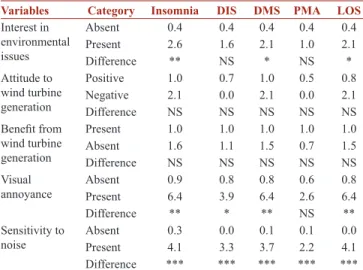
Aeq,nand insomnia or poor health. The odds ratio (OR) of insomnia was signifi cantly higher when the noise exposure level exceeded 40 dB, whereas the self-reported sensitivity to noise and visual annoyance with wind turbines were also independently associated with insomnia. OR of poor health was not signifi cant for noise exposure, but signifi cant for noise sensitivity and visual annoyance. The above two moderators appear to indicate the features of respondents who are sensitive to stimuli or changes in their homeostasis.
Keywords: Field survey, insomnia, moderator, self-reported symptoms, wind turbine noise
Access this article online
Quick Response Code: