• 検索結果がありません。

Adjusting serum urate level by affecting membrane transporters involved in the disposition of urate

N/A
N/A
Protected

Academic year: 2021

シェア "Adjusting serum urate level by affecting membrane transporters involved in the disposition of urate"

Copied!
95
0
0

読み込み中.... (全文を見る)

全文

(1)

Adjusting serum urate level by affecting membrane transporters involved in the disposition of urate

著者 盧 楊

著者別表示 Lu Yang journal or

publication title

博士論文本文Full 学位授与番号 13301甲第3967号

学位名 博士(薬学)

学位授与年月日 2013‑09‑26

URL http://hdl.handle.net/2297/41238

doi: 10.2133/dmpk.DMPK-12-RG-070

(2)

Adjusting serum urate level

by affecting membrane transporters involved in the disposition of urate

輸送体を介した血清尿酸値調節

Graduate School of

Natural Science and Technology Kanazawa University

Major subject: Life Sciences Course: Molecular Effects

School registration number: 1023032534

Name: Lu Yang

(3)

Chapter 1 Introduction 1 Chapter 2 Functional cooperation of SMCTs and URAT1 for renal

reabsorption transport of urate 6

2-1 Introduction 7

2-2 Methods and Materials 9

2-2-1 Chemicals and reagents 9

2-2-2 Preparation of human URAT1 and SMCT1 cRNA 9 2-2-3 Preparation of Xenopus oocytes 10 2-2-4 Expression of URAT1 and SMCT1 protein in Xenopus oocytes 11 2-2-5 Uptake study by Xenopus oocytes 12

2-2-6 Analytical method 13

2-3 Results 14

2-3-1 Effect of lactate on URAT1-mediated urate uptake 14 2-3-2 Effect of different monocarboxylates on URAT1-mediated urate uptake in Xenopus oocytes expressing both SMCT1 and URAT1 16 2-3-3 Accumulation of nicotinate by Xenopus oocytes expressing SMCT1

and URAT1 18

2-3-4 Influence of preincubation time of nicotinate on its stimulation effect of URAT1-mediated urate uptake 20 2-3-5 Influence of concentration of nicotinate on its stimulation effect of

URAT1-mediated urate uptake 22

2-3-6 Influence of sodium ions and SMCT1 inhibitors on the stimulation

effect 23 2-3-7 Influence of SMCT1 inhibitors on the stimulation effect 25

2-4 Discussion 28

Chapter 3 Effect of beverage on URAT1 and URATv1 in renal urate

transport 32

3-1 Introduction 33

3-2 Materials and Methods 37

(4)

3-2-1 Chemicals and reagents 37 3-2-2 Preparation of URAT1 and URATv1 cRNA 37 3-2-3 Uptake study by Xenopus oocytes 37

3-2-4 Data analysis 38

3-3 Results 39

3-3-1 Effect of congeners on URAT1 39 3-3-2 Effect of congeners on URATv1 41

3-4 Discussion 43

Chapter 4 Indoxyl sulfate upregulates BCRP expression in

intestinal cell line 45

4-1 Introduction 46

4-2 Materials and Methods 48

4-2-1 Chemicals and reagents 48

4-2-2 Cell culture 48

4-2-3 Total RNA isolation and real time PCR 48 4-2-4 Expression of BCRP in membrane fraction 50 4-2-5 Intracellular accumulation of PhA in Caco-2 cells 51 4-2-6 Transcellular urate transport in Caco-2 cells 51

4.3 Results 53

4-3-1 mRNA expression of BCRP in Caco-2 cells 53 4-3-2 Protein expression of BCRP in membrane fraction of Caco-2 cells55 4-3-3 Transcellular urate transport in Caco-2 cells treated with IS 56 4-3-4 Intracellular accumulation of PhA in Caco-2 cells after IS treatment

57

4-3-5 Effect of IS on BCRP mRNA expression in LS180 cells 58

(5)

Chapter 5 Conclusion 66

References 68

Peer-reviewed Publications 87

Acknowledgements 88


(6)

Abbreviations

AhR aryl hydrocarbon receptor

AMP adenosine monophosphate ATP adenosine triphosphate BCRP breast cancer resistance protein C/M ratio cell-to-medium ratio

cRNA complimentary RNA

D-MEM Dulbecco’ s modified Eagle’s medium FBS fetal bovine serum

FITC Fluorescein isothiocyanate

HPRT1 hypoxanthine guaninephosphoribosyltransferase 1 IC

50

half-maximum inhibition concentration

IS indoxyl sulfate

K

m

Michaelis-Menten constant MBS Modified Barth’s solution 3-MC 3-methylchoranthrene

MRP4 multidrug resistance-associated protein 4

MSU monosodium urate

NPT sodium phosphate transporter

(7)

PhA pheophorbide a

PPARα peroxisome proliferator-activated receptor-α SMCT sodium-coupled monocarboxylate transporter SUA serum urate level

UOX1 urate oxidase URAT1 urate transporter 1

URATv1 voltage-driven urate transporter 1


(8)

Chapter 1 Introduction

Urate is a weak organic acid with a pKa value of 5.8. It is the end product of purine degradation in humans and some higher primates. Due to the mutation of urate oxidase gene occurred in Miocene epoch [1-3], urate in humans cannot undergo further oxidation catalyzed by urate oxidase (UOX1 or uricase) to form allantoin, a more water-soluble substance with being easily excreted.

Loss of urate oxidase results in higher serum urate level (SUA) in humans, compared with those in other mammals [4-5]. Mutation of urate oxidase and increased serum urate level were believed to be of critical importance in creating human by working as a cerebral stimulant to accelerate brain development and improve human intelligence because of the similarities of urate to other cerebral stimulants, such as caffeine or theobromine [6]. Urate also has strong antioxidant properties and helps humans survive in the oxygen environment by cleaning oxidants, such as singlet oxygen and hydroperoxyl radicals, which are harmful to humans. It is reported that urate eliminates about as much as 60% of free radicals in human serum [7-9]. Increased serum urate level owing to evolutionary loss of uricase in humans is regarded as compensation to the mutation of L-gulonolactone oxidase, which is responsible for the synthesis of another important antioxidant substance, vitamin C [10-13].

In addition to its antioxidant function, urate seems to play a pivotal role in the maintenance of in vivo blood pressure homeostasis in humans [14, 15].

Epidemiologic studies show that abnormal serum urate level is associated with

several diseases. For example, hyperuricemia is closely related to gout attack,

a disease with a history of more than 5,000 years ever since its first

(9)

2 men, over 360 μM for women) may increase the risk of gout attack as reported by many studies [21-24]. Previous reports also indicate that hyperuricemia might play a role in the development of coronary heart disease, stroke, hypertension, diabetes mellitus, renal diseases and other cardiovascular diseases [25-42]. Because urate has anti-oxidant property, reduced SUA level may cause harmful effect in humans. Reduced serum urate level may decrease the antioxidant ability of humans. Indeed, hypouricemia (serum urate level lower than 120 μM) has already been linked to Hodgkin’s disease and Alzheimer’s disease [43-46]. Thus, maintenance of normal serum urate level is crucial to human health. Due to the close relationship of urate with a number of diseases, it has been used as a biomarker for many diseases [47-50] and is now involved in regular clinical blood test. Clinical and animal studies have suggested the participation of urate in the generation and development of diseases, and the importance of controlling urate level as a preventing and/or treating method of such diseases as well [45].

Generation of urate primarily occurs in liver, muscles and intestine, while excretion of urate mainly occurs from the kidney and intestine [51-52]. Of the urate daily produced, about two thirds is excreted from kidney and the rest is mainly eliminated directly across intestinal epithelial cells from blood [52-53].

In kidney, there is a urate transport system located on renal proximal tubule

which plays an important role in the regulation of serum urate level. Most of

urate is filtrated at the glomerulus and reabsorbed by this transport system. In

2002, Enomoto et al. identified human urate transporter 1 (URAT1, encoded by

SLC22A12) as a reabsorptive urate transporter on the apical membrane of

renal proximal tubule where it plays a predominant role in urate uptake from

urine [54]. Mutations and defects of human URAT1 have been reported to

result in hypouricemia [55-57]. Previous studies found that many drugs (such

as benzbromarone and losartan) could decrease serum urate level by

(10)

exhibiting inhibitory effects on URAT1 [58-60]. These studies have suggested an essential role of URAT1 in the transport of urate.

Similarly, organic onion transporter 4 (OAT4, encoded by SLC22A11) and OAT10, encoded by SLC22A13, are highly expressed at the apical side of proximal tubular cells and also involved in the reabsorptive transport of urate from luminal side into tubular cells [61-63]. On the basolateral membranes of proximal tubular cell, a voltage-driven urate transporter, URATv1 (GLUT9) encoded by SLC2A9 gene is recently reported as a solute carrier responsible for the urate transport from the tubular cells into blood [64]. Hypouricemia was also found in patients with the loss-of-function mutations in URATv1, independent of genetics of URAT1 [64]. URAT1, OAT4, and OAT10 at the apical side of renal proximal tubule and URATv1 at the basolateral side of proximal tubule cells together consist of the vectorial transport form the urine to blood (as is shown in Fig. 1-1).

Since urate simultaneously undergoes secretion from blood to urine, other

transporter system may also important to consider renal handling of urate in

kidney. The system is possibly consisted of organic onion transporter 1 (OAT1,

encoded by SLC22A6), and organic onion transporter 3 (OAT1, encoded by

SLC22A8) on the basolateral side of proximal tubule cells, and sodium

phosphate transporter 1 (NPT1, encoded by SLC17A1), NPT4 (encoded by

SLC17A3), multidrug resistance protein 4 (MRP4, encoded by ABCC4), and

breast cancer resistance protein (BCRP, encoded by ABCG2) [65-74].

(11)

4 mediates the urate efflux transport across the intestinal epithelial wall.

Reduction of BCRP function is closely related to gout and hyperuricemia as is demonstrated by recent genome-wide association studies [75-76]. Thus, BCRP can be regarded as an important efflux transporter mediating the non-renal excretion of urate (as is shown in Fig. 1-2).

With the development of economy, and westernization of lifestyle, the past several decades have witnessed an obvious increase in the prevalence of diseases such as cardiovascular disease, obesity, hyperuricemia, diabetes mellitus, which are called “rich man’s diseases” and the prevalence of these disease will continue to increase in the following several decades [77-79].

Serum urate level seems to be closely associated with these diseases [80].

Due to the important role of urate transporters in regulation serum urate level, modulation of these urate transporters to control serum urate level is of critical significance. The present thesis will focus on this topic and investigate the modulation of urate transporters to affect serum urate level.

Fig. 1-1 Transporter mediated urate transport in renal proximal tubule. On the apical side of renal proximal tubule, URAT1, OAT4, and OAT10 are responsible for the reabsorptive transport of urate from luminal side into renal

Urine Proximal tubular cell Blood

GFR

Urate

URATv1

OAT3 OAT1 BCRP

URAT1

OAT10

NPT1/4 OAT4

MRP4

(12)

proximal tubular cell. On the basolateral side, URATv1 is responsible for the transport of urate from proximal tubular cell into blood. OAT1 and OAT3 on the basolateral side mediate the urate excretory transport from blood into proximal tubular cell. MRP4, BCRP, NPT1 and NPT4 located on the apical side functions as excretory transporter and transport urate from proximal tubular cell into urine.

Fig. 1-2 Transporter mediated urate transport in intestine. BCRP is located at the apical side of intestinal epithelial cells and responsible for the urate efflux transport into intestinal lumen.

.

Blood

BCRP

Urate

Intestinal

lumen

(13)

6

Chapter 2 Functional cooperation of SMCTs and URAT1 for renal reabsorption transport of urate

Abstract:

Urate is mainly excreted into urine in humans. Serum urate level is regulated by a urate transport system located on renal proximal tubule. Urate transporter 1 (URAT1) is located on the apical side of renal proximal tubule and is responsible for the reabsorption of urate from luminal side into tubular cells. At the same site, it has been hypothesized that sodium-coupled monocarboxylate transporters (SMCTs) are responsible for the transportation of monocarboxylates such as lactate and nicotinate, which are exchanged for urate transport via URAT1 as the driving force. Accordingly, SMCTs could indirectly stimulate URAT1-mediated urate reabsorption by providing a counter ion, monocarboxylates, for the exchange.

The present study investigated to clarify the hypothesized functional cooperative relationship between URAT1 and SMCTs in the reabsorptive transport of urate. By preloading nicotinate in SMCT1-URAT1 co-expressing Xenopus oocytes, URAT1-mediated urate transport was stimulated by preloading nicotinate. Nicotinate was taken up by SMCT1 but not by URAT1.

When removing sodium ion from the uptake medium, the stimulation effect was decreased. When adding SMCT1 inhibitors, the stimulation effect was also reduced. The results from this study indicate the cooperative relationship of URAT1 and SMCT1, and that SMCT1 is a potential target for the alteration of renal handling of urate indirectly.

(14)

2-1 Introduction

Renal urate transport system is essential to the regulation of serum urate level.

In kidney, many urate transporters including URAT1 are involved in renal handling of urate. Monocarboxylates are the counterpart of urate in the transport of urate via URAT1. Recently, two members of sodium-coupled monocarboxylate transporters were identified and characterized as

monocarboxylate transporters with electrogenic nature, in which SMCT1 and SMCT2 were encoded by SLC5A8 and SLC5A12, respectively [81-82].

Substrates of SMCT1 and SMCT2 include lactate, nicotinate, and butyrate [81-82]. Both of them are reported to locate on the apical side of proximal tubular cells [81-82]. SMCTs are involved in the absorption of

monocarboxylates in a sodium-dependent manner, and it is hypothesized that SMCTs enhance URAT1-mediated urate reabsorption by providing

monocarboxylates for the exchange transport with urate. Moreover,

Thangaraju et al. observed the decrease of serum urate level and increase of urinary excretion of urate in mice that are knocked out of both Slc5a8 and Slc5a12 in the kidney [83]. Serum lactate level was also reduced in the knockout mice. These observations indicated a possible role of SMCT1 and SMCT2 in the reabsorptive transport of urate in kidney. Accordingly, it is considered that URAT1 and SMCTs are linked via lactate and/or other monocarboxylates transport [84-86]. Furthermore, it has been reported that PDZK1, which is a PDZ domain containing protein located on the renal

proximal tubule, could bind to URAT1 at the C terminal part of URAT1 [87]. In

addition, SMCT1 and SMCT2 were reported to be binding partners of PDZK1

[84]. These findings suggested possible physiological links between URAT1

(15)

8 relationship between SMCTs and URAT1 using the Xenopus oocytes

gene-expressing system. The results of this study provide strong support for the functional links of SMCTs and URAT1 in the transport of urate.


Fig. 2-1 Hypothesized urate transport model at renal proximal tubule. SMCTs take up monocarboxylates, such as lactate and nicotinate, from luminal side into proximal tubular cells. The monocarboxylates taken up by SMCTs then exchange with urate via URAT1 enhancing URAT1-mediated urate

reabsorptive transport.

URATv1 Na +

Urate

Proximal Tubular Cell

URAT1

Urine Blood

SMCT1/2 Lactate

Nicotinate

etc Lactate

Nicotinate, etc

? No Direct Evidence

(16)

2-2 Materials and Methods 2-2-1 Chemicals and reagents

[

14

C]Urate (1.96 TBq/mol) was obtained from Moravek Biochemicals, Inc.

(Brea, CA). [

3

H]Nicotinate (37 GBq/mol) was purchased from American Radiolabeled Chemicals Inc. (St. Louis, MO). Nicotinate (purity>98%), collagenase and gentamicin sulfate were purchased from Wako Pure Chemical Industries (Osaka, Japan). Sodium L-lactate (purity around 98%), sodium butyrate (purity>98.5%), N-methyl-D-glucamine (NMDG) and

phenol/chloroform/isoamyl alcohol (25:24:1) were the products of

Sigma-Aldrich (St. Louis, MO). Clearsol-I was obtained from Nacalai Tesque (Kyoto, Japan). All other reagents were of analytical grade.

2-2-2 Preparation of human URAT1 and SMCT1 cRNA

Human URAT1 plasmid DNA, which was cloned in pGEMHE vector, was

synthesized according to the method previously described [88] and then the

plasmid DNA was digested with NheI (Takara Bio Inc., Otsu, Japan) before

cRNA preparation. SMCT1 plasmid DNA cloned in pGH19 vector [81] was

kindly provided by Professor Seiji Miyauchi at Toho University and was

linearized by PstI (Takara Bio Inc., Otsu, Japan). cRNA of URAT1 and SMCT1

were synthesized by in vitro transcription method using T7

mMESSAGE-mMACHINE kit (Ambion, Austin, TX). One μg of the linearized

template DNA was mixed with 10 μL of 2X NTP/CAP, 2 μL of 10X Reaction

Buffer, 2 μL Enzyme Mix supplemented with purified water to 20 μL, and

incubated in a water bath maintained at 37

o

C for 2h. Then, 1 μL of TURBO

DNase was added to the reaction tube and the tube was incubated at 37 °C for

(17)

10 volume of chloroform, vortexed for 2min, and centrifuged at 15,000 rpm for 15 min (4 °C). The aqueous phase (upper phase) of the sample was transferred into another tube. RNA was precipitated by the addition of an equal volume of isopropanol and chilled at –20 °C overnight. Pellet of RNA was obtained by centrifuging the sample at 15,000 rpm for 20 min (4 °C). RNA pellet was then washed by the addition of 100 μL of 70% ethyl alcohol and dried in a water bath maintained at 37°C for 1 h to evaporate residual ethyl alcohol. RNA was dissolved in purified water. Concentration of RNA was determined by UV method on an Eppeendorf BioPhotometer (Eppendorf, Hamburg, Germany).

2-2-3 Preparation of Xenopus oocytes

Xenopus laevis provided by Hamamatsu Biological Research Service, Inc.

(Hamamatsu, Japan) were anaesthetized for 30 min in a mixture of ice and water. Then Xenopus laevis were put on ice and oocytes were taken out from ovaries of Xenopus laevis. After washed by Oocyte Ringer 2 (OR2) solutions 10 times, oocytes were incubated with 2 mg/mL collagenase (dissolved in OR2 solution) for up to 20 min at room temperature. Then oocytes were washed by pH7.4 OR2 solution another 10 times and were transferred into a dish

containing the modified Barth solution (MBS, pH7.4) supplemented with 50 μg/mL gentamycin. Oocytes were defolliculated with fine forceps under Olympus SZ61 stereo microscope (Olympus Optical Co. Ltd., Tokyo, Japan) before use. Defolliculation of the oocytes was carried out in pH7.4

Defolliculation solution.

Oocyte Ringer 2 (OR2) solution:

82.5 mM NaCl

2 mM KCl

10 mM MgCl2

5 mM HEPES

Adjust pH to 7.4

(18)

Modified Barth’s solution (MBS):

88 mM NaCl 1 mM KCl

0.33 mM Ca(NO

3

)

2

0.41 mM CaCl

2

0.82 mM MgSO

4

2.4 mM NaHCO

3

10 mM HEPES Adjust pH to 7.4.

Defolliculation solution 110 mM NaCl

1 mM EDTA*2Na 10 mM HEPES Adjust pH to 7.4.

2-2-4 Expression of URAT1 and SMCT1 protein in Xenopus laevis oocytes

URAT1 and SMCT1 protein were expressed in Xenopus oocytes by

microinjection method. In preparing oocytes expressing URAT1 alone, 12.5 ng

URAT1 cRNA (50 nL) was injected into each oocyte by a Drummond Digital

Microdispenser (Drummond Scientific Company; Broomall, PA, USA). In

oocytes expressing both URAT1 and SMCT1, a 50 nL mixture of 12.5 ng

URAT1 cRNA and 12.5 ng SMCT1 cRNA was injected into each oocyte. The

(19)

12 Committee of Kanazawa University.

2-2-5 Uptake study by Xenopus laevis oocyte

For urate uptake experiments, oocytes were preloaded with monocarboxylate by preincubation for 60 min or the indicated time in each result at 25

o

C in ND96 buffer in the presence or absence of sodium ions (in the study investigating sodium effect, sodium ions were substituted by NMDG) containing monocarboxylate before urate uptake. Then, the oocytes were washed three times with 25

o

C ND96 buffer in the presence or absence of sodium ions. The uptake study was carried out for 60 min at 25

o

C in ND96 buffer in the presence or absence of sodium ions containing 10 μM [

14

C]urate.

For nicotinate uptake experiments, the uptake study was carried out at 25

o

C in ND96 buffer containing radio-labeled and unlabeled nicotinate and was

stopped by removing the uptake buffer, and then the oocytes were washed three times with ice-cold uptake buffer. Each oocyte was transferred into a microcentrifuge tube containing 50 μL 5% sodium dodecyl sulfate solution.

After homogenization of the oocytes, 1.5 mL of Clearsol-I was added into each tube for quantitation of radioactivity.

Uptake buffer used in this study:

pH 7.4 ND96 buffer:

96 mM NaCl 2 mM KCl 1 mM MgCl

2

5 mM HEPES Adjust pH to 7.4.

ND96 buffer free of sodium ions:

192 mM N-methyl-D-glucamine

plus 19.2 mL 5N HCl

(20)

3.6 mM CaCl

2

4 mM KCl 2 mM MgCl

2

10 mM HEPES Adjust pH to 7.4

2-2-6 Analytical method

A liquid scintillation counter (LSC-5100, Aloka, Tokyo) was used to determine the radioactivity. The amount of [14C]urate or [3H]nicotinate taken up by oocytes was calculated according to the radioactivity obtained from each oocyte. Uptake of urate or nicotinate, expressed as the cell-to-medium (C/M) ratio (μL/oocyte), was calculated by dividing the uptake amount by the

concentration of substrate in the uptake buffer. Results were expressed as

mean ± SEM. Statistical differences were analyzed by Student’s t-test. A p

value less than 0.05 was considered statistically significant.

(21)

14 2-3 Results

2-3-1 Effect of lactate on URAT1-mediated urate uptake

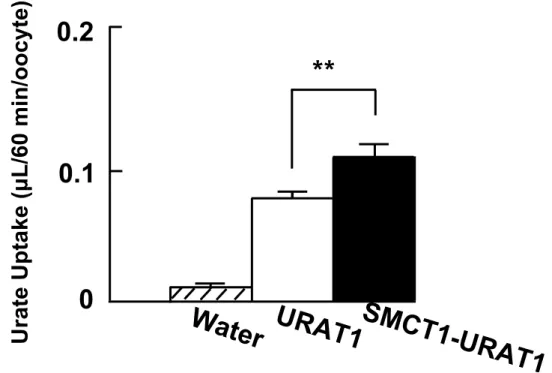
Initially, urate uptake by oocytes expressing URAT1 alone or SMCT1-URAT1 co-expressing oocytes was determined after preloading 1.5 mM L-lactate for 60 min before urate uptake, respectively. The result is shown in Fig. 2-2. Urate uptake by oocytes expressing both SMCT1 and URAT1 was higher than that by oocytes expressing URAT1 alone, as shown in Fig. 2-2. The increase of urate uptake can be attributable to two mechanisms. Firstly, the L-lactate taken up by SMCT1 can be high enough to be exchanged with urate and enhance the urate uptake. The second is due to the different expression level of URAT1 between oocytes expressing URAT1 alone and both of SMCT1 and URAT1.

The former mechanism, which is a hypothesis of the present study, was further examined.

Fig. 2-2 Stimulation effect of monocarboxylate on urate uptake.

SMCT-URAT1 co-expressing oocytes (closed bar), oocytes expressing URAT1 alone (open bar) and water-injected oocytes (slashed bar) were preincubated in ND96 buffer (pH7.4) containing 1.5 mM sodium lactate for 60 min. Then, the uptake study was carried out in ND96 buffer 10 μM [

14

C]urate at pH7.4 for 60

**

0.2

0.1

0

Urate Uptake ( μ L /60 min/oocyte )

(22)

min. Each point represents the mean ± SEM from 9-10 oocytes. Student’s

t-test: **p<0.01 vs. URAT1-mediated urate uptake in oocytes expressing

URAT1 alone.

(23)

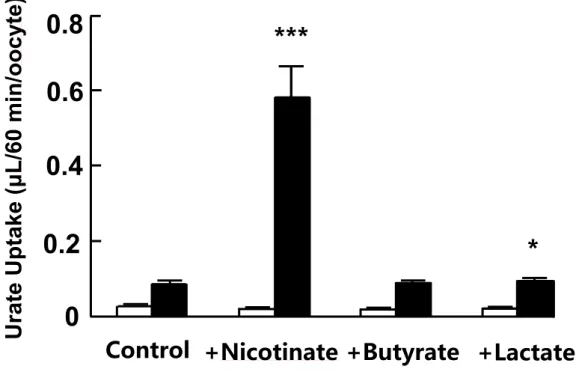
16 2-3-2 Effect of different monocarboxylates on URAT1-mediated urate uptake in Xenopus oocytes expressing both SMCT1 and URAT1 In order to eliminate the differences of uptakes caused by the difference of expression level of transporter proteins between URAT1-alone and

SMCT1-URAT1 double expressing oocytes, and to optimize condition for this study, the effect of several other monocarboxylates on urate uptake was examined in SMCT1-URAT1 co-expressing oocytes. Nicotinate, butyrate, and L-lactate were used as monocarboxylates to examine the stimulation effect of urate transport by URAT1. The results are shown in Fig. 2-3. SMCT1-URAT1 co-expressing oocytes were preincubated with 1.5 mM nicotinate, butyrate, or L-lactate for 60 min before initiation of urate uptake. Then, uptake of urate by SMCT1-URAT1 co-expressing oocytes was measured for 60 min at 25

o

C in ND96 buffer containing 10 μM [

14

C]urate. Nicotinate and L-lactate exhibited a stimulation effect on urate uptake. Nicotinate exhibited the highest stimulation effect of the urate uptake, which was as much as 8.7 folds compared with the control (SMCT1-URAT1 co-expressing oocytes without preloading of

nicotinate) group. L-Lactate also exhibited a stimulation effect with an increase

of 28% compared with control group. As for butyrate, although it tends to

stimulate (22%), there was no statistically significant difference compared with

control group. Therefore, nicotinate was used in the following studies.

(24)

Fig. 2-3 Effect of different monocarboxylates on urate uptake by SMCT1-URAT1 co-expressing oocytes. SMCT1-URAT1 co-expressing oocytes (closed bar) and water-injected oocyte (open bar) were preincubated in ND96 buffer (pH7.4 containing 1.5 mM sodium nicotinate, sodium butyrate, or sodium lactate at 25

o

C for 60 min before urate uptake. Then, the oocytes were washed three times with ND96 buffer (pH7.4) and were transferred to a 24-well plate containing ND96 buffer (pH7.4) and 10 μM [

14

C]urate for the uptake study. Each point represents the mean ± SEM from 8-9 oocytes.

Student’s t-test: ***p<0.001, *p<0.05, compared with control.

Control +Nicotinate +Butyrate +Lactate

*

***

Urate Uptake ( μ L /60 min/oocyte )

0.8

0.6

0.4

0.2

0

(25)

18 2-3-3 Accumulation of nicotinate by Xenopus oocytes co-expressing SMCT1 and URAT1

Fig. 2-4 depicts the accumulation of nicotinate in oocytes co-expressing SMCT1-URAT1 and oocytes expressing URAT1 alone. When the uptake time was set at 60 min, accumulation of nicotinate in SMCT1-URAT1 co-expressing oocytes exhibited a concentration-dependence and saturated at 1 mM (Km:

241 ± 36 μM) (Fig. 2-4A). When nicotinate concentration was set at 1 mM, accumulation of nicotinate in SMCT1-URAT1 co-expressing oocytes reached steady-state at 60 min (Fig. 2-4B). In oocytes expressing URAT1 alone, the accumulation of nicotinate is quite small compared with that of SMCT1-URAT1 co-expressing oocytes and was comparable with that in water-injected control oocytes.

Fig. 2-4 Accumulation of nicotinate in oocytes expressing SMCT1 and URAT1.

A. Uptake of nicotinate was investigated in SMCT1-URAT1 co-expressing oocytes (closed circle), oocytes expressing URAT1 alone (open circle), or water-injected oocytes (closed triangle) with nicotinate concentration ranged

0 1.0 1.5

0.5 1.0 1.5

0.5 Nicotinate (mM)

Nicotinate Uptake (nmol/oocyte)

(26)

from 0.15 to 1.5 mM. The uptake time was set at 60 min. Each point represents the mean ± SEM from 9-10 oocytes.

B. Uptake of nicotinate was investigated in SMCT1-URAT1 co-expressing oocytes (closed circle), oocytes expressing URAT1 alone (open circle), or water-injected oocytes (closed triangle) with uptake time ranged from 15 to 90 min. Nicotinate concentration was set at 1 mM. Each point represents the mean ± SEM from 9-10 oocytes.

0 30

1.5

1.0

0.5

60 90

Nicotinate Uptake (nmol /oocyte )

Time (min)

(27)

20 2-3-4 Influence of preincubation concentration of nicotinate on its

stimulation effect of URAT1-mediated urate uptake

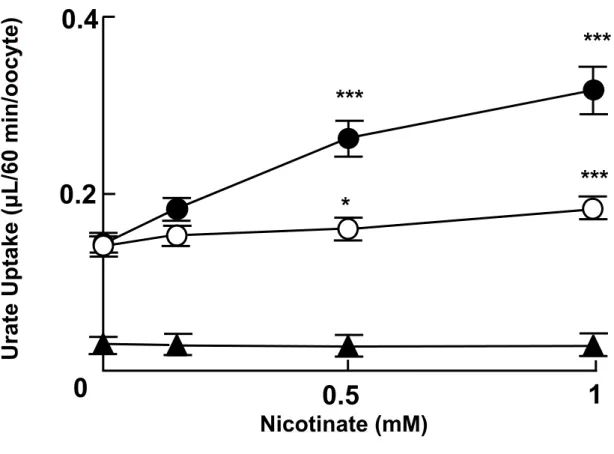
Influence of nicotinate concentration on the stimulation effect was studied in SMCT1-URAT1 co-expressing oocytes after preloading 0, 0.15, 0.5, and 1 mM nicotinate for 60 min. Urate uptake was stimulated by nicotinate in

SMCT1-URAT1 co-expressing oocytes in a concentration-dependent manner

(Fig. 2-5A). Effect of preloading of nicotinate on urate uptake by oocytes

expressing URAT1 alone was also studied. An increase of urate uptake by

URAT1 expressing oocytes was also observed after preloading nicotinate

compared without preloading of nicotinate. Accordingly, co-expression of

URAT1 and SMCT1 is effective to activate URAT1-mediated uptake of urate.

(28)

Fig. 2-5 Influence of preincubation time and concentration of nicotinate on the stimulation of urate uptake by SMCT1-URAT1 co-expressing oocytes.

A. SMCT1-URAT1 co-expressing oocytes (closed circle), oocytes expressing URAT1 alone (open circle), or water-injected oocytes (closed triangle) were preincubated in ND96 buffer (pH7.4) containing 0, 0.15, 0.5, and 1mM sodium nicotinate at 25

o

C for 60 min before urate uptake. Uptake of urate was carried out in ND96 buffer (pH7.4) containing 10 μM [

14

C]urate at 25

o

C for 60 min.

Each point represents the mean ± SEM from 7-9 oocytes. Student’s t-test:

***p<0.001, *p<0.05, vs. control (0 min preincubation).

***

***

***

*

0 0.4

0.2

1 0.5

Urate U ptake ( μ L /60 m in/oocyte )

Nicotinate (mM)

(29)

22 2-3-5 Influence of preincubation time of nicotinate on the stimulation effect of URAT1-mediated urate uptake

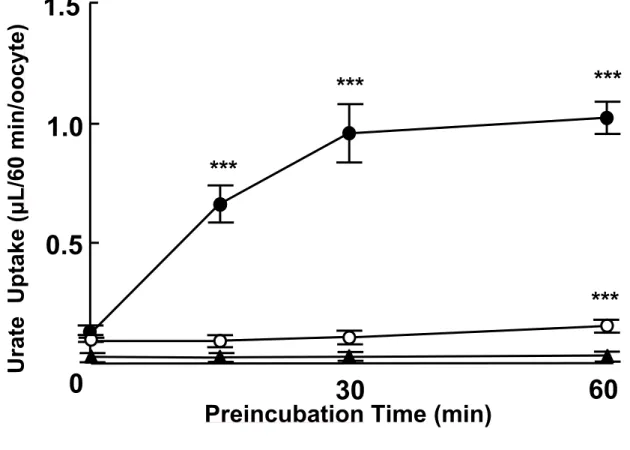
The influence of nicotinate preincubation time on stimulatory effect was studied after preincubation with 1 mM nicotinate for 0, 15, 30, 60 min before initiation of urate uptake. With an increasing preincubation time of nicotinate, higher stimulation of urate uptake was observed in SMCT1-URAT1

co-expressing oocytes for up to 30 min as shown in Fig. 2-5B.

Fig. 2-5B SMCT1-URAT1 co-expressing oocytes (closed circle), oocytes expressing URAT1 alone (open circle), or water-injected oocytes (closed triangle) were preincubated in ND96 buffer (pH7.4) containing 1 mM sodium nicotinate for 0, 15, 30, 60 min before urate uptake. Then, the oocytes were washed three times with ND96 buffer (pH7.4) and were transferred to a 24-well plate containing ND96 buffer (pH7.4) and 10 μM [

14

C]urate for the uptake study.

Each point represents the mean ± SEM from 8-9 oocytes. Student’s t-test:

***p<0.001, *p<0.05, vs. control (0 min preincubation).

***

*** ***

***

0 30 60

0.5 1.0 1.5

Urate Uptake ( μ L /60 min/oocyte )

Preincubation Time (min)

(30)

2-3-6 Influence of sodium ions on the stimulation effect

To verify the mechanism of SMCT1-mediated stimulation effect, the influence of sodium ions and SMCT1 inhibitors was investigated. SMCT1-URAT1 co-expressing oocytes and oocytes expressing URAT1 alone were

preincubated in ND96 buffer with 1 mM nicotinate for 60 min in the presence or absence of sodium ions by replacing with N-methylglucamine. For the uptake of urate, oocytes were transferred to uptake medium with or without sodium ions. Fig. 2-6 shows that uptake of urate by SMCT1-URAT1 co-expressing oocytes was drastically decreased when removing sodium ions in the

preloading condition. Meanwhile, the uptake of urate by oocytes expressing URAT1 alone was unchanged in the presence or absence of sodium ions.

The apparent sodium ion dependence in preincubation medium is ascribed to the sodium dependent uptake of nicotinate by SMCT1. Slight, but not

significant, effect of sodium ions during uptake of urate may be explained by

the re-uptake of nicotinate by URAT1, which was effluxed by exchange with

urate via URAT1.

(31)

24 Fig. 2-6. Influence of sodium ions on the stimulation of urate uptake by SMCT1-URAT1 co-expressing oocytes.

SMCT1-URAT1 co-expressing oocytes (closed bar), oocytes expressing URAT1 alone (open bar) and water-injected oocytes (slashed bar) were preincubated in ND96 buffer (pH7.4) containing 1 mM nicotinate in the presence or absence of sodium ions. Then, the oocytes were washed three times with ND96 buffer or sodium free ND96 buffer (pH7.4), and were transferred to a 24-well plate containing ND96 buffer (pH7.4) and 10 μM [

14

C]urate for the uptake study in the presence or absence of sodium ions.

Each point represents the mean ± SEM from 8-11 oocytes.

(+)Na, (+)Na (+) Na, (-)Na (-)Na, (+)Na (-)Na, (-)Na

0 0.8

0.4

Urate Uptake ( μ L /60 m in/oocyte )

(32)

2-3-7 Influence of SMCT1 inhibitors on the stimulation effect

When SMCT1-URAT1 co-expressing oocytes were preincubated with 5 mM butyrate or propionate, uptake of nicotinate by SMCT1-URAT1 co-expressing oocytes had 85% and 76% decrease, respectively (Fig. 2-7A). When oocytes expressing both URAT1 and SMCT1 or URAT1 alone were preincubated with 5 mM butyrate or propionate, the stimulatory effect was also significantly decreased by 78% and 73%, respectively, as shown in Fig. 2-7B. Nicotinate uptake was comparable with that in oocytes expressing URAT1 alone, while the uptake was still much higher than that by water-injected control oocytes.

Thus, these compounds are suggested to be inhibitors but not exchanged well

with urate via URAT1 as shown in Fig. 2-3 (butyrate). Accordingly, observed

decrease in urate uptake in the presence of butyrate and propionate may be

due to the decreased supply of nicotinate into oocytes by inhibiting nicotinate

uptake by SMCT1, resulting in the decreased stimulation effect of urate via

URAT1.

(33)

26 A:

Fig. 2-7 Influence of SMCT1 inhibitors on the uptake of nicotinate and stimulation effect on urate uptake by SMCT1-URAT1 co-expressing oocytes.

A. Influence of butyrate and propionate on nicotinate uptake by SMCT1-URAT1 co-expressing oocytes (closed bar) was investigated.

Nicotinate uptake was carried out for 60 min with 1 mM nicotinate in the presence or absence of 5 mM of butyrate or propionate. Open bar: uptake of nicotinate by water-injected oocytes. Each point represents the mean ± SEM from 10 oocytes.

0 1.0

0.5

Nicotinate Uptake ( μ L /60 min/oocy te )

+Propionate +Butyrate

Control

(34)

B:

B. SMCT1-URAT1 co-expressing oocytes (closed bar), oocytes expressing URAT1 alone (open bar), or water-injected oocytes (slashed bar) were

preincubated in ND96 buffer (pH7.4) with or without 1 mM nicotinate in the presence or absence of 5 mM of butyrate or propionate for 60 min before urateuptake. Then urate uptake was carried out for 60 min. Each point represents the mean ± SEM from 10 oocytes.

0 1

Butyrate Propionate 0

Urate Uptake ( μ L /60 min/oocy te )

1.0 2.0 1.5 2.5

0.5

Nicotinate

(mM) 1 1

Monocarboxylate 0 0

(35)

28 2-4 Discussion

In this study, we investigated the functional cooperation between human URAT1 and SMCTs in the reabsorptive transport of urate in vitro. Because SMCT1 and SMCT2 have similar function in the transport of monocarboxylates and are expressed at the tubular cells, one of them (SMCT1) was chosen to prove the cooperation of SMCT1 and URAT1 for urate reabsorption.

Initially, a SMCT1-URAT1 double expressing system was established in Xenopus oocytes to express both SMCT1 and URAT1. A trans-stimulation effect of L-lactate was observed when comparing the uptake of urate by oocytes expressing URAT1 alone and by SMCT1-URAT1 co-expressing oocytes after preincubating the oocytes with L-lactate. Considering the possible differences in the expression level of URAT1 between URAT1-alone and SMCT1-URAT1 co-expressing oocytes, which may also explain apparent difference of urate uptake between these two types of oocytes, the effect of nicotinate, butyrate and L-lactate on urate uptake was studied in

SMCT1-URAT1 co-expressing oocytes to find a better counter

monocarboxylate to be exchanged with urate via URAT1. Since nicotinate showed the highest stimulation effect, we further studied the stimulation effect by changing the preincubation time and concentration of nicotinate. Finally, to confirm that URAT1 activity is stimulated by SMCT1 function, the influence of removing sodium ions from uptake buffer and adding SMCT1 inhibitors were investigated. The results of this study clearly demonstrated the functional cooperation of SMCT1 in urate reabsorption via URAT1.

Affinities of nicotinate, L-lactate, and butyrate on SMCT1 have been reported

in the previous studies. K

m

values for nicotinate, L-lactate and butyrate are 230

μM, 81 μM, and 235 μM, respectively [81, 89]. Because they have a K

m

value

around or lower than 250 μM, 1.5 mM was initially selected as the preloading

concentration to provide enough monocarboxylate for the exchange of urate

via URAT1. In Fig. 2-3, while SMCT1-URAT1 co-expressing oocytes were

(36)

preincubated with monocarboxylates, nicotinate showed higher stimulation effect. This phenomenon may be explained by the different affinity of nicotinate and lactate in the exchange with urate via URAT1 and is consistent with the results of a previous study in which a different stimulation effect was observed with direct injection of them into oocytes expressing URAT1 alone [54].

Physiologically, normal serum lactate concentration is around 1.5 mM, which is considered to provide the major driving force for URAT1. Although lactate concentration used in this experiment was close to normal serum lactate concentration, lactate showed much smaller stimulation effect than nicotinate under current experimental condition. The discrepancy between in vivo and in vitro might be explained by the reason that any monocarboxylates other than lactate and nicotinate may also be involved in the trans-stimulation of URAT1 in vivo. Also, intracellular lactate concentration may be different between this experimental model and in vivo renal proximal tubular cell. Renal cell might show lower lactate concentration, so URAT1-mediated urate uptake is more sensitive to stimulation by SMCT1-mediated lactate transport in the renal cells in vivo. Although physiological relevance such as serum monocarboxylate concentration and stimulation of URAT1 may not be clear at present, it is clear that SMCT substrates increase the apparent urate uptake activity by URAT1, demonstrating functional cooperation of these two transporters.

The accumulation of nicotinate showed concentration- and time-dependence and attained maximum accumulation of nicotinate at 1 mM and 60 min (Fig.

2-5A). In accordance with such accumulation of nicotinate, urate accumulation

in oocytes was increased with an increase of concentration and preincubation

(37)

30 urate uptake by oocytes expressing URAT1 alone was observed (Fig. 2-5A).

This can be explained by the diffusion and/or carrier-mediated uptake of nicotinate from the uptake medium into oocytes by endogenous transporter which can be exchanged with urate via URAT1.

As SMCT1 is a sodium dependent transporter [81, 89] but URAT is sodium independent, function of SMCT1 in SMCT1-URAT1 co-expressing oocytes should be depressed by removing sodium ions from the uptake buffer, thus reducing the nicotinate taken up by SMCT1-URAT1 co-expressing oocytes in exchange with urate and affecting the observed stimulation effect. Because the uptake of urate via URAT1 is not affected by sodium ions [54], removing

sodium ions from uptake buffer should not affect the function of URAT1 in SMCT1-URAT1 co-expressing oocytes. As expected, by removing the sodium ions during the preloading of nicotinate, uptake of urate in SMCT1-URAT1 co-expressing oocytes was greatly reduced (Fig. 2-6). The addition of butyrate and propionate also led to the decrease of the stimulation effect (Fig. 2-7B), because butyrate and propionate are inhibitors of SMCT1 and can reduce the accumulation of nicotinate in SMCT1-URAT1 co-expressing oocytes (Fig.

2-7A). These results clearly indicate that the increase of urate uptake in SMCT1-URAT1 co-expressing oocytes was due to the exchange of nicotinate taken up by SMCT1 with urate and demonstrated the cooperative relationship between SMCT1 and URAT1 in urate reabsorption.

It has been suggested that URAT1 and SMCTs can be physically linked through PDZK1, resulting in a possible functional relationship [90-92]. Both of SMCT1 and SMCT2 are known to be binding partners of PDZK1 [84].

Accordingly, the present study provides the functional cooperation of SMCTs

and URAT1 in the reabsorptive transport of urate via URAT1. Expressed in

colon, ileum, kidney and thyroid gland [93], SMCTs was recognized as a tumor

(38)

suppressor in the previous studies [94-99]. This study reveals the pivotal of SMCTs in modulation of renal urate transport.

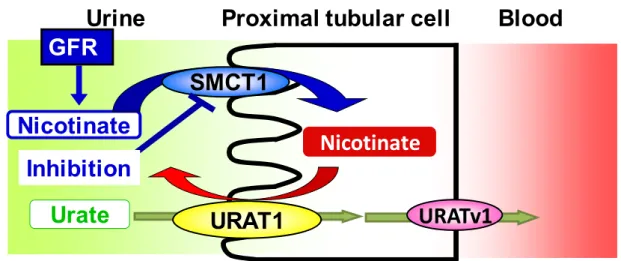
In conclusion, this is the first study providing direct evidence for the hypothesis that SMCTs could enhance URAT1-mediated urate uptake. Results from this study demonstrate the cooperative relationship of URAT1 and SMCTs and indicate that SMCTs may be used as a potential target for the alteration of renal handling of urate indirectly. Also, we should be careful in considering the serum uric acid level by clinically used drugs or other factors including

diseases since change in activity of SMCTs affect reabsorptive activity of urate.

Fig. 2-8 Indirect regulation of serum urate level by affecting SMCT1.

Urine Proximal tubular cell Blood

Nicotinate GFR

Nicotinate

Urate URAT1

Inhibition

URATv1

SMCT1

(39)

32

Chapter 3 A putative mechanism of lowered serum urate level by whisky

Abstract:

Clinical studies show that moderate consumption of whisky results in an increase of renal excretion of urate into urine and a decrease of the serum urate level. The effects of whisky congeners on urate transporters responsible for the reasorptive transport of urate were examined using Xenopus oocytes gene-expressing system. Urate uptake by Xenopus oocytes expressing human URAT1 or human URATv1 was investigated in the presence or

absence of congeners. Congeners from 12-year and 18-year whiskies showed an inhibitory effect of the urate uptake by URAT1 with an IC

50

value of 0.084 ± 0.011 and 0.042 ± 0.0056 mg/mL, respectively. For urate uptake by URATv1, congeners from 12-year whisky exhibited an inhibitory effect of about 24.4 ± 3.0% inhibition only at 1 mg/mL. Similarly, congeners from 18-year whisky showed 22.5 ± 1.6% inhibition only at 1 mg/mL. There was no significant difference between the inhibitory effect of congeners from 12 years on

URATv1-mediated urate uptake and that by congeners from whisky stored for 18 years. At lower concentrations, there was no inhibitory effect observed for both of the congeners. Results of this study suggested that decreased serum urate level after whisky consumption may be due to the inhibition of URAT1 by congeners.


(40)

3-1 Introduction

Lifestyle and dietary factors are closely related to human health. Daily

exposure of food is inevitable for all human beings. Influence of different kinds of food and beverage on human health has been realized since ancient times.

At present, food therapy has been regarded as one of the most important approaches of Traditional Chinese Medicine for the cure or prevention of a number of diseases [100]. With the development of modern science, an increasing number of scientific evidences and reports have emerged in recent years illustrating the mechanisms of the impact of food and beverage on human health and providing new evidences at the same time.

Urate is the final product of purine metabolism in humans. Because humans

lack urate oxidase, urate cannot undergo further oxidation reaction to form

allantoin, a more soluble compound. Serum urate level is maintained by the

generation and excretion of urate. Purine intake from food is an important

source of serum urate accounting for approximately one third of daily urate

load [101]. Intake of purine-rich food has been associated with incident of

hyperuricemia and gout attack [102-103]. Acute intake of purine-rich food can

raise the risk of recurrent gout attack as high as five fold in patients suffering

from gout [104]. It is also found that impact of purine from animal sources on

recurrent gout attack was higher than that from plant sources. Thus, intake of

low purine food and reduced consumption of animal-source food have been

suggested in the prevention and treatment of hyperuricemia and gout

[105-107].

(41)

34 Alcohol intake is responsible for 21.6% of hyperuricemia occurrence in

Japanese men [108]. Alcohol consumption can also increase the risk for gout attack in men [109]. For the relationship between alcohol consumption and high urate level, two putative mechanisms have been proposed. One is that alcohol intake can increase lactate level during alcohol oxidation and lactate is an important substrate of sodium-coupled monocarboxylate transporters (SMCTs) for the exchange of urate via urate transporter 1 (URAT1). SMCTs have functional cooperative relationship with URAT1 as is demonstrated in Chapter 2 and has been reported in our previous study [110]. Increased lactate may enhance the reabsorptive transport of urate through URAT1. The other might be due to the increased adenosine triphosphate (ATP) degradation to adenosine monophosphate (AMP) during alcohol metabolism [111-113].

Because urate is synthesized from adenosine, the production of urate will be enhanced after alcohol intake.

Consumption of alcoholic beverages has been a feature of many cultures throughout the world since ancient times, and especially in some Asian

countries, is often associated with social gatherings. Many studies have shown that regular alcohol consumption is a risk factor for hyperuricemia and gout attack, though moderate consumption of some kinds of alcoholic beverages may provide health benefits. For example, moderate red wine drinking may help to reduce the risk of coronary heart disease [114]. Such effect might be attributed to the nonvolatile substances (called congeners) generated during brewing maturation processes. It has been reported that congeners contained in whisky exhibit diverse biological activities including protection of the

gastrointestinal tracts, inhibition of melanogenesis and suppression of NO production [115-118]. Recent clinical studies show that consumption of

whiskey results in an increase of renal excretion of urate as well as a decrease

of the serum urate level (SUA) [119], although the mechanism remains to be

determined. Therefore, understanding effect of the congeners on alteration in

(42)

urate reabsorption may help us to find the molecular details of decreased SUA after whisky consumption.

In order to delineate the mechanism by which serum urate level is reduced after whisky consumption presumably by certain congeners, it is essential to understand how whisky congener is involved in alteration in serum urate level.

Urate is poorly hydrophilic to permeate the membranes of proximal tubular cells, thus membrane transporters play a pivotal role in its reabsorptive and secretory transcelluar transport and maintain SUA [120]. Till now, a number of membrane transporters involved in urate transport have been identified

including organic anion transporter family members (OATs) and breast cancer resistance protein (BCRP) [54]. Among these transporters, urate transporter 1 (URAT1/SLC22A12), which is a member of OATs, is localized on the apical side of renal proximal tubular cells and has been characterized as a

transporter mainly responsible for renal reabsorption of urate from lumen into blood [54]. Since kidney handles approximately 70% of urate in the body, renal urate transporters are of great significance. Currently, URAT1 has already been a target for the development of novel anti-hyperuricemia compounds. On the basolateral side of renal proximal tubule, a voltage-driven urate transporter (URATv1/ SLC2A9) functions as a urate transporter mediating the urate

transport from proximal tubular cell into blood [64]. Cooperative role of URAT1

and URATv1 in renal reabsorption of urate has been demonstrated by the

previous study conducted in our laboratory [121]. In order to explain the

phenomenon of decreased SUA after drinking whisky, in the present study we

examined whether whisky congeners have any inhibitory effect on URAT1 and

(43)

36 Fig. 3-1 Hypothesized model of congener’s effect on renal urate reabsorptive transport. Whisky congeners inhibit URAT1and URATv1-mediated urate reabsorptive transport, reducing the serum urate level.

Urine Proximal tubular cell Blood GFR

Urate URAT1

congeners

URATv1

congeners

(44)

3-2 Materials and Methods 3-2-1 Materials

[

14

C]Urate (1.96 TBq/mol) was purchased from Moravek Biochemicals, Inc.

(Brea, CA). Congeners from 12 and 18-year old whiskies were supplied by Suntory Holdings (Osaka, Japan). Clearsol-I was the product of Nacalai Tesque (Kyoto, Japan). All other reagents were of analytical grade.

3-2-2 Preparation of URAT1 and URATv1 cRNA

Human URAT1 and URATv1 cRNA were in vitro transcribed and Xenopus oocytes expressing these transporters are prepared as previously described in Chapter 2-2. The whole study was approved by the Institutional Animal Care and Use Committee of Kanazawa University.

3-2-3 Uptake study by Xenopus laevis oocyte

As for uptake of urate by oocytes expressing URAT1 or URATv1, oocytes were treated as previously described in Chapter 2-2. Uptake of [

14

C]urate (20 μM) by oocytes expressing URAT1 was carried out for 60 min at 25

o

C in pH7.4 ND 96 buffer free of Cl

-

ions. [

14

C]Urate uptake by oocytes expressing URATv1 was performed for 60 min in ND96 buffer not containing Na

+

ions. At the end of uptake experiment, oocytes were washed three times with ice-cold uptake buffer, and each oocyte was lysed in 5% sodium dodecyl sulfate solution (50 μL) to quantify radioactivity on a liquid scintillation counter (LSC-5100, Aloka, Tokyo).

pH7.4 ND96 buffer free of Cl

-

ions:

(45)

38 5 mM HEPES

Adjust pH to 7.4.

ND96 buffer not containing Na

+

ions 98 mM KCl

1 mM MgCl

2

1.8 mM CaCl

2

5 mM HEPES Adjust pH to 7.4.

3-2-4 Data Analysis

Inhibitory effect of congeners on urate uptake was calculated by KaleidaGraph 4.0 (Synergy Software, Reading, PA) with following equation:

% of control = 100 × IC

50

/(IC

50

+ I),

in which IC

50

is the 50% inhibitory concentration;

I is the concentration of the congeners used in the experiment.

All data were expressed as mean ± SEM. Statistical significance was analyzed by Student’s t-test. A p value less than 0.05 was considered statistically

significant.

(46)

3-3 Results

3-3-1 Effect of whisky congeners on URAT1 mediated urate uptake

Influence of whisky congeners on URAT1- and URATv1-mediated urate uptake was studied to delineate their potentials to lower SUA after whisky

consumption. Congeners from 12 and 18-year old whiskies were tested for their effect on URAT1-mediated [

14

C]urate uptake at a concentration range from 0.01 to 0.5 mg/mL, and 0.002 mg/mL to 0.5 mg/mL, respectively. Both congeners inhibited URAT1-mediated urate uptake in a

concentration-dependent manner (Fig. 3-2 A and B). IC

50

values for congeners

from 12 and 18-year old whiskies were estimated at 0.084 ± 0.011 (Fig. 3-2A)

and 0.042 ± 0.0056 mg/mL (Fig. 3-2B), respectively.

(47)

40 A:

B:

Fig. 3-2 Inhibitory effect of 12 (A) and 18-year (B) old whisky congeners on URAT1-mediated urate uptake. Each point represents the mean ± SEM from 10 oocytes.

20 100

0 0 0.01 0.1 1

40 60 80 120

Upt ake (% of cont ro l)

12-year Congener (mg/mL)

20 100

0 0 0.01 0.1 1

40 60 80 120

Upt ake (% of cont ro l)

18-year Congener (mg/mL)

(48)

3-3-2 Effect of whisky congeners on URATv1 mediated urate uptake To determine whether congeners from 12 and 18-year old whiskies have any inhibitory effect on URATv1-mediated urate uptake, the congeners were tested for their inhibitory effects on uptake of urate by oocytes expressing URATv1.

Figure 3-3A shows that congeners from 12-year old whisky reduced the

uptake by 24.4 ± 3.0% at 1mg/mL. Similarly, congeners from 18-year old

whisky showed 22.5 ± 1.6% inhibition at 1mg/mL (Fig. 3-3B). No significant

difference was found between the effects of the congeners from 12 and

18-year old whiskies at 1 mg/mL. At lower concentrations (0.1 mg/mL and 0.01

mg/mL), both congeners showed no inhibitory effect on URATv1-mediated

urate uptake (Fig. 3-3A and Fig. 3-3B).

(49)

42 A:

B:

Figure 3-3 Inhibitory effect of 12 (A) and 18-year (B) old whisky congeners on URATv1-mediated urate uptake. Each point represents the mean ± SEM from 10 oocytes. Student’s t-test: ***, p<0.001 compared with control.

20 100

0 0 0.01 0.1 1

40 60 80 120

U p ta ke (% o f c o n tro l)

12-year Congener (mg/mL)

***

20 100

0 0 0.01 0.1 1

40 60 80 120

U p ta ke (% o f co n tro l)

18-year Congener (mg/mL)

***

(50)

3-4 Discussion

In the present study, we aimed at investigating the possible mechanism of lowered serum urate level after whisky consumption. Due to the important role of URAT1 and URATv1 in regulating serum urate level, we investigated the effect of whisky congeners on these urate transporters. Both 12-year and 18-year congeners showed inhibitory effect on URAT1 mediated urate uptake (Fig. 3-2). Interestingly, 18-year old whisky congener exhibited stronger inhibitory effect on URAT1-mediated urate uptake compared with that by 12-year old one. Spirit maturation is an important process responsible for the quality, flavor, color and taste of whisky. During the long maturation time, many substances are generated including aromatic aldehydes, phenols and acids [122-123], either by migration of oak constituents or by maturation of spirit. It has been reported that 18-year congener has higher contents of polyphenolic compounds compared with 12-year congener, such as gallic acid, ellagic acid and lyoniresinol [124]. Because content of congeners in whisky is associated with maturation time [123], longer maturation of whisky in oak casks might generate more substances, resulting in more enriched congeners, where higher yield of active ingredients may be responsible for greater inhibition of URAT1. This might explain observed stronger effect of congener from18-year old whisky.

Congeners showed inhibitory effect on URATv1-mediated urate uptake at 1

mg/mL (Fig. 3-3). At lower concentration, congeners seem to have no

inhibitory effect on URATv1-mediate urate uptake. Because 1 mg/mL is close

to the original concentration of congeners in whisky, these congeners are

(51)

44 In conclusion, the current study shows that congeners from whiskies matured for 12 and 18 years can inhibit URAT1 and URATv1 mediated urate uptake under experimental conditions employed in the present study. Considering the concentration of congeners in vivo, inhibition of URAT1 by congeners more likely contributes to reduce SUA after whisky consumption (Fig. 3-4).

Fig. 3-4 Proposed mechanism for lowered serum urate level after whisky consumption. Whisky congeners may reduce serum urate level by inhibition of URAT1-mediated urate reabsorptive transport.

Urine Proximal tubular cell Blood GFR

Urate URAT1

congeners

URATv1

(52)

Chapter 4 Indoxyl sulfate upregulates BCRP expression in intestinal cell line

Abstract

In the state of chronic renal disease (CKD), renal function is greatly reduced.

However, the rise of serum urate level is not much, compared with other solutes. Compensatory increased non-renal urate excretion might be contributing to explain this phenomenon. Intestinal BCRP is significantly involved in controlling serum uric acid level and previous study shows that Bcrp expression is increased in CKD rats, while it is not known whether such an increase of Bcrp affect intestinal secretion of urate or not. In this report, we examined whether indoxyl sulfate (IS) is involved in the upregulation of BCRP in intestine at CKD state. After exposure to IS, mRNA level, and protein level of BCRP in Caco-2 cells were assayed by real-time PCR and flow cytometry, respectively. BCRP mRNA level was increased by exposure to IS for 24 h at a concentration dependent manner and reach steady state at 0.2 mM, a clinical relevant concentration. BCRP expression in membrane fraction was also increased by 1.8 folds after treatment with 0.2 mM for three days.

Basolateral-to-apical transport of urate in Caco-2 cells had 22% increase after IS treatment. Intracellular accumulation of selective substrate of BCRP, pheophorbide a, was also decreased by 22% after IS treatment. IS was also observed to increase BCRP mRNA expression in LS180 cells and HepG2 cells, which are enterocytes- and hepatocytes-model cell lines, respectively.

However, no protein was expressed in membrane fraction of LS180 cells.

BCRP protein expression in membrane fraction of HepG2 cells was increased

after IS treatment, whereas no function of BCRP was observed in HepG2 cells.

(53)

46 4-1 Introduction

Urate is the final product of purine metabolism in humans. Due to the loss of uricase in the evolution of human being, urate cannot be degraded into

allantoin which is more soluble than urate. In humans, urate primarily excretes through kidney and intestine. Traditionally, kidney is regarded as an important organ in the excretion of urate. It has been revealed that almost two thirds of urate daily produced is excreted through kidney [125-126]. In many cases, reduced function of kidney has been associated with gout and hyperuricemia [127-129]. However, the rise of serum urate level is not high compared with many other solutes which may be excreted by kidney at chronic kidney failure state, a state during which renal function is greatly reduced. This might be explained by a compensatory increase of intestinal urate excretion, as is reported by Vaziri et al. who observed the increase of intestinal urate excretion in CRF rats [130]. Recent genome-wide association studies show that breast cancer resistance protein (BCRP, encoded by ABCG2), which is highly

expressed in intestine, is associated with the cause of gout and hyperuricemia [131-137]. Urate was identified as the substrate of BCRP by efflux experiments using oocytes expressing ABCG2 gene and decreased intestinal urate

excretion was observed in Bcrp knockout mice [138]. Yano et al. reported that BCRP expression was increased in the intestine of CRF rats [139].

Indoxyl sulfate (IS), a derivative of diary protein, is generated in intestine by

bacteria-mediated protein-derived tryptophan metabolism and mainly excreted

by kidney [140-141]. Members from OAT family, OAT1 and OAT3, located at

renal proximal tubule are responsible for the excretion of IS [142-146]. At

normal state, serum indoxyl sulfate concentration is about 2.5 μM in humans

[147-148]. In patients with chronic kidney failure, serum indoxyl sulfate

concentration can be increased to as much as 210 μM [147-148]. Indoxyl

sulfate exhibits numerous biological functions. It induces oxidative stress in

(54)

many kinds of cells, inhibits NO production, and has an inhibitory effect on

endothelial proliferation [149-153]. It also stimulates glomerular sclerosis and

plays a pivotal role in the progression of kidney failure [154-155]. Recent

reports indicate that indoxyl sulfate exhibits as a potent endogenous agonist

for the aryl hydrocarbon receptor (AhR) [156], a transcriptional activator of

BCRP [157]. In the present study, we investigated whether indoxyl sulfate is

involved in the compensatory increased intestinal urate excretion at CKD

state.

(55)

48 4-2 Materials and Methods

4-2-1 Chemicals and reagents

Indoxyl sulfate (potassium salt) was purchased from Nacalai Tesque (Kyoto, Japan). 3-Methylchoranthrene (3-MC) and Ko143 were from Sigma-Aldrich (St.

Louis, MO). Pheophorbide a (PhA) and albumin from bovine serum (Fraction V) were the products of Wako Pure Chemical Industries (Osaka, Japan).

Fluorescein isothiocyanate (FITC) labeled 5D3 antibody (anti-BCRP) and FITC-labeled isotype control (mouse IgG2b) were purchased from BioLegend (San Diego, CA). [

14

C]Urate (1.96 TBq/mol) was purchased from Moravek Biochemicals, Inc. (Brea, CA). All other reagents were of analytical grade.

4-2-2 Cell culture

Caco-2 cells, HepG2 cells and LS180 cells obtained from the American Type Culture Collection (Rockville, MD) were cultured at 37

o

C in Dulbecco’ s modified Eagle’s medium (D-MEM; Wako Pure Chemical Industries, Osaka, Japan) with L-Glutamine and phenol red, supplemented with 10% (v/v) fetal bovine serum (FBS; Hyclone, Thermo Scientific, Logan, UT, USA), 1% (v/v) MEM nonessential amino acids (Wako Pure Chemical Industries, Osaka, Japan), 100 units/mL penicillin, and 100 μg/mL streptomycin.

4-2-3 Total RNA isolation and real time PCR

Total RNA from the cells was extracted by the addition of Isogen (Wako Pure

Chemical Industries, Osaka, Japan) according to the manufacturer’s

operational manual. Briefly, after the removing the culture medium, cells were

washed by pH7.4 phosphate buffered saline (PBS) twice. Isogen was then

added into each well and samples of each well were transferred into a 1.5 mL

tube after 5 min. Chloroform was added to purify RNA and isopropanol was

used to precipitate RNA. The concentration of total RNA was determined by

UV method on an Eppeendorf BioPhotometer (Eppendorf, Hamburg,

(56)

Germany). 1 μg of total RNA was used for the synthesis of cDNAs with a High Capacity cDNA Reverse Transcription Kit (Invitrogen, Carlsbad, CA). RNA was mixed with 2 μL 10xRT Random Primers supplemented with purified water to 10 μL and was denatured at 65

o

C for 7min.

Reverse transcription reactions were prepared by mixing denatured RNA with following components:

10xRT buffer 2.0 L 100 mM dNTP Mix 0.8 L Reverse Transcriptase 1.0 L Pure water 6.2 L Total: 10 L

Reverse transcription was then carried out on GeneAmp PCR System 2700 (Applied Biosystems, Foster City, CA, USA) using following program:

Step1: 25°C 10min Step2: 37°C 120min Step3: 85°C 5 s Step4: 4°C ∞ Real-time PCR

For real-time PCR reaction was performed using a Stratagene Mx3000P real-time PCR system (Agilent Technologies, La Jolla, CA, USA). Master Mix was made by following method:

primer mix (each 10 µM) 0.75 μL

2 X SYBRGS 7.5 µL

ROX dye 0.2 µL

Fig. 1-1 Transporter mediated urate transport in renal proximal tubule. On the  apical side of renal proximal tubule, URAT1, OAT4, and OAT10 are  responsible for the reabsorptive transport of urate from luminal side into renal
Fig. 1-2 Transporter mediated urate transport in intestine. BCRP is located at  the apical side of intestinal epithelial cells and responsible for the urate efflux  transport into intestinal lumen
Fig. 2-1 Hypothesized urate transport model at renal proximal tubule. SMCTs  take up monocarboxylates, such as lactate and nicotinate, from luminal side  into proximal tubular cells
Fig. 2-2 Stimulation effect of monocarboxylate on urate uptake.
+7

参照

関連したドキュメント

Emerging evidence in recent years shows that sphingosine-1-phosphate (S1P) acts on several types of target cells and is engaged in pro-fibrotic inflammatory process and

However, VPA prevented the morphological changes characteristic for activation and inhibited the expres- sion of collagen type 1 α 1 (COL1A1) and TGF- β 1 in activated LI90 cells

The purpose of the present study was to clarify the role of P-gp in drug disposition in skin, focusing on transdermal drug permeation from the epidermal side and on drug

The pharmacokinetic profiles of clenbuterol enantiomers following intravenous and intraduodenal administration of clenbuterol racemate (2 mg/kg) in rats were

Immunohisto- chemical analysis of the LSECs using an anti-SE-1 antibody confirmed that marked staining was found along the sinusoids in zone 3 surrounding the central vein in both

Transporter adaptor protein PDZK1 regulates several influx transporters (PEPT1 and OCTN2) in small intestine, and their expression on the apical membrane is diminished in pdzk1

The answer, I think, must be, the principle or law, called usually the Law of Least Action; suggested by questionable views, but established on the widest induction, and embracing

In section 2 we present the model in its original form and establish an equivalent formulation using boundary integrals. This is then used to devise a semi-implicit algorithm