A T∑bi‘ and His Family in Khur∑s∑n
NISHIMURA Jun’ichi
Introduction
Within the research to date on the history of the Umayyad and the early ‘Abb∑sid caliphates, many studies have touched upon Merv,
1)a large city in Khur∑s∑n. However, little is known about the ‘ulam∑’ (schol- ars) of Merv during that time due to a lack of contemporary historical sources and the delicacy of the subject matter.
2)Apart from such funda- mental questions as what kinds of person were called ‘ulam∑’ and when, where and how ‘ulam∑’ first appeared on the historical stage, it is certain that from a few to over twenty men who lived in Merv during that time have been regarded as ‘ulam∑’ in later biographical works.
3)More re- search on these so-called ‘ulam∑’ is indispensable for a better understand- ing of the formation of Merv’s Arab-Muslim community and the ‘ulam∑’
community there, in Khur∑s∑n and in D∑r al-Isl∑m (“the land of Islam”).
This present article is a case study focusing on one ‘∑lim of Merv, ‘Abd All∑h b. Burayda.
Ab = Sahl ‘Abd All∑h b. Burayda b. al- I u a ayb al-Aslam 9 was an Arab and a t∑bi‘ (a successor of the companions of the Prophet Mu [ ammad).
He settled in Merv with his father Burayda (d. ca. 60〜 63/680〜 83)
4)and his twin brother Sulaym∑n (d. 105/723–4) and died there in the year
115/733–4. Although he is well-known in the history of Merv as one of
the earliest ‘ulam∑’ and also as a q∑ d. ∏ (judge) of the city, there seems to be
no detailed study on him.
5)This article will describe his career and ex-
amine the activities of his family, which will be referred to here as the
Burayd 9 ya Family after his father.
6)It is hoped that this investigation will
also shed light on some aspects of the history of Merv that have been
overlooked by scholars in the past.
I. ‘Abd All∑h and his father before their settlement in Merv
‘Abd All∑h’s father, Burayda b. al- I u a ayb b. ‘Abd All∑h b. al- I ∑rith b. al-A‘raj b. Sa‘d b. Riz∑ [ b. ‘Ad 9 y b. Sahm b. M∑zin b. al- I ∑rith b.
Sal∑m∑n b. Aslam b. Af a ∑ b. I ∑ritha
7)was a chief of Aslam b. Af a ∑, a branch of the Khuz∑‘a, one of the Arab tribes.
8)Probably accepting Islam early after the Hegira, he took part in all the Prophet’s military campaigns after the battle of U [ ud. It is obscure how he was involved in the selections of the caliphs after the Prophet’s death (11/632).
According to an anecdote, it was while he was sitting beside the caliph
‘Umar (r. 13〜23/634〜44) that he received the news of the birth of his twin sons, ‘Abd All∑h and Sulaym∑n,
9)in the third year of ‘Umar’s reign (15/636–7).
10)He moved from Medina to Ba a ra sometime during the reign of either caliph ‘Umar or ‘Uthm∑n (r. 23〜35/644〜656), but cer- tainly with his family.
11)Though the historical sources say nothing about
‘Abd All∑h’s life in Ba a ra, it was there that he no doubt acquired his knowledge of the h. ad∏ths (traditions), which would stand him in good stead later. This topic will be discussed in more detail in the next section.
Then Burayda moved his family again from Ba a ra to Merv. According to al-Bal∑dhur 9 (d. 279/892),
12)In 51/671–2 Ziy∑d b. Ab 9 Sufy∑n appointed al-Rab 9 ‘ b. Ziy∑d al- I ∑rith 9 as governor of Khur∑s∑n and order him to settle there with about 50,000 families of two mi s. rs (K = fa and Ba a ra), which included Burayda b. al- I u a ayb al-Aslam 9 Ab = ‘Abd All∑h, who died there during the reign of Yaz 9 d b. Mu‘∑wiya.
(thumma wall∑ Ziy∑d b. Ab∏ Sufy∑n al-Rab∏‘ b. Ziy∑d al- I ∑rith∏ sana i h. d∑
wa khams∏n Khur∑s∑n wa h. awwala ma‘a-hu min ahl al-mi s. rayn zuh∑’a khams∏n alfan bi-‘iy∑l∑t-him wa k∑na f∏-him Burayda b. al- I u s. ayb al-Aslam∏
Abπ ‘Abd All∑h wa bi-Marw tuwuffiya f∏ ayy∑m Yaz∏d b. Mu‘∑wiya)
13)This settlement was conducted relatively early after the Arab conquest of the city in 31/651, since al-Bal∑dhur 9 states that Arabs began residing there in 45/665–6.
14)As to Burayda after his settlement in Merv, we only know that he died there during the reign of the Umayyad caliph Yaz 9 d I (r. 60〜
63/680〜683)
15)and his body was buried in the city at a place called
Ja aa9 n.
16)It is said that ‘Abd All∑h eulogized his father as follows.
17)He is the chief of the people of Mashriq and their light on Judgment Day, because the Prophet said, “He of my companions who dies in a certain land, is the chief of its people and their light on Judgment Day.”
(huwa q∑’id ahl al-Mashriq yawm al-qiy∑ma wa nπr-hum wa q∑la Ibn Burayda [sic] q∑la al-Nab∏y s. all∑ All∑h ‘alay-hi wa sallam ayyum∑ rajul min a s.h. ∑b∏ m∑ta bi-balda fa-huwa q∑’id-hum wa nπr-hum yawm al-qiy∑ma)
II. ‘Abd All∑h as a r∑w∏
18)‘Abd All∑h was one of the t∑bi‘πn who played the role of transmitter of the h. ad∏ths after the death of the Prophet’s companions. His later biog- raphers focus mainly on his role as a r∑w∏.
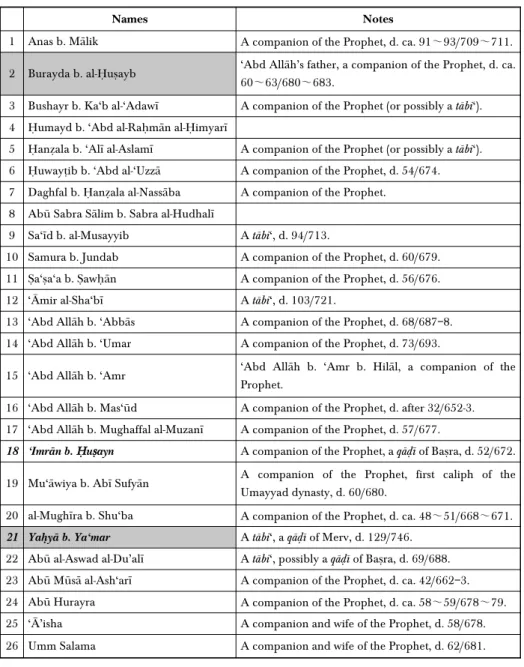
19)It is al-Mizz 9 (d. 742/1341) who enumerates 26 people who transmitted the h. ad∏ths to ‘Abd All∑h and 57 to whom ‘Abd All∑h transmitted the h. ad∏ths, the greatest number of all the biographies.
20)(See Tables 1 and 2 in the Appendix.
21))
Table 1 in the Appendix lists the above 26 r∑w∏s, most of whom were very famous companions of the Prophet, lived in I ij∑z or ‘Ir∑q (Ba a ra and K = fa), having no relation to Khur∑s∑n. This is why it seems reason- able to suppose that he accumulated his knowledge of the h. ad∏ths while he was living in Ba a ra.
22)Table 2 lists the above 57 r∑w∏s, quite a few of whom came from Khur∑s∑n, especially from Merv, in contrast to Table 1.
That is to say, 19 (33%) were related to Khur∑s∑n, of whom at least 16 were related to Merv. On the basis of two tables, it can be assumed that
‘Abd All∑h became the connection between the Prophet’s famous com- panions and the r∑w∏s of Khur∑s∑n. This suggests on the one hand that he was one of the earliest Arab settlers to carry the h. ad∏ths with his father to Khur∑s∑n, and on the other that later on the ‘ulam∑’ of Khur∑s∑n trusted him as a reliable source of the h. ad∏ths.
In addition, ‘Abd All∑h b. ‘A ] ∑’ al-Makk 9 and ‘Abd al-Mu’min b.
Kh∑lid al- I anaf 9 (nos. 23 and 27 in Table 2), were known as s. ∑ h. ibs of
‘Abd All∑h.
23)This means they were his followers, or possibly members of what could be called the ‘Abd All∑h school of h. ad∏th transmitters. In any case, we can conclude that there were people of Khur∑s∑n who con- sidered the h. ad∏ths which he transmitted as reliable,
24)and others who did not regarded him as a reliable r∑w∏, branding his h. ad∏ths as munkars.
25)Another look at Appendix Tables 1 and 2 reveals that two r∑w∏s in
Table 1 (nos. 18, 21) and five r∑w∏s in Table 2 (nos. 8, 14, 24, 27, 42) had been q∑ d. ∏s. ‘Abd All∑h as a r∑w∏ became acquainted with these seven q∑ d. ∏s through his transmission of the h. ad∏ths. Moreover, four out of these seven (Table 1, no. 21; Table 2, nos. 8, 24, 27) had been q∑ d. ∏s of Merv, one of whom ‘Abd al-Mu’min b. Kh∑lid al- I anaf 9 (no. 27 in Table 2) was a s. ∑ h. ib of ‘Abd All∑h as mentioned above. These facts are by no means merely coincidental to the fact that ‘Abd All∑h was himself a q∑ d. ∏ of Merv at some time in his career.
26)III. ‘Abd All∑h as a q∑ d. ∏ 1. Related h. ad∏th
In one of the h. ad∏ths (with the isn∑d: Mu [ ammad b. I ass∑n al-Samt 9
← Khalaf b. Khal 9 fa ← Ab = H∑shim
27)← Ibn Burayda ← Ab 9 (Burayda)) which ‘Abd All∑h transmitted we find
28)He (the Prophet) said, “There are three kinds of q∑ d. ∏. One of these three will be in Heaven, and the others will be in Hell. The one in Heaven is the man who knows the truth and judges from it. The man who knows the truth but deviates in judgment is the one in Hell. The man who judges without knowledge to please people is also the one in Hell.”
(al-qu d. ∑t thal∑tha w∑ h. id f∏ al-Janna wa ithn∑ni f∏ al-N∑r fa-’amm∑ alladh∏ f∏
al-Janna fa-rajul ‘arafa al- h. aqq fa-qa d. ∑ bi-hi wa rajul ‘arafa al- h. aqq fa-j∑ra f∏
al- h. ukm fa-huwa f∏ al-N∑r wa rajul qa d. ∑ li-al-n∑s ‘al∑ jahl fa-huwa f∏ al-N∑r) This h. ad∏th, which outlines the dos and don’ts for q∑ d. ∏s and warns of retri- bution for errors in judgment, appears in many h. ad∏th collections and books on jurisprudence.
29)Moreover, the transmission of this h. ad∏th through ‘Abd All∑h is proof of his connection with the judgeship.
Interestingly, there is another version of this h. ad∏th different from the above in both its isn∑d (Ab = Ja‘far Mu [ ammad b. 9∑li [ ← Jub∑ra ←
‘Abd All∑h b. Bukayr ← I ak 9 m b. Jubayr
30)← ‘Abd All∑h b. Burayda) and matn (body).
31)Yaz 9 d b. al-Muhallab troubled me (‘Abd All∑h), hoping to appoint
me to the judgeship of Khur∑s∑n. So I said, “By God, I’ll never ac-
cept the appointment, because I heard from my father (Burayda) that the Prophet said to him, ‘There are three kinds of q∑ d. ∏. Two of these three will be in Hell, and the other will be in Heaven. The man who knows [the truth] and judges from it, is the one in Heaven. The man who knows the truth but deviates intentionally [in judgment] is the one in Hell. The man who judges without knowledge and is ashamed to tell that he doesn’t know anything, is also the one in Hell.’”
(ar∑da Yaz∏d b. al-Muhallab an yasta‘mila-n∏ ‘al∑ qa d. ∑’ Khur∑s∑n fa-ala h.h. a
‘alay-ya fa-qultu l∑ wa All∑h qad h. addatha-n∏ ab∏ ‘an Rasπl All∑h s. all∑ All∑h
‘alay-hi wa sallam f∏ al-qu d. ∑t thal∑tha ithn∑n f∏ al-N∑r wa w∑ h. id f∏ al-Janna q∑ d. in ‘alima fa-qa d. ∑ bi-hi fa-huwa min ahl al-Janna wa q∑ d. in ‘alima al- h. aqq fa-j∑ra muta‘ammidan fa-huwa min ahl al-N∑r wa q∑ d. in qa d. ∑ bi-ghayr ‘ilm wa-sta h. y∑ an yaqπla l∑ a‘lamu fa-huwa min ahl al-N∑r)
Thus this version is supplemented with ‘Abd All∑h’s own explanation of his situation,
32)but this part is very doubtful. According to the explana- tion, ‘Abd All∑h was earmarked for a q∑ d. ∏ship by the governor of Khur∑s∑n Yaz 9 d (82〜 85/702〜 704; 97〜 99/715–6〜 717), but he re- fused the appointment.
33)However, most of the historical sources state that he was in fact a q∑ d. ∏ of Merv at some time and thus it is quite possi- ble that he was appointed by Yaz 9 d (A more detailed discussion will ap- pear in section III, 2). Therefore, the supplementary explanation should be interpreted in either of the following three ways:
①
‘Abd All∑h did not consider himself competent for the judgeship based on the words of the Prophet, but the governor of Khur∑s∑n compelled him to accept the appointment anyway.
②
‘Abd All∑h tried to avoid becoming a q∑ d. ∏ for some reason besides the words of the Prophet, but the governor of Khur∑s∑n com- pelled him to accept the appointment anyway.
③
The explanation is a fabrication by later ‘ulam∑’.
In the final analysis, it is most probable that the explanation was fabricat-
ed.
34)In either case, this h. ad∏th is important for projecting the image of
the ideal q∑ d. ∏, and by passing it down from his father Burayda, who
heard it from the Prophet, ‘Abd All∑h was a q∑ d. ∏ who aspired to that ide-
al. Thus, the anecdote of his refusal of a judgeship bears a significance
that later ‘ulam∑’ could not deny, although the statement’s verity remains in doubt.
2. ‘Abd All∑h’s term as q∑ d. ∏
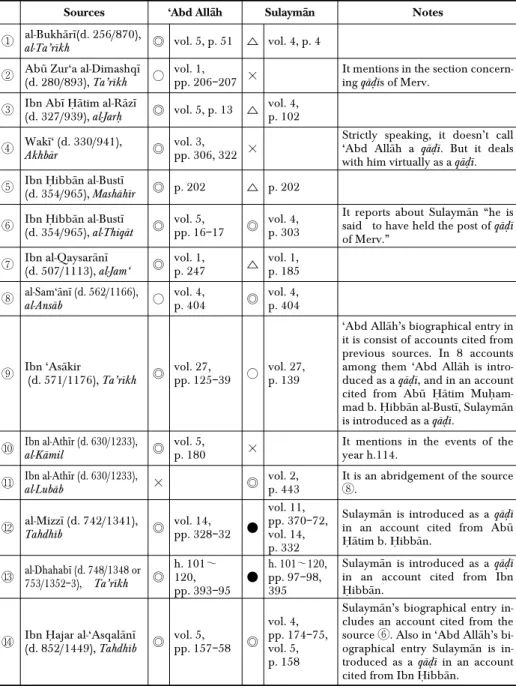
Appendix Table 3 lists the historical sources that mention ‘Abd All∑h as a q∑ d. ∏, beginning with al-Ta’r∏kh al-Kab∏r of al-Bukh∑r 9 (d.
256/870)
35)and also lists those sources that report ‘Abd All∑h’s brother Sulaym∑n as a q∑ d. ∏, beginning with al-Thiq∑t of Ibn I ibb∑n al-Bust 9 (d.
354/965). Some of the sources in the Table indicate ‘Abd All∑h’s term as q∑ d. ∏, the details of which can be divided into three groups as follows.
2.1. Group 1: ‘Abd All∑h takes over the judgeship from his brother in 105/723–4
According to Tahdh∏b al-Kam∑l of al-Mizz 9 ,
36)Sulaym∑n b. Burayda, holding a judgeship in Merv, died there in 105/723–4, and after him, his brother (i.e. ‘Abd All∑h) took charge of it in Merv and held it until his death in 115/733–4.
(m∑ta Sulaym∑n b. Burayda bi-Marw wa huwa ‘al∑ al-qa d. ∑’ bi-h∑ sana khams wa mi’a wa waliya akhπ-hu ba‘da-hu al-qa d. ∑’ bi-h∑ fa-k∑na ‘al∑ al- qa d. ∑’ bi-Marw il∑ an m∑ta sana khams ‘ashra wa mi’a)
This story, which does not tell us when Sulaym∑n was appointed and who appointed him and his brother, suffers from two problems. One con- cerns ‘Abd All∑h’s age. If in fact he had held the position at the time quoted, he would have been 89–90/86–8 years of age when appointed and 99–100/96–7 at the time of his death, which is physically improba- ble. The other problem concerns his succession to Sulaym∑n’s judgeship.
As Table 3 suggests, the sources which mention Sulaym∑n as a q∑ d. ∏ are
fewer than those of ‘Abd All∑h, and some do not mention Sulaym∑n as a
q∑ d. ∏ in their biographical entries for him. Therefore, at this stage in the
investigation, it can not be confirmed that Sulaym∑n was in fact a q∑ d. ∏,
thus casting serious doubt on Group 1.
2.2. Group 2: It was al-Muhallab who appointed ‘Abd All∑h q∑ d. ∏ In the mid-twelfth century, an ‘∑lim of Merv by the name of al- Sam‘∑n 9 (d. 562/1166) tells a story about ‘Abd All∑h’s term as q∑ d. ∏ which is not found in the other sources.
37)He (Sulaym∑n b. Burayda) held the judgeship of Merv during the governorship of al-Muhallab b. Ab 9 9ufra. He tendered his resigna- tion to al-Muhallab. al-Muhallab, who relieved him of the post, in- stalled his (Sulaym∑n’s) brother ‘Abd All∑h b. Burayda instead.
(k∑na ‘al∑ qa d. ∑’ Marw ayy∑m al-Muhallab b. Ab∏ 9 ufra ista‘f∑-hu fa-a‘f∑-hu wa ja‘ala mak∑n-hu akh∑-hu ‘Abd All∑h b. Burayda)
This story is similar to the view of the first group that ‘Abd All∑h took over the judgeship from his brother Sulaym∑n, but differs from it in that rather than dying, Sulaym∑n resigned his post and the governor of Khur∑s∑n al-Muhallab (79〜82/698〜702) appointed ‘Abd All∑h in his place. This story, which does not indicate when Sulaym∑n resigned or how long ‘Abd All∑h held the post, also suffers from two problems. One concerns whether or not Sulaym∑n held the post of q∑ d. ∏, as stated above in the examination of the first group. The other concerns the role played by al-Muhallab. Unfortunately, no source exists other than al-Sam‘∑n 9 ’s which testifies that al-Muhallab appointed ‘Abd All 5 h q∑ d. ∏. Despite the absence of supporting historical evidence, it is quite possible to suggest that al-Sam‘ 5 n 9 may have taken this unique story from Ta’r∏kh Marw (History of Merv) or Ta’r∏kh al-Mar∑wiza (History of the people of Merv), which are no longer extant.
38)Therefore, while this story is worth considering in the future, it remains unacceptable at this stage.
2.3. Group 3: It was Yaz 99 d who appointed ‘Abd All 5 5 h q∑ d. ∏ Besides al-Ans∑b of al-Sam‘ 5 n 9 , there are four more sources which state definitely who appointed ‘Abd All 5 h q∑ d. ∏ (namely, Mash∑h∏r ‘Ulam∑’
al-Am s. ∑r of Ibn I ibb 5 n al-Bust 9 , al-Thiq∑t of Ibn I ibb 5 n al-Bust 9 , Ta’r∏kh
Mad∏na Dimashq of Ibn ‘As 5 kir, and Ta’r∏kh al-Isl∑m of al-Dhahab 9 ),
39)all of
which are in agreement that he was appointed by Yaz 9 d b. al-Muhallab,
the son of the above-mentioned al-Muhallab and governor of Khur 5 s 5 n
from 82/702 to 85/704 and from 97/715–6 to 99/717.
40)Thus it seems
reasonable at this stage to regard Yaz 9 d as the one who actually made the appointment.
Ibn ‘As 5 kir (d. 571/1176) gives two accounts of the appointment, one of them telling the story definitely and in detail as follows.
41)He (Aws b. ‘Abd All 5 h b. Burayda) said, “‘Abd All 5 h b. Burayda had been q∑ d. ∏ of Merv for 24 years, receiving a stipend while holding the judgeship. Yaz 9 d b. al-Muhallab appointed him q∑ d. ∏, and he held the post until the governorship of Asad b. ‘Abd All 5 h.”
(q∑la k∑na ‘Abd All∑h b. Burayda q∑ d. ∏ Marw arba‘an wa ‘ishr∏n sana wa k∑na ya’khudhu al-rizq ‘al∑ al-qa d. ∑’ k∑na Yaz∏d b. al-Muhallab istaq d. ∑-hu fa- lam yazal q∑ d. iyan h. att∑ k∑na f∏ wil∑ya Asad b. ‘Abd All∑h)
According to this account told by his son, ‘Abd All 5 h held the judgeship of Merv for a period of 24 years.
42)The Asad mentioned in the account held a governorship in Khur 5 s 5 n from 106/724–5 to 109/727–8 and from 117/735 to 120/738. The period between the first governorship of Yaz 9 d (from 82/702 to 85/704) and the first governorship of Asad (from 106/724–5 to 109/727–8) was at least 22 years in length (from 85/704 to 106/724–5) and at most 28 years (from 82/702 to 109/727–8), which ver- ifies the above fact that ‘Abd All 5 h held the judgeship for 24 years, mak- ing it natural to assume that the term lasted between the first governor- ships of these two governors of Khur 5 s 5 n.
However it is noteworthy that some historical sources say that Qutayba b. Muslim, a governor of Khur 5 s 5 n from 86/705 to 96/715, ap- pointed Ya [ y 5 b. Ya‘mar (d. 129/746) q∑ d. ∏ of Merv,
43)and that al-Jarr 5[
b. ‘Abd All 5 h, a governor of Khur 5 s 5 n from 99/717–8 to 100/719, re- lieved ‘Abd All 5 h of the judgeship and installed Ab = ‘Uthm 5 n al-An a5 r 9 in his place.
44)These are events inconsistent with the content of the above account from Ta’r∏kh Mad∏na Dimashq, for the judgeship of any city in early Islamic times was given to one person. Moreover, it is hard to suppose that ‘Abd All 5 h held the post without a break for 24 years, mak- ing Ibn ‘As 5 kir’s account not completely reliable. Nevertheless, two con- clusions can probably be safely drawn from the information about ‘Abd All 5 h’s term as q∑ d. ∏ of Merv.
①
Yaz 9 d (or possibly his father al-Muhallab) appointed him.
②
His term of q∑ d. ∏ lasted a certain long time between the first year of
the governorship of Yaz 9 d (82/702) and the fourth year of the gov- ernorship of Asad (109/727–8).
These two conclusions lead us to another significant point that there was no q∑ d. ∏ in Merv prior to ‘Abd All 5 h, though there is still room for further examination of that fact.
45)Furthermore, as mentioned above, ‘Abd All 5 h as a r∑w∏ transmitting the h. ad∏th proclaiming the code of conduct for q∑ d. ∏s became acquainted with four other q∑ d. ∏s of Merv (who presumably served after him), one of whom, ‘Abd al-Mu’min b. Kh 5 lid al- I anaf 9 , was a s. ∑ h. ib of ‘Abd All 5 h. From all these facts, there is no doubt that ‘Abd All 5 h had set an admirable example for the q∑ d. ∏s who succeeded him in Merv dur- ing the latter Umayyad and the early ‘Abb 5 sid periods.
3. The q∑ d. ∏ship of ‘Abd All 5 5 h
According to Wak 9 ‘ (d. 330/941) in his Akhb∑r al-Qu d. ∑t,
46)He (‘Umayr b. ‘Uqba) said, “I saw ‘Abd All 5 h b. Burayda moving from one village to another riding an ass and delivering judgments among people.”
(q∑la ra’aytu ‘Abd All∑h b. Burayda ‘al∑ h. im∑r ya t. πfu al-qur∑ yaq d. ∏ bayna al- n∑s)
This citation demonstrates the tentative situation of a q∑ d. ∏ in the early eras as an arbitrator, differing from the later well-established condition of q∑ d. ∏s presiding over formal trials, usually in mosques.
47)Unfortunately, this is the only description attesting of the actual conditions of his q∑ d. ∏ship. Moreover, since the activities of the q∑ d. ∏s of Merv during these times are wrapped in obscurity, hopefully further research will reveal more about their positions in the local community and the contemporary system of jurisprudence.
48)IV. The Burayd 99 ya Family after the death of ‘Abd All 5 5 h 1. The gravesite
‘Abd All 5 h b. Burayda died at the village of J 5 warsa
49)in
115/733–4
50)at the age of 99–100/96–7, if the years of his birth and
death are accurately recorded in the historical sources.
51)His body was buried in J 5 warsa and his tomb became an object of ziy∑ra (visitation) lat- er on, but it is not known when this custom began. Judging from the fact that the earliest historical source referring to the location of his tomb is Ibn I ibb 5 n al-Bust 9 ’s al-Thiq∑t, it may have been during the 10
thcentury.
In the 12
thcentury, al-Sam‘ 5 n 9 , a native of Merv, mentions the custom in his explanation of the nisba of J 5 wars 9 as follows.
52)This nisba [ J 5 wars 9 ] is derived from J 5 warsa which is [the name of] a village located at a distance of three farsakh (18 km) from Merv. The tomb of ‘Abd All 5 h b. Burayda is there, and the people of Merv and its environs gather there on the night of the Bar∑’a.
(h∑dhihi al-nisba il∑ J∑warsa wa hiya qarya ‘al∑ thal∑tha far∑sikh min Marw wa bi-h∑ qabr ‘Abd All∑h b. Burayda ra d. iya All∑h ‘an-hum∑ wa ahl Marw wa al-naw∑ h. ∏ yajtami‘πna ‘inda-hu layla al-Bar∑’a)
Although al-Sam‘ 5 n 9 refers to the other tombs in the Merv region to which people visit,
53)the visitation to ‘Abd All 5 h’s tomb is unique in that it was a special yearly event for the people of Merv.
54)2. The Burayd 99 ya Family
‘Abd All 5 h had four children, three of whom (excepting Jam 9 l) were known as r∑w∏s and are mentioned in the biographical sources cited for Appendix Table 4. They also may have been engaged in political activi- ties, since Merv is well-known as the eastern focal point for the Da‘wa al-
‘Abb∑s∏ya (‘Abb 5 sid movement), and ‘Abd All 5 h’s descendants seem to have been involved in that movement, which began in Merv in 98/717, possibly during ‘Abd All 5 h b. Burayda’s service as the city’s q∑ d. ∏.
55)The first leader of the movement in Merv was Sulaym 5 n b. Kath 9 r al-Khuz 5 ‘ 9 al-Aslam 9 (d. 132/750), and there were a lot of other Khuz 5 ‘ 9 s involved in it.
56)It is only natural that members of the Burayd 9 ya Family of Aslam al- so took part. We are sure that two mawl∑s (clients or freedmen) of ‘Abd All 5 h’s father Burayda, ‘∞s 5 b. A‘yan and ‘Amr b. A‘yan
57), joined early on.
58)Moreover, we know that ‘Abd All 5 h’s grandson, I amm 5 d b. 9akhr b. ‘Abd All 5 h b. Burayda, also participated, but there are no details about the role he played.
59)When the second leader of the movement in Merv, Ab = Muslim (d.
137/755), rose in rebellion (ayy∑m khurπj-hi), the Burayd 9 ya Family faced a serious dilemma, when L 5 hiz b. Quray2 al-Tam 9 m 9 (d. 130/747–8), one of twelve naq∏bs (leading members of the movement) and a son-in-law of the above Sulaym 5 n b. Kath 9 r, requested Ab = Muslim to kill ‘Abd All 5 h’s son, Sahl b. ‘Abd All 5 h b. Burayda.
60)Though it is unknown what the reason for the request was or whether Ab = Muslim acquiesced, as a result, Sahl fled for his life. After that the Ab = Muslim’s army captured the city of Merv in 130/747, and in the course of the siege, L 5 hiz helped the Umayyad governor of Khur 5 s 5 n, Na a r b. Sayy 5 r (d. 131/748), escape the city. Later, Ab = Muslim would hear of L 5 hiz’s act of treachery and sentence him to death,
61)which was carried out voluntarily by ‘Abd All 5 h’s grandson, Bishr b. 9akhr b. ‘Abd All 5 h b. Burayda.
62)Although, al-Ans∑b states that the executioner was I amm 5 d b. 9akhr b. ‘Abd All 5 h, not Bishr,
63)we can be sure that ‘Abd All 5 h’s grandson took part in the execution to avenge his uncle’s hardship.
There is no trace indicating that the descendants of ‘Abd All 5 h en- gaged in political activities after the ‘Abb 5 sid caliphate was established;
and it also seems that the family name decreased in prestige in favor of a number of mawl∑s rising among the ‘ulam∑’ of Merv.
64)Although Ibn I azm (d. 456/1064) states that there were many descendants of ‘Abd All 5 h and his brother Sulaym 5 n in Merv,
65)no Burayd 9 ya name appears in the sources after Burayda b. Mu [ ammad (d. 493/1100).
66)Conclusion
This article has examined the career of ‘Abd All 5 h b. Burayda, an Arab and a t∑bi‘ who lived in Merv during the Umayyad period, and the activities of his family there. The findings can be summarized as follows.
①
It is clear from al-Bal 5 dhur 9 ’s account that ‘Abd All 5 h’s father Burayda was typical of the Arabs who settled in Merv during the early Umayyad period, and that ‘Abd All 5 h enjoyed an important position in the Arab-Muslim community there.
Carrying the h. ad∏ths to Khur 5 s 5 n shortly after the Arab con- quest of the region, ‘Abd All 5 h played the role as a r∑w∏; and some of those to whom ‘Abd All 5 h transmitted the h. ad∏ths were known as his s. ∑ h. ibs.
He contributed to the stabilization of Islamic society in Merv as
its first q∑ d. ∏, serving in that capacity some time between 82/702
and 109/727–8. Although the particulars of ‘Abd All 5 h’s career as a q∑ d. ∏ remain almost unknown, he must have had a strong influ- ence on succeeding q∑ d. ∏s in Merv through his transmission of the h. ad∏ths.
②
‘Abd All 5 h contributed to the prosperity of the Burayd 9 ya Family.
He fostered four children more than his brother Sulaym 5 n; and they and their sons were active in Merv after his death, some par- ticipating in the ‘Abb 5 sid movement and playing proactive roles in the execution of L 5 hiz, the traitor.
③
After his death, ‘Abd All 5 h’s tomb became a venerable place, pos- sibly in the 10
thcentury; and during the 12
thcentury, visitation to the tomb became a special yearly event for the people of Merv.
While this article amounts to nothing more than a biographical sur- vey of ‘Abd All 5 h’s life, the facts ascertained are closely connected to such important points for research on early Islamic history as Arab set- tlers in the conquered lands, the h. ad∏ths, ‘ulam∑’, q∑ d. ∏s, local leading fig- ures, the ‘Abb 5 sid movement, and ziy∑ra. That is to say the life history of
‘Abd All 5 h and his family affords the researcher a window through which to see these subjects in concrete terms, or to put it another way, the life of ‘Abd All 5 h represents a unique portrait of the history of Merv, in which these subjects are depicted.
67)This is a revised English translation of the author’s article in Japanese enti- tled “‘Abd All5h b. Burayda: A T5bi‘ and his Family in Khur5s5n during the Umayyad Period” Seinan Ajia Kenkyu (Bulletin of the Society for Western and Southern Asiatic Studies), No. 58 (2003), pp. 32–56(「アブド・アッラーフ・
ブン・ブライダ ─ ウマイヤ 期ホラーサーン地方の一タービゥとその一族 について ─」『西南アジア 究』).
Notes
01) The name of this city can be transcribed as Marw from Arabic or as Marv from Persian, but in this present article Merv will be used, due to its wide usage in the English language research literature. Other proper nouns will be transcribed from Arabic, except those most widely used.
02) For the general history of Merv from the Umayyad period to the early
‘Abb5sid period, see Yakubovskii & Bosworth 1991; Far9dan9 1992; Sato
1994; Kennedy 1999. Works that offer information on the ‘ulam∑’of Merv include Ranjbar 1343Kh. pp. 235–37; R5dfar 1372Kh..
03) See, for example, the work of Ibn Iibb5n al-Bust9titled Mash∑h∏r ‘Ulam∑’ al- Ama∑r.
04) For Burayda’s biography, see Zettersteen & ‘Arafat 1960.
05) There is a brief reference to him in al-Zirikl9 1996, vol. 4, p. 74, but it is quite insufficient.
06) Though the term “Burayd9ya Family,” such as ∑l Buraydaor bayt Burayda, is not found in the historical sources, it is reasonable to call them the Burayd9ya since their nisba derived from his name; i.e., al-Burayd9 or al- Iuaayb9. See Ibn M5k=l5, al-Ikm∑l, vol. 1, p. 548; al-Sam‘5n9, al-Ans∑b, vol.
1, p. 334; vol. 2, p. 229.
07) Ibn al-Kalb9, Nasab, vol. 2, p. 144; Ibn Sa‘d, al-T.abaq∑t, vol. 4, p. 241; vol. 7, pp. 8, 365; Khal9fa b. Khayy5], al-T.abaq∑t, vol. 1, p. 240. According to Ibn Iajar al-‘Asqal5n9, al-Is.∑ba, vol. 1, p. 146; Ibn N5air al-D9n al-Dimashq9, Tawd.∏h., vol. 3, p. 431, the name Burayda is a laqab(nickname) and his real name is ‘≠mir.
08) Ibn Qutayba, al-Ma‘∑rif, p. 300. Khuz5‘a is an Arab tribe of obscure origin.
Some Muslim genealogists argue that it is of Mu3ar9origin, and others that it is of Yaman9origin. See Kister 1986.
09) Ibn Sa‘d, al-T.abaq∑t, vol. 7, p. 221; Ibn ‘As5kir, Ta’r∏kh, vol. 27, p. 127; al- Dhahab9, Siyar, vol. 5, p. 51.
10) Ibn Sa‘d, al-T.abaq∑t, vol. 7, p. 221; Ibn Iibb5n al-Bust9, al-Thiq∑t, vol. 5, pp.
16–17; Ibn Iibb5n al-Bust9, Mash∑h∏r, p. 202; Ibn ‘As5kir, Ta’r∏kh, vol. 27, pp. 127-29, 133, 139. al-Bukh5r9(d. 256/870) mentions that they were born during ‘Umar’s reign, but does not refer to the year of their birth. See al- Bukh5r9, al-Ta’r∏kh, vol. 4, p. 4. Their birthplace is obscure. Many sources regard them as Baar9s, while Ibn ‘As5kir, Ta’r∏kh, vol. 27, p. 136 and Ibn Iajar al-‘Asqal5n9, Tahdh∏b, vol. 5, p. 158 mention that they are K=f9s.
According to an account in Ibn ‘As5kir, Ta’r∏kh, vol. 27, p. 139, they were born before their father’s settlement in Baara from Medina.
11) It is obscure when he moved from Medina to Baara. See Ibn Sa‘d, al- T.abaq∑t, vol. 4, pp. 242–43, vol. 7, pp. 8, 365; al-Bukh5r9, al-Ta’r∏kh, vol. 2, p. 141; Ibn Ab9 I5tim al-R5z9, al-Jarh., vol. 2, p. 424; Ibn Iibb5n al-Bust9, Mash∑h∏r, p. 100; Ibn ‘Abd al-Barr, al-Istiy‘∑b, vol. 1, p. 185; Ibn ‘As5kir, Ta’r∏kh, vol. 27, p. 139; Ibn al-Ath9r, Usd, vol. 1, p. 203.
12) al-Bal5dhur9, Futπh., p. 577, and similarly Ibn al-Ath9r, al-K∑mil, vol. 3, p.
489. However according to an account in Ibn ‘As5kir, Ta’r∏kh, vol. 27, p.
139, Burayda fought against the infidels in S9st5n before moving to Merv by way of Har5t. Other sources also mention that he went to S9st5n. See Ibn Sa‘d, al-T.abaq∑t, vol. 4, p. 243; al-Bukh5r9, al-Ta’r∏kh, vol. 2, p. 141; Ibn Iibb5n al-Bust9, al-Thiq∑t, vol. 3, p. 29; Ibn Iibb5n al-Bust9, Mash∑h∏r, pp.
100–101.
13) al-T.abar9, Ta’r∏kh, II, pp. 81, 155 mentions the settlement of the people to Merv, but does not refer to Burayda. Ziy5d was a governor of ‘Ir5q, who
planned the settlement in order to control the Muq5tila (warriors) better. In Shimada Johei’s view (1977, p. 104), “he intended to fortify the defense of the frontier, and remove a possible future cause of social unrest coming from ‘Ir5q.” Incidentally, Ibn al-Faq9h, Mukhtas.ar, p. 316 mentions the fol- lowing h.ad∏th, which seems to have motivated Burayda to advance to Merv:
The Prophet said to Burayda, “Oh Burayda, the delegations will be sent after me. Then, take part in the delegation to Mashriq, to Khur5s5n and to the place which is called Marw. When you have reached there, settle in the city. It was Alexander the Great who built it, and Ezra who prayed in it. The river flows [there] with blessing, and there is an angel in every river of the place, who will remove vice from the people with his drawn sword until Judgment Day.”
(q∑la Rasπl All∑h s.all∑ All∑h ‘alay-hi wa sallam y∑ Burayda anna-hu sa- tub‘athu ba‘d∏ bu‘πth fa-idh∑ bu‘ithat fa-kun f∏ ba‘th al-Mashriq thumma kun f∏ ba‘th Khur∑s∑n thumma kun f∏ ba‘th ard.yuq∑lu la-h∑ Marw fa-idh∑ atayta- h∑ fa-nzil mad∏na-h∑ fa-inna-hu ban∑-h∑ Dhπ al-Qarnayn wa s.all∑ f∏-h∑ ‘Uzayr anh∑r-h∑ tajr∏ ‘alay-h∑ bi-al-baraka ‘al∑ kull nahr min-h∑ malak sh∑hir sayf-hu yadfa‘u ‘an ahl-h∑ al-sπ’ il∑ yawm al-qiy∑ma)
This h.ad∏thin praise of Merv is mentioned also in Ibn Qutayba, ‘Uyπn, vol.
1, p. 314; Ibn Ianbal, al-Musnad, vol. 6, p. 490; I5kim N9sh5b=r9, Ta’r∏kh, p. 68; Y5q=t, Mu‘jam, vol. 5, pp. 132–33.
14) al-Bal5dhur9, Futπh., p. 576.
15) Ibn Sa‘d, al-T.abaq∑t, vol. 4, p. 242, vol. 7, p. 365; Khal9fa b. Khayy5], Ta’r∏kh, p. 156; al-Bukh5r9, al-Ta’r∏kh, vol. 2, p. 141; Ibn Qutayba, al-Ma‘∑rif, p. 300; Ibn Iibb5n al-Bust9, Mash∑h∏r, p. 101; Ibn ‘Abd al-Barr, al-Istiy‘∑b, vol. 1, p. 185. al-Dhahab9, Ta’r∏kh, h. 61–80, p. 76 states the year of his death as 62/681-2, but Ibn Sa‘d, al-T.abaq∑t, vol. 7, p. 8 and Ibn Iajar al-
‘Asqal5n9, Tahdh∏b, vol. 1, p. 432 consider it to be 63/682–3.
16) For Jaaa9n, see al-Bakr9, Mu‘jam, vol. 2, p. 384; al-Sam‘5n9, al-Ans∑b, vol. 4, p.
305; Y5q=t al-R=m9, Mu‘jam, vol. 2, p. 164. As an aside, Burayda’s tomb- stone exists, and the position of the Jaaa9n cemetery has been located (See Sato 1994, pp. 32, 52). A picture of the tombstone appears in Zhukovskiı˘
1894.
17) al-Bukh5r9, al-Ta’r∏kh, vol. 2, p. 141; Ibn ‘Abd al-Barr, al-Istiy‘∑b, vol. 1, p.
186; al-Bakr9, Mu‘jam, vol. 2, p. 384; Ibn al-Ath9r, Usd, vol. 1, p. 203. In re- gard to this h.ad∏th, Michael Lecker (2000, pp. 46–47) states: “The context [in which ‘Abd All5h reported his father’s death in Merv, adding this h.ad∏th]
suggests that Burayda was in fact a martyr. The association of Burayda’s burial with the general principle attributed to the Prophet suggests that ac- cording to ‘Abd All5h’s testimony, the great eschatological honour be- longed to his father.” This interpretation is full of interesting suggestions nevertheless, there are no sources which specifically describe Burayda as a
shah∏d(martyr).
18) In this article, the term r∑w∏means a transmitter of the h.ad∏ths: cf. Jacobi 1995.
19) The bibliographical notes regarding ‘Abd All5h in al-Dhahab9, Ta’r∏kh, h.
101–120, p. 393; al-Mizz9, Tahdh∏b, vol. 14, pp. 328–29, given by the edi- tors, are helpful.
20) Ibid. pp. 329–30.
21) From several points of view, both tables might need to be confirmed by a careful examination of isn∑ds of h.ad∏ths mentioned in h.ad∏thcollections, but such a task goes far beyond the scope of this present article and is now the subject of ongoing research. Numerical values from both tables should be understood as showing not exact data but rather tendencies.
22) According to an anecdote, ‘Abd All5h was with Burayda when his father met the Umayyad caliph Mu‘5wiya (Ibn ‘As5kir, Ta’r∏kh, vol. 27, pp.
126–27; al-Dhahab9, Ta’r∏kh, h. 101–120, p. 394; al-Dhahab9, Siyar, vol. 5, p.
52). From this it can be inferred that ‘Abd All5h made contact with the companions of the Prophet through his father.
23) Ya[y5 b. Ma‘9n, Ta’r∏kh, vol. 2, p. 277; Ibn Iibb5n al-Bust9, Mash∑h∏r, p.
310.
24) See also Ibn Iajar al-‘Asqal5n9, Tahdh∏b, vol. 5, p. 158 (an example which shows trust of the people of Merv in the h.ad∏ths transmitted through ‘Abd All5h). Incidentally, G.H.A. Juynboll refers to ‘Abd All5h in his article on dyeing the hair and beard in early Islam (Juynboll 1986), which argues that the propriety of hair dyeing was a matter of controversy in Islamic law, and one of the h.ad∏ths transmitted by ‘Abd All5h was regarded as an authority on the subject.
25) Cf. Ibn Ianbal, al-‘Ilal, vol. 2, p. 22. The term munkarmeans a certain type of h.ad∏th or a transmitter of such (Juynboll 1993). It has often a negative meaning (e.g., “objectionable”), and munkartransmitters are generally sus- pected of having had a hand in the invention of the matn(body) of a h.ad∏th.
H.ad∏ths containing family isn∑ds, genealogies of transmission from father to son to grandson, were also suspected of being munkars; therefore those h.ad∏ths with the isn∑d“the Prophet → Burayda → ‘Abd All5h” would be considered typical munkars.
26) According to Ibn Sa‘d’s al-T.abaq∑t(vol. 7, p. 334), Ab=‘Abd All5h Mu[am- mad b. ‘Umar al-W5qid9(d. ca. 207/823), who was the compiler of Kit∑b al- Magh∑z∏ and a q∑d.∏ of Baghd5d, was also a mawl∑(client) of ‘Abd All5h b.
Burayda. This is likely a fiction based on the fact that both al-W5qid9and
‘Abd All5h were members of the tribe of Aslam b. Afa5. Whether fiction or not, it is an interesting example that shows a relationship between ‘Abd All5h and another q∑d.∏.
27) He is Ab=H5shim al-Rumm5n9, no. 57 in Table 2.
28) Ab=D5’=d, Sunan, vol. 3, pp. 288–89.
29) al-Khaaa5f, Adab, pp. 33–34; Ibn M5ja, Sunan, vol. 2, p. 776; al-Tirmidh9, 9ah.∏h., vol. 2, p. 65; al-T.abar5n9, al-Mu‘jam, vol. 4, pp. 377–78, vol. 7, pp.
388, 402–403. In all of these sources, the isn∑ds of this h.ad∏th include Ibn Burayda (=‘Abd All5h). Only in Adabof al-Khaaa5f it is mentioned as Ibn Ab9Burayda not as Ibn Burayda, but it can be inferred that it means ‘Abd All5h. In Wak9‘’s Akhb∑r, vol. 1, pp. 13–19, this h.ad∏th is mentioned 13 times, each time accompanied by the respective isn∑ds. Five times out of 13 the isn∑ds include Ibn Burayda or ‘Abd All5h b. Burayda, and there is no t∑bi‘ mentioned except ‘Abd All5h, who appears in the isn∑ds more than three times. Four times out of the eight in which ‘Abd All5h does not ap- pear, the matn is attributed to ‘Al9 b. Ab9 T.5lib (d. 40/661), not to the Prophet. As far as this writer knows, this h.ad∏th is mentioned 24 times in nine sources (See also note 31 below). Sixteen times out of 24 Ibn Burayda or ‘Abd All5h appears, and the transmitters after him in the isn∑ds do not show any noteworthy tendency. Meanwhile, the term al-qud.∑t(pl. of al-q∑d.∏) used in this h.ad∏thappears in al-Qur’∑nonce in the form of q∑d.in(the infinite singular form) (XX, 72) and once in the form of al-q∑d.iya(the definite femi- nine form) (LXIX, 27). In al-Qur’∑nalso, the Arabic root q-3-y means “to fix, determine (of All5h),” “to finish, achieve, fulfill,” and “to judge” (See also Margoliouth 1910, pp. 312–13). More research is needed to better under- stand the usage of this term in the h.ad∏thliterature, but it seems safe to as- sume that this h.ad∏thdid exist during ‘Abd All5h’s lifetime.
30) Not found in Table 2.
31) Wak9‘, Akhb∑r, vol. 1, p. 15. The same version of this h.ad∏thalso appears in al-I5kim al-Nays5b=r9’s Ma‘rifa(pp. 98–99), al-Nasaf9’s al-Qand(p. 683) and Ibn ‘As5kir’s Ta’r∏kh (vol. 27, pp. 136–37), although the wording in these three sources differs slightly from that of the version in Wak9‘’s Akhb∑r(See also notes 32 and 33 below). The version which contains ‘Abd All5h’s own explanation appears five times out of 16 as pointed out in note 29.
32) In the three sources cited in note 31, this supplementary explanation is written in the third person, not in the first.
33) In the three sources cited in note 31, the governor of Khur5s5n Qutayba b.
Muslim (86〜96/705〜715), not Yaz9d, intended to appoint ‘Abd All5h.
34) al-I5kim al-Nays5b=r9 (d. 405/1014), after putting this h.ad∏thin his work, adds the following comment to it (al-I5kim al-Nays5b=r9, Ma‘rifa, p. 99).
This is a h.ad∏th which have been transmitted only by the people of Khur5s5n, for the men who heard it from someone except the trans- mitters in the isn∑dcome from Merv.
(h∑dh∑h.ad∏th tafarrada bi-hi al-Khur∑s∑n∏yπn fa-inna ruw∑t-hu ‘an ∑khar-him Mar∑wiza)
Judging from this comment, it is only natural to assume that the anecdote of ‘Abd All5h’s refusal to accept the appointment of the judgeship was fab- ricated by the ‘ulam∑’of Khur5s5n. Juynboll (1983, p. 94) indicates that the anecdote is one of the “anti-judgeship slogans,” and supposes that the slo-
gan originated in the period of mi[na (218〜234/833〜848). For ‘ulam∑’s refusals of the appointment of q∑d.∏ from the 1stcentury to the 4thcentury A.H., see Coulson 1956.
35) Earlier sources, for example Ya[y5b. Ma‘9n’s Ta’r∏kh; Khal9fa b. Khayy5]’s al-T.abaq∑t and Ibn Sa‘d’s al-T.abaq∑t, give him very little attention.
Incidentally, a certain ‘Abd All5h b. Burayda al-Aslam9is mentioned as a q∑d.∏ of Baara in Khal9fa b. Khayy5]’s Ta’r∏kh(p. 235), but the name of the q∑d.∏should be ‘Abd All5h b. Yaz9d al-Aslam9.
36) al-Mizz9, Tahdh∏b, vol.14, p.332. The same account appears in three other sources; namely, Ibn ‘As5kir, Ta’r∏kh(vol. 27, p. 139); al-Dhahab9, Ta’r∏kh(h.
101–120, p. 395), and Ibn Iajar al-‘Asqal5n9, Tahdh∏b (vol. 5, p. 158). All four of these sources quote from Ibn Iibb5n al-Bust9.
37) al-Sam‘5n9, al-Ans∑b, vol. 4, p. 404. The same account is also found in Ibn al- Ath9r, al-Lub∑b, vol. 2, p. 443, but the second half of it is omitted.
38) Six authors of History of Mervare mentioned in K5tip Çelebi’s Lexicon(vol. 2, p. 145) and in al-Sakh5w9’s al-I‘l∑n (pp. 275-76 (tr. Rosenthal 1968, pp.
476–77)). Sato Akemi states that five kinds ofHistory of Mervexisted, and F.
Sezgin mentions three authors of them (Sato 1994, p. 28; Sezgin 1967, vol.
1, pp. 351–52). Those to which al-Sam‘5n9 may have referred are at least the following three:
①Ab= al-‘Abb5s A[mad b. Sa‘9d b. A[mad b. Ma‘d5n (d. 375/986), Ta’r∏kh al-Mar∑wiza (cited in al-Sam‘5n9, al-Ans∑b, vol. 2, p. 13; vol. 3, p.
382).
②Ab=Raj5’ Mu[ammad b. Iamdawayh al-H=rq5n9(d. 306/918), Ta’r∏kh al-Mar∑wiza(cited in ibid., vol.1, p. 320, vol. 5, p. 656).
③Ab=Zur‘a al-Sinj9, Ta’r∏kh li-Marw(cited in ibid., vol. 5, p. 77).
For the books al-Sam‘5n9makes reference to, see also Kamaliddinov 1993, pp. 16–18. This writer intends to examine History of Mervin a separate pa- per.
39) Among these four sources, Ta’r∏khof Ibn ‘As5kir and Ta’r∏khof al-Dhahab9 carry accounts in accordance with Group 1 also (See note 36).
40) Ibn Iibb5n al-Bust9, Mash∑h∏r, p.202; Ibn Iibb5n al-Bust9, al-Thiq∑t, vol. 5, pp. 16–17; Ibn ‘As5kir, Ta’r∏kh, vol. 27, pp. 129, 137; al-Dhahab9, Ta’r∏kh, h.
101–120, p. 395.
41) Ibn ‘As5kir, Ta’r∏kh, vol. 27, p. 137.
42) Aws heard this story from his brother Sahl, his mother, and his family (ahl bayt-∏). He was ‘Abd All5h’s later son, and did not hear the h.ad∏ths directly from his father. Incidentally, he was considered to be an untrustworthy r∑w∏
in h.ad∏th literature (al-Bukh5r9, al-Ta’r∏kh, vol. 2, p. 17; al-D5raqu]n9, al-
=u‘af∑’, p. 67).
43) Ibn Iibb5n al-Bust9, Mash∑h∏r, p. 203; al-Dhahab9, Ta’r∏kh, h. 81–100, p.
502; Ibn Khallik5n, Biographical Dictionary, vol. 4, pp. 59–62.
44) Ibn ‘As5kir, Ta’r∏kh, vol. 27, p. 130.
45) That is to say, as suggested previously, it can not be confirmed that Sulaym5n b. Burayda was appointed q∑d.∏. Furthermore, the list of q∑d.∏s of Khur5s5n and Merv in the Umayyad period and the early ‘Abb5sid period compiled by Juynboll (1983, pp. 229–30) regards ‘Abd All5h as a q∑d.∏ of Khur5s5n; however, the historical sources, with the exception of Wak9‘’s Akhb∑r, mention him as a q∑d.∏of Merv, and this is why the latter title has been adopted in this article, but there is still room for more work on reveal- ing whether q∑d.∏s of Khur5s5n and Merv differed.
46) Vol. 3, p. 306.
47) The expression “moving from one village to another” suggests that there were Arab settlers dispersed in villages around the city of Merv. For more details, see Shaban 1970, pp. 32–34. The Burayd9ya Family had also settled in villages, ‘Abd All5h’s descendants residing in the village of J5warsa, where his tomb was located, and his brother Sulaym5n’s descendants resid- ing in the village of Fan9n, where his tomb was located (Ibn ‘As5kir, Ta’r∏kh, vol. 27, p. 131). Also, there was a village named 9akhr5b5dh after ‘Abd All5h’s son 9akhr (al-Sam‘5n9, al-Ans∑b, vol. 3, p. 525; Y5q=t al-R=m9, Mu‘jam, vol. 3, p. 448). Therefore, it may be assumed that the Burayd9ya Family was influential in such villages.
48) Concerning the overall situation of q∑d.∏s during the Umayyad and the early
‘Abb5sid period, see Schachat 1964, pp. 23–48 and Juynboll 1983, pp.
77–95.
49) Concerning this village, see Y5q=t al-R=m9, Mu‘jam, vol. 2, p. 112.
50) Ibn Iibb5n al-Bust9, al-Thiq∑t, vol. 5, pp. 16–17; Ibn Iibb5n al-Bust9, Mash∑h∏r, p. 202; Ibn ‘As5kir, Ta’r∏kh, vol. 27, pp. 130, 139; al-Mizz9, Tahdh∏b, vol. 14, p. 332; al-Dhahab9, Ta’r∏kh, h. 101–120, p. 395; Ibn Iajar al-‘Asqal5n9, Tahdh∏b, vol.5 , p. 158. Ibn ‘As5kir’s Ta’r∏kh, al-Mizz9’sTahdh∏b, al-Dhahab9’s Ta’r∏kh and Ibn Iajar al-‘Asqal5n9’s Tahdh∏b all quote Ibn Iibb5n al-Bust9on the year of his death.
51) In reference to his death, there is an account mentioning, “he and his twin brother Sulaym5n were born on the same day and died also on the same day,” in Ibn Iazm, Jamhara, p. 240; al-Mizz9, Tahdh∏b, vol. 14, p. 332; Ibn Iajar al-‘Asqal5n9, Tahdh∏b, vol. 4, p. 174. This story is intended to give the impression of his death as a wonderful event, but it is probably fictional.
52) al-Sam‘5n9, al-Ans∑b, vol. 2, p. 13. “Night of the Bar∑’a” means the night of mid-Sha‘b∑nor the religious festival held on that day (Brunschvig 1960).
53) Cf. al-Sam‘5n9, al-Ans∑b, vol. 2, p. 497; vol. 3, pp. 145, 197, 257, 318; vol. 4, pp. 358, 377; vol. 5, pp. 76, 636. al-Sam‘5n9himself personally visited most of these tombs.
54) In addition, visitations also seem to have been made to his father Burayda’s tomb located in the Jaaa9n cemetery of Merv city proper and to his brother Sulaym5n’s tomb located in the village of Fan9n. As to the former, there is no definite evidence to show any visitations, but we can probably assume that it was visited, since many sources mention its location and there is doc- umentation proving the tomb of another companion of the Prophet located
near it, al-Iakam b. ‘Amr al-Ghif5r9(d. ca. 45〜51/665〜672), was in fact visited (al-Sam‘5n9, al-Ans∑b, vol. 4, p. 305). As to Sulaym5n’s tomb , there is the following account in al-Sam‘5n9, al-Ans∑b, vol. 4, p. 404.
It (Fan9n) is one of the villages of Merv, located at a distance of three farsakh (18 km) from the city. The tomb of Sulaym5n b. Burayda is there.... It is very famous and has been visited.
(hiya qarya min qur∑ Marw ‘al∑ thal∑tha far∑sikh min-h∑ wa bi-h∑ qabr Sulaym∑n b. Burayda ... wa qabr-hu bi-h∑ mashhπr yuz∑lu)
55) Sharon 1983, p. 149. For previous studies on “the ‘Abb5sid revolution,” see also Humphreys 1991, pp. 104–27; Daniel 1996, pp. 150–58.
56) Anonymous, Akhb∑r, p. 216; Daniel 1979, p. 35; Amabe 1983, p. 72.
57) As to this ‘Amr, al-Nasaf9, al-Qand, p.613 considers the year of his death as 142/759–60, but more research is need to confirm that.
58) Anonymous, Akhb∑r(p. 216) states that ‘∞s5was a mawl∑of Burayda, and al- Sam‘5n9, al-Ans∑b (vol. 4, p. 404) that ‘Amr was. Incidentally, the latter source mentions that both ‘∞s5and ‘Amr were natives of the village of Fan9n (though, according to al-Nasaf9, al-Qand, p. 613, ‘Amr came from Samarqand). The tomb of Sulaym5n b. Burayda was located in this village, and his descendants were living there. Moreover, it is known that Ab= Muslim resided there and conducted negotiations with Sulaym5n b. Kath9r over the leadership of the movement (Sharon 1990, pp. 70–72). These facts support the existence of a close relation between the Burayd9ya Family and the movement.
59) Ibn ‘As5kir, Ta’r∏kh, vol. 27, p. 131. AnonymousAkhb∑r al-Dawla al-‘Abb∑s∏ya, which is a major source for the study of the ‘Abb5sid movement, does not mention Iamm5d, but it does mention a certain Burayda b. Khuaayb in a list of d∑‘∏s (emissaries)(p. 221). This name is evidently associated with ‘Abd All5h’s father Burayda despite the spelling “Kh-a-y-b” (not “I-a-y-b”), and can thus be cited as indirect evidence that the Burayd9ya Family participat- ed in the movement.
60) Ibn ‘As5kir, Ta’r∏kh, vol. 27, p. 130.
61) Sharon 1990, p. 157.
62) Ibn ‘As5kir, Ta’r∏kh, vol. 27, p. 131.
63) al-Sam‘5n9, al-Ans∑b, vol. 3, p. 468.
64) As to the ‘ulam∑’of Merv in the early ‘Abb5sid period, the following obser- vation is made in al-Sam‘5n9, al-Ans∑b, vol. 3, p. 515.
al-‘Abb5s b. Mus‘ab said, “Merv has produced four men who were sons of slaves and the Im∑ms of their day. One is ‘Abd All5h b. al- Mub5rak, whose father al-Mub5rak was a slave. One is Ibr5h9m b.
Maym=n al-95ygh, whose father Maym=n was a slave. One is al- Iusayn b. W5qid, whose father W5qid was a slave. The other is Ab=
Iamza Mu[ammad b. Maym=n al-Sukkar9, whose father Maym=n was a slave.”
(q∑la al-‘Abb∑s b. Mus‘ab kharaja min Marw arba‘a min awl∑d al-‘ab∏d m∑
min-hum ah.ad ill∑ wa huwa im∑m ‘as.r-hi ‘Abd All∑h b. al-Mub∑rak wa al- Mub∑rak ‘abd wa Ibr∑h∏m b. Maymπn al-9∑ygh wa Maymπn ‘abd wa al- Iusayn b. W∑qid wa W∑qid ‘abd wa AbπIamza Muh.ammad b. Maymπn al- Sukkar∏ wa Maymπn ‘abd)
Concerning ‘Abd All5h b. al-Mub5rak (d. 181/797), a typical case of such a mawl∑, see Robson 1971.
65) Ibn Iazm, Jamhara, p. 240. According to Ibn Sa‘d, al-T.abaq∑t, vol. 4, p. 242;
vol. 7, pp. 8, 365, some members of Burayd9ya moved from Merv to Baghd5d and settled there in the 3rd/9thcentury or even earlier.
66) Burayda b. Mu[ammad lost his eyesight in his later years and died at the age of 76–7/74–5. He had transmitted the h.ad∏ths to al-Sam‘5n9’s uncle Ab= Mu[ammad (al-Sam‘5n9, al-Ans∑b, vol. 3, p. 361).
67) This article is by no means an exhaustive treatment of ‘Abd All5h b.
Burayda’s life. For example, we find the following rather obscure anecdote in Ab=Zur‘a al-Dimashq9, Ta’r∏kh, vol. 1, p. 630.
He (‘Abd All5h b. Burayda) said, “I came to my mother the day
‘Uthm5n was killed. I said [to her], ‘Oh my mother! The man has been killed.’ She said, ‘Oh my son! Leave me alone, I’m busy playing with the boys.’”
(q∑la ji’tu il∑ umm∏ yawm qatl ‘Uthm∑n rah.ma All∑h ‘alay-hi fa-qultu y∑
umm-hu [sic]qutila al-rajul fa-q∑lat y∑ bun-∏ idhhab fa-al‘aba ma‘a al-ghilm∑n) In al-Sam‘5n9, al-Ans∑b, vol. 4, p. 135, there is another rather strange refer- ence.
He (al-Iasan b. Shaq9q al-‘Abd9) said, “I saw ‘Abd All5h b. Burayda urinate in running water.”
(q∑la ra’aytu ‘Abd All∑h b. Burayda yabπlu f∏ al-m∑’ al-j∑r∏)
What these anecdotes signify needs to be further studied to see if they are meaningful in further clarifying the history of early Islamic society and cul- ture.
References
1. Primary sourcesAb=D5’=d, Sunan Ab∏ D∑’πd, 4 vols., Bayr=t, 1994.
Ab=Zur‘a al-Dimashq9, Ta’r∏kh Ab∏ Zur‘a al-Dimashq∏, ed. Shukr All5h b. Ni‘ma All5h al-Qawj5n9, 2 vols., Dimashq, 1980.
Anonymous, Akhb∑r al-Dawla al-‘Abb∑s∏ya, ed. ‘Abd al-‘Az9z al-D=r9 & ‘Abd al- Jabb5r al-Mu]]alib9, Bayr=t, 1971 (3rded. 1997).
al-Bakr9, Mu‘jam m∑ Ista‘jam, ed. Mua]af5al-Saqq5, 4 vols. in 2, Bayr=t, 1983.
al-Bal5dhur9, Futπh.al-Buld∑n, ed. ‘Abd All5h An9s al-T.abb5‘ & ‘Umar An9s al- T.abb5‘, Bayr=t, 1987.
al-Bukh5r9, al-Ta’r∏kh al-Kab∏r, 9 vols., Iaydar5b5d, 1958–64.
al-D5raqu]n9, Kit∑b al-=u‘af∑’ wa al-Matrπk∏n, ed. 9ub[9 al-Badr9 al-S5marr5’9, Bayr=t, 1986.
—al-Mu’talif wa al-Mukhtalif, ed. Muwaffaq b. ‘Abd All5h b. ‘Abd al-Q5dir, 5 vols., Bayr=t, 1986.
al-Dhahab9, Siyar A‘l∑m al-Nubal∑’, 25 vols., Bayr=t, 1994.
— Ta’r∏kh al-Isl∑m wa Wafay∑t al-Mash∑h∏r wa al-A‘l∑m, ed. ‘Umar ‘Abd al- Sal5m Tadmur9, 49 vols. to date, Bayr=t, 1987–.
al-I5kim al-Nays5b=r9, Kit∑b Ma‘rifa ‘Ulπm al-Iad∏th, ed. Mu‘2am Iusayn, al- Q5hira, n.d..
I5kim N9sh5b=r9, Ta’r∏kh-i N∏sh∑bπr, ed. M. R. Shaf9‘9Kadkan9, T.ehr5n, 1996.
Ibn Ab9 I5tim al-R5z9, al-Jarh.wa al-Ta‘d∏l(includes Taqdima al-Ma‘rifa li-Kit∑b al- Jarh. wa al-Ta‘d∏l in vol. 1), ed. ‘Abd al-Ra[m5n b. Ya[y5al-Mu‘allim9 al- Yam5n9, 9 vols., Bayr=t, n.d..
Ibn ‘Abd al-Barr, al-Istiy‘∑b f∏ Ma‘rifa al-As.h.∑b, ed. ‘Al9Mu[ammad al-Baj5w9, 4 vols., al-Q5hira, n.d..
Ibn ‘As5kir, Ta’r∏kh Mad∏na Dimashq, ed. ‘Umar b. Ghar5ma al-‘Amraw9 & ‘Al9 Sh9r9, 80 vols., Bayr=t, 1995–2001.
Ibn al-Ath9r, al-K∑mil f∏ al-Ta’r∏kh, ed. C. J. Tornberg, 13 vols., Bayr=t, 1979–82.
—al-Lub∑b f∏ Tahdh∏b al-Ans∑b, 3 vols., Bayr=t, 1980.
— Usd al-Gh∑ba f∏ Ma‘rifa al-9ah.∑ba, ed. Khal9l Ma’m=n Sh9[5, 5 vols., Bayr=t, 1997.
Ibn al-Faq9h, Mukhtas.ar Kit∑b al-Buld∑n, ed. M. J. De Goeje, Bibliotheca Geographorum Arabicorum V, Leiden, 1967.
Ibn Iajar al-‘Asqal5n9, al-Is.∑ba f∏ Tamy∏z al-9ah.∑ba, 4 vols., n.p.: D5r al-Fikr al-
‘Arab9, n.d..
—Tahdh∏b al-Tahdh∏b, 12 vols. in 6, al-Q5hira, 1993.
Ibn Ianbal, Kit∑b al-‘Ilal wa Ma‘rifa al-Rij∑l, ed. Waa9y All5h ‘Abb5s, 4 vols., Bayr=t & al-Riy53, 1988.
—al-Musnad, 9 vols., Bayr=t, 1993.
Ibn Iazm, Jamhara Ans∑b al-‘Arab, Bayr=t, 1983.
Ibn Iibb5n al-Bust9, Mash∑h∏r ‘Ulam∑’ al-Ams.∑r, ed. Marz=q ‘Al9 Ibr5h9m, al- Mana=ra, 1991.
— al-Thiq∑t, ed. Mu[ammad ‘Abd al-Mu‘9d Kh5n, 9 vols., Iaydar5b5d,
1973–83.
Ibn al-Kalb9, Nasab Ma‘add wa al-Yaman al-Kab∏r, ed. Ma[m=d Fird=s al-‘A2m, 3 vols., Dimashq, 1988.
Ibn Khallik5n, Ibn Khallikan’s Biographical Dictionary, tr. M. G. De Slane, 4 vols., Paris & London, 1843–71.
Ibn M5ja, Sunan Ibn M∑ja, ed. Mu[ammad Fu’5d ‘Abd al-B5q9, 2 vols., al-Q5hi- ra, n.d..
Ibn M5k=l5, al-Ikm∑l f∏ Raf‘ al-Irtiy∑b, ed. ‘Abd al-Ra[m5n b. Ya[y5al-Mu‘allim9 al-Yam5n9, 7 vols., Bayr=t, 1990.
Ibn N5air al-D9n al-Dimashq9, Tawd.∏h.al-Mushtabih, ed. Mu[ammad Na‘9m al-
‘Irqs=s9, 10 vols., Bayr=t, 1993.
Ibn al-Qaysar5n9, al-Jam‘ bayna Rij∑l al-9ah.∏h.ayn Bukh∑r∏ wa Muslim, 2 vols., Bayr=t, 1984.
Ibn Qutayba, al-Ma‘∑rif, Miar: Hay’a al-Miar9ya al-‘≠mma li-al-Kit5b, 1992.
—‘Uyπn al-Akhb∑r, 4 vols. in 2, Bayr=t, n.d..
Ibn Sa‘d, al-T.abaq∑t al-Kubr∑, ed. I[s5n ‘Abb5s, 9 vols., Bayr=t, 1985.
K5tip Çelebi, Lexicon Bibliographicum et Encyclopaedicum (Kashf al-Runπn), ed. & tr.
G. L. Flügel, London & Leipzig, 1835–58.
Khal9fa b. Khayy5], al-T.abaq∑t, ed. Suhayl Zakk5r, 2 vols., Dimashq, 1966.
— Ta’r∏kh, ed. Mua]af5 Naj9b Faww5z & Iukmat Kashl9 Faww5z, Bayr=t, 1995.
al-Khaaa5f, Adab al-Q∑d.∏, ed. Far[5t Ziy5da, al-Q5hira, 1978.
al-Mizz9, Tahdh∏b al-Kam∑l f∏ Asm∑’ al-Rij∑l, ed. Bash5r ‘Aww5dh Ma‘r=f, 35 vols., Bayr=t, 1992–94.
al-Nasaf9, al-Qand f∏ Dhikr ‘Ulam∑’ Samarqand, ed. Y=suf al-H5d9, Tehr5n, 1999.
al-Sakh5w9, al-I‘l∑n bi-al-Tawb∏kh, ed. F. Rosenthal, tr. (notes into Arabic) 95li[ A[mad al-‘Al9, Bayr=t, n.d..
al-Sam‘5n9, al-Ans∑b, ed. ‘Abd All5h ‘Umar al-B5r=d9, 5 vols., Bayr=t, 1988.
al-T.abar5n9, al-Mu‘jam al-Awsat., ed. Ma[m=d al-T.a[[5n, 11 vols., al-Riy53, 1985–95.
al-T.abar9, Ta’r∏kh al-Rusul wa al-Mulπk, ed. Mu[ammad Ab=al-Fa3l Ibr5h9m, 11 vols., al-Q5hira, 1979–93.
al-Tirmidh9, 9ah.∏h.Sunan al-Tirmidh∏, 4 vols., al-Riy53, 2000.
Wak9‘, Akhb∑r al-Qud.∑t, 3 vols., Bayr=t, n.d..
Ya[y5b. Ma‘9n, Ta’r∏kh Yah.y∑ b. Ma‘∏n, ed. ‘Abd All5h A[mad Iasan, 2 vols., Bayr=t, n.d..
Y5q=t al-R=m9, Mu‘jam al-Buld∑n, ed. Far9d ‘Abd al-‘Az9z al-Jund9, 7 vols., Bayr=t, 1990.
2. Secondary sources
Amabe, F. 1983 “The ‘Abb5sid Revolution in Khur5s5n,” Bulletin of the Society for Near Eastern Studies in Japan26(1), pp. 69–84 (余部@三「アッバース 革命と ホラーサーン」『オリエント』).
Brunschvig, R. 1960 “BAR≠’A,” in The Encyclopaedia of Islam(2nd ed.), Leiden, vol. 1, pp. 1026–28.
Coulson, N. J. 1956 “Doctrine and Practice in Islamic Law: One Aspect of the Problem,” Bulletin of the School of Oriental and African Studies18, pp. 211–26.
Daniel, E. L. 1979 The Political and Social History of Khurasan under Abbasid Rule 747–820, Minneapolis & Chicago.
— 1996 “The ‘Ahl al-Taq5dum’ and the Problem of the Constituency of the Abbasid Revolution in the Merv Oasis,” Journal of Islamic Studies 7(2), pp.
150–79.
Far9dan9, ≠zarm9dokht Mash5yekh 1992 “Marv dar ‘Ahd-e Ban9 Omayye,” in Far9dan9 (ed.), Majalle-ye Tah.q∏q∑t-e Ta’r∏kh∏ (‘Elm∏ va Pazhπhesh∏) 6 and 7, Tehr5n, pp. 155–94.
Humphreys, R. S. 1991 (rev. ed.) Islamic History: A Framework for Inquiry, Princeton.
Jacobi, R. 1995 “R≠W∞,” in The Encyclopaedia of Islam (2nd ed.), Leiden, vol. 8, pp. 466–67.
Juynboll, G. H. A. 1983 Muslim Tradition, Cambridge.
— 1986 “Dyeing the Hair and Beard in Early Islam: A Iad9th-analytical Study,” Arabica 33, pp. 49–75 (being included in Studies on the Origins and Uses of Islamic Iad∏th, Aldershot (VARIORUM), 1996).
— 1993 “MUNKAR,” in The Encyclopaedia of Islam(2nd ed.), Leiden, vol. 7, pp. 575–76.
Kamaliddinov, Sh. S. 1993 “KITAB AL-ANSAB” Abu Sa‘da Abdalkarima ibn Mukhammada as-Sam‘ani kak istochnik po istorii kul’tury Sredneı˘ Azii, Tashkent.
Kennedy, H. 1999 “Medieval Merv: An Historical Overview,” in G. Herrmann, Monuments of Merv: Traditional Buildings of the Karakum, London, pp. 25–44.
Kister, M. J. 1986 “KHUZ≠‘A,” in The Encyclopaedia of Islam (2nd ed.), Leiden, vol. 5, pp. 76–80.
Lecker, M. 2000 “On the Burial of Martyrs in Islam,” in Yanagihashi Hiroyuki (ed.), The Concept of Territory in Islamic Law and Thought, London, pp. 37–49.
Margoliouth, D. S. 1910 “Omar’s Instructions to the Kadi,” Journal of Royal Asiatic Society, pp. 307–26.
R5dfar, Ab= al-Q5sem 1372Kh. “Olam5-ye Marv,” in Mas‘=d Mehr5b9 (ed.), Y∑d Y∑r ... Majmπ‘e-ye Maq∑l∑t darb∑re-ye ≠siy∑-ye Markaz∏, Tehr5n, pp. 125–46.
Ranjbar, A. 1343Kh. Khor∑s∑n-e Bozorg, Tehr5n.
Robson, J. 1971 “IBN AL-MUB≠RAK,” in The Encyclopaedia of Islam(2nd ed.), Leiden, vol. 3, p. 879.
Rosenthal, F. 1968 A History of Muslim Historiography, Leiden.
Sato, A. 1994 “Marw al-Sh5hij5n in the Early Islamic Era,” The World of Islam43,
pp. 27–53 (佐 明美「初期イスラーム時代のメルヴ」『イスラム世界』).
Schachat, J. 1964 An Introduction to Islamic Law, Oxford.
Sezgin, F. 1967–84 Geschichte des Arabischen Schrifttums, 9 vols., Leiden.
Shaban, M. A. 1970 The ‘Abb∑sid Revolution, Cambridge.
Sharon, M. 1983 Black Banners from the East, Jerusalem & Leiden.
— 1990 Revolt: The Social and Military Aspects of the ‘Abb∑sid Revolution, Jerusalem.
Shimada, J. 1977 State and Society in Islam, Tokyo (嶋田襄 『イスラムの國家と
會』岩波書店).
Yakubovskii, A. Yu. & Bosworth, C. E. 1991 “MARW AL-SH≠HIDJ≠N,” in The Encyclopaedia of Islam(2nded.), Leiden, vol. 6, pp. 618–21.
Zettersteen, K. V. & ‘Arafat, W. 1960 “BURAYDA B. AL-IU9AYB,” in The Encyclopaedia of Islam(2nded.), Leiden, vol. 1, p. 1313.
al-Zirikl9, Khayr al-D9n 1996 (10thed.) al-A‘l∑m: Q∑mπs Tar∑j∏m, 8 vols., Bayr=t.
Zhukovskiı˘, V. A. 1894 Razvaliny Starogo Merva, Sankt-Peterburg.
Names Notes
1 Anas b. M5lik A companion of the Prophet, d. ca. 91〜93/709〜711.
2 Burayda b. al-Iuaayb ‘Abd All5h’s father, a companion of the Prophet, d. ca.
60〜63/680〜683.
3 Bushayr b. Ka‘b al-‘Adaw9 A companion of the Prophet (or possibly a t∑bi‘).
4 Iumayd b. ‘Abd al-Ra[m5n al-Iimyar9
5 Ian2ala b. ‘Al9al-Aslam9 A companion of the Prophet (or possibly a t∑bi‘).
6 Iuway]ib b. ‘Abd al-‘Uzz5 A companion of the Prophet, d. 54/674.
7 Daghfal b. Ian2ala al-Nass5ba A companion of the Prophet.
8 Ab=Sabra S5lim b. Sabra al-Hudhal9
9 Sa‘9d b. al-Musayyib A t∑bi‘, d. 94/713.
10 Samura b. Jundab A companion of the Prophet, d. 60/679.
11 9a‘aa‘a b. 9aw[5n A companion of the Prophet, d. 56/676.
12 ‘≠mir al-Sha‘b9 A t∑bi‘, d. 103/721.
13 ‘Abd All5h b. ‘Abb5s A companion of the Prophet, d. 68/687–8.
14 ‘Abd All5h b. ‘Umar A companion of the Prophet, d. 73/693.
15 ‘Abd All5h b. ‘Amr ‘Abd All5h b. ‘Amr b. Hil5l, a companion of the Prophet.
16 ‘Abd All5h b. Mas‘=d A companion of the Prophet, d. after 32/652-3.
17 ‘Abd All5h b. Mughaffal al-Muzan9 A companion of the Prophet, d. 57/677.
18 ‘Imr∑n b. IIuaaayn A companion of the Prophet, a q∑d.∏of Baara, d. 52/672.
19 Mu‘5wiya b. Ab9Sufy5n A companion of the Prophet, first caliph of the Umayyad dynasty, d. 60/680.
20 al-Mugh9ra b. Shu‘ba A companion of the Prophet, d. ca. 48〜51/668〜671.
21 Yah.y∑ b. Ya‘mar A t∑bi‘, a q∑d.∏of Merv, d. 129/746.
22 Ab=al-Aswad al-Du’al9 A t∑bi‘, possibly a q∑d.∏of Baara, d. 69/688.
23 Ab=M=s5al-Ash‘ar9 A companion of the Prophet, d. ca. 42/662–3.
24 Ab=Hurayra A companion of the Prophet, d. ca. 58〜59/678〜79.
25 ‘≠’isha A companion and wife of the Prophet, d. 58/678.
26 Umm Salama A companion and wife of the Prophet, d. 62/681.
Appendix
Table 1: R∑w∏s Who Transmitted the H.ad∏ths to ‘Abd All55h b. Burayda (al-Mizz9, Tahdh∏b, vol. 14, p. 329)
※The names are arranged in Arabic-alphabetical order.
※The person painted gray has relation to Khur5s5n, and the person written in boldface and italics has been a q∑d.∏.
※The notes are based on four sources: al-Jarh.of Ibn Ab9 I5tim al-R5z9;al-Is.∑baand Tahdh∏b of Ibn Iajar al-‘Asqal5n9; Tahdh∏b of al-Mizz9. The years of their death are from The Encyclopaedia of Islam(2nded., 11 vols., Leiden, 1960–2008) or al-Zirikl91996.