The complexities of “inheriting” a language: The language iden- tities of Japanese heritage learners in Australia
Kenta KOSHIBA
Abstract
This paper explores the language identities of three Japanese-English bilinguals who were enrolled in a Japanese heritage language class at an Australian university. Based on narratives col- lected though a series of semi-structured interviews with these focal students, it aims to show the heterogeneity of their family and educational backgrounds, and the diversity in the ways they con- structed their relationships with the Japanese language—their “heritage” language. The paper argues that these youths were not inheritors of fixed ethnic or linguistic identities. Instead, their identities were shaped by the dynamic relationship between their senses of language expertise, affil- iation, and inheritance.
Keywords: Heritage language education, Japanese, identity, ethnicity, bilingual education
1. INTRODUCTION
Due to large-scale migration brought about by advances in transportation and technology, an increasing number of children around the world are growing up in bilingual environments, speaking the ethnic language at home and the majority language outside. Some of these children may opt to study their home language—or heritage language—in language classes in order to maintain or to re- connect with their ethnic heritage.
These learners are often called “heritage learners.” Because of their exposure to the language at home or elsewhere prior to entering the language classroom, these learners may possess distinct abilities and characteristics that differentiate them from foreign language learners who are learning the language for the first time. Their presence in language classrooms may thus pose problems for teachers because traditional foreign language curricula do not sufficiently cater to this emerging group of learners. Consequently, as Valdés (1995) stated, it has become imperative for applied lin- guists to develop a better understanding of who they are—their identities—and how that might influence their language learning needs.
Responding to this statement, recent years have seen a great increase in the number of studies that have investigated various aspects of heritage language education: pedagogical approaches, cur- riculum development, the language ability of heritage learners, and the sociocultural factors that
impact heritage language development. A particularly active area of research has been the explora- tion of the relationship between these learners and their heritage language. These studies have typi- cally highlighted how the language is often connected to a sense of ethnic identity (Chinen & Tucker, 2005; Cho, 2000; Cho, Cho, & Tse, 1997; Lee, 2002; Lee & Kim, 2008). However, many of these studies are undergirded by a language-as-identity paradigm (Young, 2008), which does not suffi- ciently capture the dynamic, changing relationships that people may have with a language. A better understanding of this relationship will help teachers develop more appropriate pedagogical approaches and curricula that cater to these learners’ needs.
This paper, therefore, seeks to provide a more nuanced representation of these learners’ language identities and the values they attach to their heritage language. It draws from a qualitative case study that involved three heritage learners who were enrolled in a Japanese heritage language class at an Australian university. Based on semi-structured interviews with these three focal students, the paper shows the heterogeneity in their educational and family backgrounds and the diversity in the ways they presented their relationships with the Japanese language. I thus argue that these students were not inheritors of fixed ethnicities or languages. Instead, they were constructing dynamic rela- tionships with their putative linguistic inheritance, which involved the negotiation of language expertise, affiliation, and inheritance (Leung, Harris, & Rampton, 1997; Rampton, 1990).
2. HERITAGE LEARNERS IN AUSTRALIA
The latest statistics by the Ministry of Foreign Affairs of Japan (Ministry of Foreign Affairs of Japan, 2018) showed that, in 2017, Australia had the third largest population of Japanese nationals after the United States and China, with 97,223 long term residents and permanent residents, up 5%
from the previous year. This growth can be partly attributed to the increase in the number of perma- nent residents, which has doubled since the beginning of the century, and who now outnumber long- term residents. In 2017, there were 56,006 Japanese nationals living permanently in the country, compared to the 41,217 long-term residents.
One consequence of this growth has been a concomitant increase in the number of second- generation children who grow up in bilingual environments. This has raised issues of language main- tenance and development for the Japanese ethnic community (Shiobara, 2004). Traditionally, Japanese Saturday Schools or hoshūkō, have catered to the needs of Japanese families hoping to maintain and develop their children’s Japanese ability. The aim of these Saturday Schools—similar to their counterparts in the US—is often to teach Japanese as a “national language,” and to prepare children for re-entry into the Japanese educational system (Kataoka, Koshiyama, & Shibata, 2008).
However, this assumption does not apply to many second-generation children, who may have never lived in Japan and may never continue their education there.
The presence of these children, who are neither “native speakers” nor foreign language learners, has raised a whole range of questions for parents and educators seeking to maximise these youths’
language potential. What kind of curriculum best suits their linguistic and social needs? More funda- mentally, what does their “heritage” language—Japanese—mean to them? What motivates them to study it? How do their experiences bear on their relationship with the language?
The situation described above is part of a global phenomenon. These questions are now being studied worldwide under the umbrella of heritage language education. Speaking broadly, scholarship in this field focus on two main objectives. The first objective is concerned with identifying how the language abilities of heritage language learners differ from that of foreign language learners and native speakers. Studies that have addressed this objective generally agree that the difference lies in oral competence. That is to say, because heritage learners are exposed to the language at home, often from speaking with family members, they develop a relatively high level of oral competence that is not found in foreign language learners (Xiao, 2006). However, because the home input is often oral, these learners’ literacy skills may remain relatively undeveloped. For instance, they might “write as they speak” (Kim, 2001), although it should be noted that there are differences amongst heritage learners, which make the definition of a heritage learner an important variable in research (Kondo-Brown, 2005).
The second objective, which is more relevant to this paper, explores the identities of these learn- ers and how that bears on their relationships with the heritage language. The assumption here is that the biggest factor that distinguishes heritage learners from foreign language learners is the eth- nic connection that they have with the language they are studying. Indeed, studies show that a posi- tive sense of ethnic identification—and hence a desire to become part of the ethnic community—can motivate these learners to take up the study of their heritage language (Chinen & Tucker, 2005;
Cho, 2000; Cho et al., 1997; Lee & Kim, 2008). Moreover, self-assessed proficiency has been shown to correlate with self-reported cultural identity (Lee, 2002).
The problem with studies that pursue this second objective, however, is that they appear to be based on a monolithic understanding of ethnicity and language. They are also underlined by a language-as-identity paradigm that reifies their connection (Young, 2008). In reality, what people mean when they say that they “are Japanese” or that they “speak Japanese” can be highly variable.
Studies show, for instance, that people have different criteria for defining Japanese-ness (Doerr &
Lee, 2010), and, further, a person’s connection to a language may not be just an issue of attachment or disavowal, but involve complex feelings of ownership and authenticity, or a lack thereof (Kramsch,
2012). There is also the question of identity itself. Identities—ethnic or linguistic—are contextual and emergent (Bucholtz & Hall, 2005), and they can change across a lifetime (Kanno, 2000; Norton, 2000).
Given these developments, there thus seems to be a necessity to explore how heritage learners construct their relationships with their heritage language from a perspective that does not automati- cally assume that they have a sense of ethnic attachment to it. This study seeks to address this need in the context of Japanese heritage learners in Australia. More specifically, it explores the following questions: How do these learners present their educational/family backgrounds, and how do they construct their relationship with the Japanese language? Moreover, what common values do they attribute to the heritage language?
3. LANGUAGE EXPERTISE, AFFILIATION, AND INHERITANCE
To explore these questions, and to examine the learners’ relationships to their heritage language, this study employs the notions of language expertise, affiliation, and inheritance (Leung et al., 1997;
Rampton, 1990). These concepts arose in the UK from the need in TESOL to reconceptualise the notion of “native speaker.” It was long believed in the field that bilingual learners of migrant back- grounds were “native speakers” of their ethnic language and that they had strong affiliations to the language and culture that they were exposed to at home. That is, a strong one-to-one correspon- dence was assumed between these learners’ ethnicities and languages. This led many researchers to conceptualise bilingual learners as outsiders and as a homogeneous group with similar needs and identities.
However, Leung et al. (1997) explained that classroom realities suggested otherwise. For exam- ple, some bilingual learners were not proficient in the language that was used at home. Others felt very little affiliation to their home languages and cultures, regardless of their degrees of expertise in them. As such, there was a great deal of diversity in the ways that individuals with ethnic back- grounds constructed their relationships with their heritage language. The authors, therefore, argued that in a highly complex society, fixed categories of languages, ethnicities, and social identities were no longer applicable to individuals. Citing Hall (1992), Leung et al. (1997) explained that:
Members of minority groups are not simple inheritors of fixed identities, ethnicities, cultures, and languages but are instead engaged in a continual collective and individual process of mak- ing, remaking, and negotiating these elements, thereby constantly constructing dynamic new ethnicities. (p. 547)
Therefore, what Leung et al. (1997) suggested was the replacement of words like “mother tongue” (and for the purposes of this paper, “heritage language”) with the notions of language exper- tise, language affiliation, and language inheritance. Firstly, language expertise refers to an individu- al’s ability or proficiency in a language. An individual may have varying degrees of expertise in their home language and in English. Some bilingual students may disclaim expertise in their home lan- guage, while others may possess very high proficiency.
Secondly, language affiliation refers to the “attachment or identification that one feels for a lan- guage whether or not they nominally belong to the social group customarily associated with it”
(Leung et al., 1997, p. 555). This provides a more flexible way of viewing an individual’s orientation to a language that does not consider ethnic background as a marker of affiliation. For instance, a Japanese heritage learner in Australia born to Japanese parents may have a very weak affiliation to the Japanese language, even though he or she may have a high proficiency in it. This aspect is par- ticularly connected to one’s identity. Miller (2003) explained that the “language we are affiliated to reflects how we wish to speak, but also how we are positioned to speak and how we are heard”
(p. 43).
Thirdly, language inheritance refers to the way in which individuals are born into a language tradi- tion that is prominent in the family or community. This is regardless of whether they claim expertise in, or affiliation to that language. This notion thus questions the one-to-one correspondence between one’s ethnicity and language. For example, a Japanese heritage learner born in Australia may feel a strong affiliation to Japanese, but also feel that they do not inherit it automatically. Instead he or she may feel like an outsider with regard to it. The difference between inheritance and the aforemen- tioned concept of affiliation is that while the former occurs within ethnic boundaries, the latter can occur across these boundaries.
Block (2006) called these concepts a person’s “language identity” and defined it as “the assumed and/or attributed relationship between one’s sense of self and a means of communication which might be known as a language (e.g. English) a dialect (Geordie) or a sociolect (e.g. football-speak)”
(p. 36). While Rampton (1990) originally did not conceptualise the notions of expertise, affiliation and inheritance as a framework, it nonetheless suggests a useful way of breaking down an individu- al’s relationships to a language into three components, so that each can be examined independently.
Importantly, it does not assume any fixed link between an individual’s ethnic and linguistic identity.
4. METHODOLOGY
This paper draws from a qualitative case study conducted in Australia between 2010 and 2011.
The data collection and participant recruitment were conducted through a special advanced-level Japanese class for heritage learners, which was offered by an Australian university. This subject was established in 2010 by the Japanese program in the university to address the increasing number of heritage learners enrolling in advanced-level Japanese language subjects. This subject was offered to two groups of students. Firstly, it was available as an extra-curricular “extension study” subject to excelling Year 12 secondary school students who had already completed all of the Japanese language classes at their own schools. Upon successful completion of the subject, these students could get additional university entrance scores, which increased their likelihood of getting into their desired universities. Secondly, the subject was also available to university students, regardless of their year, as long as they met the criteria above. In addition, to enrol, students had to either have a home- background in Japanese or two or more years of education in Japan.
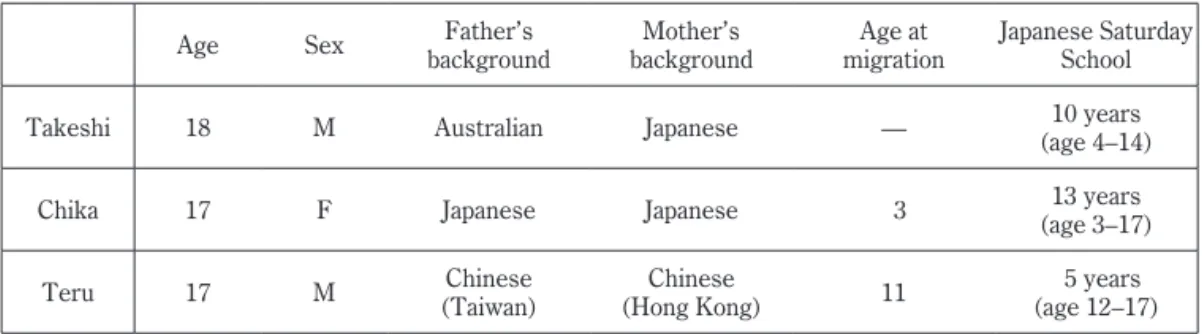
From this class, I recruited three focal students: Takeshi, Chika, and Teru (these names are pseudonyms). Their profiles are given in the table below. Since Chika and Teru were under 18 years of age, I also obtained the consent of their guardians.
These three students were chosen because they represented different types of heritage learners.
Takeshi was born to a Japanese mother and an Anglo-Australian father, Chika was born to Japanese parents, and Teru grew up in Japan, but had Chinese ancestry. To elicit information from a participant- relevant and participant-oriented perspective (Pavlenko & Blackledge, 2004), I conducted three semi-structured interviews with each of these students. The interviews lasted anywhere between 30 to 60 minutes and were held in open spaces, including classrooms, cafes, and the university library. The interviews were audio-recorded using a digital recorder, transcribed, and translated into English for analysis. The data collection was conducted in accordance with all ethnical requirements of the institution where this study took place.
While the students were given the option to speak either in Japanese or English (or to switch between them) in the interviews, all of them chose to speak in Japanese. This may have been due to
Table 1 Participants’ profiles
Age Sex Father’s
background Mother’s
background Age at
migration Japanese Saturday School
Takeshi 18 M Australian Japanese — 10 years
(age 4–14)
Chika 17 F Japanese Japanese 3 13 years
(age 3–17)
Teru 17 M Chinese
(Taiwan) Chinese
(Hong Kong) 11 5 years
(age 12–17)
my involvement in the course as an observer and an occasional guest lecturer. They perhaps saw me as someone associated with the university and the Japanese language class and as a “Japanese” per- son, much like their teachers in the course who were also ethnically Japanese. This, in turn, had implications for the way I interpreted the interview data. As Block (2000) pointed out, accounts from interviewees may not always be “representational” of real events but “presentational” of how they construct or construe their relationships with the interviewer. Furthermore, what they say may also be bound by what is deemed to be appropriate to say in a given context in a given community. Thus, while the accounts given to me by the participants provide insights into their identities and how they are negotiated, the data should not be viewed as direct or “true” accounts, but as acts of representa- tion (Harris, 2006) that take into account my role as a researcher, a Japanese teacher, and as an eth- nically Japanese bilingual.
5. FINDINGS
In this section I present the narratives of the focal students, focusing on their language identities.
My aims are to explore the heterogeneity of their family and educational backgrounds, and to exam- ine the diverse ways in which they constructed their relationships with their heritage language.
These narratives show the shifting and negotiated nature of their language identities, which may not be visible under a language-as-identity paradigm.
5.1 Takeshi
Takeshi was born in Australia to a Japanese mother and an Australian father, and was 18 years old at the time of this study. He first learned to speak Japanese, but grew up in a limited bilingual envi- ronment because his father spoke very little Japanese. He seemed to remember quite vividly that growing up bilingually was a confusing experience. He recalled that in the prep year at primary school, when he first interacted with monolingual English-speaking peers, he tried to speak to them in Japanese, wondering why in the world they did not understand him. At the time, he thought that everyone spoke both Japanese and English.
As Takeshi entered primary school and began learning English, he started to mix Japanese and English to communicate with his father. He reported that it was not until the age of five or six years that he was able to get a good command of using and alternating between both languages. Eventually he began to speak English with his father and brother and Japanese with his mother.
Takeshi’s mother wanted him to maintain his Japanese so he could communicate with relatives in Japan. She enrolled Takeshi in the Japanese Saturday School at the age of four. Although Takeshi had
difficulty adjusting to the environment at first, sometimes resisting to go at all, he reluctantly contin- ued attending the school until the age of 15, when he quit to concentrate on his secondary school study. At the Japanese Saturday School, he began taking an interest in Japanese pop culture and became an avid fan of Japanese manga (i.e. comics), anime (i.e. animations), TV dramas, and music.
He especially loved manga and this remained unchanged at the time of the interview. His manga col- lection numbered more than 500 books. While Takeshi’s visits to Japan had been sporadic when he was younger, he started visiting approximately once every two years as he grew older. Every time he went, Takeshi would visit his relatives and former classmates from the Japanese Saturday School who had returned to Japan. The year before the interview, he made his first trip to Japan alone and experienced living with a homestay family for five days. According to him, this was to test out his Japanese ability, commenting as follows:
Extract 1
The reason was that I wanted to test out my Japanese language ability in Japan and that’s why I went alone. I’d already seen my relatives [in a previous visit], so I didn’t have to visit them that time. I wanted to see if I could make it on my own.
Growing up, Takeshi had some Japanese acquaintances both from school and from the Japanese Saturday School, but most of his friends were English speakers of multilingual and multiethnic back- grounds, whom he referred to as “kokusaijin” (global individuals). Influenced by these friends, he took an interest in Korean and Chinese pop music, and often went to karaoke with them to sing Japanese and Korean pop songs. He was interested in the sciences, especially physics. In the future, he wanted to study engineering at university and eventually work as an engineer. While he vaguely hoped to work in Japan, his plans were still up in the air.
In terms of his language identity, despite growing up in Australia and having no formal education in Japan, Takeshi claimed a strong sense of expertise in Japanese and perceived it as his stronger language, making frequent references to his inheritance of “nihonjin no chi” (Japanese blood). He was confident in his ability to converse in Japanese. Recalling his most recent visit to Japan, he explained that he had had no trouble communicating in Japanese with his host family:
Extract 2
Well, I didn’t think too much about it, I grew up with two languages from when I was little, so I could confidently understand the language itself. There were only a few instances when I couldn’t understand, but everyone spoke to me using simple language.
According to Takeshi, his mother seemed to agree that his stronger language was Japanese, which perplexed her. He, after all, had grown up in Australia. However, he seemed quite confident that this was normal and that it was due to his exposure to the language and his strong sense of affiliation to it. He explained:
Extract 3
Even though I say that my Japanese is stronger, it’s not as strong as a Japanese person’s. But probably, the reason I can write and read is because I’ve read a lot of manga. The reason I can speak is because I’ve watched a lot of anime. And, I don’t read English books, and I only use it to talk with friends, so I use Japanese more often. Listening, speaking, reading, writing, I do more often in Japanese, so I don’t think it’s odd that I’m better at Japanese. It all depends on what I’m doing now.
While recognising that he did not have the same level of expertise as “a Japanese person,”
Takeshi seemed to be saying that his linguistic expertise in the Japanese language was not deter- mined by where he was or by which language he was educated in. It was, instead, influenced more by his affiliation to the language and perhaps more importantly, his investment in it.
However, Takeshi’s sense of language expertise was sometimes not shared by others. Perhaps because of his mixed-race appearance, language expertise was something he needed to negotiate, particularly with Japanese speakers. Recalling his most recent visit to Japan, he explained that his host family initially spoke to him in simple Japanese or “foreigner talk.” However, he proved himself by speaking Japanese with confidence. He explained:
Extract 4
My appearance doesn’t look Japanese, so the host family thought I was a foreigner. But, when I spoke Japanese properly to them, we were able to talk normally.
In contrast, Takeshi presented his expertise in English as being relatively lower. At times, he dis- played some uncertainty about his ability in it. When asked why this was the case, he answered:
Extract 5
I don’t know, probably because I learned Japanese first when I was small, so that’s the reason.
The Japanese person inside me expanded. I’m not only Australian because I can’t think like an Australian person. I can’t think like an Australian person, so when I read English sentences,
there are times when I don’t understand things like the layers of meaning or the theme, stuff like that. When I write English essays, I can only write simple sentences. I can’t do complex analysis, and I get a lot of comments from the teacher to make it more complex.
Takeshi seemed to place importance on the language he first learned to speak at home as the basis for his expertise. On the other hand, he felt that his English ability was not equal to that of Australians. He was not able to think like one. However, at the same time, he occasionally present himself as an Australian commenting, “I have a Japanese passport, a Japanese one and an Australian one, so I’m both Japanese and Australian. But, I think I’m Australian inside.” In this regard, Takeshi seemed to show ambivalent affiliation to both Japan and Australia.
This duality and the ability to switch between identifying as a Japanese and as an Australia (or both) seemed to be an important part of Takeshi’s ethnic identification. Indeed, he reported that his
“white” Australian friends at school saw him as an Australian, and his “Asian” friends saw him as a Japanese. He, therefore, called himself a “haafu” (mixed-race). Moreover, he held both a Japanese and an Australian passport. Although the Japanese government does not permit dual citizenship, he explained that he could not say for certain which one he would choose in the future when he reached the age of 20, when the law would require him to do so. For the time being, he explained that he wanted to renew his Japanese passport and hope that, before it expired, the Japanese legislation will change to allow dual citizenship.
5.2 Chika
Chika was 17 years of age at the time of study and was born in Japan as the only child of Japanese parents. The first language she learned to speak was Japanese, and she recalled that she was a very talkative girl who would talk like a “machine-gun” in Kansai dialect. She migrated to Australia at the age of three and entered a local primary school. While her parents considered enrolling her in a school with a large number of Japanese families, they disliked the close-knit Japanese community.
They chose, instead, a school without any Japanese students. There, Chika naturally learned to speak English. She reported that during primary school, her parents emphasised her acquisition of English. They would not allow her to mix it with Japanese.
Chika attended the Japanese Saturday School from the age of four and continued to attend for 13 years until she was 17 years old. She enjoyed going there, commenting that “Saturday School was for me a very fun place, I was looking forward to it every week. I didn’t mind doing the homework from the Saturday School either.” Since she was usually the only Japanese student at her local school, the Japanese Saturday School was an important opportunity to befriend Japanese-speaking
peers her age. As a result, during her childhood, she was always surrounded by Japanese friends.
Most of them were children of sojourning families, and Chika was always the one to see them off when they returned to Japan. However, she maintained contact with them through the Internet, often chatting with them on Instant Messenger or through Facebook. Her mother also maintained close contact with relatives in Japan through video-chat, and Chika would usually participate in these weekly conversations.
Chika was passionate about reading. She had liked reading English books, but at the time of the interview she had also started taking an interest in Japanese novels. Her bookshelf consisted of English classics such as Jane Austen as well as Japanese novels set in the 17th and 18th century Edo period. Her preference for music was also a mixture of both Japanese and English. While she pre- ferred to hum along to English songs on the radio, her iPod was full of Japanese songs, with occa- sional Korean and Chinese pop songs mixed in—recommendations from her Asian friends at school.
Her favourite Japanese band was called “One Ok Rock.” She particularly liked the fact that the lead vocalist was bilingual and sang both in Japanese and English. She was also up to date with the latest Japanese dramas, which she viewed online.
At the time of the interview, Chika attended an extra-curricular class in biology on the weekends, and hoped to study medicine at university. She also worked part-time at Kumon, a Japanese prepara- tory school with branches around the world, where she taught English and mathematics. Her future aspiration was to become a doctor in Australia. She hoped to use her Japanese ability to help recently arrived Japanese families.
Chika reported that her stronger language overall was English. However, she explained that both languages were usually mixed inside her head:
Extract 6
My mind is funny. When I’m writing an essay in English, for some reason good words come out in Japanese. So, I have to think “what is that in English” and do my best to translate it. And, when I’m writing essays in Japanese, good words always come out in English. It takes double the effort for my brain. It’s always been like that from a long time ago.
In contrast, Chika’s language expertise in Japanese was something that she needed to negotiate and establish with others. Unlike Takeshi, who did not have language expertise attributed to him, she was usually expected to have a high level of expertise in Japanese. She felt that she had an obli- gation to meet these expectations:
Extract 7
My appearance is Japanese, and I even speak like a regular Japanese person. So, I think other people expect a far better Japanese from me. So that’s why I’m studying Japanese. I don’t want to end up becoming an adult who can’t speak properly.
It was her appearance and relatively high competence that seemed to make others assume that Chika was more competent than she actually was. Thus, from the fear of letting people down, she was especially reluctant to speak Japanese in formal settings. She said, “It’s just that I personally get nervous. I can’t help but feel that I need to speak with more honorifics, that I have to speak much better Japanese.”
However, despite these occasional awkward moments, Chika identified herself as a Japanese. She explained:
Extract 8
The way I think is probably closer to that of a Japanese person. Everything I learned from my parents was in Japanese, and they taught me to be a normal Japanese person.
For Chika, it seemed that being “Japanese” was something that was passed down to her from her parents, who also taught her distinctly Japanese “ways of thinking.” Perhaps for this reason, she also felt a strong sense of inheritance towards the Japanese language, explaining that it was thanks to her parents that she was competent in it. She guessed that other people probably saw her as a “normal Japanese daughter”:
Extract 9
I can speak quite well in Japanese, so people would think “oh, she’s Japanese.” I’m not sure if the teachers [in the heritage language class] think that way too, but my parents’ friends at least see me as a normal Japanese daughter. They don’t treat me any differently.
At the same time, Chika was also ambivalent towards Japan. Although she loved to visit the coun- try on holiday, whenever she stayed there too long, she would feel overwhelmed by a sense of lone- liness.
Chika held a Japanese passport and permanent residency in Australia. As university entrance loomed closer, she was considering applying for Australian citizenship. The tuition would be lower if she enrolled as a domestic student. However, while she understood the practical benefits, she was
reluctant to act on it because it meant that she would need to forfeit her Japanese citizenship. She commented that her nationality as a Japanese was an important part of who she was. She explained:
“After all, I’m connected to Japan only with my nationality, so if I lost that, it would feel like my con- nection with the country has really disappeared. That’s why I want my nationality to be Japanese.”
5.3 Teru
Teru was 17 years old at the time of study and was born in Japan to a Chinese mother from main- land China and a Taiwanese father. He had two sisters, aged 15 and 16. Teru recalled, albeit with uncertainty, that the first language he learned from his parents was Japanese. However, because his grandmother had come to live with him in Japan when he was in kindergarten, he was also exposed to Chinese. At that time, he could understand some basic Chinese conversations.
He eventually enrolled in a Chinese primary school in Tokyo, which taught in both Japanese and Chinese. It was there that he began studying Chinese as a second language. As a result, he recalled that he became quite fluent in the language. His parents could also understand both Chinese and Japanese and would converse using both languages. When he was in his third year at the school, his family moved from Tokyo to Kanagawa Prefecture, and his parents moved him into a local Japanese- medium primary school.
For Teru, the Chinese school was an environment that allowed him to be less conscious of his eth- nic and linguistic background. He recalled:
Extract 10
When I was attending the Chinese school, there were a lot of Japanese kids, and there were others like me who were Chinese but could only speak Japanese. So, when I was with them, I didn’t have to think about my ethnicity, just like here in Australia, because there were a lot of kids like me. But, in the Japanese parimary school, when I was asked what my ethnicity was, I felt awkward, like, I didn’t know. There weren’t any problems, but it was difficult making a dis- tinction between Chinese and Japanese.
Although Teru did not have any bad experiences due to his Chinese background, entering a Japa- nese primary school required some adjustments. He could not help being conscious of his difference from his peers. He even wanted to hide his Chinese background and become “Japanese”:
Extract 11
When I was living in Japan, I did the best I could to not tell anyone that I was Chinese. Instead,
I wanted to become like everyone else. I’m not sure how to say it, but in the beginning, I did my best not to tell anyone that I was Chinese. As time went by, people found out, but there weren’t any problems.
Teru continued his study at the Japanese primary school until the middle of Year 5, when he immi- grated to Australia with his mother. His father stayed behind in Japan due to work commitments. His parents wanted him to get an education in English. They had decided to try out this arrangement at least for three years.
Teru’s move to Australia became a critical turning point in his language development. His tempo- rary separation from his father, his lack of contact with Chinese speakers, and his acquisition of English led to a rapid attrition of his Chinese. However, his parents did not seem to mind this. They even seemed to welcome his quick acquisition of English. At home, he began speaking English with his sisters and with his mother, who was fluent in English. Gradually within the first six month, he forgot a large number of kanji and the ability to write in Japanese.
However, as Teru began attending the Japanese Saturday School from Years 6 to 11, his Japanese started to come back. Moreover, throughout this time, he maintained his connection with Japan, where his father lived. He would visit once every two or three years, and, every time, he would return to Australia with Japanese workbooks, which he studied in his spare time. At the time of the interview, Teru usually hung out at school with Japanese friends. Their interactions were bilingual.
When they were talking about Japanese topics, they would speak in Japanese, but if the conversation shifted to an English topic, their language would also switch to English.
Teru’s use of the Internet and other media was mostly in Japanese too. He used Facebook and Skype to communicate with friends from the Japanese Saturday School who had returned to Japan.
He often read Yahoo Japan news, tweeted in Japanese, and watched Ustream, a Japanese video- streaming website. He particularly liked watching Japanese comedies on his computer.
In the future, Teru wanted to study accounting at university and work for a multinational financial institution, which would allow him to travel and work in different places around the world. He felt an attachment to Japan and wanted to work there, given the opportunity. He did not want to confine himself to Australia, and was keen to learn new things and expose himself to new environments. He explained:
Extract 12
In the future, I want to live in Japan. To be honest, though, I like the excitement, like the excite- ment I had when I first came to Australia from Japan. I want to go to places where I can learn
new things. If it’s only Japan or Australia, I don’t want that. I don’t want to be stuck in just one place. I want to be able to live in different places.
In terms of his language identity, Teru reported that his strongest language was Japanese. He felt that his English was much weaker in comparison, particularly in writing, because he lacked the vocabulary to fully express himself. This lack of expertise in English seemed to strengthen the importance of the Japanese language and his affiliation to it. For example, in the following extract, he explained the significance of maintaining and developing his Japanese competence:
Extract 13
Honestly, I think Japanese is very important. My guess is that if I compare my English ability to that of ordinary people around me, it’s definitely lower. So, I’m not sure how to say this, but I want to make use of my strengths and differentiate myself. I think it’ll be more fun that way too.
That’s why I’ve continued studying Japanese up until now, and I want to continue it.
For Teru, his knowledge of Japanese was a strength that he perceived would allow him to make up for his lack of competence in English and gain an edge over his peers at school.
However, despite claiming a sense of expertise and affiliation to Japanese, Teru felt that he could not claim inheritance of the Japanese language or claim an ethnic identification as a Japanese either.
At the same time, neither did he feel that he could legitimately call himself Chinese, because he could not speak the language. He explained:
Extract 14
I get angry if someone makes fun of Japan and I also get angry if someone makes fun of China. I have pride in both, so it’s really weird. If, for example, a Chinese person was fighting with a Japanese person, I wouldn’t want to stick my nose into that. In China, when people find out that I’m Chinese, but can’t speak Chinese, they would ask me “what language do you speak?”
Whenever I say that I speak Japanese, they would all look at me funny, especially the elderly men. It’s like they don’t accept me as a Chinese. On the other hand, in Japan, because I have a Chinese surname, people would ask me “nanijin?” (what’s your nationality/ethnicity?), I have no choice but to answer Chinese. Besides, my passport is from Taiwan. So, that’s why I felt much more at ease when I came to Australia, because I didn’t have to be Australian, Taiwanese, or Chinese. Not even Japanese. There’s not too much racism here, so it was a load off of my back. I didn’t have to think too much about it, about where I stand.
The above extract highlights the complexity of Teru’s language identity. Because of his surname, people assumed that he was Chinese. This however, made him feel powerless in front of both Chi- nese and Japanese individuals. In front the former, he felt that he was letting them down by not maintaining his presumed linguistic inheritance, Chinese. In front of the latter, he felt powerless because it made him appear to be an illegitimate speaker of the Japanese language, which he had an expertise in.
Teru held a passport from Taiwan, permanent residency in Australia, and a visa from Japan. He did not want an Australian passport because it would mean that he would need to forfeit his Japanese visa. On the other hand, he felt that keeping his passport from Taiwan would be meaningless because he could not speak Chinese. At the time of the interview, Teru was leaning towards obtain- ing a Japanese passport. However, he was hard-pressed to decide because he felt he was Chinese, Japanese and Australian, and at the same time none of them. He wished that there was a passport
“right in between.” He elaborated:
Extract 15
Honestly, I don’t know what my ethnicity is. I’m a Chinese who can’t speak Chinese. I’m not a Japanese either, or am I? I don’t know, but I can speak Japanese. I’ve also lived in Australia now for a number of years, and so my English and Japanese are right about the same. And, I think I’ve become more “Aussie”, so I don’t know. I don’t know which passport to choose, if there was one right in the middle, I’d choose that.
For Teru, an identity defined by a singular connection to a particular nation or ethnicity did not sufficiently capture his complex sense of belonging.
6. DISCUSSION
The narratives of the students reveal the significant diversity in the ways they presented their educational/family backgrounds and their language identities. As Leung et al. (1997) pointed out, these students were not simply inheritors of fixed ethnic or linguistic categories. For instance, the students’ expertise and interest in the Japanese language appeared to have waxed and waned throughout their lives, influenced by multiple factors including their migration to Australia, parental expectations, participation in friendship groups, exposure to Japanese language media and culture (for example, books, manga, anime, and music) and so on. In addition, the students’ reported sense of expertise in the language was not equally distributed amongst the different modalities and con-
texts, showing the truncated nature of their bilingual repertoires (Blommaert, 2010).
Furthermore, the students’ language expertise was not simply about how competent they felt in the language, but about how they were positioned by others (Blommaert, Collins, & Slembrouck, 2005). For instance, Chika was sometimes presumed by to have inherited the Japanese language and, by extension, expected to be an expert in it. However, this high expectation was at odds with her self-perceived lack of expertise, which made her timid in speaking Japanese in situations that required the use of honorifics. On the other hand, Takeshi, because of his mixed-race appearance, was sometimes not attributed language inheritance and spoken to in foreigner talk. This did not coincide with his sense of expertise and confidence in Japanese, which resulted in the need to nego- tiate and assert his legitimacy as a Japanese speaker.
In addition, the notion of inheritance was complicated by the presence of Teru, who did not have
“Japanese blood” and did not necessarily inherit the language in the narrow sense of the word. How- ever, he nonetheless felt a strong attachment to the Japanese language. His narrative suggests the possibility of the emergence of a new linguistic inheritance, which is not defined by one’s ancestry, but through strong affiliations to the language. That is to say, Teru shows that it is possible for senses of language affiliation and inheritance to cut cross ethnic boundaries (Rampton, 1990).
Despite the diversity in the youths’ language identities, there were also common themes in the youths’ narratives with regard to the value of Japanese. The first theme was the value of the lan- guage as a means of maintaining transnational connections. While the students’ lives were based in Australia at the time of this study, these students constructed transnational ties to Japan, through both regular visits to the country or through the use of technology. Tools like Skype, Facebook, blogs, and streaming websites allowed them to maintain connections with friends, family, and rela- tives living in Japan and also to access the latest news and popular culture (for example, manga, anime, music, and books) almost in real-time. For them, the learning and maintenance of the Japanese language was thus important for accessing, transnationally, both cultural and social forms of capital (Bourdieu, 1977).
The second theme was the value of bilingualism and its role in the youths’ career aspirations. For example, Takeshi was considering the possibility of living and working in Japan, Chika wanted to be a bilingual doctor for new arrivals, and Teru wanted to work for a multinational company. All of these goals were predicated on the attainment of a high level of bilingual competence. Studying the Japanese language was, therefore, not just important per se. It was also important to the youths as a means of consolidating their identities as bilinguals, which they hoped would help to distinguish them in the pursuit of career goals. In this sense, their relationship to their heritage language was mediated by the symbolic value of bilingualism and the mobile, cosmopolitan futures that it seemed
to promise.
Finally, the third theme that emerged was the issue of belonging, citizenship, and the tension between territorised and de-territorised identities (Vertovec, 2001). That is to say, regardless of the transnational connections that these students maintained with Japan, this study has shown that this did not necessarily equate to a sense of belonging to the nation-state or ethnicity that is often assumed to be linked to the heritage language. Indeed, the students expressed varying senses of ethnic identification, including Japanese, Australian, and mixed-ethnicity (i.e., Japanese and Austra- lian). Furthermore, these ethnic identifications were contextually dependant and were not necessar- ily indicators of the students’ language identities or of their choice of nationality in the future. In Chika’s case, identifying as a Japanese existed simultaneously with a sense of expertise in English and the possibility of obtaining Australian citizenship. Moreover, in Teru’s case, his life trajectories spanned Japan, Australia, and China, which led him to conclude that he wanted a mode of belonging in-between fixed ethnonational categories. In these regards, this study has provided empirical evi- dence for the potential disalignment between transnational ways of being (i.e., constructing or main- taining transnational ties to a nation) and transnational ways of belonging (i.e., feeling a sense of belonging to a nation or ethnicity to which one maintains transnational connections; see Levitt &
Glick Schiller, 2004).
7. CONCLUSION
In this paper, through the narrative of the three focal students, I have shown that their relation- ships with their heritage language were not simply about attachment or disavowal. Instead, their relationships involved a dynamic negotiation of language expertise, affiliation, and inheritance with others, which was influenced by their family and educational backgrounds, parental expectations, ethnicity, and future aspirations. I have also shown the complexity of heritage learners’ language identities, which is not captured in studies that are undergirded by a language-as-identity paradigm.
More broadly, the findings of this study may also suggest that the term “heritage learner” may not be an appropriate label for this particular group of learners who have relatively high bilingual compe- tence in both Japanese and English. Indeed, this study seems to provide support for the criticism that the term heritage language is rear-viewing and “connotes something that one holds onto vaguely as one’s remembrances, but certainly not something that is used in the present or that can be projected into the future” (García, 2005, p. 601). As the youths’ narratives have shown, the Japanese language was not a “remembrance,” but a day-to-day tool. It was an important part of their bilingual identities and a resource for shaping their futures.
REFERENCES
Block, D. (2000). Problematizing interview data: Voices in the mind’s machine? TESOL Quarterly, 34(4), 757–
763.
Block, D. (2006). Multilingual identities in a global city: London stories. New York: Palgrave Macmillan.
Blommaert, J. (2010). The sociolinguistics of globalization. Cambridge, UK: Cambridge University Press.
Blommaert, J., Collins, J., & Slembrouck, S. (2005). Spaces of multilingualism. Language and Communication, 25, 197–216.
Bourdieu, P. (1977). The economics of linguistic exchanges. Social Science Information, 16(6), 645–668.
Bucholtz, M., & Hall, K. (2005). Identity and interaction: A sociocultural linguistic approach. Discourse Studies, 7(4–5), 585–614.
Chinen, K., & Tucker, R. G. (2005). Heritage language development: Understanding the roles of ethnic identity and Saturday school participation. Heritage Language Journal, 3(1), 27–59.
Cho, G. (2000). The role of heritage language in social interactions and relationships: Reflections from a language minority group. Bilingual Research Journal, 24(4), 369–384.
Cho, G., Cho, K., & Tse, L. (1997). Why ethnic minorities want to develop their heritage language: The case of Korean American. Language, Culture and Curriculum, 10(2), 106–112.
Doerr, N., & Lee, K. (2010). Inheriting “Japanese-ness” diversely. Critical Asian Studies, 42(2), 191–216.
García, O. (2005). Positioning heritage languages in the United States. The Modern Language Journal, 89(4), 601–
605.
Hall, S. (1992). New ethnicities. In J. Donald & A. Rattansi (Eds.), “Race”, cultures, and difference (pp. 252–259).
London: Sage Publication.
Harris, R. (2006). New ethnicities and language use. New York, NY: Palgrave Macmillan.
Kanno, Y. (2000). Bilingualism and identity: The stories of Japanese returnees. International Journal of Bilingual Education and Bilingualism, 3(1), 1–18.
Kataoka, H. C., Koshiyama, Y., & Shibata, S. (2008). Japanese and English language ability of students at supple- mentary Japanese schools in the United States. In K. Kondo-Brown & J. D. Brown (Eds.), Teaching Chinese, Japanese, and Korean heritage language students: Curriculum needs, materials, and assessment (pp. 47–76). New York: Lawrence Erlbaum Associates.
Kim, H.-S. H. (2001). Issues of heritage learners in Korean language classes. In J. Ree (Ed.), Korean Language in America 6: Papers from the Sixth Annual Conference and Professional Development Workshop (pp. 257–
273). Honolulu: American Association of Teachers of Korean.
Kondo-Brown, K. (2005). Difference in language skills: Heritage language learner subgroups and foreign lan- guage learners. The Modern Language Journal, 89(4), 563–581.
Kramsch, C. (2012). Authenticity and legitimacy in multilingual SLA. Critical Multilingualism Studies, 1(1), 107–
128.
Lee, J. S. (2002). The Korean language in America: The role of cultural identity in heritage language learning.
Language, Culture and Curriculum, 15(2), 117–133.
Lee, J. S., & Kim, H.-Y. (2008). Heritage language learners’ attitudes, motivations, and instructional needs: The case of postsecondary Korean language learners. In K. Kondo-Brown & J. D. Brown (Eds.), Teaching Chinese, Japanese, and Korean heritage language students: Curriculum needs, materials, and assessment (pp. 159–186). Mahwah, NJ: Lawrence Erlbaum Associates.
Leung, C., Harris, R., & Rampton, B. (1997). The idealised native speaker, reified ethnicities, and classroom real- ities. TESOL Quarterly, 31(3), 543–560.
Levitt, P., & Glick Schiller, N. (2004). Conceptualizing simultaneity: A transnational social field perspective on society. International Migration Review, 38(3), 1002–1039.
Miller, J. (2003). Audible difference: ESL and social identity in schools. Clevedon: Multilingual Matters.
Ministry of Foreign Affairs of Japan. (2018). Kaigai zairyu hōjinsū chōsa tōkei [Annual report of statistics on japa-
nese nationals overseas]. Retrieved from https://www.mofa.go.jp/mofaj/files/000368753.pdf
Norton, B. (2000). Identity and language learning: Gender, ethnicity and educational change. Harlow, England:
Pearson Education Limited.
Pavlenko, A., & Blackledge, A. (2004). Introduction: New theoretical approaches to the study of negotiation of identities in multilingual contexts. In A. Pavlenko & A. Blackledge (Eds.), Negotiation of identities in multilingual contexts (pp. 1–33). Clevedon: Multilingual Matters.
Rampton, B. (1990). Displacing the “native speaker”: Expertise, affiliation and inheritance. ELT Journal, 44, 97–101.
Shiobara, Y. (2004). The beginnings of the multiculturalization of Japanese immgirants to Australia: Japanese community organizations and the policy interface. Japanese Studies, 24(2), 247–261.
Valdés, G. (1995). The teaching of minority languages as academic subjects: Pedagogical and theoretical chal- lenges. The Modern Language Journal, 79(3), 299–328.
Vertovec, S. (2001). Transnationalism and identity. Journal of Ethnic and Migration Studies, 27(4), 573–582.
Xiao, Y. (2006). Heritage learners in the Chinese language classroom: Home background. Heritage Language Journal, 4(1), 47–56.
Young, R. F. (2008). English and identity in Asia. Asiatic, 2(2), 1–13.
ことばを「受け継ぐ」ということ:オーストラリアで日本語 を継承語として学ぶ子供たちの言語アイデンティティ
小 柴 健 太
要 旨
本稿は,オーストラリアの大学で日本語を継承語として学ぶ日英バイリンガル三名の言語アイデンティ ティについて考察したものである。半構造化インタビューを通して得たナラティブをもとに,「継承語学 習者(heritage learner)」の日本語学習経験や継承語との関わり方について分析を行った。その結果,イン フォーマントたちは,固定された民族的・言語的アイデンティティを「継承」しているのではく,常に他 者との交渉や多様な経験の中で言語アイデンティティ(language expertise, language affiliation, language inheritance)を形成していることがわかった。
キーワード:継承語教育,日本語,アイデンティティ,エスニシティ,バイリンガル教育