Science Journal of Kanagawa University 19 : 3-6 (2008)
©Research Institute for Integrated Science, Kanagawa University
■Full-Length Paper■ By a grand of Research Institute for Integral Science, Kanagawa University
DWT-Based Watermarking Using QR Code Shanjun Zhang1 * and Kazuyoshi Yoshino
2
1 Department of Computer Science, The Faculty of Science, Kanagawa University, Hiratsuka-City, Japan 259-1293, Japan
2 Department of Welfare Systems Engineering, Kanagawa Institute of Technology, Atsugi-City, Kanagawa 243-02, Japan
* To whom correspondence should be addressed. E-mail: [email protected]
Abstract: Increased commercial activity on the Internet and media industries demands protection of multimedia contents. In this paper, we introduce a novel watermarking method to embed QR codes in digital images. The method is based on discrete wavelet transform (DWT). The original image is divided into blocks, and QR codes are added to particular bits of LL2 level coefficients of the selected block according to the visual masking effect of the human visual system. It has been shown that this method is robust for JPEG compression and has good transparency. The embedded information can be extracted correctly even if the images are compressed to 11% of the original according to the contents of the images.
Keywords: QR code, watermark, discrete wavelet transform, human visual system, JPEG.
Introduction
As digital image technology and its applications are growing quickly, digital images are now widely distributed on the Internet and other media 1, 2). The start of digital broadcasting makes it even more necessary to provide protection mechanisms against unauthorized processing and the use of multimedia contents. One of the most difficult problems in digital video watermarking is watermark recovery from images with possible perturbations, including, for example, degradation due to noise or compression, transformation by filtering, resampling, and other intentional or unintentional operations 3-8). The watermark should be selected and be properly dealt with such that it does not corrupt the visual effect of the original image and is detectable only with knowledge of the embedding secrets of the original image.
QR Code is a type of 2-D (two-dimensional) symbology developed by Denso Wave (a division of Denso Corporation at that time) and released in 1994. It is capable of handling all types of data, such as numeric and alphabetic characters, Kanji, Kana, Hiragana, symbols, binary, and control codes. Up to 7,089 characters can be encoded in
one symbol. It has large Kanji- and Kana-holding capability, and has error correction capability.
Data can be restored even if the symbol is partially dirty or damaged.
In this paper, we describe a novel method to embed the QR code into still digital images.
Most of the recent work in watermarking can be grouped into two categories: spatial domain methods, and frequency domain methods. Because frequency domain methods have better robustness than spatial domain, almost a11 techniques embed watermarks in the frequency domain, such as DCT and DWT 9, 10). To increase robustness against JPEG degradation of the watermarked image, we embed the watermark in low frequency domains of DWT. Simultaneously, the visual masking effects of the human visual system are considered to prevent the visual degradation of the watermarked image.
In the next section, we describe the proposed method in detail. In Section 3, we provide results demonstrating the high robustness of the approach to JPEG compression. Concluding remarks are in Section 4.
4 Science Journal of Kanagawa University Vol. 19, 2008
Method
The original image is divided into a set of 4x4 blocks. Each block is transformed into level two with Daubechie mother wavelet function. Water- mark signals are the embedded in the low frequency domain of the blocks. As the human eye is more sensitive to changes in the simple region of the image than the complex region, which is known as the visual masking effect, variations of the low frequency components are checked for adjacent blocks to decide if they should be used for embedding by the watermark signals. To increase the robustness, a series of binary codes of the double-sized QR code are used as watermark signals.
Figure 1 shows two-level wavelet decomposition of an image. The coefficients of the LL2 of the DWT of the selected block will be used to embed the watermark signals. After the LL2 component of a block is transformed into a binary integer, a bit will be replaced by a binary integer taken from the watermark series. The bigger the value of k, the more robust the embedded watermark, while the watermarked image obtained by reverse wavelet transform may be degraded easier. In this paper, k=5 was selected.
If the LL2 component of a block is represented by
x = ( x
1, x
2, x
3,..., x
k, x
k−1, x
k−2,.. x
n)
, and the watermark bit of the corresponding block isy
, then the kth bit ofx
will be replaced byy
, and the( k − 1 )
th bit ofx
will be replaced by its reverse value. The remaining lower bits are the same as the kth bit, so the embedded LL2 component becomesx~.) ,..
, , ,..., , ,
~ (
1 3
2
1
x x y x y y
x
x =
k−In this way, the kth bit of the embedded information can be protected from rounding errors of the decimal value.
Fig. 2 shows an example of bit embedding.
Results and Discussion
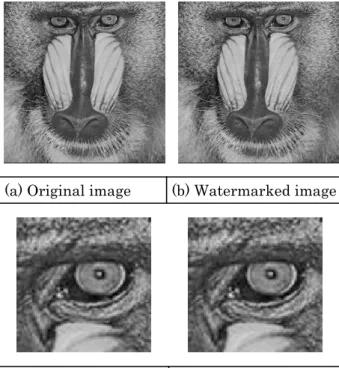
Using the method described above, a set of binary series can be embedded in all divided blocks of the image. Because the low frequency domain was changed and usually the low frequency domain has the most energy of the image so that small changes to this band may induce serious degradation of the watermarked image, it is necessary to make a trade-off between the invisibility and detectability of the watermarked image. Fig. 3 and 4 show watermarked images embedded using the bit series obtained from the QR code shown in Fig. 5.
We can hardly see a difference between Fig. 3(a)
LL2 LH2
LH1
HL2 HH2
HL1 HH1
Fig. 1. 2D wavelet transform.
1 0 0 0 1 0 1 0
1 0 1 1 1 1
Fig. 2. An example of bit embedding.
(a) Original image (b) Watermarked image
(c) Enlarged part of (a) (d) Enlarged part of (b) Fig. 3. An example of watermarking. (a) original image, (b) watermarked image, (c) enlarged part of (a), (d) enlarged part of (b).
S. Zhang et al.: DWT-Based Watermarking Using QR code 5
and Fig. 3 (b), but the difference between of Fig. 4 (a) and Fig. 4 (b) can easily be detected. To solve this problem, we make the use of the human visual masking effect, and compare the low frequency components of neighboring blocks. If the differences of low frequency components of a block are not as big as those of neighboring blocks, the information will not be embedded in that block. The sum of the horizontal and vertical differences will be compared with a threshold so as to pick out the blocks to be embedded. Fig. 6 showed the improved results with the original image showed in Fig. 4 (a). Fig. 6 (a) is corre- sponded to Fig. 4 (b), and Fig. 6 (b) to Fig. 4 (d).
The watermark can be extracted through the following steps. (1) The host image and probably corrupted watermarked image are divided into 4x4 blocks in the same way. (2) Each block undergoes 2nd level discrete wavelet transform, and then the low frequency component of the block is compared with neighboring blocks. (3) If the sum of the horizontal and vertical variances of the value is bigger than a previously defined threshold, the kth bit of the value will be extracted as one of the watermark bit series. (4) The extracted bit series are rearranged into QR
Compression rate 10.62% (Quality 66)
Recognizable Recognizable Compression rate 10.50% (Quality 65)
Unrecognizable Recognizable (b) Enlarged part of (a) (a) Watermarked image
QR code of Kanji characters
(張研究室) Fig. 5. Example of a QR code.
Fig. 6. Improved result.
Fig. 7. Recover QR code by designation.
Fig. 8. Tolerance to JPEG compression.
Fig. 4. Example of watermarking for an image with a smooth area.
(a) Original image (b) Watermarked image
(c)Enlarged part of (a) (d) Enlarged part of (b)
6 Science Journal of Kanagawa University Vol. 19, 2008
code binary images, which will be read by the QR code recognizer.
To raise the robustness for the watermarked image to JPEG compression, we firstly double the size of the QR code image, and then use the binary bit series of the image as the embedding message. After the embedded bit series are extracted, they are represented by double-sized QR codes, and then a designation method is used to recover the corrupted bits.
Finally, the QR code of original size is used to show the real signature message.
As shown in Fig. 7 double-sized pixels in the extracted QR code are used to recover the original QR code by designation. Because the four pixels are extracted from different blocks of the watermarked image, if more than three of them are wrong, the finally extracted bit may be wrong.
This method enhanced the robustness of watermark detection.
The efficiency of the method was checked by lenna, mandrill and a landscape picture of 512x512. A QR code representing the affiliation of one author was used as the signature message.
Fig. 8 shows the tolerance of the watermark method to JPEG compression. General UNIX commands of cjpeg and djpeg are used to compress and decompose the watermarked images. The compression rates and compression quality can be controlled by parameters. The threshold was selected appropriately so that over 3364 blocks can be used to embed the bits of the QR code.
Conclusion
In this paper we propose a robust method of embedding QR code into the DWT domain of divided blocks of the still image. The proposed method is highly robust to compression and
additive noise. The signature message of the bit series is embedded in a fixed position (kth) bit of the LL2 value, which is unfavorable for main raining the security, but this can be improved by introducing a random key to dynamically change the value of k in a scope.
Future work will concentrate on making the method more practical by modifying the technique such that the host image is not required to provide over 4000 blocks to embed the watermark.
References
1) Cline HE, Lorensen WE, Kikinis R and Jolesz F (1990) Threedimensional segmentation of MR images of head using probability and connectivity. Comput J . Assist. Tomogr. 14 (6):1037-1045.
2) Pitas I (1996) A method for signature casting on digital images. IEEE Int. Conf. on Image Process. 3:
215-218.
3) Villasenor JD, Belzer B and Liao J (1995) Wavelet filter evaluation for image compression. IEEE Trans.
Image Process. 4 (8):1053-1060.
4) Swanson MD and Tewfilk AH (1996) A binary wavelet decomposition of binary images. IEEE Trans. on Image Process. 5 (12):1637-1650.
5) Zeng W and Liu B (1997) On resolving rightful ownerships of digital images by invisible watermarks.
In:Proceedings of the IEEE International Conference on Image Processing,Vol., 1. pp.552-555.
6) Cox IJ, Kilian I, Leighton T and Shamoon T (1997) Secure spread spectrum watermarking for multimedia.
IEEE Trans. on Image Process. 6 (12):1673-1687.
7) Wolfgang B, Podilchuk CI and Delp EJ (1998) The effect of matching watermark and compression transforms in compressed color images. In: Proceedings of the IEEE International Conference on Image Processing,Vol., 1. Chicago, IL. pp. 440-444.
8) Zhu W, Xiong Z and Zhang Y-Q (1999) Multiresolution watermarking for images and video. IEEE Trans.
Circuits & Systems Video Tech. 9 (4): 545-550.
9) Lumini A and Maio D (2000) A wavelet-based image watermarking scheme In:Proc. Int. Conf. Information Technology: Coding and Computing. pp.122-127.
10) Alattar AM(2004) Reversible watermark using the difference expansion of a generalized integer trans- form. IEEE Trans. Image Process. 13: 1147- 1156.